
Sharks are animals people love to mythologize. Some surprising truths about sharks sound like science fiction but are based on real biology and natural history. This article runs through a list of unusual shark traits, ancient origins, and strange behaviors, presented in careful, evidence-aware language. Where conservation or species-level claims are relevant, readers can consult formal conservation assessments for more detail.
Shark Lineage Is Extremely Ancient
How ancient sharks really are
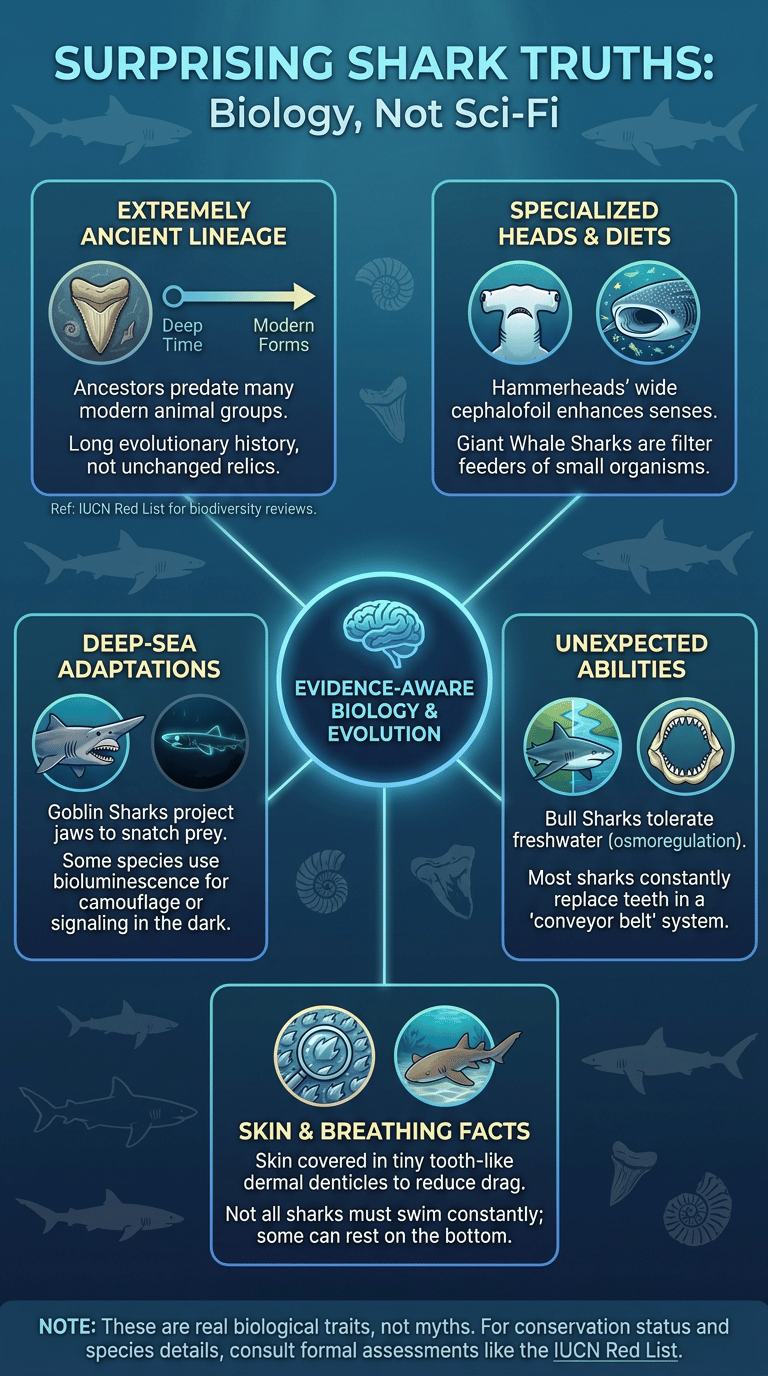
Shark ancestors appear very early in the fossil record, and shark-like fishes existed long before many modern groups of animals. Rather than describing them as unchanged relics, it is more accurate to say that the lineage we call sharks has an exceptionally long evolutionary history with many branches and adaptations over deep time. For formal conservation assessments and species entries, see the IUCN Red List for individual shark assessments and broader reviews of aquatic biodiversity on the IUCN Red List website.
Why their evolution is so impressive
Sharks diversified into many forms adapted to very different habitats, from shallow coastal waters to the deep sea. Over evolutionary time, sharks have developed a range of feeding strategies, sensory systems, and body plans. When you see a hammerhead or a whale shark, you are looking at an outcome of long evolutionary experimentation in the shark family tree. For accessible natural history context and species information, museum and zoo resources provide reader-friendly overviews of animal diversity, for example on the San Diego Zoo Wildlife Explorers site on the San Diego Zoo Wildlife Explorers site.
Readers comparing crazy shark facts you won’t believe may also find interesting facts about sharks useful for a deeper look at a closely related shark topic.
Some Sharks Exhibit Light-Related Traits
Bioluminescence explained simply
Bioluminescence is the production of visible light by a living organism. In the ocean, several groups of animals use bioluminescence for communication, camouflage, or predation. Some shark species have light-producing or light-reflecting tissues or host light-producing organisms on their skin that cause them to appear to glow under low light. Details vary across species and research continues to refine how and why different animals use light.
Why glowing helps in the deep sea
Light-related coloration can provide advantages in dim or dark habitats. Deepwater animals may use light to blend into faint downwelling light, to attract prey, or to signal other individuals. In sharks that show light-related traits, the function can include concealment, prey attraction, or other ecological roles. For conservation status and species accounts that include habitat and threats, consult formal species databases such as the IUCN Red List on the IUCN Red List website.
Some Sharks May Live Extremely Long Lives
Long-lived cold-water sharks
Research has suggested that some cold-water shark species grow and age very slowly, and scientists have proposed that certain northern deepwater sharks may reach very advanced ages compared with many other vertebrates. Those findings come from specialized age-estimation methods and remain an active area of scientific study. For formal species status and conservation context, refer to recognized conservation resources that compile data and assessments for individual shark species on the IUCN Red List website.
Why cold water may slow life down
Cold environments tend to slow metabolic rates in many marine animals. Lower metabolism can correlate with slower growth and later maturation, which in turn can be associated with longer lifespans. These patterns are general biological principles rather than precise timelines for any single species.
Whale Sharks Are Very Large and Feed on Small Prey
Among the largest fish
Whale sharks are commonly described as among the largest living fish. They occupy a unique ecological niche among sharks because they feed primarily on small organisms rather than hunting large prey. For species-specific conservation assessments and to learn more about threats, ranges, and status, consult the IUCN Red List via the IUCN Red List.
Filter feeding instead of hunting large prey
Filter-feeding sharks feed by passing large volumes of water through structures that capture plankton, small fishes, and other minute food items. This feeding strategy shows how very large body size can be compatible with feeding on small food items when the feeding apparatus and behavior are adapted accordingly. For accessible descriptions of how various animals feed and occupy ecological roles, educational wildlife sites and zoo resources can be helpful, such as the San Diego Zoo Wildlife Explorers pages on the San Diego Zoo Wildlife Explorers site.
Hammerhead Sharks Have Wide, Specialized Heads
Why their head shape helps them hunt
The distinctive wide head of hammerhead sharks, often called a cephalofoil, changes how the animal senses and handles its environment. The spread-out head provides wide spacing for sensory organs and can improve maneuverability when scanning the seafloor for prey. Different hammerhead species vary in head shape, and the adaptive significance of the cephalofoil is a topic of study in comparative biology.
How they detect hidden prey
Sharks use a suite of senses to find food, including electroreception, smell, vision, and vibration detection. The unique head shape of hammerheads can enhance detection of prey that hides in sediment or crevices by providing a broader sensory sweep. These sensory abilities are examples of how form and function are linked in shark evolution.
Goblin Sharks Can Project Their Jaws Forward
The deep-sea alien shark
Goblin sharks are notable for their unusual appearance, including a protrusible snout and a dramatic jaw that can extend forward during feeding. These features give the species an otherworldly look, especially in descriptions and photographs from deepwater research. Deepwater species often show striking specializations for life in low-light, high-pressure habitats.
Why its feeding method looks unreal
The jaw protrusion of some deepwater sharks functions as a rapid mechanism to snatch prey from close range, allowing the shark to capture prey in water where maneuvering space is limited and visual cues are reduced. This feeding adaptation illustrates how mechanical innovations can evolve in response to unique ecological challenges.
Tiger Sharks Eat a Wide Variety of Items
Opportunistic feeding
Tiger sharks are often described as opportunistic feeders with broad diets that can include invertebrates, fishes, and other oceanic foods. Opportunistic feeding helps some shark species exploit variable food supplies in coastal and offshore habitats.
Why their diet is so flexible
Dietary flexibility can be advantageous in habitats where food availability changes seasonally or unpredictably. Species that take a wide range of items may persist in varied environments where specialists could struggle. When discussing diet and conservation-related threats associated with fisheries or habitat change, consult conservation resources such as the IUCN Red List and international agreements like CITES for regulatory context on the IUCN Red List and on the CITES site.
Bull Sharks Can Tolerate Low-Salinity Water
How they handle fresh water
Bull sharks are often noted for their ability to tolerate low-salinity environments and to travel into estuaries and rivers. This tolerance involves physiological mechanisms that allow the animal to regulate salts and bodily fluids when moving between marine and brackish or freshwater habitats. Species that handle broad salinity ranges show specialized osmoregulatory adaptations.
Why this makes them unusual
Many sharks are primarily marine, so the ability to tolerate freshwater or brackish conditions expands the range of habitats a species can use for feeding, nursery activity, or seasonal movements. For the latest assessments of species that utilize multiple habitat types, consult formal conservation sources such as the IUCN Red List on the IUCN Red List website.
Sharks Constantly Replace Their Teeth
Conveyor belt teeth
One of the most famous shark traits is continual tooth replacement. Rather than holding a single lifelong set of teeth, many shark species grow new teeth and move them forward in rows as old teeth are lost. This system ensures a functional biting surface throughout life even if individual teeth are damaged or shed.
Why teeth are so important to survival
Teeth mediate how sharks capture and process food, and different tooth shapes reflect dietary specialization. For example, cutting or serrated teeth help slice flesh, while flatter teeth are useful for crushing hard-shelled prey. Maintaining an effective tooth supply is therefore central to feeding success.
Shark Skin Is Covered in Tiny Tooth-Like Structures
Dermal denticles
Under magnification, shark skin is covered with small, tooth-like structures called dermal denticles. These structures are related to teeth in developmental terms and give shark skin a rough texture when touched in one direction.
Why skin helps them swim efficiently
Dermal denticles can modify water flow over the body and reduce drag or turbulence, which helps sharks swim efficiently. The arrangement and shape of denticles vary across species and lifestyles, reflecting evolutionary tuning to different swimming and ecological demands.
Some Sharks Can Rest on the Ocean Floor
Not all sharks must swim constantly
Although many sharks rely on continuous swimming to move water over their gills, several species can rest on the seafloor and employ alternative breathing strategies. Bottom-dwelling species may settle on substrate and pump water through their gills using muscular movements rather than swimming continuously.
Breathing differences between species
Shark respiratory systems vary. Some species use active swimming to ventilate the gills, while others use buccal pumping or other methods to move water across gill surfaces while stationary. These differences allow sharks to occupy a range of ecological niches, from open-ocean cruisers to ambush predators on the bottom.
FAQs About Crazy Shark Facts
What is the craziest shark fact?
“Craziest” is subjective, but many people point to features like jaw protrusion in deepwater species, the cephalofoil of hammerheads, or the massive size combined with filter feeding in whale sharks as particularly surprising. These traits are real biological adaptations shaped by ecological needs.
Are any shark facts fake?
Some widely circulated shark claims are exaggerated or taken out of context. It is helpful to check species-level information and conservation assessments from authoritative databases when you encounter dramatic claims. For formal status and species-level details, consult recognized conservation sources such as the IUCN Red List on the IUCN Red List and international agreements on wildlife trade like CITES on the CITES site.
What is the weirdest shark species?
Weirdness is in the eye of the beholder, but species often highlighted for unusual appearance or behavior include deepwater species with exaggerated snouts or protrusible jaws, broad-headed hammerheads, and very large filter feeders like the whale shark. Each of these species illustrates a different evolutionary solution to life in the ocean.
What shark looks the most unusual?
Appearance varies widely among shark species, and many have distinctive shapes or features that look unusual to human observers. The goblin-like profile of some deepwater species, the flattened head of hammerheads, and the enormous, gentle bulk of some filter-feeding sharks are common examples people find striking. For up-to-date species accounts and conservation context, consult recognized databases and authoritative assessments.
General safety note: Sharks are wild animals. This article does not give instructions for interacting with wildlife. Do not approach, feed, touch, capture, or harass wild sharks. If you encounter sharks in the wild and need assistance, contact local authorities or qualified professionals.

Ethan Walker is the founder and research editor of Animal Fact Central. He creates and reviews educational animal facts content using trusted wildlife, pet care, and science-based sources. His work focuses on making animal behavior, adaptations, habitats, and species facts clear, accurate, and engaging for everyday readers.
Read More Details About Ethan Walker: https://animalfactcentral.com/ethan-walker/