
Quick Corn Snake Facts
Scientific name
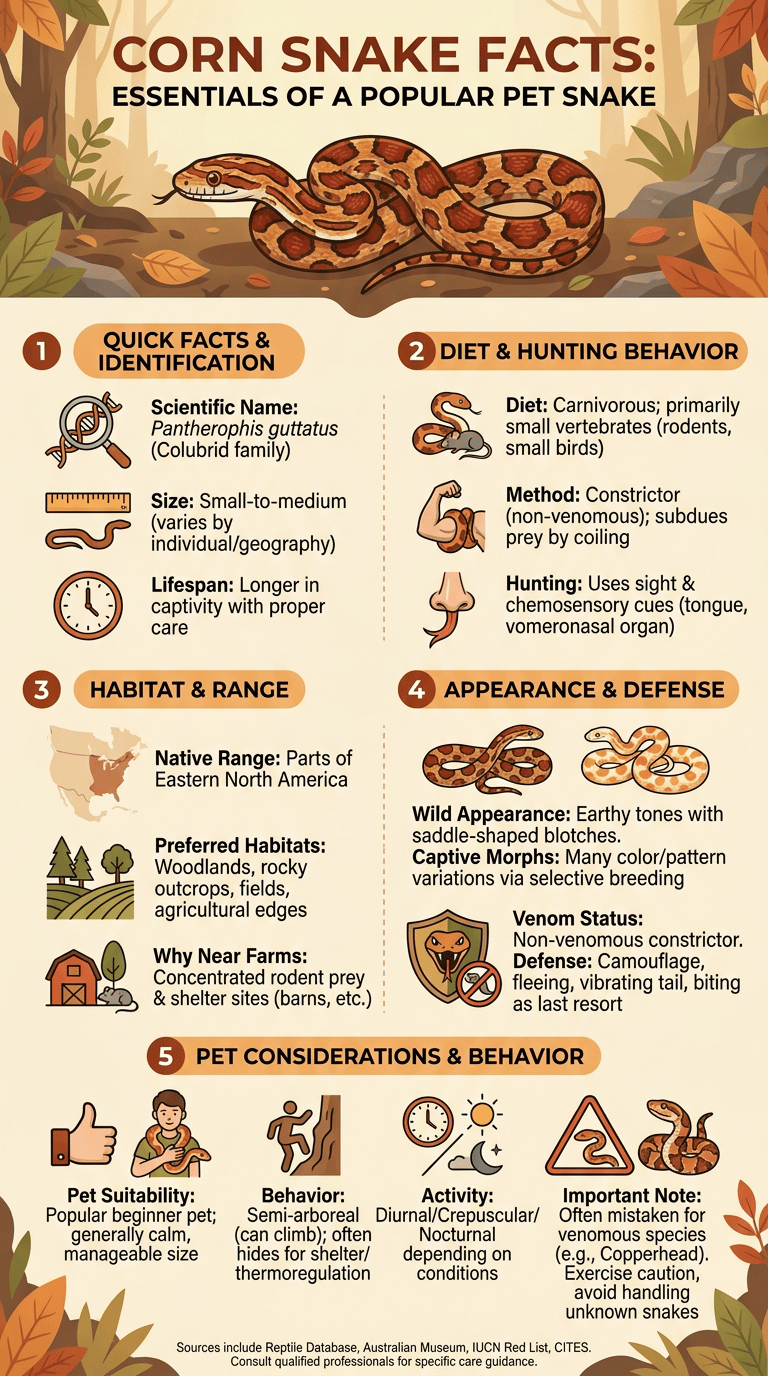
The corn snake is a North American colubrid commonly referred to as Pantherophis guttatus in contemporary taxonomic references (Reptile Database).
Average size
Corn snakes are generally described as small-to-medium sized members of the rat-snake group. Reported lengths vary with geography and individual history.
Lifespan
Lifespan differs between wild and captive animals; individuals kept in human care often live longer than wild counterparts because of regular food, shelter, and veterinary attention.
Diet
Corn snakes are constrictors that feed primarily on small vertebrate prey such as rodents and small birds. For general natural history and husbandry information see museum and species references (Australian Museum).
Habitat
In the wild, corn snakes occupy terrestrial habitats that provide prey and shelter, including woodlands, fields, and agricultural edges. Conservation assessments include maps and range descriptions with more detail (IUCN Red List).
Venom status
Corn snakes are non-venomous colubrids that subdue prey by constriction rather than with venom (Reptile Database).
For larger constrictor comparison, boa constrictor snake facts show how body size changes hunting, safety, and care needs.
What is a corn snake?
Why corn snakes are so popular
Corn snakes are common in parts of the eastern United States and are frequently bred in captivity, producing many color and pattern variations that attract hobbyists (Australian Museum).
Corn snakes versus other small snakes
Corn snakes belong to the rat-snake group and share a similar body plan and feeding ecology with other non-venomous small snakes. Differences among species include scale patterns, head shape, habitat use, and behavior; taxonomic resources can help with precise comparisons.
Where do corn snakes live?
Native range in North America
Corn snakes are native to parts of eastern North America where appropriate habitat and prey occur. Conservation and species listings provide detailed range descriptions and maps (IUCN Red List).
Preferred habitats
Typical habitats include open woodlands, rocky outcrops, fields, and edges adjacent to agricultural land. They often use rock crevices, hollow logs, and rodent burrows as shelter sites.
Why they are often found near farms
Agricultural settings concentrate small mammals that corn snakes hunt, and structures such as barns provide hiding and thermoregulation sites, creating frequent snake–human encounters.
Understanding why snakes shed skin helps explain dull coloration, cloudy eyes, and retained shed problems in corn snakes.
What do corn snakes look like?
Common colors and patterns
Wild corn snakes typically show earthy tones with saddle-shaped blotches along the back. Locality and individual genetics influence coloration, and captive breeding has produced many alternative color and pattern forms (Reptile Database).
Why corn snakes have many morphs
Selective breeding in captivity has produced a wide variety of color and pattern morphs through genetic variation affecting pigments and patterning.
Baby corn snake appearance
Hatchlings generally resemble adults in pattern but are smaller and may show coloration that changes as they mature.
Are corn snakes venomous?
How corn snakes defend themselves
As non-venomous snakes, corn snakes rely on camouflage, fleeing, and restraint of prey by constriction. When threatened they may vibrate their tails, flee, or bite as a last resort (Reptile Database).
Why corn snakes may bite
A corn snake may bite if it feels threatened, trapped, or if a handler is mistaken for prey. Bites from non-venomous snakes can break the skin and should be cleaned and assessed if there is concern.
Are corn snake bites dangerous?
Corn snakes do not inject venom. However, any bite that punctures the skin can introduce bacteria; appropriate medical or veterinary attention is recommended when needed.
What do corn snakes eat?
Diet in the wild
Wild corn snakes feed mainly on small vertebrates such as rodents and small birds; their presence near agricultural areas is often linked to rodent abundance (Australian Museum).
Diet in captivity
Captive corn snakes are typically fed appropriately sized rodents in accordance with established husbandry guidance; detailed care recommendations should come from reptile care specialists and veterinarians.
How corn snakes hunt
Corn snakes locate prey through sight and chemosensory cues, using their forked tongue and vomeronasal organ, then capture and subdue prey by coiling until immobilized (constriction).
Corn snake behavior facts
Are corn snakes aggressive?
Corn snakes are generally described as calm when handled appropriately, though individual temperaments vary. Captive-bred and well-socialized individuals tend to be less defensive than wild-caught animals.
Are corn snakes nocturnal?
Activity patterns include daytime and evening activity depending on season, temperature, and local conditions. In warm weather they may be more crepuscular or nocturnal to avoid daytime heat.
Why corn snakes hide so often
Hiding allows snakes to thermoregulate, avoid predators, and ambush prey. Common shelter sites include burrows, rock crevices, and structural gaps in buildings.
Corn snake shedding facts
How often corn snakes shed
Shedding frequency changes with growth: young, rapidly growing snakes shed more frequently than mature adults. Intervals depend on growth, health, and environment.
Signs a corn snake is about to shed
Many snakes show duller coloration and clouded eyes before shedding; they may become less active and seek rough surfaces to help remove old skin.
Common shedding problems
Shedding difficulties can arise when humidity or environmental conditions are inappropriate. Retained shed, especially around the eyes, is a common issue; persistent problems should be evaluated by a veterinarian with reptile experience.
Corn snakes as pets
Are corn snakes good beginner pets?
Hobbyists frequently recommend corn snakes for beginners because of their generally calm temperament, manageable size, and wide availability. Prospective owners should research thoroughly and consult veterinarians and experienced keepers.
Basic care needs
Basic care includes appropriate housing with secure enclosures and temperature gradients, clean water, and a species-appropriate diet. This article provides general facts and is not a substitute for detailed husbandry guidance from qualified sources.
Common mistakes new owners make
Frequent pitfalls include insecure enclosures, improper temperature or humidity, and feeding mistakes. Never take snakes from the wild for use as pets.
Interesting corn snake facts
Corn snakes help control rodents
Corn snakes prey on rodents, and their presence in agricultural areas has been associated with reductions in rodent activity in natural history accounts.
They can climb well
Corn snakes are semi-arboreal and can climb trees, logs, and structural timbers when pursuing prey or seeking shelter.
They are often mistaken for copperheads
Corn snakes can be confused with some venomous species by casual observers. Misidentification can lead to unnecessary killing of harmless snakes; when in doubt, avoid handling and contact local wildlife authorities or professionals.
Corn snake versus garter snake
Size difference
Corn snakes and garter snakes differ in typical adult size; field guides and taxonomic resources provide regional measurements and comparisons.
Diet difference
Corn snakes generally favor rodent prey and small birds, while garter snakes often include amphibians, fish, and a broader mix of prey depending on local availability.
Pet suitability difference
Both groups have been kept by hobbyists, but corn snakes are more commonly recommended for beginners because they generally tolerate handling and captive conditions better than many garter-snake species.
A garter snake comparison can help readers separate common backyard species from popular pet snakes.
Corn snake FAQs
How long do corn snakes live?
Life expectancy depends on wild versus captive conditions. Captive individuals receiving consistent food, shelter, and veterinary care can live many years; consult species accounts for detailed longevity records.
Do corn snakes like being handled?
Temperament varies by individual. Many captive-bred corn snakes tolerate and may accept gentle handling, while others prefer minimal contact. Seek guidance on safe handling from qualified reptile care sources and veterinarians.
Are corn snakes dangerous?
Corn snakes are non-venomous and do not inject venom. Bites from non-venomous snakes can still break the skin; any puncture wound should be cleaned and assessed if there is concern.
How big do corn snakes get?
Descriptions of adult size vary by source and region; references classify them as small-to-medium compared with many other common snake species. Consult taxonomic and natural history databases for precise measurements (Reptile Database).
Can corn snakes live with other snakes?
Housing multiple snakes together raises risks of disease transmission, stress, and feeding safety concerns; it is generally not recommended except under controlled, professional husbandry conditions.
Final thoughts
Corn snakes are a well-known North American snake with a natural history that brings them into contact with people in agricultural and edge habitats. They are non-venomous constrictors with variable wild coloration and numerous captive-bred morphs. Because corn snakes are common in the reptile hobby, many people recognize them as relatively calm and manageable, but it is important to respect wild animals, exercise caution during wildlife encounters, and seek professional guidance for care or medical issues. For taxonomic, natural history, and conservation information consult recognized resources such as the Reptile Database, museum animal pages like the Australian Museum, conservation assessments on the IUCN Red List, and international trade context from CITES.
Corn snakes are one of the most familiar non-venomous small snakes for beginners to compare with other harmless species.

Ethan Walker is the founder and research editor of Animal Fact Central. He creates and reviews educational animal facts content using trusted wildlife, pet care, and science-based sources. His work focuses on making animal behavior, adaptations, habitats, and species facts clear, accurate, and engaging for everyday readers.
Read More Details About Ethan Walker: https://animalfactcentral.com/ethan-walker/