
Why shark behavior is more complex than people think
Sharks are not mindless predators
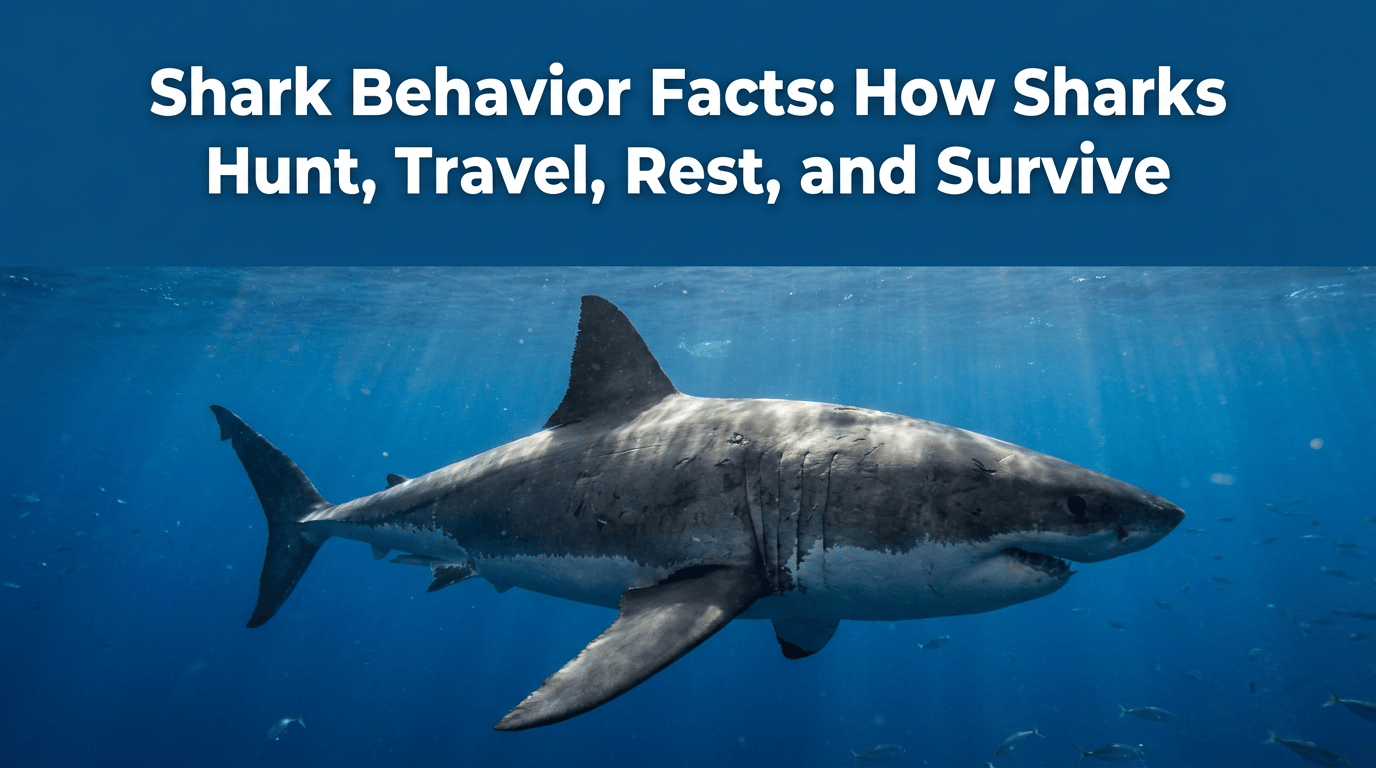
Popular culture sometimes shows sharks as single-minded hunters, but scientific observation describes a broader set of behaviors. Sharks can make decisions that reflect learning, energy budgeting, and context-dependent choices about where to feed, when to move, and how to interact with other animals. Rather than treating every shark encounter the same way, researchers observe variability in how individuals and groups respond to environmental conditions, prey availability, and human presence.
For general information about how conservation and species-level assessments are compiled, see global conservation assessments. IUCN Red List provides species-level conservation assessments and explains how threats and trends are documented.
Behavior changes by species
Different shark species show different activity patterns, social tendencies, and feeding strategies. Some species spend long periods alone and range widely, while others form predictable aggregations at particular places or seasons. These differences reflect evolutionary history, body design, diet, and the habitats where each species evolved.
Because behavior is tied to species biology, conservation listings and regulations can vary by species and by region. International trade rules are one example of how governance can affect certain species differently. CITES explains how international trade in wildlife is regulated for species that receive protection.
Why environment shapes shark behavior
Shark actions are shaped strongly by their physical and biological environment. Factors such as water temperature, prey distribution, underwater topography, currents, and human activities all influence where sharks forage, how far they travel, and where they rest or breed. When environments change, shark behavior often changes too, sometimes quickly and sometimes over longer time spans as populations adjust their ranges and timing.
For accessible educational materials on animal behavior and interpretation of wildlife responses, see general zoo and wildlife education pages. For example, the Smithsonian National Zoo provides accessible explanations of animal behavior. Zoo animal behavior resources
How sharks hunt
Ambush hunting
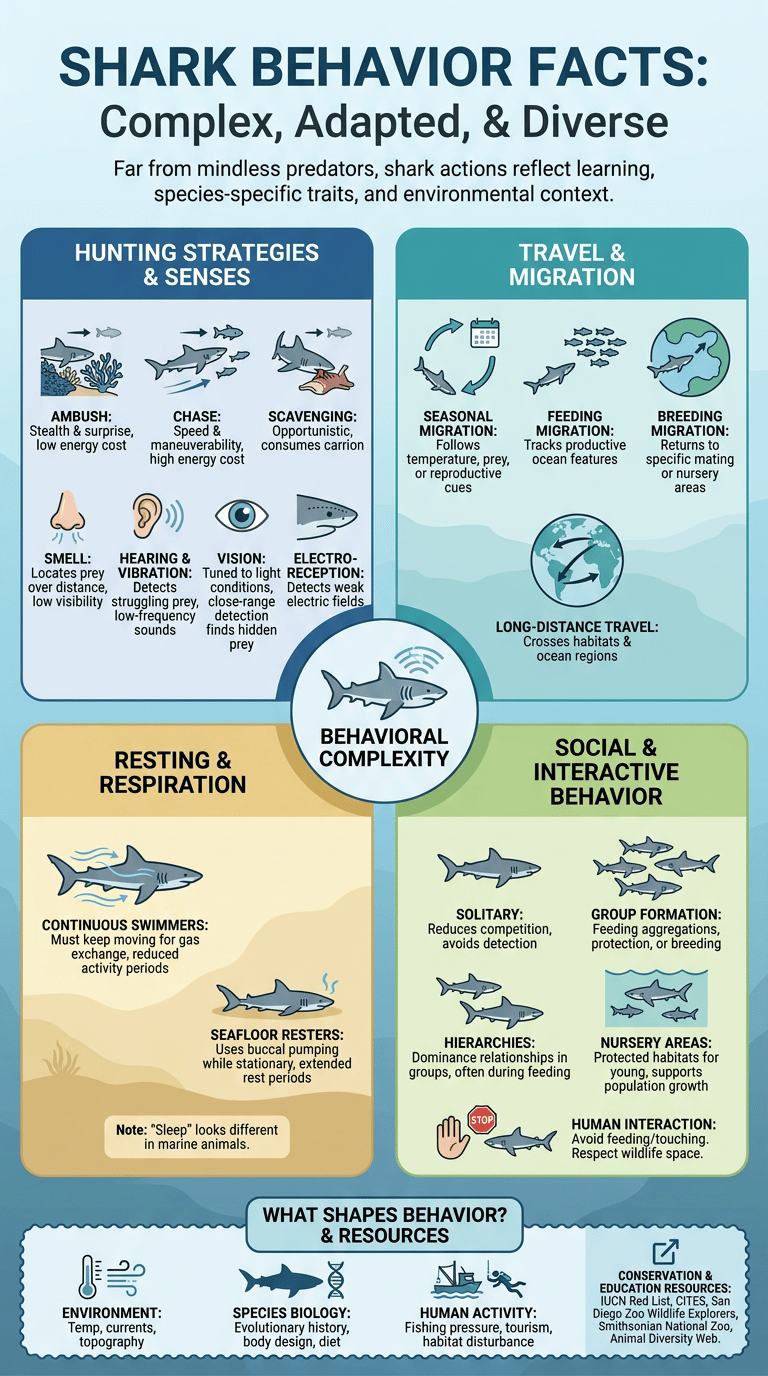
Some sharks use stealth and surprise to capture prey. Ambush hunting typically occurs where sharks can conceal themselves near structure, in low light, or at a boundary between habitats. The predator waits until prey comes within range, then bursts into action. Ambush tactics reduce energetic cost and increase the chance of a successful capture where concealment is possible.
Chase hunting
Other sharks pursue prey over short or long distances, using bursts of speed and maneuverability. Chase hunting can involve a high energy cost, so chasing species often balance pursuit attempts with periods of rest or low-effort searching. In many coastal and pelagic systems, chase hunting is most effective when predators and prey occupy the same water column and visibility and currents support active pursuit.
Scavenging
Sharks commonly scavenge on carrion when the opportunity arises. Scavenging allows sharks to use food resources that would otherwise be lost to the system. Scavenging behavior can be opportunistic, with sharks arriving at a food item and quickly consuming what they can before competitors arrive, or more prolonged when a large food source is available.
Group feeding behavior
In some situations, multiple sharks feed in the same place. Group feeding can be a loose aggregation with little coordination, or it can show coordinated or ritualized behavior around a resource. When many individuals feed together, competition and hierarchy can shape who gains priority access to food. Understanding group feeding requires attention to context: the type of prey, the size of the resource, and the number of competitors present.
How sharks use their senses
Smell
Olfaction plays an important role in how sharks locate food and navigate to areas with higher prey density. Sharks detect chemical cues in the water and use those cues to orient toward potential prey or other biologically relevant scents. Smell is often effective over distances and in low visibility, making it useful for long-range detection in the marine environment.
Hearing and vibration
Sharks detect sound and water movement, which helps them find active or injured prey. Vibrations travel efficiently through water, and sharks can orient to the source of low-frequency sounds or irregular movements, helping them detect struggling animals or environmental processes that signal prey.
Vision
Shark vision varies among species and is tuned to the light conditions of their habitats. Vision can be important for close-range detection, classification of objects, and timing strikes. In some environments, visual cues combine with other senses to guide precise hunting movements and to avoid obstacles while maneuvering.
Electroreception
Many sharks possess specialized sensory structures that detect weak electric fields produced by living animals. Electroreception is especially useful at close range and in low-light conditions, because electrical signals do not depend on light or turbidity. This sense can help sharks pinpoint prey that may be hidden under sediment or moving close to the substrate.
Do sharks sleep?
Resting versus sleeping
“Sleep” in the marine world is not always the same as sleep in terrestrial mammals. Sharks show different forms of reduced activity that serve restorative functions, but labeling those behaviors requires caution. Some behaviors appear to be restful states, where the animal reduces movement and responsiveness while remaining able to react to threats or respiration demands.
Sharks that must keep moving
Some sharks rely on continuous swimming to move water across their gills for gas exchange. These individuals do not show the same stationary resting patterns seen in some other fishes. Instead, they may enter periods of reduced activity while still moving, which can serve as functional rest without full loss of awareness.
Sharks that can rest on the seafloor
Other shark species are able to rest on the seafloor and use buccal pumping or other respiratory mechanisms to move water over their gills while stationary. These resting states can be relatively quiescent and last for extended periods, allowing recovery without constant movement.
How breathing method affects rest
Respiratory anatomy and behavior influence how sharks rest. Species that can pump water over their gills while stationary have more options for rest than species that rely primarily on swimming to ventilate their gills. This physiological difference helps explain why some sharks alternate between active and inactive periods while others maintain near-constant motion.
Shark social behavior
Solitary sharks
Many sharks spend most of their time alone. Solitary lifestyles can reduce competition for scarce resources and lower detection by both prey and potential rivals. Solitary individuals move through landscapes in patterns that reflect personal energy budgets and local conditions rather than fixed group routines.
Sharks that form groups
Some sharks form temporary or seasonal groups for feeding, breeding, or resting. Aggregations can form around reliable food sources or in places that provide safe nursery habitat. Grouping may provide benefits such as improved foraging efficiency or greater protection from predators and parasites.
Social hierarchies
When sharks spend time together, interactions can produce dominance relationships or informal hierarchies. Hierarchical behavior may be visible during feeding events, where certain individuals establish priority access, or during encounters that determine spacing and movement within an aggregation.
Why some sharks gather in large numbers
Large gatherings of sharks often reflect a combination of ecological drivers such as abundant food, suitable environmental conditions, or reproductive needs. Aggregations may be predictable in time and place, and repeatable patterns can be important for research, tourism, and management. Human activities can also influence whether and where sharks aggregate.
For reader-friendly context on social behavior and natural history, see wildlife education pages such as the San Diego Zoo Wildlife Explorers. Wildlife explorer pages
Shark migration behavior
Seasonal migration
Some sharks move seasonally to follow favorable temperatures, prey availability, or reproductive cues. Seasonal movements help individuals exploit different habitats at times when conditions are optimal for feeding or breeding. Migration timing and routes are influenced by environmental variability and life history needs.
Feeding migration
Feeding-related movements often track productive ocean features such as upwellings, river mouths, or seasonal prey concentrations. Sharks may travel to areas of high food density and then return to home ranges or different habitats when prey availability declines.
Breeding migration
Many shark populations show reproductive migrations to particular sites used for mating or pupping. These areas can function as nurseries where young sharks grow in relatively sheltered conditions. Fidelity of females to specific nursery areas is an important factor in population dynamics and conservation planning.
International conservation assessments and trade monitoring help clarify how threats can affect migratory species differently than more resident animals. See the IUCN Red List for species-level assessments. IUCN Red List
Long-distance ocean travel
Some sharks undertake long-distance movements that cross habitats and ocean regions. These journeys can be driven by food, reproduction, or life stage changes. Long-distance travelers connect distant ecosystems and are sometimes exposed to a greater variety of human impacts along their routes, making international cooperation important for their management.
Shark feeding behavior
Bite-and-wait strategy
In situations where prey is large or difficult to subdue, some sharks may deliver a disabling bite and then track the injured animal until it weakens. This strategy reduces the risk of injury to the predator and lets it conserve energy by consuming prey that is already compromised.
Filter feeding
Certain large sharks feed by filtering small prey such as plankton and small fishes from the water. Filter feeding relies on morphological adaptations that allow the animal to process high volumes of water while retaining prey particles. This feeding mode contrasts with the active predation strategies of many other sharks.
Bottom feeding
Bottom-feeding sharks forage along the seafloor for benthic prey such as crustaceans, mollusks, and other invertebrates. Their behavior often includes digging or turning over substrate to uncover hidden prey, and anatomical features can reflect adaptations for this feeding style.
Opportunistic feeding
Many sharks are flexible in diet and will take a variety of prey items when available. Opportunistic feeding allows sharks to exploit temporarily abundant resources, supporting survival in environments where prey availability changes through time. Flexibility can be an advantage in dynamic coastal and pelagic systems.
Shark reproductive behavior
Mating behavior
Shark mating behavior varies across species but commonly involves interactions that can include following, biting, and close physical contact. Courtship and mating often take place in specific habitats or during particular seasons, and successful reproduction depends on suitable habitat, timing, and condition of individuals.
Nursery areas
Nursery areas provide young sharks with habitats that offer relatively abundant food and reduced risk from predators. These areas can be shallow bays, estuaries, or other protected habitats that support growth and survival during early life stages. Protecting nursery habitat is a key component of many conservation strategies because juvenile survival strongly influences population trajectories.
Why female sharks return to certain places
Female site fidelity to particular nursery or pupping areas can reflect the consistent benefits of those places, such as sheltered conditions or reliable food. When females return to the same locations, those sites become especially important for population maintenance and for conservation planning.
Shark communication and body language
Posture
Body posture and positioning convey information during interactions. Changes in swimming height, orientation, or fin positioning can signal intent, discomfort, or readiness to interact. Observers interpret posture in context, considering the behavior of nearby animals and the environmental setting.
Swimming patterns
Swimming style and pattern can communicate intent or mood. Rapid, erratic movements may indicate alertness, arousal, or hunting, while smooth, steady swimming often signals normal cruising or transit. Divers and researchers watch for changes in swimming to anticipate the behavior of nearby animals.
Warning displays
Some behaviors function as warning displays to avoid escalation of conflict. These can include quick bursts, positional changes, or other signals that discourage further approach. Warning displays reduce the chance of physical confrontation and can be important in maintaining spacing and reducing injury.
What divers watch for
When diving near sharks, trained observers look for clear changes in posture and movement that indicate curiosity, agitation, or avoidance. Recognizing signals can help people maintain a respectful distance and allow the animal to choose its next action. Divers and other ocean users should never attempt to touch, feed, or harass wild sharks, and should follow local guidance and regulations for safe wildlife viewing.
Shark curiosity and investigation
Why sharks bite objects
Sharks sometimes bite unfamiliar objects to investigate them. Water is a sensory medium where taste, touch, and mechanical feedback help animals identify items that could be food, obstacles, or new elements in their environment. Exploratory biting is a way for a shark to gather information before committing to a full feeding response.
Exploratory bites
Exploratory bites tend to be brief and not always aimed at consumption. They allow the shark to assess hardness, taste, and whether the object resembles prey. Such bites may be more common around novel objects introduced by humans, including fishing gear, floats, or litter.
Difference between curiosity and predation
Distinguishing curiosity from predation requires context. Predatory bites are usually followed by feeding behavior and targeted tactics. In contrast, investigative bites are often isolated and may occur without subsequent consumption. Observers should avoid interpreting a single investigative bite as an attack, and should never attempt to manipulate the situation with feeding or touching.
How human activity changes shark behavior
Fishing
Fishing can alter shark behavior by removing individuals, changing prey communities, and conditioning sharks to associate humans or gear with food. Heavy fishing pressure can reduce population sizes and change age structure, which in turn affects movement patterns and social dynamics. Regulations and monitoring are tools managers use to address these impacts.
Tourism
Wildlife tourism, when managed carefully, can provide economic incentives for conservation and opportunities for education. However, tourism can also change behavior if it involves feeding, crowding, or repeated close approaches. Responsible tourism focuses on minimizing disturbance, following local rules, and prioritizing animal welfare.
Feeding sites
Artificial feeding or provisioning can lead to changes in natural behavior, including altered movement patterns, increased boldness around boats or people, and shifts in diet. Many researchers and managers caution against feeding wild sharks because it can reduce natural foraging instincts and create safety issues for both animals and people.
Habitat disturbance
Habitat loss, coastal development, pollution, and climate-driven change can all influence shark behavior by altering prey availability, nursery conditions, and migration routes. Protecting critical habitats and reducing harmful impacts supports natural behavioral patterns and the ecological roles sharks perform in marine ecosystems.
Conservation assessments and international trade rules are part of the broader toolkit used to address human impacts on marine species and their habitats. See the IUCN Red List for assessments and CITES for trade context. IUCN Red List, CITES
FAQs about shark behavior
Are sharks smart?
Intelligence is a complex concept that includes learning, memory, problem solving, and flexible behavior. Sharks exhibit behaviors that reflect learning and environmental adaptation, such as changing movement patterns in response to prey distribution or human activity. Researchers describe the cognitive and behavioral capacities that enable survival in different contexts rather than labeling sharks simply as smart or not.
Do sharks hunt humans?
Most shark feeding behavior is directed at prey items that are part of their normal diet. Human-shark interactions that involve bites are rare relative to the number of people who enter the ocean. Many such incidents involve mistaken identity, curiosity, or situational factors. People are encouraged to follow local guidance for reducing risk and to respect wildlife by giving sharks space and not attempting to feed or touch them.
Why do sharks circle?
Circular swimming can have several explanations, depending on context. Circling may be a search pattern for prey, a way to investigate an object or area, or a behavior associated with social interactions. Observers should interpret circling in light of other cues, such as speed, posture, and whether other animals are present.
Do sharks travel alone?
Both solitary and group travel occur among sharks. Many sharks are primarily solitary, while others form temporary or seasonal groups for feeding, mating, or migration. The tendency to travel alone or in groups depends on species, life stage, and ecological conditions.
Do sharks sleep at night?
Some sharks show daily cycles of activity and rest, but patterns vary across species. Nighttime activity can increase for some hunters that exploit low light to ambush prey, while others may rest more at night. Because “sleep” in fishes can look different from sleep in mammals, descriptions of nighttime rest are made cautiously and with attention to species-specific respiratory and behavioral traits.
Final notes on observing and respecting shark behavior
Shark behavior is diverse and context dependent. Observing sharks with curiosity and respect provides valuable insight and helps reduce negative interactions. When interacting with the ocean, follow local regulations, avoid feeding or touching wildlife, and consult qualified professionals or managers if you encounter a concerning situation involving sharks.
For readers who want accessible overviews of animal behavior and natural history from educational institutions, consider materials from accredited wildlife organizations such as the San Diego Zoo Wildlife Explorers or the Smithsonian National Zoo, or broad animal accounts like Animal Diversity Web. San Diego Zoo Wildlife Explorers, Smithsonian National Zoo, Animal Diversity Web
Safety reminder: Do not approach, feed, touch, capture, or harass wild sharks. In cases of injury, unusual animal behavior, or immediate danger, contact local authorities or qualified professionals for guidance.

Ethan Walker is the founder and research editor of Animal Fact Central. He creates and reviews educational animal facts content using trusted wildlife, pet care, and science-based sources. His work focuses on making animal behavior, adaptations, habitats, and species facts clear, accurate, and engaging for everyday readers.
Read More Details About Ethan Walker: https://animalfactcentral.com/ethan-walker/