
Quick Sea Snake Facts
Habitat
Sea snakes are a group of snakes adapted to life in marine environments. Most species are associated with warm, shallow coastal waters and insular sea areas, and they are often seen around coral reefs, mangroves, and seagrass beds. Information about their distributions and conservation status is documented in global conservation databases such as the IUCN Red List, which is a primary reference for range and threat assessments. IUCN Red List
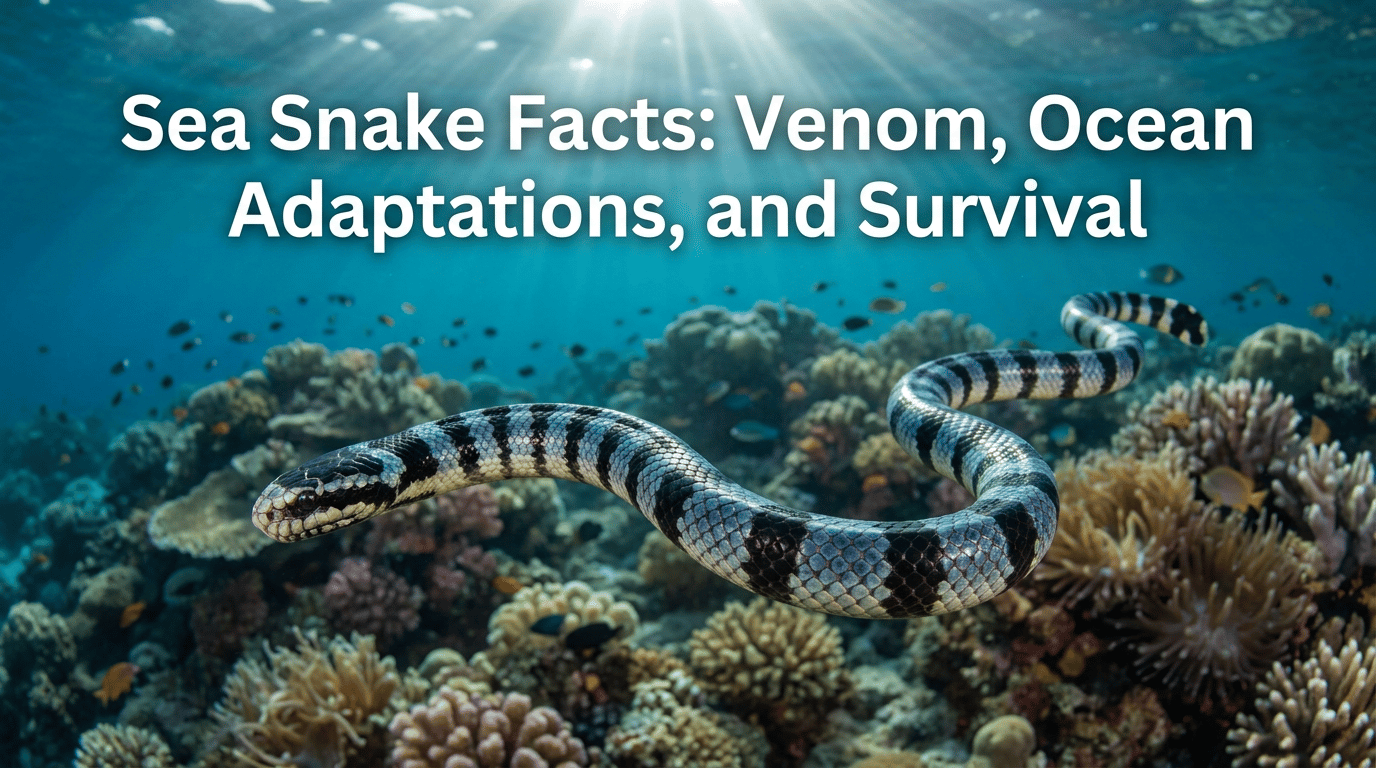
Venom Status
Many sea snakes belong to elapid groups and most species possess venom. Venom is an adaptation for subduing prey in the water, but the risks to humans vary by species and context. For conservation and regulatory information relevant to some species, international trade controls are documented by CITES. CITES
Diet
Sea snakes eat other marine animals. Typical prey items include small fishes, fish eggs, and elongated fish such as eels. Diet varies by species, with some sea snakes showing narrow, specialized diets while others eat a broader range of aquatic prey.
Breathing
Sea snakes are reptiles and must breathe air. Many species come to the surface regularly to breathe, and some have anatomical and physiological traits that help them stay submerged for longer than typical land snakes. These include body shapes and skin features that reduce water loss and help with gas exchange.
Swimming Ability
Sea snakes are strong swimmers and show body shapes suited for propulsion in water. Many species use a laterally flattened tail to push against the water and move with efficient side-to-side undulations. Different sea snakes vary in how much time they spend swimming, resting, or hunting in currents, reefs, and seagrass habitats.
Danger Level
While many sea snakes carry venom effective for immobilizing fish, encounters with people do not always lead to bites. When interactions occur, they are often accidental or defensive. If someone is bitten or otherwise exposed to a venomous snake, they should seek immediate assistance from medical professionals or local emergency services rather than attempting home treatment.
What Are Sea Snakes?
Sea Snakes vs Land Snakes
Sea snakes are snakes that have evolved traits for spending substantial time in marine environments. Unlike most land snakes, they are frequently found in saltwater habitats and exhibit changes in physiology and behavior that help them survive in those surroundings. As reptiles, they still share core features with terrestrial snakes, such as scaled skin and lung-based respiration, but many sea snakes show marked differences related to their marine lifestyle.
True Sea Snakes vs Sea Kraits
The term sea snake covers several groups of marine-adapted snakes. Broadly, there are fully marine true sea snakes that spend almost all of their lives at sea and another group commonly called sea kraits that split time between sea and land. Sea kraits typically retain stronger ties to land for activities like laying eggs, whereas fully marine lineages tend to give birth to live young at sea. These differences in reproductive behavior and habitat use are important for understanding how various sea snakes interact with coastal ecosystems and human activities.
Where Do Sea Snakes Live?
Warm Coastal Waters
Sea snakes are most commonly associated with warm tropical and subtropical waters. Many species occur in sheltered coastal zones where the water temperature and food resources support their lifestyles. Conservation and range accounts on the IUCN Red List provide species-by-species information about where different sea snakes are found and the types of habitats they rely on. IUCN Red List
Coral Reefs and Shallow Seas
Coral reefs, seagrass beds, and lagoon systems are key habitats for many sea snakes. These environments offer feeding opportunities, protection from large open-ocean predators, and places to rest near the surface. The structural complexity of reefs and associated habitats supports prey species such as small fishes and eels that sea snakes commonly hunt.
Why They Are Rare in Some Oceans
Sea snakes are uncommon or absent in colder ocean regions and in areas with extended seasonal cold. Their physiology is generally suited to warmer waters, which helps explain concentration of species richness in certain tropical ocean basins. For detailed assessments of species presence and threats, conservation listings and assessments on databases such as the IUCN Red List can be consulted. IUCN Red List
How Do Sea Snakes Breathe?
Why They Still Need Air
Like all reptiles, sea snakes rely on lungs to obtain oxygen. They cannot respire solely through water in the way fish do. This means that, even though many sea snakes are highly marine, they must surface for air. Being air breathers shapes how they hunt, rest, and navigate ocean currents.
How Long They Can Stay Underwater
The length of time a sea snake can remain submerged varies by species, behavior, and activity level. Some sea snakes surface frequently when they are active, while others may remain submerged longer when resting. Because specific values vary across species and contexts, it is best to consult species-specific sources when precise durations are needed. IUCN Red List
How Their Bodies Help Them Dive
Several morphological and physiological traits help sea snakes spend extended periods underwater compared with many terrestrial snakes. These can include streamlined bodies that reduce drag, tails adapted for efficient propulsion in water, and mechanisms that reduce water loss. Some sea snakes are also reported to exchange small amounts of oxygen through the skin or specialized tissues, which can complement lung breathing during dives.
Are Sea Snakes Venomous?
Why Sea Snake Venom Is Powerful
Many sea snakes belong to elapid groups that produce venom. In the marine environment, venom helps immobilize active, slippery prey such as fish and eels. Venoms are complex biological mixtures that act on prey physiology in different ways, depending on the species and its ecological needs. Because venom composition and effects differ across species, authoritative species accounts are the best place to look for details about a particular sea snake’s venom. Consult conservation and species databases for further information. IUCN Red List
Do Sea Snakes Bite Humans Often?
Bites to people are not the most common outcome when humans and sea snakes meet. Encounters often occur because a snake is moving through shallow water or resting near the surface. Defensive bites can occur if a snake is handled, cornered, or accidentally stepped on. For health concerns following a snake bite, contact medical professionals or local emergency services immediately; do not rely on unverified home treatments.
Why Most Sea Snakes Avoid People
Sea snakes are wild animals and, like most wild animals, tend to avoid contact with people where possible. Their behaviors are shaped by the need to feed, rest, and escape predators. Because they do not seek out people as prey or as a habitat, most human-sea-snake interactions are brief and accidental.
What Do Sea Snakes Eat?
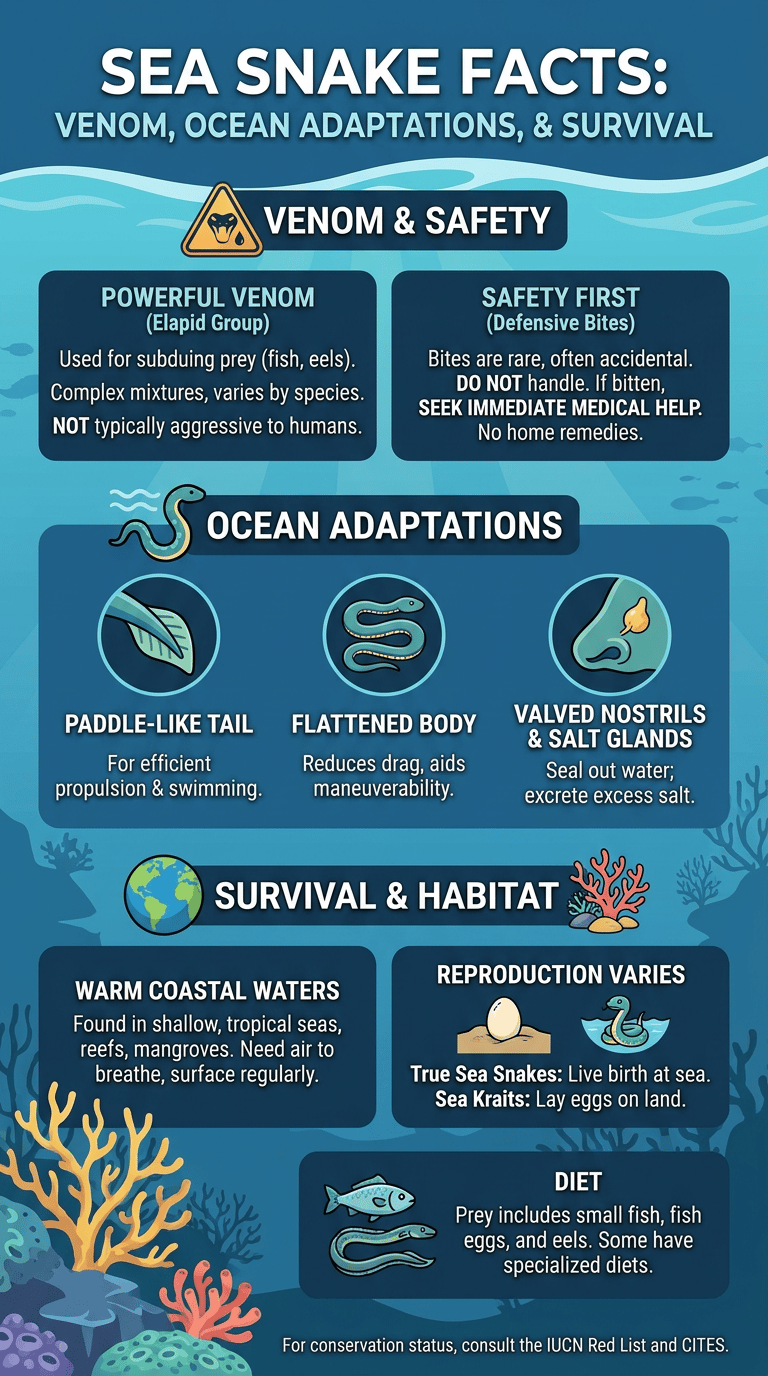
Fish
Many sea snakes eat small fishes that they locate in reef crevices, among seagrass, or in shallow lagoons. Fish provide a concentrated source of protein and fats that support the snakes’ energetic needs. Diet composition varies by species and by the habitat where the snake lives.
Eels
Some sea snakes specialize on elongated prey such as eel-like fishes, which can require different hunting techniques and jaw mechanics. Specialization on particular prey types is one reason why some sea snake species have narrower diets than others.
How They Hunt Underwater
Sea snakes use a combination of stealth, striking speed, and venom to capture prey underwater. They may search among reef structures and in sediments, using sensory cues to locate prey items. Hunting strategies reflect both the physical abilities of each species and the types of prey available in their habitat.
Sea Snake Adaptations
Paddle-Like Tail
A common adaptation for swimming in many sea snakes is a laterally flattened or paddle-like tail that increases surface area and improves propulsion. This body form allows effective movement through water and helps conserve energy during swimming.
Salt Glands
Living in saltwater requires strategies for managing salt intake and water balance. Some marine reptiles possess specialized glands to excrete excess salt. In sea snakes, various physiological mechanisms contribute to osmoregulation, helping them maintain fluid and electrolyte balance while living in a saline environment.
Flattened Body for Swimming
Beyond tail shape, many sea snakes have bodies that are more laterally compressed than typical land snakes, reducing drag and aiding maneuverability in water. These physical traits are part of a suite of changes associated with an aquatic lifestyle.
Valved Nostrils
To prevent water from entering the respiratory tract while submerged, several marine snakes have nostrils that can be closed by muscular or valve-like structures. These features support breath-holding and reduce the risk of inhaling water when diving or when caught in waves near the surface.
Sea Snake Behavior Facts
Are Sea Snakes Aggressive?
Sea snakes are not typically aggressive toward people. Like many wild animals, they may defend themselves if threatened or handled. Avoiding direct contact and observing from a safe distance reduces the chance of provoking a defensive response.
Why They Come to the Surface
Sea snakes surface to breathe and sometimes to bask. Surfacing also provides opportunities to travel efficiently by swimming near the surface or to move between feeding areas. In some species, coming ashore or resting near shorelines is part of reproductive or thermoregulatory behavior.
How They Move in Water
Sea snakes swim using lateral undulations of the body and tail, often appearing very streamlined in the water. Movement efficiency is important for hunting and for avoiding predators in complex habitats such as reefs and seagrasses.
Sea Snake Reproduction Facts
Do Sea Snakes Lay Eggs?
Reproductive modes vary among sea snakes. Some marine-adapted snake groups lay eggs on land, while others give birth to young in the water. Because reproductive strategies differ among lineages, it is important to refer to species-level accounts for precise information about whether a given sea snake lays eggs or bears live young. See species listings on the IUCN Red List for details. IUCN Red List
Live Birth in the Ocean
Several sea snake species give birth to live young at sea, which removes the need to return to land for egg-laying. Live-bearing is one evolutionary solution to a fully marine life history and reduces the risks associated with moving between land and sea to reproduce.
Sea Kraits Returning to Land
Sea kraits are a group of marine-associated snakes that typically come ashore for specific life-history events such as egg laying and resting. This partial return to land distinguishes them from fully marine species and affects their vulnerability to terrestrial threats as well as to changes in coastal habitats.
Most Interesting Sea Snake Facts
Some Rarely Come Ashore
Fully marine sea snakes may spend their entire life cycle at sea, rarely or never coming ashore. This commitment to the marine environment has led to a suite of anatomical and behavioral changes compared with terrestrial relatives.
Some Have Extremely Specialized Diets
Certain sea snakes show strong dietary specialization, feeding on particular types of fishes or even eggs. Specialization can make those species more sensitive to changes in prey availability or habitat condition, which is why habitat protection matters for their conservation.
They Are Among the Most Aquatic Snakes
Sea snakes represent some of the most fully aquatic members of the snake lineage. Their combination of respiratory constraints, reproductive diversity, and swimming adaptations makes them an interesting subject for studying how vertebrates adapt to marine life.
Sea Snake Safety Facts
What to Do If You See One
If you encounter a sea snake in the water or onshore, observe it from a safe distance. Do not attempt to touch, chase, or capture the animal. In the event of a bite or suspected envenomation, seek prompt medical attention from trained healthcare providers or local emergency services rather than attempting home remedies.
Why You Should Never Handle One
Handling wild snakes increases the risk of defensive biting and can harm the animal. For both human safety and animal welfare, leave sea snakes alone and report any concerning strandings or injured animals to local wildlife authorities or rescue organizations.
Common Myths About Sea Snakes
There are several myths about sea snakes, including ideas that all sea snakes are actively hunting people or that they are uniformly abundant everywhere in the tropics. In reality, behavior, abundance, and risk vary greatly among species and locations. Reliable information and cautious behavior are the best guides for safe coexistence.
Sea Snake FAQs
Are sea snakes deadly?
Many sea snakes are venomous, and their venom is effective for subduing prey. Whether a sea snake bite is deadly to a human depends on multiple factors including the species involved, the amount of venom injected, and the speed and quality of medical care. For personal safety, treat any bite as a medical emergency and seek professional care immediately.
Can sea snakes bite underwater?
Sea snakes can and do bite while in the water in defensive or predatory contexts. Care around wild animals reduces the chance of provoking a bite. If a bite occurs in water, get to a safe place where you can receive medical evaluation as soon as possible.
Do sea snakes live in the ocean full-time?
Some sea snakes are fully marine and spend nearly all of their time at sea, whereas others, such as sea kraits, split time between land and sea for activities like reproduction. Patterns vary among species, so species-level information is helpful when precise life-history details are needed.
Are sea snakes more venomous than cobras?
Comparisons of venom potency across broad groups are complex because venoms differ in composition and ecological function. Both sea snakes and cobras belong to elapid lineages and can possess potent venoms suited to their prey. For authoritative assessments of a specific species’ venom, consult scientific literature and clinical guidance from healthcare providers.
Where are sea snakes found?
Sea snakes are mainly found in tropical and subtropical waters with many species occurring around the Indo-Pacific region. Their exact ranges and conservation statuses are documented in global resources such as the IUCN Red List, and international trade or protection listings can be checked through CITES. IUCN Red List, CITES
Final Thoughts
Sea snakes are a notable example of reptiles that have adapted to life in the ocean. Their combinations of behavior, physiology, and life-history strategies allow them to occupy a variety of coastal habitats. While many species are venomous, understanding their ecology and practicing respectful, cautious behavior around marine wildlife reduces risks for people and helps protect these animals in changing coastal environments. For up-to-date conservation and range information, trusted databases such as the IUCN Red List and international protection listings such as CITES are useful starting points. IUCN Red List, CITES
For land-based elapid comparison, cobra snake facts explain hood displays, front-fanged venom delivery, and defensive behavior.
For a land elapid contrast, black mamba snake facts show how venom, speed, and habitat shape a very different risk profile.
For broader context on snakes, the main guide connects this topic with taxonomy, habitat, behavior, safety, and conservation across the wider group.

Ethan Walker is the founder and research editor of Animal Fact Central. He creates and reviews educational animal facts content using trusted wildlife, pet care, and science-based sources. His work focuses on making animal behavior, adaptations, habitats, and species facts clear, accurate, and engaging for everyday readers.
Read More Details About Ethan Walker: https://animalfactcentral.com/ethan-walker/