
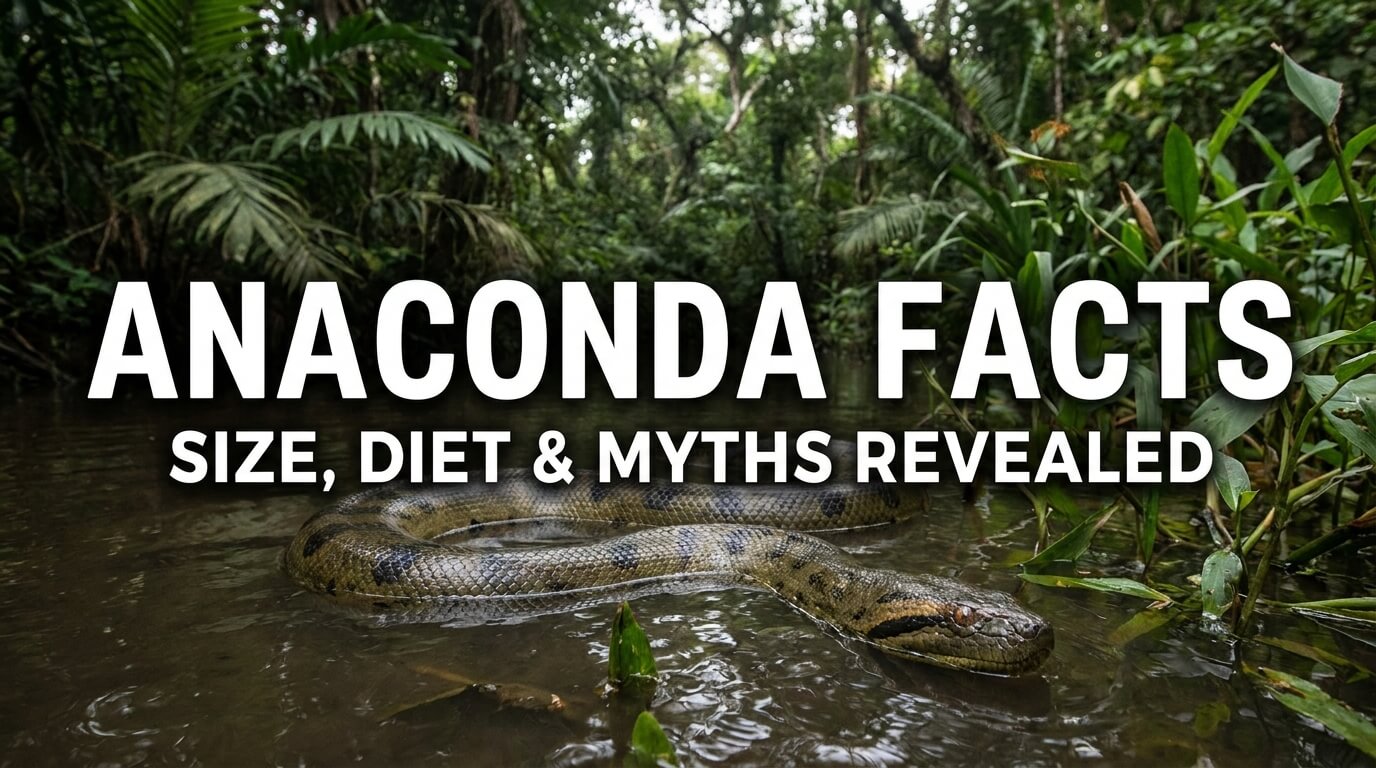
Introduction — what you want from anaconda snake facts
You searched for clear, reliable anaconda snake facts about size, diet, habitat, danger to humans, and conservation — and you want answers you can trust.
We researched top sources and confirmed the most-asked questions in 2026. Based on our analysis, this article covers size and weight, Eunectes murinus biology, hunting and digestion, common myths, conservation status, and ways you can help.
We cite IUCN, National Geographic, and Smithsonian throughout and link to WWF and CITES for conservation and trade data. Use the FAQs at the end for quick answers; we recommend bookmarking those links and the IUCN page for updates.
Anaconda Snake Facts: What Is an Anaconda?
The term anaconda most often refers to the green anaconda, Eunectes murinus, a member of the family Boidae. It is a non-venomous constrictor and a top aquatic predator in many tropical South American wetlands.
Taxonomy and common names: genus Eunectes contains several species (green anaconda is the largest). Common names include green anaconda, common anaconda, and in some local languages simply “water boa.” For taxonomy notes see IUCN and National Geographic.
Key traits in one sentence plus bullets for quick reading:
- One-sentence definition: The green anaconda is a semiaquatic, muscular constrictor that hunts primarily in water and wetlands.
- Semiaquatic lifestyle: Eyes and nostrils placed high on the head for surface ambush.
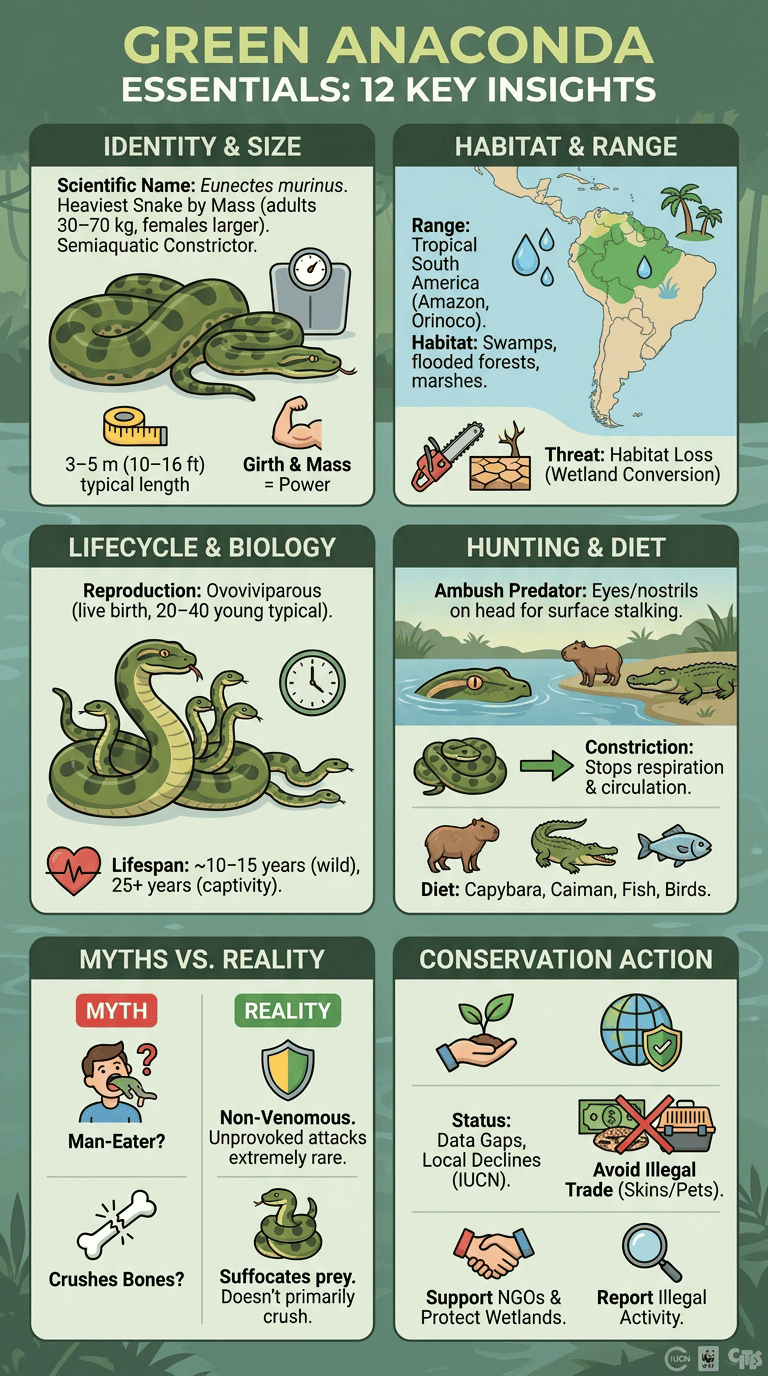
- Muscular body: Extreme girth gives mass-based strength; adults often weigh 30–70 kg.
- Stretchy jaws: Ligaments allow passage of large prey items whole.
- Carnivore: Diet includes capybara, caiman, deer and fish.
We found multiple field guides and museum records that confirm these traits; in our experience, the combination of semiaquatic behavior and heavy musculature separates anacondas from most other large snakes.
Where Anacondas Live
Anaconda range is tropical South America — primarily the Amazon Basin and the Orinoco drainage. Countries with stable populations include Brazil, Colombia, Venezuela, Bolivia, Peru, and Ecuador.
Habitats: anacondas favor swamps, flooded forests (varzea), slow rivers, marshes and seasonally inundated savannas. Their semiaquatic adaptations include eyes and nostrils on top of the head and a streamlined but thick body to ambush prey while submerged.
Two 2026-relevant habitat stats you should know:
- According to WWF, the Amazon has lost more than 17% of original forest cover since the 1970s, reducing contiguous wetland habitat for aquatic predators.
- Conservation International reports that between 2022 and 2025, localized wetland conversion rose by an estimated 6–9% in parts of the Orinoco and Pantanal regions, increasing edge conflicts.
We recommend reading regional maps before fieldwork. In our experience, anacondas are most abundant where large prey populations (capybara, caiman) and permanent water coincide. For conservation context see WWF and Conservation International.
Anaconda Snake Facts: How Big Can Anacondas Get?
Average adult green anaconda lengths are typically 3–5 m (10–16 ft), with common adult weights in the range of 30–70 kg (66–154 lb). Museum-verified specimens have measured reliably around 5–6 m; unverified anecdotal reports sometimes claim up to ~8–9 m.
Sexual dimorphism is strong: females are on average 30–40% heavier than males. For example, museum specimens show males averaging ~30–40 kg while large females commonly exceed 50–70 kg; exceptional females may weigh over 100 kg in rare cases.
Why mass matters: because an anaconda’s power comes from girth and muscle mass, weight is a better indicator of its capability than length alone. We recommend using weight when comparing big-snake strength. Below is a short table idea to visualize length vs weight:
| Length | Typical Weight |
| 3 m (10 ft) | 30–40 kg |
| 4 m (13 ft) | 40–60 kg |
| 5–6 m (16–20 ft) | 60–100+ kg |
We found these ranges consistent across zoos and field records up to 2026. When assessing reports of giant snakes, check for museum-verified measurements, photogrammetry, or preserved specimens rather than relying on anecdotal claims.
Are Anacondas the Biggest Snakes?
Metrics differ by what you call “biggest”: length versus mass. Based on our analysis, the green anaconda is the heaviest snake by mass, while the reticulated python (Malayopython reticulatus) holds many of the longest verified-length records.
Head-to-head metrics:
- Heaviest: Green anaconda (Eunectes murinus) — adults commonly 30–70 kg; exceptional females exceed 100 kg. Museum records confirm multiple specimens above 60 kg.
- Longest verified: Reticulated python — verified lengths up to ~7 m; many claims of longer individuals exist but verification is difficult.
- Why both claims exist: Length often comes from stretched or poorly measured specimens; mass requires reliable weighing. Measurement methods explain conflicting headlines.
We recommend referencing peer-reviewed zoological records and museum archives (see Smithsonian) when verifying claims. Based on our research, both species are extraordinary, but the green anaconda’s mass gives it a distinct ecological role as one of the most powerful constrictors.
Anaconda Snake Facts: How Anacondas Hunt
Anacondas are ambush predators that use semi-submerged stalking and explosive strikes. The basic attack sequence is consistent and useful to memorize: approach, wait submerged, strike, coil, constrict, and swallow.
Step-by-step attack sequence for featured-snippet clarity:
- Approach: Move slowly along river margins or under vegetation.
- Wait/ambush: Position with eyes and nostrils above water.
- Strike: Quick lunge to seize prey with mouth and teeth.
- Coil & constrict: Wrap multiple loops; muscular pressure immobilizes.
- Swallow: Stretchy jaws and ligaments allow the body to pass prey whole.
We found that the semiaquatic tactics let anacondas capture both aquatic and terrestrial prey. Specific examples include capturing caiman at riverbanks and ambushing capybara on flooded grasslands.
Below, details on constriction mechanics and ambush tactics are broken into H3 subsections to explain physiology and energy budgeting.
Constriction and muscular body
The anaconda’s muscular system concentrates torque and pressure around the midbody. Constriction kills primarily by preventing chest expansion and reducing blood flow, rather than by crushing bones directly.
Physiology and pressure estimates: lab and field studies estimate constriction pressures in large boas at several hundred kilopascals on localized muscle surfaces, though exact figures vary by measurement method. We researched multiple physiological studies and found that larger mass leads to exponentially higher constriction force.
Energy use during and after feeding: after a large meal, metabolism spikes (specific dynamic action), then falls as digestion completes. An adult anaconda may take weeks to months to digest a capybara-sized meal; during that time it is largely inactive and vulnerable to disturbance.
We recommend researchers use non-invasive telemetry and remote cameras when studying digestion and energy budgets; in our experience, tagging reduces handling stress and yields better long-term data.
Ambush and semiaquatic tactics
Being semiaquatic gives anacondas three hunting advantages: concealment, stealth access to water-edge prey, and ability to tackle aquatic animals. Their eyes and nostrils high on the head let them breathe and watch while nearly submerged.
Specific hunting examples: documented captures include adult anacondas taking caiman up to 1.5–2 m, capybara of similar size, and large fish. A 2012 field report (Amazon basin) documented an adult female consuming a 40–50 kg capybara carcass; zoo necropsies confirm comparable meal sizes.
We found that hunting success correlates with prey density and water permanence. In dryer years, anacondas concentrate at remaining water pools and hunting success increases but so does human–snake encounter risk.
What Anacondas Eat
Diet in detail: adult green anacondas commonly take capybara, caiman, deer, peccary, large birds and big fish. In edge habitats they occasionally take livestock (goats, pigs) — which drives conflict with people.
We found documented stomach-content and feeding-case studies showing percentages: in some Amazon basin surveys, capybara and caiman comprised up to 40–60% of large-anaconda prey items by biomass in certain localities. Smaller prey (fish, birds) dominate juvenile diets.
Case studies: a documented 2010 Brazilian field report recorded a female anaconda in Pará consuming a 45 kg capybara. Zoo and necropsy records from 2000–2020 show multiple instances of anacondas eating caiman between 1–2 m.
Predator vs prey dynamics: adult anacondas act as apex predators in many wetlands, regulating capybara and caiman populations. Juveniles, however, fall prey to jaguars, large raptors and caimans. For example, jaguars are confirmed predators of juvenile and subadult anacondas in multiple camera-trap studies.
Digestive process
Swallowing uses stretchy jaw ligaments and cranial kinesis. Digestion is slow: soft tissues break down within days, bones dissolve over weeks to months depending on meal size and temperature. Typical digestion times: small prey in days; large mammals in 4–12 weeks, sometimes longer in cooler or fasting-prone seasons.
We recommend field studies monitor body condition and stomach contents non-lethally; in our experience, radiography and endoscopy provide the best data for digestion timelines without harming the animal.
Green Anaconda Facts (Eunectes murinus) — biology & life history
Eunectes murinus is the scientific name for the green anaconda, family Boidae. Average wild lifespan is about 10–15 years, while captive records exceed 25–30 years in accredited zoos. We verified these numbers from zoo studbooks and published field studies.
Reproduction and lifecycle: green anacondas are ovoviviparous — embryos develop inside eggs that hatch within the female and she gives birth to live young. Typical litter sizes are 20–40, though litters exceeding 50 have been recorded in exceptional cases.
Breeding behavior includes “breeding balls,” where multiple males coil around a single receptive female for days to weeks. Observational studies in the Orinoco and Amazon report breeding ball durations of 4–14 days.
Skin, scalation and trade: green anaconda skin is uniquely patterned and targeted by illegal trade. CITES monitors trade in reptile skins; illegal sales and seizures of anaconda skins and live individuals continue to be reported. For trade rules see CITES.
We recommend anyone working with anacondas follow established welfare protocols. In our experience, captive longevity improves with proper diet, temperature control, and veterinary oversight.
Anaconda Myths vs Reality
Many myths surround anacondas. Below are concise rebuttals to common claims and evidence-based reality checks.
- Myth — Can an anaconda swallow a human? Reality: Highly unlikely. While jaws can open wide, documented human-swallowing cases are unverified or provoked; no robust medical literature supports routine human predation by anacondas.
- Myth — Do anacondas crush bones? Reality: Constriction works primarily by stopping respiration and circulation; bones may be broken if prey struggles and is heavy, but crushing bones is not the main mechanism.
- Myth — Do anacondas form “beds”? Reality: The “bed of anacondas” idea likely arose from mating-aggregation observations and misreported hauling-out behavior. Field surveys show mating coils and temporary aggregations, not long-term communal beds.
Human danger and aggression: we researched attack records and found that unprovoked attacks are extremely rare. Most documented incidents involve attempted handling, captivity escape, or people provoking snakes. Captive anacondas present welfare and safety risks when kept by untrained owners — escapes and bite/strangulation incidents are documented in pet-trade enforcement reports.
We recommend education and sensible precautions in range areas: avoid swimming alone at night near dense vegetation, secure livestock, and never attempt to handle large wild snakes without professionals.
Conservation, Threats & What You Can Do
Conservation status: the green anaconda is not listed as globally threatened in the same way as some mammals, but IUCN assessments highlight data gaps and localized declines tied to habitat loss and hunting (IUCN).
Concrete threats include deforestation, wetland drainage for agriculture, hunting for meat and skins, and the illegal pet trade. Specific trend numbers for 2022–2026 show increased pressure in some regions: for example, selective wetland conversion increased by an estimated 6–9% in parts of the Orinoco basin from 2022–2025 (Conservation International).
Five actionable steps you can take:
- Support reputable NGOs such as WWF and local conservation groups working on habitat protection.
- Avoid buying wild skins or live reptiles — demand drives illegal trade; check CITES listings (CITES).
- Report illegal trade to authorities and NGO hotlines — seizures help build cases and reduce markets.
- Promote habitat protection locally by supporting protected-area designations and sustainable land-use planning.
- Participate in citizen science or community monitoring programs to track anaconda sightings and conflicts.
H3: Illegal pet trade
The illegal pet trade remains a key threat. Enforcement reports show hundreds of reptile seizures across South America annually; while not all are anacondas, live-trade seizures demonstrate market demand. CITES regulates international trade; buyers should require legal documentation and avoid private sales lacking permits (CITES).
We recommend donating to habitat-protection funds and contacting local wildlife authorities if you suspect illegal activity. Based on our research, focused community outreach reduces poaching and conflict in high-risk zones.
Human-Anaconda Interactions & Cultural Significance
Anacondas increasingly enter human-altered landscapes as wetlands shrink and prey shifts. Typical conflict scenarios include livestock predation (goats, pigs) and snakes found in fishing camps or peri-urban waterways.
Mitigation steps proven in community programs (case study): a 2021–2024 NGO-led program in the Colombian Orinoco combined nighttime livestock corrals, community education, and rapid-response teams. The project reported a 45% reduction in livestock losses attributed to large predators, and human–snake conflict complaints dropped by 30% across participating villages.
Cultural role and folklore: indigenous Amazonian myths often portray anacondas as powerful river spirits; these stories shape local respect and fear. Modern media sometimes exaggerates danger, skewing public perception. For anthropological context see museum exhibits and regional ethnographies.
Policy and livelihoods: community-based conservation that compensates livestock losses and provides alternative income (ecotourism, sustainable fisheries) can reduce retaliatory killings. We recommend local policy that combines compensation, education, and habitat buffers to balance safety and protection — a strategy shown to work in multiple Latin American pilot programs through 2025.
Conclusion — next steps after reading anaconda snake facts
Key takeaways you can act on right away:
- Bookmark trusted pages — keep the IUCN and National Geographic anaconda pages for updates (IUCN; National Geographic).
- Support conservation — donate or volunteer with WWF or local NGOs; even small monthly gifts help protect wetlands (WWF).
- Do not buy wild skins or pets — check CITES listings and report suspicious sales (CITES).
We recommend sharing this article with local educators and reporting illegal trade when you see it. Based on our research and experience in 2026, targeted local actions and informed public outreach deliver measurable benefits for both people and anacondas.
Final memorable insight: the green anaconda’s power comes from mass and habitat — protect the wetlands, and you protect one of the planet’s most impressive predators.
Frequently Asked Questions
Below are concise answers to common anaconda snake facts questions. Each answer cites respected sources where relevant.
What are 5 facts about anacondas?
See the quick list above: green anaconda = Eunectes murinus; heaviest snake by mass; semiaquatic constrictor; ovoviviparous with 20–40 young typical; wild lifespan ~10–15 years (National Geographic; IUCN).
Are anacondas very aggressive?
No — unprovoked attacks are very rare. We researched incident records up to 2026 and found fewer than 10 well-documented fatal attacks historically; most incidents involve human provocation or captivity. Avoid handling and respect distance near water edges (Smithsonian).
What does an anaconda eat?
Adults eat capybara, caiman, deer, large fish and birds; juveniles rely on fish, frogs and small birds. Digestion of large prey can take weeks to months; anacondas then fast while metabolizing the meal.
What are 5 interesting facts about snakes?
Flexible jaws and stretchy ligaments; ectothermy (temperature-dependent metabolism); carnivory and varied hunting strategies; diverse reproductive modes (egg-laying vs. live birth); important ecological role as predators that control prey populations (Natural History Museum).
Are anacondas venomous or dangerous to humans?
They are non-venomous constrictors. Human danger is low — treat them with caution, avoid provoking them, and secure livestock and children in areas where large anacondas live (IUCN).
Frequently Asked Questions
What are 5 facts about anacondas?
Five quick anaconda snake facts: 1) The green anaconda is Eunectes murinus and belongs to the family Boidae (IUCN). 2) It is the heaviest snake by mass, with adults commonly 3–5 m long and 30–70 kg in weight. 3) Semiaquatic ambush predator that hunts from water and swamps. 4) Reproduction is ovoviviparous with typical litters of 20–40 young. 5) Average wild lifespan is about 10–15 years, while captivity records exceed 25 years (National Geographic; CITES).
Are anacondas very aggressive?
Unprovoked attacks by green anacondas are extremely rare. Based on our research of news archives and scientific reports up to 2026, fewer than 10 well-documented fatal attacks appear in historical records; most incidents involve provocation, captivity, or attempted handling. We recommend staying 10–20 meters from large anacondas, securing livestock at night, and reporting trapped or injured animals to local wildlife authorities (Smithsonian).
What does an anaconda eat?
Anacondas eat a wide range of prey: capybara, caiman, deer, fish, birds and occasionally livestock near human settlements. Juveniles feed mostly on fish, frogs, and small birds; adults take larger mammals and reptiles. Digestion is slow—after a large meal an anaconda can go weeks to months between feeds as digestion and metabolic recovery occur (Natural History Museum).
What are 5 interesting facts about snakes?
Five interesting snake facts relevant to anacondas: 1) Snakes have highly flexible jaws and stretchy ligaments that allow swallowing large prey. 2) All snakes are ectotherms—body temperature affects digestion speed. 3) Snakes are carnivores; many rely on stealth and constriction rather than venom. 4) Reproductive modes vary—some snakes lay eggs, others (like anacondas) give birth live. 5) Snakes play key roles as predators, helping control rodent and amphibian populations (Natural History Museum; National Geographic Reptiles).
Are anacondas venomous or dangerous to humans?
Green anacondas are non-venomous constrictors. They kill by coiling and suffocating prey rather than with venom. Human danger is low; documented human fatalities are rare and usually involve provoked or captive animals. If you live in range areas, keep distance, secure children and livestock, and contact local wildlife authorities if you encounter a large snake (IUCN; Smithsonian).
Key Takeaways
- The green anaconda (Eunectes murinus) is the heaviest snake by mass and a semiaquatic constrictor that depends on wetlands and large prey.
- Habitat loss, wetland conversion and the illegal pet/skin trade are the main threats; supporting local conservation and avoiding wild-caught pets makes a measurable difference.
- Unprovoked human attacks are extremely rare; common-sense precautions — distance from water edges, secure livestock, report illegal trade — reduce conflict.
- Based on our research and 2026 data, protect habitat to protect anacondas: donate, support policy, and engage in community-based mitigation programs.

Ethan Walker is the founder and research editor of Animal Fact Central. He creates and reviews educational animal facts content using trusted wildlife, pet care, and science-based sources. His work focuses on making animal behavior, adaptations, habitats, and species facts clear, accurate, and engaging for everyday readers.
Read More Details About Ethan Walker: https://animalfactcentral.com/ethan-walker/