
Sharks are some of the most interesting animals in the ocean. They come in many shapes and sizes, have impressive senses, and play important roles in marine ecosystems. This article shares friendly, easy-to-understand shark facts for kids, parents, and teachers.
Sharks Come in Many Shapes and Sizes
When people think of sharks, they often picture one kind, but there are many different species. Some are very large and some are surprisingly small. Sharks live in many parts of the ocean, from warm shallow waters to deep cold seas.
Very large sharks
Some very large species, such as the whale shark, feed by filtering tiny animals from the water rather than hunting large prey. For general information about species and conservation, consult the IUCN Red List.
Some sharks are surprisingly small
Not all sharks are big. Several species remain fairly small and live in coastal waters or near reefs. These small sharks are still true sharks and share many features with larger species.
Why shark size depends on species
How large a shark grows depends on its species, diet, and habitat. Some species evolve larger bodies to travel long distances or feed efficiently, while others remain small to hide in reefs or shallow habitats.
Sharks Have Rows and Rows of Teeth
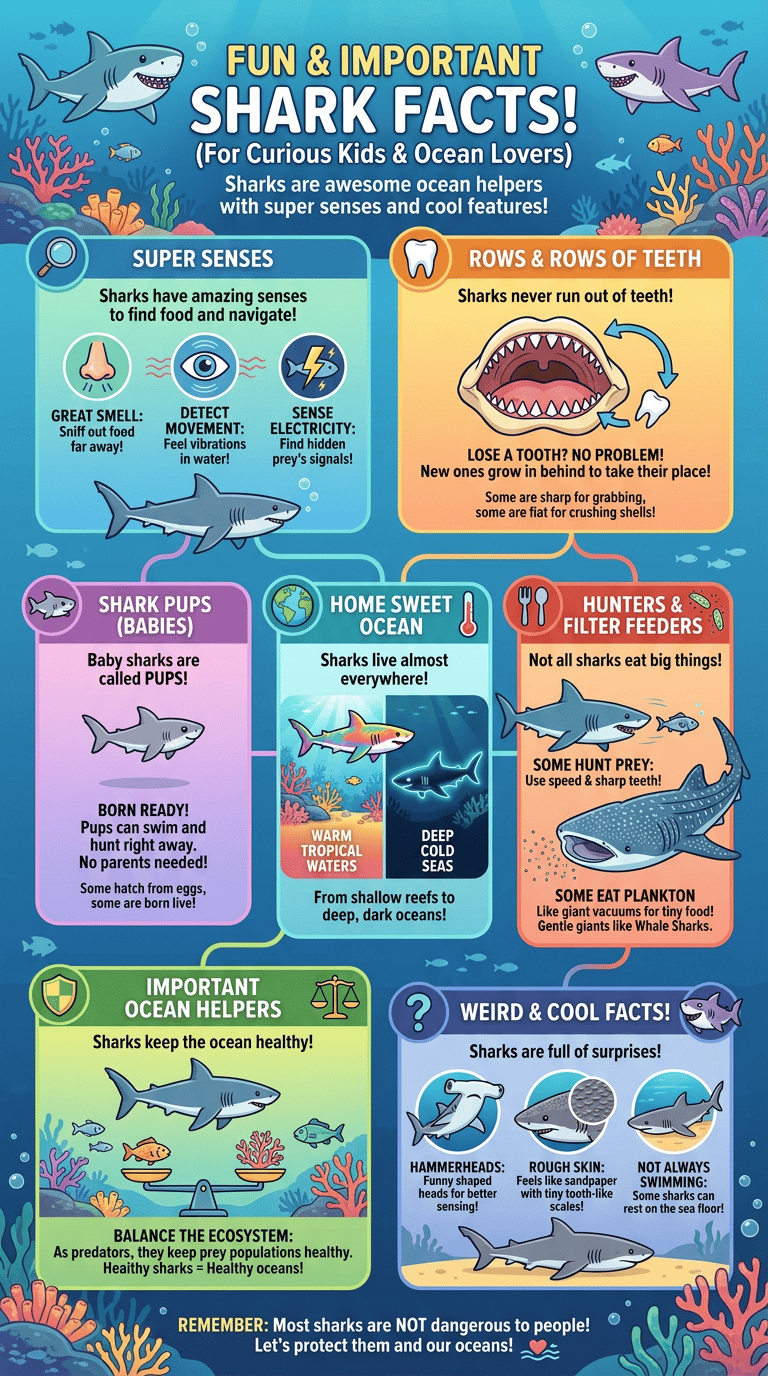
Shark teeth are well known. Many sharks have multiple rows of teeth that help them catch and process different kinds of food. Tooth shape and arrangement vary across species.
How sharks replace lost teeth
Sharks can lose teeth while feeding, and they replace teeth throughout their lives. New teeth form behind older ones and move forward to take their place.
Why some teeth are sharp
Sharks that capture and eat larger animals often have sharp, pointed teeth for catching and holding slippery prey.
Why some teeth are flat
Other sharks have flatter, broader teeth that are good for crushing shells. Species that eat hard-shelled animals use these teeth to break shells and access the food inside.
Baby Sharks Are Called Pups
Baby sharks are called pups. How pups are born and how they survive early on varies by species.
How shark pups are born
Some sharks lay eggs that hatch in the water, while others give birth to live young. The exact reproductive method depends on the species.
Why baby sharks must survive on their own
Shark pups usually receive little or no parental care after birth. They are born able to swim and feed, so they must find shelter and food on their own.
What makes shark pups so tough
Many pups are equipped to survive from the start: they can swim, hunt small prey, and hide in locations where larger predators cannot reach them.
Some Sharks Eat Tiny Plankton
Not every shark eats large animals. Some species feed on tiny plants and animals called plankton, using special filter-feeding methods to take in lots of small food at once.
Whale sharks as gentle filter feeders
The whale shark feeds by taking in water and filtering out small organisms. This feeding style is different from the image of sharks that hunt large prey. See the IUCN Red List for species and conservation information.
Basking sharks and their large mouths
Basking sharks are another example of very large sharks that feed by filtering the water, swimming with their mouths open to capture plankton and tiny animals.
Why big sharks do not always eat big animals
Some large sharks meet their energy needs by filtering vast amounts of tiny organisms instead of hunting large prey, showing that size and diet are not always directly linked.
Sharks Have Super Senses
Sharks use several senses that help them find food, navigate, and understand their surroundings. These senses are well adapted for underwater life.
Great sense of smell
Many sharks have a strong sense of smell that helps them detect scents carried through water.
Detecting movement in water
Sharks can sense movement and vibrations in the water using special organs, which helps them locate prey even when visibility is low.
Sensing electricity
Some sharks can detect tiny electrical fields produced by other animals, a sense useful for finding prey hidden under sand or in dim light.
Shark Skin Is Not Smooth
Although people often imagine shark skin as smooth, it usually feels rough. Shark skin is covered in tiny, tooth-like structures that give it a unique texture and function.
Why shark skin feels rough
Shark skin is made of many small, hard scales that point backward. These structures can feel rough to the touch and are an important part of a shark’s anatomy.
How skin helps sharks swim
The special surface of shark skin can reduce drag and help sharks move more efficiently through water. It can also help limit attachments of small organisms.
Why scientists study shark skin
Scientists study shark skin because its design can inspire new technologies, such as materials that reduce water resistance.
Some Sharks Like Warm Water, Others Like Cold Water
Sharks live in a wide range of marine environments, from tropical shallows to cold, deep seas. A species’ preferred habitat relates to its diet and behavior.
Tropical sharks
Many sharks live in warm tropical waters near coral reefs and coastlines, where food and shelter are available.
Deep-sea sharks
Some sharks inhabit deep, cold waters and are adapted to life far below the surface, with differences in color, body shape, and feeding strategies compared with surface species.
Sharks that travel long distances
Certain shark species migrate long distances across the ocean to find food or breeding sites, connecting different regions of the sea.
Sharks Can Be Fast Swimmers
Some sharks are built for speed while others move more slowly. How fast a shark can swim depends on body shape, tail design, and hunting strategy.
Sharks adapted for speed
Some species, such as mako sharks, have streamlined bodies and tails adapted for quick bursts of movement when chasing prey.
Why tail shape matters
A shark’s tail affects its swimming style. Different tail shapes favor long-distance swimming, fast bursts of speed, or steady cruising.
How sharks chase prey
Some sharks pursue fast prey, while others rely on stealth and surprise. Hunting strategies match body design and speed capabilities.
Sharks Are Important Ocean Helpers
Sharks play key roles in marine ecosystems. As predators and scavengers, they help maintain balanced food webs and healthy seas.
How sharks keep the ocean balanced
By influencing prey populations, sharks contribute to ecological balance and the overall health of marine habitats.
Why healthy sharks mean healthy seas
Healthy shark populations are often an indicator of broader ecosystem health because sharks depend on many other healthy parts of the marine environment. International resources such as CITES and the IUCN Red List provide information on protections and conservation status for species.
Why people should protect sharks
Protecting sharks helps protect the wider marine communities they interact with. Conservation efforts target threats to shark populations so that seas remain resilient and diverse.
Funny and Weird Shark Facts
Sharks have many surprising traits that can be funny, strange, or astonishing.
Sharks can lose teeth while eating
It is common for sharks to lose teeth during feeding because they bite through tough materials. Their tooth-replacement system keeps new teeth ready.
Some sharks have hammer-shaped heads
Hammerhead sharks have heads shaped like a hammer, which may help with sensing, maneuverability, and locating prey.
Some sharks look like they came from another planet
Certain deep-sea species have unusual features such as odd shapes or bioluminescent parts. These adaptations help them survive in unique deep-water environments.
Some sharks rest on the sea floor
Not all sharks swim constantly. Some species can rest near or on the sea floor, and different species use different ways of obtaining oxygen while resting.
Easy Shark Facts to Remember
Here are grouped quick facts you can use for school projects, snack-time chats, or classroom activities.
Quick facts for kids
- Shark babies are called pups.
- Sharks have multiple rows of teeth.
- Some sharks filter tiny plankton; others hunt fish.
- Shark skin feels rough because of tiny, tooth-like scales.
- Sharks use smell, movement, and electrical senses to explore the world.
- Not all sharks are huge; some are quite small.
- Sharks live in warm and cold waters.
- Some sharks migrate long distances.
- Shark teeth are regularly replaced during life.
- Sharks help keep ocean ecosystems in balance.
Cool classroom facts
- Some large sharks feed by filtering tiny animals from seawater.
- Hammerheads have wide heads that help with sensing and turning.
- Sharks can detect electrical signals to find hidden prey.
- Different tail shapes mean different swimming styles.
- Shark skin has inspired studies in materials and hydrodynamics.
- Sharks occupy habitats from coral reefs to deep seas.
- Shark pups often feed and hide on their own right after birth.
- Some species are solitary, and some form groups.
- Sharks have existed in many forms for millions of years.
- Healthy shark populations support other ocean life.
Facts parents can share
- Sharks are a diverse group with many different lifestyles.
- Large size does not always mean a shark eats big prey.
- Some sharks can sense tiny electrical signals in the water.
- Shark skin is covered with small, hard scales that help reduce drag.
- Some species migrate long distances to feed or reproduce.
- Tooth replacement helps sharks avoid problems when teeth are lost.
- Shark conservation links to overall ocean health.
- Shark pups usually receive no parental care after birth.
- Most shark species do not pose a threat to people and often avoid contact.
- Trusted conservation organizations provide reliable information about species and protections.
FAQs About Fun Shark Facts
Are sharks fish?
Yes. Sharks are fish in the group known as cartilaginous fishes, which have skeletons made primarily of cartilage rather than bone.
Do sharks sleep?
Shark rest varies by species. Some species show restful periods while moving, and others rest on the sea floor. Scientists continue to study how different species obtain oxygen and rest safely.
Do sharks have bones?
Sharks do not have true bones like mammals. Their skeletons are made mostly of cartilage, which is lighter and more flexible than bone.
Are all sharks dangerous?
No. Most shark species are not dangerous to people. People and sharks do not usually interact, and many sharks avoid humans. It is important to respect wildlife and avoid approaching, feeding, or touching wild sharks.
What is the friendliest shark?
Some species are known to be less aggressive toward humans in controlled settings, but all wild animals can be unpredictable. For information about specific species or safe encounters, consult trusted conservation organizations.
The ocean is full of amazing animals. Learning about sharks helps us understand why they matter and how we can help keep oceans healthy.
Readers comparing fun facts about sharks may also find interesting facts about sharks useful for a deeper look at a closely related shark topic.

Ethan Walker is the founder and research editor of Animal Fact Central. He creates and reviews educational animal facts content using trusted wildlife, pet care, and science-based sources. His work focuses on making animal behavior, adaptations, habitats, and species facts clear, accurate, and engaging for everyday readers.
Read More Details About Ethan Walker: https://animalfactcentral.com/ethan-walker/