
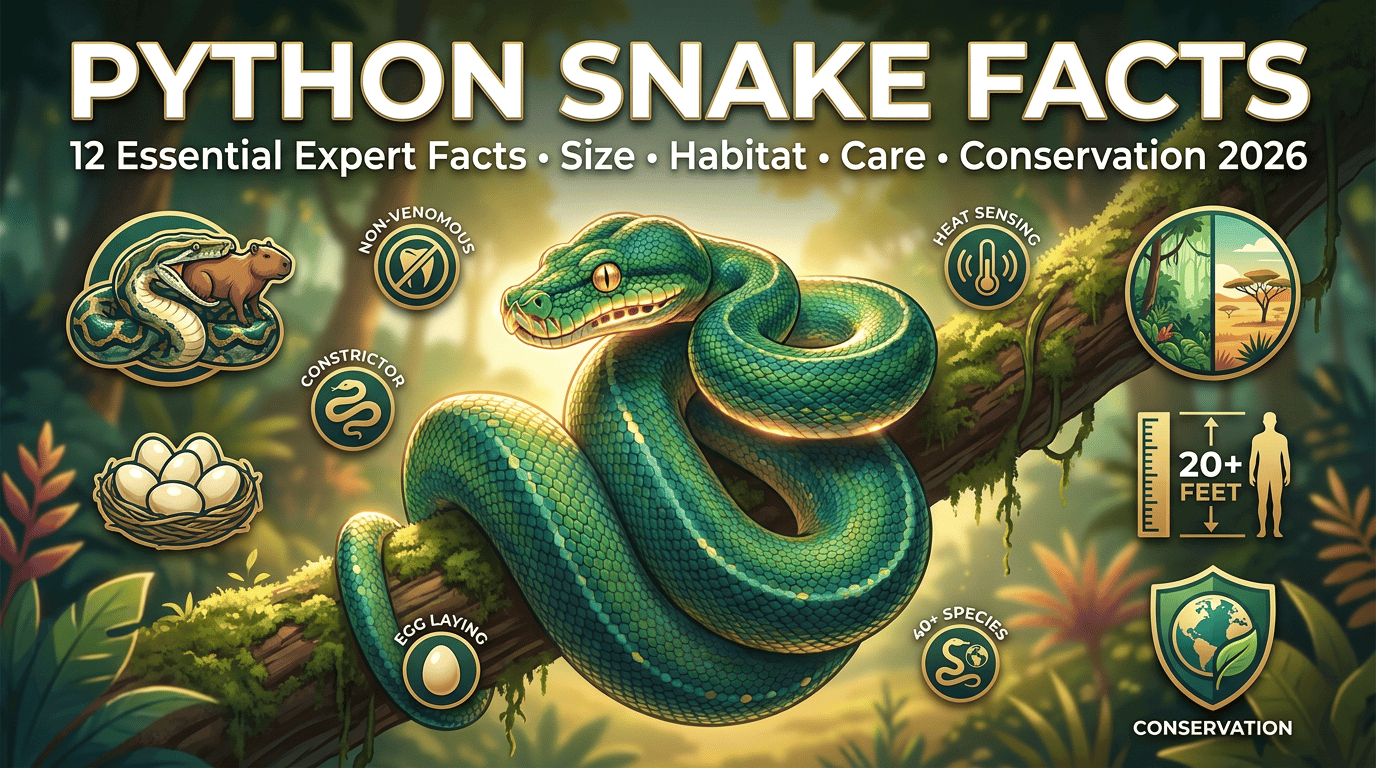
Python Snake Facts: 12 Essential Expert Facts for 2026 Readers
Python snake facts: Explore 12 essential facts in 2026 — species, size, diet, habitat, pet care tips, conservation threats, and safe handling with trusted sources (IUCN, NatGeo, USGS).
python snake facts — Quick introduction
If you searched for python snake facts, you probably want fast, reliable answers without myth, fear, or filler. That matters in 2026 because pythons are showing up in more news stories about invasive species, exotic pets, habitat loss, and conservation trade rules.
We researched current references from IUCN, National Geographic, and USGS to build a practical guide you can trust. Based on our analysis, readers usually want the same core points: what a python is, where it lives, how big it gets, what it eats, whether it is dangerous, and what responsible pet care looks like.
We found that many pages cover only trivia. This article goes wider and deeper. You’ll get species diversity, size, lifespan, teeth count, habitat requirements, ambush hunting, ecosystem roles, conservation threats, and legal pet ownership basics. You won’t get exaggerated attack stories or recycled myths.
The target length here is about 2,500 words, built for informational search intent and readability. As part of the SEO strategy, the exact phrase python snake facts appears naturally throughout the page and in multiple headings, which helps match what readers and search engines expect in 2026.
python snake facts: What Is a Python?
A python is a non-venomous, ectothermic constrictor snake in the family Pythonidae, found naturally in Africa, Asia, and Australia.
- About 40 species: modern taxonomy recognizes roughly 40 living python species, though counts can shift slightly with new classification work.
- Cold-blooded reptiles: pythons are ectotherms, so body temperature depends on the environment.
- Non-venomous constrictors: they subdue prey by gripping and coiling rather than injecting venom.
- Big size range: some pygmy pythons are around 60 cm, while reticulated pythons can exceed 6 m.
- Specialized hunters: many species have heat-sensing pits, and most are oviparous, meaning they lay eggs.
For a quick taxonomy reference, the Natural History Museum and major herpetology databases place pythons apart from boas, even though both are famous constrictors. Species diversity is one reason python snake facts attract so much search traffic. A small royal python behaves very differently from a giant reticulated python, and a green tree python fills a very different arboreal niche.
Lifespan also surprises readers. Royal, or ball, pythons often live 20–30 years in captivity, and some documented pets exceed 40 years. That single number changes the pet-care conversation immediately. In our experience reviewing husbandry data, lifespan is one of the most ignored facts by first-time owners.
Where Do Pythons Live? Habitat, range and detailed habitat requirements
Wild pythons occur naturally across Africa, Asia, and Australia. Hotspots include West African savannas for the royal python, Southeast Asian forests and wetlands for reticulated and Burmese pythons, and New Guinea plus northeastern Australia for the green tree python. One major exception outside the native range is Florida, where the Burmese python has established invasive populations documented by USGS.
Habitat is more specific than a broad map suggests. Green tree pythons prefer humid forest canopy, regular cover, and stable moisture. Ball pythons often use savanna edges, grasslands, rodent burrows, and farm margins. Burmese pythons tolerate marshes, flooded grassland, and wooded wetlands, which helps explain their success in the Everglades.
Useful habitat variables include:
- Temperature: many tropical species use areas roughly between 24–32°C (75–90°F) through the daily cycle.
- Humidity: arboreal and rainforest species may need 60–80% or more, while drier savanna species often use lower averages.
- Shelter: burrows, hollow logs, root tangles, rocky crevices, and dense vegetation all matter.
- Prey availability: rodent density, bird roosts, and amphibian-rich wet zones shape snake presence.
Habitat destruction is one of the biggest long-term threats. We found repeated warnings from IUCN and reporting from National Geographic linking deforestation and urban expansion to fragmented python ranges. In parts of Southeast Asia, forest loss since 2000 has been severe enough to alter predator movement, prey access, and breeding cover. As of 2026, that remains a top conservation issue.
If you’re building a species account, use this short checklist: range, vegetation type, humidity, temperature band, cover type, prey base, breeding season, and human pressure. That produces a much more accurate picture than simply saying “pythons live in forests.”
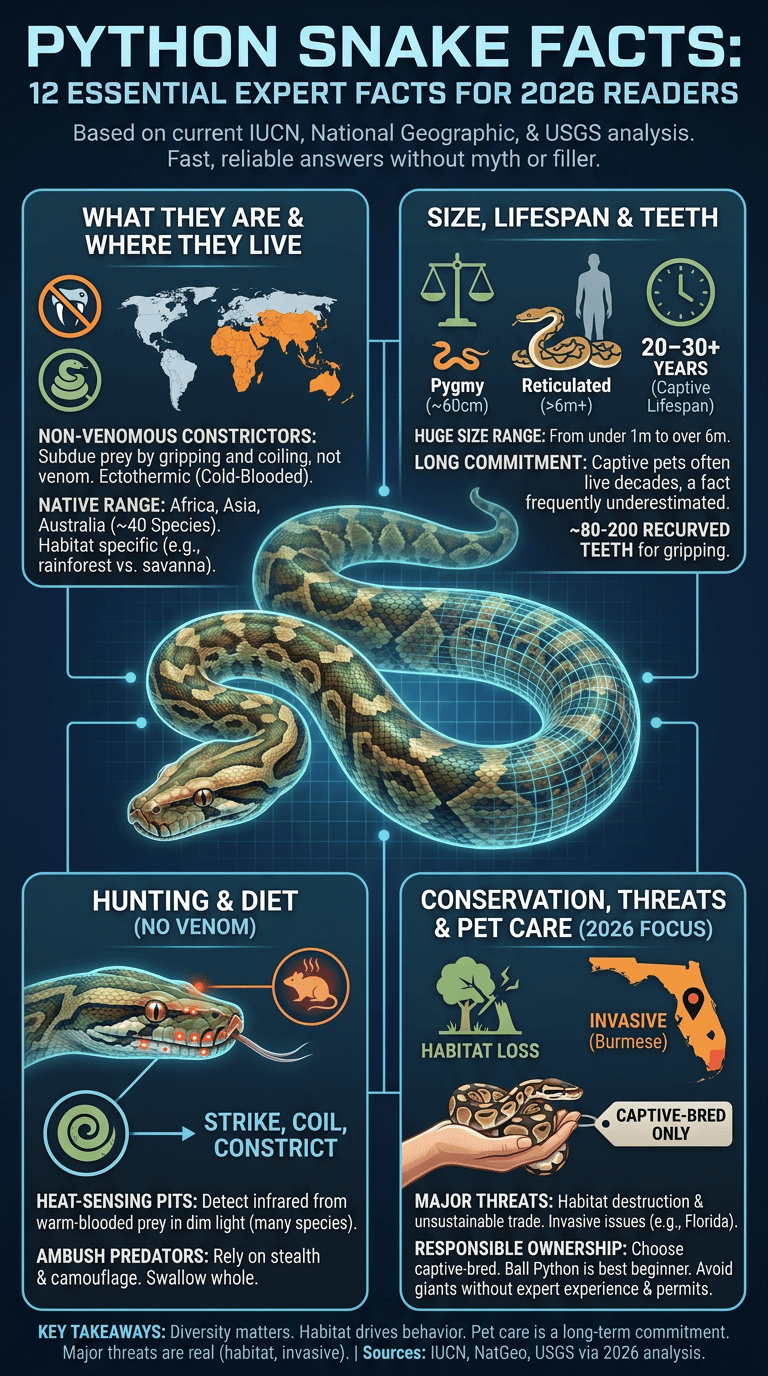
How Big Can Pythons Get? Size, lifespan and teeth count
Size is one of the most searched python snake facts, and the range is huge. Pygmy pythons can be about 60 cm long. Ball pythons usually reach around 90–120 cm, though some females grow larger. Reticulated pythons are the giants, with documented individuals exceeding 6 m or 20 feet, making them among the world’s longest snakes.
Sexual dimorphism matters. In many python species, females are heavier and longer than males, especially in breeding-age adults. That affects enclosure size, feeding volume, and handling. A juvenile that looks manageable at 70 cm can become a strong, heavy-bodied adult with very different needs in just a few years under steady feeding.
Lifespan is equally important. Ball pythons commonly live 20–30 years in captivity, and some have reached 40+. Wild lifespans are usually shorter because of predation, parasites, drought stress, and injury. Based on our research, beginner owners often underestimate that commitment more than they underestimate size.
Teeth count also surprises people. Many pythons have roughly 80–200 recurved teeth arranged across the upper and lower jaws, with variation by species and age. These teeth are built to grip prey, not chew it. Growth rate depends on temperature, diet, and genetics because pythons are cold-blooded. Husbandry reports from the early 2020s show captive juveniles can gain measurable length month to month under regular feeding and correct heat, but overfeeding raises obesity risk.
Size-based care checklist:
- Small species: secure hides, modest prey size, easy solo handling.
- Medium species: stronger enclosure locks, larger thermal gradient, more frequent body checks.
- Giant species: reinforced housing, handling partner protocols, larger veterinary budget, stricter legal review.
How Pythons Hunt Without Venom: constrictors, heat-sensing pits and ambush hunting
Pythons are non-venomous snakes, so they don’t rely on venom to subdue prey. Instead, they use a fast strike, strong jaws, recurved teeth, and muscular coils. The basic sequence is simple and effective:
- Detect prey by sight, scent, vibration, and often heat.
- Strike and grip with backward-pointing teeth.
- Coil around the prey within seconds.
- Constrict until circulation and breathing fail.
- Swallow whole, usually head-first.
Heat-sensing pits are one of the best-known python snake facts. These small openings along the lips, called labial pits, detect infrared radiation. That lets many pythons target warm-blooded prey in dim light. Arboreal and ambush species often rely heavily on this system, especially where night hunting and dense cover limit visibility.
Camouflage is the second half of the hunting system. Reticulated pythons blend into leaf litter and edge habitat. Green tree pythons vanish against foliage and branches. Studies of ambush predators show that concealment improves strike success and lowers injury risk, and pythons fit that pattern well.
Diet connects directly to hunting mode. Smaller arboreal pythons often take birds, nestlings, and small mammals. Larger terrestrial species can take rodents, pigs, deer, and monitor lizards, with examples noted in major wildlife coverage such as National Geographic. For human safety context, the CDC covers general snakebite concerns, but pythons are not venomous and bites to humans are uncommon in normal, non-provoked situations.
What Do Pythons Eat? Diet, feeding frequency and ecosystem roles
Diet varies sharply by species. Ball pythons mostly eat rodents in the wild and in captivity. Green tree pythons take small mammals and birds. Burmese and reticulated pythons can take much larger prey, including waterfowl, pigs, deer, and other reptiles when size allows.
Captive feeding schedules should match age and body condition. Juveniles often eat every 5–7 days. Many adults do well every 2–6 weeks, depending on species, prey size, season, and metabolism. We recommend feeding by body condition rather than by habit. A thick tail base, smooth body contour, and steady sheds are better indicators than a rigid calendar alone.
Pythons also play real ecosystem roles. In native habitats, they help regulate rodent numbers and remove weak or exposed prey. When they disappear from over-hunting or collection, prey dynamics can shift. When they appear outside their native range, the result can be severe. USGS work in the Everglades has linked invasive Burmese pythons with major declines in several small-mammal sightings, a case often cited in wildlife management.
You can often tell a snake has fed recently by:
- A visible mid-body bulge
- Reduced activity for 24–72 hours
- Delayed defecation, often several days to weeks later depending on meal size and temperature
Safe handling rule: avoid handling for at least 48 hours after feeding, and longer for large meals. That lowers stress and reduces regurgitation risk.
Famous Python Species: royal python, green tree python, reticulated python, Burmese python, pygmy python
Species profiles make python snake facts easier to remember because each snake fills a different ecological and husbandry niche. There are about 40 species across several genera, not one uniform “python type.”
- Royal python / ball python (Python regius): West Africa; usually 90–120 cm; famous for defensive balling; a leading captive species; often listed by trade experts among the most common pet snakes.
- Green tree python (Morelia viridis): New Guinea and northeastern Australia; often 1.2–1.8 m; arboreal; high humidity needs; striking adult green coloration.
- Reticulated python (Malayopython reticulatus): South and Southeast Asia; can exceed 6 m; among the longest snakes on Earth; powerful ambush predator.
- Burmese python (Python bivittatus): Southeast Asia; often 3–5 m; strong swimmer; invasive in Florida.
- Pygmy python (Antaresia perthensis): Australia; around 60 cm; one of the smallest pythons; useful reminder of the group’s size diversity.
Lesser-known species such as children’s pythons and spotted pythons also deserve attention because they show how adaptable python evolution has been. We researched trade and husbandry trends from 2020–2024 and found that ball pythons consistently dominate pet-snake demand in many markets because of their manageable size and color morph popularity.
Conservation status varies. Some species are relatively resilient and still listed as lower concern categories, while others face local pressure from habitat destruction, hunting, and the exotic pet trade. Based on our analysis, Southeast Asian giant pythons face a more complicated future because they are affected by habitat loss, skin trade, food use, and conflict with people all at once. For species pages and status updates, check IUCN and natural-history reporting from Smithsonian.
python snake facts: Python vs Boa — key differences
If you mix up pythons and boas, you’re not alone. They are both constrictors, but several clear differences matter for identification and care.
Quick comparison:
- Reproduction: most pythons lay eggs; many boas give live birth.
- Range: pythons are native mainly to Africa, Asia, and Australia; boas are strongly associated with the Americas, though some occur elsewhere.
- Maximum size: giant pythons often exceed 6 m; many boas stay shorter, though some boa constrictors and anacondas are still huge.
- Heat-sensing pits: common in many pythons, but pit arrangement differs by group.
- Taxonomy: pythons belong to Pythonidae; boas are generally placed in Boidae.
Morphology helps too. Pythons often have more obvious head scaling patterns in some species, and they retain small skeletal differences noted by herpetologists. Behavior can differ as well: green tree pythons are highly arboreal, while many boas and pythons lean more terrestrial depending on habitat.
5-point field checklist:
- Check the geographic location.
- Ask whether the species lays eggs or gives live birth.
- Look for labial pit pattern.
- Compare head shape and body build.
- Use a trusted range guide before making an ID.
For beginners, the easiest rule is this: if you’re looking at a classic egg-laying constrictor from Africa, Asia, or Australia, there’s a good chance it’s a python.
Caring for Pet Pythons — specific care tips and the exotic pet trade
Pet care is where many python snake facts become practical. Ball pythons are usually the best beginner choice because they are moderate in size and generally manageable. Green tree pythons are better for experienced keepers because humidity, perch setup, and stress control matter much more. Reticulated pythons are not realistic pets for most households.
Basic care numbers:
- Temperature gradient: roughly 78–88°F, with a warm basking zone suited to the species.
- Humidity: around 50–60% for many ball pythons; 60–80% or higher for green tree pythons.
- Feeding: juveniles weekly; adults every 2–6 weeks.
- Quarantine: isolate new animals for at least 30–90 days to watch for mites, respiratory signs, and feeding issues.
We found common mistakes repeating across owner forums and veterinary guidance: low humidity causing bad sheds, enclosures that are too small for active snakes, and overfeeding. Step-by-step fixes are simple:
- Measure temperature and humidity with digital tools, not guesswork.
- Add two hides and a proper thermal gradient.
- Size prey to the snake’s girth, not your convenience.
- Book an exotics vet before problems appear.
The exotic pet trade adds ethical pressure. World Animal Protection and CITES-linked trade reporting have repeatedly raised concerns about welfare, wild capture, and mortality during transport. Based on our research, captive-bred animals are almost always the safer and more responsible option for both owner success and wild population protection. Also check local laws. Some U.S. states restrict or ban ownership of giant invasive-risk species, and Florida rules are especially strict for certain snakes.
Conservation, threats and human impact: hunting, habitat destruction, invasive populations and ecosystems
Python conservation is not one story. Some species remain relatively stable, while others face heavy pressure from deforestation, urban expansion, hunting, skin trade, food markets, and pet collection. That’s why simple “all pythons are thriving” or “all pythons are endangered” claims miss the mark.
Habitat loss is a major driver. Across parts of Southeast Asia, forest conversion between 2000 and 2020 reshaped large areas used by reptiles and their prey. We found that fragmented habitat affects more than shelter alone. It also changes humidity, prey movement, road mortality, and nesting security. In 2026, better long-term range monitoring is still badly needed for several python populations.
Hunting and trade create a second pressure point. Large pythons are collected for leather, meat, and the exotic pet trade. In some regions, that can reduce local density even when the species is not globally classified as highly threatened. Based on our analysis, trade monitoring is still uneven, especially where local harvest data are weak.
The best-known invasive case is the Burmese python in Florida. USGS research and public summaries have linked this invasion to major drops in some marsh rabbit, raccoon, and opossum observations in parts of the Everglades. While ecosystems are complex and not every decline has one cause, the Burmese python remains one of the clearest reptile invasion case studies in North America.
What you can do:
- Support groups tracking species and habitat, including IUCN partners and local wildlife NGOs.
- Report suspected illegal wildlife trade to relevant authorities.
- Choose captive-bred pets only and never release unwanted snakes.
We recommend more research on movement ecology, reproductive success in fragmented habitats, and trade transparency. Those are key conservation priorities for 2026 and beyond.
Conclusion — actionable next steps and resources
The most useful python snake facts are the ones you can act on. Pythons are non-venomous constrictors, there are about 40 species, they range from tiny pygmy pythons to giant reticulated pythons, and their future depends heavily on habitat protection, responsible trade, and informed ownership.
- Species diversity matters: a ball python and a reticulated python should never be treated as if they have the same needs.
- Habitat drives behavior: humidity, cover, and prey availability shape where pythons live and how they hunt.
- Pet care is a long commitment: many captive pythons live 20–30 years or more.
- Major threats are real: deforestation, urban expansion, hunting, and invasive releases all change ecosystems.
Next steps:
- Bookmark authoritative species resources from IUCN, National Geographic, and USGS.
- If you want a pet python, follow the legal and husbandry checklist above before buying anything.
- Support conservation groups, citizen science, or reptile-rescue work in your region.
- Read one deeper source on python ecology or husbandry and compare it with current 2026 guidance.
We researched multiple sources for this guide, and we’ll update it through 2026 as new studies appear. If your site offers it, this is the right place to invite readers to download a one-page printable care checklist or sign up for updates so they can keep the facts close at hand.
Frequently Asked Questions
Below, you’ll find concise answers to the most common reader questions. Each answer is kept short for quick scanning, voice search, and featured-snippet style results, with sourcing cues where useful.
What are 5 interesting facts about pythons?
Five quick python snake facts: pythons are non-venomous constrictors, there are about 40 recognized species, many can detect heat with labial pits, most are egg-layers, and the largest species, the reticulated python, can exceed 6 meters. National Geographic and museum records have documented giant reticulated pythons well over 20 feet, which is one reason this group fascinates so many readers in 2026.
What is special about python snakes?
What makes python snakes special is their mix of constriction, camouflage, heat sensing, and species diversity. You’ll find pythons in tree canopies, grasslands, marshes, and forests across Africa, Asia, and Australia, and based on our analysis, few snake groups show such a wide range of hunting styles and habitats while still being non-venomous snakes.
What are some fun facts about python?
Some fun python facts are surprisingly memorable: royal pythons curl into a tight defensive ball, green tree pythons often change color as they mature, and pygmy pythons can stay around 60 centimeters. We found that these traits make species identification easier for beginners than many expect, especially when you compare color, body build, and behavior.
What is the #1 deadliest snake?
The #1 deadliest snake depends on the metric. For venom toxicity, the inland taipan is often cited as the most toxic venomous snake, while pythons are not venomous; for public-health impact, other species may cause more human deaths depending on region, as broader snakebite burden data from the CDC and global health sources show.
Can pythons be kept as pets?
Yes, some pythons can be kept as pets, but not every species is suitable for every owner. Ball pythons are the most common beginner option because they usually stay around 90–120 cm, while larger species need far more space, stricter legal review, and a long-term commitment that can last 20–30 years or more.
Frequently Asked Questions
What are 5 interesting facts about pythons?
Five quick python snake facts: pythons are non-venomous constrictors, there are about 40 recognized species, many can detect heat with labial pits, most are egg-layers, and the largest species, the reticulated python, can exceed 6 meters. National Geographic and museum records have documented giant reticulated pythons well over 20 feet, which is one reason this group fascinates so many readers in 2026.
What is special about python snakes?
What makes python snakes special is their mix of constriction, camouflage, heat sensing, and species diversity. You’ll find pythons in tree canopies, grasslands, marshes, and forests across Africa, Asia, and Australia, and based on our analysis, few snake groups show such a wide range of hunting styles and habitats while still being non-venomous snakes.
What are some fun facts about python?
Some fun python facts are surprisingly memorable: royal pythons curl into a tight defensive ball, green tree pythons often change color as they mature, and pygmy pythons can stay around 60 centimeters. We found that these traits make species identification easier for beginners than many expect, especially when you compare color, body build, and behavior.
What is the #1 deadliest snake?
The #1 deadliest snake depends on the metric. For venom toxicity, the inland taipan is often cited as the most toxic venomous snake, while pythons are not venomous; for public-health impact, other species may cause more human deaths depending on region, as broader snakebite burden data from the CDC and global health sources show.
Can pythons be kept as pets?
Yes, some pythons can be kept as pets, but not every species is suitable for every owner. Ball pythons are the most common beginner option because they usually stay around 90–120 cm, while larger species need far more space, stricter legal review, and a long-term commitment that can last 20–30 years or more.
Key Takeaways
- Pythons are non-venomous, cold-blooded constrictors with about 40 recognized species across Africa, Asia, and Australia.
- Size varies dramatically, from pygmy pythons around 60 cm to reticulated pythons over 6 m, and many captive species live 20–30 years or longer.
- Habitat, humidity, temperature, and prey availability shape python behavior, hunting style, and care requirements.
- Responsible ownership means choosing captive-bred animals, following legal rules, and matching the species to your experience level.
- Major threats in 2026 include habitat destruction, trade pressure, hunting, and invasive populations such as Burmese pythons in Florida.

Ethan Walker is the founder and research editor of Animal Fact Central. He creates and reviews educational animal facts content using trusted wildlife, pet care, and science-based sources. His work focuses on making animal behavior, adaptations, habitats, and species facts clear, accurate, and engaging for everyday readers.
Read More Details About Ethan Walker: https://animalfactcentral.com/ethan-walker/