
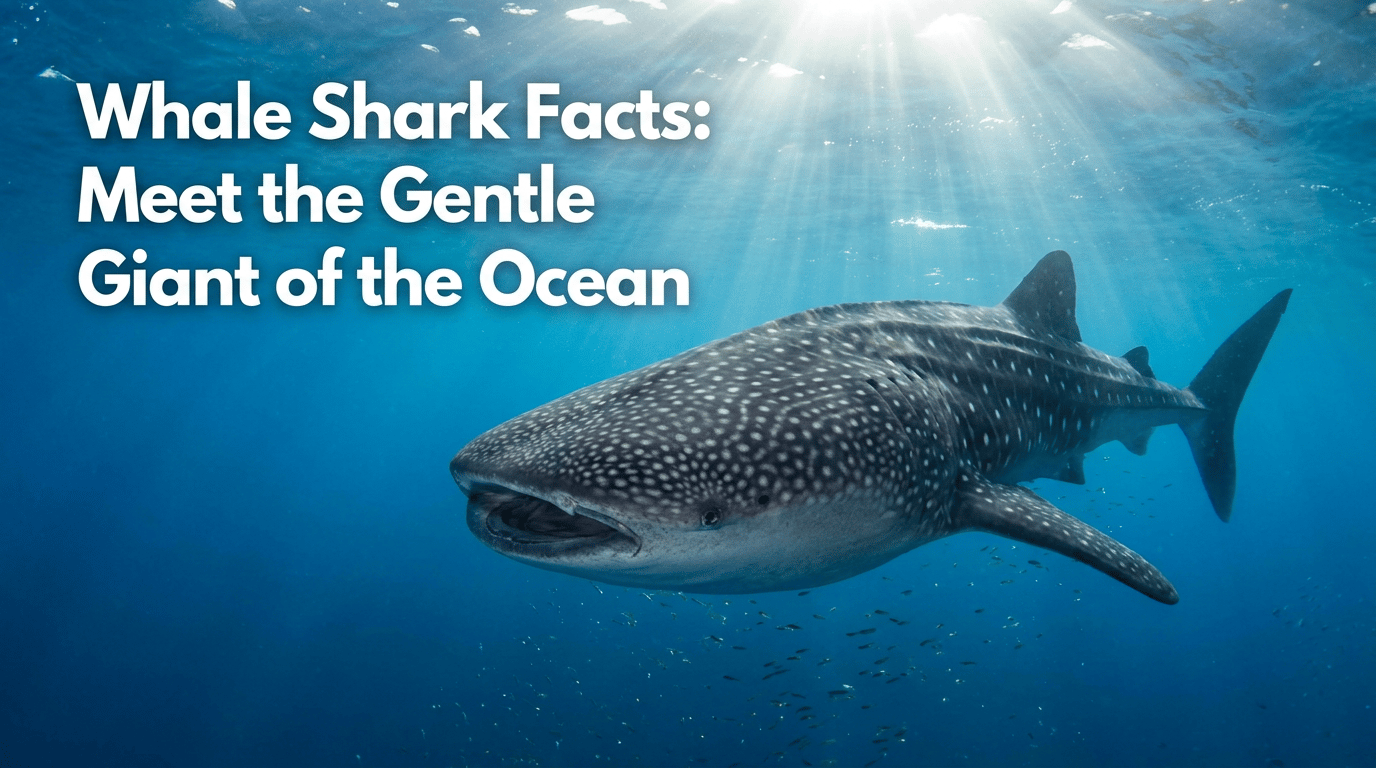
Whale sharks are often called the gentle giants of the sea. They are enormous, slow-moving filter feeders that eat tiny organisms, yet they are true sharks, not whales. This article summarizes what scientists know about whale shark identity, appearance, feeding, distribution, migration, reproduction, safety around them, conservation concerns, and a few notable facts. Where authoritative information about conservation, status, range, or trade is relevant, this article links to established global resources for further reading.
What is a whale shark?
Whale shark is a shark, not a whale
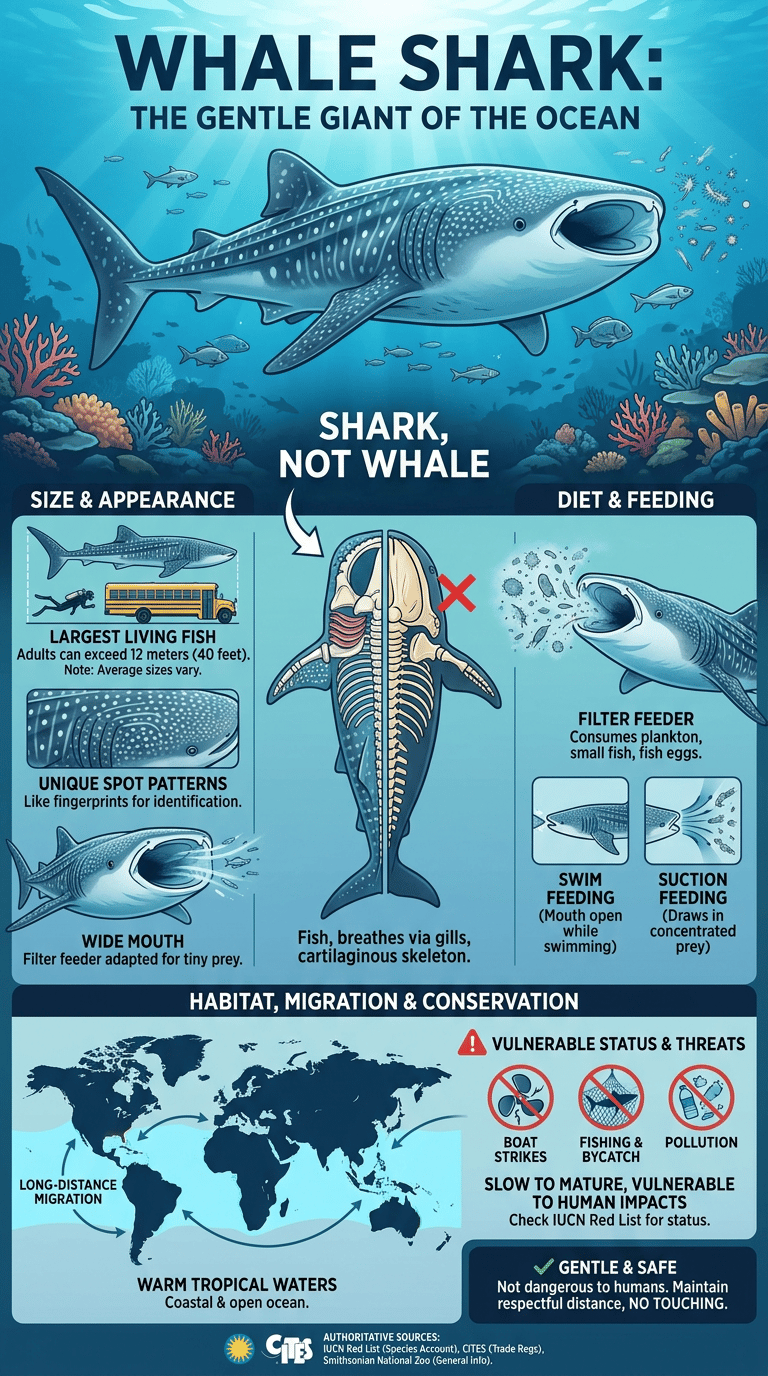
The whale shark is a fish in the shark group, not a mammal. It breathes through gills, has a cartilaginous skeleton, and belongs to the shark order. Its common name reflects its large size and generally non-aggressive behavior rather than mammalian traits. For global species assessments and conservation information, see the IUCN Red List entry for whale sharks on the IUCN Red List website.
Scientific classification
The whale shark is classified in the order Orectolobiformes with the scientific name Rhincodon typus. For up-to-date species-level information and conservation notes, consult the IUCN Red List IUCN species account.
Why it is called a whale shark
The name “whale shark” reflects two traits: a very large body size that invites comparison with whales, and a filter-feeding style that resembles how some baleen whales feed on small prey. Despite this resemblance in feeding, the species is anatomically and taxonomically a shark.
Whale shark size and growth
Largest fish among living species
Whale sharks are widely recognized as the largest living fish species. For conservation context about whale sharks as a globally notable large fish species, consult the IUCN Red List IUCN species account.
Variation in size
Average sizes vary by region and sampling methods. Rather than presenting a single numeric average here, note that adult whale sharks are much larger than most other fishes and grow over many years as they mature.
Why whale sharks grow so large
Several ecological and evolutionary traits help explain whale shark gigantism. A large body supports wide mouths and swimming power needed for efficient filter-feeding, allowing animals to process large volumes of water for dispersed prey. Research synthesizing field observations and ecological theory informs these ideas; consult species assessments for the latest summaries.
What whale sharks look like
Spotted skin pattern
Whale sharks are known for a striking skin pattern of pale spots and stripes on a darker background. These markings can appear like a mosaic and help make each animal visually distinctive; researchers often use photographs of these patterns to match individuals across time and locations.
Wide mouth
The whale shark’s mouth is very wide and located at or near the front of the head. This opening helps the animal take in large volumes of water when filter feeding; the mouth and gill structures work together to retain small prey while expelling water.
Broad head and large body
Whale sharks have a broad, flattened head and a robust body adapted for steady, continuous swimming and the demands of filtering water for food.
Unique spot patterns like fingerprints
Individual spot patterns are treated like fingerprints because they are unique and stable over time. Photo-identification projects compare spot patterns from beneath the fish and on the flanks to recognize animals over years and across distances.
What do whale sharks eat?
Plankton and tiny organisms
Plankton, including microscopic plants and animals that drift in the ocean, are a primary food source for whale sharks. Their filter-feeding behavior enables them to harvest plankton effectively when these prey items are abundant.
Small fish and fish eggs
In addition to plankton, whale sharks consume small schooling fishes and may feed on dense patches of fish eggs or similar aggregations of small prey when available.
How filter feeding works
Filter feeding combines a wide mouth, internal filtering surfaces, and swimming to move water through the mouth and across structures that trap prey. Whale sharks use a combination of passive filtering and active mechanisms to retain small organisms while expelling water. For information on feeding ecology and species context, see the IUCN Red List IUCN species account.
How whale sharks feed
Swimming with mouth open
One common feeding mode is for a whale shark to swim forward with its mouth open, allowing water rich in prey to flow in where filter structures retain food.
Suction feeding
Whale sharks can also use suction feeding to draw water and prey into the mouth when encountering concentrated food patches.
Vertical feeding behavior
Occasionally whale sharks adopt a vertical posture in the water column to feed on dense prey layers, such as during spawning events or plankton blooms, positioning their mouth to sample concentrated bands of prey.
Specialization for small prey
Whale sharks are specialized filter feeders adapted to capture very small prey items. Their anatomy favors processing large volumes of water rather than pursuing large, agile animals.
Where whale sharks live
Warm tropical and subtropical waters
Whale sharks are associated with warm tropical and subtropical seas worldwide and are often reported in regions where surface waters are warm and productive. For global range and distribution assessments, see the IUCN Red List IUCN species account.
Coastal feeding areas
Although capable of open-ocean travel, whale sharks are frequently observed in coastal areas where seasonal or local productivity concentrates prey, including upwelling zones and places with fish spawning or plankton blooms.
Open ocean movements
Whale sharks also move through the open ocean and are not restricted to nearshore habitats. Tagging and photo-identification studies reveal movements between feeding grounds and long-distance transits in search of food or suitable conditions.
Well-known aggregation sites
Certain coastal locations are known for predictable seasonal whale shark sightings tied to food availability. These places attract divers and researchers when animals arrive in numbers; follow local rules and management plans to observe them responsibly.
Whale shark migration
Long-distance travel
Tagging and photo-identification indicate that whale sharks can travel long distances between feeding and seasonal areas, connecting widely separated productive regions across ocean basins.
Seasonal food sources
Seasonal concentrations of plankton, fish spawn events, and other productive phenomena drive much of the seasonal occurrence of whale sharks in particular areas, and animals may return to known feeding sites when conditions favor food availability.
Challenges of tracking
Tracking marine megafauna is technically challenging because tags must transmit through water and studies require sustained effort; tag loss, limited coverage, and vast ocean distances all complicate gathering continuous movement records.
Whale shark reproduction
Live birth
Whale sharks are ovoviviparous, meaning embryos develop inside eggs that hatch within the mother and she gives birth to live young. For conservation and reproductive notes, consult the IUCN Red List IUCN species account.
Pups and juvenile life
Newborn whale sharks enter the ocean fully formed and are relatively small compared with adults; juveniles require time to grow and reach maturity, and researchers continue to learn about juvenile habitats and survival rates.
Gaps in knowledge
Many aspects of whale shark reproduction, such as specific mating behavior and pupping locations, remain difficult to observe because these events may occur in remote or deep waters, making reproduction an active area of research.
Are whale sharks dangerous?
Generally gentle
Whale sharks are generally considered gentle and are not a threat to people. They feed on small organisms and show no evidence of predatory behavior toward humans, and most encounters are calm when animals are left undisturbed.
Safety and distance
Because whale sharks are very large, accidental contact can cause injury to people or animals. Observing them from a respectful distance reduces stress to the animal and lowers the risk of accidental harm. Follow local guidance and the directions of trained guides when participating in wildlife viewing.
Responsible tourism
Responsible whale shark tourism emphasizes no touching, keeping a safe distance, limiting observer numbers, and following local rules to reduce disturbance. Many regions have guidelines or regulations to manage encounters and protect both animals and visitors.
Whale shark conservation
Boat strikes
Boat strikes and propeller injuries are documented threats where whale sharks overlap with heavy vessel traffic. Collisions can cause severe injury or death, and managing boat speeds and traffic in known aggregation areas helps reduce this risk. For global threat summaries and conservation status, see the IUCN Red List IUCN species account.
Fishing, bycatch, and trade
Whale sharks can be caught accidentally as bycatch or targeted in some regions. International agreements and national regulations aim to reduce intentional take and bycatch. The Convention on International Trade in Endangered Species of Wild Fauna and Flora provides an international framework related to trade and protection of listed species; consult the CITES website CITES official site for more information.
Pollution
Marine pollution, including plastics, poses ecological risks across ocean species and habitats. Ingestion of debris and habitat degradation from pollution add to pressures faced by whale sharks and other marine life.
Vulnerability from life history
Whale sharks mature slowly and reproduce relatively infrequently, so populations can take a long time to recover from declines caused by fishing, bycatch, or other human-caused mortality. Conservation strategies emphasize reducing adult mortality and protecting key habitats to support population resilience.
Fun whale shark facts
Small teeth
Despite large mouths, whale sharks have very small teeth that are not used to capture prey in the way predatory sharks do; their feeding depends on filtering small organisms.
Spot patterns aid research
Researchers use spot patterns to identify individual whale sharks for long-term studies. Photo-identification databases help scientists track movements and site fidelity over time.
Long-lived relative to many fishes
Whale sharks are believed to have long lifespans relative to many fishes and reach maturity only after several years of growth. These life-history traits contribute to conservation concerns when adult mortality increases.
Large enough to compare to familiar objects
Adults are often compared in size to vehicles and other familiar objects to help visualize their scale; because individual sizes vary, these comparisons are general rather than precise.
FAQs About Whale Sharks
Is a whale shark a whale or a shark?
It is a shark. The common name reflects its large size and filter-feeding habit that resemble some large whales, but anatomically and taxonomically it is a shark. See the IUCN Red List for species information IUCN species account.
What does a whale shark eat?
Whale sharks feed on tiny organisms such as plankton, small schooling fishes, and fish eggs by filtering water through their mouths and internal structures.
Can whale sharks hurt humans?
Whale sharks are not considered dangerous to people and do not hunt humans. However, because they are very large, unintentional contact can be harmful. Observers should maintain distance and follow local guidelines.
Where can you see whale sharks?
Whale sharks are found in warm seas worldwide and are seasonally predictable in some coastal locations where food concentrates. If you plan to observe them, choose authorized operators and follow local rules that prioritize animal welfare and safety.
Why are whale sharks vulnerable?
Whale sharks face multiple human-caused threats including fishing pressure, bycatch, vessel collisions, and habitat degradation. Their slow growth and reproductive traits make population recovery slow when adults are lost. International frameworks such as CITES and conservation assessments such as the IUCN Red List provide context for protections and management actions; see the CITES website CITES official site and the IUCN Red List IUCN species account for more information.
For general background on animal taxonomy and accessible species information beyond marine resources, reader-friendly guides such as the Smithsonian National Zoo animal listings can be useful Smithsonian National Zoo.
Do not touch, feed, chase, or harass whale sharks or any wild animals. If you encounter a distressed or injured marine animal, contact local wildlife authorities, marine rescue organizations, or trained professionals for help.