
Some animals cannot fly because flight is expensive, demanding, and not always worth keeping. In birds, insects, and a few other animals, wings may become smaller, stiffer, weaker, or useful for something other than air travel when running, swimming, hiding, breeding, or saving energy matters more than lifting off the ground.
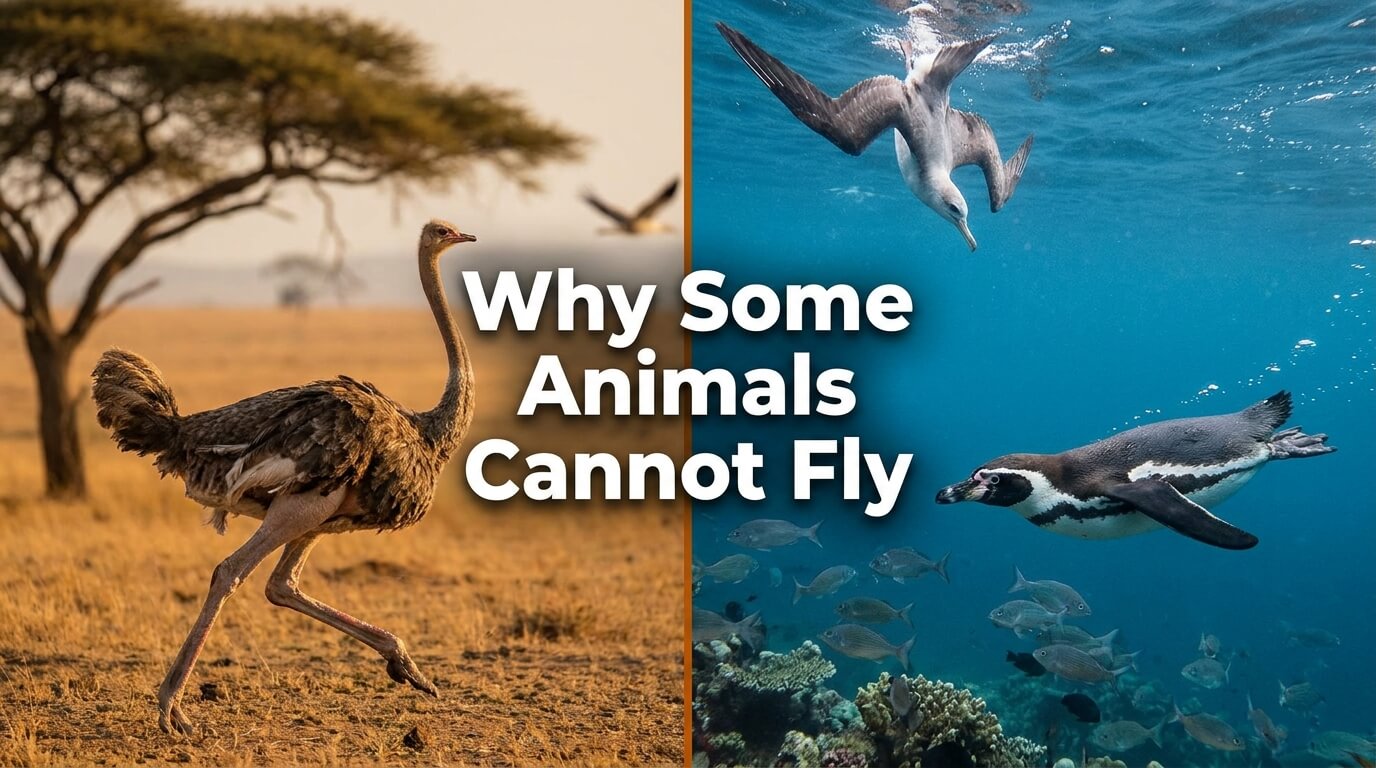
That does not make flightless animals incomplete. An ostrich is not a failed eagle. A penguin is not a broken seabird. A kiwi is not helpless because its wings are hidden under shaggy feathers. Flightlessness is often a trade-off: one ability becomes less useful while another becomes more important. Understanding why some animals cannot fly helps explain evolution, body design, habitat, predator pressure, and the many ways animals move through the world.
Quick Answer
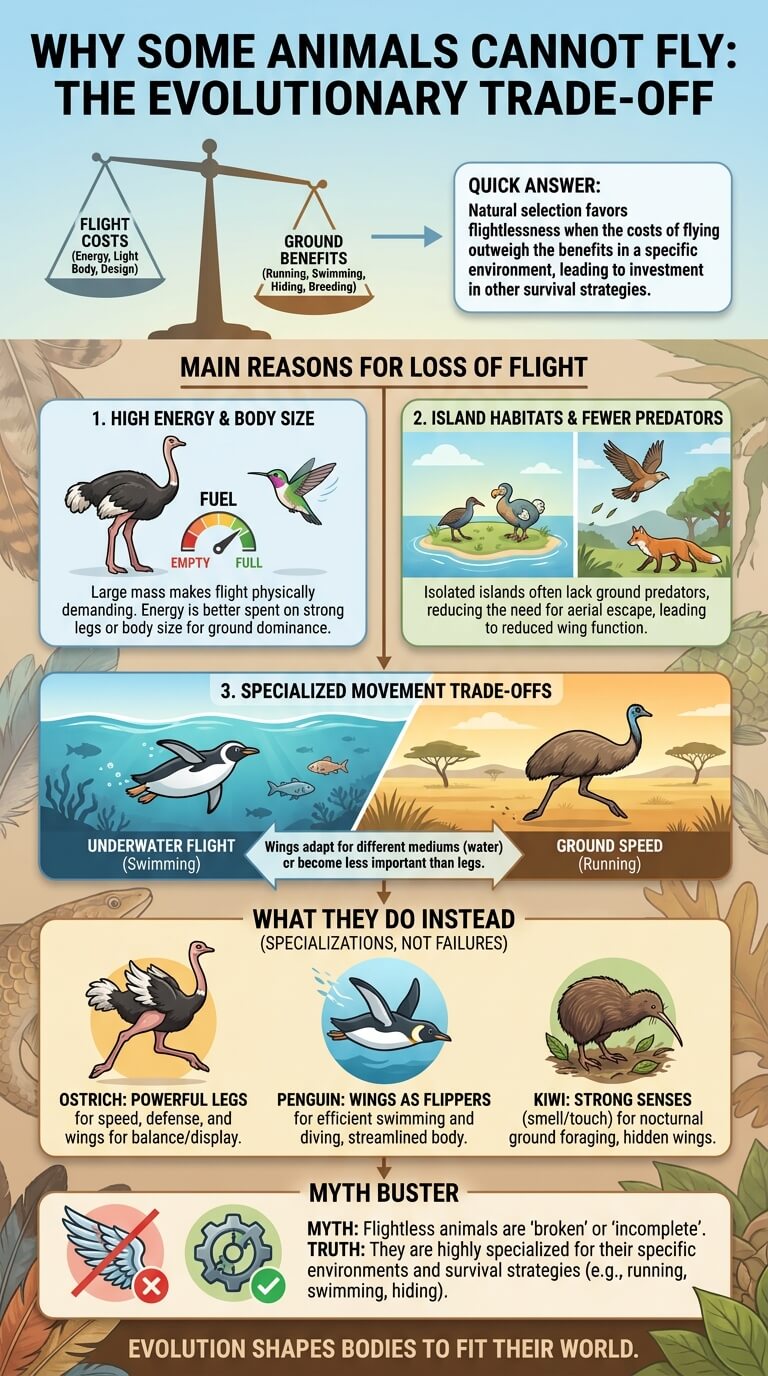
Animals lose or lack flight when the costs of flying outweigh the benefits. Flying requires light bodies, strong flight muscles, suitable wings, balance, fuel, and frequent use. If an animal can survive better by running, diving, swimming, hiding, climbing, or producing more young, natural selection may favor bodies that no longer invest as heavily in flight.
The most familiar examples are flightless birds, including ostriches, penguins, emus, cassowaries, kiwis, rheas, and many island rails. Some insects also have reduced wings, and in certain moths, females may be unable to fly even when males can. Domestic birds, injured birds, molting birds, and young birds may also have limited flight, but those cases are not the same as a species that evolved flightlessness over many generations.
What It Means When an Animal Cannot Fly

Not all animals that cannot fly are alike. Some never evolved powered flight in the first place. Others descended from flying ancestors but later lost the ability to fly. Still others have wings and can move through air or water in ways that look flight-like without true powered flight.
Never Evolved Flight Versus Lost Flight
Most animals cannot fly because their ancestors never evolved true powered flight. Elephants, frogs, snakes, fish, and dogs are not flightless in the same sense as ostriches or penguins; they simply belong to animal lineages whose bodies evolved for other ways of moving.
Flightless birds are different. Birds as a group are built from flying ancestors, yet some bird lineages gave up flight later. That is why a penguin still has wings, feathers, a beak, and bird anatomy even though it cannot fly through air. Its body tells two stories at once: its ancestry connects it to flying birds, but its current shape is tuned for a different life.
Reduced Wings, Heavy Bodies, and Specialized Limbs
Powered flight has strict design requirements. Wings need enough surface area and strength to generate lift. Flight muscles need a strong attachment area on the breastbone. The body must stay light enough for the wings and muscles to lift it. When these traits shrink, weaken, or become redirected, flight becomes harder or impossible.
Flightless animals often show the opposite pattern: heavier bodies, stronger legs, denser bones, reduced wings, or wings shaped for another job. Penguins use wings like flippers. Ostriches use wings for balance and display. Kiwis have tiny wings mostly hidden under feathers. In each case, the animal is not missing a random part; the whole body has shifted toward a different survival strategy.
Flightless Does Not Mean Helpless
Flight helps many animals escape danger, search for food, find mates, and travel long distances. But it is not the only way to survive. A fast runner can escape across open ground. A strong swimmer can hunt underwater. A small nocturnal bird can stay hidden. A heavy insect female may invest energy in eggs rather than wings.
This is the first myth to clear up: flightlessness is not automatically weakness. It is a different balance of costs and benefits. Some flightless animals are vulnerable today because humans changed their habitats or introduced new predators, but that does not mean flightlessness was a mistake in the environments where it evolved.
The Main Reasons Animals Lose or Lack Flight

There is no single reason every flightless animal stopped flying. Different species took different evolutionary paths. Still, several patterns appear again and again: energy costs, body size, habitat, predator pressure, and the value of other movement skills.
Energy Costs of Flying
Flying takes energy before an animal ever leaves the ground. A flying bird or insect must build and maintain wings, flight muscles, nerves, sensory control, and light but strong body structures. Then it must fuel flight with food and oxygen. Those costs can be worth it when flight helps the animal escape predators or reach scattered food. They may be less worth it when food is nearby and ground life is safe enough.
Once flight becomes less useful, evolution can favor animals that spend less on flight equipment. Smaller flight muscles, shorter wings, stronger legs, or heavier bodies may become advantages. This does not happen because an individual animal decides to stop flying. It happens over many generations when individuals with slightly different bodies survive and reproduce in a particular environment.
Large Body Size and Ground Specialization
Body size matters because heavier animals need larger wings and stronger muscles to fly. Birds can be large and still fly, but the physics become more demanding as mass increases. Many flightless birds are large ground specialists with legs doing the work that wings once did.
Ostriches show this clearly. They are the largest living birds, and their powerful legs are central to their survival. The Smithsonian’s National Zoo ostrich profile explains that ostriches do not use their large wings for flight; instead, they can use them while running, changing direction, cooling themselves, and displaying. Their wings still matter, just not as aircraft wings.
Island Habitats and Reduced Predator Pressure
Flightlessness appears often on islands. Islands can have fewer land predators than mainland habitats, especially before humans arrive with rats, cats, dogs, pigs, or other introduced animals. If a bird lives where it can feed and nest without constant pursuit by ground predators, the escape value of flight may drop.
Research on island birds supports this pattern. A PNAS study on island birds found that island species tended to shift toward traits associated with flightlessness, especially where predator diversity was lower. This does not mean every island bird becomes flightless, but it helps explain why islands have produced so many birds with weaker flight, smaller flight muscles, or ground-focused bodies.
Swimming, Running, and Diving Trade-Offs
Some animals lose flight because another movement skill becomes more valuable. Penguins are the famous example. Their wings are not useless; they are stiff, strong tools for moving through water. A wing that is excellent for underwater propulsion is not shaped like a wing that works well in air.
Cornell Lab describes penguins as birds that in a sense fly through water, with strong wings and powerful chest muscles adapted for swimming rather than air travel, in Cornell Lab’s explanation of penguin swimming. Water is much denser than air, so short, rigid wings can push against it effectively. The same design would be poor for taking off into the sky.
Molting, Age, Injury, and Temporary Flight Limits
Not every animal that cannot fly at a given moment is naturally flightless. Young birds may have wings that are not fully developed. Some birds become temporarily unable to fly during heavy molt, when old feathers are replaced. Injury, disease, starvation, or damaged feathers can also prevent flight.
Those cases matter because they change how people should respond. A baby bird on the ground may be a normal fledgling learning to move. A bird with a drooping wing, obvious injury, or extreme weakness may need help from a licensed wildlife rehabilitator. Temporary flight limits are different from a species whose adult body is naturally built without flight.
Flightless Birds and What They Specialize In Instead

Flightless birds are the clearest examples because they retain recognizable bird traits while using their bodies in surprising ways. They are also diverse. Some live on open plains, some in forests, some on islands, and some in cold oceans. Their shared feature is not one identical body plan; it is a reduced role for aerial flight.
Ostriches and Running
Ostriches survive in open African habitats by running, watching, kicking, and moving in ways that match their long-legged build. Their large eyes help them notice danger. Their long legs cover ground efficiently. Their wings help with balance and communication rather than lift.
It is tempting to describe ostriches as birds that are “too big to fly,” but that is incomplete. Size is part of the story, yet ostriches are not merely oversized flying birds. They are ground specialists with bodies shaped around speed, stamina, and powerful legs. Their wings did not vanish because they still serve useful roles.
Penguins and Underwater Movement
Penguins are birds, and they have wings, but those wings have become flippers. A penguin body is streamlined, dense, and powerful in water. That is excellent for chasing fish, krill, and squid, but poor for air travel. Their reduced aerial flight is linked to a dramatic gain in underwater movement.
This is why calling penguins “birds that cannot fly” is true but incomplete. The better explanation is that penguins shifted the main job of their wings. Their movement still looks like wing-powered travel, but the medium changed from air to water.
Kiwis, Rails, and Island Ground Life
Kiwis are small, nocturnal, ground-living birds from New Zealand. Their wings are tiny and hidden under shaggy-looking feathers, while their legs, beak, and sensory abilities are much more important to their daily life. The San Diego Zoo’s kiwi profile describes kiwi wings as very small and hidden, with strong legs used for running and fighting.
Many rails have also evolved reduced flight on islands. Rails are especially famous among scientists because different island rail species have lost flight in different places. For a ground bird living where food is close and predators are limited, staying low and moving through dense vegetation can be more useful than maintaining strong flight.
Emus, Cassowaries, and Strong Legs
Emus and cassowaries are large flightless birds related to other ratites, the group that includes ostriches, rheas, kiwis, and extinct giants such as moas and elephant birds. These birds are not built for aerial escape. Their legs, feet, balance, and body mass fit ground movement.
Cassowaries live in dense forests, where sprinting across open plains is less important than moving through vegetation and defending space when necessary. Emus travel across open Australian landscapes and can cover long distances on foot. Their movement is not a substitute for flight in a simple one-to-one way; it is a whole different way of living.
Other Animals With Limited or No Flight

Birds get most of the attention, but flightlessness is not only a bird story. Some insects lose flight. Some mammals glide but do not fly. Some animals have wings only during part of life, while others never use wings the way people expect.
Flightless Insects
Many insects fly, but not all adults can. In some beetles, grasshoppers, crickets, cockroaches, moths, and other groups, wings may be shortened, fused under wing covers, reduced to small pads, or absent. Flightlessness can appear in cold, windy, isolated, cave-like, or ground-based environments where flying may be risky or unnecessary.
Moths offer a useful example because some species have flying males and flightless females. A review of flightless female moths notes that most adult moths can fly, but adults of some species cannot because the wings are reduced or absent. In those cases, the female may stay near the emergence site, release chemical signals, and invest heavily in reproduction instead of long-distance movement.
Mammals That Glide Instead of Fly
Bats are the only mammals capable of true powered flight. Other mammals sometimes called “flying” animals, such as flying squirrels, colugos, and sugar gliders, do not fly like bats or birds. They glide. A gliding mammal launches from a high point and controls its fall using skin membranes, body posture, and tail or limb adjustments.
This difference matters because gliding does not require flapping wings to generate continuous lift. A glider can steer and slow descent, but it cannot take off from level ground and climb through the air by wingbeats. Gliding is an impressive movement skill, just not the same as powered flight.
Young Birds and Animals Not Ready to Fly Yet
Many birds are temporarily grounded when young. Nestlings may be featherless or partly feathered and unable to leave the nest. Fledglings may hop, flutter, and make short attempts while their wings, muscles, coordination, and confidence develop.
People often mistake fledglings for abandoned birds. In many cases, the parents are nearby and still feeding them. A grounded young bird should not be handled unless it is in immediate danger, clearly injured, or local wildlife guidance recommends moving it a very short distance to safety. The safest response is usually to keep pets away and contact a licensed rehabilitator if the bird appears hurt or truly orphaned.
Evolutionary Trade-Offs Behind Flightlessness

Evolution works with trade-offs. A body cannot be optimized for every possible job at once. A wing shaped for diving is not ideal for soaring. A body built for heavy egg production may not be ideal for lift. Long running legs, dense swimming bones, and tiny hidden wings all show how animal bodies shift when selection pressures change.
Wings Can Become Flippers, Balance Tools, or Display Features
Flightless wings can still be useful. Penguins use them for underwater propulsion. Ostriches use them for balance, turning, cooling, and courtship displays. Some flightless birds use small wings in social signals. In insects, reduced wings may have little movement value but still reflect a body plan inherited from flying ancestors.
This is why “unused wing” is often too simple. The better question is what the wing does now. A wing does not need to lift an animal into the air to have biological meaning.
Strong Legs Can Replace Aerial Escape
For ground birds, strong legs can be a major survival tool. Running can help an animal escape, search for food, defend itself, or move across a large home range. Strong legs can also support larger bodies, which may help with defense, reproduction, or feeding in certain habitats.
Leg specialization also changes behavior. A running bird may rely on open sightlines and speed. A forest bird may rely on quiet movement and cover. An island bird may rely on staying hidden near ground food. Flightlessness is not one behavior; it is tied to the whole setting in which the animal lives.
Predator Environments Shape Whether Flight Is Worth Keeping
Flight is often valuable because predators exist. If predators are common and fast, being able to launch into the air can be a major advantage. If predators are rare, absent, or avoidable in other ways, the advantage may shrink. That is one reason predator-poor islands are famous for flightless birds.
The risk changes when people alter the environment. Many flightless island birds evolved without cats, rats, stoats, dogs, or other introduced mammals. When those predators arrived, the birds’ old defenses no longer matched the new danger. That is why flightlessness can be successful in one setting but risky after a habitat changes.
Common Myths About Flightless Animals
Flightless animals attract myths because wings usually make people think of air travel. The truth is more interesting than the myths. These animals are not failed designs, and their bodies often show very precise specialization.
Flightless Birds Are Not Primitive Failures
Flightless birds are sometimes described as primitive, but that word can mislead readers. They are modern animals with long evolutionary histories. Many descended from flying ancestors and later changed as their environments changed.
A kiwi, penguin, or ostrich is not lower on an evolutionary ladder. Evolution is not a ladder from “simple” to “advanced.” It is a branching process in which different bodies fit different conditions. Flightless birds fit ground, water, or island conditions in ways that flying birds may not.
Penguins Do Not Fly in Air but Are Powerful Swimmers
Penguins cannot fly through air, but their wings are not weak. They are strong, rigid, and specialized for water. Their movement underwater can look like flight because the wings produce thrust in a fluid, but the fluid is water rather than air.
This trade-off helps explain why penguins look so different from gulls, albatrosses, or ducks. A penguin body is shaped like a swimming bird first. Expecting it to fly through air is like expecting a seal to run like a deer. The body is excellent, just excellent at a different job.
Ostriches Do Not Need Flight to Survive in Open Habitats
Ostriches show that a bird can lose flight and still be highly capable. Their long legs, large eyes, body size, speed, and wing-assisted balance fit open-country life. They avoid many dangers by noticing them early and moving away quickly.
They also remind us that wings can have more than one job. Even when wings no longer lift an animal into the sky, they may help with signals, balance, temperature control, or body posture. Flight is only one possible use for a wing.
Edge Cases and Exceptions
Some animals fall between obvious categories. A bird may fly poorly but not be truly flightless. A domestic bird may have limited flight because people selected heavy bodies. A moth species may have one flying sex and one flightless sex. These gray areas are important because they stop the explanation from becoming too simple.
Birds That Fly Poorly but Are Not Fully Flightless
Some birds can fly only short distances, make heavy takeoffs, or use flight mainly for escaping danger. Turkeys, chickens, some ducks, and many ground birds may be clumsy or limited fliers compared with swallows or falcons, yet that is not the same as being flightless.
Flight ability exists on a spectrum. Some birds soar for hours. Some make quick bursts. Some flutter into trees. Some cannot fly as adults. The differences reflect body mass, wing shape, muscle strength, habitat, and how much the bird depends on flight in daily life.
Domestic Birds and Human Selection
Domestic animals add another layer because humans influence their bodies. Many domestic chicken breeds can flutter, hop, or fly short distances, but heavy-bodied breeds are poor fliers. Selection for meat, eggs, body shape, or tameness can reduce flight ability even if the wild ancestor was more capable.
Scientific work on commercial laying hens shows that even birds that can move down from perches may not land like strong wild fliers. In a study of laying-hen landings, researchers found landing speeds higher than those seen in bird species that are adept fliers, which helps explain why captive bird design and welfare matter.
Species Where Males and Females Differ in Flight Ability
In some insects, males and females differ greatly in flight. A male may have normal wings and search widely for mates, while a female may have reduced wings or no functional wings. This pattern can appear when female energy is directed toward egg production and mate attraction happens through scent signals rather than travel.
That difference shows why “can this animal fly?” is sometimes too broad. The answer may depend on sex, age, season, molt, body condition, or life stage. Flight is not simply present or absent across every individual in the same way.
How Flightless Animals Use Other Movement Skills
Flightless animals help reveal how flexible animal movement can be. When air travel becomes less important, other skills can become the center of survival. Running, swimming, diving, hiding, climbing, and gliding each solve a different movement problem.
Strong Runners and Swimmers
Ostriches and emus show how legs can dominate movement. Penguins and flightless cormorants show how wings and feet can shift toward underwater travel. In both cases, the animal is not simply lacking flight; it has invested in another way of moving through its environment.
This matters because movement is tied to food and danger. A penguin’s body helps it pursue prey underwater. An ostrich’s body helps it cross open ground. A kiwi’s body helps it work through forest floor material at night. The best movement style depends on where the animal lives and what it needs to do there.
Gliding Is Different From Being Unable to Fly
Gliding animals are sometimes grouped with flightless animals because they cannot flap upward like birds, bats, or many insects. But gliding is its own movement strategy. A glider uses height, gravity, and body surfaces to travel between trees or across gaps.
A flying squirrel is not flightless in the same way as an ostrich. It belongs to a mammal group that never evolved powered flight, and it uses membranes to control descent. That is why gliding should be described as controlled falling, not failed flying.
Flightlessness as Part of Animal Movement
Flight is one chapter in the larger story of animal movement. Walking, running, swimming, jumping, climbing, gliding, burrowing, and drifting all come with costs and benefits. Animals do not need every movement skill; they need the movement skills that match their bodies and habitats.
Flightless animals make that lesson easy to see. Their bodies show that losing one ability can come with gains elsewhere. The important question is not “why can’t it fly?” but “what does it do instead, and why does that work?”
FAQ
Why did ostriches lose the ability to fly?
Ostriches evolved as large ground-running birds. Their bodies are built around strong legs, open-habitat movement, balance, and defense rather than aerial lift. Their wings are not useless, but they are not shaped to carry such a large bird through the air. They help with balance, display, turning, and heat control instead.
Are penguins birds if they cannot fly?
Yes. Penguins are birds because they have bird traits such as feathers, beaks, wings, egg-laying reproduction, and bird ancestry. Flight is common in birds, but it is not required for an animal to be a bird. Penguins are flightless birds whose wings are specialized for swimming underwater.
Can flightless birds ever fly again?
In theory, evolution can produce major changes over long periods, but a fully flightless bird would not simply start flying again in a few generations. Regaining strong powered flight would require many coordinated changes in wings, muscles, bones, feathers, balance, and behavior. It is safer to say that flightlessness can evolve repeatedly, while the return to strong flight would be difficult and would depend on future selection pressures.
Are all birds without strong flight endangered?
No. Flightless or weak-flying birds are not automatically endangered. Some have stable populations, while others are highly threatened. Risk depends on the species, habitat, predators, human disturbance, introduced animals, reproduction rate, and conservation work. Many island flightless birds are vulnerable because they evolved without certain mammal predators and nesting threats.
Final Thoughts
Why some animals cannot fly comes down to trade-offs. Flight is powerful, but it is costly. When running, swimming, diving, hiding, breeding, or saving energy becomes more valuable, wings may shrink, stiffen, or take on new jobs. Flightless animals are not lesser animals. They are evidence that movement evolves around real conditions, and sometimes the best way to survive is not to leave the ground at all.

Ethan Walker is the founder and research editor of Animal Fact Central. He creates and reviews educational animal facts content using trusted wildlife, pet care, and science-based sources. His work focuses on making animal behavior, adaptations, habitats, and species facts clear, accurate, and engaging for everyday readers.
Read More Details About Ethan Walker: https://animalfactcentral.com/ethan-walker/