
Animals that climb use far more than simple strength. A good climber needs grip, balance, body control, and the right body shape for the surface it lives on. A gecko on a wall, a monkey in the canopy, a mountain goat on a cliff, and a tree frog on a leaf are all solving the same basic problem in very different ways: how to move upward without falling.

Climbing matters because height can change an animal’s whole life. It can open food that ground animals cannot reach, provide a safer place to sleep, help an animal escape predators, and create routes through a forest, cave, cliff, or rocky slope. The best climbers are not all built alike. Some dig claws into bark. Some wrap tails around branches. Some stick to smooth surfaces. Some rely on careful hoof placement more than obvious grasping.
Quick Answer

Animals that climb include monkeys, squirrels, cats, sloths, koalas, raccoons, tree frogs, geckos, snakes, lizards, goats, ibex, bears, woodpeckers, insects, spiders, and many others. They climb for food, safety, shelter, mating access, nesting sites, and movement through complex habitats.
Their climbing tools vary by animal group. Mammals often use claws, flexible limbs, grasping hands, or balancing tails. Reptiles may use claws, belly scales, toe pads, or body friction. Amphibians such as tree frogs can use sticky toe pads on leaves and branches. Birds that climb tree trunks often use strong feet, stiff tail feathers, and bills that help them brace against bark. Insects and spiders may use claws, adhesive pads, silk, or tiny hairs.
No single animal is the best climber in every situation. A gecko is extraordinary on smooth walls, a mountain goat is built for steep rock, a spider monkey is a canopy specialist, and a woodpecker is made for vertical tree trunks. The best climber depends on the surface, the size of the animal, and the job the climb is meant to solve.
Why Climbing Matters for Animals

Climbing is not a trick animals perform for fun. In many species, it is part of daily survival. Moving above the ground can change where an animal eats, sleeps, watches for danger, raises young, and avoids rivals. A climbing animal may live in a three-dimensional world where vertical space is just as important as distance across the ground.
Finding food
Many climbing animals reach food that would be unavailable from ground level. Monkeys and squirrels move through trees for fruit, seeds, leaves, flowers, insects, eggs, and bark. Woodpeckers climb trunks to search for insects hidden under bark. Bears climb trees for fruit, nuts, escape, or resting places, although climbing ability varies by species and age.
Climbing can also give predators access to prey. A snake may climb into shrubs or trees for birds, eggs, lizards, or small mammals. A cat may climb after prey or use a higher position to scan an area. Arboreal predators often need quiet movement, grip, and balance more than raw speed.
Escaping predators
Height can be a powerful escape route. A squirrel that reaches a tree trunk may avoid a fox. A lizard that runs up a wall may escape a ground predator. A young bear may climb a tree when threatened. For cliff animals, steep rock can function like a fortress because many predators cannot follow safely.
Animal Diversity Web describes mountain goats as preferring steep, rocky areas with cliffs or bluffs in alpine and subalpine regions, especially places with escape terrain. That habitat preference helps explain why their climbing is so tied to survival: the terrain itself becomes part of their defense.
Nesting, resting, and reaching mates
Many animals climb because the best resting or nesting places are off the ground. Birds nest in tree cavities, cliffs, shrubs, and ledges. Tree frogs may rest on leaves above wet ground. Mammals such as porcupines, monkeys, and binturongs may sleep or rest in branches, where cover and height reduce some risks.
Climbing can also affect social life. Animals may use high branches, cliff ledges, trunks, or canopy routes to find mates, defend space, or avoid direct conflict. In forests, being able to move through trees can determine which feeding areas and social groups an animal can reach.
The Main Climbing Surfaces Animals Use

Climbing is not one skill. Bark, rock, leaves, walls, vines, caves, and smooth glass-like surfaces all create different challenges. A body feature that works beautifully on one surface may be almost useless on another. That is why climbing animals have such different feet, toes, claws, tails, and body shapes.
Trees and branches
Trees are among the most important climbing structures on Earth. Bark gives claws something to grip. Branches offer paths, resting places, fruit, flowers, insects, and escape routes. In dense forests, an animal may move long distances through branches without spending much time on the ground.
Tree climbers often need both traction and balance. Squirrels use claws and flexible ankle movement. Monkeys may use hands, feet, and tails. Sloths move slowly with curved claws that hook onto branches. Koalas use strong limbs and sharp claws to hold onto eucalyptus trunks and branches. The challenge is not just getting up. The animal must turn, hang, feed, rest, and sometimes descend headfirst or sideways.
Rocks, cliffs, and caves
Cliffs and rocky slopes reward careful foot placement. Goats, ibex, bighorn sheep, and some lizards use small ledges and rough surfaces that would be difficult for many animals to cross. Their climbing is often less about grabbing and more about balance, friction, limb control, and reading the shape of the rock.
Caves and rock walls create special problems. A bat may cling to a cave ceiling with its feet. A cave-dwelling insect or spider may move across stone using claws and tiny contact points. Reptiles may climb rough rock by pressing the body and limbs against surfaces. On these surfaces, one misplaced step can matter, so stability is often more important than speed.
Walls, leaves, and smooth surfaces
Smooth surfaces are hard because claws need cracks, bark, or roughness to catch. This is where sticky pads and microscopic structures become important. Geckos are famous for climbing walls and ceilings because many species have specialized toe pads that cling through close contact with surfaces.
Animal Diversity Web notes that common house geckos have enlarged claws and adhesive toe pads that help them climb walls and ceilings. That combination matters: the claws can help on rougher surfaces, while toe pads increase control on smoother surfaces.
Leaves create a different challenge. They bend, shake, and may be wet. Tree frogs and many insects need light bodies, careful foot placement, and adhesive contact that works on flexible plant surfaces. A heavy animal might tear a leaf or slide off, while a small animal can use it as a path.
Body Features That Help Animals Climb
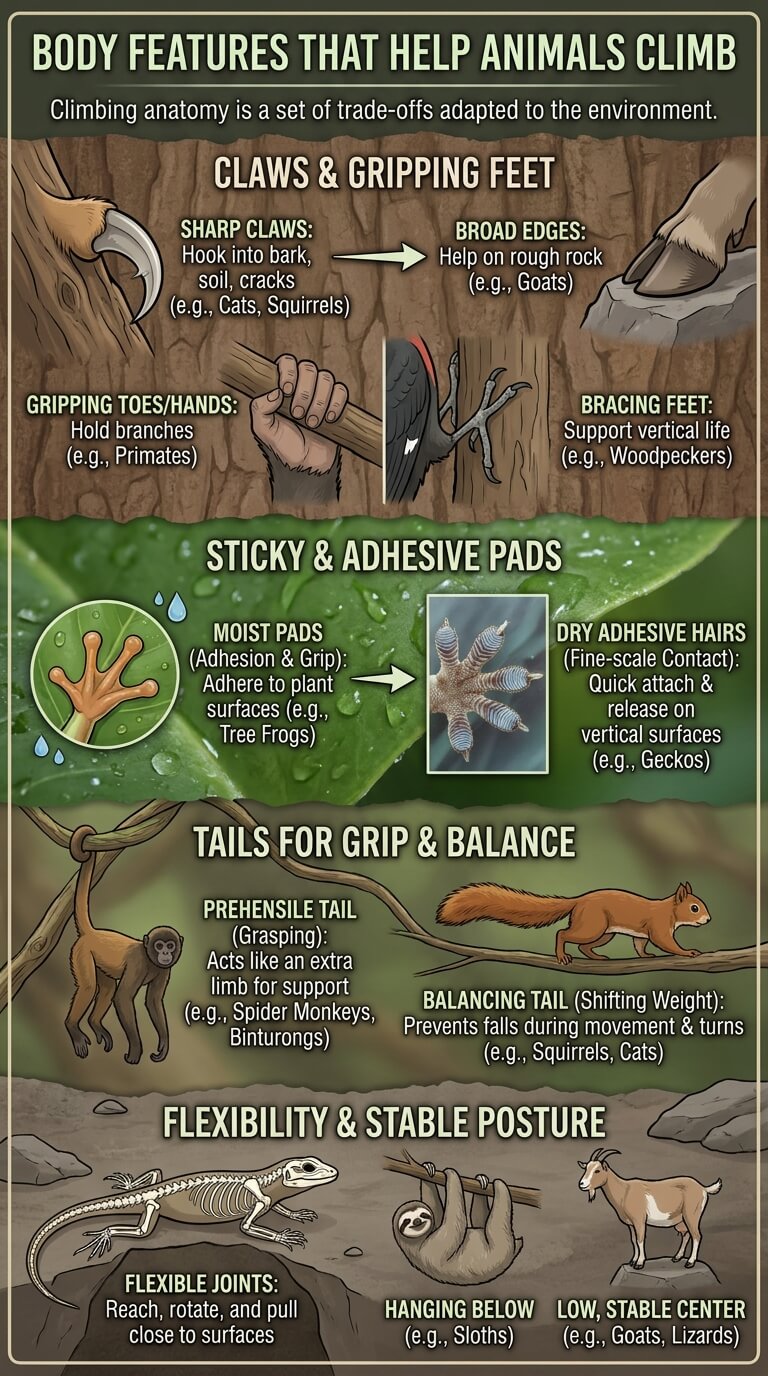
Climbing anatomy is a set of trade-offs. Better grip may slow an animal down on open ground. Stronger claws may help on bark but not on glass. A long tail may improve balance but add weight. The best body plan depends on where the animal lives and what it does there.
Claws and gripping toes
Claws are one of the most common climbing tools. They can hook into bark, soil, cracks, vines, and rough rock. Squirrels, raccoons, cats, bears, sloths, lizards, and many birds use claws in different ways. The shape of the claw matters. A sharply curved claw can catch on bark, while a broader hoof edge can help on rock.
Gripping toes are just as important. Primates can hold branches with hands and feet. Some birds have toe arrangements that help them grip trunks or branches. Woodpeckers, for example, brace against tree trunks while climbing and searching for insects. Their feet and tail support a lifestyle that depends on vertical surfaces.
Sticky pads and microscopic hairs
Sticky feet do not all work the same way. Tree frogs use moist toe pads that help them adhere to plant surfaces. Geckos use dry adhesive structures on their toe pads. Many insects use pads, claws, or hair-like structures that increase surface contact.
A study in the Journal of Experimental Biology explains that hylid tree frogs climb with a mix of adhesion and gripping, and that surface curve and roughness affect how well they perform. That is a useful reminder that sticky pads are not magic. They work better on some surfaces than others.
Gecko feet are a classic example of fine-scale contact. Their toes can attach and release quickly, which lets them move across vertical surfaces rather than simply cling motionless. Scientists studying gecko climbing have shown that the animal’s limbs produce different forces on vertical surfaces than they do during level running, which helps explain why wall movement is a specialized skill.
Prehensile tails and balancing tails
A prehensile tail can grasp or wrap around branches. It is not just a decoration. In some animals, it acts like an extra support point during climbing, hanging, or feeding. Spider monkeys, some porcupines, kinkajous, binturongs, and some reptiles use tails in ways that improve control in trees.
The Smithsonian’s binturong profile describes binturongs as tree-dwelling mammals with strong prehensile tails, and notes that a leathery patch near the tail tip gives extra traction while climbing. This is a good example of a tail acting as both a balancing tool and a gripping surface.
Not every useful tail is fully prehensile. Cats, squirrels, lizards, and many monkeys use tails for balance while running along branches, turning, jumping, or landing. A tail can shift body position mid-movement and help prevent a fall.
Flexible joints, strong shoulders, and low body control
Climbing requires the body to move around obstacles. Flexible joints help animals reach across gaps, wrap around branches, rotate feet, and pull the body close to a surface. Strong shoulders and hips allow an animal to lift, hang, brace, and recover when footing changes.
Some climbers have a low, stable body posture. A lizard may press close to a wall. A binturong has a low, muscular body. A goat keeps its body balanced over small footholds. A sloth hangs below branches rather than balancing on top of them. These different strategies all reduce the chance of falling.
Climbing Animals by Group
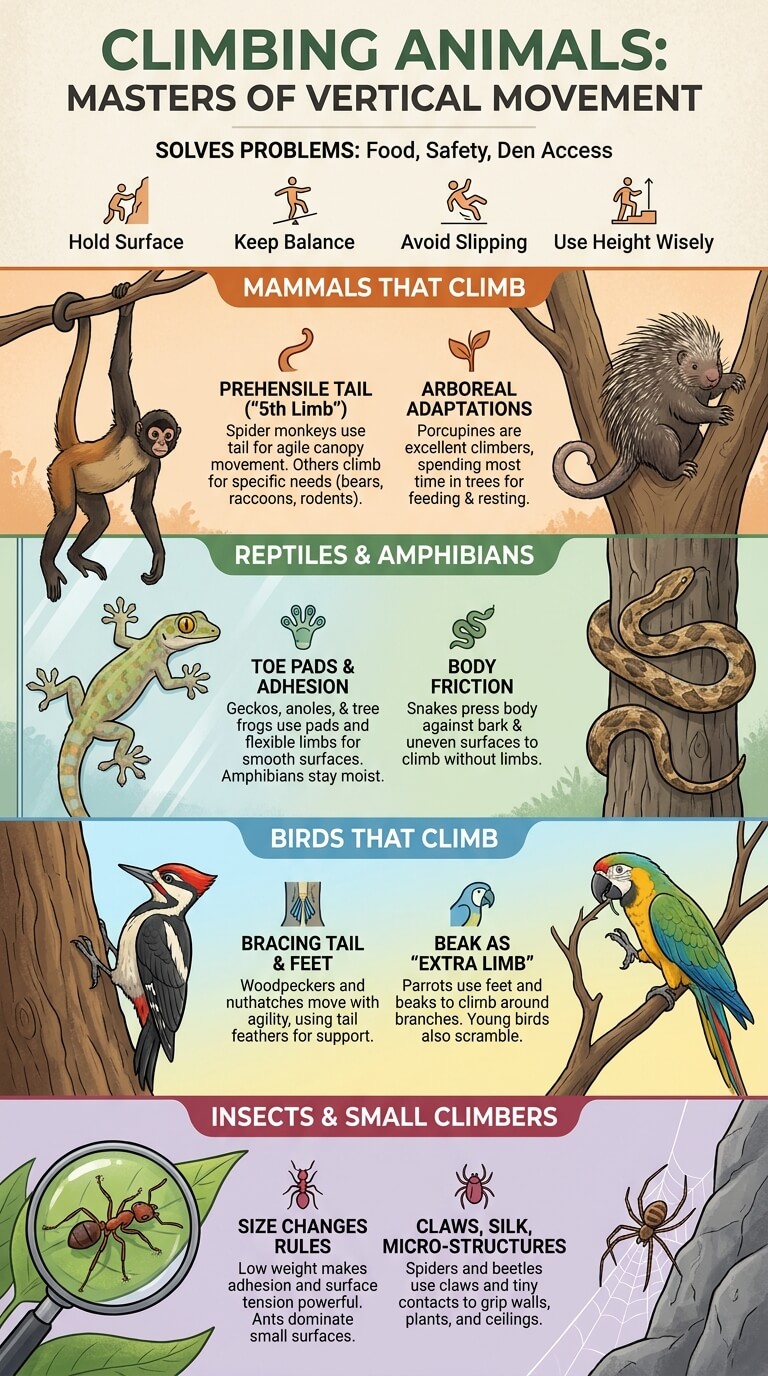
Climbing appears in many animal groups because vertical movement solves many problems. The details differ, but the same broad themes return again and again: hold the surface, keep balance, avoid slipping, and use height wisely.
Mammals that climb
Mammal climbers include squirrels, monkeys, cats, raccoons, sloths, koalas, bears, porcupines, binturongs, and many rodents. Some are mostly tree-dwelling. Others climb when they need food, safety, or access to a den. A black bear may climb well as a youngster but become less agile with size and age. A squirrel may climb every day as part of ordinary travel.
Spider monkeys show how specialized canopy movement can become. Animal Diversity Web describes Central American spider monkeys as agile primates that live mainly in the upper canopy and can hang by a limb or by the tail, which functions almost like a fifth limb. That tail gives them options that ground-running mammals do not have.
Prehensile-tailed porcupines show another version of tree life. The Smithsonian’s prehensile-tailed porcupine profile describes them as arboreal animals that are excellent climbers and spend most of their time in trees. Their climbing is connected to feeding, resting, and life in South American forests.
Reptiles and amphibians that climb
Reptile climbers include geckos, anoles, chameleons, monitors, snakes, and many tree-living lizards. Their tools include claws, toe pads, grasping feet, body friction, and careful movement. A snake can climb without limbs by pressing parts of its body against bark, branches, or other uneven surfaces.
Amphibian climbers are often small, light, and tied to moist places. Tree frogs can climb plants, branches, and other surfaces using toe pads and flexible limbs. Their climbing often helps them reach calling sites, resting places, food, or safer spots above ground. Because amphibians can dry out, climbing ability must work together with moisture needs.
Birds that climb
Birds are often thought of as flyers first, but some are impressive climbers. Woodpeckers climb tree trunks while bracing with their feet and tail feathers. Nuthatches move along trunks and branches with unusual agility. Parrots climb with their feet and beaks, using the beak almost like an extra limb while moving around branches.
Young birds may climb before they fly well. Nestlings or fledglings can scramble through branches, bark, or cavities. This kind of climbing is usually not as precise as the movement of a woodpecker or parrot, but it can help a young bird stay off the ground while its flight skills develop.
Insects, spiders, and other small climbers
Small animals often dominate surfaces that large animals cannot use. Ants climb stems, bark, walls, and ceilings. Beetles grip leaves and bark. Caterpillars move across plants using prolegs and silk. Spiders use claws, silk, and tiny contact structures to move across webs, walls, plants, and rocks.
Size changes the rules. A tiny animal weighs very little compared with the contact area of its feet. That makes adhesion, surface tension, and small cracks more useful. A wall that seems smooth to a person may offer many usable footholds to an insect or spider.
Climbing Trade-Offs

Climbing gives animals access to height, but it is not free. A climber must spend energy, manage fall risk, and use body features that may limit performance in other settings. That is why climbing ability often comes with trade-offs.
Grip versus speed
Strong grip can slow movement. An animal that digs claws deeply into bark may need time to release and place each foot. A gecko must attach and detach toe pads in the right sequence. A sloth has an excellent hanging lifestyle but is not built for fast movement on the ground.
Fast climbers solve this problem by making grip quick and repeatable. Squirrels race up trunks because their claws and limb positions match bark well. Geckos move quickly because their toes can attach and peel away. Monkeys combine reach, balance, and strength to move through branches without stopping at every step.
Height versus fall risk
Height can protect an animal, but falling can be dangerous. Climbing animals reduce that risk with low body posture, multiple contact points, tails, flexible joints, claws, or slow movement. Some animals choose surfaces carefully instead of climbing anything available.
Young animals may be more vulnerable because their coordination is still developing. Wet bark, loose rock, smooth walls, wind, and broken branches can all make a climb harder. Even skilled climbers are not immune to accidents.
Specialized bodies versus flexibility
A body built for climbing may be less efficient somewhere else. A sloth is excellent at hanging below branches, but awkward on the ground. A mountain goat is remarkable on cliffs, but its body is not designed for tree branches. A gecko can climb walls, but that does not mean it has the same running strategy as a mammal on open ground.
This is why climbing should be understood as habitat-specific. The question is not simply whether an animal can climb. A better question is: what surface is it built to climb, and what does that climb help it do?
Common Myths About Climbing Animals
One common myth is that every animal with claws is a good climber. Claws help, but they do not guarantee climbing skill. The animal also needs the right limb motion, balance, body size, and surface. A claw that works on bark may not work on smooth glass or wet leaves.
Another myth is that sticky-footed animals can climb anything. Gecko and frog feet are impressive, but surface texture, moisture, dust, body weight, and angle all matter. A sticky pad is part of a system, not a supernatural ability.
A third myth is that climbing animals are always safe from predators. Many predators climb too. Snakes, cats, monitors, birds of prey, and mammals can all hunt above ground in some situations. Height reduces certain risks, but it does not remove danger.
People also assume that animals climb only upward. In reality, climbing includes descending, hanging, crossing sideways, rotating around branches, squeezing through gaps, and recovering from slips. Moving down can be harder than going up because gravity pulls the body into the fall direction.
When Climbing Turns Into Jumping, Gliding, or Swimming
Climbing often overlaps with other kinds of movement. An animal may climb to reach a launch point, leap between branches, glide to another tree, or drop into water. Vertical movement is part of a larger movement toolkit.
Launching from high places
Many animals use climbing to reach a place where jumping or gliding becomes useful. A squirrel may climb before leaping across a gap. A gliding mammal or lizard needs height before it can glide. A frog may climb onto vegetation before jumping toward prey, water, or a safer perch.
That does not make climbing the same as jumping or gliding. Climbing is contact-based movement along a surface. Jumping is a launch through air. Gliding is controlled movement through air without powered flight. Many animals combine them, but the body mechanics are different.
Moving through trees without touching the ground
Forest animals often benefit from staying above the ground. Branch routes can reduce encounters with ground predators, allow access to fruit or flowers, and keep animals away from flooded or muddy ground. In fragmented forests, gaps between trees can make movement harder for canopy animals.
Some animals solve those gaps by leaping, reaching, swinging, or using tails. Others descend and cross the ground only when necessary. A canopy animal’s whole daily route can depend on whether branches, vines, trunks, and resting sites line up safely.
FAQ
What animal is the best climber?
There is no single best climber for every surface. Geckos are outstanding on walls and ceilings, mountain goats are specialized for cliffs, spider monkeys are exceptional in tree canopies, and woodpeckers are built for tree trunks. The best answer depends on whether the surface is bark, rock, leaves, smooth walls, or branches.
Why can geckos climb walls?
Many geckos have specialized toe pads that make close contact with surfaces. Their feet can attach and release quickly, which lets them move on vertical walls and even ceilings. Claws may also help on rough surfaces. Dust, moisture, surface texture, and species differences can affect how well a gecko climbs.
Are goats better cliff climbers than monkeys?
Goats and monkeys are built for different climbing worlds. Mountain goats are excellent on steep rocky slopes and cliffs where careful hoof placement matters. Monkeys are better suited to branches, canopy travel, hanging, reaching, and grasping. One is not simply better than the other. Each is specialized for a different surface.
Can all cats climb down safely?
No. Many cats can climb up more easily than they can climb down, especially on trees with high trunks and few branches. Climbing down requires different body control and foot placement. Domestic cats may become stuck or frightened, so people should avoid forcing them higher and should seek safe help if a cat is trapped.
Do climbing animals ever fall?
Yes. Skilled climbers can still fall because of wet surfaces, loose bark, broken branches, smooth walls, injuries, young age, fatigue, or predator pressure. Climbing adaptations reduce risk, but they do not remove it completely. Many climbers use multiple contact points, tails, claws, adhesive pads, or slow movement to lower the chance of falling.
Final Thoughts
Animals that climb show how many ways a body can solve the same physical challenge. Some grip with claws, some cling with toe pads, some balance with tails, and some place hooves on rock ledges with extraordinary control. Climbing is not just about going upward. It shapes where animals feed, hide, rest, raise young, escape danger, and move through their habitats.
The most useful way to compare climbing animals is to match the animal to the surface. A gecko on a wall, a spider monkey in a canopy, a tree frog on a leaf, and a mountain goat on a cliff are each impressive because their bodies fit their own climbing world.

Ethan Walker is the founder and research editor of Animal Fact Central. He creates and reviews educational animal facts content using trusted wildlife, pet care, and science-based sources. His work focuses on making animal behavior, adaptations, habitats, and species facts clear, accurate, and engaging for everyday readers.
Read More Details About Ethan Walker: https://animalfactcentral.com/ethan-walker/