
Animal anatomy is the study of the body parts that let animals live, move, feed, sense danger, find mates, raise young, and survive in their surroundings. A beaver’s chisel-like front teeth, an alligator’s armored skin, a red panda’s bushy tail, and a bird’s feathers all look different, but they share the same basic idea: body structure matters because survival is physical.

Body parts are not just decorations. They are tools shaped by each animal’s way of life. Some help an animal catch food. Some help it avoid being eaten. Some protect it from heat, cold, water loss, impact, or injury. Others send signals, carry young, dig shelter, climb trees, swim, glide, run, or grip slippery prey. To understand animal anatomy, it helps to ask one simple question about each feature: what job does this body part help the animal do?
Quick Overview

Animal anatomy includes outside features such as teeth, claws, tails, wings, shells, scales, feathers, fur, hooves, horns, and antlers, as well as inside features such as bones, muscles, lungs, stomachs, hearts, and sensory organs. This overview focuses mostly on visible body features because those are the parts readers usually notice first in wildlife photos, backyard encounters, zoo visits, nature documentaries, and pet behavior.
In many invertebrates, exoskeletons protect the body and give muscles a hard frame to pull against, which makes them more than simple armor.
The same body part can serve more than one purpose. A tail may help with balance, swimming, communication, defense, fat storage, or warmth depending on the animal. Teeth may slice meat, grind plants, crack shells, scrape algae, grip fish, or gnaw wood. Feathers can support flight, insulation, waterproofing, courtship display, camouflage, and touch. A useful way to read an animal’s body is to look at the whole lifestyle, not just one feature in isolation.
Animal body features usually fall into a few broad survival jobs:
- Movement: legs, fins, wings, tails, claws, hooves, and body shape help animals travel through water, air, soil, trees, grass, rock, snow, or mud.
- Feeding: teeth, beaks, tongues, jaws, claws, filters, tentacles, and digestive structures help animals find, handle, and process food.
- Protection: shells, thick skin, armor, spines, scales, quills, camouflage patterns, and defensive postures help animals reduce risk.
- Sensing: eyes, ears, whiskers, antennae, nostrils, tongues, lateral lines, and heat-sensitive structures help animals detect food, mates, rivals, and threats.
- Communication: color patches, antlers, horns, feathers, scent glands, tails, crests, and posture help animals send signals to others.
What Animal Anatomy Includes
Animal anatomy can be broad, but it becomes easier to understand when grouped by function. The body of an animal is not a random collection of parts. It is a working system, and each structure has costs as well as benefits. A heavy shell may protect an animal, but it can slow movement. Long antlers may help in display or combat, but they take energy to grow and can catch on vegetation. Sharp claws can help a predator hold prey, but the same claws may not be ideal for long-distance running on open ground.
Body parts for movement
Movement anatomy is shaped by the environment. Fish need fins, streamlined bodies, and muscular tails for water. Birds need wings, feathers, strong flight muscles, and lightweight body plans. Hooved mammals need feet that can carry body weight over ground without sinking too deeply into soil or wearing down too quickly. Climbing animals need grip, balance, flexible joints, and sometimes long tails.
Movement features are especially easy to misread because similar-looking animals may move in very different ways. A crocodilian’s tail is not just a trailing body part. In water, it is a major source of propulsion. A monkey’s tail may help with balance in trees, while a kangaroo’s tail can help support the body during slow movement and add balance during hopping. Body parts make the most sense when matched to the surface or medium the animal uses most.
Body parts for feeding
Feeding structures reveal a lot about an animal’s diet. Carnivores may have sharp teeth and strong jaws for gripping and cutting animal tissue. Grazers need teeth and jaws that handle tough plant material. Rodents have incisors that keep growing and must be worn down by gnawing. Birds do not chew with teeth, so many rely on beaks and digestive structures that match their food type.
Feeding anatomy also includes the body parts that get food into reach. A raptor’s talons help seize prey. A frog’s tongue can help capture insects. A whale shark uses filter-feeding structures to strain tiny animals from water. A sea star can open shellfish with tube feet and use a digestive strategy very different from a mammal’s. The mouth matters, but so do limbs, body shape, senses, and digestion.
Body parts for protection
Protection can be passive or active. Passive protection includes armor, shells, thick skin, camouflage, and hard coverings. Active protection includes claws, horns, antlers, venom-delivery structures, stings, spines, and defensive body movements. Some animals avoid danger by hiding, blending in, or fleeing. Others stand their ground with shields, spikes, warning colors, or group defense.
Armored animals show that protection does not have to look the same across groups. An alligator’s skin includes bony plates called osteoderms or scutes, which help form an armored back, as described in Smithsonian’s American alligator profile. A turtle’s shell is built from bone and keratin-covered scutes. A porcupine’s quills are modified hairs. These structures are not identical, but they show how different body materials can be used for defense.
Body parts for sensing the world
Animals survive by detecting what is around them. Eyes help many species locate food and threats, but eyesight is only one part of the story. Whiskers can help mammals feel nearby objects. Antennae help many insects and crustaceans detect chemicals, touch, air movement, or vibrations. Fish may use a lateral line system to sense movement in water. Snakes use chemical cues picked up by the tongue and processed by a special sensory organ in the roof of the mouth.
Sensory structures are often tied to habitat. An animal that hunts at night may rely more heavily on smell, hearing, touch, or low-light vision. A burrowing mammal may have reduced eyes but strong claws and sensitive whiskers. A predator in open water may depend on vibration and chemical cues. These features are not better or worse in a simple ranking. They are useful in different worlds.
The Main Survival Framework for Animal Body Features

The best way to understand animal anatomy is to connect each body feature to a survival challenge. Every animal has to get food, avoid danger, move through its environment, reproduce, and cope with weather, water, oxygen, temperature, disease, competition, and injury. A body part is successful only if it helps enough to outweigh its costs.
Structures that help animals eat
Feeding features are some of the clearest examples of form following function. A beaver’s front teeth are a good example because they are not just big teeth. They are continuously growing incisors used for gnawing woody plants and cutting trees. The Smithsonian’s beaver profile explains that beaver incisors grow throughout life and are worn down through use, a reminder that some body parts require constant maintenance to keep working.
Predators also show the link between anatomy and feeding strategy. A cat’s teeth and claws help it grip and kill small prey. A crocodilian’s jaws are built for grabbing and holding. A pelican’s bill handles fish differently from a woodpecker’s bill, which handles bark and wood. A hummingbird’s long bill and tongue help reach nectar, while a hawk’s hooked beak helps tear food after capture. Each feeding tool only makes sense within a full feeding routine.
Not every feeding structure looks dramatic. Many grazing animals have flat grinding teeth and digestive systems that help break down plant material. Some filter feeders have large mouths or specialized filters instead of sharp teeth. Insects may have chewing, piercing, sucking, or sponging mouthparts depending on the species. A body part does not need to look fierce to be highly specialized.
Structures that help animals escape or attack
Speed, grip, balance, and strike ability all depend on anatomy. Hooves can support fast travel over open ground. Talons can close around prey. Claws can dig, climb, hold food, fight, or groom. Long legs can increase stride length, but they can also make an animal more visible. Short, strong limbs may be better for digging or pushing through dense vegetation.
Predator and prey anatomy overlap more than people sometimes expect. A claw can be a hunting tool in a predator and an escape tool in a climbing prey animal. Strong legs can help a predator chase or help prey flee. Large eyes can help a hunter judge distance or help a prey animal scan for movement. The meaning of a body part depends on how the animal uses it.
Structures that protect animals from climate and predators
Body coverings are among the most visible protective structures. Fur and hair can reduce heat loss, block sun, shed water, or add camouflage. Feathers can insulate, repel water, support flight, and display color patterns. Scales can help reduce water loss, protect skin, and create a flexible outer covering. Shells and exoskeletons provide stronger physical barriers, although they come with movement and growth costs.
Mammal spines and quills show how one body material can be transformed into a defensive feature. Animal Diversity Web’s spines and quills overview describes these structures as modified hairs with a hard keratin outer tube. That matters because it connects quills to ordinary hair while showing how a familiar material can become a very different survival tool.
Climate protection can be just as important as protection from predators. Dense fur can help animals in cold habitats. Light-colored coats can reflect sunlight in some environments. Waterproofing can reduce heat loss in aquatic or wet habitats. Bare skin, large ears, or specialized blood flow can help some animals release heat. The same body covering that helps in one habitat may be a problem in another.
Structures that help animals communicate or attract mates
Some body parts are also signals. Antlers, horns, crests, bright feathers, inflatable throat sacs, color patches, and posture can affect how animals interact with mates and rivals. These features may show size, maturity, health, species identity, sex, social status, or readiness to breed. In many cases, the signal works because other animals respond to it.
Communication anatomy can be costly. Growing a large display structure takes energy and materials. Bright colors may attract mates but also catch a predator’s eye. Long feathers can improve courtship display while making movement harder. That trade-off is one reason animal signals are so interesting: they are shaped not only by survival, but also by reproduction and social competition.
Key Animal Anatomy Facts Readers Should Know
The first key fact is that similar materials can produce different structures. Keratin, a tough protein, is found in many outer body features, including hair, claws, nails, horn sheaths, feathers, and parts of scales. That does not make those structures the same. It means animals can use related building materials in many ways. A claw, a feather, and a quill can share a material connection while serving very different jobs.
The second key fact is that anatomy works as a system. A bird’s wing is not just feathers. Flight also depends on muscles, bones, lungs, nerves, balance, tail feathers, and behavior. A deer does not survive on antlers alone. It also depends on legs, hooves, senses, digestion, social behavior, and habitat. A turtle’s shell is not useful without muscles, limbs, senses, and behaviors that let the animal feed and avoid danger.
The third key fact is that anatomy reflects trade-offs. A body built for swimming may be clumsy on land. A body built for sprinting may not be good at climbing. Armor can protect but add weight. Long teeth can be useful but require space and wear control. A specialized diet can reduce competition, but it may make an animal vulnerable if that food becomes scarce.
The fourth key fact is that young animals may not have the same anatomy as adults. Some animals change shape, color, proportions, or body function as they grow. Tadpoles and adult frogs have different bodies for different stages of life. Young birds may have duller feathers than adults. Juvenile reptiles can have brighter patterns than adults. Anatomy can shift as an animal’s risks and needs change.
The fifth key fact is that body parts can be lost, reduced, or repurposed over evolutionary time. Not every animal needs every structure. Snakes do not need legs for their usual style of movement. Flightless birds may have wings that no longer support powered flight. Cave animals may have reduced eyes if vision gives little advantage in darkness. A missing or reduced feature can be just as meaningful as a dramatic one.
How Body Parts Work Together in Real Animals
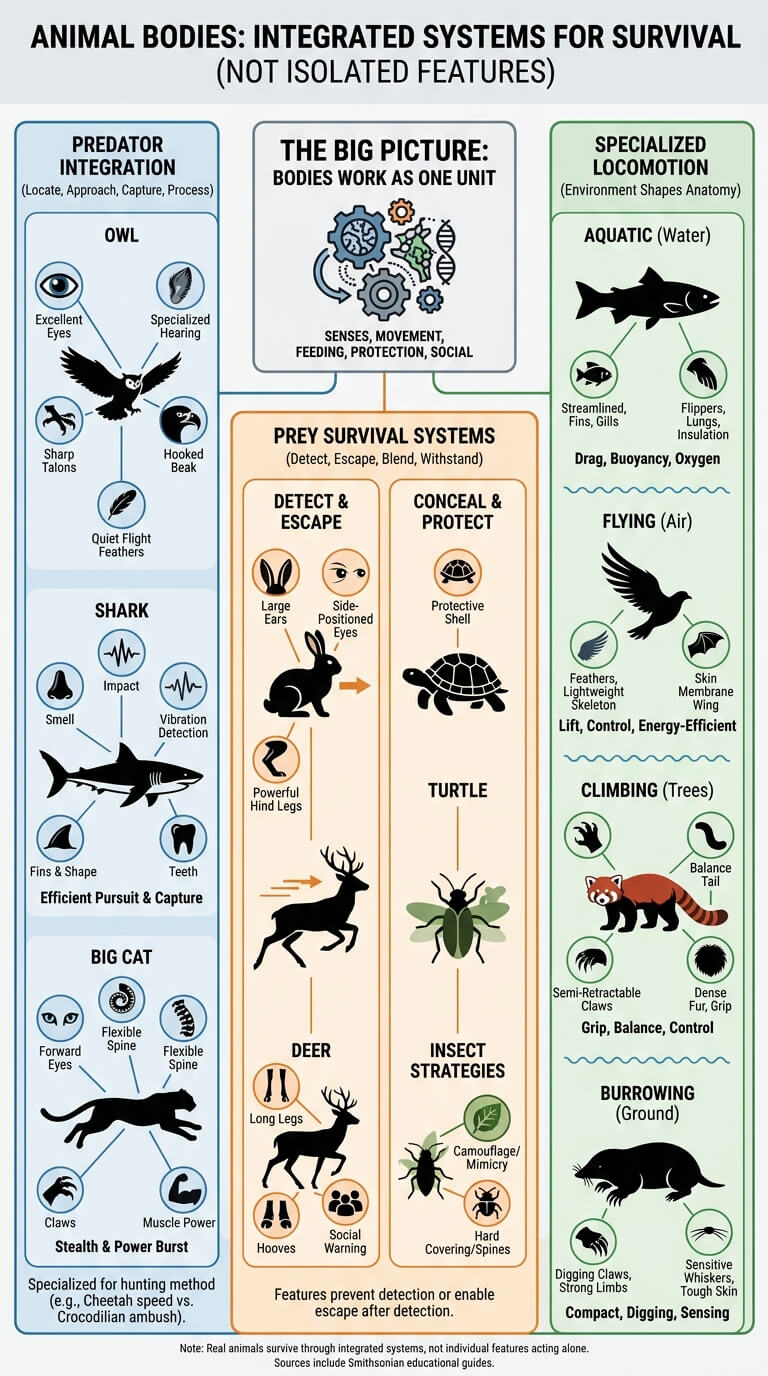
Real animals do not survive through one feature at a time. Their bodies work as integrated systems. A predator needs senses to locate prey, movement structures to approach it, feeding structures to capture and process it, and protective structures to avoid injury. A prey animal needs senses to detect danger, muscles and limbs to escape, body coverings to blend in or withstand conditions, and social signals to coordinate with others.
Predator anatomy examples
Predators often combine detection, pursuit, capture, and feeding features. Owls use sharp talons, hooked beaks, excellent hearing, large eyes, and specialized feathers that can reduce flight noise. Sharks use body shape, fins, teeth, smell, vibration detection, and movement patterns. Big cats use forward-facing eyes, flexible spines, claws, teeth, whiskers, and muscle power. None of these features works alone.
Predator anatomy also varies by hunting method. A cheetah’s body is built for short bursts of speed, while a crocodilian’s body is built for ambush in and near water. A spider’s body may use silk, venom-delivery structures, sensitive hairs, and specialized legs. A heron’s long legs and bill help it hunt in shallow water. Calling all predators simply “sharp-toothed animals” misses the variety of body plans that hunting can produce.
Prey animal anatomy examples
Prey animals are not passive. Their anatomy can be highly specialized for survival. Rabbits have large ears, side-positioned eyes, powerful hind legs, and alert postures. Deer have long legs, hooves, strong senses, and social warning behaviors. Turtles rely more on protective shell structure, while many insects rely on camouflage, hard outer coverings, jumping legs, wings, chemical defenses, or mimicry.
Some prey features work by preventing detection. Patterns can break up body outlines. Stillness can make an animal hard to notice. Fur, feathers, scales, or skin color may match bark, leaves, sand, snow, or water. Other features work after detection, such as speed, spines, shells, toxic skin secretions, sudden color displays, or group movement.
Aquatic, flying, climbing, and burrowing anatomy examples
Aquatic animals tend to show anatomy shaped by drag, buoyancy, pressure, oxygen, and temperature. Fish often have streamlined bodies, fins, gills, scales, and muscular tails. Marine mammals have lungs, streamlined bodies, flippers, and insulation. Crocodilians combine aquatic movement with land movement, using body armor, strong tails, eyes and nostrils positioned high on the head, and powerful jaws.
Flying animals need lift, balance, control, and energy-efficient movement. Birds use feathers, wings, strong flight muscles, lightweight skeleton features, and specialized breathing systems. A Smithsonian educational guide on birds describes feathers as a defining bird feature involved in flight, insulation, and communication. Bats solve flight with skin membranes stretched across elongated fingers, showing that wings can be built in different ways.
Climbing animals need grip, balance, and body control. Red pandas show this clearly with dense fur, semi-retractable claws, and long tails that help with balance and cold protection, according to Smithsonian’s red panda profile. Burrowing animals have a different body challenge. They may need compact bodies, strong forelimbs, digging claws, reduced external ears, sensitive whiskers, and tough skin or fur that handles soil contact.
Common Myths and Misunderstandings About Animal Body Parts
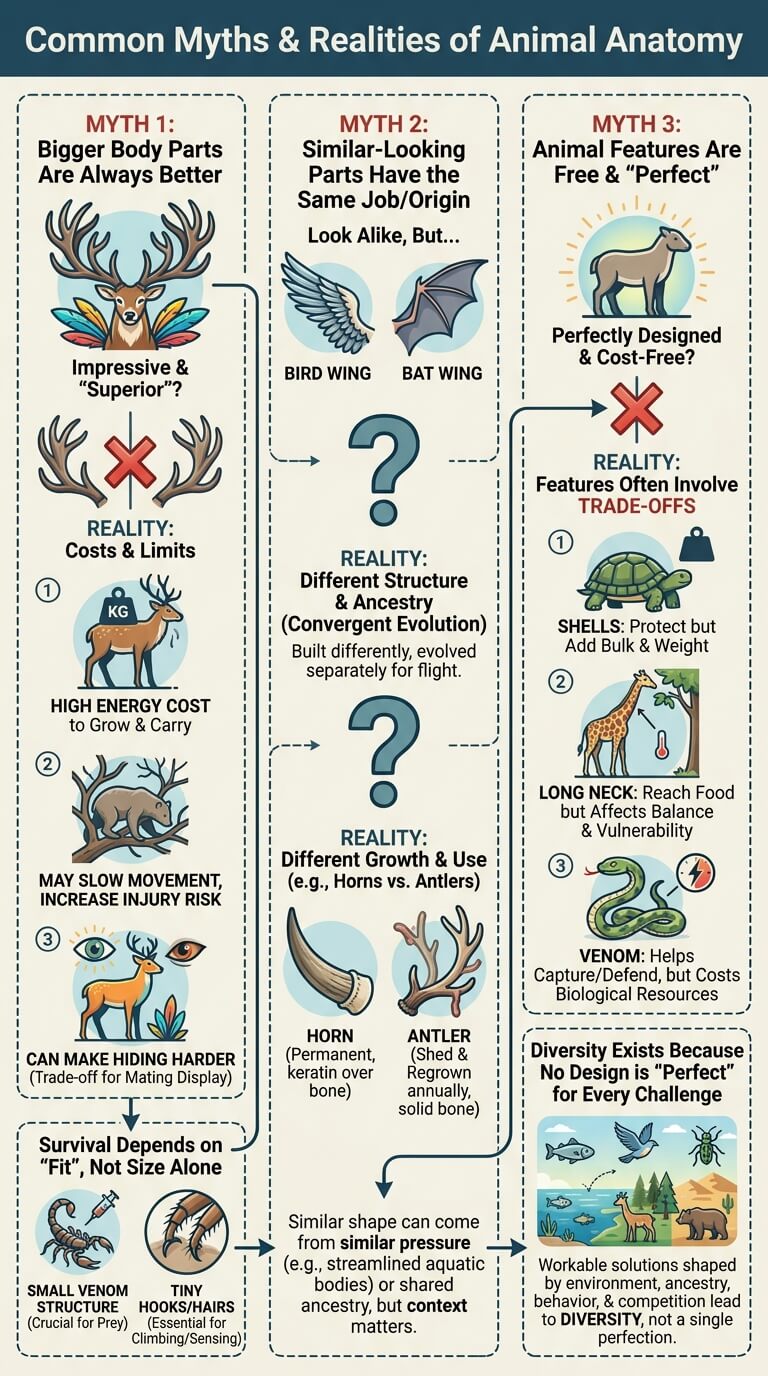
Animal body features are easy to oversimplify. A dramatic body part can make people assume the animal is dangerous, superior, primitive, or perfectly designed for one job. Real anatomy is more flexible and more complicated. Most features have several functions, costs, limits, and exceptions.
Bigger body parts are not always better
Large horns, large teeth, long tails, huge claws, and bright feathers can look impressive, but bigger is not automatically better. Larger structures can cost more energy to grow and carry. They may slow the animal, increase injury risk, or make hiding harder. A large display feature can help in mating competition, yet it may also make escape more difficult.
Small body parts can be just as important. Tiny sensory hairs can detect touch or air movement. Small hooks on insect feet can help with climbing. Fine feather structure can affect insulation and flight. A small venom-delivery structure may be more important than a large tooth if it changes how the animal captures prey. Survival depends on fit, not size alone.
Similar-looking parts can evolve for different jobs
Similar-looking structures are not always the same. Horns and antlers both grow on the head of mammals, but they differ in growth pattern, structure, and use. Scales in fish, reptiles, and some other animals can differ in material and development. A bird wing and a bat wing both support flight, but they are built differently. A claw used for digging is not the same as a talon used for seizing prey.
This is why animal comparisons need careful wording. Similar shape can come from similar pressure, shared ancestry, or both. Streamlined bodies appear in many aquatic animals because water favors shapes that reduce drag, but that does not mean all streamlined swimmers are closely related. Anatomy can reveal ancestry, lifestyle, or both, and context matters.
Animal features often involve trade-offs
No body part is free. Feathers require care. Teeth wear down. Antlers are shed and regrown in many deer species, which takes energy. Shells protect but add bulk. Venom can help capture prey or defend against threats, but producing venom uses biological resources. A long neck can help reach food, but it also changes blood flow, balance, and vulnerability.
Trade-offs help explain why animals are so diverse. If one body design were perfect for every challenge, animal bodies would look much more alike. Instead, survival pushes animals toward different solutions in different habitats. The result is not perfection, but workable anatomy shaped by environment, ancestry, behavior, and competition.
Body Features People Often Compare

Many animal body questions come from features that look similar at first glance. These comparisons are useful because they teach readers to notice structure, function, material, growth, and behavior. A careful comparison can also prevent common mistakes, such as confusing horns with antlers or assuming every hard outer covering works like a shell.
Horns, antlers, and headgear
Animal headgear can be used for defense, display, competition, species recognition, or a mix of those jobs. Horns, antlers, ossicones, crests, casques, and bony knobs are not interchangeable terms. Some are covered in keratin, some are bone, some are shed, and some grow throughout life. Looking at growth pattern and structure is more accurate than judging by shape alone.
Fur, hair, feathers, scales, shells, and skin
Outer coverings help animals meet the world directly. They protect against temperature, water loss, sunlight, abrasion, parasites, predators, and impact. They can also support flight, communication, camouflage, and mate attraction. Fur and hair are mammal features, feathers are bird features, scales appear in multiple animal groups, shells can be built in different ways, and skin itself can be a powerful survival surface.
Teeth, tails, claws, hooves, talons, and exoskeletons
Other body features are easier to understand by job. Teeth process food or help grip prey. Tails can balance, steer, signal, store fat, swat insects, or help with swimming. Claws and talons grip, climb, dig, or capture. Hooves support weight and movement on land. Exoskeletons protect many invertebrates and provide muscle attachment, but they also create challenges during growth because many animals with hard outer skeletons must molt.
FAQ
What is animal anatomy in simple terms?
Animal anatomy means the structure of an animal’s body. It includes visible parts such as legs, wings, teeth, claws, tails, shells, feathers, scales, and fur, as well as internal parts such as bones, muscles, organs, nerves, and blood vessels. In simple terms, anatomy is what an animal is physically made of and how those parts fit together.
Which animal body parts are most important for survival?
The most important body parts depend on the animal. A bird may rely heavily on feathers, wings, beak shape, eyesight, and feet. A burrowing mammal may depend on digging claws, strong shoulders, whiskers, and a compact body. A fish may depend on gills, fins, scales, and body shape. Survival usually depends on a set of body parts working together, not one single feature.
Why do different animals have different body parts?
Different animals face different survival challenges. Habitat, diet, predators, climate, movement style, ancestry, and reproduction all influence body structure. Animals that live in water, trees, deserts, grasslands, caves, forests, and snowfields need different tools. Over many generations, body features that help animals survive and reproduce can become more common in a population.
Can unrelated animals evolve similar body features?
Yes. Unrelated animals can evolve similar features when they face similar challenges. This is called convergent evolution. For example, streamlined bodies are useful in water, so they appear in several swimming animals that are not close relatives. Wings also evolved in different animal groups, including birds, bats, and insects, but the details of those wings are not the same.
Final Thoughts
Animal anatomy is one of the clearest ways to see how survival works. Body parts help animals move, feed, sense danger, protect themselves, communicate, and reproduce, but no feature works in isolation. The same structure can have several jobs, and every advantage has limits. When you look at an animal’s teeth, tail, fur, feathers, claws, shell, or scales, you are seeing a clue to how that animal meets the challenges of its world.

Ethan Walker is the founder and research editor of Animal Fact Central. He creates and reviews educational animal facts content using trusted wildlife, pet care, and science-based sources. His work focuses on making animal behavior, adaptations, habitats, and species facts clear, accurate, and engaging for everyday readers.
Read More Details About Ethan Walker: https://animalfactcentral.com/ethan-walker/