
Animal teeth types are clues to how animals bite, chew, slice, grind, scrape, grip, and survive. A wolf’s pointed canines, a horse’s broad grinding teeth, a beaver’s orange incisors, and a shark’s replaceable cutting teeth all solve different feeding problems. Teeth are not just white points in a jaw. They are body tools shaped by diet, movement, prey, predators, habitat, and the way an animal handles food.
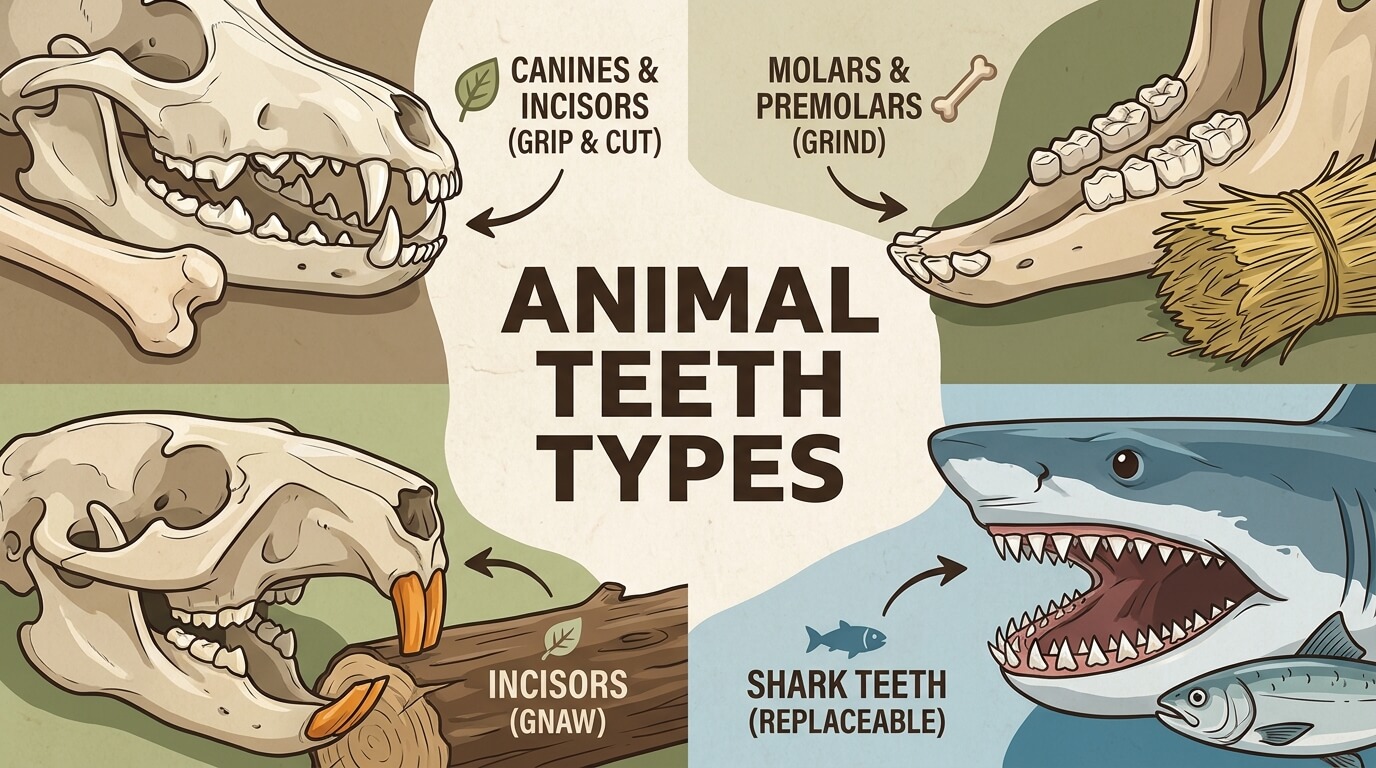
The quickest way to understand animal teeth is to look at shape and job. Incisors usually cut or nibble. Canines often grip or pierce. Premolars and molars process food farther back in the mouth. Some animals add special versions, such as carnassial teeth for slicing meat, tusks for digging or display, and fangs that can help some snakes deliver venom. Other animals, including baleen whales, feed without true teeth as adults.
This article focuses on teeth as feeding anatomy. It will not turn every section into a full diet profile for each animal. Instead, it explains how tooth shape works, why similar teeth can have different jobs, and why teeth alone do not tell the whole story about an animal’s behavior.
Quick Answer: The Main Types of Animal Teeth
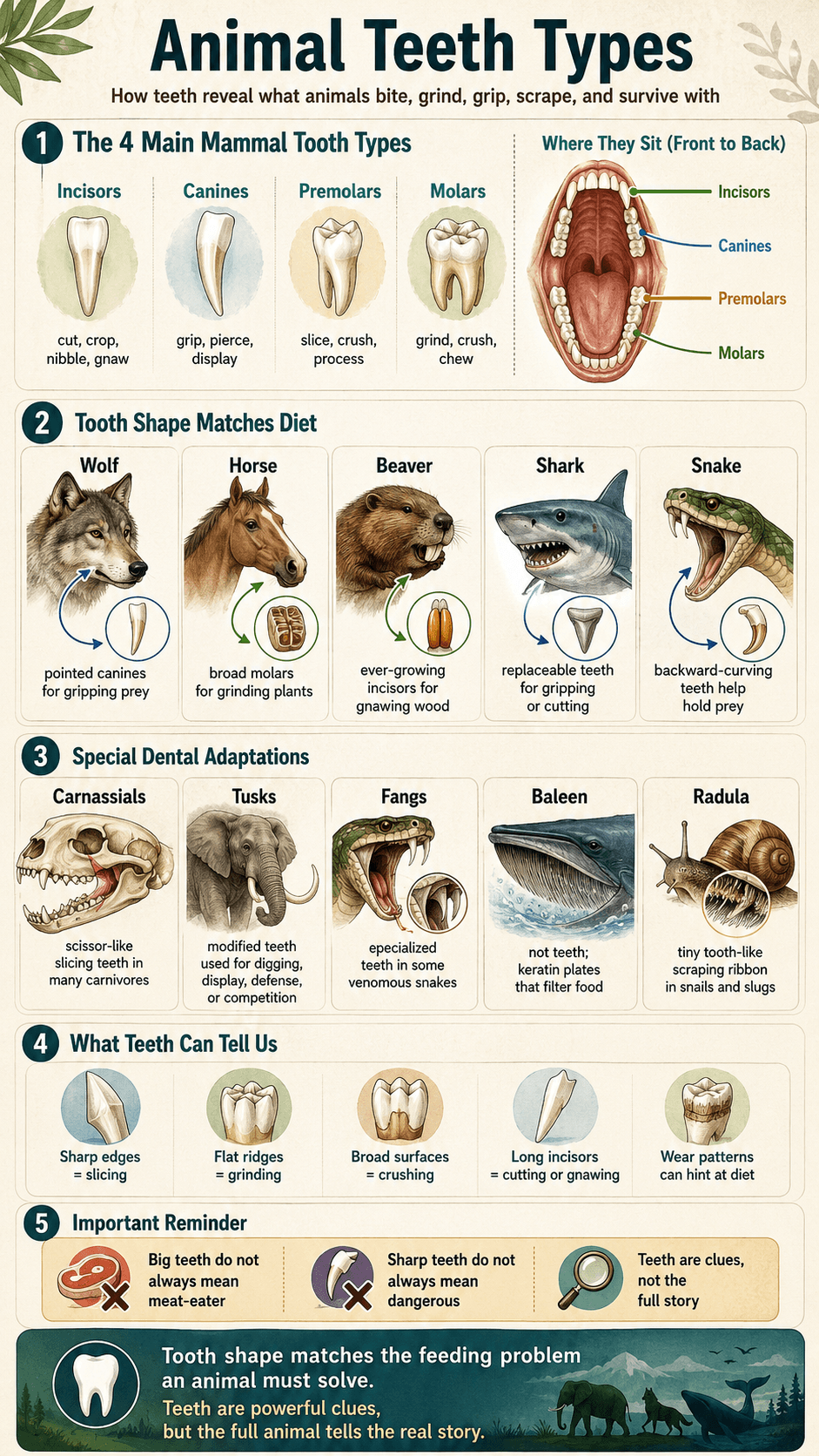
The four main types of mammal teeth are incisors, canines, premolars, and molars. Incisors sit near the front and are often used for cutting, cropping, or nibbling. Canines are usually pointed and can help grip, pierce, or display. Premolars sit behind the canines and help slice, crush, or prepare food. Molars are usually farther back and are often built for grinding or crushing.
Mammals are especially useful for learning tooth types because many species have different tooth shapes in the same mouth. The Animal Diversity Web mammal tooth overview describes the basic mammal pattern as incisors, canines, premolars, and molars, although real animals often modify, reduce, enlarge, or lose some of these teeth.
Outside mammals, the picture gets even more varied. Sharks can replace teeth continuously. Many snakes have backward-curving teeth that help hold prey, while venomous species may have specialized fangs. Some fish have crushing teeth, scraping teeth, or pharyngeal teeth in the throat. Snails and slugs have tiny tooth-like structures on a feeding ribbon called a radula. So animal teeth types are best understood as a set of feeding tools, not a single universal design.
Why Animal Teeth Matter
Teeth are often the first part of an animal’s feeding system to touch food, but they do not work alone. A tooth only becomes useful when it works with jaw muscles, skull shape, tongue movement, lips, beaks, claws, or other body parts. A lion’s teeth matter because its jaws, paws, senses, and hunting behavior work with them. A cow’s grinding teeth matter because its digestive system can break down plant material after chewing.
Hard structures on the head can be confusing, but horns and antlers are not teeth and grow in very different ways.
Teeth also affect survival beyond the meal itself. Worn, broken, infected, or poorly matched teeth can make feeding harder. In wild animals, that can affect body condition, reproduction, and the ability to avoid predators. In fossils, teeth are among the most useful remains because enamel can preserve well and tooth shape can hint at an extinct animal’s diet. Still, a tooth is a clue, not a full biography.
How Tooth Shape Matches Diet

Tooth shape reflects the physical challenge of food. Grass is abrasive and needs grinding. Meat can require gripping and slicing. Seeds may need crushing. Fish can be slippery and hard to hold. Bark must be gnawed. Shells require pressure. Nectar needs little chewing at all. Animals do not need the same tools because they are not solving the same feeding problem.
Cutting, gripping, tearing, crushing, grinding, and filtering
Cutting teeth have edges that meet food like blades. Gripping teeth are often conical or pointed, giving the animal a way to hold prey. Tearing teeth can have sharp crests that pass against each other. Crushing teeth tend to be broad or rounded, spreading force over a hard object. Grinding teeth have flatter surfaces, ridges, or complex crowns that break plant matter into smaller pieces.
Filtering is different. A filter-feeding animal may not need teeth at all for adult feeding. Baleen whales, for example, use baleen plates rather than true teeth to strain small prey from water. The Natural History Museum’s baleen whale explanation describes baleen as keratin plates that hang from the upper jaw and work like a sieve.
Predator teeth vs herbivore teeth
Predator teeth are often described as sharp, but that is too simple. A predator that catches fish may need needle-like teeth for holding slippery prey. A mammalian carnivore may need canines for gripping and cheek teeth for slicing. A snake may need many backward-facing teeth that help move prey into the mouth. A predator’s teeth match the prey and the method of feeding.
Herbivore teeth can look less dramatic, but they are often highly specialized. Grazers deal with tough, abrasive plants that can wear teeth down. Browsers that eat leaves, twigs, or bark may need cutting and grinding surfaces. Some plant-eating mammals have high-crowned cheek teeth that resist wear from gritty grasses. Herbivore teeth are not weaker than predator teeth. They are built for a different kind of work.
Why omnivores often have mixed teeth
Omnivores often show a mixture of tooth shapes because they eat a wider range of foods. Many omnivorous mammals have incisors for biting, canines that may help with gripping or display, and cheek teeth that can crush or grind. Their teeth are not usually as specialized as those of strict grazers or highly meat-focused carnivores.
That flexibility has trade-offs. Mixed teeth may let an animal handle fruit, insects, eggs, small animals, carrion, roots, or human-associated food, depending on the species. But flexible does not mean perfect at everything. Tooth shape only tells part of the story; the animal’s senses, hands, claws, gut, social behavior, and habitat also shape what it can actually eat.
The Major Types of Animal Teeth
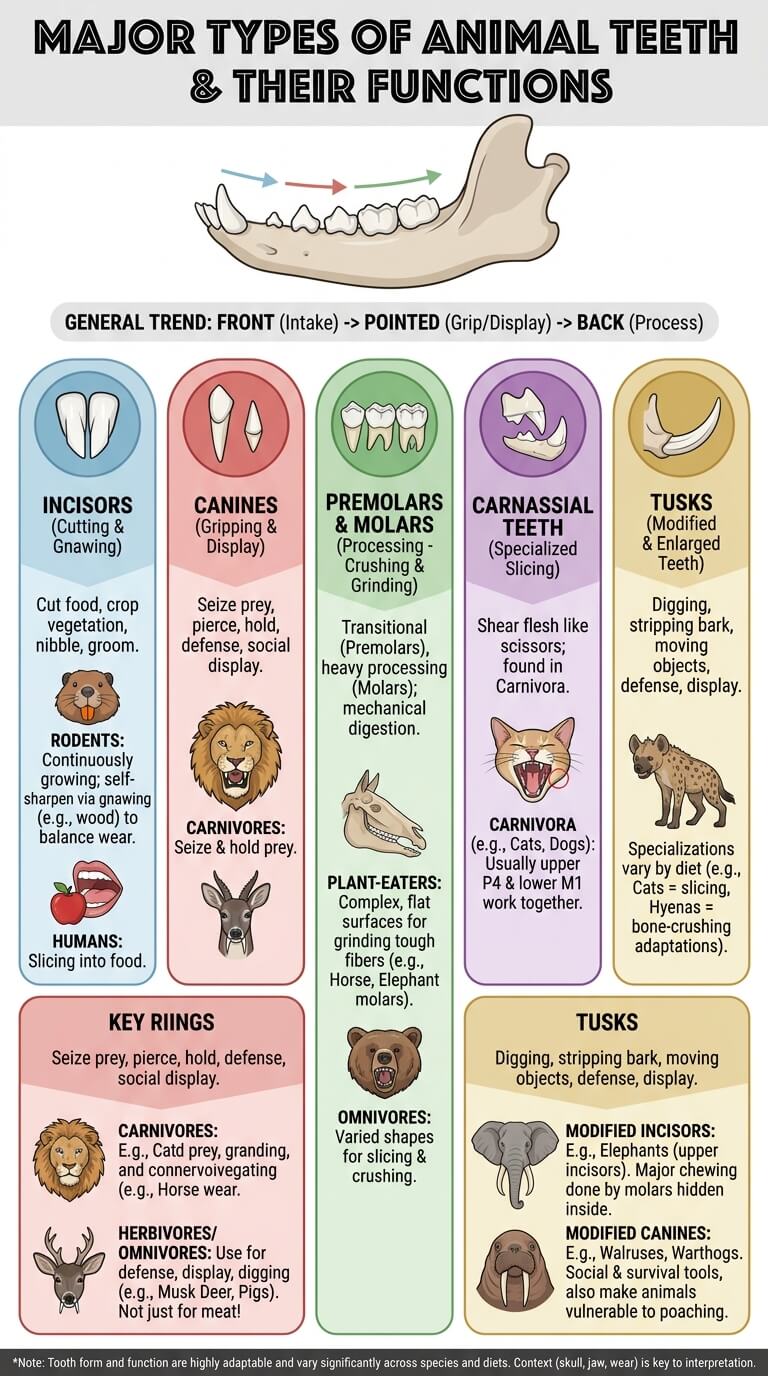
The most familiar tooth categories come from mammals, but the ideas behind them are useful across the animal world. Front teeth often help take food in. Pointed teeth often grip. Back teeth often process food. Special teeth can become weapons, tools, or display structures. The same category can also change meaning from one animal to another.
Incisors for cutting and nibbling
Incisors are usually the front teeth. In many mammals, they cut food, crop vegetation, nibble seeds, or groom fur. Human incisors slice into food. Horse incisors crop grass. Rodent incisors gnaw wood, bark, nuts, and other materials that would quickly wear down ordinary teeth.
Rodents are the classic example of incisors turned into powerful tools. The Animal Diversity Web account of rodents notes that rodents share a specialized gnawing dentition with one pair of upper and lower incisors and no canine teeth. Their incisors grow continuously, so gnawing and natural wear help keep the teeth functional.
Continuously growing incisors show why tooth growth is part of tooth function. A beaver, squirrel, or rat does not simply have sharp front teeth. It has teeth that keep erupting as the front edges wear. That adaptation is useful, but it also creates a need for constant balance between growth and wear.
Canines for gripping and piercing
Canines are often the pointed teeth near the front corners of the mouth. In many carnivorous mammals, canines help seize prey and hold it. In some animals, canines are also used in fights, displays, or social competition. They can look dramatic, but they are not limited to meat-eaters.
Some herbivores and omnivores have large canines. Male musk deer have long upper canine teeth that look like small tusks. Male pigs and warthogs have enlarged canine teeth that become tusks. Even animals that eat mostly plants may use large canines for defense, display, digging, or competition rather than meat-eating.
That is why a single sharp tooth should not be treated as a simple danger label. A canine tells you an animal has a pointed tooth, not that it is naturally aggressive toward people. The animal’s size, behavior, habitat, and reason for using the tooth all matter.
Premolars for slicing and processing food
Premolars sit between canines and molars in many mammals. They are transitional teeth, which means they can perform different jobs depending on the animal. In some species, premolars help slice. In others, they help crush or grind. Their shape can be sharp, rounded, ridged, or reduced.
In fossils, premolars can reveal important diet clues because their shape changes with feeding style. But they should not be read in isolation. A tooth row, jaw joint, skull muscle attachment, and wear pattern together tell a stronger story than one tooth alone.
Molars for grinding and crushing
Molars are the back teeth in many mammals. They often do the heavy processing, especially for plant-eaters that must grind tough food. Molars may be flat, ridged, crescent-shaped, or covered in complex enamel patterns. Those surfaces increase contact with food and help break it apart before swallowing.
Molars are a reminder that chewing is mechanical. Digestion starts before food reaches the stomach. Smaller food pieces expose more surface area to digestive fluids and microbes. That matters especially for animals that rely on plant material, which can be hard to break down.
Carnassial teeth in many mammalian carnivores
Carnassial teeth are specialized slicing teeth found in many members of the mammalian order Carnivora, the group that includes cats, dogs, bears, seals, hyenas, raccoons, and their relatives. In many meat-focused species, the upper fourth premolar and lower first molar work together like shears. When the jaw closes, their sharp edges pass each other and slice flesh.
Not every carnivoran eats only meat, and not every meat-eating animal has the same carnassial emphasis. Cats have highly developed carnassials for slicing. Bears have broader cheek teeth because many species eat a more varied diet. Seals, otters, and hyenas show different specializations because their food and feeding methods are different.
Tusks as modified teeth
Tusks are enlarged teeth that grow beyond the mouth. They may be incisors or canines, depending on the animal. Elephants have tusks that are modified upper incisors, while warthog tusks are enlarged canine teeth. Walrus tusks are also enlarged canine teeth. Narwhal tusks are elongated teeth, most often seen as a long spiral tusk in males.
The Smithsonian National Zoo explanation of elephant teeth describes elephant tusks as modified incisors and notes that elephants also have large molars used for grinding. That matters because the most visible tooth on an elephant is not the one doing most of the chewing.
Tusks can help with digging, stripping bark, moving objects, display, defense, and competition. They can also make animals vulnerable to poaching when humans value ivory. So tusks are feeding-related body structures in some contexts, but they are also social and survival tools.
Special Dental Adaptations
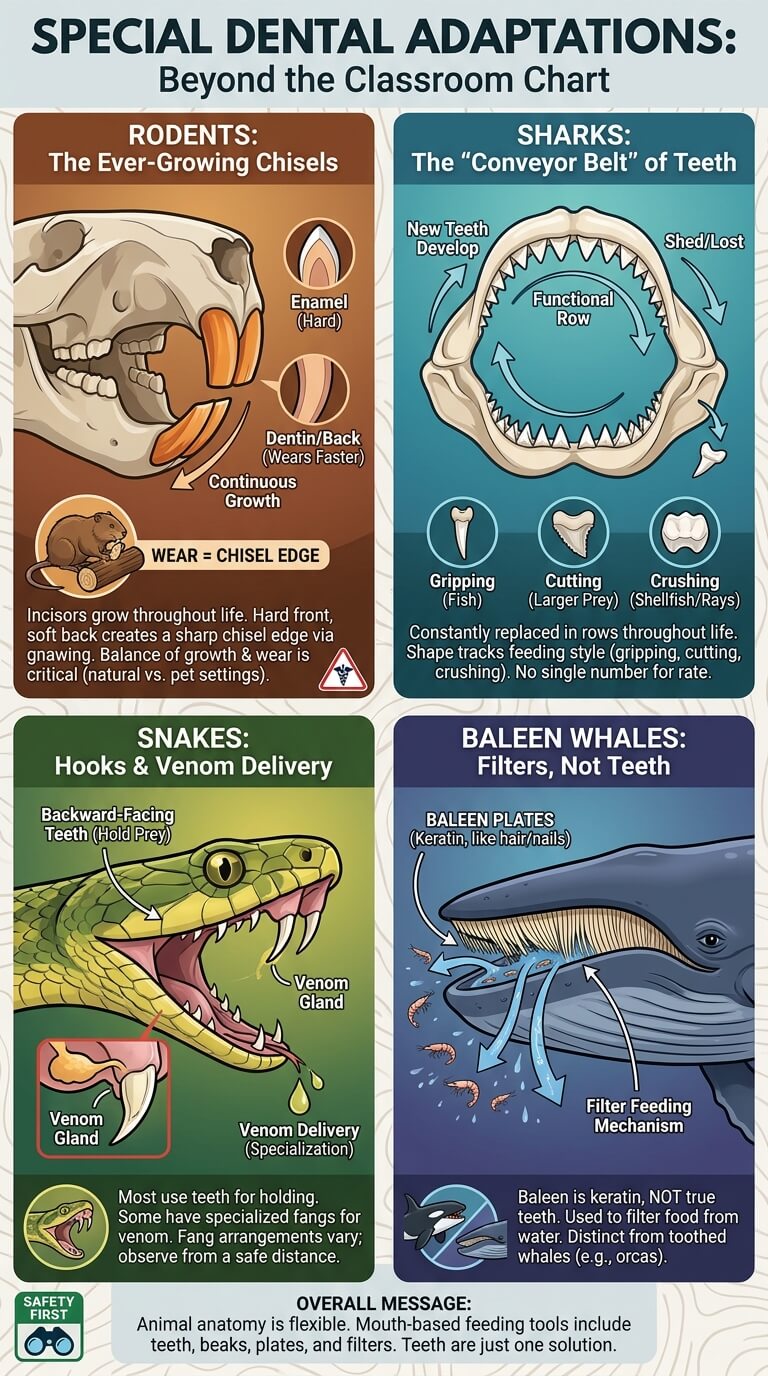
Some animal teeth do not fit neatly into a simple classroom chart. They grow continuously, get replaced repeatedly, deliver venom, scrape surfaces, or disappear from adult feeding altogether. These unusual examples are often the most memorable because they show how flexible animal anatomy can be.
Rodents and continuously growing incisors
Rodent incisors grow throughout life. The front surface has hard enamel, while the back wears faster, helping create a chisel-like edge as the animal gnaws. This is why gnawing is not just a habit. It is part of how the tooth system stays usable.
Continuously growing teeth are powerful but demanding. If growth and wear fall out of balance, the teeth can become a serious problem, especially in captive pets or injured wild animals. In a wild setting, natural food, bark, seeds, soil, and other materials help create wear. In pet settings, dental problems require veterinary guidance rather than home trimming attempts.
Sharks and replaceable teeth
Shark teeth are famous because they are replaced again and again. Instead of keeping one adult set for life, sharks produce teeth in rows, with newer teeth moving forward as older teeth are lost or damaged. This fits a life where grabbing prey can break or shed teeth.
The Florida Museum’s shark tooth regeneration article explains that sharks have a dentition that regenerates constantly through life, and that in some sharks a new set can develop very quickly. Because rates vary, it is better to say sharks replace teeth continuously rather than give one number for all sharks.
Shark tooth shape also varies. Some sharks have narrow teeth for gripping fish. Others have broad, serrated teeth that can cut larger prey. Rays, close relatives of sharks, may have flatter teeth for crushing shellfish. Tooth shape tracks feeding style, even within the same broad group of cartilaginous fishes.
Snakes and fangs
Most snakes do not chew like mammals. They use teeth to catch, hold, and move prey toward the throat. Many snake teeth curve backward, which helps prevent prey from slipping out. Venomous snakes add another layer of specialization when some teeth become fangs connected to venom delivery.
The National Park Service snake dentition explainer describes aglyphous snakes as lacking fangs for venom delivery and notes that snakes have backward-facing teeth that help secure prey. Venomous snakes can have different fang arrangements, so the word fang should not be used as if every snake has the same dental system.
Fangs are not a reason to handle a snake for a closer look. Many harmless snakes are misidentified, and many venomous snakes prefer to avoid people when left alone. The safest approach is to observe wild snakes from a distance and contact a qualified professional when a snake creates a real safety concern near people or pets.
Baleen is not teeth
Baleen whales are often discussed with teeth because they feed through the mouth, but baleen is not true teeth. It is made of keratin, the same general protein family found in hair, nails, claws, and hooves. Baleen plates hang from the upper jaw and filter food from water.
This matters because it corrects a common mistake. A blue whale, humpback whale, or right whale does not chew prey with rows of teeth as an adult. It takes in water and prey, then pushes water out while prey remains trapped by baleen. Toothed whales, such as sperm whales, dolphins, and orcas, belong to a different feeding group and have teeth.
Baleen shows that not every mouth-based feeding tool is a tooth. Some animals solve feeding problems with beaks, plates, tongues, lips, suction, or filter structures. Teeth are important, but they are only one possible solution.
What Teeth Can and Cannot Tell You About an Animal
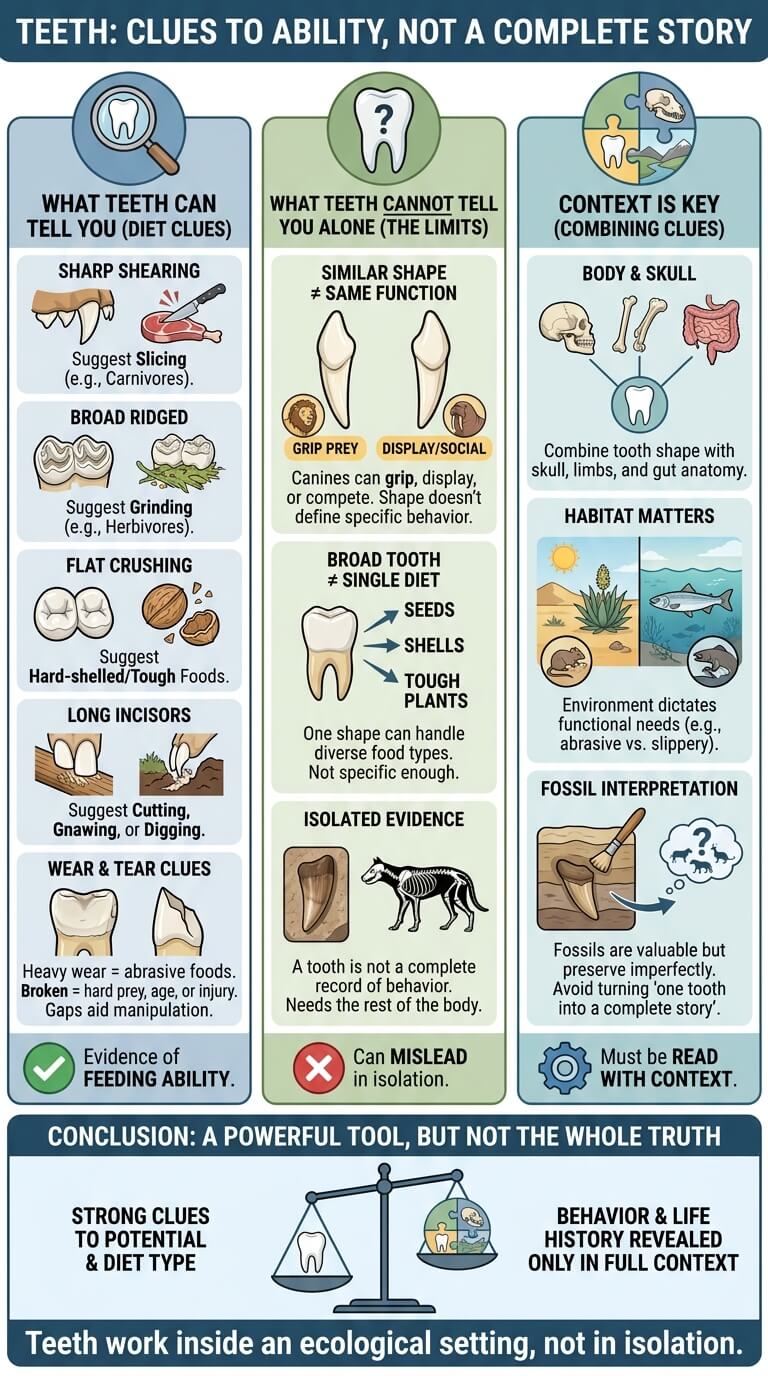
Teeth can tell readers a lot, but they can also mislead when viewed alone. A tooth is evidence of feeding ability, not a complete record of behavior. To understand an animal, teeth should be read with the rest of the body.
Diet clues from teeth
Sharp shearing teeth suggest slicing. Broad ridged molars suggest grinding. Flat crushing teeth suggest hard-shelled or tough foods. Long incisors suggest cutting, gnawing, or digging, depending on the species. Gaps between teeth can help animals manipulate vegetation or use the tongue and lips more effectively.
Tooth wear can also be a clue. Heavy wear may show abrasive foods. Broken teeth may show hard prey, age, or injury. In fossils, tooth enamel and microscopic wear can help researchers infer diet. Still, tooth clues are strongest when combined with skull shape, limb structure, gut anatomy, and environmental evidence.
Why behavior and habitat still matter
Two animals can have similar-looking teeth but use them differently. A canine tooth may grip prey in one animal, serve as a display weapon in another, and help with social competition in a third. A broad tooth may crush seeds, shells, or tough plant material. The shape matters, but the behavior gives it meaning.
Habitat also changes how teeth function. A desert rodent, forest squirrel, beaver, and porcupine may all gnaw, but they encounter different foods, materials, and risks. A marine predator may need teeth that hold slippery prey. A grassland grazer faces constant wear from abrasive plants and grit. Teeth work inside an ecological setting, not in isolation.
Fossil teeth and extinct animals
Fossil teeth are valuable because they preserve better than many other body parts. They can reveal diet clues, growth patterns, and relationships among extinct animals. The shape of a fossil molar, the thickness of enamel, or the wear on a tooth surface can all help researchers ask better questions about an animal’s life.
But fossil teeth also have limits. An extinct animal may have eaten different foods at different ages or seasons. A tooth found alone may not show the full animal. Some animals change diet as they grow. For that reason, careful fossil interpretation avoids turning one tooth into a complete story.
Common Mistakes and Myths About Animal Teeth
Animal teeth are easy to turn into dramatic claims. Many of those claims are oversimplified. A good rule is to ask what the tooth does, how it is used, and whether the claim applies to one species or a whole group.
Sharp teeth do not always mean a dangerous animal
Sharp teeth help animals handle food. They do not automatically mean an animal is eager to attack people. Many fish, bats, shrews, lizards, and small mammals have sharp teeth because their food is small, slippery, armored, or fast. Risk depends on size, behavior, venom, disease, defensive reactions, and how close a person gets.
It is still smart to respect teeth. Wild animals should not be grabbed, fed by hand, teased, cornered, or handled for photos. Even a small bite can cause injury or infection. The calmest interpretation is usually best: teeth explain feeding first, and safety risk must be judged by context.
Big teeth are not always for eating meat
Big teeth can be used for digging, display, fighting, scraping, defense, or moving objects. Elephant tusks are modified incisors, but elephants are plant-eaters. Warthog tusks come from canine teeth, yet warthogs are not big-cat-style hunters. Walrus tusks can help with social behavior and movement on ice, not just feeding.
Not every animal with fangs is venomous
People often use fang to mean any long, pointed tooth. In biology, the word is often used more specifically for elongated teeth, especially those associated with venom delivery in some animals. That difference can create confusion. A mammal can have fang-like canines and no venom. A nonvenomous snake can have sharp teeth but no venom-delivering fangs.
Venom is also not the same as poison. Venom is usually delivered by a bite, sting, spine, or similar structure. Poison is harmful when touched, eaten, or absorbed. For readers, the safest takeaway is simple: do not rely on casual tooth labels to decide whether an animal is safe to handle.
Teeth as Part of an Animal’s Feeding Body Plan
Teeth are important, but feeding is a whole-body event. Animals use jaws, lips, tongues, claws, talons, hooves, beaks, digestive organs, and senses together. A tooth type becomes meaningful when it fits the rest of the animal.
Teeth work with jaws, claws, talons, and hooves
A carnivore may use claws to seize prey before teeth finish the job. A raptor uses talons more than teeth because birds have beaks rather than mammal-style teeth. A grazing mammal uses hooves to move across open ground and molars to process grass. A rodent uses incisors, jaw muscles, and paws together while gnawing.
This is why animal anatomy works like a toolkit. Teeth are one tool among many. When readers compare a wolf, cow, shark, snake, elephant, and beaver, the differences are not just about teeth. They are about how the whole animal gets food safely and efficiently.
Teeth are one part of survival anatomy
Animal teeth types fit into a larger survival pattern. Body coverings protect animals. Tails help with balance, communication, or movement. Horns and antlers may help with competition and defense. Claws, hooves, and talons shape how animals climb, dig, run, capture prey, or grip surfaces.
FAQ
What are the four main types of mammal teeth?
The four main types of mammal teeth are incisors, canines, premolars, and molars. Incisors are usually front teeth used for cutting or nibbling. Canines are often pointed and help grip, pierce, display, or compete. Premolars help process food between the front and back of the mouth. Molars are usually back teeth used for grinding, crushing, or heavy chewing. Not every mammal has all four types in the same form, and some mammals reduce or modify certain teeth.
Which animals have the most teeth?
The answer depends on what you count as teeth. Among familiar vertebrates, some sharks produce many teeth over a lifetime because they keep replacing lost or worn teeth. Among invertebrates, snails and slugs have a radula, a ribbon-like feeding structure with many tiny tooth-like parts. That is why viral claims about the animal with the most teeth can be confusing. Mammal teeth, shark teeth, and radula teeth are not all the same kind of structure.
Why do sharks keep replacing their teeth?
Sharks often bite, grip, cut, or shake prey in ways that can damage teeth. Replacing teeth helps keep the mouth functional even when teeth are lost. The exact rate varies by species, age, diet, and conditions, so it is better to describe shark tooth replacement as continuous rather than give one fixed schedule for every shark.
Do herbivores ever have canine teeth?
Yes, some herbivores and mostly plant-eating animals have canine teeth or enlarged canine-derived tusks. These teeth may be used for display, competition, defense, digging, or social interactions rather than hunting. Deer, pigs, hippos, and some other mammals can show why tooth category does not always predict diet by itself.
Final Thoughts
Animal teeth types make survival visible. Incisors cut and gnaw, canines grip and pierce, premolars slice or process, molars crush and grind, and special structures such as tusks, fangs, shark teeth, and baleen-like feeding tools show how varied mouth anatomy can be. The most useful lesson is not that one tooth is better than another. It is that tooth shape matches the feeding problem an animal must solve.
When you look at an animal’s mouth, ask what the teeth are built to do, what the rest of the body adds, and what the animal actually eats in its habitat. Teeth are powerful clues, but the full animal tells the real story.

Ethan Walker is the founder and research editor of Animal Fact Central. He creates and reviews educational animal facts content using trusted wildlife, pet care, and science-based sources. His work focuses on making animal behavior, adaptations, habitats, and species facts clear, accurate, and engaging for everyday readers.
Read More Details About Ethan Walker: https://animalfactcentral.com/ethan-walker/