
Animals have tails because a tail can solve many different survival problems. Depending on the species, a tail may help with balance, swimming, steering in the air, communication, defense, warmth, fat storage, or social signals. A kangaroo’s tail is not doing the same job as a fish’s tail, and a dog’s wagging tail is not the same kind of signal as a lizard dropping its tail to escape danger.

The simple answer is that tails are useful body parts, but they are not useful in one single way. A tail is part of an animal’s skeleton, muscles, nerves, skin, feathers, scales, or fur. Its shape depends on how that animal moves, where it lives, what tries to eat it, how it communicates, and what trade-offs its body can afford.
Quick Answer

Animals have tails for different reasons. Many mammals use tails for balance while climbing, running, or jumping. Fish use the tail region and caudal fin to push through water. Birds use tail feathers to steer, brake, display, and balance. Some animals use tails to send social signals, swat insects, hold fat, help regulate heat, or distract predators.
Not every tail has the same purpose. A squirrel’s tail can help with balance and signaling. A crocodilian tail is a powerful swimming tool. A cat’s tail helps with balance and body language. A peacock’s long display feathers are not the same as the bird’s main flight tail feathers, even though people often group them together as a dramatic tail display.
Some animals have very short tails or no obvious external tail because their way of life does not need a long one, or because a long tail would add cost. Humans, apes, frogs, adult toads, and some burrowing mammals show that losing or reducing a tail can also be useful when body shape, posture, or movement style changes.
Why Tails Matter in Animal Survival
A tail is not just an ornament attached to the back of an animal. It is often a moving structure connected to the spine or body covering, controlled by muscles and nerves, and shaped by the animal’s daily challenges. If an animal runs fast, climbs narrow branches, swims through currents, makes sharp turns, or lives around predators, a tail can become part of how that animal survives.
Tails can also reduce risk. A tail may help an animal land safely after a jump, keep its body level while sprinting, turn quickly in water, or communicate before a fight begins. In some species, tail movement can tell nearby animals whether an individual is alarmed, curious, aggressive, relaxed, or ready to mate.
The value of a tail also depends on cost. A long tail can be grabbed by predators, injured in fights, exposed to cold, or energetically expensive to grow and maintain. That is why tail shape varies so much. A body part is only useful when the benefits outweigh the costs for that species in its usual environment.
The Main Functions of Animal Tails
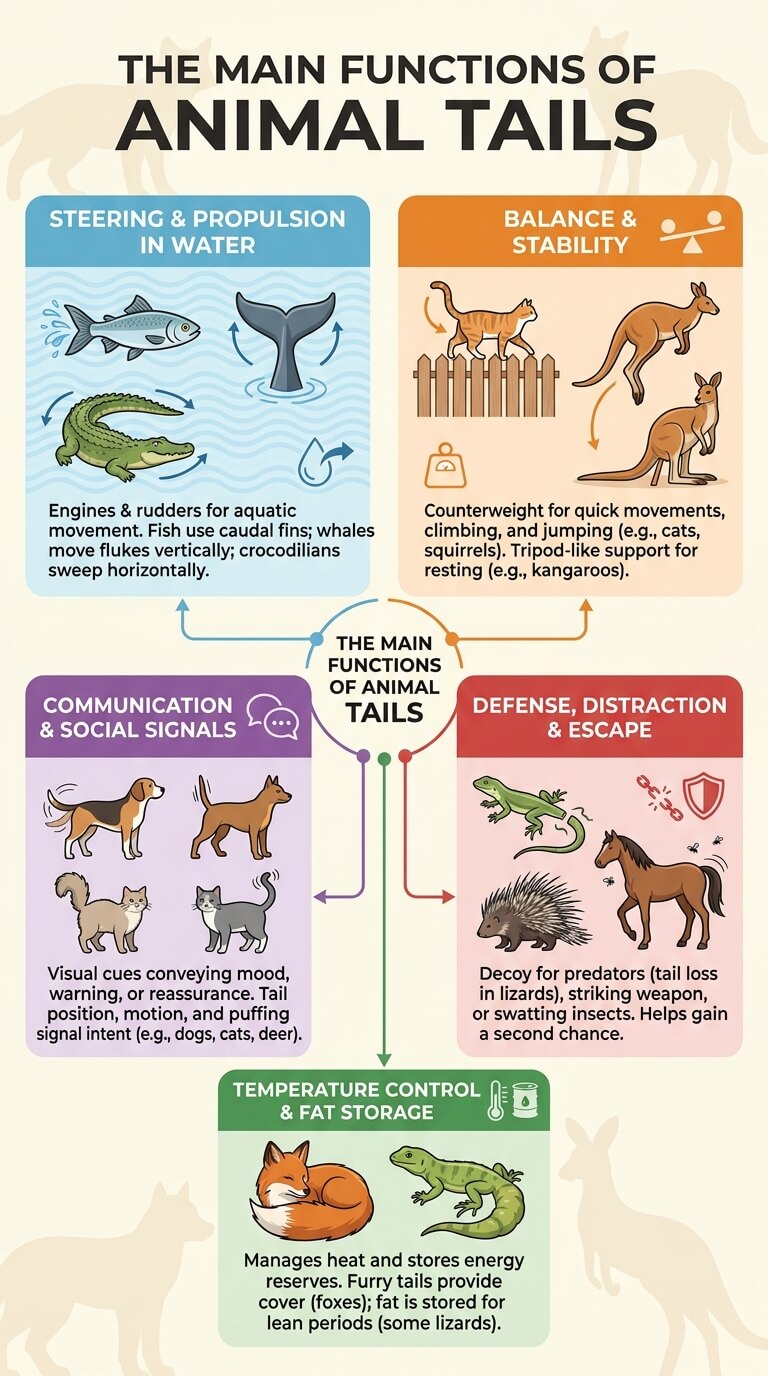
Balance for climbing, running, and jumping
One of the most familiar tail functions is balance. When an animal moves quickly or changes direction, the tail can act like a counterweight. This is especially clear in animals that leap, climb, or run along narrow surfaces.
Cats are a good example for everyday observation. A cat walking along a fence may shift its tail as its body weight moves. The tail does not make the cat magically balanced by itself, but it helps the animal make fine adjustments along with the inner ear, eyes, paws, claws, spine, and muscles. The same basic idea appears in many climbing animals, including squirrels and some monkeys, although the details differ by species.
Kangaroos show an even more dramatic use of the tail. The Animal Diversity Web’s red kangaroo profile describes the tail as muscular and strong enough to support body weight, with roles in balance while hopping and support when resting. In slow movement, a kangaroo can use the tail with its hind legs in a tripod-like posture, which makes the tail more like a strong extra support than a simple dangling appendage.
Balance tails are often thick, flexible, or highly mobile because they must respond to body motion. A stiff or tiny tail may still matter, but it will not do the same balancing work as a long muscular tail on a jumping or climbing animal.
Steering and propulsion in water
In water, tails often become engines, rudders, or both. Fish do not move like land mammals. Many species create waves along the body that travel toward the tail, and the caudal fin helps convert that motion into forward movement.
The American Fisheries Society’s Fishionary entry on the caudal fin describes the fish tail as the fin connected to the vertebral column and the primary means of locomotion for most fish. That does not mean every fish swims the same way. Tuna, eels, seahorses, rays, and reef fish all use different combinations of body motion and fins. Still, the tail region is central to swimming in many familiar fish.
Other aquatic animals use tails differently. Crocodilians sweep powerful tails from side to side to move through water. Otters use tails along with flexible bodies and webbed feet. Whales and dolphins move their tail flukes up and down, not side to side like most fish. The shared idea is not that every aquatic tail has the same shape, but that water makes a broad moving tail surface especially useful.
Communication and social signals
Some tails are message boards. Tail position, motion, stiffness, puffing, color, and rhythm can all change how an animal appears to others. These signals may warn rivals, reassure group members, attract mates, or reveal fear.
Dog tails are the example many readers know best, but they are also easy to misread. A wagging tail does not automatically mean a dog is friendly. The American Kennel Club’s explanation of dog tail wagging emphasizes that tail movement should be read with the rest of the dog’s body, including posture, facial tension, ears, and the situation. A loose, sweeping wag on a relaxed dog is different from a high, stiff, fast wag on a tense dog.
Cats also use tail signals, although cat tail language is not identical to dog tail language. A cat may hold the tail upright during friendly greeting, twitch the tip when focused or irritated, puff the tail when startled, or tuck it when frightened. The rest of the body still matters. Eyes, ears, whiskers, posture, and vocal sounds help complete the message.
Wild animals use tail signals too. Deer may raise the tail while fleeing, squirrels flick their tails during alarm or conflict, and some lizards use tail motions during social displays. A tail signal works because other animals can see it and respond before direct contact happens.
Defense, distraction, and escape
For some animals, a tail is a survival decoy. If a predator grabs the wrong body part, the prey may gain a second chance. Tail loss is one of the most striking examples.
Many lizards can shed part of the tail through a process called autotomy, which means self-cutting or self-amputation. A Royal Society study on tail regeneration after autotomy describes this ability as widespread among lizard families and tied to predator escape and survival costs. The detached tail may continue moving for a short time, helping draw attention away from the lizard’s body.
That escape has a cost. The lost tail may have helped with balance, fat storage, communication, or movement. A regenerated tail may not match the original perfectly in structure, color, or flexibility. Some lizards can regrow tails better than others, and not all reptiles can drop tails in the same way. A crocodile cannot simply abandon its tail and grow a new one.
Tails can also defend without being dropped. Some animals use strong tails to strike, slap, or brace the body. Crocodilians and large lizards can deliver powerful tail swings. Horses and cattle use tails to swat biting insects. Porcupines do not shoot quills, but their body posture and tail region can make close contact risky for predators that ignore the warning.
Temperature control and fat storage
A tail can also help manage energy and heat. This function is less obvious than swimming or wagging, but it matters in certain species.
Some desert and dryland lizards store fat in the tail. That stored energy can help during lean periods, but it also makes tail loss costly. When a predator forces a lizard to drop its tail, the animal may lose both a distraction device and part of its energy reserve.
Other animals use tails as coverings. A fox curled tightly in cold weather may wrap its bushy tail around the body and face. A squirrel can use its tail as shade, cover, or a signal, depending on the situation. A tail with dense fur is not the same as a naked, scaly, or feathered tail, so the covering changes what the tail can do.
Tails do not explain an animal’s whole lifestyle by themselves, because animal teeth can reveal a very different part of how the animal feeds and survives.
Temperature functions usually work alongside other body features. Fur, fat, posture, blood flow, nesting behavior, and habitat choice all affect how an animal handles heat or cold. The tail is one part of that larger body system.
Tail Examples Across Animal Groups

Mammal tails in cats, dogs, squirrels, monkeys, and kangaroos
Mammal tails are extremely varied because mammals live in so many different ways. A house cat’s tail is flexible and expressive. A dog tail can communicate excitement, uncertainty, tension, or social interest depending on the whole body. A squirrel’s bushy tail can assist with balance, signaling, and body cover. A monkey’s tail may help with balance in trees, and in some species it can grip branches.
Kangaroos show how far a mammal tail can go beyond signaling. Their tail is large, muscular, and important during movement and rest. It can help balance the body while hopping and add support during slower movement. That is very different from the tail of a rabbit, which is short and not built for heavy support.
Mammal tails are also shaped by social life. Dogs with different tail shapes may still communicate, but curled tails, docked tails, very short tails, or thick coats can make signals harder for humans to read. That is one reason body language should never be reduced to the tail alone.
Reptile tails in lizards and crocodilians
Reptile tails can be weapons, rudders, fat stores, balancing tools, or escape devices. Lizards are especially diverse. Some use long tails for balance while climbing. Others rely on tail autotomy when attacked. A few species have brightly colored tails as juveniles, which may draw attention away from the head and body.
Crocodilians have a very different tail design. Their tails are thick, muscular, and laterally compressed, which means the tail is flattened from side to side. That shape helps them push through water with sweeping movements. A crocodilian tail is so important for swimming that describing it as a simple rear body part misses its main function.
Snakes complicate the picture because their bodies are long and limbless. A snake tail is the part behind the cloaca, not the entire long body. Rattlesnakes use specialized tail structures to make warning sounds, while many other snakes have tails that are less visually obvious. The key is that tail function depends on anatomy, not just length.
Fish tails for swimming
Fish tails are among the clearest examples of body shape matching movement. A forked or crescent-shaped tail can help fast swimmers maintain speed. A rounded tail may help with quick starts, maneuvering, or bursts in tight spaces. A long eel-like body uses waves along much of the body, not only the tail fin.
The tail does not work alone. Fish also use body muscles, pectoral fins, dorsal fins, anal fins, buoyancy control, and body shape. A fish built for open-water speed looks different from a fish that darts around coral, hovers near the bottom, or hides in vegetation.
This is why the phrase animal tails covers very different structures. A fish tail is a fin system connected to swimming. A mammal tail is usually a vertebrate appendage covered in skin, hair, or fur. A bird tail is built from feathers attached to a short bony tail region. The shared word is useful, but the biology differs.
Bird tail feathers for flight control and display
Bird tails are not long fleshy mammal tails. The visible tail is mainly feathers, especially the tail feathers called rectrices. These feathers can spread, fold, twist, and help control movement in air.
Cornell Lab’s Bird Academy explains that tail feathers support precision steering in flight. Birds use them while turning, braking, landing, and adjusting body position. A hawk banking after prey, a woodpecker bracing against a tree, and a songbird landing on a branch all show different tail uses.
Bird tails also matter in display. Peacocks, turkeys, lyrebirds, and many other birds use tail or tail-like feather displays to communicate with mates or rivals. These displays can be costly because large feathers may require energy to grow and can affect movement. That cost can make the display meaningful, because only healthy individuals may be able to carry and show it well.
Animals With Short Tails or No Obvious Tails

Why some species lose or reduce tails
If tails are so useful, it may seem strange that some animals have short tails or no obvious external tail. The answer is that every body part has trade-offs. A long tail may help one animal but hinder another.
Burrowing animals may benefit from compact bodies that move easily through tunnels. Some ground-dwelling animals rely more on short bursts, hiding, armor, group warning, or strong hind legs than on long tail balance. Frogs and toads lose the tadpole tail during metamorphosis because adult movement depends on limbs, body shape, and jumping rather than a swimming tail.
Apes, including humans, do not have external tails. Their ancestors had tails far back in evolutionary history, but the ape body plan shifted toward different posture, movement, and balance systems. A reduced tail can be useful when the spine, pelvis, muscles, and limbs are doing different jobs.
Hidden tailbones and evolutionary history
A missing external tail does not always mean there is no tail history. Humans have a coccyx, often called the tailbone, at the lower end of the spine. It is not a moving tail, but it reflects ancestry and provides attachment points for muscles and ligaments.
Other animals also have reduced tail structures that are easier to see in skeletons than in daily life. Adult frogs do not keep the long swimming tail of their tadpole stage. Some mammals have tails so short that fur hides them. Birds have a short bony structure that supports tail feathers, even though the visible tail is mostly feather.
These examples show why anatomy is not only about what is obvious from the outside. A body part may be reduced, hidden, modified, or replaced by another structure that performs a similar job.
Trade-offs of having or not having a tail
A tail can help an animal, but it can also create problems. A long tail can be bitten, stepped on, trapped, injured, or costly to carry. In cold environments, exposed tail tissue can lose heat. In dense underground spaces, a long tail may be awkward. In some social animals, a visible tail signal may reveal excitement or fear to both friends and enemies.
On the other hand, losing a tail can remove useful functions. An animal without a tail may need stronger limbs, different posture, wider feet, more flexible spine movement, or other ways to communicate. Evolution does not aim for one perfect body plan. It favors workable combinations that fit a species’ life.
That is why short-tailed animals are not unfinished, and long-tailed animals are not automatically more advanced. They are different solutions to different problems.
Common Mistakes and Myths About Animal Tails
A wagging tail does not always mean happiness
The most common tail myth is that a wagging dog is always friendly. Tail wagging can be friendly, but it can also appear during uncertainty, arousal, stress, or conflict. The body tells the rest of the story.
A relaxed dog with loose muscles, soft eyes, and a broad sweeping wag is very different from a stiff dog with hard staring, raised body tension, and a tight, fast wag. Children especially should be taught not to approach a dog only because its tail is moving.
Cat tail signals are also easy to oversimplify. A raised tail may be friendly in one context, while a thrashing tail can show irritation or high arousal. No single tail motion should be treated as a complete translation.
Tail loss is not the same in every species
Another myth is that any animal can lose a tail and grow it back. This is not true. Tail autotomy is common in many lizards, but it is not a universal animal ability. Mammals do not regrow lost tails. Birds replace feathers through molting, but that is not the same as regrowing a bony tail. Crocodilians cannot drop and regrow their tails as an escape trick.
Even among lizards, tail regrowth varies. A regenerated tail may have a different internal structure than the original and may look shorter, smoother, darker, lighter, or differently shaped. Tail loss can affect balance, social signals, stored energy, and future survival.
Not all tails are mainly for balance
Balance is important, but it is not the main job of every tail. A fish tail is mostly about movement through water. A bird tail may steer, brake, or display. A lizard tail may store fat or distract a predator. A dog tail is heavily tied to communication. A cow or horse tail can help swat insects.
Reducing all tails to one function makes animal anatomy less interesting and less accurate. The same body part category can be reshaped for many jobs. That is one reason tails are so useful for understanding animal adaptations.
When Tail Behavior May Matter for Pets

Normal tail signals in dogs and cats
In pets, tails can help people understand mood, comfort, and social signals, but only when read with the whole animal. A relaxed dog with a loose wag, curved body, and soft face is sending a different message from a tense dog holding the tail high and stiff. A cat walking toward a trusted person with its tail upright may be greeting, while a puffed tail usually means the cat is startled or frightened.
Breed and individual body shape also matter. Some dogs have naturally curled tails, short tails, long feathered tails, or docked tails. Some cats carry their tails high, while others are naturally more reserved. A good reading comes from patterns: posture, movement, ears, eyes, mouth, vocal sounds, and the situation.
Tail signals are helpful, but they are not a substitute for safe handling. If a pet is cornered, guarding food, injured, sleeping, or trying to move away, give space rather than relying on one tail clue.
Concerning signs that need veterinary guidance
A tail can also show pain or injury. Sudden limpness, swelling, bleeding, loss of movement, a tail held at an unusual angle, repeated chewing at the tail base, strong sensitivity to touch, or a sudden change in bathroom habits after a tail injury should be taken seriously.
VCA Animal Hospitals notes in its guidance on tail injuries in dogs that a limp tail can be painful and that fractures or infections can look similar without a veterinary exam. Pet owners should not try to splint, pull, or force movement in an injured tail. Cats with tail trauma also need prompt veterinary care, especially if the injury follows a fall, door accident, vehicle strike, or pulling injury.
Tail behavior can be emotional, but sudden physical changes deserve caution. Pain, weakness, wounds, loss of movement, repeated licking, lethargy, or signs of distress are reasons to contact a veterinarian.
Tails Work With the Rest of the Body
Anatomy works as a system
A tail rarely works alone. Balance depends on the spine, limbs, feet, claws, muscles, eyes, and inner ear. Swimming depends on body shape, fins, muscles, and water resistance. Communication depends on posture, color, movement, sound, scent, and social context.
This is why tail function is easier to understand when it is viewed as part of the whole animal. A monkey’s tail fits life in trees. A fish tail fits life in water. A bird tail fits flight and display. A kangaroo tail fits hopping, support, and posture. Each tail makes sense only when the animal’s whole body and lifestyle are considered.
Coverings, fins, feathers, and scales change what tails can do
The surface of a tail matters. A furry tail can insulate, signal, or make the animal look larger. A scaly tail may resist abrasion and help a reptile move through rough surfaces. A finned tail can push against water. A feathered tail can control airflow and create visual displays.
Other body features can change the tail’s job too. Claws help a climbing animal grip while the tail balances. Hooves change how an animal runs and turns, which affects tail use. Teeth and jaws shape feeding behavior, which may influence whether the tail is mostly for movement, defense, or social life. Animal bodies are built from interacting parts, not isolated features.
FAQ
Why do cats use their tails for balance?
Cats use their tails as one part of a larger balancing system. When a cat walks along a narrow surface, jumps, or turns quickly, the tail can shift position and help counterbalance the body. The cat also relies on flexible spine movement, strong muscles, sharp claws, paw placement, vision, and the inner ear. The tail helps, but it does not work by itself.
Why do dogs wag their tails?
Dogs wag their tails as part of body language. A wag can appear during friendliness, excitement, uncertainty, stress, or conflict depending on the dog’s posture and the situation. A loose wag on a relaxed body is not the same as a stiff, high, tight wag on a tense body. Look at the whole dog before deciding what the wag means.
Can animals live without tails?
Some animals can live without external tails because their bodies use other ways to balance, move, and communicate. Humans and other apes do not have external tails, and many animals have short or reduced tails. However, losing a tail through injury can be serious for animals that normally rely on it. In pets, sudden tail damage or loss of movement should be checked by a veterinarian.
Why do lizards drop their tails?
Many lizards can drop part of the tail to escape a predator. The detached tail may keep moving briefly, which can distract the attacker while the lizard runs away. The ability is useful, but it is not free. The tail may have helped with balance, fat storage, and communication, and the regrown tail may not be identical to the original.
Final Thoughts
Animals have tails because tails can do many jobs. They can balance a climber, power a swimmer, steer a flying bird, signal emotion, distract a predator, store energy, swat insects, or help manage warmth. The best way to understand any tail is to ask what problem it solves for that animal. A tail is not just a leftover body part. In many species, it is a flexible tool shaped by movement, habitat, communication, and survival.

Ethan Walker is the founder and research editor of Animal Fact Central. He creates and reviews educational animal facts content using trusted wildlife, pet care, and science-based sources. His work focuses on making animal behavior, adaptations, habitats, and species facts clear, accurate, and engaging for everyday readers.
Read More Details About Ethan Walker: https://animalfactcentral.com/ethan-walker/