

Learning how to identify animal tracks starts with a simple rule: treat a footprint as a clue, not a final answer. A clear print in mud, snow, sand, or soft soil can tell you the animal’s general size, foot shape, toe count, claw marks, direction of travel, and sometimes its style of movement. It rarely tells the whole story by itself.
The best approach is step-by-step. First measure the print. Then look at its shape, toes, claws, pads, hoof marks, and repeating track pattern. After that, compare the track with the habitat around it and any other signs nearby, such as trails, feeding marks, holes, or droppings. If the evidence does not fit neatly, it is better to say “possible raccoon” or “likely dog family” than to force an exact species name.
Wildlife tracking is also a low-impact activity. Photograph, sketch, and observe tracks without following fresh trails toward dens, nests, or animals that may feel trapped. A good tracker learns more by reading the ground carefully than by getting close to wildlife.
Quick Answer
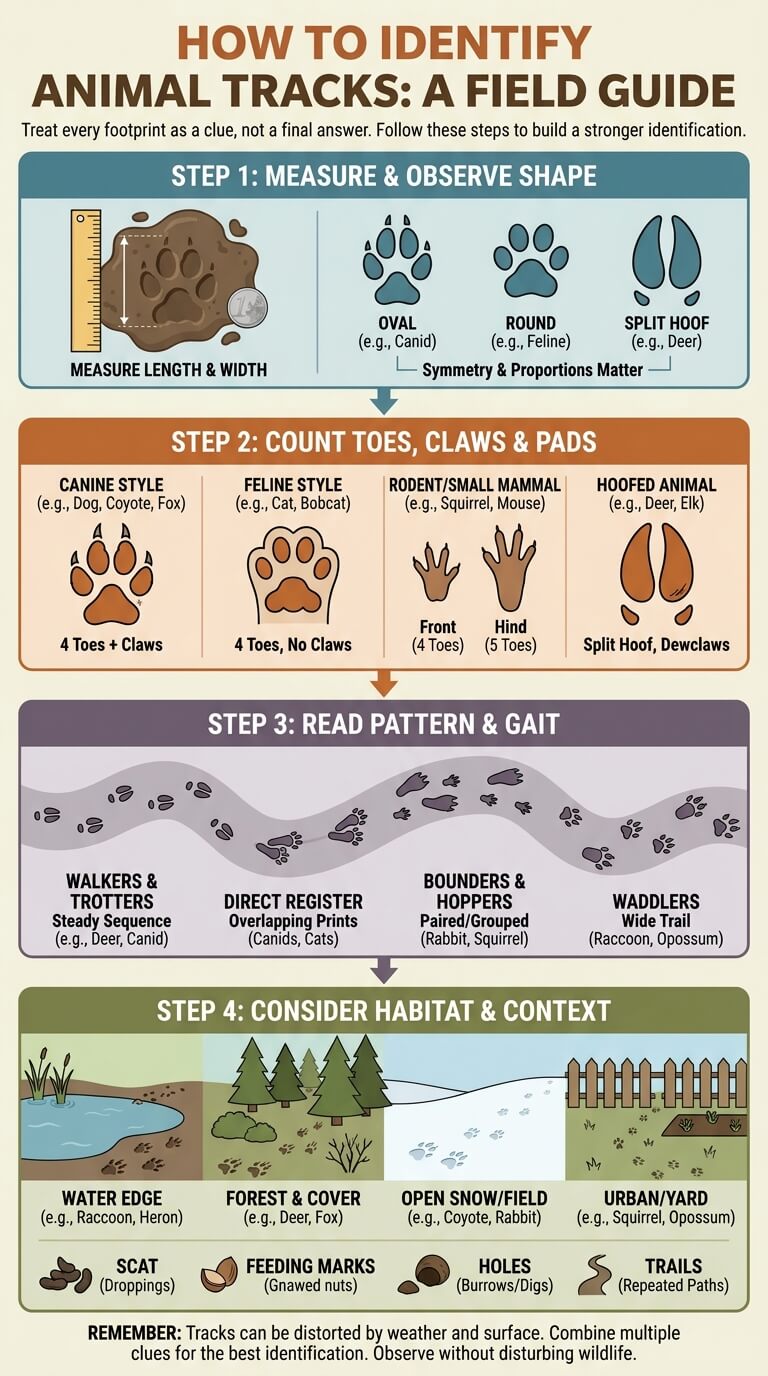
To identify animal tracks, look at six things in order: size, overall shape, number of toes, claw or nail marks, foot pads or hoof shape, and the repeating pattern made by several steps. Then use the habitat and other signs to narrow the possibilities.
A practical field checklist looks like this:
- Measure the track length and width at the clearest point.
- Notice whether the print is round, oval, long, handlike, birdlike, or split into hooves.
- Count visible toes on the front and rear feet if you can tell them apart.
- Check whether claws show, but remember hard ground or soft snow can hide or exaggerate them.
- Look for pads, heel marks, webbing, tail drags, wing marks, or a trough in the snow.
- Follow the track pattern with your eyes to see whether the animal walked, trotted, bounded, hopped, or waddled.
- Ask whether the habitat makes sense for the animals on your shortlist.
The Maine Department of Inland Fisheries and Wildlife track poster shows why this checklist matters: similar-looking prints can become easier to separate when you compare size, direction, track pattern, and foot structure together.
Why Animal Tracks Can Be Hard to Identify
Animal footprint identification is harder in real life than it looks in a clean drawing. Field tracks are often smudged, partial, melted, windblown, stepped on, or stretched by a moving foot. A deer hoof can slide in mud. A dog print can expand in thawing snow. A raccoon toe may not press deeply enough to show. A fox track can look larger when the snow collapses around it.
Substrate is the tracking word for the surface that holds the print. Mud, snow, sand, dust, gravel, and leaf litter each record feet differently. Fine, damp mud may show toe pads and claws clearly. Deep snow may show only a hole and a rough direction. Sand can crumble at the edges. Dry soil may catch only the strongest pressure points.
That is why good tracking uses patterns instead of one perfect mark. A single print may be confusing, but a trail of ten prints often shows direction, stride, gait, and repeated foot placement. The Internet Center for Wildlife Damage Management notes that field tracks are often smudged or partial and may only narrow the list of possible animals rather than confirm one species instantly in its animal track identification guidance.
Instead of asking “What animal is this?” start with “What group could this belong to?” That shift makes the process more accurate. A four-toed print with claws and an oval shape may point toward a canid. A round four-toed print with no obvious claws may point toward a feline. A split mark with two main halves points toward a hoofed animal. A small group of larger hind-foot marks ahead of smaller front-foot marks may point toward a hopper or bounder.
Step 1: Look at Track Size, Shape, and Symmetry
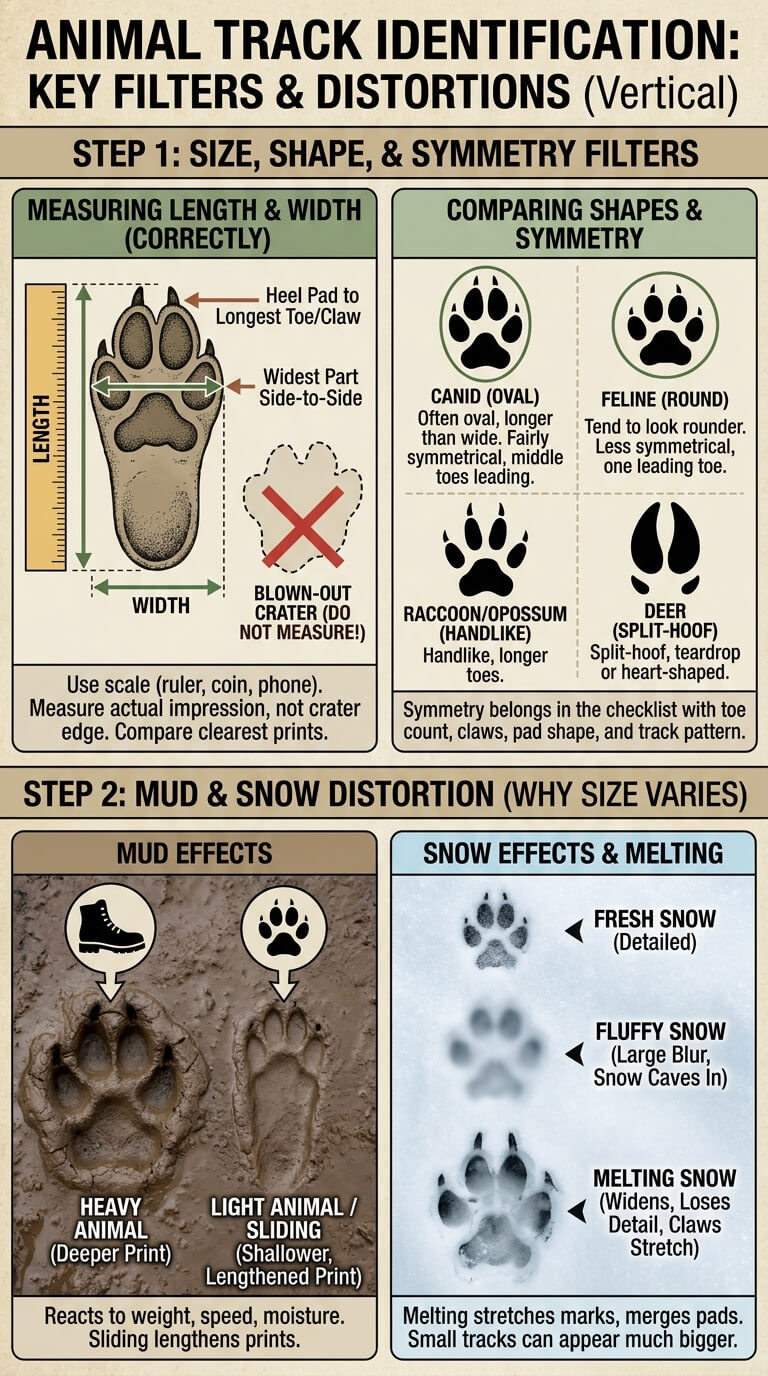
Size and shape are the first filters. They will not give you a final answer by themselves, but they can quickly remove animals that are too large, too small, or built with a very different kind of foot.
Measuring length and width correctly
Use a ruler, tape measure, coin, field notebook, or your phone beside the print for scale. Measure the longest part of the actual impression from the back of the heel pad or hoof to the front of the longest toe or claw mark. Then measure the widest part from side to side.
Do not measure the whole blown-out crater around the track unless the surface collapsed evenly and you cannot see the true edge. In snow, the top opening can be much wider than the pressure mark near the bottom. In mud, sliding can lengthen a print. If there are several prints, measure the clearest one and compare it with two or three others in the same trail.
Comparing round, oval, heart-shaped, and split-hoof prints
Overall shape is the next filter. Canid tracks often look oval or longer than wide, especially when the animal was traveling steadily. Feline tracks tend to look rounder. Raccoon and opossum tracks can look handlike, with longer toes. Deer tracks are usually split-hoof prints, often shaped like two narrow teardrops or a heartlike mark depending on angle, speed, and substrate.
Symmetry also helps. Many canid tracks look fairly symmetrical from left to right, with the two middle toes leading. Feline tracks often look less symmetrical because one toe sits slightly ahead of another. That does not mean symmetry alone proves dog, coyote, fox, or cat. It means symmetry belongs in the same checklist as toe count, claws, pad shape, and track pattern.
Why mud and snow can distort track size
Soft surfaces do not simply copy a foot. They react to weight, speed, temperature, moisture, and the angle of the step. A heavy animal walking through mud may leave a deeper print than a lighter animal with a similar foot shape. A small animal crossing fluffy snow may leave a large blur because the snow caves in around the leg.
Melting snow is one of the most common reasons beginners overestimate animal size. As snow warms, a small track widens and loses detail. Claw marks stretch. Toe pads merge into a rounded hole. A fox, squirrel, or house cat may suddenly appear much bigger than it really was.
Step 2: Count Toes, Claws, Pads, and Hooves
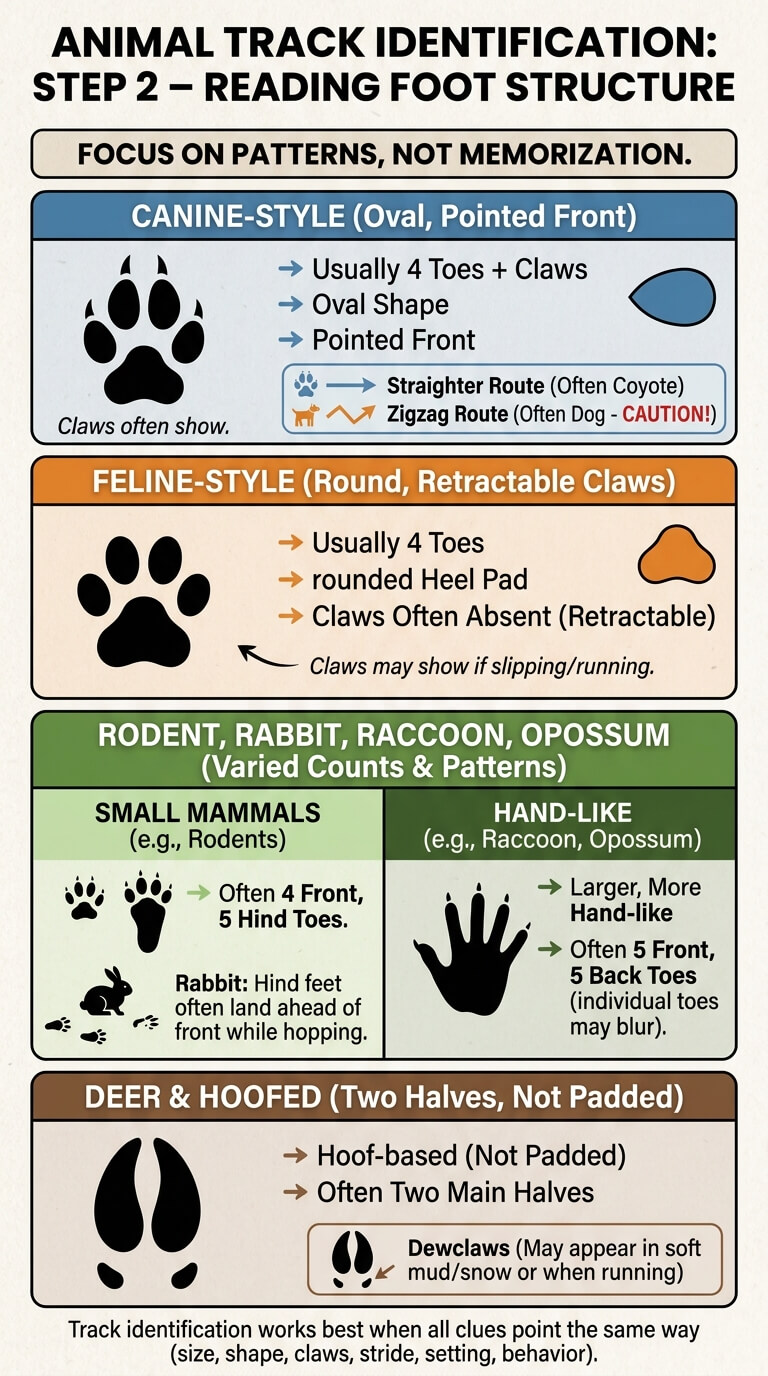
Foot structure is where animal tracks become more readable. Toe count, claw marks, pads, heel marks, hoof shape, and webbing help separate broad animal groups. The goal is not to memorize hundreds of species. The goal is to recognize useful patterns.
Canine-style tracks
Canine-style tracks usually show four toes on the ground and often show claw marks. Domestic dogs, coyotes, foxes, and wolves belong in this general group, though their size and trail patterns differ. Canid tracks are often more oval than feline tracks, and the front of the track may look pointed because the middle toes and claws press forward.
Look at the line of travel. The U.S. Fish and Wildlife Service snow tracks story explains that dog tracks can be hard to distinguish from coyote tracks, but dogs often zigzag while playing, whereas coyotes are more likely to travel in a straighter route.
That clue should still be used cautiously. A leashed dog may walk straight. A coyote investigating food smells may wander. Track identification works best when size, shape, claws, stride, setting, and repeated behavior all point the same way.
Feline-style tracks
Feline-style tracks usually show four toes and a rounded heel pad, and claw marks are often absent because cats have retractable claws. Bobcats, mountain lions, and domestic cats can leave this general design, though their track size, habitat, and stride differ greatly.
Do not assume “no claws” proves cat. Claw marks can fail to show in hard ground for many animals. Cats may also show claw marks if they slip, jump, run, turn sharply, or move on a slick surface. The better question is whether the whole track looks feline: rounder shape, toe arrangement, broad pad, and a trail pattern that matches a cat-sized animal moving through that place.
Rodent, rabbit, raccoon, and opossum-style tracks
Small mammal tracks can be confusing because front and rear feet may have different toe counts and sizes. Many rodents show four toes on the front feet and five on the hind feet. The University of Michigan BioKIDS track key describes several small mammals, including mice, voles, chipmunks, and squirrels, as having four front toes and five back toes, with claws that may not always register.
Rabbits and squirrels are often recognized less by one footprint and more by their pattern. A rabbit commonly places its larger hind feet ahead of its smaller front feet when hopping. Squirrels may leave paired or grouped tracks near trees, fences, decks, bird feeders, and fallen nuts. Tail drags, tiny nail marks, and repeated routes through snow can add context.
Raccoon and opossum tracks are larger and more handlike. The University of Michigan BioKIDS guide lists raccoons, opossums, and skunks among larger mammals with five front and five back toes, although individual toes may not all show clearly in every track.
Deer and other hoofed tracks
Hoofed tracks are often easier to sort into a broad group because the foot is not padded like a paw. White-tailed deer, mule deer, elk, moose, pronghorn, sheep, goats, cows, and horses leave hoof-based tracks, but which ones are possible depends heavily on region and setting.
Deer tracks are common in many parts of the United States. They often show two main hoof halves. In soft mud or snow, dewclaws may appear behind the main hoof, especially if the animal is running, jumping, moving downhill, or stepping into deep substrate. Dewclaw marks can make a track look larger or more complex than a simple field guide drawing.
Step 3: Read the Track Pattern, Stride, and Gait
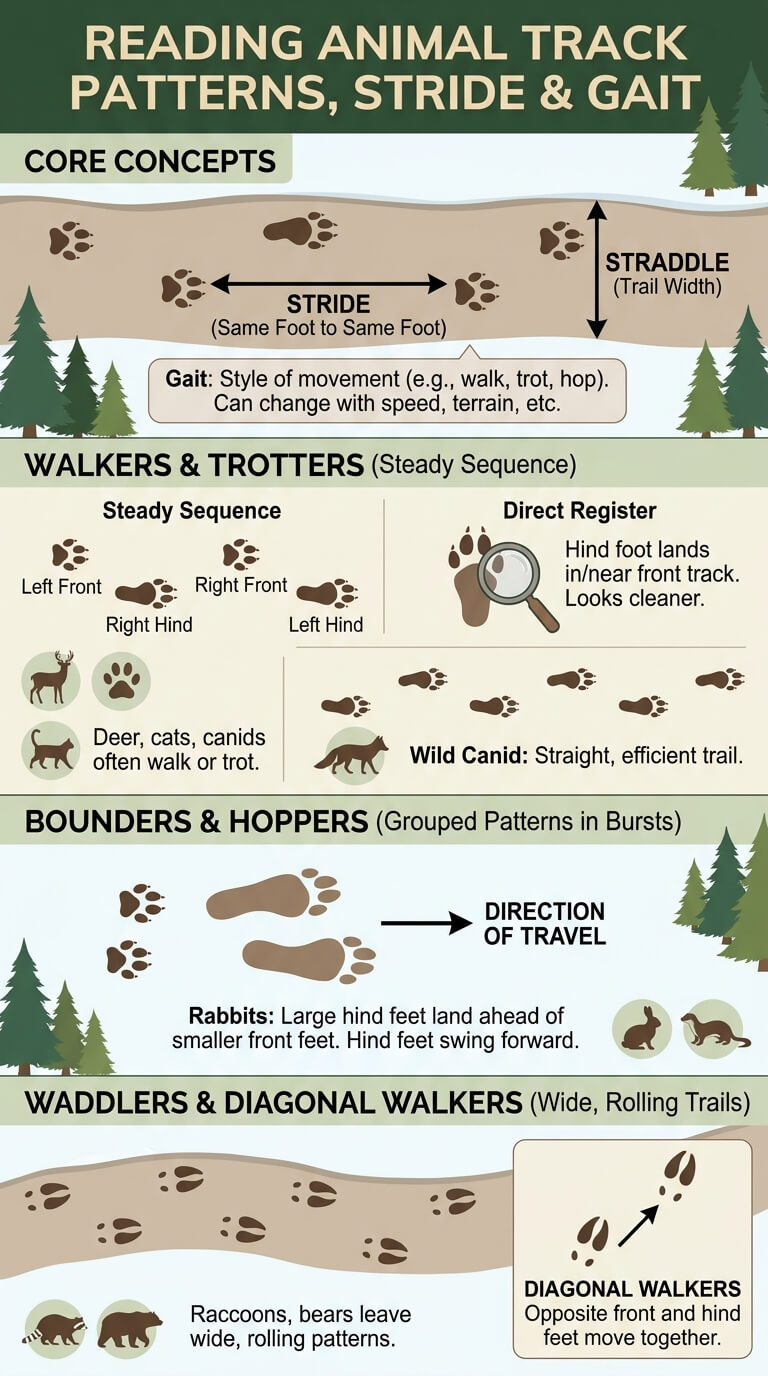
A track pattern is the trail made by multiple steps. It can be more useful than the neatest single print because it shows how the animal moved. Stride is the distance between repeated footfalls, often measured from one print to the next print made by the same foot. Straddle is the width of the trail from side to side.
Gait means the style of movement, such as walking, trotting, hopping, bounding, or waddling. Gait can change with speed, alarm, snow depth, terrain, injury, and behavior, so it should not be treated as a fixed label. Still, many animal groups use common patterns when moving normally.
Walkers and trotters
Walkers place feet in a steady sequence. Deer, cats, canids, and many other mammals walk or trot when traveling from place to place. A direct register happens when a hind foot lands in or very near the track made by the front foot on the same side. This can make the trail look cleaner than four separate footfalls.
Canids often trot efficiently when traveling. A wild canid trail may form a straighter line than the loose wandering pattern of a playful domestic dog. Cats may also place feet carefully, especially when stalking or moving through cover.
Bounders and hoppers
Bounders and hoppers leave grouped patterns because their bodies move in bursts. Rabbits often place their large hind feet ahead of the smaller front feet. Squirrels and chipmunks may leave grouped prints near trees or logs. Weasels, mink, and similar animals can leave paired or bounding patterns, especially in snow.
These patterns can look backwards at first. In a rabbit trail, the bigger hind tracks are usually in front of the smaller front tracks because the hind feet swing forward as the animal pushes off. Direction of travel is easier to read after you learn that pattern.
Waddlers and diagonal walkers
Waddlers often leave wide, side-to-side trails. Raccoons, opossums, skunks, porcupines, and bears can produce track patterns that look less narrow than a fox or coyote trail. Their body shape, foot placement, and pace can create a rolling pattern across mud or snow.
Diagonal walkers move opposite front and hind feet in a coordinated way, which can create alternating patterns. Many mammals can use diagonal walking at slow speeds, but the resulting trail varies by body shape and step length.
Step 4: Use Habitat and Nearby Clues Without Guessing Too Fast
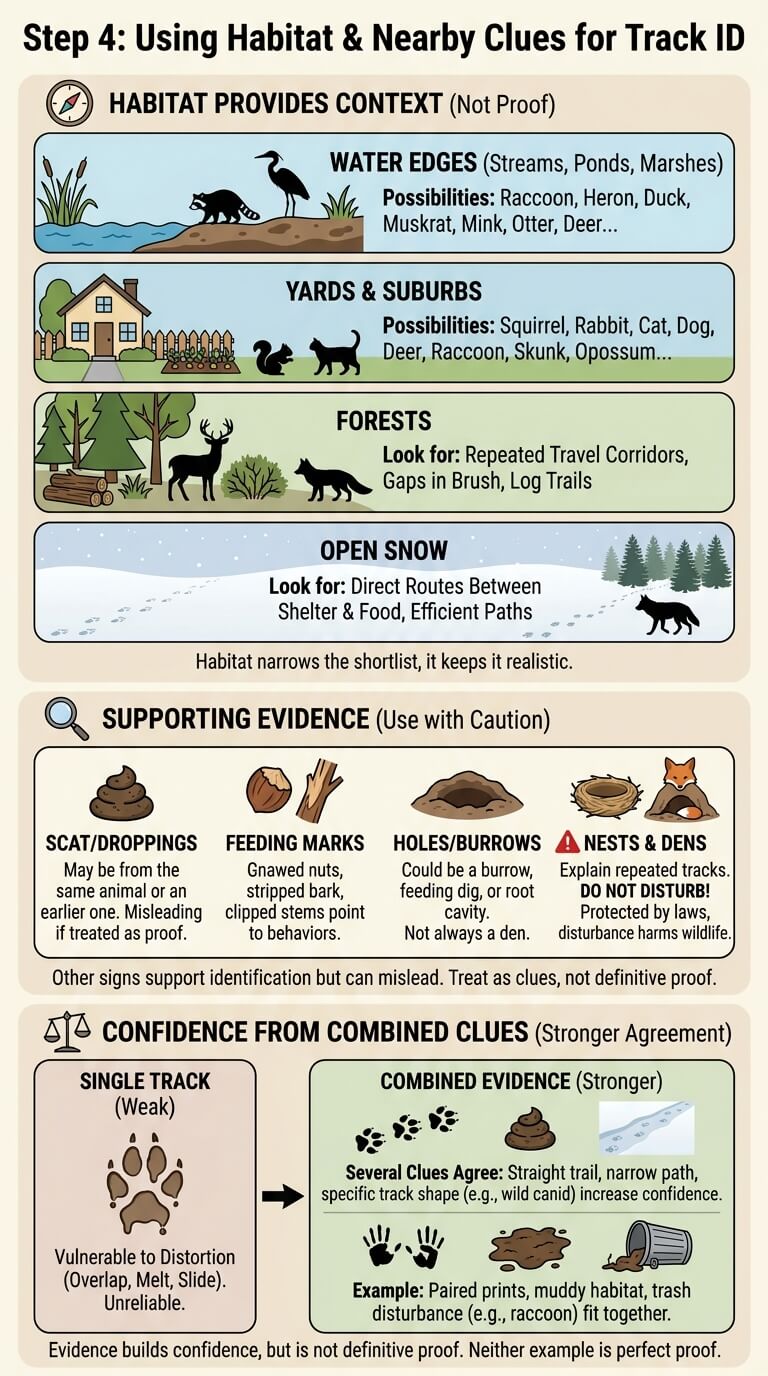
Habitat helps because animals do not appear randomly. A muddy creek bank, a snowy suburban driveway, a sandy beach, a forest trail, a farm lane, and a backyard compost area invite different possibilities. Habitat does not prove the animal, but it keeps your shortlist realistic.
Trails, water edges, yards, forests, and snow paths
Start with where the track was found. Tracks near streams, ponds, marshes, and shorelines may include raccoons, herons, ducks, geese, muskrats, mink, otters, deer, dogs, and many other animals depending on region. Tracks around yards may include squirrels, rabbits, cats, dogs, deer, raccoons, skunks, opossums, and rodents.
In forests, look for repeated travel corridors: gaps in brush, narrow paths under fences, tracks along fallen logs, and trails between cover and feeding areas. In open snow, look for direct routes between shelter and food. Animals often choose efficient paths, but they also follow scent, avoid exposure, and use cover.
Scat, feeding marks, holes, and nests as supporting evidence
Other signs can support track identification, but they can also mislead you if you treat them as proof. Droppings near a track may be from the same animal, or they may have been left earlier by a different one. A hole near paw prints may be a burrow, a feeding dig, a root cavity, or damage from tools, weather, or pets.
Feeding marks can be useful. Gnawed nuts, stripped bark, clipped stems, dug grubs, scattered feathers, opened shells, and overturned stones can point toward certain behaviors. Nests and dens can also explain repeated tracks, but do not disturb them. Many animals are protected by state or federal laws, and disturbance can harm eggs, young, or resting wildlife.
Why one track should be treated as a clue, not proof
A single print is vulnerable to distortion. It may be a front foot only, a hind foot only, an overlap of two feet, a melted track, a sliding hoof, or a print partly stepped on by another animal. It may even be a non-animal mark that happens to resemble a footprint.
Confidence increases when several clues agree. For example, a line of oval four-toed tracks with claw marks, a narrow steady trail, and a straight route across open snow may fit a wild canid better than a wandering pet dog. A set of handlike five-toed prints near a muddy creek, with paired foot placement and trash-can disturbance nearby, may fit raccoon. Neither example is perfect proof, but the combined evidence is stronger than one mark.
Common Track Identification Mistakes
Most mistakes come from moving too fast. Beginners often jump from one feature to a species name, especially when the track looks exciting. Slow comparison is more reliable.
Mistaking dog tracks for coyote or fox tracks
Dog, coyote, and fox tracks are among the most common sources of confusion in the United States. They can all show four toes and claw marks. Their print shape can overlap, especially in poor substrate. Small dogs may look fox-sized. Large dogs may create tracks that seem wild in snow or mud.
Look for the whole trail. Domestic dogs often wander, circle, stop, turn, and zigzag because they are exploring smells or playing. Coyotes and foxes may travel more efficiently when moving between places, but they can also investigate scent and food. Track pattern is helpful, not absolute.
Mistaking melted snow tracks for large animals
Melted snow makes tracks grow. Sun, warmth, rain, and refreezing can widen toe marks and erase claw details. A squirrel track can become a blob. A cat print can look like a larger carnivore. A bird track can lose its thin toe lines and turn into a strange star shape.
Check the snow surface around the track. Are edges rounded and soft? Is the track wider at the top than at the bottom? Are nearby boot prints also enlarged? If human footprints look melted and expanded, animal tracks probably are too.
Ignoring scale, direction, and repeated patterns
Photos without scale are hard to use later. A print may look big in a close-up and small in the field. Place a ruler, coin, key, or gloved hand beside the track without damaging it. Take one photo straight down and another from a low angle to show depth and direction.
Direction matters because some patterns look confusing until you know which way the animal traveled. In rabbit tracks, the large hind feet often land ahead of the front feet. In a direct-register trail, hind feet may land on top of front feet, making a trail look simpler than the actual foot sequence.
Repeated patterns are the strongest beginner clue. One odd print may be a mistake. Ten similar prints moving across the same surface give you a better story.
Tricky Cases and Exceptions
Some tracks resist neat identification. That is normal. Field tracking is partly about knowing when the evidence is too weak for a confident answer.
Partial tracks
A partial track may show only toes, only a heel pad, one hoof half, or a smear. It can still be useful if it appears in a longer trail. For example, repeated two-part hoof marks can point toward deer even if each individual print is incomplete. Repeated four-toed paw marks with claw points can point toward a canid-style track even if the pads are blurry.
Overlapping tracks
Overlapping tracks happen when one foot lands partly on another track, or when several animals use the same trail. A dog may step over deer tracks. A raccoon may walk through bird tracks at a pond edge. A hiker may crush half a fox trail before anyone notices it.
Look for the freshest edges and the most repeated pattern. If two kinds of tracks cross, compare depth, sharpness, and direction. A track on top of another is usually newer, but mud, snow, and wind can complicate that reading.
Juvenile animals and unusually small prints
Young animals leave smaller prints than adults, and adult animals vary in size by sex, age, species, and region. A small print does not automatically mean a small species. A juvenile raccoon, fox, skunk, rabbit, or deer can produce tracks that do not match adult-size examples.
Domestic animals add another complication. Dog breeds vary enormously in paw size and shape. Outdoor cats can overlap with wild cat tracks in some settings. Livestock and escaped domestic animals can also confuse track reading near rural properties.
Supporting Clues That Help Confirm Tracks
Track reading improves when you combine footprints with the rest of the scene. The same field method can be used on a hiking trail, in a schoolyard after snow, along a creek, or in a backyard garden.
When common US track examples help
Common examples are useful for learning patterns. Deer tracks teach split hooves. Dog and coyote tracks teach canid structure. Cat and bobcat tracks teach rounder paw prints and reduced claw marks. Raccoon tracks teach handlike toes. Rabbit and squirrel tracks teach hopping and bounding patterns.
But examples should not replace local knowledge. A printed guide for Maine, Arizona, Alaska, or Florida will not perfectly match every animal in every state. Use local wildlife agency materials when possible, especially for large carnivores, hoofed animals, and species that have limited ranges.
When droppings, holes, and cameras add context
Droppings can show what animals are using an area, but they require safety caution. Holes can show digging, nesting, feeding, or shelter, but they can also be old or abandoned. Trail cameras can add useful context because they show the animal directly, especially when tracks appear repeatedly in the same place.
Whether you use a field guide, camera, or notebook, keep the same safety rule: observe without crowding, baiting, cornering, or trying to touch wildlife. Tracks are a way to learn from animals without interfering with them.
FAQ
How can you tell if a track is from a dog or a wild canine?
Start by looking for four toes, claw marks, overall oval shape, and the trail pattern. Domestic dogs often leave more wandering or zigzagging trails, especially when off leash and exploring. Coyotes and foxes may travel in a straighter, more efficient line when moving between places. Still, this is not proof by itself. A leashed dog can walk straight, and a wild canid can wander while investigating scent. Use size, shape, stride, location, and repeated tracks together before calling it likely.
What animal tracks show four toes?
Many animals can show four toes in a track. Canids such as dogs, coyotes, and foxes usually show four toes and often claw marks. Felines such as domestic cats and bobcats also usually show four toes, but claw marks are often absent or faint. Some rodents show four toes on the front feet and five on the hind feet, so a track series may show both counts. Toe count is useful, but it should be combined with pads, claws, size, shape, habitat, and track pattern.
What is the best way to photograph animal tracks for later ID?
Take at least three photos. First, photograph one clear print straight down with a ruler, coin, or other scale object beside it. Second, photograph the track from a low angle so the depth and edges are visible. Third, photograph the trail pattern from several feet away so direction and spacing are clear. Avoid stepping on the trail before photographing it, and do not place your hand in or on the track. Notes about location, surface, weather, and nearby signs can be just as helpful as the image.
Final Thoughts
How to identify animal tracks is really a method, not a guessing game. Measure the print, study its shape, count toes, look for claws or hooves, read the repeating pattern, and compare the evidence with the habitat around it. The more clues that agree, the stronger your identification becomes.
The most reliable trackers are cautious observers. They know when a track is clear, when it is only a possibility, and when the surface has distorted the evidence too much to call. That careful mindset makes wildlife tracking more accurate, safer for people, and better for the animals whose quiet movements you are learning to read.

Ethan Walker is the founder and research editor of Animal Fact Central. He creates and reviews educational animal facts content using trusted wildlife, pet care, and science-based sources. His work focuses on making animal behavior, adaptations, habitats, and species facts clear, accurate, and engaging for everyday readers.
Read More Details About Ethan Walker: https://animalfactcentral.com/ethan-walker/