

Animal tracks and signs are clues wild animals leave behind when they move, feed, rest, dig, nest, or pass through after dark. A single footprint in mud can be interesting, but it is only one piece of a larger story. The best clues usually come from a pattern: where the mark was found, what shape it has, how fresh it looks, and whether the habitat makes sense.
For a beginner, the goal is not to name every species instantly. Slow down and read the scene safely. Hoofprints near a field edge, pellets under shrubs, bark stripped from a sapling, a round hole beside a fence, and nighttime camera images can each reveal a different part of animal life.
Good wildlife observation also has limits. Wild animals should not be chased, fed, cornered, touched, or forced out of shelter just to confirm an identification. The U.S. Fish and Wildlife Service wildlife viewing advice recommends giving animals space, avoiding nesting and denning areas, and never feeding wildlife.
Quick Overview
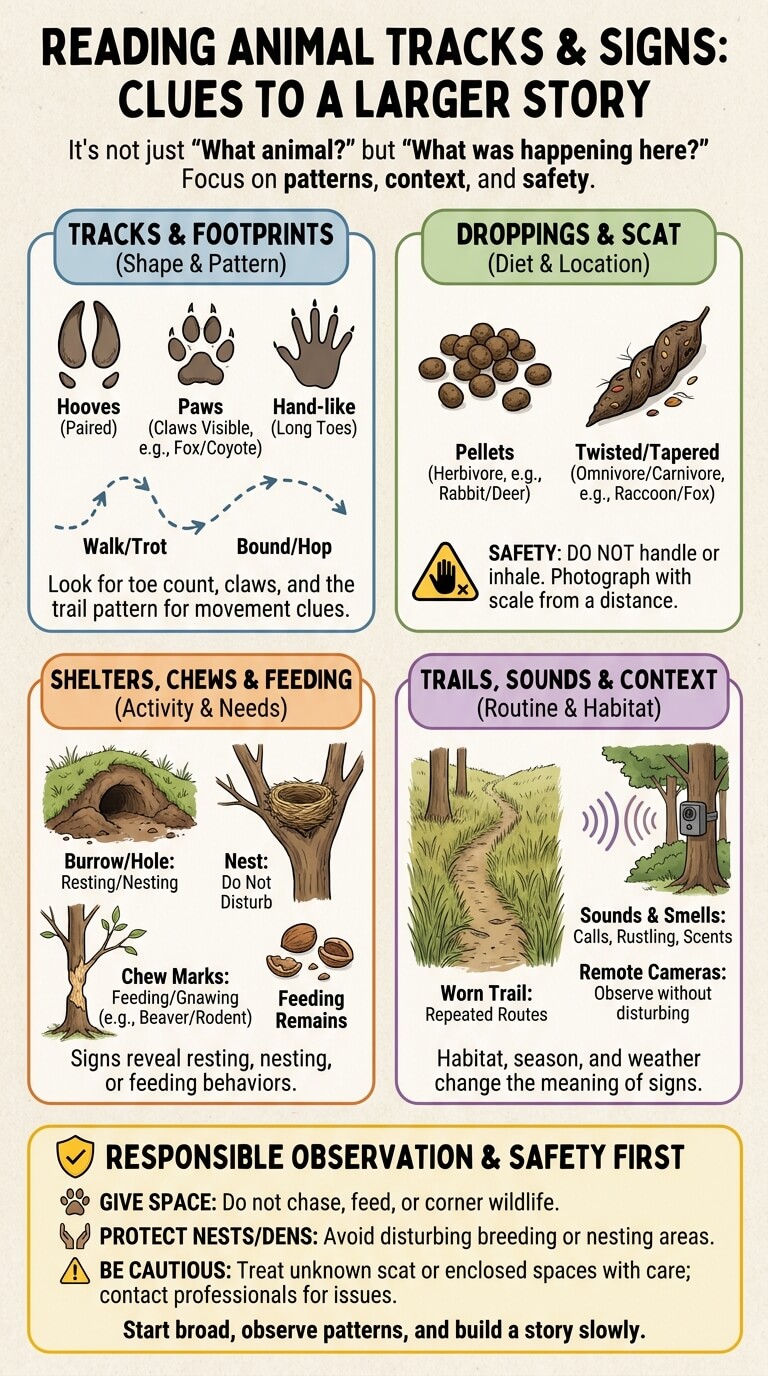
Animal signs are physical or sensory evidence of wildlife activity. Tracks are the most familiar sign, but they are only one category. Droppings, nests, burrows, scratch marks, rubs, feeding remains, shed fur, feathers, chewed plants, trails through grass, and repeated noises can all point to an animal’s presence.
The most useful question is not simply, “What animal made this?” A better first question is, “What was happening here?” The animal may have been traveling to water, looking for insects, caching food, nesting, or using a sheltered route between cover and feeding areas.
Beginners often do best by sorting clues into broad groups before naming a species. Was the animal walking on padded feet, hooves, claws, or webbed feet? Is the sign on a tree, in soil, near water, beside a trash can, or along a fence? Does it suggest feeding, digging, nesting, resting, or repeated travel?
What Counts as an Animal Sign

An animal sign is any clue that shows an animal has used a place. Some signs are obvious, like footprints across snow. Others are subtle, like a faint tunnel under matted grass or a narrow path where deer repeatedly pass through brush.
Tracks and footprints
Tracks are impressions left by feet, hooves, claws, tails, wings, or dragging body parts. Mud, snow, wet sand, dusty soil, and soft streambanks can all hold prints. The clearest tracks usually form where the surface is firm enough to keep a shape but soft enough to register detail.
A track can show foot structure. Hoofed animals such as deer leave paired hoof marks. Many canids, such as foxes and coyotes, often show four toes and claw marks. Raccoons may leave handlike prints with long toes, while squirrels and rabbits often show patterns that reflect hopping or bounding movement.
Track patterns can be as important as track shape. A straight, narrow line of prints may suggest purposeful travel. A scattered set of marks can suggest feeding, digging, playing, or searching. A clear animal footprints guide usually starts with toe count and shape, but the bigger clue is the whole trail.
Droppings and scat
Droppings, also called scat in wildlife tracking, can reveal diet and general animal type. Pellet-like droppings may suggest herbivores such as deer or rabbits, while twisted or tapered scat with hair, seeds, or insect parts may point toward an omnivore or carnivore. The location matters too. Droppings on a log, along a trail, at a den entrance, or under a roost can have different meanings.
Scat is useful, but it should be treated as a health and safety clue, not a thing to handle. Rodent droppings are a special concern in enclosed spaces such as sheds, cabins, garages, and barns. The CDC guidance on cleaning up after rodents warns against sweeping or vacuuming rodent urine, droppings, or nesting materials because that can stir contaminated particles into the air.
For outdoor observation, photograph droppings from a safe distance if needed and note the size, shape, contents, and location. Do not smell scat closely, break it apart with your hands, or let children or pets investigate it.
Burrows, holes, nests, chew marks, and rubs
Holes and burrows are among the most common backyard animal clues, but they are also easy to misread. A hole may be a true living space, a temporary escape route, a feeding dig, a collapsed tunnel, or a place where an animal searched for insects, roots, bulbs, or cached food. The size of the opening, the soil pile, nearby tracks, and repeated use all matter.
Nests are another sign of animal activity, especially for birds, squirrels, wasps, and some small mammals. Bird nests require extra caution. In the United States, many native bird nests, eggs, and young are protected by law, and active nests should not be disturbed. The U.S. Fish and Wildlife Service bird nest guidance explains that destroying a nest with eggs or chicks can violate federal protections for migratory birds.
Chew marks can show feeding or gnawing behavior. Beavers leave distinctive cuts on woody stems near water. Rabbits and deer may browse twigs and garden plants. Rodents may gnaw wood, plastic, insulation, or stored material.
Sounds, smells, trails, and camera evidence
Not every animal sign is something you can pick out of mud. Sounds can matter: chipmunks scolding, owls calling, woodpeckers hammering, squirrels rustling in leaves, frogs calling near water, or raccoons moving in an attic. Smell can also be a clue, especially with skunks, fox scent marks, or strong odors near dens, but you should never lean close to unknown material to investigate.
Trails through grass, repeated paths under fences, flattened vegetation, and narrow tunnels under snow can show regular movement. These signs are often more useful than a single mark because they show repeated behavior. A lightly worn path from brush to a bird feeder, for example, may say more about animal routine than one blurred print in dry soil.
Remote cameras can add another layer of evidence. Utah State University Extension notes that trail cameras are motion-triggered devices used for personal observation, education, and documenting biodiversity around homes and gardens in its trail camera overview. Camera placement should still avoid disturbing nests, dens, or private property.
The Wildlife Clue Framework

A practical way to read wildlife signs is to combine place, shape, pattern, and timing. This keeps you from relying on one clue too heavily. Instead of saying, “This is definitely a raccoon,” you might say, “This looks like a medium-sized mammal using the fence line at night.”
Location and habitat clues
Habitat narrows the possibilities. A track beside a marsh, pond, or creek points toward animals that use water, such as raccoons, herons, muskrats, beavers, otters, or deer. A hole in a sunny lawn may suggest a different set of animals than a hole under a woodpile. A chewed sapling beside water is not the same clue as clipped stems in a vegetable garden.
Location also includes human features. Fences, decks, sheds, compost piles, bird feeders, woodpiles, gardens, and trash cans can attract or funnel wildlife. A brush line between a lawn and woods may collect tracks from rabbits, deer, foxes, raccoons, squirrels, and neighborhood cats.
Season changes the meaning of habitat. Snow can reveal travel paths that are invisible in summer. Spring may bring nesting birds and fresh digging. Fall may bring feeding signs around nuts, fruits, and stored food.
Size, shape, pattern, and repeated behavior
Size is useful, but only when measured carefully. A print can look larger when mud slumps, snow melts, sand crumbles, or the animal steps into an older track. If you can photograph a ruler, coin, or other safe scale beside the mark without touching it, the image becomes easier to interpret later.
Shape gives stronger clues. Count visible toes, look for claw marks, note whether the heel pad is round or triangular, and compare front and hind prints if both are present. Some animals have front feet that differ from hind feet. Others place a hind foot partly on top of the front track, creating a confusing merged print.
Pattern reveals movement. Walking, trotting, hopping, bounding, and loping can leave very different arrangements. Rabbits often leave a pattern where larger hind feet land ahead of the smaller front feet. Repeated behavior is one of the strongest clues because animals often use the same routes if they feel safe.
Freshness, weather, and season
Freshness is an estimate, not a guarantee. Sharp edges in mud or snow can suggest a recent mark, while softened edges may mean wind, melting, rain, foot traffic, or time has changed the sign. In very cold weather, snow can preserve older tracks. In warm weather, mud may dry and crack quickly.
Weather can create false clues. Raindrops can pit soil. Melting snow can enlarge prints. Leaves can scrape mud as they blow. Human shoes, dog paws, bicycle tires, and garden tools can overlap with animal signs. A good observer treats weather as part of the evidence, not as background.
Season also affects animal movement. Breeding, nesting, dispersal, migration, food availability, and winter shelter needs can all change where signs appear. A yard that shows squirrel digging in fall may show rabbit browsing in winter and bird nesting clues in spring. The place is the same, but the animal story changes.
Key Facts Readers Should Know Before Identifying Wildlife
Wildlife signs are clues, not courtroom evidence. Even experienced trackers can disagree when signs are partial, old, distorted, or mixed with human activity. A careful answer is often more accurate than a confident one.
One clue is rarely enough
A single clue can suggest a possibility, but several clues create a stronger interpretation. A handlike track in mud may point toward raccoon, but droppings nearby, a path to water, overturned stones, and nighttime camera evidence would make the case stronger. A round lawn hole may suggest digging, but surrounding soil, tunnel ridges, plant damage, and repeat activity help separate moles, voles, skunks, squirrels, armadillos, or other causes depending on the region.
The same principle applies on trails. A print, a scat pile, a feather, and a disturbed patch of leaves should be read together. UNH Extension encourages beginners to slow down, listen, and look for signs such as tracks, disturbed soil, holes, chewed leaves, scat, and scratch marks in its activity on finding animal signs. That broad observation habit is more reliable than jumping to a species name from one mark.
Similar animals can leave similar signs
Many animals overlap in size, diet, and behavior. Fox and coyote tracks can confuse beginners. Domestic dog tracks can look like wild canid tracks, especially when prints are partial. Deer and feral hog tracks can overlap in some regions. Squirrel digs and bird foraging marks may be hard to separate in loose mulch.
Similar signs do not mean the animals are doing the same thing. A skunk may dig shallow holes while searching for grubs. A squirrel may dig to bury or retrieve food. A raccoon may turn over objects while searching for invertebrates. A dog may dig for play, scent, or escape. The mark alone is not the whole behavior.
Regional range matters too. An animal must live in your area or plausibly pass through it before it becomes a likely answer. Before assuming a rare animal made a track, compare the sign with common local wildlife, pets, livestock, and human activity.
Safety comes before curiosity
Animal signs can lead you toward places where animals rest, nest, den, feed young, or hide from people. That is exactly why caution matters. Do not reach into holes, lift boards without care, peer into dens at close range, or let pets investigate unknown droppings. If you suspect an animal is sick, trapped, injured, or living inside a home, contact a licensed wildlife professional, local animal control, or the appropriate state wildlife agency.
Safety also protects the animal. Repeated visits to a nest or den can create stress or draw predators. Feeding wildlife can change behavior and increase conflict.
How Animals Leave Clues While Feeding, Moving, Nesting, and Sheltering

Most signs come from basic survival needs. Animals must find food, move between safe places, rest, avoid danger, communicate, and raise young. Once you think in those categories, scattered clues become easier to organize.
Feeding signs and chew patterns
Feeding signs can include clipped stems, stripped bark, gnawed nuts, opened cones, dug-up bulbs, torn fruit, scattered feathers, insect holes in wood, or fish remains near water. These clues can suggest diet and feeding style, but they rarely provide perfect certainty by themselves.
Chew marks often reflect body structure. Rodents have incisors that grow continuously and leave paired gnaw marks. Deer lack upper front incisors, so browsed twigs may look torn or ragged compared with a cleaner cut. Rabbits can clip small stems close to the ground. Beavers often leave angled cuts on woody plants near water. These examples are useful patterns, but plant texture, age, weather, and other animals can change the final look.
Feeding signs can also reveal timing. Freshly chewed stems or moist wood chips point to recent activity. Old, dry material may show past use of the area rather than a current problem.
Movement paths and travel corridors
Animals often move through the landscape in repeatable ways. They may follow stream edges, fence lines, hedgerows, fallen logs, drainage ditches, game trails, garden edges, or the sheltered side of buildings. These routes reduce exposure and connect food, water, and cover.
A path can show size and habit. A narrow tunnel under grass may suggest small mammals. A low opening under a fence may suggest repeated passage by an animal that squeezes through. Pawprints across a driveway may be less useful than seeing where the animal entered and where it went next.
Movement signs are especially helpful in snow. Fresh snow can reveal routes between shrubs, bird feeders, compost piles, woodpiles, and water. However, snow can also distort prints quickly, so track patterns and direction can matter more than fine toe details.
Shelter clues such as holes, nests, and dens
Shelter signs often raise the biggest questions because they can appear near homes. A hole under a deck, a nest in a gutter, scratching in a wall, or a burrow near a shed can suggest animals seeking warmth, cover, food access, or a protected place to raise young.
Do not block an active hole without knowing whether animals are inside. Blocking a den or nest can trap animals, separate young from adults, or push wildlife into living spaces. The safer approach is to observe from a distance, identify activity patterns, and use professional help when a home, attic, chimney, or crawl space may be involved.
Bird nests deserve special restraint. If a nest is active, avoid moving it, handling eggs or young, or repeatedly approaching it. If a nest is in a risky place, such as a vent or high-traffic doorway, contact a local wildlife rehabilitator, state wildlife agency, or qualified professional for legal and safe next steps.
Common Myths and Misunderstandings About Animal Signs
Beginner tracking is full of easy mistakes because animal signs feel like puzzles. A clue can be exciting, but excitement should not outrun the evidence. The most common mistakes come from overvaluing size, ignoring safety, or assuming every hole has one obvious owner.
Why footprint size alone can mislead
A footprint is not a perfect stamp. Mud can spread under pressure. Snow can melt and enlarge the outline. Wet sand can collapse at the edges. A hind foot can land over a front foot. An animal can slip, turn, run, or step on uneven ground. Any of these can change the apparent size.
Scale also depends on how you photograph the sign. A close-up without a reference object can make a small print look huge. A print at an angle can make the toes appear longer or shorter. For serious observation, take one close photo and one wider photo showing the path, nearby habitat, and safe scale.
Size is still useful, but it should be paired with shape, pattern, and location. A large dog track in a neighborhood may be more likely than a wolf track. A blurred hoofprint near a farm may not be a wild deer. The ordinary explanation is often worth checking first.
Why droppings should not be handled casually
Droppings are tempting to inspect because they can contain seeds, hair, insect parts, or plant material. But handling scat is not worth the risk for casual identification. Some droppings can carry parasites or pathogens, and dry material can break apart or become airborne.
If droppings are outdoors and not in a place where people or pets contact them, observation may be enough. If droppings are in a home, shed, garage, attic, or other enclosed area, treat the situation as a cleanup and safety concern rather than a simple animal puzzle. Use official health guidance or professional help, especially when the amount is large or the animal is unknown.
Pet safety matters too. Dogs may sniff, roll in, or eat wildlife scat. Keep pets away from unknown droppings and contact a veterinarian if a pet becomes sick after possible exposure.
Why a hole does not always mean the same animal made it
Holes are easy to mislabel. One animal may dig the hole, another may enlarge it, and a third may use it later. Rain can collapse the entrance. Roots can leave gaps. Burrowing insects, rodents, armadillos, skunks, groundhogs, crayfish, moles, voles, and other animals can all create or modify holes depending on the region and habitat.
The soil pile is a clue. A fan-shaped mound, a plug of loose soil, a raised tunnel, or no mound at all can each suggest different activity. The surroundings matter too. A hole in a lawn, a creek bank, a mulch bed, a tree cavity, and the base of a foundation are not the same kind of clue.
Before taking action, watch for repeated use. Are there fresh tracks? Does the hole change overnight? Are plants being clipped? If the hole is near a structure or could contain young animals, avoid sealing it without professional advice.
Where a Beginner Can Go Deeper
A broad understanding of animal tracks and signs helps you decide what kind of information you need next. Sometimes you need a careful track comparison. Sometimes you need safety guidance. Sometimes the most useful clue is a nest, a hole, a smell, a camera photo, or a pattern of backyard damage.
When a track deserves a closer look
A track deserves closer study when it is clear, repeated, and found with a trail pattern. That is when toe count, claw marks, pad shape, stride, and gait become more useful. A single muddy print under a bird feeder may be interesting, but a line of prints crossing a creek bank can show direction and movement.
Clear tracks are useful for learning broad groups. Hooves, paws, handlike prints, webbed feet, and hopping patterns each point you toward a different set of animals. Beginners should also stay open to pets, livestock, and human-made marks.
When droppings or nests require caution
Droppings and nests are clues with stronger safety boundaries. Droppings in living spaces, sheds, barns, or garages may need careful cleanup. Nests with eggs or young should be left alone unless a qualified person advises otherwise. The goal is to learn without creating risk for people, pets, or wildlife.
Bird nests are easy to disturb accidentally. Use binoculars or a camera from a respectful distance when possible.
When holes, backyard mammals, or cameras add context
Backyard signs often make more sense when several clues are combined. A hole under a shed, shallow digs in the lawn, a musky odor, and nighttime movement are different clues than a neat burrow in an open field. Raccoons, squirrels, skunks, rabbits, groundhogs, moles, voles, armadillos, and domestic animals can all leave confusing evidence in yards depending on location.
A trail camera can help confirm patterns, but it should be used responsibly. Place cameras where they do not aim into neighbors’ private spaces, disturb active nests, block an animal’s path, or require baiting wildlife.
Beginner Field Checklist for Reading Wildlife Clues

The safest way to learn animal signs is to treat the site like a small investigation. Move slowly, record what you see, and avoid disturbing the clue. A good field habit is simple: observe, photograph, compare, and stay cautious.
Observe from a safe distance
Start by looking at the whole area. Notice water, cover, food sources, fences, buildings, trails, trees, shrubs, snow, mud, and human activity. Listen for birds, squirrels, frogs, insects, or rustling leaves. Watch for repeated routes rather than only the most dramatic mark.
Do not reach into holes, touch droppings, move nests, lift unknown carcasses, or follow fresh signs into dense cover. If an animal may be present, give it room to leave. If the sign is near a home entry point, chimney, attic, crawl space, or occupied nest, switch from curiosity to caution.
Photograph with scale and context
Take several photos if safe. One photo should show the close detail. Another should show the surrounding area. A third can show the line of travel. Place a scale object beside a track only if you can do it without touching droppings, nests, or the animal’s shelter. A coin, ruler, or gloved hand near the print can help, but the object should not damage the sign.
Write down the date, approximate time, weather, location, and what else was nearby. Was the ground wet or frozen? Did it rain overnight? Were there bird feeders, fruit trees, garbage cans, pet food bowls, water sources, or garden beds nearby? These details often matter more than memory.
Compare multiple signs before deciding
After you record the clue, compare it with several possibilities. Start with common animals in your area. Ask whether the habitat fits, whether the size is realistic, whether the trail pattern makes sense, and whether other signs agree. Be comfortable with “unknown small mammal,” “likely deer,” or “possible raccoon” when the evidence is incomplete.
Good tracking is patient. The more often you return to the same yard, trail, creek bank, or field edge, the more you learn what is normal there.
FAQ
What is the easiest animal sign to identify?
The easiest animal sign is usually a clear, repeated track pattern in fresh mud or snow, especially when it belongs to a common local animal. Deer hoofprints, rabbit hopping patterns, and raccoon-like handprints are often easier for beginners than blurred pawprints or old scat. Even then, the safest answer should include the setting, pattern, and nearby clues.
Can you identify an animal from one footprint?
Sometimes you can make a reasonable guess from one clear footprint, but one print is rarely enough for a confident identification. Mud, snow, overlapping steps, melting, and partial impressions can distort size and shape. A trail of prints, surrounding habitat, droppings, feeding signs, and repeated activity usually give a more reliable answer.
What should you do if you find unknown droppings in your yard?
Keep children and pets away from the droppings, do not handle them with bare hands, and avoid breaking them apart. If the droppings are outside in a low-contact area, a photo from a safe distance may be enough for identification. If they are in a home, shed, garage, attic, or other enclosed area, follow official cleanup guidance or contact a qualified professional, especially if rodents may be involved.
Final Thoughts
Animal tracks and signs turn ordinary places into readable wildlife stories. A muddy print, a chewed stem, a nest, a hole, a path through grass, or a nighttime camera photo can show how animals move, feed, shelter, and avoid danger. The best approach is careful and humble: use more than one clue, consider the habitat, respect safety limits, and leave wildlife undisturbed. With practice, you will not just ask which animal passed through. You will begin to understand what it was doing and why that place mattered.

Ethan Walker is the founder and research editor of Animal Fact Central. He creates and reviews educational animal facts content using trusted wildlife, pet care, and science-based sources. His work focuses on making animal behavior, adaptations, habitats, and species facts clear, accurate, and engaging for everyday readers.
Read More Details About Ethan Walker: https://animalfactcentral.com/ethan-walker/