

A dead animal in the wild does not stay unused for long. To people, a carcass may look like the end of a story. In nature, it becomes food for birds, mammals, reptiles, fish, crabs, beetles, flies, and many smaller organisms that turn leftover tissue back into energy for the living world.
Scavengers in nature are often misunderstood because their food seems unpleasant from a human point of view. Yet many ecosystems depend on them. They remove carrion, move nutrients through habitats, reduce leftover remains, and help connect predators, decomposers, and food webs. Without scavengers, dead animals would still break down, but the process would be slower, messier, and less available to the wider animal community.
Quick Answer
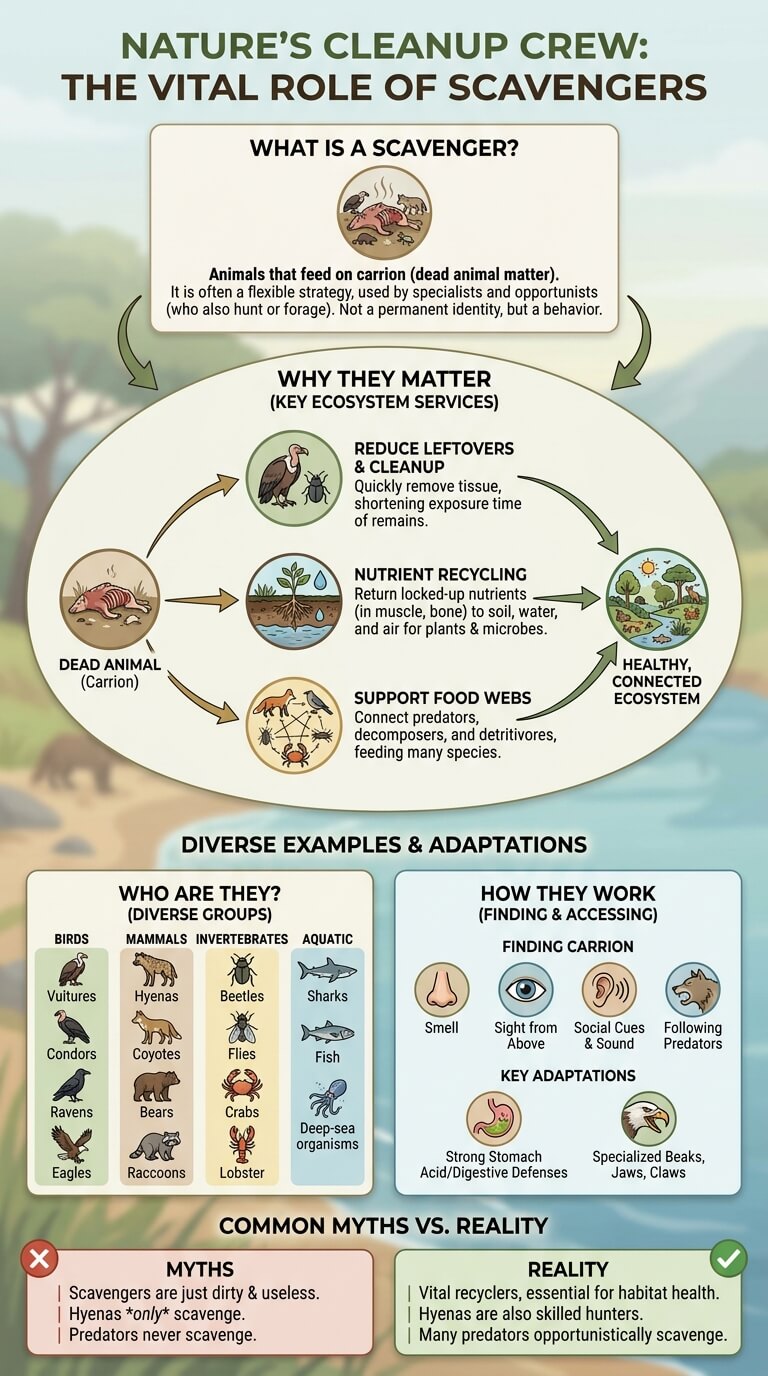
Scavengers are animals that feed on dead animals or leftover animal remains. Vultures, condors, hyenas, coyotes, bears, crabs, beetles, flies, and many fish can scavenge. They matter because they recycle nutrients, clean up carcasses, support food webs, and make carrion available to many other organisms.
What Is a Scavenger?

A scavenger is an animal that eats carrion, which means dead animal matter. Scavenging can be a main feeding strategy, as it is for many vultures, or it can be an occasional behavior used by animals that also hunt, forage, or eat plants. The important point is not whether the animal is famous for scavenging. It is whether the animal uses dead animal remains as food.
This makes scavenging more flexible than many people expect. Some animals are mostly scavengers. Others are opportunists that take carrion when it is safer or easier than catching live prey. A fox, gull, bear, crab, or fish may scavenge in one situation and hunt or forage in another.
Carrion and animal remains
Carrion is the flesh or body of a dead animal. It can come from many events: a predator’s unfinished kill, an animal that died from disease or old age, a fish washed onto a beach, a whale fall in the deep sea, a road-killed deer, or a nestling that did not survive. To scavengers, those remains are not waste. They are a temporary but valuable food opportunity.
Different scavengers use different parts of a carcass. Large birds may open soft tissue. Mammals may tear hide, break bones, or carry pieces away. Crabs and fish may pick at remains in water. Beetles, fly larvae, and other invertebrates may work on smaller pieces, dried tissue, skin, hair, feathers, and material left after larger animals have fed.
Scavenger vs predator vs decomposer
Scavengers, predators, and decomposers can all be involved with the same carcass, but they are not the same. A predator kills another animal for food. A scavenger eats an animal that is already dead or eats leftovers from a kill. A decomposer, such as certain bacteria and fungi, breaks down organic material chemically and helps return nutrients to soil, water, and air.
| Role | What it does | Simple example |
|---|---|---|
| Predator | Catches and kills live prey | A hawk catching a mouse |
| Scavenger | Feeds on dead animals or leftovers | A vulture feeding on carrion |
| Decomposer | Breaks organic matter down at a microscopic level | Fungi and bacteria acting on remains |
| Detritivore | Eats dead organic material, often in small pieces | Some worms, insects, and crustaceans feeding on detritus |
The roles overlap in real life. A beetle larva on carrion may be both a scavenging animal and part of the detritus-processing community. A coyote may hunt rodents but also eat a deer carcass. Nature rarely follows classroom categories perfectly.
Why scavenging is common in nature
Scavenging is common because catching live prey is risky and expensive. Hunting takes energy. It can fail. It can lead to injury. If an animal finds safe carrion, it may gain calories without the same chase, struggle, or danger.
Carrion is also unpredictable. It appears suddenly, changes quickly, and attracts competition. That is why many scavengers are good at searching wide areas, detecting odors, watching other animals, moving fast when food appears, and feeding efficiently before the opportunity disappears.
Why Scavengers Matter

Scavengers are part of nature’s cleanup system, but that phrase can make their role sound smaller than it is. They do not simply remove unpleasant remains. They help move energy from one death into many lives, feeding animals that might otherwise spend more energy hunting or foraging.
Nutrient recycling
When a carcass is eaten, nutrients locked inside muscle, organs, fat, skin, and bone move into other animals. A vulture may carry energy into its own body. A beetle larva may turn tissue into growth. A crab may move coastal carrion into a marine food web. Later, those animals become food, waste, or soil nutrients themselves.
This recycling happens in stages. Large scavengers often arrive first and remove big pieces. Smaller scavengers follow. Insects and microbes continue the breakdown. Instead of one dead animal sitting in place, its nutrients are spread through many bodies and across the habitat.
Reducing leftover carcasses
A large carcass can attract many animals. When scavengers feed quickly, they reduce how long soft tissue remains exposed. This does not mean scavengers erase every disease risk, and it does not mean carcasses are safe for people to touch. It means scavenging can shorten the time that remains are available to some pests and competing organisms.
Vultures are a clear example. The National Park Service describes turkey vultures as birds that help clean the environment of dead animal carcasses. The National Park Service explains how turkey vultures feed on carcasses. Their role is not glamorous, but it is ecologically useful.
Supporting food webs and disease balance
Carrion can support a surprising number of animals. A single large carcass may feed vultures, ravens, eagles, coyotes, foxes, bears, insects, and smaller scavengers. In aquatic habitats, a dead fish, seal, or whale can feed crabs, sharks, hagfish, worms, and many deep-sea organisms.
Scavengers can also affect disease dynamics, but this needs careful wording. Some scavengers consume decaying tissue that might otherwise remain exposed, and vultures have digestive adaptations that help them tolerate carrion. Still, dead animals can carry germs or attract risky wildlife, so people should not handle carcasses casually. The CDC advises people not to touch dead wild animals with bare hands and to call appropriate local services when removal is needed.
How Scavengers Find Food

Carrion does not call out. It may be hidden under vegetation, frozen under snow, floating offshore, buried in leaf litter, or guarded by a predator. Scavengers need ways to locate food before competitors do.
Smell, sight, sound, and social cues
Some scavengers rely heavily on smell. Turkey vultures are famous for using odor to locate carrion, especially in habitats where trees or uneven ground can make carcasses hard to see from above. Mammals such as bears, coyotes, foxes, and raccoons can also use strong noses to detect food from a distance.
Other scavengers depend more on sight. Many vultures soar high and watch the ground, other birds, and animal movement. The Smithsonian’s National Zoo notes that Rüppell’s griffon vultures rely on vision alone to detect carrion. The Smithsonian profile describes their carrion feeding and social behavior.
Sound and social information can matter too. Ravens may notice predator activity. Hyenas may hear other animals feeding. Crabs may respond to chemical cues in water. Insects may detect odors released as tissue changes after death. Finding carrion is often a race among many senses.
Following predators or other scavengers
Some scavengers watch predators because predators create leftovers. A lion kill, wolf kill, shark bite, or eagle’s meal can leave scraps that other animals use. This does not mean scavengers are lazy. Following risk is dangerous. A carcass may still be guarded by a predator that can injure or kill competitors.
Scavengers also watch each other. A circling vulture can attract other vultures. A group of ravens may reveal food to eagles or coyotes. A feeding frenzy in water can draw fish, crabs, and sharks. Once one animal finds carrion, the location can become obvious to many others.
Seasonal and habitat-based carrion availability
Carrion availability changes with season and habitat. Winter can create carcasses when animals die from cold, starvation, or deep snow. Spring can bring fish runs, nesting failures, and young animals that do not survive. Dry seasons can concentrate animals near water, increasing both predation and natural deaths.
Habitats also shape who gets access. Open grasslands make carcasses visible to soaring birds. Forests may favor animals that use smell. Beaches and shorelines bring marine remains to land scavengers. Rivers and lakes carry dead fish into places where turtles, crayfish, insects, birds, and mammals can feed.
Examples of Scavengers in Nature

Scavengers appear in nearly every major habitat. Some are specialists, while others are flexible animals that scavenge when the opportunity is right. The best examples show that scavenging is not one lifestyle but many different feeding strategies built around dead animal matter.
Vultures and condors
Vultures and condors are among the most specialized scavenging birds. New World vultures and condors all feed on carrion, according to Animal Diversity Web’s overview of the Cathartidae family. Animal Diversity Web describes New World vultures and condors as carrion feeders.
California condors are a powerful example because they are large carrion eaters that do not kill for food. The U.S. Fish and Wildlife Service explains that California condors feed on carcasses of mammals such as deer, marine mammals, and cattle, and that they may find food by sight or by following other scavenging birds. The U.S. Fish and Wildlife Service provides details on California condor feeding.
Vultures can look harsh because they feed with bare heads deep in carcasses, but that appearance is part of their adaptation. Less feathering on the head and neck can help keep the feeding area cleaner. Wide wings and soaring flight allow many species to search large areas while saving energy.
Hyenas, coyotes, bears, and other mammals
Mammal scavengers are often more flexible than their reputations suggest. Spotted hyenas, for example, are not simply animals that wait for leftovers. They are skilled hunters and powerful scavengers, and they compete intensely with lions over kills. Animal Diversity Web describes spotted hyenas as top predators that often scavenge each other’s kills with lions. Animal Diversity Web’s spotted hyena profile shows this mix of hunting and scavenging.
Coyotes, foxes, bears, raccoons, opossums, wolves, eagles, gulls, and many other animals may scavenge when food is available. For these species, carrion is part of a wider menu. A black bear may eat berries, insects, fish, plants, and carcasses. A coyote may hunt rodents one day and feed from a deer carcass the next.
This flexibility is important because wild food supply changes constantly. A strict hunter must find live prey. A strict plant eater must find suitable plants. An opportunistic scavenger can take advantage of events created by weather, predators, disease, accidents, and seasonal die-offs.
Crabs, beetles, flies, and aquatic scavengers
Scavenging is not limited to large animals. Crabs, lobsters, crayfish, shrimp, hagfish, some fish, sea stars, amphipods, snails, and many worms can feed on dead animal material in water. On land, flies, beetles, ants, wasps, and other invertebrates may arrive at remains quickly.
Beetles are especially diverse. The Smithsonian notes that beetles include species that eat many kinds of food, including scavengers found in carrion, dung, fungi, rotting wood, and other habitats. The Smithsonian beetle overview shows how varied beetle feeding habits can be. Some carrion beetles and dermestid beetles are so good at cleaning tissue that museums use certain beetles to prepare skeletons.
Flies are also important, especially because their larvae can break down soft tissue. Maggots may seem unpleasant, but they are part of the process that converts dead animal matter into living insect bodies, which then feed birds, reptiles, amphibians, fish, and other animals.
Scavenger Adaptations

Scavengers face a hard problem: carrion is valuable, but it can be rotten, defended, hidden, contaminated, or crowded with competitors. Their bodies and behaviors reflect those challenges.
Strong stomach acid and digestive defenses
Many scavengers have digestive systems that help them handle food most animals would avoid. Vultures are the best-known example. Their stomach environment can help break down carrion and reduce some harmful microbes. This is one reason they can feed on carcasses that would make many animals sick.
That does not make scavengers invincible. Poison, lead fragments, pesticides, veterinary drugs, plastics, and other human-made contaminants can harm or kill scavengers. Digestive defenses are adaptations for natural carrion, not protection against every hazard humans leave in the environment.
Beaks, jaws, claws, and mouthparts
Scavengers need tools that match the food. Vultures and condors have hooked beaks for tearing flesh. Hyenas have powerful jaws that can crush bone. Crabs use claws to pull and pick. Beetle larvae and fly larvae use mouthparts suited to soft tissue, dried remains, or smaller particles.
These body parts do not all do the same job. Some open a carcass. Some scrape. Some crush. Some reach into small spaces. Some process the remains after larger animals have left. A carcass is not one uniform meal, so different scavengers specialize in different stages and textures.
Social feeding and competition at carcasses
Carrion can create crowded feeding scenes. A carcass may attract multiple vulture species, ravens, eagles, coyotes, insects, and mammals within a short time. Competition can be noisy and aggressive because the food may disappear quickly.
Social feeding has benefits too. A group of vultures may locate food faster than a lone bird. Some scavengers watch others for clues. Larger or stronger animals may open a carcass that smaller animals could not access alone. Even conflict can create feeding opportunities, because scraps get pulled away and exposed to more species.
Common Mistakes and Myths
Scavengers are surrounded by myths because people often judge them by human feelings about decay. A clearer view shows that scavenging is neither shameful nor simple. It is a practical, ancient, and ecologically important way to survive.
Scavengers are not dirty or useless
Scavengers feed on dead matter, but that does not make them useless or naturally filthy. They are adapted to a job that most animals cannot do as efficiently. Their feeding removes tissue, moves nutrients, and supports many living organisms.
| Myth | More accurate view |
|---|---|
| Scavengers only spread disease. | They can interact with germs, but they also remove remains and shorten the time some carcasses stay exposed. |
| Scavengers are weak animals. | Many are strong, intelligent, social, or highly specialized searchers. |
| Scavengers are rare. | Scavenging is common across birds, mammals, reptiles, fish, crustaceans, and insects. |
| Only vultures scavenge. | Vultures are famous scavengers, but many other animals feed on carrion too. |
Hyenas are not only scavengers
Hyenas are often used as a symbol of scavenging, but that is incomplete. Spotted hyenas are capable hunters with complex social lives. They also scavenge, steal, defend kills, and compete with lions. Their success comes from flexibility, not from one simple feeding label.
This matters because animal reputations can hide real biology. Calling hyenas only scavengers misses their hunting skill. Calling vultures dirty misses their specialization. Calling coyotes pests misses their role as predators, scavengers, and omnivorous survivors in many habitats.
Many predators scavenge when they can
Predators often scavenge when carrion is available. A wolf may eat from a carcass it did not kill. An eagle may take roadkill. A shark may feed on a dead whale or fish. A crocodile may eat dead animals as well as live prey.
That does not make those animals less predatory. It shows that survival favors flexibility. If safe, carrion can be a high-reward meal. In nature, the line between hunter and scavenger is often a line of behavior, not a permanent identity.
Edge Cases and Exceptions
Scavenging becomes easier to understand when you accept the gray areas. Some animals are specialists. Many are opportunists. Some organisms help break down remains but are better described as detritivores or decomposers.
Opportunistic scavengers
An opportunistic scavenger is an animal that does not rely only on carrion but uses it when available. Bears, coyotes, ravens, gulls, eagles, raccoons, opossums, crocodilians, sharks, and many fish fit this idea in different habitats. Their diets may shift with season, location, age, competition, and risk.
Opportunistic scavenging can be especially important after major events. A fish die-off may feed birds, turtles, and mammals. A winter die-off may support coyotes, eagles, and ravens. A whale fall may feed deep-sea animals for months or even years, depending on size and conditions.
Decomposers and detritivores that are not the same as scavengers
Decomposers are usually microbes and fungi that chemically break down organic matter. Detritivores are animals that eat dead organic material, often in smaller pieces. Scavengers usually feed on dead animal tissue that is still recognizable as remains or carrion.
The boundary can be fuzzy. A fly larva in a carcass is an animal feeding on dead tissue, so it can be described as part of the scavenging community. A fungus growing through remains is doing decomposition. A worm eating tiny organic fragments in soil may be called a detritivore. These labels help us understand roles, but nature blends them.
How Scavenging Fits Into the Bigger Ecosystem
Scavenging connects several feeding ideas that readers often learn separately. It touches carnivore behavior, omnivore flexibility, predator leftovers, decomposition, and food webs. Looking at those connections makes the role of scavengers easier to see.
Carnivores and omnivores
Many scavengers are carnivores because carrion is animal tissue. Others are omnivores that eat both animal and plant material. A vulture is a carrion specialist. A bear, raccoon, or opossum may eat carrion along with fruits, nuts, insects, eggs, and other foods.
This is why diet labels alone are not enough. “Carnivore” tells you an animal eats other animals. “Scavenger” tells you something about how it gets that animal food. The two ideas answer different questions.
Predator-prey relationships
Predators create many scavenging opportunities. A wolf pack may leave bones, hide, and tissue. A shark bite may produce drifting remains. A hawk may drop scraps. Even when a predator eats most of its prey, smaller animals may still use what remains.
Scavengers can also affect predator behavior. If many scavengers are nearby, a predator may eat quickly, guard a carcass, drag it into cover, or leave after stronger competitors arrive. A carcass is often a meeting point for several feeding strategies at once.
Food chains and food webs
Food chains can make feeding look simple: plant to herbivore to carnivore. Scavengers show why real ecosystems are more like webs. Energy does not stop when an animal dies. It keeps moving into birds, mammals, insects, microbes, soil, water, and the animals that eat those organisms later.
A deer carcass may feed a coyote, a vulture, beetle larvae, fly larvae, microbes, and plants through nutrient return. Those insects may feed birds. Those birds may feed predators. In that way, scavenging turns death into a set of connections rather than a dead end.
FAQ
Are vultures scavengers or predators?
Vultures are scavengers. They mainly feed on carrion rather than catching and killing live prey. Some birds of prey may both hunt and scavenge, but vultures and condors are especially known for locating dead animals and using specialized beaks, soaring flight, and digestive adaptations to feed on remains.
Why do scavengers not get sick from carrion?
Scavengers can tolerate carrion because many have adaptations such as strong digestive systems, specialized immune defenses, careful feeding behavior, or body parts suited to keeping messy tissue away from sensitive areas. They are not immune to every danger, though. Poison, contaminants, lead, disease, and human waste can still harm them.
Are scavengers important for the environment?
Yes. Scavengers help remove carcasses, move nutrients through ecosystems, feed other organisms, and connect predators with decomposers and detritivores. Their work is especially visible when a large animal dies, but the same process happens on smaller scales whenever insects, crabs, fish, birds, or mammals feed on dead animal material.
Final Thoughts
Scavengers in nature prove that feeding roles are more complex than “hunter” and “hunted.” A dead animal can feed dozens of species, and each one helps move energy and nutrients into the next stage of life. Vultures, hyenas, crabs, beetles, flies, coyotes, bears, and fish all show that cleanup is not a side job in nature. It is part of how ecosystems stay connected.
The next time you see vultures circling or insects working around remains, it is worth seeing more than decay. You are watching a recycling process that has supported wild habitats for millions of years. Respect it from a safe distance, do not feed or handle wildlife, and let nature’s cleanup crew do the work it is built to do.
Some scavengers have beaks, jaws, or teeth suited for tough food, which connects scavenging with animal teeth and diet.
The line between scavenging and hunting can overlap, which is why predator and prey relationships are useful for understanding the difference.
Ethan Walker is the founder and research editor of Animal Fact Central. He creates and reviews educational animal facts content using trusted wildlife, pet care, and science-based sources. His work focuses on making animal behavior, adaptations, habitats, and species facts clear, accurate, and engaging for everyday readers.
Read More Details About Ethan Walker: https://animalfactcentral.com/ethan-walker/