
Why biodiversity matters comes down to one simple idea: ecosystems work better when many different living things share the work of staying alive. A forest, prairie, coral reef, river, or backyard pond is not balanced by one impressive animal alone. It is shaped by predators, prey, pollinators, seed dispersers, grazers, scavengers, decomposers, parasites, microbes, plants, and countless small interactions that are easy to miss.
Biodiversity means more than having a long species list. It includes the variety of species in a place, the genetic differences within those species, and the range of ecological jobs they perform. The Convention on Biological Diversity describes biodiversity as including species, genetic differences within species, and the variety of ecosystems where living things interact with one another and with air, water, and soil.
For animal lovers, biodiversity is the reason ecosystems do not act like simple chains. A hawk does not only affect the mouse it catches. A bison is not only a grazer. A vulture is not only a cleanup bird. Each animal is part of a larger living network, and the strength of that network depends on variety, connection, and enough healthy habitat for populations to keep doing their jobs. When biodiversity declines, food-web changes can sometimes spread as trophic cascades.

Quick Answer
Biodiversity matters because it helps ecosystems stay productive, flexible, and resilient. When a community has many species and many ecological roles, it has more ways to move energy, recycle nutrients, pollinate plants, spread seeds, clean up dead material, control prey pressure, and recover after stress.
Low biodiversity does not always cause an instant collapse. Some ecosystems can keep functioning for a while after losing species, especially if other species can fill similar roles. But biodiversity loss removes options. It can make a system more vulnerable to disease, invasive species, extreme weather, habitat damage, overgrazing, food shortages, and sudden shifts that are difficult to reverse.
The safest way to think about biodiversity is as working structure. As pieces disappear, more pressure falls on the pieces that remain. Sometimes the change is obvious, such as fewer pollinators around flowering plants. Sometimes it is hidden, such as reduced genetic variation in an animal population.

What Biodiversity Really Means
Biodiversity is often used as a broad word for nature, but the idea is more specific. It describes how much living variety exists, how that variety is arranged, and how it supports ecological function.
The National Park Service defines biodiversity as the full variety of organisms at different levels of biological organization, including genetic, species, and ecosystem levels in its biodiversity glossary. That layered definition matters because a place can seem rich in one way and fragile in another. A pond might have many insects but very few amphibians. A prairie might have healthy numbers of one grazer but poor plant diversity. A species might still be present but have little genetic variation left.

Species diversity in animal communities
Species diversity is the part most people picture first. It asks how many kinds of animals, plants, fungi, and microorganisms live in a place, and how evenly they are represented. A wetland with herons, frogs, fish, dragonflies, snails, turtles, aquatic insects, native plants, and microbes is more than a scenic habitat. It is a busy system where many organisms feed, reproduce, compete, shelter, and recycle materials.
Species richness is the number of species present. Species evenness is how balanced their numbers are. For animals, this difference matters because food webs depend not only on presence but also on abundance. A prey species that exists in very low numbers may not support predators, and a rare pollinator may not visit enough flowers to keep plant reproduction strong.
Genetic diversity within populations
Genetic diversity is variation within a species. It is not as visible as a flock of birds or a reef full of fish, but it can be crucial. Individuals with different genetic traits may vary in disease resistance, heat tolerance, body size, timing of breeding, diet flexibility, or ability to survive drought. When a population has more genetic variation, it may have more raw material for adaptation.
Functional diversity and ecosystem jobs
Functional diversity describes the different jobs organisms perform. In an animal community, those jobs include grazing, browsing, hunting, scavenging, pollinating, seed dispersing, burrowing, filtering water, turning soil, cleaning carcasses, and serving as prey. Two herbivores can affect habitat differently if one grazes grass and another browses shrubs.
This is where biodiversity becomes especially important for food webs. A community with only one kind of seed disperser, one major grazer, or one important scavenger may be more fragile than a community where several species share similar work in different ways. Functional diversity does not mean every species is replaceable. Some animals have unusually strong effects. But it does mean ecosystems are stronger when important jobs are not carried by only one thread.
Why Biodiversity Helps Ecosystems Stay Balanced
Ecosystem balance does not mean nature stays frozen in one perfect condition. Fires, floods, storms, droughts, migrations, outbreaks, and seasonal changes are part of real ecosystems. Balance means the system can keep its core processes working through change. Biodiversity helps by spreading ecological work across many species and by giving the food web more routes for energy and nutrients to move.
The World Wildlife Fund explains that biodiversity helps keep ecosystems stable and resilient while supporting food, water, clean air, medicine, and protection from natural disasters in its overview of what biodiversity is. For AnimalFactCentral readers, the animal side of that message is clear: animals are not just passengers in habitats. They are movers of energy, nutrients, seeds, pollen, bodies, and behavior.

More roles in the food web
A food web with many species has more feeding relationships than a simple food chain. A small fish may eat insect larvae and plankton, while also feeding herons, otters, larger fish, and turtles. A beetle may feed on dung, fungi, pollen, or decaying wood depending on the species. A coyote may hunt rodents, eat fruit, scavenge carcasses, and compete with smaller predators. Each relationship gives energy another path through the system.
When biodiversity is high, the food web has more connections. This can make it harder for one change to control the whole system. If one prey species becomes scarce, some predators may switch to another food. If one pollinator declines, some plants may still receive visits from others. This flexibility is not unlimited, and it depends on the habitat and species involved. But more connections usually mean more ways for an ecosystem to keep functioning.
Ecological redundancy and backup species
Ecological redundancy means more than one species can perform a similar role. The word can sound like a species is unnecessary, but that is not the right takeaway. Backup species are not duplicate copies. They often work at different times, in different places, or under different conditions. One pollinator may be active in cool mornings, while another is active during warmer afternoons. One scavenger may open a carcass, while insects and microbes finish the cleanup.
This backup effect can reduce the risk that a single loss will stop a process entirely. If a wetland has several fish, insect, bird, and amphibian species that feed at different levels, the system may keep moving energy even when one population declines. If a forest has several seed dispersers, some plants may still spread after one disperser becomes rare. The value of redundancy becomes most obvious during stress, when some species struggle and others continue working.
Resilience after fires, storms, disease, or climate stress
Resilience is the ability of an ecosystem to absorb disturbance and keep functioning, or to recover after damage. A diverse grassland may recover from fire partly because different plants regrow at different rates and different animals return or remain in patches. A healthy river system may rebound after flooding because fish, insects, microbes, floodplain plants, and scavengers all respond in different ways.
Yellowstone National Park describes biodiversity as a benchmark for ecosystem health and notes that a variety of organisms can make an ecosystem more flexible through events such as floods or fire in its page on ecological cycles and processes. That flexibility matters because disturbance is normal. The problem comes when habitat loss, pollution, invasive species, overuse, or climate stress reduces the living variety that helps the system bounce back.
Support for pollination, seed dispersal, nutrient cycling, and cleanup
Some of biodiversity’s most important work happens through animal movement. Bees, flies, moths, beetles, birds, and bats move pollen. Birds, primates, rodents, bears, fish, and many other animals move seeds. Vultures, beetles, crabs, coyotes, flies, and microbes help break down dead organisms. Burrowing mammals, insects, worms, and crustaceans change soil or sediment structure.
These roles connect animal behavior to plant growth, water quality, soil fertility, and habitat structure. The ecosystem result comes from many species doing ordinary survival tasks that add up to larger ecological processes.
Animal Examples That Show Why Biodiversity Matters
Animal examples make biodiversity easier to understand because they show how different roles overlap. The point is not that one animal saves the entire ecosystem. The point is that many animals, each with specific behaviors and body plans, help keep ecological processes moving. When several roles are present, the system has more depth.

Pollinators keep plant reproduction connected to animal behavior
Pollination is often associated with honey bees, but wild pollination is much broader. Native bees, butterflies, moths, flies, beetles, hummingbirds, and bats can all serve as pollinators in different habitats. Some plants depend heavily on a narrow set of pollinators. Others are visited by many kinds of animals. In both cases, biodiversity affects how reliably pollen moves between flowers.
Pollinator diversity matters because animals differ in size, tongue length, flight time, seasonal timing, temperature tolerance, and flower preference. A cold morning bee, a night-flying moth, and a nectar-feeding bat do not play the same role even if all can move pollen. When pollinator communities shrink, flowering plants may lose visits at certain times or under certain conditions. That can affect fruit production, seed production, and the animals that later feed on those fruits or seeds.
Seed dispersers help plants move through changing landscapes
Many plants rely on animals to carry seeds away from the parent plant. Birds may swallow fruit and deposit seeds elsewhere. Mammals may bury nuts and forget some of them. Fish in flooded forests can move seeds through water. Ants can carry small seeds into soil. These movements shape where plants grow and how forests, grasslands, wetlands, and islands renew themselves.
Seed disperser diversity matters because animals move seeds at different distances and into different microhabitats. A small bird may move seeds from one shrub patch to another. A large mammal may carry them farther across the landscape. An ant may move a seed only a short distance, but place it in a safer or more nutrient-rich spot. Losing one disperser can change the future plant community, especially if that animal handled large seeds or traveled between habitat patches.
Predators help shape numbers and behavior
Predators can matter through what they eat and through how prey respond to risk. A predator may reduce the abundance of certain prey, but it can also influence where prey feed, when they move, and how long they stay in exposed areas. These behavior changes can affect plants, smaller animals, and scavengers.
Predator diversity matters because different predators hunt in different ways. An owl hunts differently from a fox. A shark hunts differently from a seal or large predatory fish. A spider, dragonfly, snake, wolf, and hawk all create different kinds of risk for prey. When predator communities become simplified, some prey may face less pressure while others still face strong pressure. The result can shift competition, grazing, nesting success, and the food available to scavengers.
Scavengers and decomposers keep nutrients moving
Dead animals do not disappear on their own. Scavengers and decomposers move nutrients back into the system. Large scavengers may find carcasses quickly. Smaller scavengers, insects, fungi, bacteria, and soil organisms continue the process. This cleanup role connects predators, disease dynamics, nutrient cycling, and soil fertility.
Scavenger diversity matters because carcasses differ by size, location, season, and condition. A vulture, beetle, crab, and microbe do not use carrion in the same way. If a system loses major scavengers, carrion may be handled by a narrower set of animals, changing who gets food and how nutrients return to plants and soil.
Ecosystem engineers create habitat for other species
Some animals physically change the places they live. Beavers build dams and create wetlands. Corals build reef structures that shelter fish and invertebrates. Prairie dogs dig burrow systems that affect soil and provide shelter opportunities. Woodpeckers create cavities that other animals may later use. Earthworms, ants, termites, crabs, and burrowing mammals can alter soil or sediment.
These animals show why functional diversity matters. Habitat building is not one job. It can involve water storage, soil mixing, reef growth, burrow construction, dead wood excavation, or vegetation change. When habitat-shaping animals decline, other species may lose shelter, breeding sites, feeding areas, or protection from temperature extremes. This is one reason biodiversity and habitat structure are deeply connected.
What Happens When Biodiversity Declines
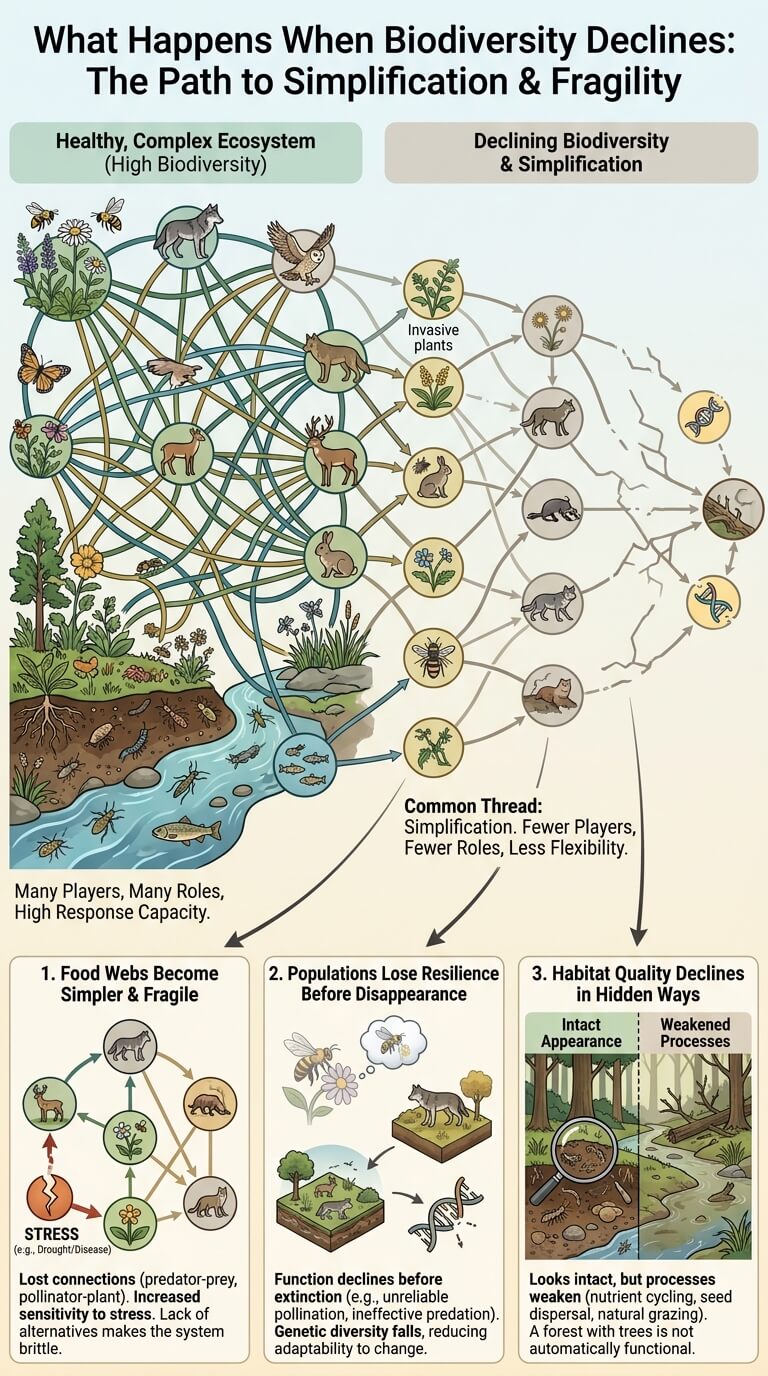
Biodiversity decline does not look the same everywhere. In one ecosystem, it may appear as fewer native pollinators. In another, it may mean the loss of large predators. In another, it may be a shift from many native plants to a few invasive ones, followed by changes in insects, birds, reptiles, and mammals. The common thread is simplification. The system has fewer players, fewer roles, and fewer ways to respond.
Food webs become simpler and more fragile
When species disappear or become rare, food webs lose connections. A predator may have fewer prey options. A plant may have fewer pollinators. A scavenger may receive fewer carcasses. A prey animal may lose cover when plant diversity declines. These changes can make the food web more sensitive to the next stress.
Simpler food webs may still function, but they often have less flexibility. If a drought reduces one major food source, animals with few alternatives may decline quickly. If a disease hits a dominant species, the habitat may change faster than it would in a more diverse system. This is why biodiversity loss is not only about the species already gone. It is also about increased risk for the species that remain.
Populations can lose resilience before they disappear
A species does not need to vanish to lose ecological strength. A pollinator population can become too small to visit flowers reliably. A predator can become too rare to shape prey behavior across a landscape. A seed disperser can remain in a few fragments but stop moving seeds between habitat patches. This matters because ecosystem function often declines before local extinction is obvious.
Genetic diversity can also fall while a species still appears present. Small, isolated populations may have less ability to adapt to disease, heat, drought, or new parasites. For readers, this is an important caution: seeing a few animals does not always mean a population is secure. Conservation often focuses on population size, habitat quality, connectivity, and genetic health together.
Habitat quality can decline in hidden ways
Some biodiversity loss is easy to see, such as a missing bird species or a dead coral reef. Other changes are quieter. Soil may lose invertebrates that help cycle nutrients. Streams may lose aquatic insects that feed fish and birds. Forests may lose large seed dispersers, changing which trees regenerate. Grasslands may lose grazing patterns that help maintain open habitat.
These hidden shifts can make habitats look intact while their processes weaken. A forest with trees is not automatically a fully functioning forest. A meadow with grass is not automatically a healthy prairie. Animal communities help reveal whether the system is feeding, breeding, dispersing, decomposing, and recovering in a balanced way.
Common Mistakes About Biodiversity
Biodiversity is easy to value in a general way but easy to misunderstand in detail. Many mistakes come from treating ecosystems like simple collections of animals instead of living networks. These misunderstandings can lead people to underestimate small species, ignore genetic diversity, or assume conservation is only about the most famous animals.
Mistake 1: Thinking biodiversity only means rare animals
Rare species matter, but biodiversity also includes common species that do a lot of ecological work. Common insects may feed birds, pollinate plants, and recycle nutrients. Common fish may move energy between insects and larger predators. Common rodents may disperse seeds or aerate soil. If these ordinary animals decline, the ecosystem can lose function even before a famous endangered species disappears.
This does not make rare species unimportant. It means biodiversity includes both rarity and function. A healthy ecosystem needs enough variety and enough abundance for ecological roles to keep operating. Conservation that protects only charismatic species while ignoring habitat and community structure can miss much of what keeps ecosystems alive.
Mistake 2: Assuming more species always means a healthier ecosystem
More native species often support stronger ecosystem function, but the details matter. A habitat packed with invasive species is not healthier simply because the count is high. A disturbed area may have many generalist animals but few specialists that once defined the habitat. A pond may gain nonnative fish and lose native amphibians, which can reduce ecological value even if the species number changes only slightly.
Good biodiversity thinking asks which species are present, whether they belong in that ecosystem, how abundant they are, and what roles they perform. Counting species is useful, but it is not the whole story.
Mistake 3: Believing one keystone species explains everything
Keystone species can have powerful effects, but they do not replace biodiversity. A sea otter, wolf, beaver, bison, coral, or vulture can strongly influence a system, yet each one operates inside a larger community. Their effects depend on prey, competitors, plants, microbes, climate, human pressure, and habitat conditions.
A keystone species may help organize a food web, but the web still needs enough supporting species to function. Strong conservation stories usually involve both important species and the broader communities that allow them to keep playing their roles.
Edge Cases and Exceptions
Biodiversity is valuable, but real ecosystems are complex. Some natural habitats are not species-rich compared with tropical forests or coral reefs, yet they are still important. Arctic tundra, desert springs, high mountain habitats, and specialized wetlands may have fewer species but contain animals with unusual adaptations and ecological roles. Low species richness does not automatically mean low value.
Another edge case is disturbance. Some ecosystems need periodic fire, flooding, grazing, storms, or seasonal drying. The goal is not to freeze nature in place. The goal is to maintain the natural processes and living communities that allow ecosystems to renew themselves.
There are also cases where adding species is harmful. Introducing nonnative animals to increase variety can damage native biodiversity. Healthy biodiversity is not created by adding random species. It is protected by conserving native species, habitat connections, ecological processes, and the conditions that allow natural communities to persist.
How This Connects to Nearby Animal Topics
Keystone species and biodiversity are related but not identical
A keystone species has an unusually large effect compared with its abundance. Biodiversity describes the wider variety of life and roles in the system. A keystone species can help maintain biodiversity, but biodiversity also supports the keystone species. For example, a predator needs prey, scavengers use leftovers, plants respond to herbivory, and microbes recycle nutrients. The whole community matters.
Predator loss can reduce biodiversity in indirect ways
When predators disappear, prey numbers and prey behavior may change. That can affect vegetation, nesting habitat, smaller predators, scavengers, and competitors. This is one way predator loss can connect to biodiversity decline. The details depend on the ecosystem, so it is better to avoid simple claims that every predator loss causes the same result.
Scavengers and habitat-shaping animals add functional diversity
Scavengers, burrowers, grazers, reef builders, and dam builders show why biodiversity is about jobs as well as names. They may not be the animals people notice first, but they help determine where nutrients go, where water moves, where plants grow, and where smaller animals find shelter. Losing these roles can change the living structure of a habitat.
FAQ
Why is biodiversity important for animals?
Biodiversity is important for animals because it supports food, shelter, breeding opportunities, predator-prey balance, and habitat stability. A bird may need insects to feed chicks, plants for nesting cover, predators to shape prey communities, and scavengers or microbes to recycle nutrients. Animals rarely depend on only one other species. They live inside networks.
When biodiversity declines, animals may lose food sources, safe movement routes, nesting sites, or seasonal resources. Even if one species survives at first, the habitat around it may become less reliable over time. That is why conservation often focuses on whole ecosystems rather than only one animal at a time.
What are the three main levels of biodiversity?
The three main levels are genetic diversity, species diversity, and ecosystem diversity. Genetic diversity refers to variation within a species. Species diversity refers to the variety and relative abundance of species in a place. Ecosystem diversity refers to the variety of habitats and ecological communities, such as forests, grasslands, wetlands, rivers, deserts, and reefs.
These levels overlap. A healthy animal population needs genetic diversity. A healthy food web needs species diversity. A landscape that supports many habitats gives animals more places to feed, breed, migrate, shelter, and recover after disturbance.
Can an ecosystem survive with low biodiversity?
Some ecosystems naturally have fewer species than others, and they can be healthy if their native species and ecological processes remain intact. A desert or tundra may not have the same number of species as a tropical rainforest, but it can still support specialized animals and important food web relationships.
The concern is biodiversity loss, especially when human activity removes native species, fragments habitat, introduces invasive species, or reduces genetic diversity. An ecosystem with low or declining biodiversity may continue functioning for a while, but it often has fewer ways to respond to future stress.
Does biodiversity only matter in wild places?
No. Biodiversity also matters in farms, cities, suburbs, parks, riversides, schoolyards, and backyards. Native plants can support insects. Insects can feed birds and bats. Trees can offer nesting sites. Healthy streams can support fish, amphibians, aquatic insects, and the animals that eat them.
Human-shaped places will not function exactly like wilderness, but they can still support useful habitat. Reducing pesticide pressure, protecting native vegetation, keeping pets from harassing wildlife, avoiding feeding wild animals, and supporting connected green spaces can all help local biodiversity in practical ways.
Is biodiversity the same thing as conservation?
Biodiversity is the living variety itself. Conservation is the work of protecting, restoring, and managing that variety. Conservation may focus on endangered species, habitat restoration, wildlife corridors, invasive species control, sustainable fishing, pollution reduction, or protection of important breeding and migration areas.
The two ideas are closely connected, but they are not identical. Biodiversity explains what is at stake. Conservation describes the choices people make to keep ecosystems, species, and populations healthy enough to last.
Final Thoughts
Why biodiversity matters is not just a question about saving rare animals. It is a question about how life stays connected. Biodiversity gives ecosystems more roles, more relationships, more genetic options, and more ways to recover when conditions change. Animals are central to that system because they hunt, graze, pollinate, disperse seeds, clean up carrion, dig, build, filter, migrate, compete, and feed one another.
The clearest takeaway is that ecosystems are stronger when their living networks remain rich and connected. Protecting biodiversity means protecting the ordinary work that animals and other organisms do every day. That work keeps food webs moving, habitats renewing, and natural systems flexible enough to face stress without losing the functions that make them alive.
Ethan Walker is the founder and research editor of Animal Fact Central. He creates and reviews educational animal facts content using trusted wildlife, pet care, and science-based sources. His work focuses on making animal behavior, adaptations, habitats, and species facts clear, accurate, and engaging for everyday readers.
Read More Details About Ethan Walker: https://animalfactcentral.com/ethan-walker/