
Scavengers and ecosystem cleanup are closely connected because every natural habitat must deal with dead animals. A carcass is not just waste. It is a temporary food patch, a nutrient package, a meeting place for competing animals, and eventually a part of the soil or water again. Scavengers are the animals that enter this process early by feeding on carrion, which means the flesh of dead animals. By moving nutrients around, scavengers can influence how animals shape their habitats.
The quick idea is simple: scavengers help ecosystems by removing carcasses, moving nutrients through food webs, feeding other species, and limiting how long dead animal remains sit exposed on the landscape. That does not mean scavengers make every carcass safe or that people should touch dead wildlife. It means animals such as vultures, ravens, coyotes, hyenas, crabs, beetles, flies, and many others perform a cleanup role that is easy to overlook until it is missing.
This guide explains how animal scavengers work, why they matter, how they find carrion, and why myths about them being dirty or useless miss the bigger ecological picture. In some systems, cleanup animals can function like keystone species because many other species are affected by their role.

Quick Answer
Scavengers are animals that eat dead animals. They help clean ecosystems by consuming carrion before it can remain in one place for long periods. In doing so, they return energy and nutrients to the food web and create opportunities for decomposers, detritivores, plants, insects, and other wildlife.
Some scavengers, especially many vultures, depend heavily on carrion. Other animals are opportunistic scavengers that also hunt, forage, or eat plants. Coyotes, bears, eagles, gulls, crabs, ants, beetles, and flies can all use carrion when it is available. A Scientific Reports study on facultative scavengers found that scavenging can provide important ecosystem services even in forests without obligate scavengers such as vultures.
The most useful way to think about scavengers is not as a single type of animal, but as a cleanup guild. A guild is a group of species that use a similar resource. In this case, the resource is carrion. Different members of that guild arrive at different times, use different senses, and handle different parts of a carcass.
Why Scavengers Matter
Dead animals appear in every habitat. Some die from predation, disease, starvation, old age, harsh weather, road collisions, or seasonal stress. Without scavengers, carcasses would still break down, but the process would often be slower, more localized, and more dependent on microbes and weather.

Carrion Removal and Nutrient Recycling
When a deer, fish, bird, or small mammal dies, its body contains nitrogen, phosphorus, carbon, calcium, and other nutrients that living organisms need. Scavengers move those nutrients through the ecosystem by eating tissues, carrying pieces away, excreting waste, feeding young, and leaving scraps for insects and microbes.
This is recycling, but it is not a neat factory process. It is messy, competitive, and spread across many species. A vulture may remove soft tissue. Beetle larvae may feed in protected spaces. Flies may lay eggs on exposed tissue. Coyotes or bears may drag remains away from the original death site. Microbes then continue breaking down what remains. Each step changes where nutrients go and which organisms can use them.
How Scavengers Connect Predators and Decomposers
Predators often provide carrion even when they are not trying to. A mountain lion kill can feed the predator first, then bears, coyotes, ravens, insects, and microbes after the lion leaves. The National Park Service notes that mountain lions can provide a food source for scavenging species and help cycle nutrients to soil and plants through the remains of their prey in the Valles Caldera large mammal monitoring project.
This is one reason scavengers belong in food web discussions. They are not separate from hunting, decomposition, or plant growth. They connect those processes. A carcass can begin as a predator’s kill, become food for scavenging vertebrates, support insect larvae, feed microbes, and ultimately add nutrients back to the habitat.
Why Cleanup Roles Vary by Habitat
Scavenger communities look different in different places. In open grasslands, vultures and ravens may spot carcasses from the air. In dense forests, mammals using smell may find carcasses quickly while birds have less visual access. On beaches, gulls, crabs, fish, and marine invertebrates may divide the work. In deserts, heat can speed odor production and insect activity, but water stress and open exposure also shape which animals arrive.
No single scavenger does the whole job everywhere. Habitat structure, temperature, moisture, carcass size, predator activity, human disturbance, and animal diversity all influence how cleanup happens.
The Main Scavenger Framework
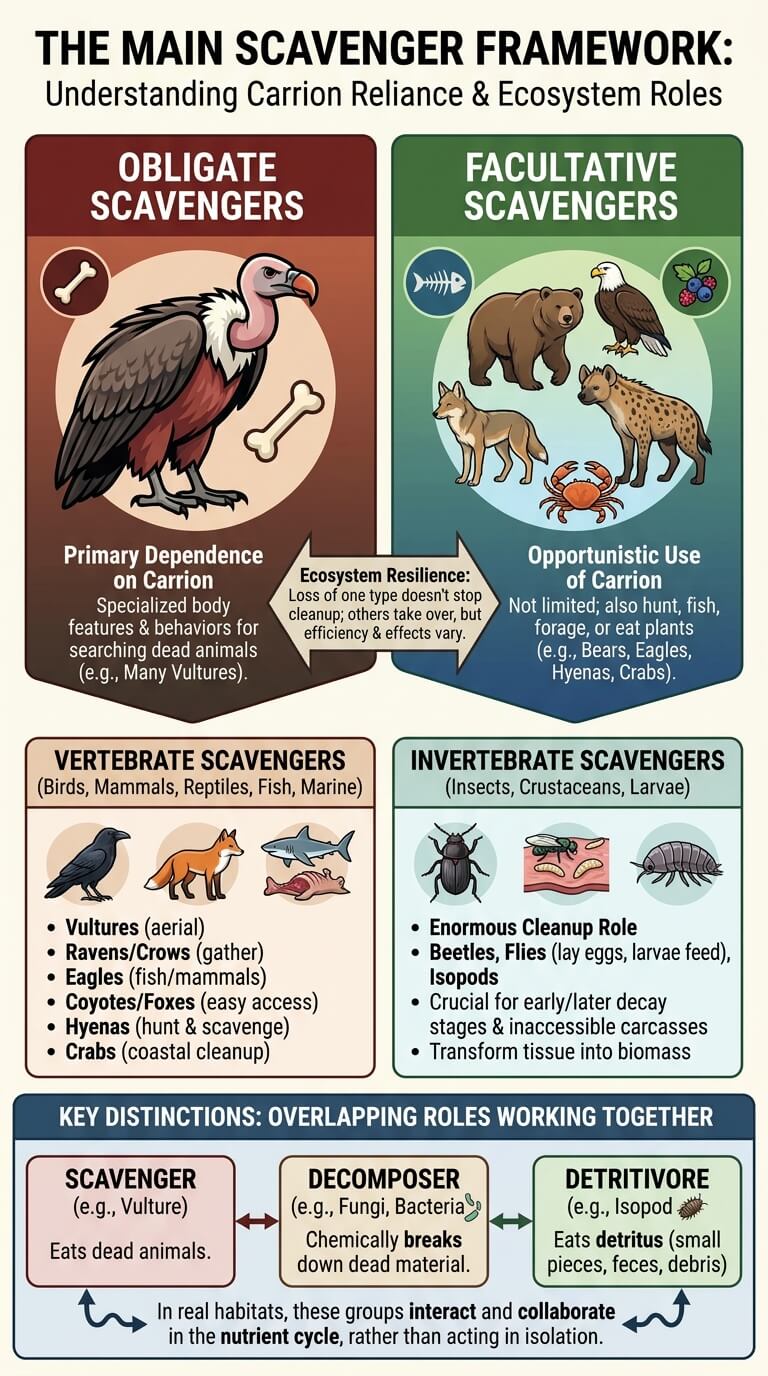
The word scavenger sounds simple, but the category is broad. Some animals are built around carrion. Others use carrion only when the opportunity appears. Understanding that difference helps prevent many common mistakes.
Obligate vs Facultative Scavengers
An obligate scavenger depends heavily on carrion as a primary food. Many vultures are the clearest examples. They spend much of their lives searching for dead animals and have body features and behaviors that fit that role.
A facultative scavenger eats carrion opportunistically, but it is not limited to carrion. Bears, coyotes, foxes, eagles, gulls, ravens, hyenas, and many crabs may scavenge while also hunting, fishing, foraging, or eating plant material. Facultative scavenging matters because most ecosystems contain many animals that can switch into cleanup mode when carrion is available.
This difference also explains why losing one scavenger type does not always stop cleanup completely. Other animals may take over part of the role, although not necessarily with the same speed, safety, or ecological effect.
Vertebrate Scavengers Such as Vultures, Hyenas, Coyotes, Eagles, and Crabs
Vertebrate scavengers include birds, mammals, reptiles, fish, and some larger marine animals. Vultures are the most familiar aerial scavengers in many regions. Ravens and crows often gather around carcasses. Bald eagles may scavenge fish, waterfowl, or mammal remains. Coyotes and foxes use carrion when hunting is difficult or when a carcass is easy to access.
Hyenas are often misunderstood here. The spotted hyena is not merely a lazy scavenger. It is also an effective hunter, and its diet varies by region and opportunity. The Animal Diversity Web profile of the spotted hyena explains that the species hunts as well as scavenges, which is exactly why the scavenger label can be too narrow for many animals.
Crabs are important scavengers in coastal and marine systems. A dead fish, bird, turtle hatchling, or stranded organic material can attract crabs and other shoreline cleaners. In water, scavenging fish, shrimp, amphipods, and worms may reach remains that land animals never see.
Invertebrate Scavengers Such as Beetles, Flies, and Isopods
Invertebrate scavengers are often smaller, but their cleanup role can be enormous. Carrion beetles, blow flies, flesh flies, ants, wasps, isopods, amphipods, and many larvae can use dead animal tissue. Some arrive early, while others specialize in later stages of decay.
Flies are especially important because adults can locate carrion and lay eggs on it. The larvae then feed on the remains. This may sound unpleasant, but it is part of how animal tissue gets transformed into living insect biomass and, eventually, food for birds, reptiles, amphibians, fish, and other animals.
Invertebrates also matter when vertebrate scavengers cannot access a carcass. A carcass under leaves, inside a burrow, in a tide pool, or beneath dense cover may be used heavily by insects, mites, worms, and small crustaceans before larger animals ever find it.
Difference Between Scavengers, Decomposers, and Detritivores
A scavenger is an animal that eats dead animals. A decomposer is usually a fungus, bacterium, or other organism that chemically breaks down dead material into simpler substances. A detritivore eats detritus, which is dead organic material in small pieces, such as leaf litter, decaying plant matter, feces, or tiny remains.
The categories overlap in everyday language, but they are not identical. A vulture feeding on a carcass is a scavenger. Bacteria breaking down tissues are decomposers. An isopod feeding on decaying organic debris may be called a detritivore, though some isopods can also feed on animal remains. In real habitats, these groups work together rather than in separate boxes.
How Scavengers Find and Use Food
Carrion is unpredictable. A carcass may appear in a forest hollow one day, beside a road the next day, or in a river after a flood. Scavengers need ways to find these temporary meals before competitors do.

Smell, Sight, Sound, and Social Cues
Different scavengers use different signals. Turkey vultures are famous for combining vision with a strong sense of smell. The Animal Diversity Web account of the turkey vulture describes the species as using both smell and sight to locate carcasses, and notes that black vultures may follow turkey vultures to food.
Other scavenging birds rely more on sight. Ravens may watch predators, other birds, or mammal movement. Mammals such as coyotes and bears can use smell trails and memory of the landscape. In open habitats, a circling group of birds can become a signal to other scavengers. In forests, odor and ground-level exploration may matter more.
Sound can also play a role indirectly. Alarm calls, predator activity, or the noise of other scavengers may draw attention. A carcass is not only a food item. It is an information center where animals notice each other.
Competition at Carcasses
A carcass is valuable because it offers a high-energy meal without the cost of killing prey. That value creates competition. Large animals may displace smaller ones. Birds may arrive first but lose access when a mammal appears. Insects may be fastest on warm days, while vertebrates may have more time in colder conditions.
Competition also changes the carcass itself. Large scavengers can open tough hides, drag remains, crush bones, or expose tissue. Smaller animals then use what becomes available. In some systems, one species may act almost like a door opener for many others.
Not every carcass becomes a dramatic feeding scene. A mouse under leaf litter may be used mostly by insects. A fish on a riverbank may be taken by a raccoon at night. A large ungulate carcass in open country may attract a whole sequence of vultures, coyotes, ravens, beetles, flies, and microbes.
Digestive and Immune Adaptations in Some Scavengers
Carrion can contain microbes and toxins produced during decay, so some scavengers have adaptations that help them handle food that would be risky for many other animals. Vultures are the classic example. Research on New World vultures has found evidence of specialized gut conditions and microbial communities associated with their carrion-based diet.
This does not mean vultures are immune to every danger. They can still be poisoned by toxins in carcasses, contaminated bait, veterinary drugs, or lead fragments. Digestive toughness is not a magical shield. It is a set of adaptations that helps them exploit a difficult food source.
Other scavengers have different strategies. Hyenas have strong jaws and social feeding behavior. Beetle and fly larvae can develop rapidly in temporary food patches. Crabs use claws to tear soft tissue. The cleanup role is shared, but the tools vary widely.
Ecosystem Benefits of Scavenger Cleanup
Scavenger cleanup is valuable because it affects energy flow, nutrient movement, wildlife interactions, and the amount of time carcasses remain available to other organisms. The benefits are ecological, not cosmetic. Nature is not trying to keep a landscape tidy for human eyes. It is moving matter and energy from one living system into another.
Returning Nutrients to Soil and Water
Animal bodies are concentrated nutrient packages. When scavengers feed, they do not make those nutrients disappear. They redistribute them. Some nutrients are carried away in the bodies of scavengers. Some return through droppings. Some remain in bones, hair, feathers, shells, or skin. Some enter soil and water as microbes and invertebrates continue the process.
This nutrient redistribution can create small hotspots. Plants near old carcass sites may receive pulses of nutrients, while insects and microbes may briefly flourish. In streams and coastal systems, fish carcasses or marine remains can feed aquatic scavengers and transfer nutrients between water, shore, and land.
Supporting Other Animals in the Food Web
Carrion supports more animals than the first scavenger that finds it. A carcass can feed adult insects and larvae, which then feed birds and amphibians. It can support coyotes during lean periods, ravens during nesting seasons, or crabs along a beach. Even bones may be gnawed or used by animals seeking minerals.
This is why carrion should not be treated as ecological trash. It is part of the food web. In many habitats, it provides backup energy during harsh seasons or unpredictable weather, especially for opportunistic animals that cannot rely on one food type all year.
Reducing Carcass Persistence and Some Disease Opportunities
Scavengers can reduce the time carcasses remain exposed, which may limit some opportunities for certain microbes, insects, or mammalian pests to use them. But this point needs careful wording. Scavengers do not sterilize ecosystems, and disease dynamics vary by pathogen, carcass type, climate, and scavenger community.
A more accurate statement is that fast carrion removal can reduce carcass persistence and may reduce some ecological risks connected with dead animal remains. It is not a guarantee that disease disappears. In some cases, scavengers can also move contaminated material or become exposed to toxins themselves. The ecological value is real, but it is not a simple medical claim.
Cleaning Beaches, Forests, Grasslands, Deserts, and Cities
On beaches, gulls, crabs, fish, amphipods, and insects may consume stranded fish, birds, and other organic remains. In forests, bears, coyotes, foxes, raccoons, beetles, flies, and fungi may divide the work. In grasslands and savannas, vultures and hyenas can be major players around larger carcasses. In deserts, ravens, coyotes, ants, beetles, and reptiles may use carcasses quickly when conditions allow.
Cities have scavenger systems too, although they are shaped by people. Crows, gulls, rats, raccoons, opossums, coyotes, ants, flies, and beetles may feed on roadkill, food waste, and dead urban wildlife. That does not mean people should leave dangerous carcasses in yards or roads. It means urban ecosystems also have cleanup guilds, even when those guilds cause conflict.
Common Mistakes and Myths
Scavengers are easy to misjudge because their food is associated with death, odor, and decay. Many myths come from human disgust rather than ecological reality.
Myth That Scavengers Are Dirty or Useless
Scavengers may look messy while feeding, but that does not make them useless. Their work is one reason dead animals do not simply accumulate in healthy ecosystems. Vultures, beetles, flies, crabs, coyotes, and other carrion feeders turn a dead body into food for many forms of life.
Calling scavengers dirty also ignores their adaptations. Bare vulture heads, strong digestive systems, fly life cycles, and crab feeding behavior all make sense in the context of carrion. These traits are not flaws. They are part of a cleanup strategy.
Myth That Scavengers Only Eat Dead Animals
Some scavengers rely heavily on carrion, but many do not eat only dead animals. Coyotes hunt and scavenge. Bears forage, hunt occasionally, and scavenge. Hyenas may hunt and steal kills as well as feed on carcasses. Gulls eat fish, eggs, invertebrates, refuse, and carrion. Crabs may feed on algae, detritus, small animals, and dead material depending on the species.
This flexibility is important. Opportunistic animals can shift diets when seasons change or food becomes scarce. Carrion is one part of a broader survival strategy for many species.
Myth That Scavengers Always Spread Disease
Scavengers can interact with germs because carcasses can contain microbes. That does not mean they always spread disease. In many situations, rapid carcass removal may reduce the time remains are available to certain insects or mammals. Some scavengers also have adaptations that allow them to consume decaying tissue without getting sick in the same way a human or pet might.
The safest conclusion is balanced: scavengers are important cleanup animals, but people and pets should still avoid carcasses. A carcass can carry bacteria, parasites, toxins, or other hazards, and the risks depend on the animal, place, and cause of death.
Edge Cases and Safety Context
Most scavenger behavior is natural and beneficial. Problems often appear when carrion is created or changed by people, such as roadkill, poisoned bait, lead ammunition, livestock carcasses, trash, or urban wildlife feeding.
Roadkill, Urban Scavengers, and Human Conflict
Roadkill can feed scavengers, but it can also put them in danger. Vultures, eagles, crows, coyotes, foxes, opossums, and other animals may be struck by vehicles while feeding on roadsides. Roads can create a food source and a mortality risk at the same time.
Urban scavengers can also become conflict animals when they associate people with food. Open trash, outdoor pet food, compost, and illegal feeding can draw raccoons, coyotes, gulls, rats, and vultures into places where people do not want them. The safest approach is usually prevention: secure garbage, keep pets supervised, avoid feeding wildlife, and give scavengers space.
Carcass Poisoning and Lead Ammunition Risks
Scavengers are vulnerable when carcasses contain poisons or toxic fragments. The U.S. Fish and Wildlife Service says lead ammunition fragments can poison scavenging condors and identifies lead poisoning as the number one known cause of death in California condors in its California Condor Recovery Program guidance.
This risk is not limited to condors. Other scavenging birds and mammals may be exposed to toxins through carrion. Poisoned bait, pesticide exposure, contaminated livestock carcasses, and lead fragments can turn a food source into a hazard. That is one reason wildlife agencies often discourage poisoning animals and encourage safer carcass and hunting practices.
When Carcasses Should Be Left to Nature or Handled by Officials
In wild areas, a carcass away from trails, homes, roads, and water supplies may be best left alone unless park or wildlife officials say otherwise. It can feed scavengers and support natural nutrient cycling. In a yard, road, public path, livestock area, or place where people and pets may contact it, the answer may be different.
The CDC advises people not to pick up or touch dead animals with bare hands and says animal control can remove dead animals in its wildlife safety guidance. For readers, the practical rule is simple: observe from a distance, keep pets away, and contact local authorities when a carcass is near people, roads, domestic animals, or public spaces.
How This Connects to Nearby Animal Topics
Scavenger cleanup links naturally to predators, biodiversity, keystone species, and habitat engineering. These connections are useful because carrion is a crossroads where many food web processes meet.
Predators as Carrion Providers
Predators do more than control prey populations. They also create leftovers. A wolf, mountain lion, shark, owl, or snake may leave remains that other animals use. Even a successful predator rarely converts every part of a prey animal into its own body. Scraps, bones, hides, and partially eaten remains become resources for scavengers.
This is why predator disappearance can change scavenger access to food. Fewer large predators may mean fewer predator-kill carcasses in some systems, while more roadkill, livestock remains, or human waste may favor a different set of scavengers.
Biodiversity and Cleanup Redundancy
Biodiversity matters in cleanup because multiple scavenger species can provide backup roles. If one animal misses a carcass, another may find it. If weather slows insects, a mammal may remove tissue. If a large carcass is too tough for small scavengers at first, a larger animal may open it.
This does not mean all scavengers are interchangeable. A vulture, beetle, coyote, and crab do different things. But diverse cleanup guilds can make carrion processing more flexible across seasons, habitats, and carcass types.
Keystone Scavengers in Vulnerable Ecosystems
Some scavengers can have outsized importance where they remove carrion quickly or support many other species. Vultures are often discussed this way because they can cover large areas, find carcasses efficiently, and gather in groups. In places where vulture populations decline, other scavengers may not fully replace the same role.
Still, keystone language should be used carefully. A scavenger’s importance depends on the ecosystem, the species involved, and what happens when that species declines. The better question is not simply whether an animal is famous, but whether its cleanup function is hard for other species to replace.

FAQ
What Animals Are Scavengers?
Scavengers include animals that eat carrion, either as a main food or as an occasional food. Common examples include vultures, ravens, crows, eagles, hyenas, coyotes, foxes, bears, raccoons, opossums, gulls, crabs, carrion beetles, blow flies, flesh flies, ants, and many fish and marine invertebrates.
Some of these animals are mostly scavengers, while others are flexible feeders. That flexibility is why scavenging is so widespread. Carrion is unpredictable, but when it appears, many animals can benefit from it.
Are Vultures Important for Ecosystems?
Yes. Vultures are important because they are highly specialized carrion feeders in many ecosystems. They can locate dead animals, consume soft tissue, and reduce how long carcasses remain exposed. Their role is especially visible in open landscapes where they can search large areas from the air.
Vultures are not the only scavengers, but they can be especially efficient ones. When vulture populations are harmed by poisoning, lead exposure, habitat change, or food contamination, other scavengers may not always replace their cleanup role in the same way.
What Is the Difference Between Scavengers and Decomposers?
Scavengers are animals that eat dead animals. Decomposers are organisms such as bacteria and fungi that chemically break down dead material. A vulture, coyote, crab, or carrion beetle is a scavenger when it feeds on carrion. Bacteria and fungi breaking down remaining tissues are decomposers.
The two groups work together. Scavengers tear, move, consume, and expose material. Decomposers continue the chemical breakdown. Detritivores, such as some isopods and worms, may also feed on smaller pieces of dead organic matter.
Do Scavengers Spread Disease or Reduce It?
The answer depends on the situation. Scavengers can reduce carcass persistence, which may limit some opportunities for certain pathogens, insects, or pest animals to use remains. But scavengers do not make every carcass safe, and some can be exposed to toxins or germs through carrion.
For people, the safety rule does not change: do not touch dead wildlife with bare hands, do not let pets eat dead animals, and contact local authorities when a carcass is near homes, roads, pets, livestock, or public spaces.
Final Thoughts
Scavengers and ecosystem cleanup are essential parts of how nature handles death. Carrion does not sit outside the food web. It feeds vultures, coyotes, ravens, crabs, beetles, flies, microbes, plants, and many other organisms through a chain of feeding and decomposition.
The most important takeaway is that scavengers are not failed predators or dirty extras. They are part of the system that moves energy and nutrients from dead animals back into living communities. At the same time, carrion can carry hazards for people, pets, and wildlife, so the best human role is usually to keep distance, avoid feeding scavengers, prevent poisoning, and let wildlife professionals handle risky situations.
Ethan Walker is the founder and research editor of Animal Fact Central. He creates and reviews educational animal facts content using trusted wildlife, pet care, and science-based sources. His work focuses on making animal behavior, adaptations, habitats, and species facts clear, accurate, and engaging for everyday readers.
Read More Details About Ethan Walker: https://animalfactcentral.com/ethan-walker/