
A keystone species is an organism whose role is unusually important to the structure of its ecosystem. The idea is not that the species is always the biggest, rarest, or most aggressive animal in a habitat. It is that the ecosystem can change in major ways when that species declines or disappears. Predator-based examples are easier to understand when compared with what happens when predators disappear.
Keystone species explained means this: some species have effects that are much larger than their abundance suggests. A sea otter may influence a kelp forest by eating urchins. A beaver may reshape a stream by building dams. A predator may change where prey feed, not only how many prey animals survive. These roles matter because ecosystems are built from relationships, not just from a list of species.
The phrase is useful, but it needs careful handling. Scientists do not simply label every impressive animal as a keystone species. The strongest cases come from evidence showing disproportionate effects on food webs, habitat structure, biodiversity, or ecosystem function. As National Geographic’s keystone species overview explains, the term is often used for predators, ecosystem engineers, and mutualists, but scientists may debate which species deserve the label in a specific ecosystem.

Quick Answer
A keystone species is a species that helps hold an ecosystem together in a way that is larger than its population size or physical presence might suggest. If it is removed, the ecosystem may not simply lose one species. It may lose a controlling pressure, a habitat-building force, a pollination relationship, a seed dispersal pathway, or a cleanup role that many other species depend on.
That does not mean every keystone species is endangered, every apex predator is keystone, or every ecosystem has one obvious keystone animal. Keystone status depends on context. The same type of animal can be central in one habitat but less influential in another. A species may also become more or less important as climate, human activity, invasive species, disease, or prey populations change.
Good keystone species examples usually show one of four patterns: controlling prey pressure, reshaping habitat, supporting another species through mutualism, or recycling dead material. The best examples show how one animal role can influence many other lives.
Why Keystone Species Matter
Keystone species matter because ecosystems are connected systems. Animals feed, compete, hide, nest, migrate, pollinate, dig, browse, scavenge, and move nutrients. When one highly connected role weakens, the effects can spread through plants, prey, predators, soil, water, and shelter. This is why conservation biologists often care about roles, not only species counts.

Disproportionate impact compared with abundance
The central idea behind keystone species is disproportionate impact. A species does not need to be common to be important. In some habitats, a relatively small number of predators can influence the feeding behavior of many herbivores. In other habitats, a small population of habitat builders can create ponds, burrows, clearings, or nesting sites used by many other animals.
This is also why keystone species are not always charismatic. Wolves, sea otters, and elephants are familiar examples, but smaller animals can also have outsized effects. Burrowing animals may aerate soil and create shelter. Pollinators may connect flowering plants to fruit and seed production. Intertidal predators may stop one prey species from taking over limited space.
What can change when a keystone species declines
When a keystone species declines, the first effect is often direct. Prey animals may become more numerous. A plant that relied on an animal for seed movement may reproduce less successfully. Wetlands built by dam-building animals may shrink. Carrion may remain longer in the landscape if major scavengers vanish.
The next effects are usually indirect. If a prey species increases, it may browse more vegetation. If vegetation changes, birds, insects, fish, and small mammals may lose nesting or feeding habitat. If an ecosystem engineer disappears, water flow, shade, sediment, and shelter can all change. These indirect effects are why keystone species are often discussed in connection with trophic cascades, biodiversity, and habitat structure.
However, not every decline produces a dramatic collapse. Ecosystems are complicated. Some have backup species that perform similar roles. Others are already shaped by human land use, fire, drought, invasive species, disease, or climate stress. A careful keystone species explanation should show importance without pretending that one animal alone controls everything.
Why the term matters in conservation
The term matters because conservation is often about protecting relationships. Saving a keystone predator may also help protect plants and smaller animals affected by prey pressure. Restoring a habitat engineer may support fish, amphibians, birds, insects, and water storage. Protecting a major pollinator or seed disperser may help maintain plant communities that feed many other species.
Still, conservation decisions should not rely on a popular label alone. A keystone claim should be supported by field evidence, long-term monitoring, or a clear ecological mechanism. The label is a starting point for understanding influence, not a shortcut around science.
The Main Types of Keystone Species
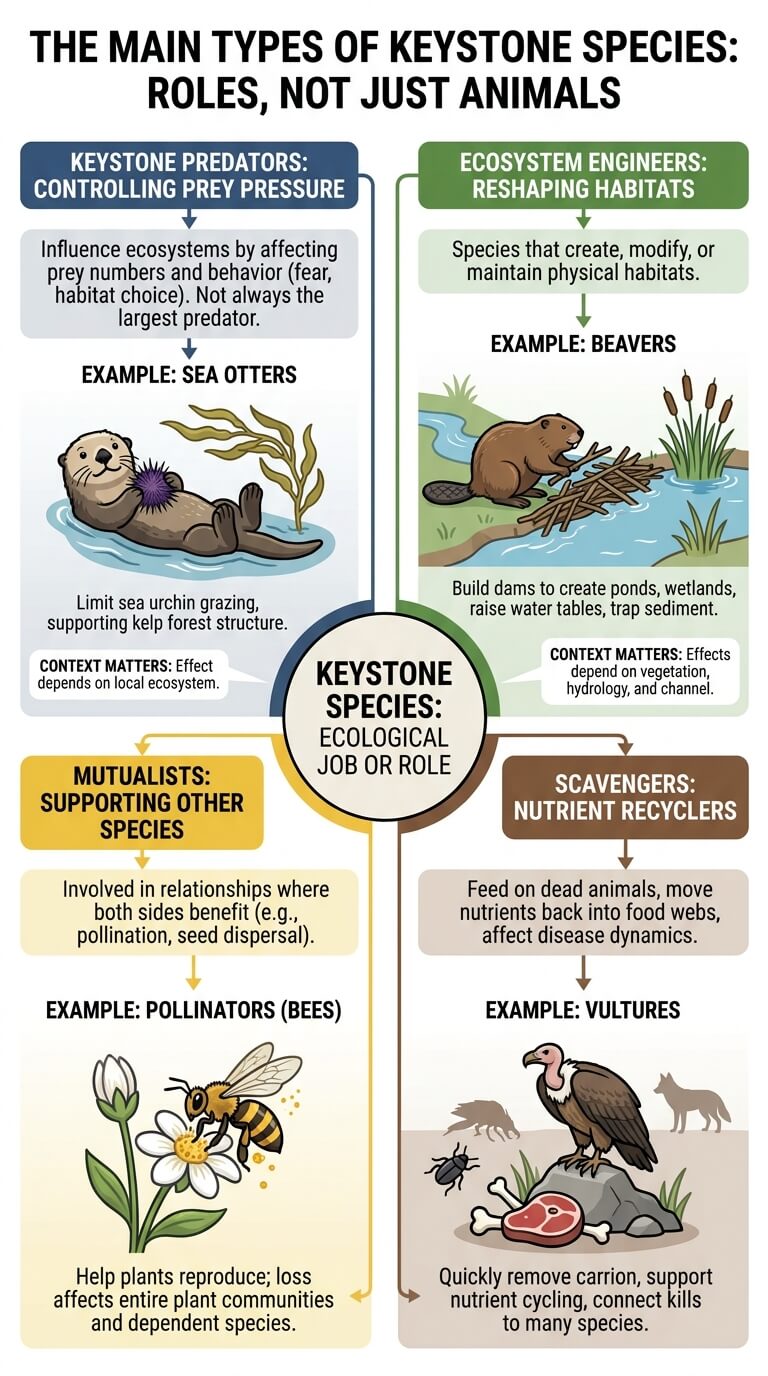
Keystone species are often grouped by the kind of ecological job they perform. These categories are helpful because they show that a keystone species is not one kind of animal. It is a role. Predators, herbivores, engineers, mutualists, and scavengers can all shape ecosystems in different ways.
Keystone predators that control prey pressure
Keystone predators influence ecosystems by affecting prey animals. That effect can happen through killing prey, but it can also happen through fear, vigilance, habitat choice, and movement. Prey animals may feed in different places, spend less time in risky areas, or avoid overusing vulnerable plants when predators are present.
Sea otters are a classic marine example because they eat sea urchins, which graze on kelp. In places where otters are ecologically important, their feeding can help limit urchin pressure and support kelp forest structure. Wolves can also play this kind of role in some landscapes by influencing elk, deer, or other large herbivores. The effect is not always simple, but predators can shape ecosystems through both numbers and behavior.
A keystone predator is not automatically the largest predator in the region. The important question is whether its presence changes the ecosystem in a broad and measurable way. A predator may be apex without being clearly keystone, and a predator may be keystone in one place but not another.
Ecosystem engineers that physically reshape habitats
Ecosystem engineers are species that create, modify, or maintain habitat. Beavers are the familiar North American example. By building dams, they can slow water, create ponds, raise local water tables, trap sediment, and create wetland conditions used by fish, amphibians, birds, insects, and mammals.
A U.S. Geological Survey report on beaver-modified streams notes that beaver dams can help connect streams to floodplains and expand available aquatic habitat, while also emphasizing that effects depend on local vegetation, hydrology, and channel conditions. That context matters because ecosystem engineering is powerful but not identical in every stream. The same dam-building behavior can create benefits, conflicts, or mixed outcomes depending on place.
Mutualists and animals that support other species
Mutualists are species involved in relationships where both sides benefit. Pollinators are a common example. Bees, bats, birds, butterflies, and other animals may gain nectar, pollen, or fruit while helping plants reproduce. Seed dispersers can also be mutualists when they eat fruit and move seeds to new places.
A mutualist can be keystone when many species depend on that relationship or when the service is difficult to replace. For example, a plant community that depends heavily on a particular pollinator or seed disperser may change if that animal declines. The animal does not need to be fierce or large. Its influence comes from connecting species that otherwise could not complete the same life cycle as effectively.
Scavengers and nutrient recyclers with broad effects
Scavengers feed on dead animals and help move nutrients back into food webs. Vultures, condors, hyenas, coyotes, eagles, crabs, beetles, and many other animals can use carrion. In some ecosystems, major scavengers may reduce how long carcasses remain available and influence which other animals, insects, and microbes use that resource.
Not every scavenger is automatically keystone. Many ecosystems have several species that share cleanup roles. But a scavenger can have broad ecological effects if it removes carrion quickly, supports nutrient cycling, affects disease dynamics, or connects predator kills to many other species. Scavenging also shows why food webs are not neat ladders. Dead matter can feed many organisms at once.
Animal Examples That Show Keystone Roles
Examples make the keystone concept easier to understand, but they also create a risk: famous stories can become oversimplified. The animals below are useful because they show different kinds of keystone roles. They should be read as ecosystem-specific examples, not as proof that one species always has the same effect everywhere.

Sea otters, urchins, and kelp forests
Sea otters are among the best-known animal keystone species examples. In kelp forest ecosystems, otters prey on sea urchins and other invertebrates. When urchin grazing pressure is high, kelp can be heavily reduced. When otters are present and feeding effectively, they can help limit urchin grazing and support a more complex kelp forest community.
NOAA’s Office of National Marine Sanctuaries describes sea otters in kelp forest ecosystems as an important keystone species because their presence is central to the health of their environment. Kelp forests provide structure for fish, invertebrates, marine mammals, and birds, so a change in urchin pressure can affect more than the otters and urchins themselves.
Wolves, elk behavior, and riparian habitats
Wolves are often used to explain keystone predators because their return to Yellowstone restored a missing predator-prey relationship. Wolves can affect elk and other prey through predation, movement, vigilance, and risk. Those changes can interact with plants, scavengers, other predators, and streamside habitats.
The National Park Service explains that wolves in Yellowstone were reintroduced in 1995 to restore native species and the ecological role of predation, and that wolves have influenced parts of the park’s food web, including scavenger communities and some vegetation communities. That makes wolves a strong example of a keystone predator, but not a simple magic switch.
Yellowstone is also a good example of scientific caution. Elk numbers, elk behavior, willow and aspen growth, beaver activity, water availability, climate, other predators, and site conditions can all matter. The most accurate takeaway is that wolves can be a major ecological force, while the exact size and pathway of their effects can vary across the landscape.
Beavers, wetlands, and freshwater habitat creation
Beavers show how a keystone species can work by changing the physical environment. Their dams can slow moving water and create ponded or wetland conditions. Those changes may influence fish habitat, amphibian breeding areas, insect communities, water storage, riparian vegetation, and sediment movement.
USGS research on beaver dams in the Tualatin River Basin notes that beaver dams can help streams connect to floodplains and expand aquatic habitat, while also pointing out that dam building is constrained by vegetation, topography, and hydrology. This is exactly the kind of balanced evidence that keystone species discussions need.
Beavers are not beneficial in every human setting. Their dams can flood roads, fields, yards, or culverts, and management should be handled by qualified wildlife or land management professionals. Ecologically, though, they show how one animal’s building behavior can create habitat for many other species.
Elephants, savanna structure, and seed movement
Elephants can act as ecosystem engineers and large-scale seed dispersers. In savannas and forests, their feeding, movement, dung, browsing, and tree-breaking can affect vegetation structure. By opening paths, creating gaps, spreading seeds, and altering woody growth, elephants can influence the habitat available to many smaller animals.
Their role is context-dependent. In some places, elephant activity helps maintain a mixture of open and wooded areas. In other places, high elephant densities in fenced or compressed landscapes can damage trees and create difficult management questions. That does not erase their ecological importance. It shows that keystone-like influence must be understood in the conditions where it occurs.
Elephants are a useful reminder that keystone roles are not limited to predators. A large herbivore can shape habitat through feeding pressure and movement. The mechanism is different from a wolf or sea otter, but the broader idea is similar: one animal’s role can ripple into plant communities, shelter, food availability, and movement routes for other species.
Keystone Species vs Similar Ecology Terms
Several ecology terms sound similar, but they do not mean the same thing. Confusing them can make animal articles, classroom assignments, and conservation discussions less accurate. A keystone species is about ecological impact. Other terms may describe food web position, conservation strategy, warning signs, or abundance.

Keystone species vs apex predators
An apex predator is a predator at or near the top of a food web, usually with few regular natural predators as an adult. A keystone species is defined by its disproportionate ecological impact. These categories can overlap, but they are not identical.
A wolf, shark, or big cat may be an apex predator and may also be keystone in a particular system. But being at the top of the food web does not automatically prove keystone status. The question is whether removing that predator would strongly change prey behavior, prey abundance, vegetation, competition, or other parts of the ecosystem.
Likewise, some keystone species are not apex predators at all. Beavers, pollinators, sea stars, corals, prairie dogs, and elephants can be discussed as keystone or keystone-like species in certain ecosystems even though their roles are not based on being top predators.
Keystone species vs indicator species
An indicator species signals something about environmental conditions. Amphibians may indicate freshwater or wetland health because their skin, eggs, and life cycles can be sensitive to changes in water quality and habitat. Some birds, insects, fish, or plants can also serve as indicators.
A keystone species is different because it helps drive ecological structure. An indicator species tells people that something may be changing. A keystone species is one of the reasons the system works the way it does. A species can sometimes be both, but the terms answer different questions.
For example, sea otters can be discussed as keystone predators in some kelp ecosystems, and their population trends may also tell researchers something about marine ecosystem health. The keystone role concerns what otters do. The indicator role concerns what their condition reveals.
Keystone species vs umbrella species
An umbrella species is used in conservation planning because protecting its habitat may also protect many other species that live in the same area. Large animals with broad ranges are often considered as possible umbrella species because their habitat needs cover large landscapes.
A keystone species is not defined by how much land it needs. It is defined by what happens when its ecological role weakens. An umbrella species may be chosen because it helps protect a whole habitat. A keystone species may be prioritized because its function keeps that habitat working.
These ideas can overlap. A large predator might be an umbrella species because it needs connected habitat and keystone because it influences prey. Those are two separate reasons to care about it.
Keystone species vs common or abundant species
Common species can be extremely important. A highly abundant fish, insect, rodent, or plankton species may feed many other animals. But abundance alone does not equal keystone status. A species can be important because it is everywhere, while another is keystone because its particular role is difficult to replace.
This distinction matters because ecosystems need both. Conservation should not focus only on rare icons, and it should not assume common species are replaceable. A food web can depend on abundant prey and also depend on a less common predator, engineer, or mutualist that keeps the system from shifting.
Common Mistakes and Myths
Keystone species are popular in wildlife education, which is useful but also risky. The concept can become too loose if every impressive animal is called keystone. A good explanation protects the power of the idea by keeping the definition precise.
Myth that every apex predator is automatically keystone
Apex predators are often important, but keystone status requires evidence of disproportionate ecosystem impact. Some top predators may have strong effects in one habitat and weaker effects in another. Prey may have alternative predators, abundant refuges, or food sources that reduce the top predator’s influence.
It is more accurate to ask what the predator does in that specific ecosystem. Does it change prey numbers? Does it change prey behavior? Does it affect plants, scavengers, or smaller predators? Does the system shift when the predator is removed? Those questions are better than simply ranking predators by size or power.
Myth that only large animals can be keystone
Small animals can have large ecological effects. Intertidal sea stars can influence which species occupy rocky shoreline space. Pollinating insects can affect plant reproduction. Burrowing rodents can create shelter and soil disturbance. Invertebrates can recycle nutrients or change sediment.
The keystone concept is about influence, not body size. A large animal may be visually dramatic, but a small species with the right ecological role can shape the lives of many other organisms.
Myth that keystone status never changes by ecosystem
Keystone status is not a permanent badge that applies everywhere. A species can be keystone in one ecosystem, less influential in another, or important only under certain conditions. Its role may depend on what prey are present, what habitat exists, whether similar species fill the same role, and how humans have changed the landscape.
This is why phrases like “the world’s most important keystone species” are usually too simplistic. Ecosystems do not all work the same way. A kelp forest, desert grassland, coral reef, prairie, river floodplain, and savanna each has its own relationships and pressures.
Edge Cases and Scientific Caution
The keystone species idea is valuable because it highlights ecological relationships. It is also limited because nature rarely follows a single-cause story. Scientific caution makes the concept stronger, not weaker.
Why evidence can vary by location and time
Evidence can vary because ecosystems vary. A predator’s effect may be stronger where prey have few refuges. A beaver’s effect may be stronger where streams have the right gradient and woody vegetation. A pollinator’s effect may be stronger where plants have fewer alternative pollinators. A scavenger’s effect may be stronger where carcasses are seasonal, concentrated, or tied to predator kills.
Time also matters. Some effects appear quickly, such as prey changing where they feed. Other effects take years because trees, wetlands, soils, reefs, or animal populations change slowly. Short studies may miss long-term effects, while famous long-term examples may not apply perfectly to new places.
The National Park Service discussion of scientific debate around trophic cascades in Yellowstone is a helpful reminder that predator effects can involve behavior, numbers, water availability, vegetation condition, and changing climate. A keystone species can be important while the details remain complex.
Why one famous example should not be generalized everywhere
Famous examples are teaching tools. They are not universal formulas. Sea otters can be central in some kelp forest dynamics, but kelp forests are also shaped by temperature, storms, nutrients, disease, and fishing history. Wolves can matter in Yellowstone, but predator-prey dynamics in another national park may involve different prey, different vegetation, and different human pressures.
Even beavers, one of the clearest ecosystem engineer examples, do not produce identical outcomes everywhere. A dam in a forested stream, a high desert creek, an agricultural ditch, and an urban channel can have very different effects. The keystone label is most useful when it stays tied to a specific place, mechanism, and body of evidence.
How This Connects to Nearby Animal Topics
Keystone species connect naturally to several bigger animal topics. Understanding those connections helps readers see why this concept is central to ecosystem balance without turning every ecology question into the same article.
Predator removal and cascading ecosystem effects
Predator removal can reveal keystone roles when prey numbers or behavior change and those changes affect plants, smaller animals, or scavengers. This is where keystone predators overlap with trophic cascades. The predator is the species with the role. The cascade is the chain of effects that may follow a change in that role.
Not every predator removal creates a clear cascade, and not every cascade is caused by predators. But when a predator has a strong effect on prey pressure, losing it can reorganize more than the predator-prey pair. That is why predator disappearance is one of the most important nearby topics for understanding keystone species.
Biodiversity as ecological insurance
Biodiversity matters because ecosystems with more species, genetic variety, and functional roles may have more ways to absorb stress. If one species declines, another may partly fill a similar role. This backup is often called ecological redundancy, although the backup is rarely perfect.
Keystone species show the other side of the issue. Some roles are not easily replaced. A food web may include many species, but a few roles may be especially influential. Protecting biodiversity and protecting keystone roles are not competing ideas. They work together.
Animals that shape habitats through engineering behavior
Habitat-shaping animals are one of the clearest groups of keystone species. Beavers build dams. Corals build reef structure. Prairie dogs dig burrow networks. Termites build mounds. Elephants open paths and alter vegetation. These animals do not only live in habitats. They help create or maintain them.
This connection is important because people often think of habitat as the background scenery of animal life. In reality, animals can be habitat makers. Their behavior can change water, soil, plant cover, shelter, and nesting opportunities for other species.

FAQ
What makes a species keystone?
A species is considered keystone when it has a disproportionately large effect on the ecosystem compared with its abundance. The effect may involve controlling prey, shaping habitat, supporting pollination or seed dispersal, recycling nutrients, or maintaining food web structure. The best cases are supported by evidence showing that the ecosystem changes strongly when the species declines or disappears.
Are humans considered a keystone species?
Humans have enormous effects on ecosystems, but calling humans a keystone species depends on how the term is being used. In many modern contexts, humans are better described as a dominant ecological force because people alter land, water, climate, species movements, hunting pressure, and habitat structure at a global scale. Some scientists discuss humans as a special kind of keystone influence, but it is not the same as a natural role in a local food web.
Can a small animal be a keystone species?
Yes. A small animal can be keystone if its ecological role is unusually important. Sea stars, pollinating insects, burrowing rodents, reef-building invertebrates, and some scavenging animals can have effects that are much larger than their body size. Keystone status is about ecological influence, not size.
Is a keystone species always endangered?
No. A keystone species is not always endangered, and an endangered species is not automatically keystone. Keystone status describes ecological function. Conservation status describes extinction risk. The IUCN Red List categories classify species by extinction risk, including categories such as Vulnerable, Endangered, and Critically Endangered. A species can be common and keystone, rare but not keystone, or both threatened and ecologically influential.
Final Thoughts
Keystone species explained simply are species whose roles help hold ecosystems together. They may be predators, engineers, mutualists, scavengers, or other organisms with unusually strong effects on food webs and habitats. The most useful way to understand them is not to memorize a list of famous animals, but to ask what job the species performs, what changes when that job weakens, and whether other species can realistically replace it.
For animal lovers, students, and conservation-minded readers, the keystone concept is a reminder that wildlife is connected. A sea otter can influence kelp. A beaver can create wetland habitat. A wolf can reshape predator-prey relationships. An elephant can alter vegetation and move seeds. Protecting animals often means protecting the living processes they support.

Ethan Walker is the founder and research editor of Animal Fact Central. He creates and reviews educational animal facts content using trusted wildlife, pet care, and science-based sources. His work focuses on making animal behavior, adaptations, habitats, and species facts clear, accurate, and engaging for everyday readers.
Read More Details About Ethan Walker: https://animalfactcentral.com/ethan-walker/