
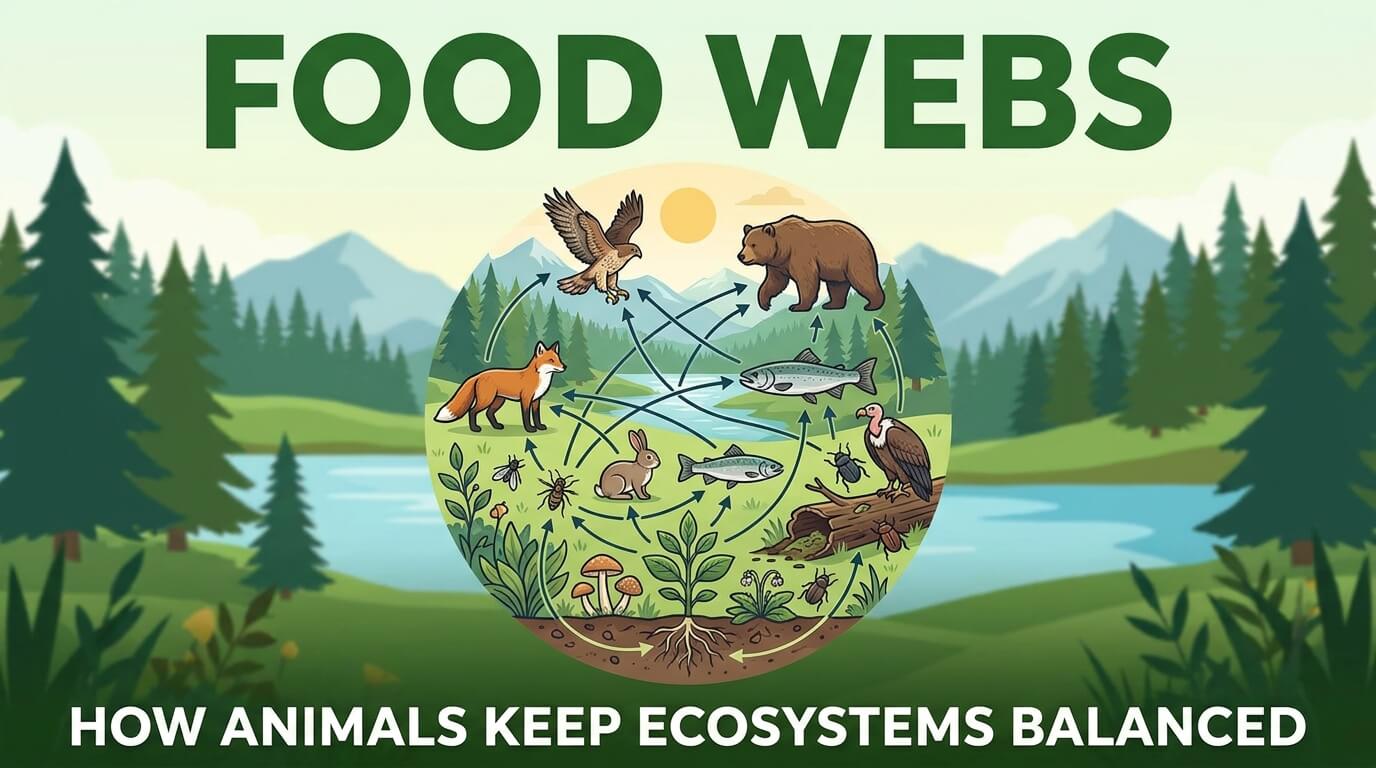
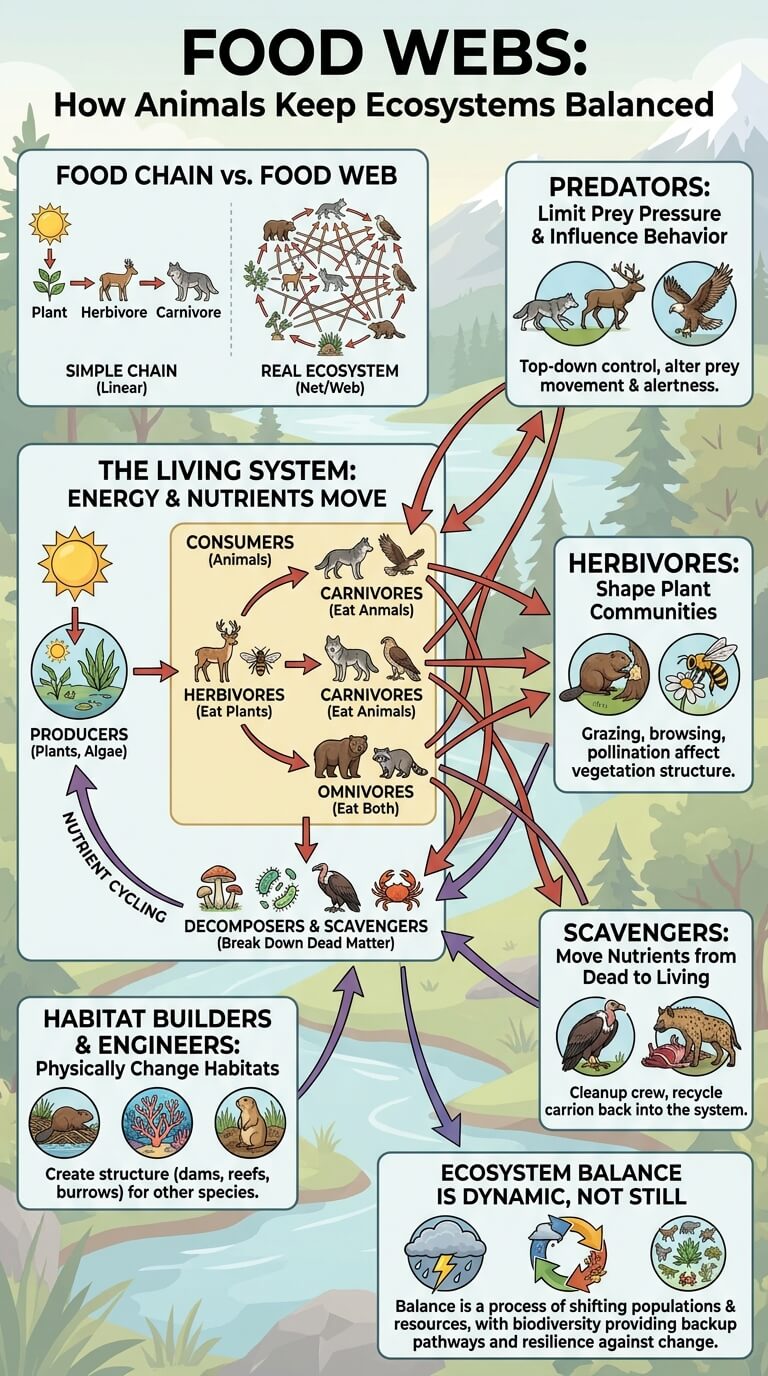
Food webs show how animals, plants, fungi, bacteria, and other living things are connected by feeding relationships. A food chain can make nature look like a straight line, but real ecosystems are usually more like a net: one animal may eat several foods, become food for several predators, and affect the habitat around it in ways that reach far beyond a single meal.
Food Webs: How Animals Keep Ecosystems Balanced is really a question about roles. Predators can limit prey pressure. Herbivores can shape plant communities. Scavengers help move nutrients from dead animals back into the system. Burrowers, reef builders, beavers, and grazers can physically change habitats. Biodiversity adds backup pathways when one species declines or a season changes.
The important idea is not that every ecosystem stays perfectly balanced. Ecosystems change constantly. Storms, fires, droughts, disease, migration, seasonal breeding, invasive species, and human activity can all shift the web. Still, food webs help explain why animals are not isolated characters in nature. They are part of a living system where energy, nutrients, behavior, and population pressure move through many connections.
Quick Overview
A food web is a map of who eats whom in an ecosystem. The USGS food web explanation describes it as the links among species in an ecosystem, while noting that food chains show only a simpler line of feeding relationships.
Animals help keep ecosystems functioning because they move energy and nutrients through those links. A deer eating young tree shoots, a wolf hunting deer, a vulture feeding on carrion, a bee pollinating flowers, a salmon carrying marine nutrients into a river system, and a beaver holding water behind a dam are all part of the larger flow of life.
Balance in this context does not mean nature is still or perfectly even. It means the system has processes that can keep populations, resources, and habitat structure from swinging too far for too long. Sometimes those processes fail. Sometimes they recover. Food webs give readers a simple way to understand those changes without reducing nature to a cartoon chain.
The rest of this guide works as a broad hub. It explains the main pieces of food webs, the animal roles that matter most, the myths that often confuse people, and the related ecosystem questions that deserve deeper attention.
What Food Webs Include
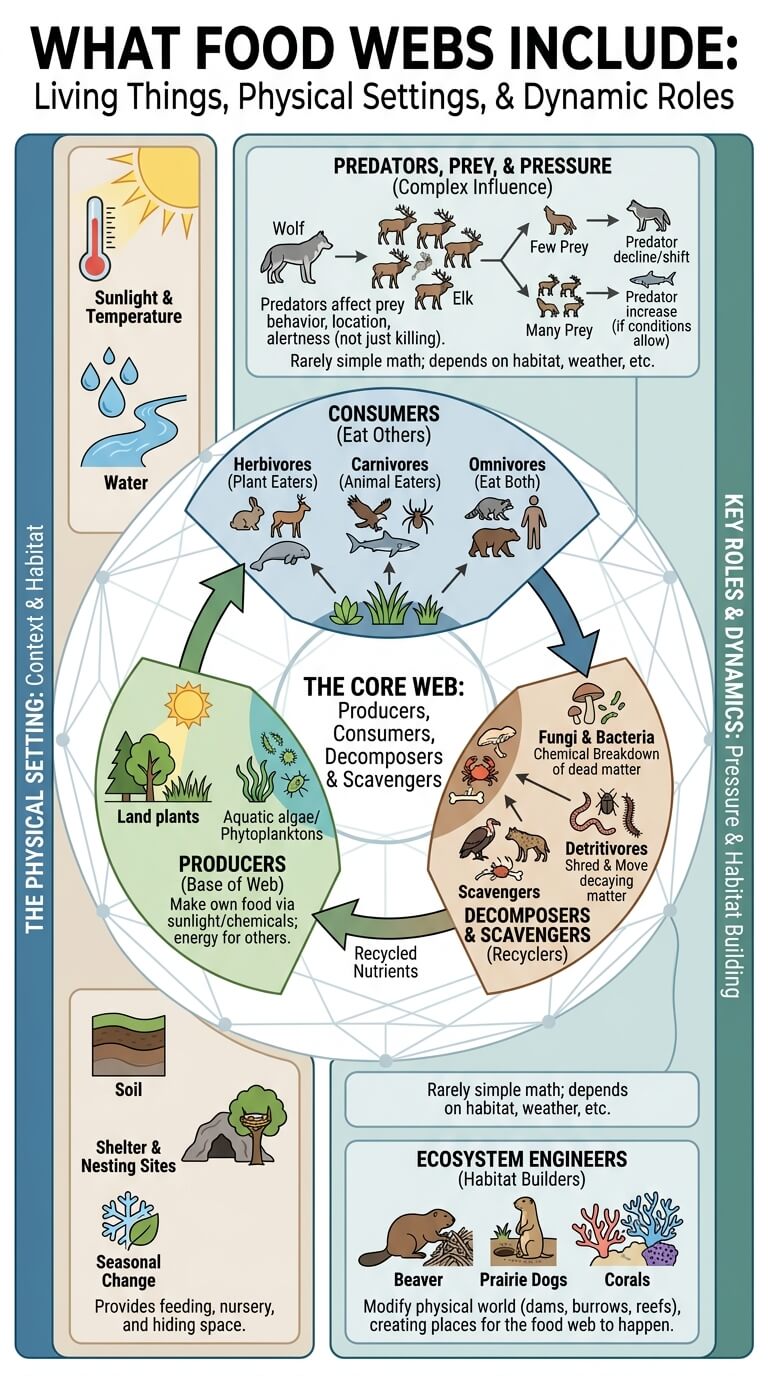
A food web includes many kinds of living things, not just big predators. It includes producers that make their own food, consumers that eat plants or animals, decomposers that break down dead organic matter, and scavengers that feed on carcasses or other remains. It also includes the physical setting: water, soil, sunlight, temperature, shelter, nesting sites, and seasonal change.
For animal-focused readers, it helps to think of a food web as a set of jobs. Some animals graze, browse, hunt, scavenge, pollinate, disperse seeds, dig, filter water, build homes, or become prey. These jobs overlap. A single species can be predator, prey, scavenger, competitor, seed disperser, and habitat modifier during different parts of its life.
Producers, consumers, decomposers, and scavengers
Producers are the base of most food webs. On land, they are usually plants. In water, they often include algae, seagrasses, and microscopic phytoplankton. Producers capture energy from sunlight or chemical processes and turn it into living tissue that other organisms can eat.
Consumers include animals that eat producers or other consumers. Herbivores such as rabbits, grasshoppers, deer, manatees, and sea urchins feed directly on plants or algae. Carnivores such as hawks, wolves, sharks, frogs, spiders, and many fish eat animals. Omnivores, including raccoons, bears, crows, some turtles, and many humans, eat both plant and animal material.
Decomposers and detritivores break down dead material into simpler substances. Fungi and bacteria do much of this chemical work, while animals such as earthworms, millipedes, isopods, fly larvae, and many beetles help shred, consume, and move decaying matter. Scavengers are animals that feed on dead animals or scraps left by predators. Vultures, hyenas, crabs, eagles, coyotes, beetles, and many fish can all take part in cleanup, depending on habitat.
Predators, prey, and population pressure
Predators are not just animals that kill prey. They can also influence where prey go, how long prey feed, when prey move, and how alert prey need to be. A herd of elk may use a meadow differently when wolves are present. Small fish may stay closer to shelter when larger fish are nearby. Songbirds may change feeding behavior when hawks patrol an open area.
Prey animals influence predators too. If prey becomes scarce, predators may switch food sources, expand their range, compete more strongly, reproduce less successfully, or decline. If prey becomes abundant, some predators may reproduce more successfully, but only if habitat, disease, competition, and other limits allow it.
This back-and-forth pressure is one reason food webs rarely behave like simple math. A predator does not automatically control every prey species. A prey species does not automatically explode when one predator declines. Other predators, food supply, weather, parasites, habitat cover, breeding rates, and human changes can all shape the result.
Habitat builders and ecosystem engineers
Some animals affect ecosystems by changing the physical world around them. Beavers build dams that slow water and create wetlands. Prairie dogs dig burrow systems that influence soil, vegetation, and shelter for other animals. Corals build reef structures that support fish, crustaceans, mollusks, and many other species. Elephants can open paths and knock down trees, which changes plant structure in some landscapes.
These animals are often called ecosystem engineers because their bodies and behaviors modify habitat. The National Park Service beaver research summary describes beavers as ecosystem engineers that help create and maintain wetland complexes through dam building and foraging.
Habitat builders matter because food webs need places to happen. A wetland, coral reef, burrow system, grassland patch, dead tree, kelp forest, or leaf litter layer can provide feeding sites, nursery space, hiding cover, nesting material, and moisture. When animals reshape those places, they can change who survives there.
The Main Framework Behind Ecosystem Balance
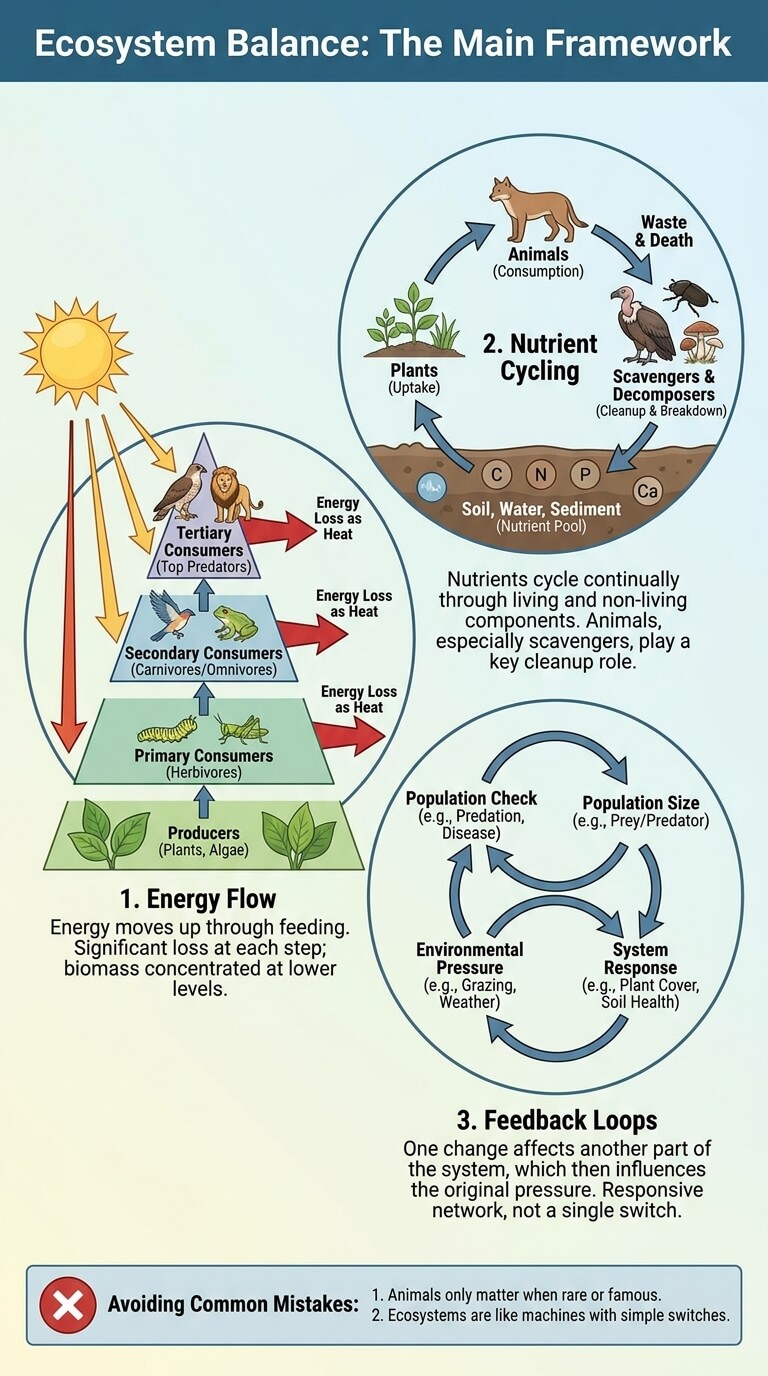
Food webs help explain ecosystem balance through three big processes: energy flow, nutrient cycling, and feedback. Energy moves from producers to consumers and is lost as heat along the way. Nutrients cycle through bodies, waste, dead material, soil, water, and new growth. Feedback occurs when one change affects another part of the system, which then affects the original pressure.
This framework is useful because it avoids two common mistakes. One mistake is thinking that animals matter only when they are rare, cute, dangerous, or famous. The other is thinking that ecosystems work like machines with one switch for every result. Food webs are more flexible and more complicated than that.
Energy flow through feeding relationships
Energy usually enters a food web through producers. A plant grows leaves. A caterpillar eats the leaves. A bird eats the caterpillar. A hawk eats the bird. At each step, energy is used for movement, body heat, growth, waste, reproduction, and daily survival, so only part of the energy becomes available to the next consumer.
A NOAA National Ocean Service lesson explains that food webs are more complex than simple chains and that energy and biomass are concentrated more heavily at lower trophic levels.
This is why ecosystems usually contain many more small prey animals, plankton, insects, seeds, leaves, or grazing animals than top predators. Large predators often need large hunting areas or productive habitats because they depend on energy that has already passed through several steps.
Nutrient cycling and animal cleanup roles
Energy flows through an ecosystem, but nutrients cycle. Carbon, nitrogen, phosphorus, calcium, and other materials move from soil and water into plants, from plants into animals, from animals into predators and scavengers, and eventually back into soil, sediment, or water through waste, death, and decay.
Animals help this cycling in many ways. Grazers turn plant material into dung that can feed insects and soil microbes. Predators leave remains that feed scavengers. Salmon can move marine-derived nutrients into streams and forests when they return to spawn and die. Turtles, fish, crabs, vultures, beetles, and many other animals move nutrients across boundaries that plants cannot cross on their own.
Scavengers are especially easy to overlook because their work happens after death. Yet carrion is not wasted in a healthy ecosystem. It can feed birds, mammals, reptiles, insects, fish, microbes, and plants indirectly. The Animal Diversity Web profile of New World vultures describes these birds as important in breaking down large carcasses and helping nutrient cycling.
Population checks, competition, and ecological feedback
A population check is any pressure that limits how many individuals survive or reproduce. Predation is one check. Food supply, disease, weather, nesting space, competition, parasites, and territory are others. Food webs combine these checks into a shifting network of limits.
Competition matters because animals with similar needs may limit one another. Two seed-eating birds may compete for the same winter food. Two predators may compete for the same prey. Grazers may compete with each other, but they may also create short vegetation that benefits some species and harms others.
Feedback makes food webs responsive. If a prey population grows, predators may have more food. If predators increase, prey may decline or change behavior. If heavy grazing reduces plant cover, nesting birds, insects, soil moisture, and stream banks may be affected. If plant cover recovers, it may alter shade, water temperature, shelter, and food availability. The web keeps responding.
Key Animal Roles Readers Should Know
Animals do not all contribute to ecosystem balance in the same way. Some roles are based on feeding. Others are based on movement, behavior, body structure, or habitat change. The most useful way to understand animal roles is to ask what would likely change if that animal became much more common, much rarer, or disappeared from a local ecosystem.
Keystone species and disproportionate impact
A keystone species is a species with an unusually large effect compared with its abundance. That does not mean it is always the biggest, rarest, or most famous animal in the ecosystem. It means its role helps hold parts of the community together.
The National Park Service biodiversity glossary defines a keystone species as one that has a disproportionate effect on the persistence of other species through its position in a food web or nutrient cycle.
Classic animal examples often include sea stars in some rocky shore systems, sea otters in kelp forest food webs, beavers in wetlands, and certain large predators in prey-rich landscapes. The details matter, though. A species can be keystone in one ecosystem without having the same effect everywhere it lives.
Apex predators and top-down pressure
Apex predators are predators near the top of a local food web, with few regular natural predators as healthy adults. Wolves, lions, orcas, crocodilians, large sharks, and eagles can be apex predators in certain settings. Their role is not only to remove prey. They may also influence prey behavior, competition among smaller predators, scavenger food supply, and the movement of nutrients.
Top-down pressure means that predators influence lower parts of the food web. That influence can be strong, weak, direct, indirect, or seasonal. It depends on prey behavior, habitat cover, alternate prey, hunting success, human disturbance, disease, and the presence of other predators.
Apex predator does not mean invincible or universally dangerous to people. It is an ecological term, not a monster label. A top predator in one habitat may be vulnerable as a juvenile, threatened by humans, limited by prey availability, or absent from nearby ecosystems.
Scavengers and carrion removal
Scavengers help move nutrients from dead animals back into the food web. Some animals specialize in carrion more than others, but many species scavenge when the opportunity is available. Eagles, gulls, bears, coyotes, raccoons, crabs, beetles, flies, and fish may all feed on dead material in the right setting.
This role connects predators and decomposers. A wolf, shark, owl, or big cat may kill prey and eat the best parts. Scavengers may take leftovers. Insects and microbes continue the process. Eventually, nutrients that were once locked in an animal body can support plants, algae, fungi, or new animal growth.
Cleanup roles should be discussed carefully. Scavengers can reduce the time carcasses remain available in a landscape, but disease outcomes depend on the pathogen, habitat, scavenger community, climate, and human activity. It is better to say scavengers contribute to cleanup and nutrient cycling than to claim they eliminate disease risk.
Biodiversity and ecological backup systems
Biodiversity is the variety of life in an area. It can include species diversity, genetic diversity within a species, and functional diversity, meaning different ecological jobs. A meadow with many pollinators, grazers, seed dispersers, soil animals, birds, microbes, and plant species has more possible pathways than a simplified system with only a few dominant players.
Ecological backup does not mean every species can replace every other species. A bee cannot replace a wolf, and a beetle cannot replace a beaver. But in some roles, multiple species can provide partial overlap. If one pollinator declines, another may visit some of the same plants. If one scavenger is absent, another may use part of the carrion resource.
The U.S. Fish and Wildlife Service pollinator overview notes that birds, bats, butterflies, moths, flies, wasps, beetles, and bees can all help pollinate crops and other plants. That variety shows why animal roles often depend on more than one species.
How Animals Feed, Move, and Shape Ecosystems
Food webs are not only about eating. Movement, fear, migration, digging, nesting, grazing, and waste all affect the structure of ecosystems. Animals carry seeds, pollen, parasites, nutrients, and energy across space. They also change how other animals use space.
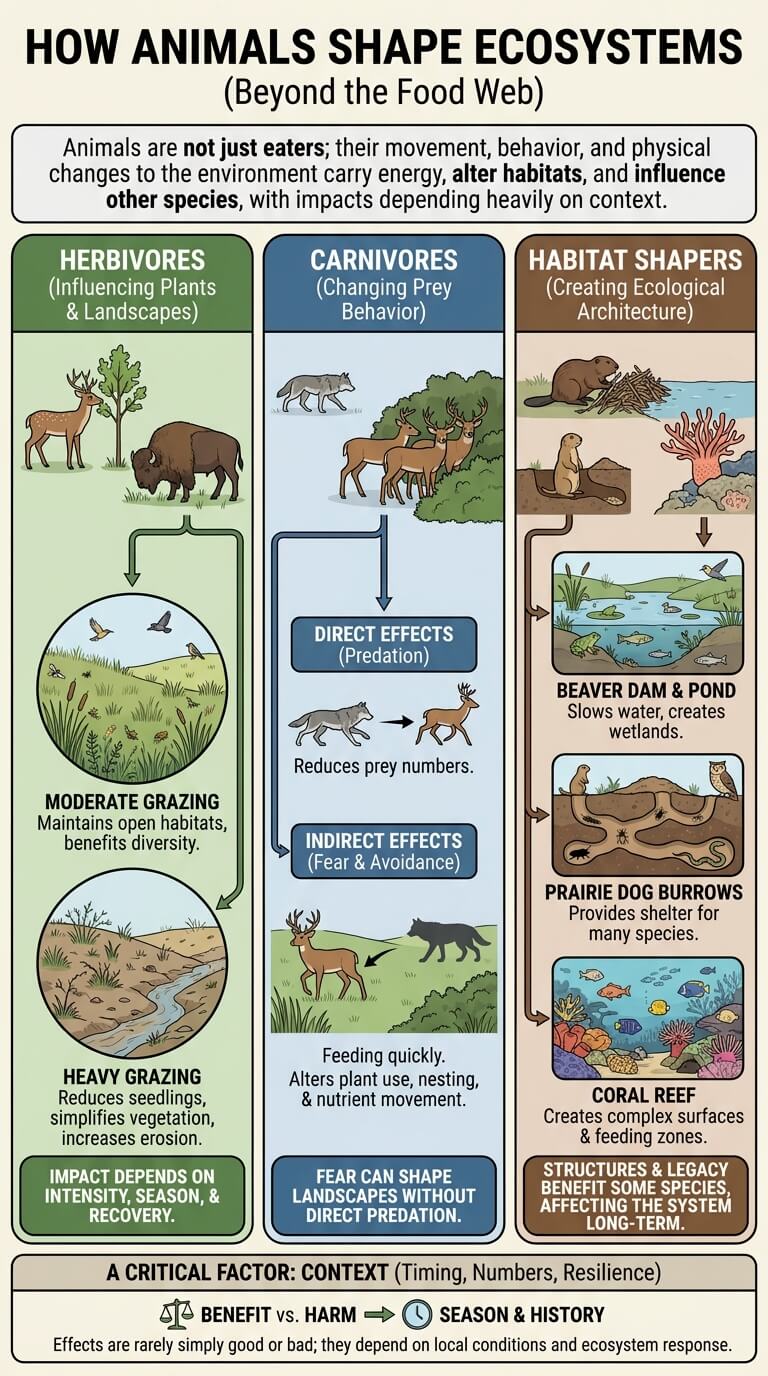
An animal’s impact depends on context. A grazer can maintain open habitat in one place and overbrowse young plants in another. A predator can stabilize one food web and have a smaller effect in another. A burrower can improve soil mixing, but dense burrowing in a fragile area may increase erosion. Food webs are always local.
Herbivores that influence plants and landscapes
Herbivores are sometimes treated as passive prey, but they can be powerful ecosystem shapers. Deer browse young trees and shrubs. Bison graze grasses, disturb soil, and create patches of different vegetation height. Sea urchins can heavily graze kelp when predator pressure is low. Insects can defoliate trees, pollinate flowers, or prune plant growth in ways that change future food availability.
The effect of herbivores depends on intensity. Moderate grazing may maintain open areas that benefit some plants, insects, and birds. Heavy grazing or browsing can reduce seedlings, simplify vegetation, expose soil, and change streamside shade. A herbivore’s role is therefore not simply good or bad. It depends on numbers, season, plant recovery, predator presence, and habitat resilience.
Carnivores that change prey behavior
Carnivores can shape ecosystems by changing prey behavior even when they do not kill many animals. Prey may avoid risky places, feed more quickly, gather in groups, use thicker cover, or move at different times of day. These behavioral changes can affect plant use, nesting success, competition, and nutrient movement.
This does not mean fear alone explains every ecosystem pattern. Scientists often separate direct effects, such as predators reducing prey numbers, from indirect effects, such as predators changing prey behavior. Both can happen, and their relative importance varies by ecosystem.
Burrowers, grazers, reef builders, and dam builders
Habitat-shaping animals create structure. A prairie dog burrow may provide shelter opportunities for insects, reptiles, amphibians, and mammals. A coral reef creates surfaces, crevices, shade, current breaks, and feeding zones for marine animals. A beaver dam can slow water, spread it across a floodplain, and create wetland habitat.
These changes can last beyond a single animal’s life. Old burrows, fallen logs opened by woodpeckers, abandoned nests, coral skeletons, and beaver ponds can continue to affect other species. In that sense, some animals leave ecological architecture behind.
Context still matters. Habitat modification can benefit some species while reducing habitat for others. A dam, burrow system, grazing patch, or reef is not automatically positive in every place. The ecological question is what it changes, which species use it, and how the surrounding system responds.
Common Myths or Misunderstandings About Food Webs
Food webs are often simplified for school diagrams, videos, and quick facts. Simple diagrams are useful, but they can create myths if readers forget that real ecosystems are messy, seasonal, and full of overlapping roles. The most common misunderstandings usually come from treating food webs as straight chains or hero stories.
Myth that food chains are simple straight lines
A food chain is a helpful teaching tool, but it is not the full picture. A grasshopper may eat several plants. A frog may eat grasshoppers, flies, moths, spiders, or smaller frogs. A snake may eat frogs, rodents, eggs, or lizards. A hawk may eat snakes, rabbits, birds, or carrion. The more realistic the picture becomes, the more it looks like a web.
This matters because changes can travel through unexpected paths. If an insect declines, it might affect birds, bats, fish, frogs, plants, and predators in different ways. If a predator disappears, prey may shift behavior, smaller predators may expand, vegetation may change, or nothing dramatic may happen if other controls remain strong.
Myth that only predators matter
Predators are important, but they are not the only animals holding ecosystems together. Herbivores influence plants. Pollinators support reproduction in many flowering plants. Seed dispersers move future plants across the landscape. Scavengers and detritivores help process dead material. Burrowers and reef builders create structure. Prey species feed predators, scavengers, parasites, and decomposers.
A healthy food web needs many roles, not just a dramatic top predator. Removing a pollinator, a grazer, a burrower, or a scavenger can matter, especially if the species has a unique job or few substitutes. Small animals can have large ecological effects when they are abundant, specialized, or connected to many other species.
Myth that removing one species rarely matters
Sometimes ecosystems absorb the loss of a species with little obvious short-term change. Other times, one species can have a much larger effect than expected. The outcome depends on the species’ role, the number of substitute species, the speed of decline, habitat condition, climate stress, invasive species, and human pressures.
That is why broad claims can be misleading. It is too simple to say every species is equally important in the same way. It is also too simple to say only famous keystone species matter. Food webs work through connections, and the strength of those connections varies.
How This Topic Connects to Related Animal Questions
Food webs are the starting point for many deeper animal questions. Once readers understand that animals move energy, nutrients, and behavior through ecosystems, it becomes easier to understand why some species have outsized effects, why predator loss can trigger change, why biodiversity matters, and why cleanup animals deserve attention.
Why keystone species can change an entire ecosystem
Keystone species matter because their influence is stronger than their abundance alone would suggest. A sea star that controls mussel competition, a beaver that creates wetland habitat, or a predator that changes prey pressure can affect many other species indirectly. The food web idea explains how one role can spread outward.
A deeper keystone species discussion should ask how scientists know a species is keystone, whether the role is local or widespread, and how it differs from being common, endangered, dominant, or charismatic.
What predator loss can do to prey and plants
When predators disappear, prey may increase, shift habitat use, or face new pressure from other predators and competitors. Plants may experience heavier browsing or grazing in some systems. Smaller predators may expand if a larger predator no longer limits them. But the outcome is not identical everywhere.
This topic deserves careful treatment because predator loss is often oversold as a simple chain reaction. The more accurate view is that predator decline changes one set of pressures, and the rest of the food web responds depending on local conditions.
How trophic cascades show hidden connections
A trophic cascade is a chain reaction that moves through feeding levels. For example, a change in predator pressure may affect herbivores, which may affect plants, which may affect insects, birds, or stream conditions. Trophic cascades show why an animal can influence organisms it never directly touches.
Not every food web change is a trophic cascade. The term is most useful when a change at one trophic level produces measurable effects at other levels. A dedicated cascade explanation can go deeper into top-down effects, bottom-up effects, behavior-mediated effects, and density-mediated effects.
Why biodiversity makes ecosystems more resilient
Biodiversity can make ecosystems more resilient by providing multiple species, genes, and ecological roles. A diverse system may have more ways to keep pollination, seed dispersal, predation, decomposition, and nutrient cycling going after disturbance. That does not make biodiversity a magic shield, but it can provide more options for recovery.
This connects food webs to conservation. Protecting a single famous animal may help, but ecosystem balance usually depends on habitats, interactions, and communities. The web matters as much as the individual thread.
FAQ
What is the difference between a food chain and a food web?
A food chain is a simple line showing one path of energy transfer, such as plant to insect to frog to snake to hawk. A food web is a broader network showing many feeding relationships in the same ecosystem. Food webs are more realistic because most animals eat more than one kind of food and may be eaten by more than one predator.
Can one animal really affect a whole ecosystem?
Yes, one animal species can affect a whole ecosystem in some cases, but the effect depends on its role and the local web. Keystone species, ecosystem engineers, major predators, abundant herbivores, important pollinators, and high-impact scavengers can influence many other species. However, not every species has the same level of visible impact, and the same animal may play different roles in different habitats.
Why are scavengers part of ecosystem balance?
Scavengers are part of ecosystem balance because they feed on dead animals and help move nutrients back into the food web. They connect predators, decomposers, soil organisms, and plants. Their work also reduces how long carcasses remain unused, although it is best to avoid simple claims that scavengers remove all disease risk.
Are humans part of food webs too?
Humans are part of food webs because people consume plants, animals, and fungi, affect predators and prey, change habitats, move species, manage land and water, and influence nutrient cycles. Modern human effects are unusually large because agriculture, fishing, urban development, pollution, climate change, and wildlife management can reshape food webs across wide areas.
Final Thoughts
Food webs show that animals keep ecosystems balanced through many connected roles. Predators influence prey numbers and behavior. Herbivores shape plants. Scavengers and decomposers return nutrients to the system. Pollinators and seed dispersers support plant reproduction. Habitat builders create living space for other species. Biodiversity gives ecosystems more pathways for response and recovery.
The main takeaway is simple: animals do not just live in ecosystems, they help make ecosystems work. A food web is the clearest way to see those connections without reducing nature to a single chain. When one part of the web changes, the effects may be small, large, immediate, delayed, obvious, or hidden. Understanding those links is the first step toward understanding ecosystem balance.
Ethan Walker is the founder and research editor of Animal Fact Central. He creates and reviews educational animal facts content using trusted wildlife, pet care, and science-based sources. His work focuses on making animal behavior, adaptations, habitats, and species facts clear, accurate, and engaging for everyday readers.
Read More Details About Ethan Walker: https://animalfactcentral.com/ethan-walker/