
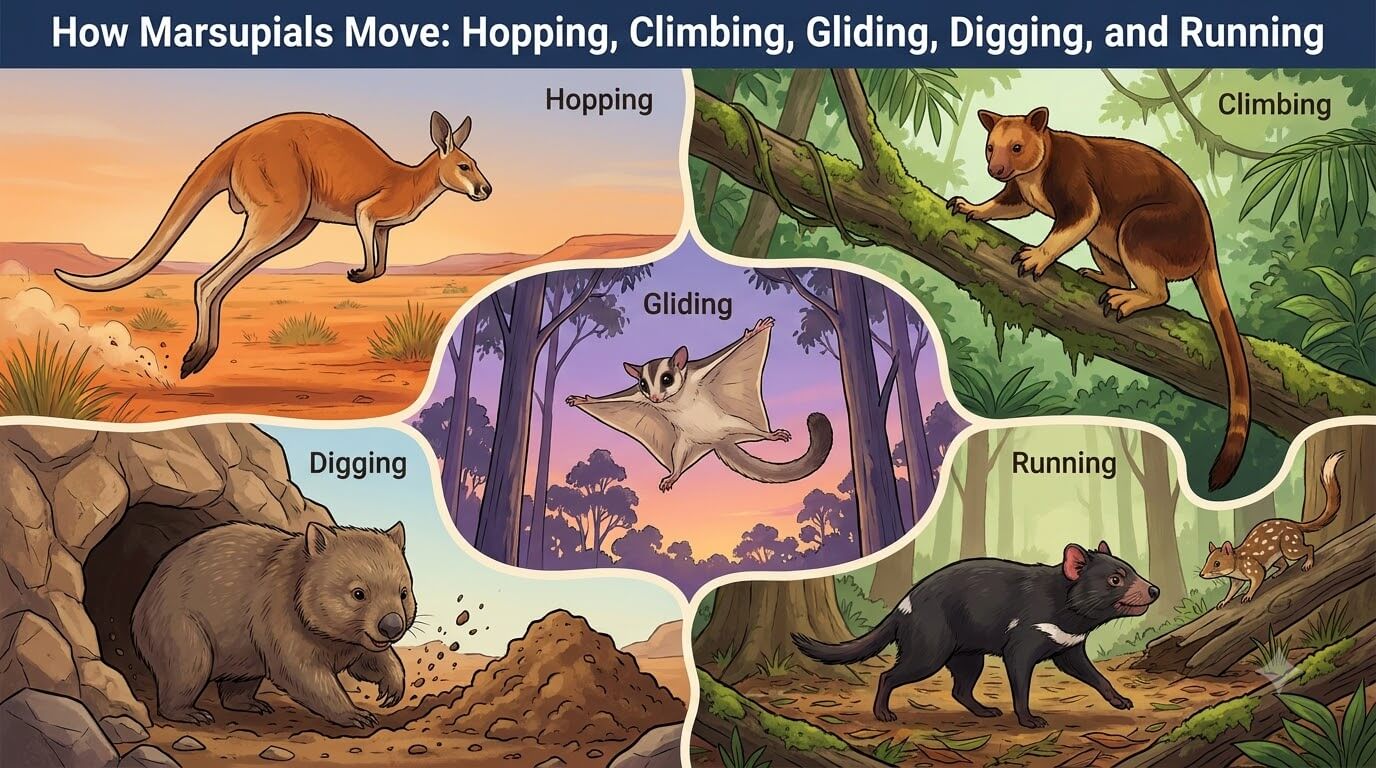
Marsupials move in far more ways than the famous kangaroo hop. Large kangaroos use powerful bipedal hopping at travel speeds and a very different five-part gait at slow speeds. Tree-kangaroos climb with broad gripping feet and flexible ankles. Sugar gliders travel between trees on a membrane of skin. Wombats excavate burrows with powerful forelimbs. Marsupial moles move through loose sand underground, while quolls, devils, bandicoots, opossums, and many other marsupials walk, run, scramble, or climb on four limbs.
These differences are not random. Locomotion reflects body size, ancestry, habitat, food, predators, and the surfaces an animal must cross. Open-country grazers face a different movement problem from canopy animals, forest-floor foragers, and subterranean specialists. Looking across living Marsupialia reveals a set of movement strategies shaped by very different ecological demands.
Quick Answer
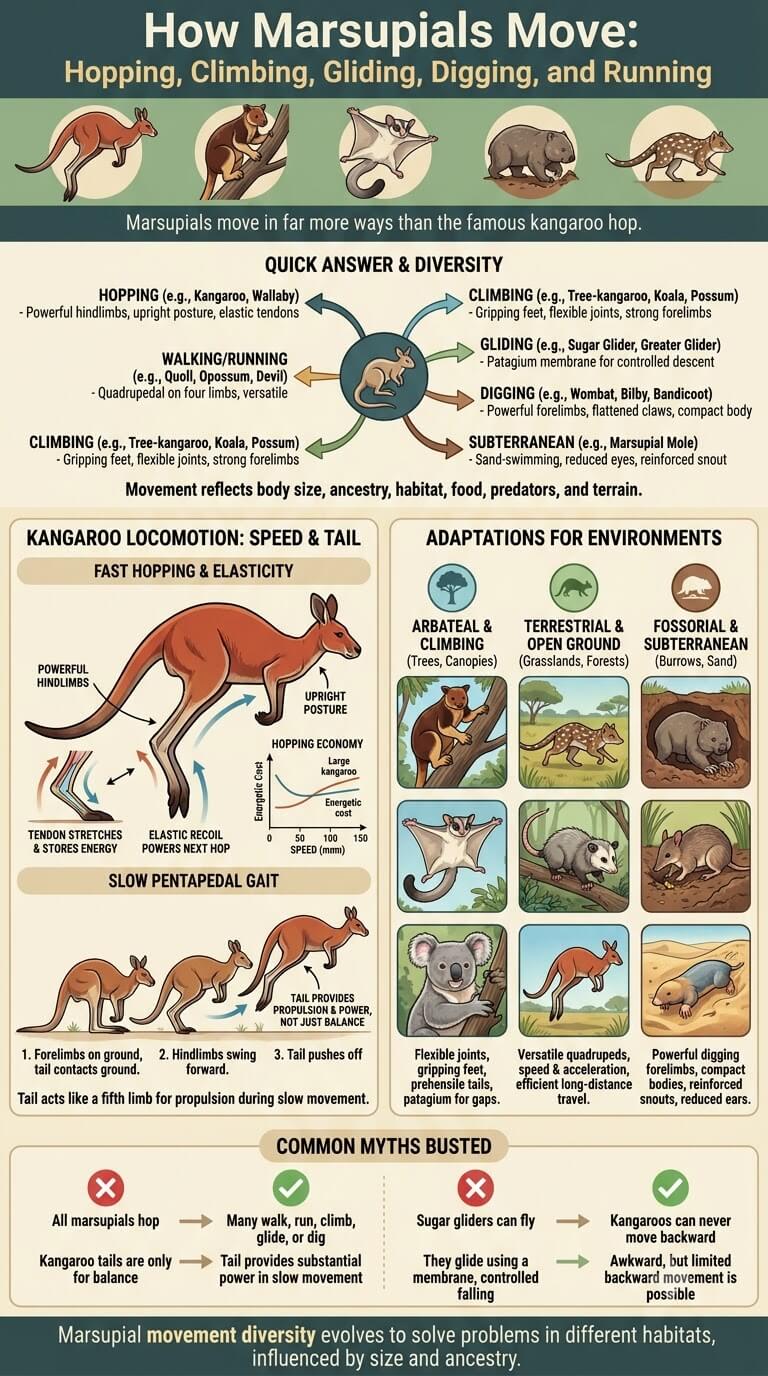
Marsupials can hop, walk, run, climb, glide, dig, scramble, and in some species swim. Hopping is especially developed in kangaroos and wallabies, but it does not define Marsupialia. Many marsupials are ordinary quadrupeds, meaning they move primarily on four limbs.
Large kangaroos are especially unusual because they switch gaits with speed. At moderate and faster travel speeds they hop on the hindlimbs. At slow speeds they place the forelimbs and tail on the ground and swing the hindlimbs forward, producing a gait commonly called pentapedal locomotion. A force-plate study of red kangaroos found that the tail powers pentapedal locomotion by providing substantial propulsion rather than acting only as a passive balance support.
Why Marsupial Movement Is So Diverse
Different habitats create different locomotor problems
An animal moving across open grassland needs a different body from one crossing narrow branches or pushing through sand. Ground distance, vertical surfaces, unstable substrates, burrow walls, canopy gaps, and dense vegetation all impose different mechanical challenges.
For kangaroos in open habitats, powerful hindlimbs can move the body efficiently over distance. For arboreal possums, gripping feet and flexible joints are more useful. For a glider, the challenge is crossing a gap without descending all the way to the ground. For a marsupial mole, ordinary walking matters far less than pushing through sand.
Body size changes what movement strategies can do
Locomotion also changes with scale. A small gliding marsupial can launch from a branch and steer with a light body and broad membrane. A large kangaroo can store substantial elastic energy in long hindlimb tendons during repeated hopping. A heavy wombat needs strong limbs and a compact body to excavate soil and move through a tunnel.
This is why the same movement label can hide very different mechanics. A tiny hopping marsupial and a large kangaroo do not necessarily gain identical energetic benefits from each hop. Size affects tendon loading, stride length, stability, and the forces acting on bones and muscles.
Ancestry sets the starting point for adaptation
Natural selection modifies inherited anatomy rather than designing movement from scratch. Closely related marsupials can therefore retain similar features while becoming adapted to different environments.
Tree-kangaroos are a striking example. Their ancestors came from a macropod lineage strongly associated with hopping, yet tree-kangaroos evolved back toward a more flexible climbing body. Their limbs, feet, and joints reflect both kangaroo ancestry and the demands of life in trees.
Kangaroo Hopping
Powerful hindlimbs and an upright hopping posture
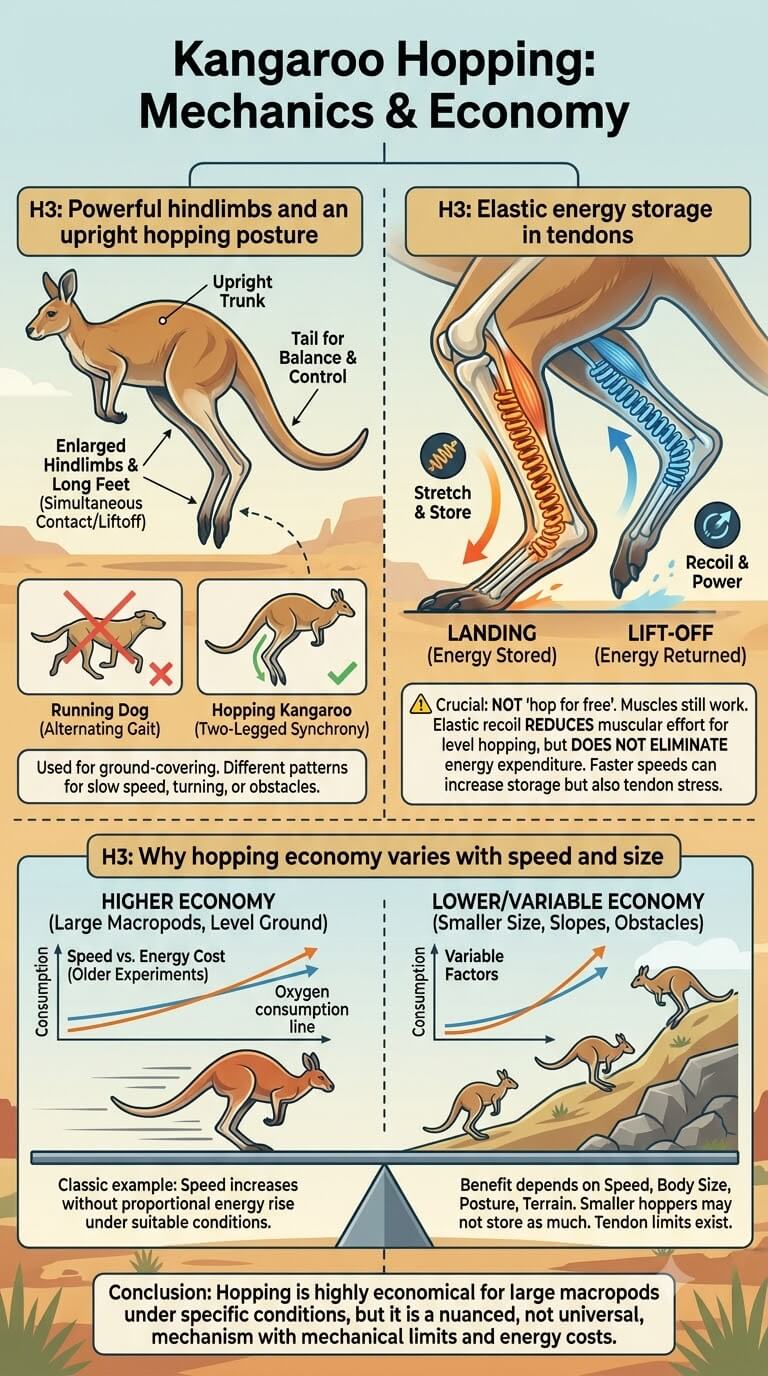
Large kangaroos use enlarged hindlimbs, elongated feet, strong ankle extensors, and a large muscular tail to support their distinctive locomotion. During hopping, the hindlimbs contact the ground together and then leave it together, unlike the alternating left-right pattern typical of a running dog, horse, or human.
The long feet and hindlimbs help produce a long effective stride. The trunk remains relatively upright compared with many quadrupedal mammals, and the tail contributes to balance and control even when it is not striking the ground during faster hopping.
Hopping is especially valuable for covering ground, but it is not automatically the cheapest gait at every speed or terrain. Kangaroos use different movement patterns when going slowly, feeding, turning, climbing slopes, or negotiating obstacles.
Elastic energy storage in tendons
One reason large kangaroo hopping is so interesting to physiologists is its use of elastic energy. When the foot and ankle load during landing, tendons can stretch and store mechanical energy. As those tendons recoil, some of that energy is returned to help power the next hop.
A recent biomechanics study of red and grey kangaroos found that changes in hindlimb posture at faster hopping speeds can increase tendon stress and potentially increase elastic energy storage during hopping. This helps explain why large kangaroos can increase speed in ways that differ energetically from ordinary quadrupedal running.
The effect should not be simplified into “kangaroos hop for free.” Muscles still do work, uphill movement costs more, and tendons face mechanical limits. Elastic recoil reduces some of the muscular work needed for repeated level hopping but does not eliminate energy expenditure.
Why hopping economy varies with speed and size
Older experiments found that red kangaroos can increase speed over level ground without the same proportional rise in oxygen consumption expected in many running mammals. That result helped establish kangaroos as classic examples of elastic locomotion.
However, energetic benefit depends on speed, body size, posture, and terrain. Smaller hoppers do not necessarily store the same proportion of energy as large kangaroos, and large animals must also keep tendon stresses within safe limits.
The useful conclusion is that hopping can be highly economical for large macropods under suitable conditions, not that every hopping marsupial uses exactly the same mechanism or pays the same energetic cost.
Slow Kangaroo Movement and the Role of the Tail
How pentapedal locomotion works
When a large kangaroo moves slowly, it usually does not perform a series of tiny upright hops. Instead, it leans forward and places its forelimbs on the ground. The tail then contacts the ground while the paired hindlimbs swing forward together. Once the hind feet land ahead of the body, the forelimbs and tail move forward for the next cycle.
The result is called pentapedal locomotion because the tail functions mechanically alongside the four limbs. The word does not mean the tail is literally a fifth leg anatomically. It means that during the gait, the tail contacts the ground and contributes substantial force.
The tail provides propulsion, not just balance
The red kangaroo force-plate study found that the tail can generate as much propulsive force during slow pentapedal movement as the front and hind limbs combined. It also generates positive mechanical power during its period of ground contact.
That finding corrected a long-standing oversimplification. Kangaroo tails certainly contribute to balance and body control, but during slow movement they can become active propulsive structures. Calling the tail a “kickstand” or “balance pole” captures only part of what it does.
Why the gait changes with speed
Pentapedal locomotion works well while feeding and moving slowly because it allows the paired hindlimbs to advance together without requiring full hops. At greater speeds, the animal transitions to bipedal hopping, where the hindlimb tendon system can exploit repeated elastic loading.
Different gaits solve different problems. Slow movement requires stability and controlled repositioning, while faster travel rewards long, repeatable strides and efficient energy recycling.
Climbing Marsupials
Tree-kangaroos and the return to arboreal life
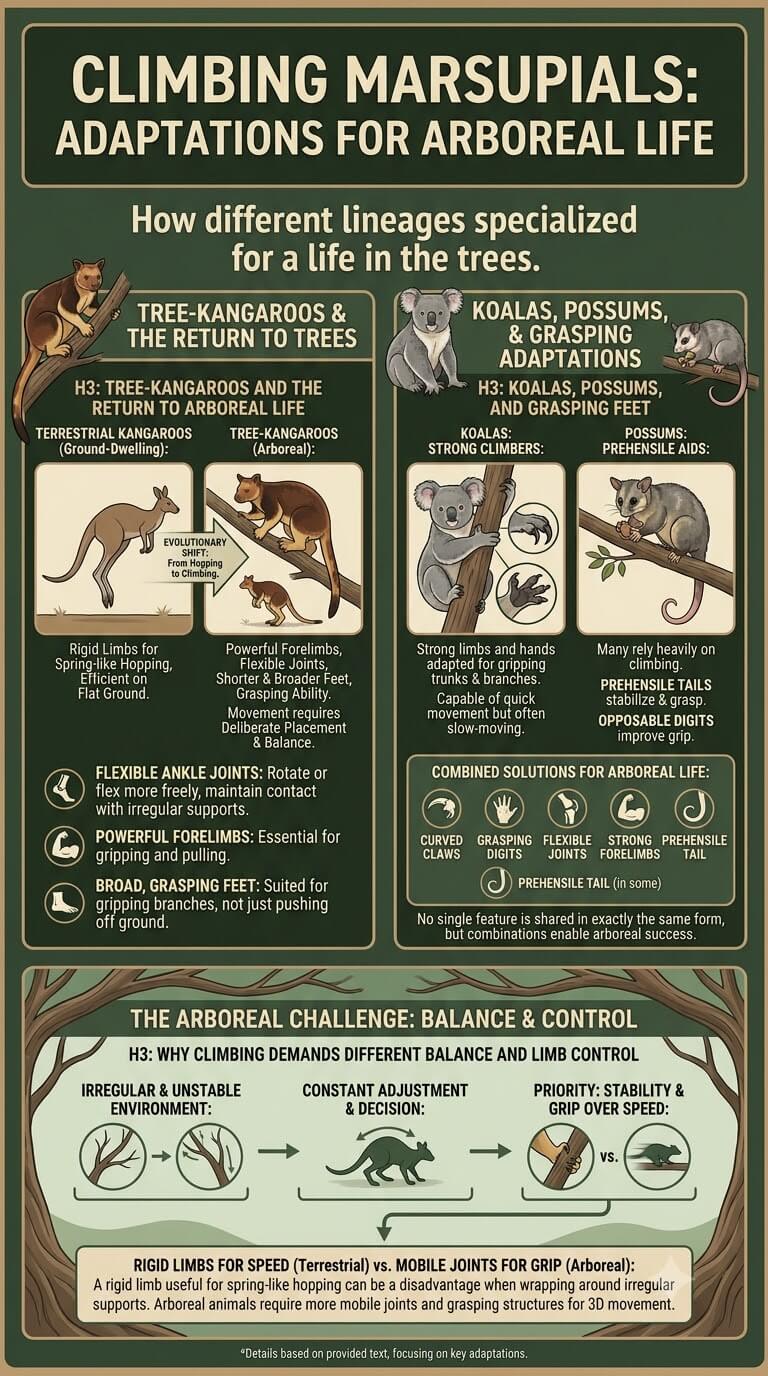
Tree-kangaroos demonstrate how dramatically a hopping lineage can change when it returns to trees. Compared with large terrestrial kangaroos, tree-kangaroos have shorter, broader feet, powerful forelimbs, and more flexible joints suited to gripping and repositioning the body on branches.
The Australian Museum’s tree-kangaroo overview describes broad feet, strongly developed forelimbs, and flexible ankle joints as key features of arboreal movement. Some species can rotate or flex the ankle more freely than ground-dwelling macropods, helping the feet maintain contact with irregular supports.
Tree-kangaroos can still hop on the ground to some degree, but their locomotion is not simply a terrestrial kangaroo gait transferred into a tree. Climbing requires deliberate placement, grasping, balance, and the ability to move among three-dimensional supports.
Koalas, possums, and grasping feet
Koalas are powerful climbers with strong limbs and hands adapted for gripping trunks and branches. Their movement can look slow because they spend much of their time feeding and resting in trees, but they are capable of climbing quickly when needed and can descend to the ground to move between trees.
Many possums also rely heavily on climbing. Prehensile tails in some species help stabilize the body and grasp supports, while opposable or partially opposable digits improve grip. The exact hand and foot arrangement varies among families.
Climbing marsupials therefore combine several solutions: curved claws, grasping digits, flexible joints, strong forelimbs, and sometimes a prehensile tail. No single arboreal feature is shared in exactly the same form by every tree-dwelling marsupial.
Why climbing demands different balance and limb control
A branch can bend, narrow, tilt, or end suddenly. Arboreal animals must constantly adjust body position and decide where to place the next foot. Falling risk changes the value of speed, stability, and grip.
This helps explain why tree specialists often have more mobile joints and grasping structures than relatives that travel efficiently on flat ground. A rigid limb useful for spring-like hopping can be a disadvantage when the foot must wrap around irregular supports.
Gliding Marsupials
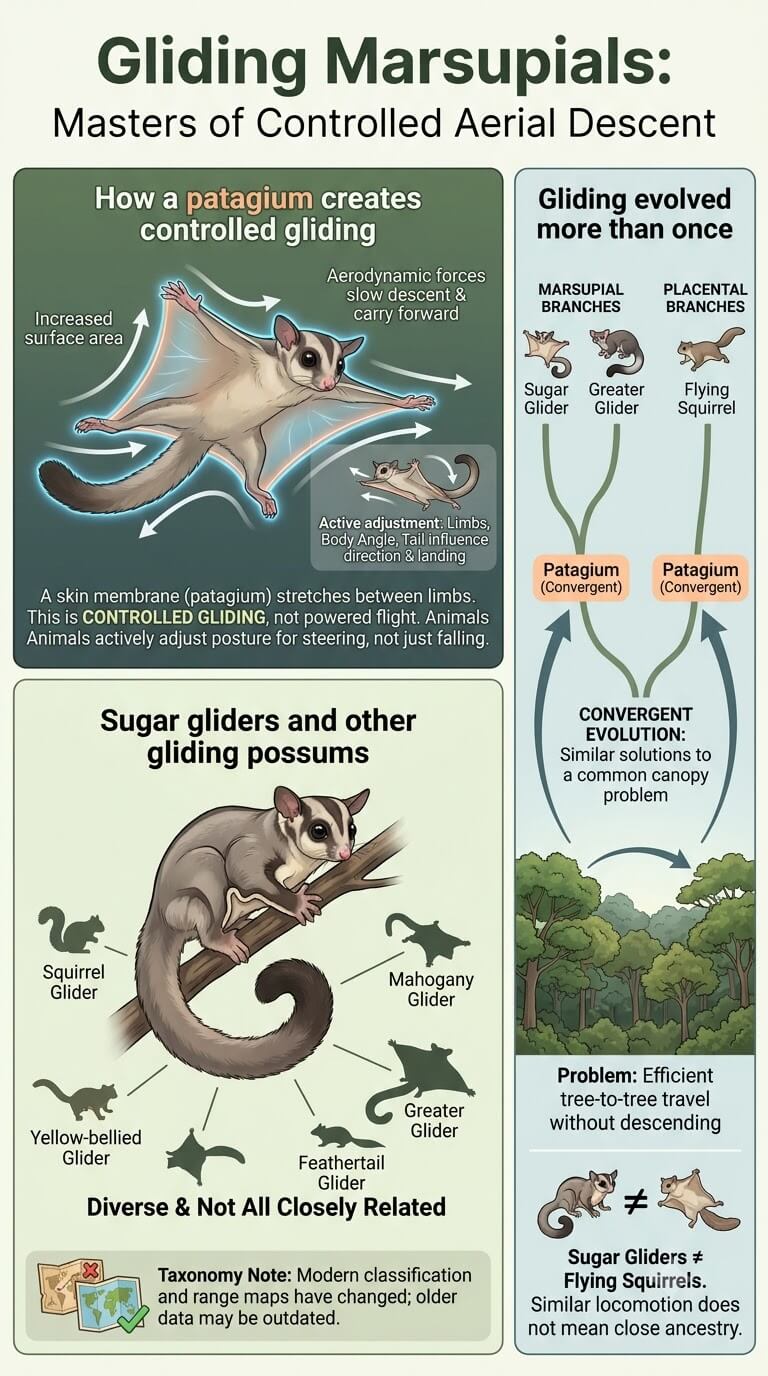
How a patagium creates controlled gliding
Gliding marsupials stretch a membrane of skin called a patagium between the limbs. When the animal leaps from a tree, the membrane increases surface area and allows aerodynamic forces to slow descent while carrying the body forward.
The Australian Museum explains that marsupial gliders use a patagium rather than wings to move from tree to tree. This is controlled gliding, not powered flight.
A glider does not simply fall with skin spread open. It adjusts limb position, body angle, and tail position to influence direction and landing. The exact membrane attachment differs among gliding marsupial lineages.
Sugar gliders and other gliding possums
Sugar gliders are small arboreal marsupials with a patagium stretching along the sides of the body. Their long tail contributes to control but is not itself a wing. Modern taxonomy has also changed the way the familiar sugar glider complex is divided, so old range maps that treated one species as widespread across much of Australia can be outdated.
Other marsupial gliders include squirrel gliders, mahogany gliders, yellow-bellied gliders, feathertail gliders, and greater gliders. These animals are not all equally closely related despite their similar aerial behavior.
Gliding evolved more than once
Similar gliding membranes occur in separate marsupial branches, which is a strong example of convergent evolution. Tree canopies repeatedly create the same movement problem: reaching another tree without climbing all the way down and back up.
Placental mammals such as flying squirrels evolved a broadly similar solution independently. Sugar gliders are therefore not flying squirrels, and flying squirrels are not marsupials. Similar locomotion does not mean close ancestry.
Digging and Subterranean Movement
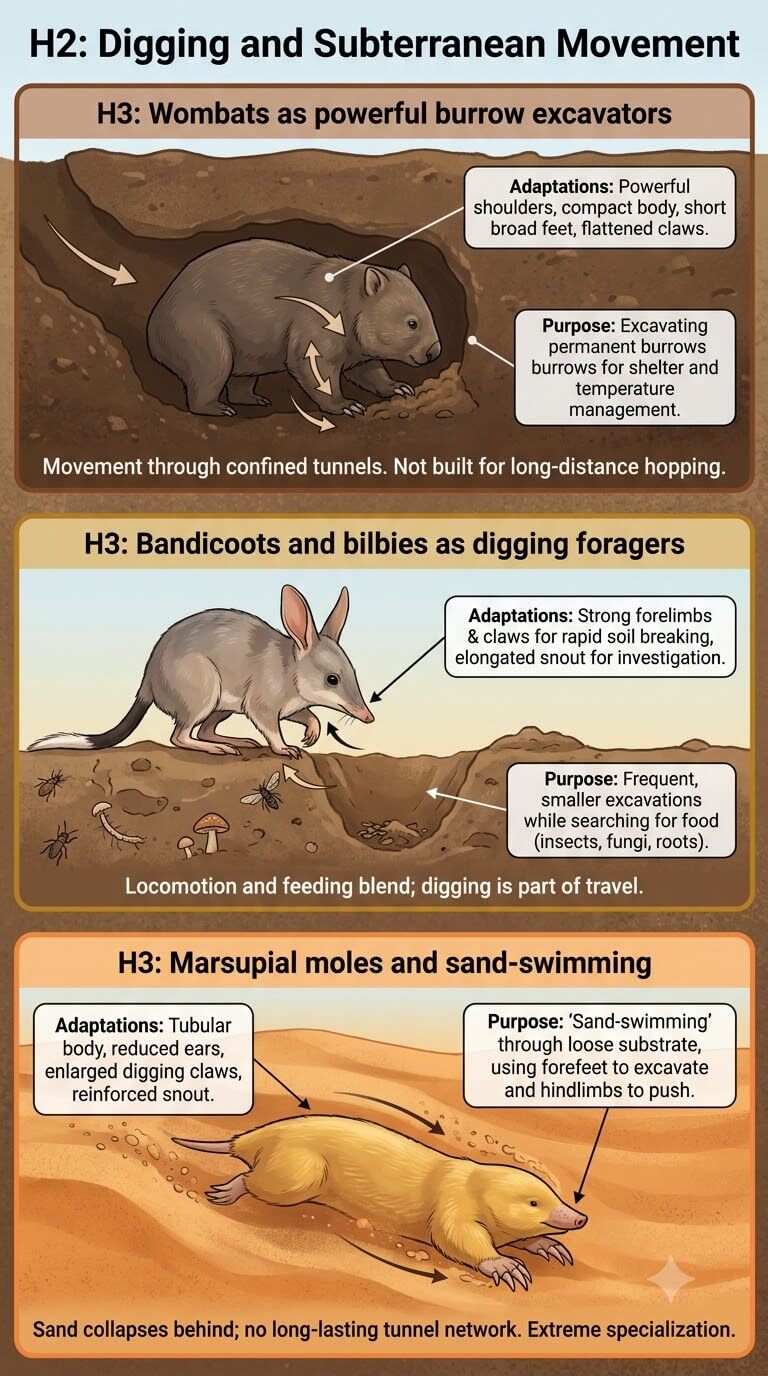
Wombats as powerful burrow excavators
Wombats are among the most heavily built living marsupial diggers. Their short broad feet, flattened claws, powerful shoulders, and compact body are well suited to excavating burrows and moving through confined tunnels.
The Australian Museum’s bare-nosed wombat profile describes powerful limbs, short broad feet, and flattened claws as adaptations for burrowing. Wombats also spend substantial portions of their lives inside burrow systems, making digging central to shelter and temperature management as well as movement.
Above ground, wombats walk and can accelerate when threatened. Their locomotor anatomy is not built for long-distance hopping like a kangaroo, but for supporting a robust body across the ground and generating force during excavation.
Bandicoots and bilbies as digging foragers
Bandicoots and bilbies dig frequently while searching for insects, larvae, fungi, seeds, roots, and other food. Their excavations are often smaller than a wombat shelter burrow because the immediate purpose is foraging rather than creating a large underground refuge.
Strong forelimbs and claws let them break soil rapidly, while the elongated snout helps investigate the ground. Locomotion and feeding blend together: a digging motion is part of how the animal travels through its food landscape.
Marsupial moles and sand-swimming
Marsupial moles represent a much more extreme subterranean specialization. Their tubular bodies, reduced external ears, powerful forelimbs, enlarged digging claws, and reinforced snout suit movement through loose desert sand.
Animal Diversity Web describes the southern marsupial mole as primarily fossorial. When digging, it uses the forefeet to excavate and the hindlimbs and tail to push sand backward. Much of the disturbed sand collapses behind the animal rather than leaving a permanent open tunnel.
This movement is sometimes called sand-swimming because the animal progresses through loose substrate rather than traveling through a long-lasting tunnel network like a wombat. Marsupial moles are not true placental moles despite their convergent digging form.
Walking, Running, and Ground Foraging
Quolls and Tasmanian devils
Quolls and Tasmanian devils are quadrupedal terrestrial marsupials. They walk, trot, run, scramble, and in the case of some quolls climb well. Their locomotion supports active searching for prey, carrion, mates, and shelter rather than long-distance grazing.
Predatory movement also requires acceleration, turning, and negotiating uneven terrain. A quoll moving through forest or rocky habitat benefits from flexibility and climbing ability, while a devil’s heavier build favors powerful ground movement.
Neither animal should be treated as a hopping marsupial simply because it shares ancestry with kangaroos at a higher level.
Opossums on the ground and in trees
Many American opossums move on four limbs and combine terrestrial travel with climbing. The Virginia opossum has a prehensile tail that assists climbing, but large adults do not routinely travel suspended by the tail.
Other didelphids occupy more strongly arboreal or semi-aquatic lifestyles. The water opossum, for example, is associated with streams and has swimming adaptations. Didelphidae therefore includes substantial locomotor variation even within one living marsupial family.
Why ordinary quadrupedal movement matters
The spectacular gaits receive the most attention, but ordinary walking and running are probably the most common movement pattern across much of Marsupialia. Small terrestrial marsupials forage through leaf litter, climb over roots, enter shelters, and run from predators without specialized hopping or gliding.
This is important because marsupials are sometimes visually represented as if hopping were their default mammalian gait. In reality, hopping is one specialization inside a lineage containing many quadrupeds.
How Locomotion Fits Habitat and Feeding
Open-country travel
Large macropods in open environments can benefit from long hindlimbs and repeated hopping when moving among feeding areas. Efficient travel matters when food is spread across broad landscapes or when animals must move between shade, water, and grazing patches.
The same body plan also influences escape behavior. Powerful hindlimbs can rapidly accelerate the body, although maneuvering through dense clutter creates different demands from crossing open ground.
Canopy movement
Tree-dwelling marsupials need secure contact with branches. Possums use claws, grasping feet, and sometimes prehensile tails. Tree-kangaroos add broad feet and flexible ankles. Gliders solve some canopy gaps by moving through the air.
Canopy movement also links directly to diet. Leaves, flowers, fruit, sap, and insects can be distributed among separate trees, so an animal’s ability to climb or glide determines which food patches are reachable.
Underground movement
Burrowing can provide shelter from predators and extreme temperatures, while digging also gives access to hidden foods. Wombats excavate substantial shelter systems, bandicoots and bilbies dig while foraging, and marsupial moles spend most of their lives moving through sand.
These animals solve different underground problems. A wombat must maintain a body-sized tunnel. A bilby repeatedly opens soil from the surface. A marsupial mole can move through collapsing sand without constructing a comparable permanent corridor.
Common Movement Myths
All marsupials hop
False. Hopping is highly developed in kangaroos, wallabies, and several relatives, but many marsupials walk or run on four limbs. Others climb, glide, or specialize in digging.
Kangaroo tails are only for balance
False. The tail helps with balance and posture, but during slow pentapedal locomotion it also contacts the ground and produces substantial propulsive force and mechanical power.
Sugar gliders fly
Not in the powered-flight sense. Sugar gliders launch from an elevated point and glide using a patagium. They cannot generate continuous wingbeats like bats or birds.
Marsupial moles are true moles
False. Marsupial moles are marsupials in Notoryctemorphia. True moles are placental mammals. Their similar digging anatomy evolved independently in response to similar subterranean challenges.
Kangaroos can never move backward
This popular statement is too absolute. The anatomy of large kangaroos makes ordinary backward progression awkward, especially during their characteristic hopping gait, but “never” is stronger than the evidence justifies. Animals can reposition, pivot, shift weight, and make limited backward adjustments in constrained situations.
The more accurate point is that kangaroo anatomy is optimized for forward hopping and slow pentapedal progression, not that the laws of anatomy make every backward movement impossible.
Why Movement Diversity Matters
Locomotion influences access to food
Movement determines which resources an animal can reach. A glider can cross canopy gaps. A potoroo or bandicoot can search the forest floor. A kangaroo can travel efficiently across open country. A marsupial mole can exploit prey below the sand surface.
Feeding ecology and locomotion therefore evolve together. A body that cannot reach, catch, dig out, or travel between food sources cannot use those resources effectively.
Locomotion affects predator avoidance and shelter
Movement also changes escape options. Climbing species can retreat into trees. Burrowers can disappear underground. Open-country macropods can accelerate rapidly over clear ground. Small terrestrial marsupials may rely on dense cover, sudden turns, or shelter entrances.
No one locomotor strategy is best in every environment. Each carries trade-offs in speed, energy, stability, maneuverability, and the kinds of terrain that can be used safely.
FAQ
Why do kangaroos use their tails when walking slowly?
Large kangaroos use the tail as part of pentapedal locomotion. They place the forelimbs and tail on the ground while swinging the paired hindlimbs forward. Force measurements in red kangaroos show that the tail contributes major propulsion and mechanical power during this slow gait.
Do kangaroos always hop?
No. Large kangaroos hop at moderate and faster travel speeds, but they use pentapedal movement while progressing slowly. They can also make short repositioning movements, climb uneven ground, sit, stand, turn, and use their forelimbs in other contexts.
What is the difference between gliding and flying?
Gliding begins with a jump from an elevated position and uses aerodynamic lift and drag to control the descent and move forward. Powered flight produces repeated active thrust, usually through wingbeats. Sugar gliders and other marsupial gliders glide; bats and birds use powered flight.
Which marsupials are specialized diggers?
Wombats are powerful burrow excavators. Bilbies and bandicoots dig frequently while foraging and can also use burrows or shelters. Marsupial moles are extreme subterranean specialists that move through loose sand using enlarged foreclaws, the hindlimbs, and tail.
Final Thoughts
Marsupial movement ranges from kangaroo hopping and tail-powered pentapedal progression to tree-kangaroo climbing, sugar-glider gliding, wombat burrowing, marsupial-mole sand-swimming, and ordinary quadrupedal walking and running. Each strategy reflects a different combination of ancestry, body size, habitat, food, and mechanical challenge. Hopping is one of the most remarkable marsupial adaptations, especially because large kangaroos can recycle elastic energy through the hindlimbs, but it is only one branch of the locomotor story. Looking across Marsupialia makes the larger lesson clear: movement evolves to solve the problems an animal encounters on the ground, in trees, through the air, or beneath the soil.

Ethan Walker is the founder and research editor of Animal Fact Central. He creates and reviews educational animal facts content using trusted wildlife, pet care, and science-based sources. His work focuses on making animal behavior, adaptations, habitats, and species facts clear, accurate, and engaging for everyday readers.
Read More Details About Ethan Walker: https://animalfactcentral.com/ethan-walker/