
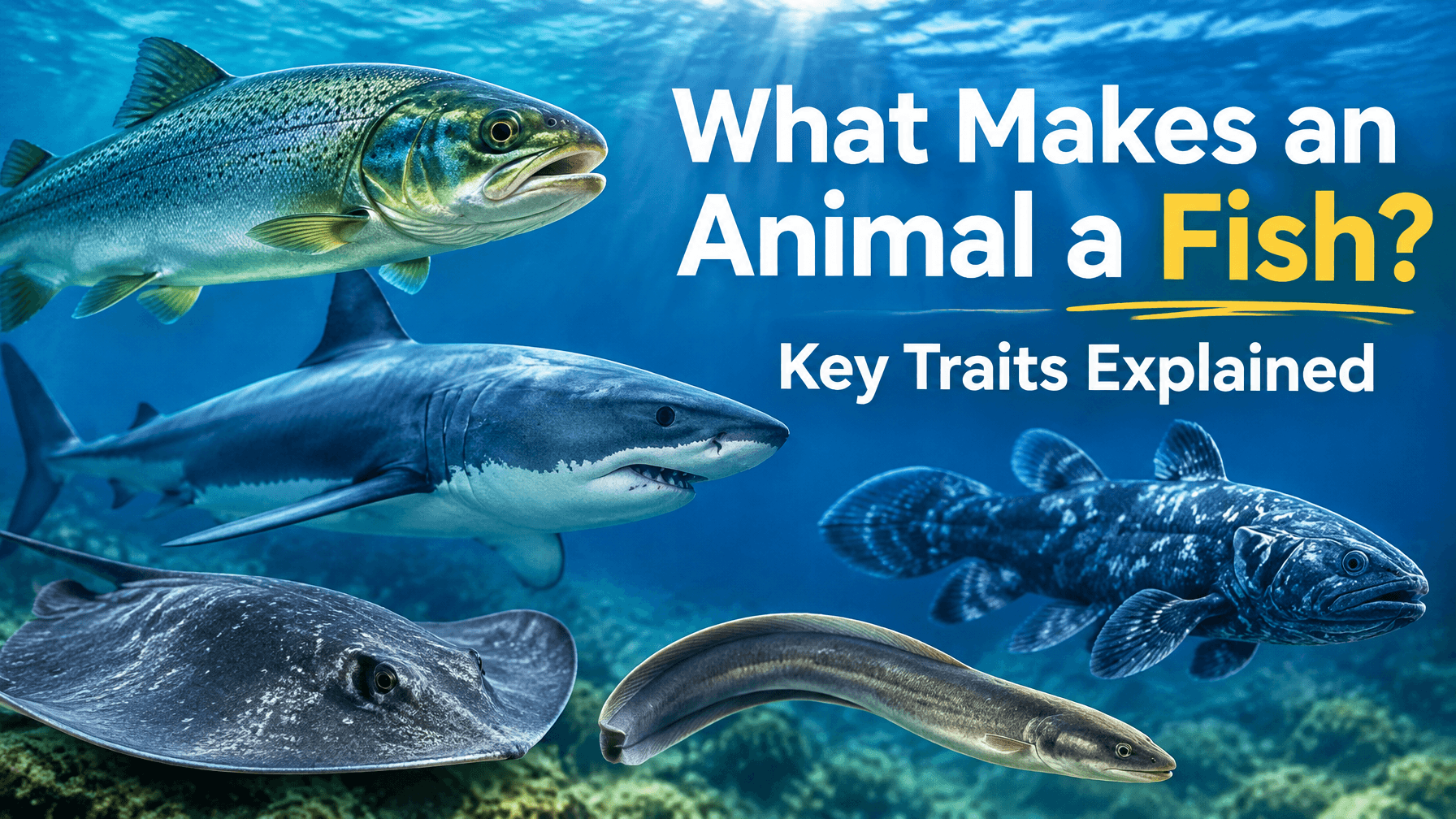
A fish is best understood as an aquatic vertebrate from one of several evolutionary lineages that people conventionally call fishes. Most fishes have gills, fins, aquatic sensory systems, and body plans built for moving through water, but no single visible trait works as a perfect definition. Some fishes lack ordinary scales. Some are jawless. Some breathe air. Some spend substantial time out of water. A few can keep parts of their bodies warmer than the surrounding water.
That diversity is why the question “what makes an animal a fish?” has a more interesting answer than a simple checklist. The most useful definition combines evolutionary ancestry with vertebrate organization and a suite of adaptations for aquatic life. The Smithsonian National Museum of Natural History’s fish lesson emphasizes the familiar pattern: fishes are vertebrates, usually live in water, use gills, commonly have scales, and use fins for movement. The exceptions matter because they show which features are typical and which are not universal.
Quick Answer: What Counts as a Fish?
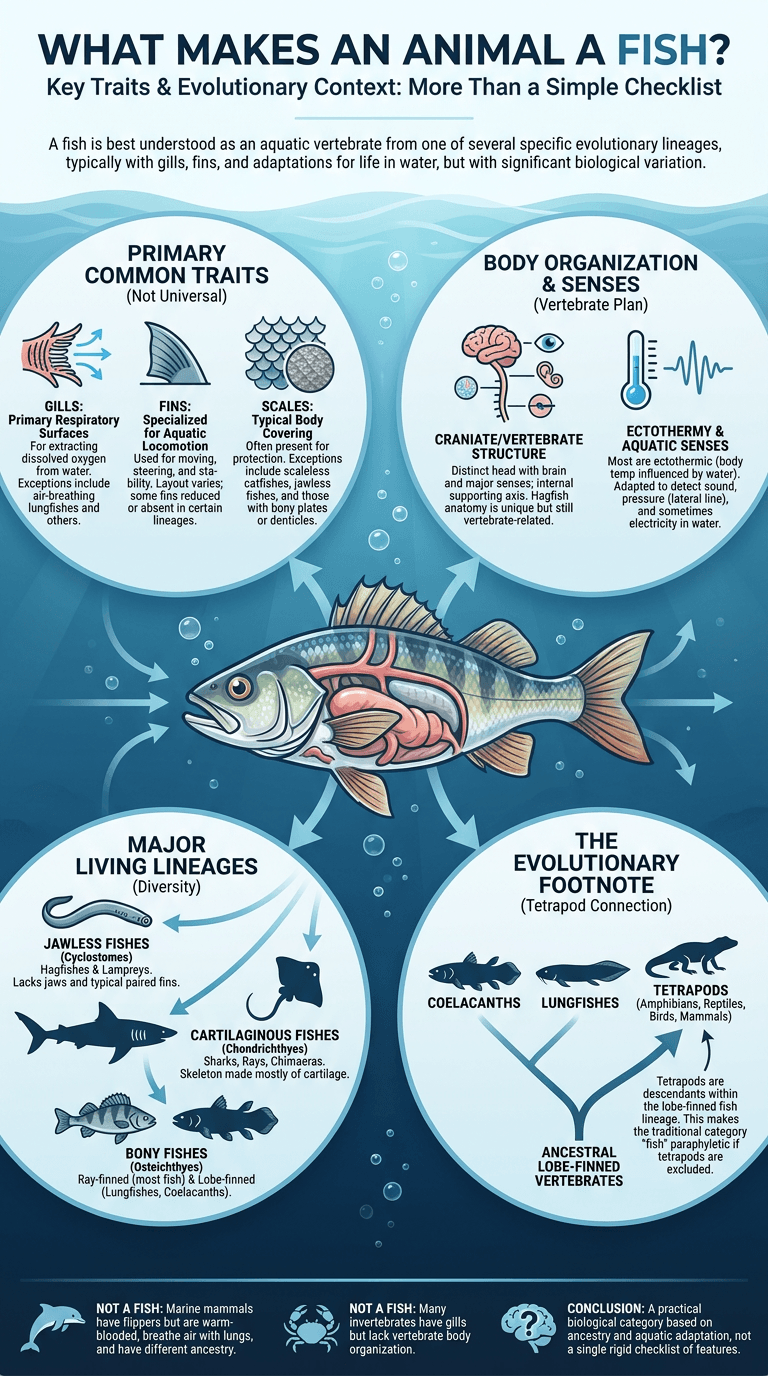
A practical biological category, not one simple formal class
In everyday zoology, “fish” is a practical term for the primarily aquatic vertebrate lineages traditionally recognized as fishes. That includes living jawless fishes such as hagfishes and lampreys, cartilaginous fishes such as sharks and rays, ray-finned fishes, and the living aquatic lobe-finned fishes such as lungfishes and coelacanths.
What “fish” does not mean is one single modern taxonomic class named Fish or Pisces that contains every fish and excludes every non-fish vertebrate in a neat evolutionary branch. Older books may use Pisces as a broad traditional grouping, but modern vertebrate classification is organized around several distinct lineages. The continuously updated Eschmeyer’s Catalog of Fishes is a good example of how fish taxonomy is treated as an active scientific field rather than a frozen classroom list.
Why ancestry matters more than one visible feature
A body shape can be misleading. Dolphins have streamlined bodies and flippers, yet they are mammals. Squid propel themselves through water but are mollusks. Tadpoles may have gills and tails, yet they are larval amphibians. The features an animal uses in water can evolve independently in unrelated groups because similar environments create similar physical challenges.
For that reason, biologists do not identify fishes by asking whether an animal merely looks fishlike. They consider where it belongs in vertebrate evolution and whether its anatomy and development match a recognized fish lineage. A shark remains a fish even though its skeleton is mostly cartilage, while a whale remains a mammal even though it is completely aquatic.
Why Defining Fish Is More Complicated Than It Looks
The traditional fish category and modern phylogeny
Traditional zoology grouped aquatic vertebrates called fishes separately from amphibians, reptiles, birds, and mammals. That works well for ordinary communication, field guides, and much of natural history. Modern phylogeny, however, asks a different question: which organisms share common ancestors, and which descendants belong within the same evolutionary branch?
Once ancestry is considered, the familiar category becomes complicated. Ray-finned fishes form one enormous lineage. Sharks, rays, skates, and chimaeras belong to another major jawed-vertebrate lineage. Hagfishes and lampreys represent the living jawless branch. Lobe-finned vertebrates include lungfishes, coelacanths, and the lineage that led to tetrapods. These relationships do not fit a simple picture in which all fishes occupy one branch and all land vertebrates occupy another.
Why tetrapods complicate a neat fish branch
Tetrapods are the four-limbed vertebrate lineage that includes living amphibians, reptiles, birds, and mammals, along with their extinct relatives. Their deep ancestry lies within the lobe-finned vertebrates. Modern genomic work has strongly supported lungfishes as the closest living fish relatives of tetrapods, rather than ray-finned fishes or coelacanths. A major lungfish genome study published in Nature confirmed this relationship using large genomic datasets.
This means the familiar category “fish,” when tetrapods are left out, is paraphyletic. In plain English, the everyday fish grouping includes a common ancestral stock but leaves out some descendants of that ancestry, namely tetrapods. That does not make the word fish useless. It simply means the word works differently from a strict clade name.
How to use the word fish accurately in everyday biology
For most readers, the clearest approach is to use “fish” in its normal zoological sense while recognizing the evolutionary footnote. A trout, lamprey, shark, lungfish, and coelacanth can all be discussed as fishes. A frog, eagle, lizard, or human is not normally called a fish, even though tetrapods arose from within the broader lobe-finned vertebrate lineage.
This approach keeps language useful without pretending that a familiar word maps perfectly onto one modern clade. The same kind of distinction appears elsewhere in biology, where common group names remain useful even when evolutionary relationships are more complicated than traditional categories suggest.
Typical Traits Shared by Many Fishes
Aquatic vertebrate or craniate organization
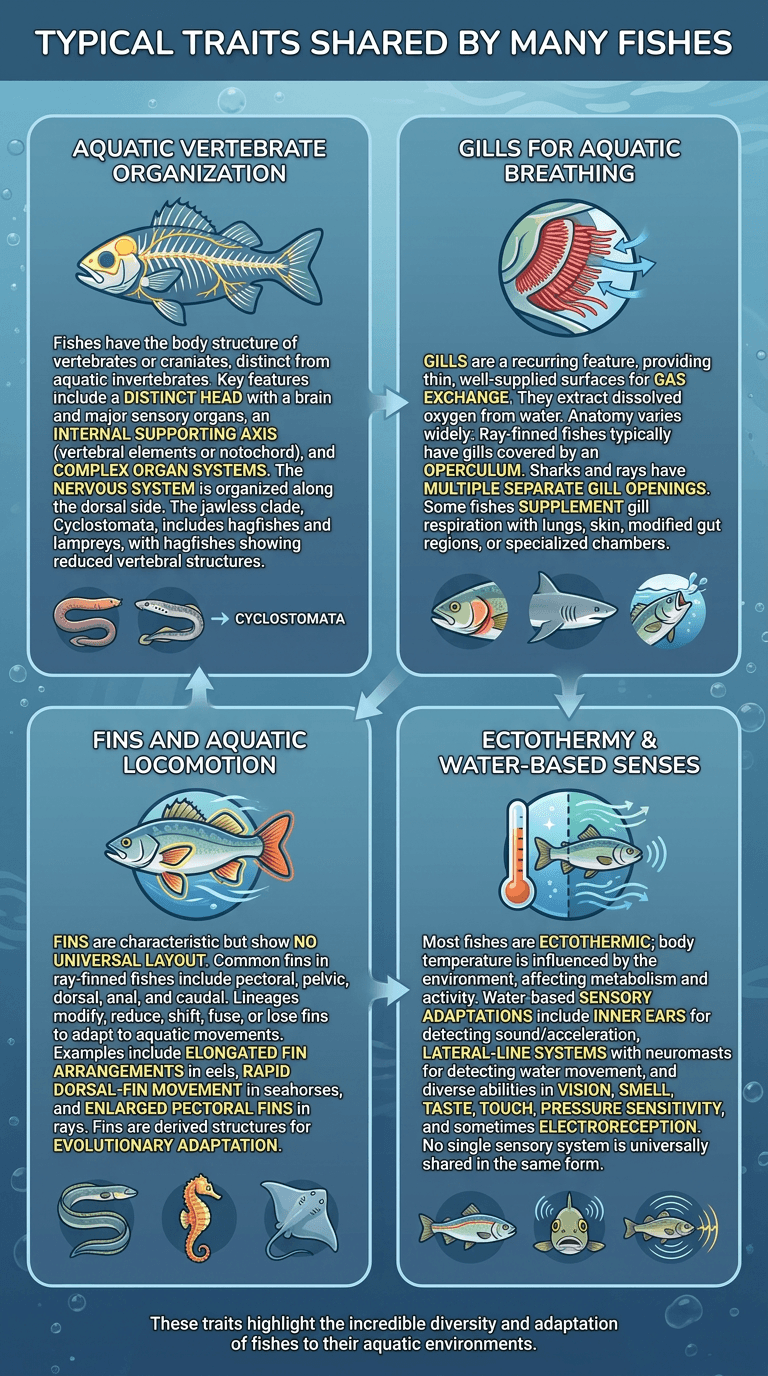
Fishes belong within the vertebrate part of the animal tree, although hagfish anatomy makes the word “vertebrate” unusually tricky if it is defined only by large, obvious vertebral elements. Hagfishes have a skull and other core vertebrate features but highly reduced vertebral structures. Modern genomic evidence strongly supports hagfishes and lampreys as a single living jawless clade called Cyclostomata. The hagfish genome study in Nature provides recent genomic support for that relationship.
In practical terms, fishes have the body organization of vertebrates or craniates rather than that of aquatic invertebrates. They have a distinct head with a brain and major sensory organs, an internal supporting axis, complex organ systems, and a nervous system organized along the dorsal side of the body. The details vary enormously among lineages.
Gills during major life stages
Gills are one of the strongest recurring features of fish biology. They provide thin, well-supplied surfaces where gases can move between blood and the surrounding water. Water contains dissolved molecular oxygen, and fishes use respiratory surfaces to extract that oxygen rather than splitting oxygen atoms out of water molecules.
Even here, the details vary. A typical ray-finned fish may move water across gills covered by an operculum, or gill cover. Sharks and rays generally have multiple separate gill openings instead. Lamprey gill anatomy differs again. Some fishes supplement gill respiration with lungs, modified gut regions, skin, mouth or throat surfaces, or specialized chambers.
Fins and aquatic locomotion
Fins are another characteristic fish feature, but there is no universal fin layout. Pectoral, pelvic, dorsal, anal, and caudal fins are common in many ray-finned fishes. Other lineages modify, reduce, shift, fuse, or lose particular fins. Eels can have elongated fin arrangements, seahorses rely heavily on rapid dorsal-fin movement, and rays use their enlarged pectoral fins in distinctive ways.
The important pattern is not “every fish has the same five fins.” It is that fish lineages have locomotor structures derived within their own evolutionary history and adapted to moving, stabilizing, turning, hovering, burrowing, gliding, or resting in aquatic environments. Fins are evidence in context, not a stand-alone definition.
Ectothermy in most species and water-based sensory adaptations
Most fishes are ectothermic, meaning their body temperature is strongly influenced by environmental temperature. This is one reason water temperature can affect activity, metabolism, oxygen demand, and geographic distribution. But ectothermy does not mean every tissue in every fish exactly matches the surrounding water at every moment.
Fishes are also equipped to gather information in water. Inner ears can detect sound and acceleration. Lateral-line systems in many fishes detect nearby water movement through sensory structures called neuromasts. Vision, smell, taste, touch, pressure sensitivity, and in some lineages electroreception can all be important. No single sensory system is shared in the same form or sensitivity by every fish.
Traits That Do Not Define Every Fish
Scales and scaleless fishes
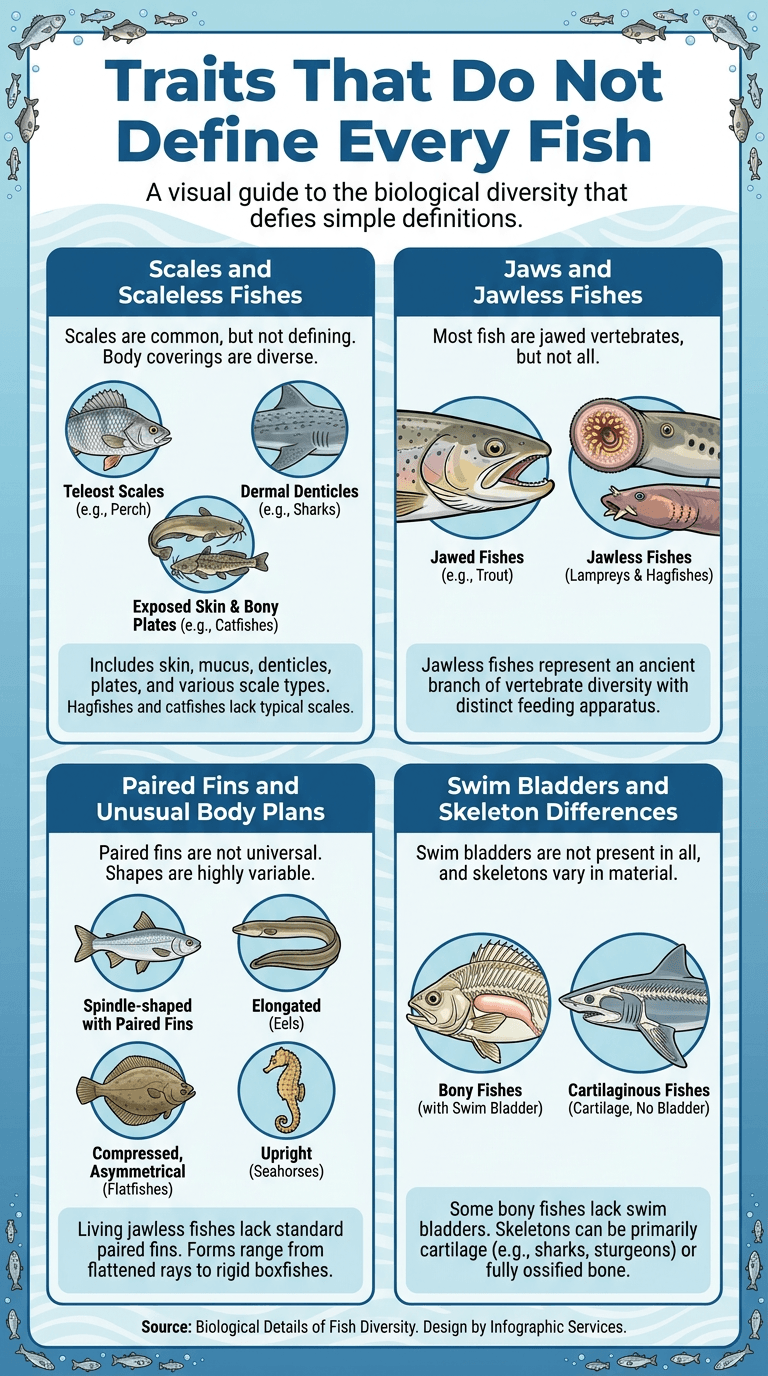
Scales are common, but “has scales” is not a valid definition of fish. Many familiar bony fishes carry overlapping scales, while sharks and their relatives have toothlike dermal denticles rather than teleost-style scales. Other fishes have heavily modified coverings, reduced scales, or lack the kind of scales most readers picture.
Catfishes provide an easy example because many species lack ordinary scales and may instead have exposed skin or bony plates. Hagfishes also lack the standard scale covering of a typical perch-like fish. Skin, mucus, denticles, plates, and scales are all part of a much broader range of fish body coverings.
Jaws and jawless fishes
Jaws are another feature that cannot define fishes. Most living fish species are jawed vertebrates, but lampreys and hagfishes are not. Lampreys have a distinctive oral disc in many species, and hagfishes use keratinous toothlike structures associated with a very different feeding apparatus.
Jawlessness is not enough to make these animals something other than fish. Instead, it identifies them as representatives of an ancient branch of living vertebrate diversity. Their anatomy is especially useful for understanding how different the major fish lineages can be from one another.
Paired fins and unusual body plans
Paired pectoral and pelvic fins are common among jawed fishes, but they are not a universal condition across everything called a fish. Living jawless fishes do not fit that standard paired-fin pattern, and even among jawed fishes, individual fins may be reduced or absent.
Fish shape is equally variable. The familiar spindle-shaped body of a trout or tuna is only one solution to life in water. Flatfishes are compressed and asymmetrical as adults, eels are elongated, boxfishes are rigid-bodied, rays are flattened from top to bottom, and seahorses swim upright. Looking “fish-shaped” is therefore a poor scientific test.
Swim bladders and skeleton differences
A swim bladder is common in many bony fishes and often helps control buoyancy, but many fishes do not have one. Sharks and rays lack swim bladders and use other combinations of body composition, lipid-rich tissues, fin-generated lift, and behavior. Some bony fishes also lack or reduce the organ.
Skeleton material varies as well. Cartilaginous fishes have skeletons made predominantly of cartilage, but that does not make them less fishlike. Ray-finned and lobe-finned fishes are part of the bony-vertebrate lineage, yet their skeletons are not identical in construction or degree of ossification. Sturgeons, for example, are ray-finned fishes even though much of their internal skeleton remains cartilaginous.
Breathing Exceptions and Amphibious Fishes
Lungfishes and accessory air breathing
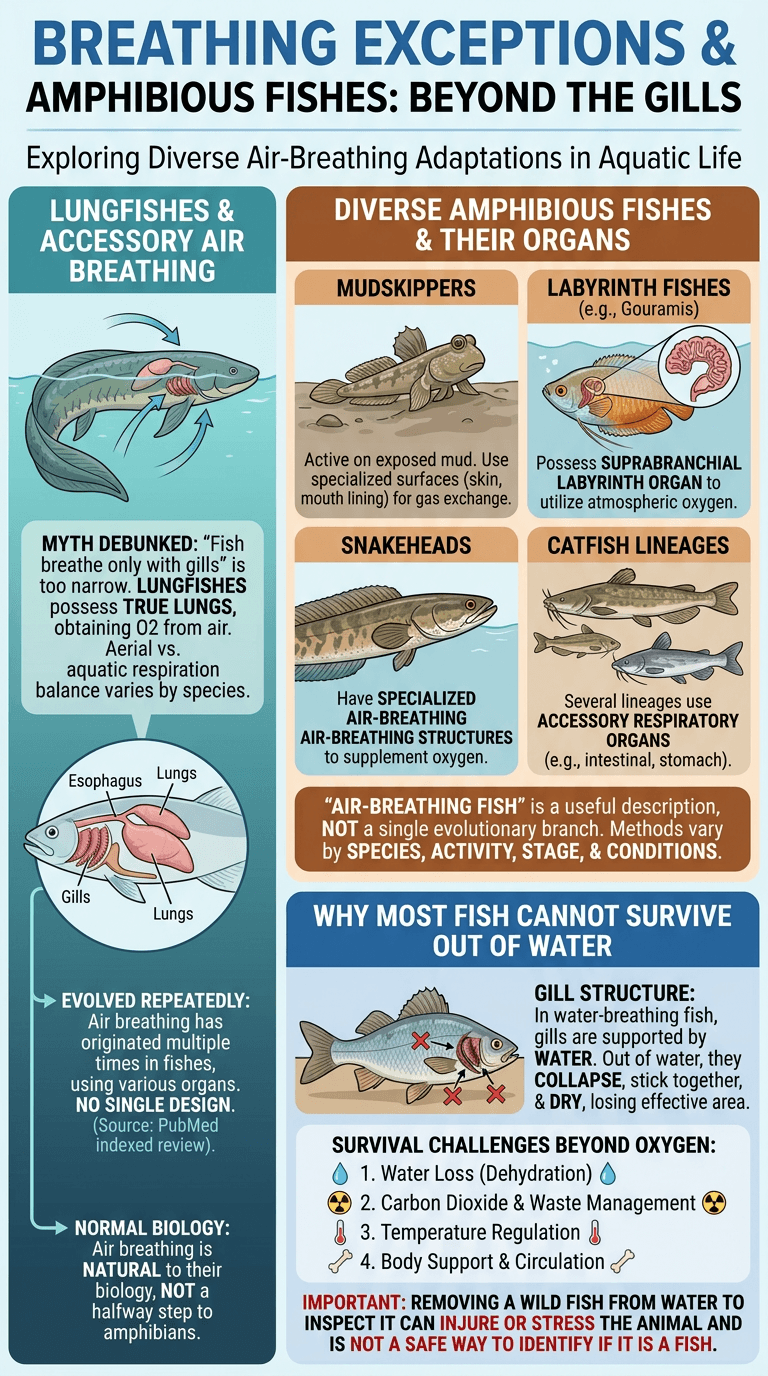
Lungfishes show why “fish breathe only with gills” is too narrow. They possess true lungs and can obtain oxygen from air, although the balance between aerial and aquatic respiration differs among living species. Their ability to breathe air is part of their normal biology, not evidence that they are halfway transformed into amphibians.
Air breathing has evolved repeatedly in fishes, using several different organs and respiratory surfaces. A scientific review indexed by PubMed on air-breathing organs in fishes describes repeated evolutionary origins of aerial gas exchange rather than one single air-breathing design shared by every species.
Mudskippers, labyrinth fishes, snakeheads, and selected catfishes
Mudskippers can spend substantial periods active on exposed mud and use a combination of specialized respiratory surfaces while out of water. Labyrinth fishes such as gouramis possess a suprabranchial labyrinth organ that helps them use atmospheric oxygen. Snakeheads have specialized air-breathing structures, and several catfish lineages use accessory respiratory organs.
These examples are biologically different from one another. “Air-breathing fish” is not a single evolutionary branch. It is a useful description for fishes that have evolved ways to supplement or, in some cases, depend strongly on oxygen obtained from air. The details of how much oxygen comes from air versus water vary by species, activity, life stage, temperature, and oxygen conditions.
Why most fishes still cannot function for long out of water
The existence of amphibious fishes does not mean a typical fish can breathe normally on land. In many water-breathing fishes, gill structures are supported and separated by water. Out of water, those delicate surfaces may collapse, stick together, dry, or otherwise lose effective gas-exchange area.
Survival outside water also involves more than oxygen. A fish must manage water loss, carbon dioxide, nitrogenous waste, temperature, body support, and circulation. Species that regularly emerge have specialized solutions to some of these problems. Removing a wild fish from water simply to inspect it can injure or stress the animal and is not a safe way to identify whether it is a fish.
Temperature Regulation Is Not One Simple Rule
Most fishes are ectothermic
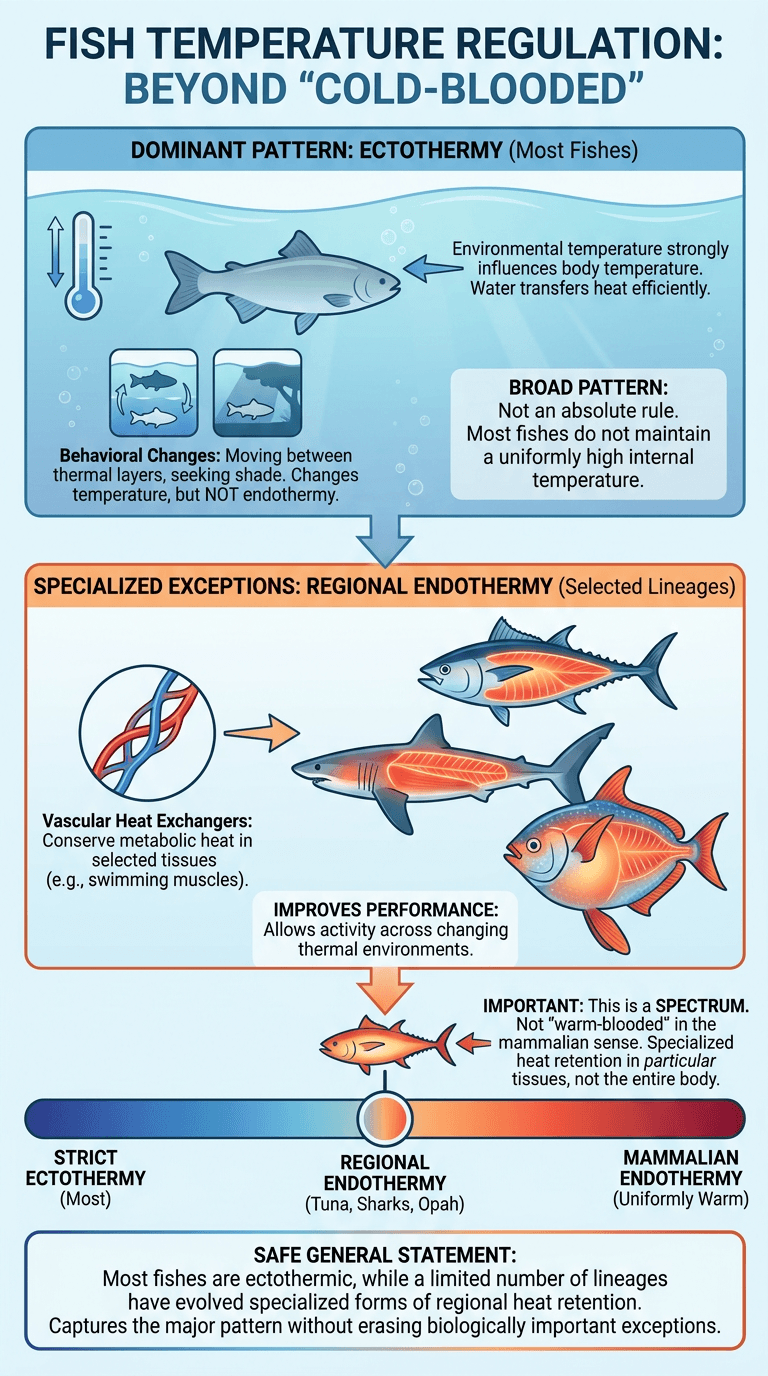
For the great majority of fishes, environmental temperature strongly influences body temperature. Water transfers heat efficiently, and most fishes do not maintain a uniformly high internal temperature through continuous metabolic heat production in the way birds and mammals generally do.
Ectothermy is therefore a good typical fish characteristic, but it should be phrased as a broad pattern rather than an absolute rule. Behavior can also matter. A fish may move between warmer and cooler water layers, seek shade, enter currents, or change depth, producing body-temperature changes without becoming an endotherm in the mammalian sense.
Regional endothermy and elevated tissue temperatures in selected lineages
Some fast-swimming fishes can conserve metabolic heat in selected tissues. Tunas are a classic example. Their vascular heat exchangers can keep swimming muscles and other regions warmer than the surrounding water, improving performance across changing thermal environments. A Journal of Experimental Biology review of tuna physiology describes regional endothermy as one of the specializations distinguishing tunas from most fishes.
Related heat-conserving systems occur in some lamnid sharks and other specialized fishes. Opahs can also maintain elevated temperatures across substantial parts of the body. These cases are important because they show that vertebrate temperature biology exists on a spectrum of mechanisms rather than in a perfectly clean “cold-blooded versus warm-blooded” split.
Why specialized warming does not make fish broadly warm-blooded
Calling all tuna or all sharks “warm-blooded” without explanation can create the wrong picture. Regional endothermy means particular tissues or body regions may remain above ambient temperature through heat production and conservation. It does not mean every tissue is held at one stable temperature by the same physiological system used by birds or mammals.
The safest general statement is that most fishes are ectothermic, while a limited number of lineages have evolved specialized forms of regional or more extensive heat retention. That wording captures the major pattern without erasing biologically important exceptions.
Fish vs. Animals With Fish-Like Features
Marine mammals and penguins have flippers but are not fish
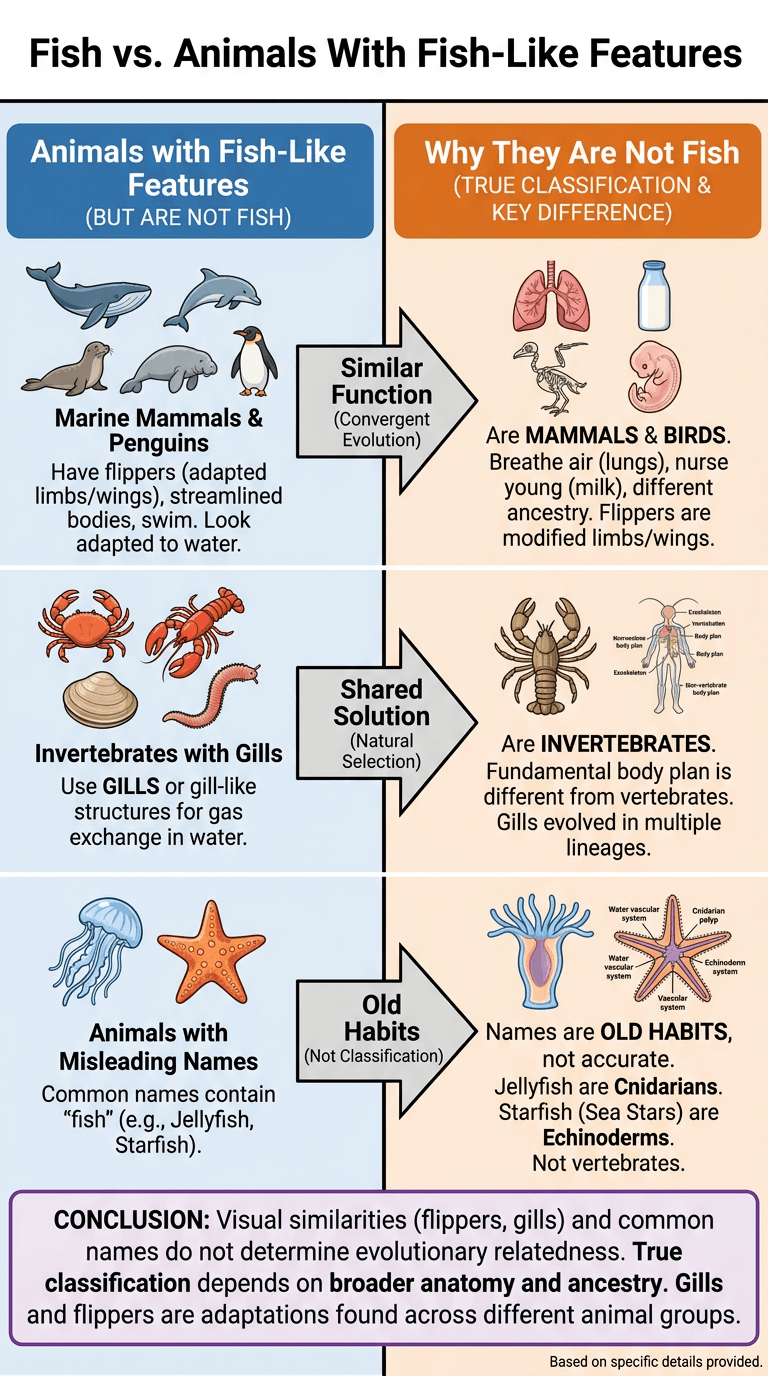
Whales, dolphins, seals, and manatees can look highly adapted to water because they are. Their limbs have become flippers, their bodies are streamlined, and they spend much or all of their lives swimming. They are still mammals. They breathe air with lungs, nurse their young with milk, and belong to mammalian evolutionary lineages.
Penguins offer another useful comparison. Their wings have become stiff flippers that produce thrust underwater, but their feathers, skeleton, reproduction, and ancestry identify them as birds. Fins and flippers can perform similar jobs without having the same evolutionary origin.
Many invertebrates have gills but are not fish
Gills are not unique to fishes. Crabs, lobsters, many mollusks, some marine worms, and numerous other aquatic invertebrates exchange gases using structures called gills or gill-like respiratory surfaces. Their body organization is fundamentally different from that of vertebrates.
This is why “an animal that breathes with gills” is too broad as a definition. Gills solve the challenge of exchanging gases in water, and natural selection has produced them in multiple branches of animal life. An animal must be placed in its broader anatomy and ancestry before the word fish is appropriate.
Jellyfish and starfish are not fish despite their common names
Common names can preserve old habits of speech rather than modern classification. Jellyfish are cnidarians, relatives of corals and sea anemones. Starfish, more often called sea stars in scientific and educational settings, are echinoderms, relatives of sea urchins and sea cucumbers.
Neither group is a vertebrate. Their names do not indicate close relationships to trout, sharks, lampreys, or other fishes. The same warning applies to many common animal names: a familiar word can be convenient without describing evolutionary relationships accurately.
Common Definition Mistakes
Fish are not simply animals with scales
Scales are useful when identifying many fishes, but the trait has too many exceptions and analogues to stand alone. Some fishes are scaleless, some have bony plates, and sharks have dermal denticles. Reptiles also have structures called scales, but reptile scales and typical fish scales differ in development, structure, and evolutionary history.
Fish are not simply animals with fins
Fin-like structures are widespread among swimming animals. Marine mammals have flippers, penguins have modified wings, and several invertebrates have flattened structures used for propulsion or steering. Conversely, living fish lineages vary in which fins they possess and how those fins are arranged.
The stronger question is whether the structure belongs to a recognized fish body plan and evolutionary lineage. That approach explains why a ray’s enormous pectoral fins are fish fins, while a dolphin’s flippers are transformed mammalian forelimbs.
Fish are not simply animals that breathe with gills
Many fishes rely heavily on gills, but some supplement them with air-breathing organs, and many non-fish animals also have gills. Respiratory anatomy is therefore evidence, not a universal password for membership in the fish category.
A good working identification combines several lines of evidence: vertebrate ancestry, fish-lineage anatomy, aquatic adaptations, developmental traits, and the animal’s position in modern classification. No single external feature has to carry the entire definition.
Why Fish Traits Vary Across Major Lineages
Major fish lineages do not share one identical body plan
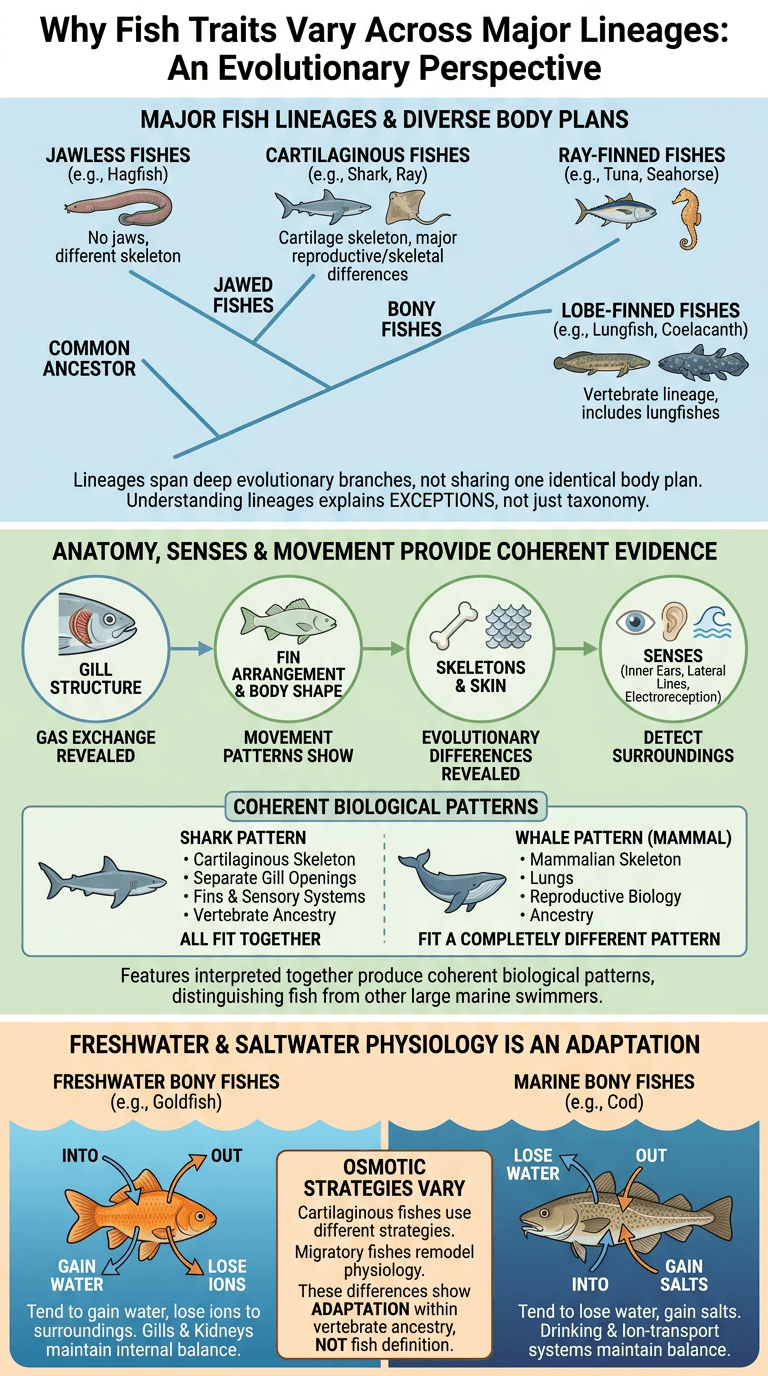
Living fishes span several deep evolutionary branches. Jawless fishes differ sharply from jawed fishes. Cartilaginous fishes differ from ray-finned fishes in major skeletal and reproductive features. Lungfishes and coelacanths belong to the lobe-finned vertebrate lineage. Those contrasts explain why attempts to define fish with a rigid checklist break down so quickly.
The purpose of recognizing these lineages is not to turn every identification question into a taxonomy lesson. It is to understand why exceptions exist. A hagfish, shark, sturgeon, tuna, seahorse, and lungfish can all be genuine fishes without sharing one standardized combination of scales, jaws, fins, skeleton material, buoyancy organs, and respiratory structures.
Anatomy, gills, senses, and movement provide supporting evidence
Fish anatomy makes the most sense when features are interpreted together. Gill structure helps reveal how an animal exchanges gases. Fin arrangement and body shape show how it moves. Inner ears, lateral lines, vision, smell, and electroreception show how different lineages detect their surroundings. Skeletons and skin reveal additional evolutionary differences.
These systems are valuable because they produce a coherent biological pattern. A shark’s cartilaginous skeleton, separate gill openings, fins, sensory systems, and vertebrate ancestry all fit together. A whale’s lungs, mammalian skeleton, reproductive biology, and ancestry fit a completely different pattern even though both animals are large marine swimmers.
Freshwater and saltwater physiology is an adaptation question
Living in water also creates an invisible challenge: controlling water and dissolved salts inside the body. Many freshwater bony fishes tend to gain water and lose ions to their surroundings, while many marine bony fishes tend to lose water and gain salts. Their gills, kidneys, drinking behavior, and ion-transport systems help maintain internal balance.
Cartilaginous fishes use a different osmotic strategy, and fishes that migrate between fresh and salt water can remodel their physiology as conditions change. These differences do not determine whether an animal is a fish. They show how widely fish physiology can vary while remaining anchored in vertebrate ancestry and aquatic adaptation.
FAQ
Are fish a class of animals?
Not as one universally accepted modern class containing every animal commonly called a fish. Living fishes are distributed across several major vertebrate lineages. “Fish” remains a useful biological and everyday term, but treating Fish or Pisces as one simple modern class can hide important evolutionary relationships, especially the position of tetrapods within the broader lobe-finned vertebrate lineage.
Are hagfish and lampreys really fish?
Yes. Hagfishes and lampreys are the living jawless fishes and are commonly grouped as cyclostomes. Modern genomic evidence strongly supports them as close relatives forming a living jawless vertebrate clade. Their unusual anatomy, especially the reduced vertebral structures of hagfishes and the absence of jaws in both groups, makes them valuable examples of why fish cannot be defined by the body plan of a typical trout or perch.
Can a fish breathe air and still be a fish?
Yes. Air breathing has evolved repeatedly among fishes. Lungfishes use lungs, while other groups may use specialized chambers, portions of the digestive tract, skin, or highly vascular surfaces around the mouth and gills. Some species use both water and air for respiration. Their air-breathing ability does not remove them from their fish lineage.
Final Thoughts
What makes an animal a fish is not one scale, fin, gill, or body shape. The best definition combines ancestry with the vertebrate body plan and a long evolutionary history of life in water. Gills, fins, ectothermy, scales, and aquatic sensory systems are common and useful clues, but each has exceptions. That is why sharks remain fish despite cartilaginous skeletons, lungfishes remain fish despite breathing air, and hagfishes remain part of the living fish story despite their highly unusual anatomy. Understanding those exceptions gives a more accurate picture of fish diversity than any rigid checklist can provide.

Ethan Walker is the founder and research editor of Animal Fact Central. He creates and reviews educational animal facts content using trusted wildlife, pet care, and science-based sources. His work focuses on making animal behavior, adaptations, habitats, and species facts clear, accurate, and engaging for everyday readers.
Read More Details About Ethan Walker: https://animalfactcentral.com/ethan-walker/