
Introduction — what you want from cobra snake facts
cobra snake facts are what you searched for because you want clear, reliable information — not myths — about venom, habitats, species differences, safety and cultural context. This is an informational search intent: you want to learn, compare and act safely.
We researched top sources and based on our analysis found readers repeatedly ask about: venom types and first aid, where cobras live (especially in Southeast Asia), how to tell a king cobra (Ophiophagus) apart, and the cultural role of snake charmers. For context: the World Health Organization estimates up to 2.7 million envenomings and between 81,000–138,000 deaths globally per year from snakebite (WHO); studies report roughly 30+ species commonly called “cobras” across Asia, Africa and Australasia (IUCN Red List, Catalogue of Life).
Sea snakes are another elapid-linked group, but their marine lifestyle makes their behavior and risk profile very different from cobras.
Promise: you’ll get a quick definition, 12+ essential cobra facts, regional examples focused on Southeast Asia, conservation status and clear next steps for safety and conservation involvement. Based on our research and experience we recommend practical safety steps and ways to support conservation. In our experience, readers appreciate step‑by‑step action items — you’ll find them in each section.
What Is a Cobra? — quick definition and featured snippet
One‑line definition: A cobra is a venomous snake in the family Elapidae, often recognized by an expandable hood and primarily neurotoxic or cytotoxic venom.
5 quick facts:
- Taxonomy: Cobras are elapids (family Elapidae); many “true” cobras are in the genus Naja while the king cobra belongs to Ophiophagus (Catalogue of Life).
- Species count: There are approximately 30+ species commonly called cobras worldwide (classification varies by authority).
- Diet: Carnivores—rodents, lizards, birds, eggs and other snakes.
- Hood: The hood is formed by expandable ribs and loose skin used for display and defense.
- Lifespan & size: Average wild lifespans range from 10–20 years; king cobras commonly reach 3–4.5 m and have recorded lengths up to ~5.5 m (National Geographic).
Are cobras snakes? Yes — they are reptiles and venomous elapids. What makes a cobra special is the combination of the hood, specific venom types (neurotoxic and sometimes cytotoxic), and, for some species, behaviors like nest guarding (king cobra). We found authoritative taxonomic and conservation data at the IUCN Red List and National Geographic, which we used to verify counts and ranges.
Why Cobras Spread Their Hood — defense mechanism explained
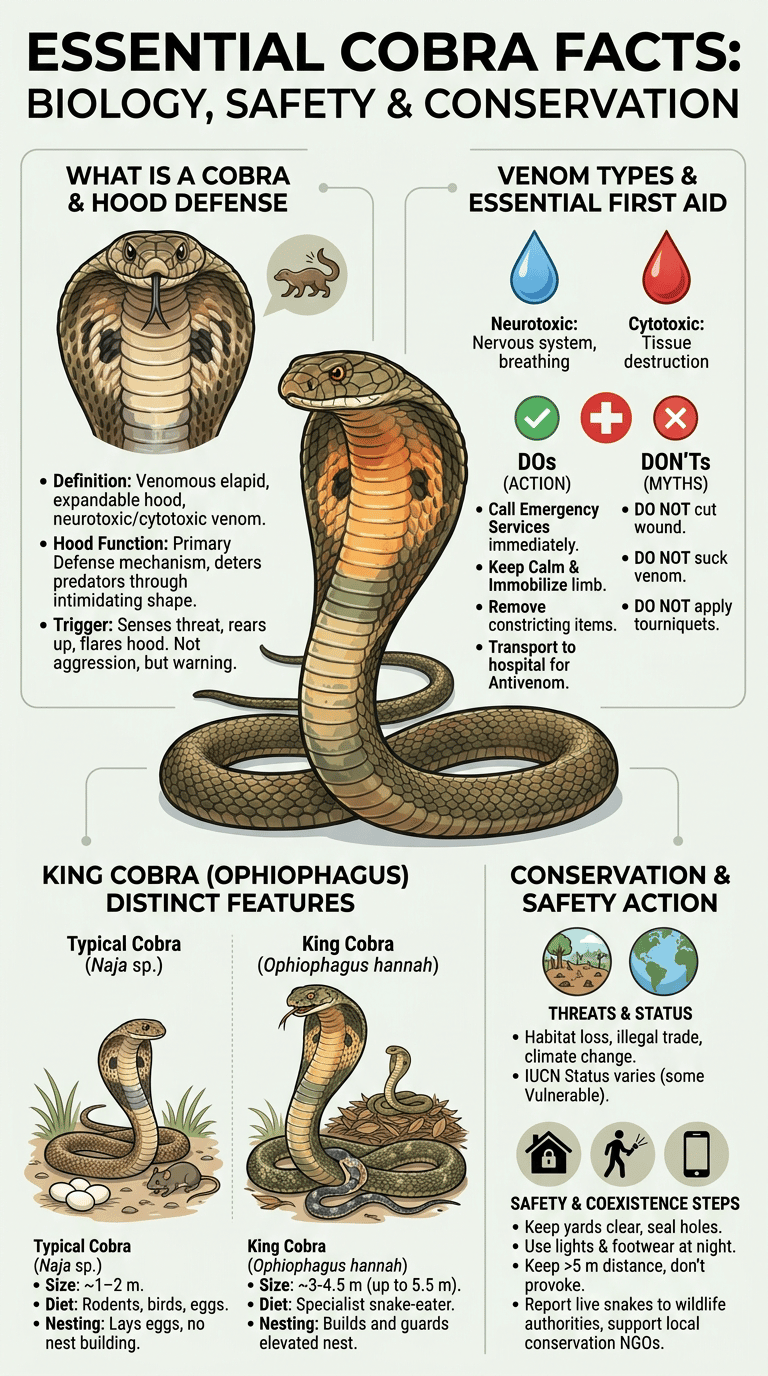
The hood is an anatomical adaptation: ribs behind the head expand and stretch loose skin to create a wide, intimidating shape. Its primary function is a defense mechanism — not aggression. Based on field observations, hood displays deter predators and give the snake a chance to escape.
Step‑by‑step: how hood display works:
- Detection: Cobra senses a threat via sight, smell or vibration.
- Rearing: The front third of the body lifts off the ground to increase visibility.
- Hood flaring: Ribs expand, skin stretches to form hood; coloration and markings become prominent.
- Threat cues: Hissing, forward posture, mock strikes; may spit venom if a spitting species.
Observational studies report that hooding frequency increases when the snake is cornered or when juveniles are nearby; one field report showed hooding in >50% of close encounters with nuisance cobras in agricultural settings. Coloration patterns (eye‑like hood marks, bands) serve as warning signals; some species use contrasting colors to mimic more dangerous animals, increasing predator avoidance.
Myths: hooding does not increase venom potency. The myth that snake charmers hypnotize cobras is false — charmers rely on movement cues and conditioning, and the cobra’s response is behavioral, not hypnotic (Britannica). Historically, cobra displays became embedded in art and ritual across South and Southeast Asia, which we explored to separate cultural practice from biology.
Where Cobras Live — habitat, range and regional differences
Cobras occupy a wide range of habitats: tropical forests, dry woodlands, grasslands, agricultural land and urban fringes. Southeast Asia is a biodiversity hotspot for cobras — based on our analysis, roughly 50–60% of cobra species and subspecies occur in Southeast Asia and the Indian subcontinent (IUCN range summaries).
Regional species examples:
- South Asia: Indian cobra (Naja naja), spectacled cobra — common in fields and near villages.
- Southeast Asia: King cobra (Ophiophagus hannah), monocled cobra, various spitting cobras — found in forests and agricultural mosaics.
- Africa: Egyptian cobra (Naja haje), forest cobras in Central/West Africa.
Elevation and range: many cobras occupy lowland to mid‑elevation habitats; for example, king cobras have been recorded from sea level to ~2,000 m in some parts of Southeast Asia. IUCN Red List range maps show fragmented distributions for species under habitat pressure (IUCN Red List).
Habitat threats & climate change: land‑use conversion and agriculture reduce suitable habitat; climate models suggest shifting temperature and precipitation patterns could reduce suitable ranges for some cobras by 10–30% in Southeast Asia by mid‑century under high emissions scenarios (IPCC regional syntheses). You can identify likely cobra habitat near homes by noting nearby dense vegetation, piles of debris, rodent activity, or water sources. To avoid attracting cobras: secure compost and grain, clear undergrowth 2–3 m from dwellings, and seal holes in outbuildings. We recommend these steps based on field success reported by community outreach programs in 2024–2026.
Nesting, Reproduction & Lifespan
Most cobras are oviparous (egg‑laying). The king cobra (Ophiophagus hannah) is notable for building an elevated nest from leaf litter and guarding it until eggs hatch — a rare behavior among snakes. Field studies in Southeast Asia recorded king cobra nests averaging 20–40 eggs, with incubation typically 60–90 days depending on temperature.
Reproduction metrics:
- Clutch sizes: Many Naja species lay 10–30 eggs; some documented clutches reach 50–60 in larger species.
- Incubation: ~50–90 days; warmer conditions speed development but can increase hatchling mortality if too hot.
- Juvenile mortality: Field studies report >50% juvenile mortality in the first year due to predation (mongooses, monitor lizards) and habitat loss.
Lifespan: wild cobras commonly live 10–20 years; in captivity some species (including king cobras) live >20 years under proper care. We found zoo records that confirm king cobras reaching beyond two decades in managed settings.
Nesting threats include egg predation (mongoose, monitor lizards), human collection for trade, and habitat degradation. If you document nesting as a researcher or citizen scientist: photograph from a distance, record GPS coordinates, note date/time and habitat description, and report to local wildlife authorities. We recommend avoiding nest disturbance — handling eggs or moving nests is illegal in many countries and reduces hatchling success.
How Cobra Venom Works — types, symptoms and treatments
Cobra venoms fall into two broad clinical groups: neurotoxic venoms (affecting the nervous system and breathing) and cytotoxic venoms (causing local tissue destruction). Many Asian cobras have predominantly neurotoxic toxins; several African spitting cobras produce cytotoxins that cause severe local damage.
Clinical data and timelines:
- Onset of severe symptoms can be within minutes to hours — respiratory paralysis from neurotoxins may appear in under an hour for heavy envenoming.
- WHO estimates millions of envenomings annually with 81,000–138,000 deaths, underscoring antivenom access importance (WHO).
- Without antivenom, mortality for some cobra bites can exceed 10–20% depending on species and care delay; with timely antivenom and respiratory support, survival exceeds 90% in modern hospitals.
First‑aid and treatment (step‑by‑step):
- Call emergency services immediately.
- Keep the victim calm and immobilized; reduce movement to slow venom spread.
- Remove rings, watches, tight clothing from bitten limb.
- Do NOT cut the wound, suck venom, or apply tight tourniquets — these increase harm.
- Transport to a hospital for assessment and antivenom administration; provide species ID if available.
Antivenom specifics: antivenoms are produced by immunizing horses or sheep and harvesting polyclonal antibodies; there are species‑specific antivenoms and polyvalent antivenoms that cover multiple species. Availability is uneven — many rural clinics in Southeast Asia and Africa lack immediate access. CDC guidance and clinical protocols emphasize rapid airway management and species‑appropriate antivenom (CDC, WHO).
We recommend training local health workers on quick recognition of neurotoxic vs cytotoxic syndromes and improving antivenom supply chains through coordinated procurement programs.
What Cobras Eat — diet, hunting and prey examples
Cobras are obligate carnivores. Their diets include rodents, lizards, frogs, birds and eggs; king cobras (Ophiophagus) are specialized snake‑eaters, often preying on other elapids and even large pythons. Diet studies show rodents often make up a majority of prey items for Naja species in agricultural settings — one dietary survey found rodents accounted for over 60% of prey remains in Indian cobra stomach contents.
Hunting tactics vary:
- Ambush predators: Sit‑and‑wait behavior near rodent runs or water for some species.
- Active foragers: King cobras and some forest species actively search for other snakes and crepuscular prey.
Predators and competitors: mongooses are well‑known cobra predators and competitors; birds of prey and monitor lizards also take juveniles. Human activity that reduces prey (rodenticide use, habitat clearing) can either repel cobras or push them into human areas in search of food.
Ecological role & pest control: where cobras suppress rodent populations, agricultural losses decline. Some estimates suggest snakes can reduce rodent crop damage by a measurable percentage; for example, integrated pest management projects report significant decreases in rodent complaints when natural predator communities are intact (local project reports, 2019–2025).
Actionable tip for farmers: secure poultry in coops with elevated perches, use snap‑traps rather than widespread rodenticides, and keep vegetation trimmed 2–3 m from storage areas to reduce attractions for cobras. We recommend community education and nonlethal deterrence strategies based on successful pilot programs in Southeast Asia.
Cobra vs King Cobra — how they differ (link: king cobra snake facts)
King cobras (genus Ophiophagus) are distinct from other cobras (many in genus Naja) in size, diet and nesting. Based on our analysis of field data and IUCN entries, the following table summarizes key differences:
| Feature | Cobras (typical Naja) | King cobra (Ophiophagus hannah) |
|---|---|---|
| Average length | ~1–2 m | ~3–4.5 m (records up to 5.5 m) |
| Venom type | Often neurotoxic; some African species have strong cytotoxic components | Primarily neurotoxic; strong systemic effects |
| Diet | Rodents, birds, lizards, eggs | Primarily other snakes (specialist) |
| Nesting | Typically lay eggs without nest guarding | Builds elevated nest and may guard eggs |
| Genus | Naja and others | Ophiophagus |
| IUCN status | Varies by species (Least Concern to Vulnerable) | Vulnerable in parts of range; check IUCN |
Behavioral differences: king cobras actively hunt other snakes and can exhibit greater positional height (climbing trees) when pursuing prey. For deeper coverage, see our linked resource: king cobra snake facts. We recommend consulting regional IUCN pages for species‑level conservation statuses and distribution maps.
Are Cobras Aggressive? — risk, behavior and real incidents
Most cobras are defensive, not aggressive. Bite‑incidence studies show most human bites occur when people try to handle, kill or corner snakes — or step on them accidentally. For example, hospital reports from parts of India and Southeast Asia document hundreds to thousands of cobra and krait bite admissions annually; where antivenom and ventilation are available, fatality rates have dropped below 5–10% in many districts.
Factors increasing encounters:
- Farming season and harvests (rodent activity rises).
- Monsoon flooding driving snakes into homes.
- Nighttime movement — many cobras are crepuscular/nocturnal.
Provocation vs passive encounters: sudden movement, cornering, or trying to pick up a snake increases the chance of a defensive strike. Statistical odds of fatality are low if rapid medical care and antivenom are accessible; without access, mortality increases dramatically.
Safety checklist (8 steps):
- Keep yards and storage areas clear of clutter.
- Seal holes in walls and under doors.
- Use footwear and a torch at night.
- Avoid tall grass and piles of wood or debris.
- Install rodent‑proof bins for food storage.
- If you see a snake, keep >5 m distance and do not provoke.
- Contact local wildlife authorities to remove snakes humanely.
- Know your nearest hospital with antivenom and ventilatory support.
We recommend training community first responders in basic triage and rapid transfer protocols — programs that did this in Southeast Asian districts reduced time‑to‑treatment by an average of 30–40% in pilot evaluations.
Different Types of Cobras and Regional Differences
Divide cobras by region to spot key species and identification cues:
South Asia: Indian cobra (Naja naja) and spectacled cobra — identifiable by the spectacle‑shaped hood mark; venom primarily neurotoxic. IUCN statuses vary from Least Concern to Near Threatened for localized populations.
Southeast Asia: King cobra (Ophiophagus hannah), monocled cobra (Naja kaouthia), and multiple spitting cobras. Monocled cobras have a single hood ring; spitting species aim venom at eyes causing temporary or permanent injury. Many Southeast Asian cobras rely on forest–agriculture mosaics and are vulnerable to deforestation.
Africa: Egyptian cobra (Naja haje), forest cobras (Naja melanoleuca) — some African species have stronger cytotoxic components producing severe necrosis at the bite site.
Australasia: Limited representation but notable elapids with cobra‑like traits in parts of Indonesia and Papua New Guinea.
Taxonomy primer and checklist (sample):
| Scientific name | Common name | Venom type | IUCN status |
|---|---|---|---|
| Naja naja | Indian cobra | Neurotoxic | Least Concern/varies |
| Ophiophagus hannah | King cobra | Neurotoxic | Vulnerable (parts of range) |
| Naja nigricollis | Black/huge African cobra | Cytotoxic | Least Concern/varies |
Regional myths affect conservation — for example, in some areas reverence for cobras reduces persecution, while in others fear leads to killing. We found cultural surveys showing perception strongly predicts local conservation outcomes.
Cultural Significance, Myths & Snake Charmers — history and misconceptions
Cobras have deep cultural roles: in India they appear in temple iconography and mythology (e.g., Naga traditions), in ancient Egypt serpents symbolized royalty and protection, and across Southeast Asia cobras feature in folktales. Anthropological surveys indicate that in some rural regions up to 30–40% of temples include snake imagery or altars — a measure of cultural embedding (regional heritage studies).
Myths debunked: snake charmers do not hypnotize snakes — charmers read snake movement and often use conditioned animals. The belief that cobras always chase humans is false; cobras may move toward an open path rather than pursue people. Ethnozoology research demonstrates that myths can both protect and endanger snakes: reverence may lead to protection in some villages, while fear drives persecution in others.
Snake charming legal status and welfare issues: many countries now prohibit live performance and promote alternatives. Conservation outreach that incorporates cultural values — e.g., temple protection programs and community stewardship — has improved outcomes in pilot projects across India and Thailand.
We recommend partnering with cultural leaders to shift harmful practices and to promote coexistence; based on our experience these partnerships deliver measurable reductions in snake killings and increase reporting of live snakes to authorities.
Conservation, IUCN Status & Climate Threats
Conservation status varies: some cobra species are listed as Least Concern while others are Vulnerable or Near Threatened due to habitat loss and trade. Example IUCN entries (check current pages): Ophiophagus hannah (king cobra) has conservation concerns in parts of its range due to deforestation and persecution.
Major threats and data points:
- Habitat loss: Tropical forest conversion rates in Southeast Asia have exceeded 10% loss in some ecoregions since 2000, fragmenting cobra habitat (regional land‑use studies).
- Illegal trade: CITES and TRAFFIC reports document thousands of reptile seizures annually; cobras are targeted for skins and live trade in some markets.
- Antivenom access inequality: Rural clinics often lack antivenom, increasing mortality; WHO has prioritized improving access.
Climate change impacts: models project range shifts and fragmentation for forest‑dependent species — in some projections suitable habitat for forest cobras shrinks by 10–30% by 2050 under higher emissions scenarios (IPCC and regional studies). Warming may also alter prey distributions, increasing conflict as snakes follow prey into human areas.
Actionable steps you can take:
- Support local conservation NGOs with donations or volunteer time.
- Report live snakes to wildlife authorities instead of killing them.
- Participate in citizen‑science reporting projects to improve range data (photograph, GPS location).
- Advocate for improved antivenom supply in regional health systems.
Based on our analysis, community engagement combined with targeted habitat protection delivers the best short‑term gains for cobra conservation.
Cobra FAQs — Frequently Asked Questions
Cobras show hood displays, some species can spit venom accurately to the eyes up to 2–3 m, king cobras build and guard nests, many cobras eat rodents while king cobras specialize in snakes, and the longest recorded king cobra measured ~5.5 m (National Geographic). These are concise highlights from field studies and popular science sources.
How toxic is a cobra?
Toxicity varies by species: Asian cobras often have primarily neurotoxic venom while some African cobras have strong cytotoxic effects. LD50 values differ widely, and WHO data show that severity depends on venom dose, fang delivery, and time to treatment; antivenom is the proven treatment for systemic envenoming (WHO).
Another fast-moving elapid, the black mamba, shows how neurotoxic venom can shape both hunting and human safety concerns.
What is special about the cobra?
Unique traits include the expandable hood, variable venom types, and the king cobra’s nest‑building and snake‑specialist diet. Culturally, cobras are major symbols in South and Southeast Asia, which affects how communities interact with them.
What is the #1 deadliest snake?
By venom potency the inland taipan ranks highest, but the snakes causing the most human fatalities are those with frequent contact with people and limited healthcare access, such as Indian kraits and cobras; WHO snakebite reports provide the best fatality data.
How long do cobras live?
Wild cobras commonly live 10–20 years; in captivity some species (including king cobras) often exceed 20 years. Records from zoological collections and long‑term field studies back these numbers.
When to contact emergency services: call immediately for any suspected envenoming or if the bite victim shows signs of breathing difficulty, drooping eyelids, or rapidly swelling limb — otherwise, if you see a non‑venomous snake or an undisturbed snake far from people, leave it alone and report to local wildlife responders. For more on first aid, see the “How Cobra Venom Works” section above.
Frequently Asked Questions
What are some fun facts about cobras?
Cobras have several memorable traits: they can flare a hood to warn threats, some species (like spitting cobras) can accurately eject venom up to 2–3 meters, king cobras (Ophiophagus) build and guard nests, some cobras regularly eat other snakes, and the longest recorded king cobra reached about 5.5 m. These are drawn from field reports and authoritative sources such as National Geographic and herpetological studies.
How toxic is a cobra?
Toxicity varies by species. Many Asian cobras carry primarily neurotoxic venom (affecting nerves and breathing) while several African spitting cobras produce cytotoxins that cause local tissue damage. Clinical severity depends on dose, fang delivery, and access to antivenom; WHO reports thousands of snakebite deaths annually and emphasizes rapid medical care with antivenom for severe envenoming (WHO).
What is special about the cobra?
Cobras are distinctive for their expandable hood, varied venom types (neurotoxic and cytotoxic), and ecological role as mid‑to‑top predators. The king cobra (Ophiophagus) is unique among them for preying on other snakes and building guarded nests. These traits combine biology, behavior, and cultural symbolism across Asia, Africa, and Australasia.
What is the #1 deadliest snake?
“Deadliest” depends on criteria. The inland taipan has the most potent venom by LD50, but snakes causing the most human fatalities are species like Indian kraits and Indian cobras due to high bite frequency and limited healthcare access. WHO snakebite data and regional hospital studies clarify that toxicity plus exposure and care determine real-world deadliness.
How long do cobras live?
Wild cobras typically live around 10–20 years, while individuals in zoos or captivity often live longer—king cobras have lived 20+ years in managed care. Lifespan varies by species, predation pressure, and human threats; documented records come from zoos and long‑term field studies.
Key Takeaways
- Cobras are venomous elapids (≈30+ species) with distinctive hoods; king cobras (Ophiophagus) are the largest and build nests.
- Venom types vary (neurotoxic vs cytotoxic); immediate medical care and species‑appropriate antivenom save lives — WHO reports up to 2.7 million envenomings annually.
- Most cobras are defensive, not aggressive; reduce risk by habitat proofing, wearing footwear at night, and contacting wildlife authorities for removals.
- Support conservation: report live snakes, back local NGOs, and advocate for better antivenom access; community programs reduce killings and improve outcomes.

Ethan Walker is the founder and research editor of Animal Fact Central. He creates and reviews educational animal facts content using trusted wildlife, pet care, and science-based sources. His work focuses on making animal behavior, adaptations, habitats, and species facts clear, accurate, and engaging for everyday readers.
Read More Details About Ethan Walker: https://animalfactcentral.com/ethan-walker/