
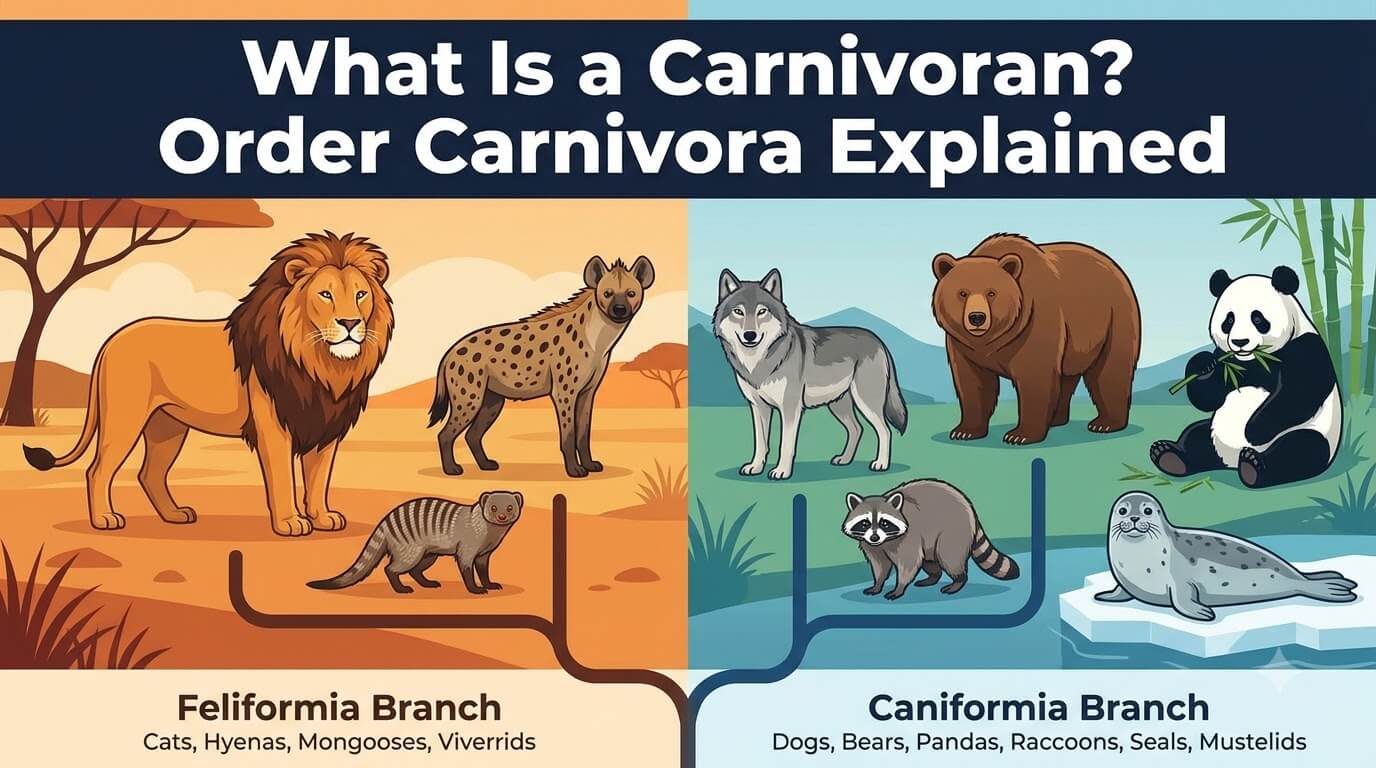
A carnivoran is a mammal that belongs to the scientific order Carnivora. Cats, dogs, bears, hyenas, mongooses, raccoons, otters, seals, sea lions, and walruses are all carnivorans because they share membership in this evolutionary branch of mammals. The word does not simply mean “an animal that eats meat.” That distinction matters because some carnivorans eat a great deal of plant material, while many meat-eating animals are not carnivorans at all.
The easiest way to remember the difference is this: carnivoran describes ancestry and classification; carnivore describes diet or feeding ecology. A giant panda remains a carnivoran even though bamboo dominates its diet. A shark may be a carnivore because it eats other animals, but it cannot be a carnivoran because it is a fish, not a member of the mammalian order Carnivora.
Quick Answer
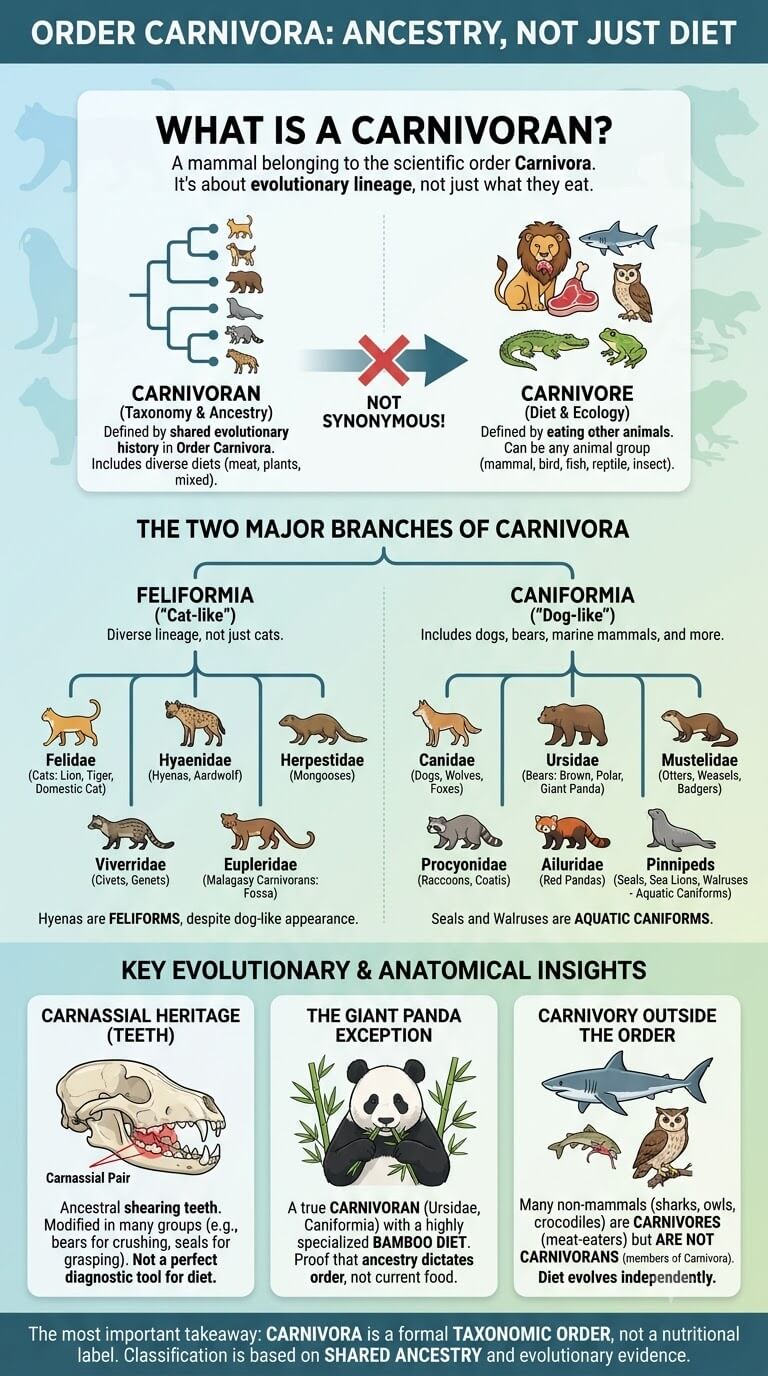
Carnivorans are placental mammals in the order Carnivora. Modern classification divides the living members of the order into two major branches, Feliformia and Caniformia. Feliforms include cats, hyenas, mongooses, civets, Malagasy carnivorans, linsangs, and the African palm civet. Caniforms include dogs and foxes, bears, red pandas, raccoons, skunks, mustelids such as otters and weasels, plus seals, sea lions, and walruses.
The Mammal Diversity Database of the American Society of Mammalogists continually tracks changes to recognized mammal species and higher taxa, which is useful because scientific classification can change as new anatomical, fossil, and genetic evidence becomes available. The important point for a general reader is that Carnivora is a formal taxonomic order, not a nutritional label.
Why the Word Carnivoran Matters
“Carnivore” and “Carnivora” look so similar that confusion is understandable. In everyday English, a carnivore is an animal that eats other animals. That description can apply to a lion, an owl, a crocodile, a frog, a shark, or a predatory insect. Those animals may share a feeding strategy without sharing close ancestry.
“Carnivoran,” by contrast, gives you information about where a mammal sits on the tree of life. If an animal is a carnivoran, scientists are saying that it belongs to a particular evolutionary lineage within Mammalia. Its present-day diet may be strongly meat-based, mixed, insect-heavy, fruit-rich, or even dominated by plants.
This difference is more than vocabulary. It prevents incorrect conclusions about anatomy, behavior, and evolution. If people assume every carnivoran must be a specialized hunter, they immediately run into animals such as giant pandas, many bears, raccoons, and other flexible feeders. If they assume every carnivore must be a carnivoran, they exclude enormous numbers of meat-eating birds, reptiles, fishes, amphibians, and invertebrates.
What Order Carnivora Means in Mammal Classification
Biologists organize living things into nested groups that reflect evolutionary relationships. An order is one of those levels. In simplified terms, an individual carnivoran belongs to the class Mammalia, then to the order Carnivora, then to a more specific branch and family, followed by genus and species.
For example, a lion is a mammal in Carnivora, within the feliform branch, and in the cat family Felidae. A gray wolf is also in Carnivora, but it belongs to the caniform branch and the dog family Canidae. Their bodies and lifestyles differ, yet both trace back through the evolutionary history represented by the order.
Taxonomic Membership Comes From Shared Ancestry
An animal does not enter Carnivora because it passes a diet test. Classification is based on evidence of relationship and common ancestry. Scientists compare anatomy, fossils, and increasingly large bodies of molecular evidence to reconstruct how lineages are related. Modern taxonomic databases then incorporate revisions when the evidence supports a different arrangement.
The Animal Diversity Web overview of Carnivora makes the central point clearly: members of the order have diverse food habits, and carnivory also appears in mammals outside the order. In other words, eating flesh is neither necessary nor sufficient by itself for determining whether a species is a carnivoran.
Shared ancestry also explains why classification can reveal relationships that appearance hides. A hyena may look superficially more dog-like than cat-like, but hyenas are feliform carnivorans. A seal looks nothing like a bear or a weasel, yet seals fall on the caniform side of the carnivoran tree.
Family, Suborder, and Order in Plain English
Taxonomic ranks can sound abstract, so it helps to treat them as nested levels rather than fixed “types” based on appearance. The order Carnivora is the broad group discussed here. Within it, the two major living suborders are Feliformia and Caniformia. Within those branches are families such as Felidae, Canidae, Ursidae, Mustelidae, and Phocidae.
| Taxonomic level | What it means here | Example |
|---|---|---|
| Class | A very broad vertebrate group | Mammalia |
| Order | A major lineage within Mammalia | Carnivora |
| Suborder | One of the two major living branches | Feliformia or Caniformia |
| Family | A narrower evolutionary grouping | Felidae, Canidae, Ursidae |
| Genus and species | Progressively more specific identity | Panthera leo for the lion |
The names “cat-like” for feliforms and “dog-like” for caniforms are convenient memory aids, but they are not literal body-shape rules. The University of Glasgow’s Carnivora taxonomy overview, based on Catalogue of Life data noted on the page, places familiar but very different animals across these two suborders, including hyenas among feliforms and bears, mustelids, and pinnipeds among caniforms.
Carnivoran vs Carnivore: The Essential Difference
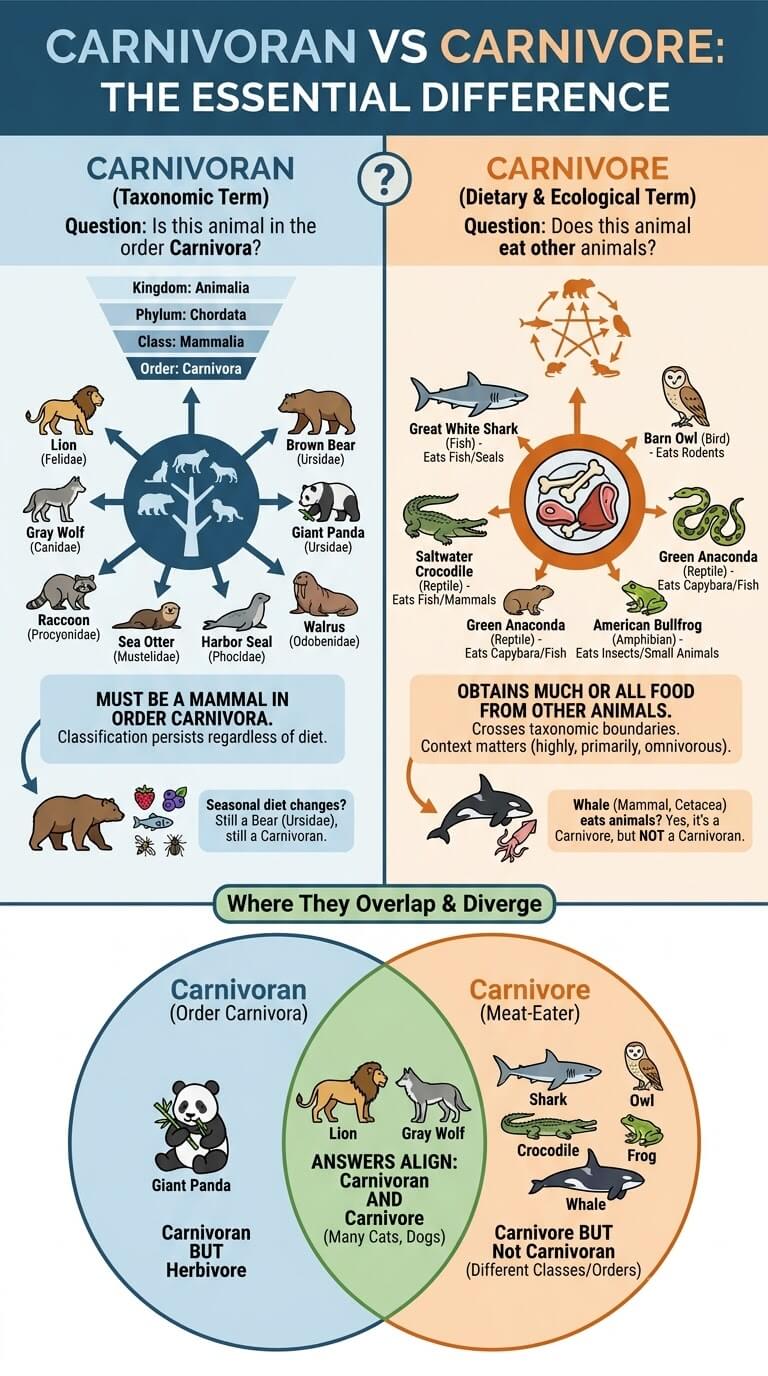
The cleanest distinction is to ask two different questions. “Is this animal a carnivoran?” is a question about classification. “Is this animal a carnivore?” is a question about what it eats. Sometimes the answers align, as in many cats. Sometimes they do not.
Carnivoran Is a Taxonomic Term
A carnivoran must be a mammal in the order Carnivora. This rule includes animals whose diets differ dramatically. Lions, wolves, brown bears, giant pandas, raccoons, mongooses, sea otters, seals, and walruses are all part of the same order even though they obtain food in very different ways.
Taxonomic membership also persists regardless of seasonal changes in diet. If a bear shifts between berries, insects, fish, carrion, or other foods as availability changes, its classification does not change with its menu. It remains a bear in Ursidae and a caniform carnivoran.
Carnivore Is Mainly a Dietary and Ecological Term
In ecology, a carnivore is generally an organism that obtains much or all of its food from other animals. The term can be used at different levels of precision, so context matters. A species may be described as highly carnivorous, primarily carnivorous, omnivorous with substantial animal prey, or specialized on particular kinds of animal food.
This dietary meaning crosses taxonomic boundaries. A meat-eating bird does not become more closely related to a cat because both catch prey. Similar feeding challenges can favor similar functional solutions in very different evolutionary lineages.
Why Sharks, Owls, Crocodiles, Snakes, and Frogs Can Be Carnivores but Not Carnivorans
Sharks are fishes, owls are birds, crocodiles and snakes are reptiles, and frogs are amphibians. Many species in these groups eat other animals, making them carnivores in the dietary sense. None can be carnivorans because none belongs to Mammalia, much less to the mammalian order Carnivora.
The same logic works within mammals. Carnivorous feeding also occurs outside Carnivora. Some whales and dolphins eat fish, squid, or other animals, for example, yet cetaceans are not carnivorans. Diet can evolve repeatedly in unrelated groups because many animals face the same basic problem of finding and processing energy-rich food.
What Broad Traits Help Scientists Understand Carnivora
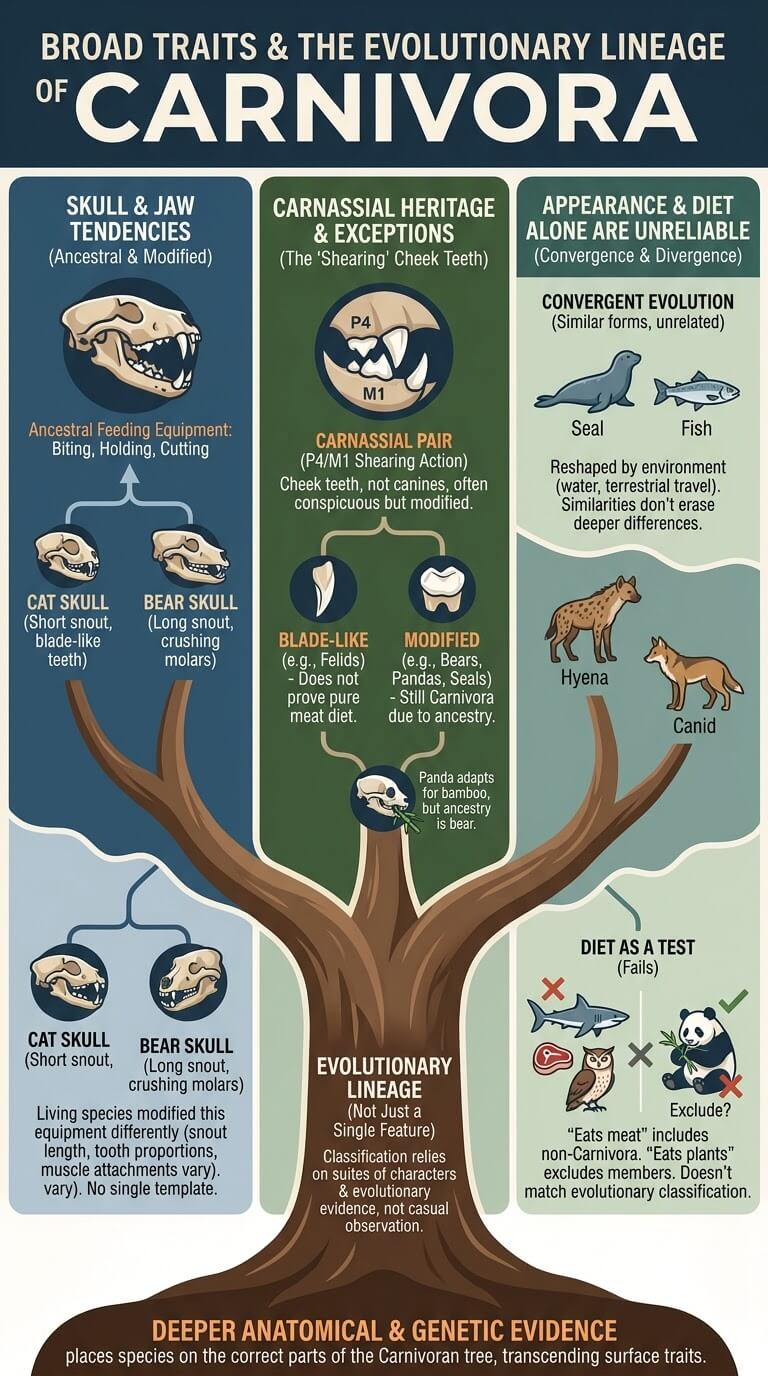
Because Carnivora is an evolutionary lineage, no single visible feature works as a perfect field test for every living member. Still, carnivorans share anatomical history, and some traits are especially informative when scientists compare skulls and teeth.
Skull and Jaw Tendencies
Many carnivorans have skull and jaw features associated with biting, holding, cutting, or processing food. Large canine teeth are common, and the jaw joint in many species emphasizes strong up-and-down movement. These tendencies are useful for understanding the ancestral feeding equipment of the group, but living species have modified that equipment in different directions.
A cat skull, bear skull, seal skull, and mongoose skull do not form one simple template. Snout length, tooth proportions, jaw-muscle attachments, auditory structures, and other features vary among lineages. This is one reason classification relies on suites of characters and evolutionary evidence rather than a single trait that a casual observer can check.
Carnassial Heritage and Why It Has Exceptions
One of the best-known features of carnivoran anatomy is the carnassial pair. In the typical carnivoran arrangement, the upper fourth premolar and lower first molar meet in a shearing action that can slice food. These are cheek teeth, not the long canine teeth used for functions such as grasping or puncturing.
Animal Diversity Web notes that these carnassials are conspicuous in many members of the order but are modified in groups such as bears, raccoons, and seals. That variation is important. Carnassial ancestry helps illuminate the history of Carnivora, but the teeth do not look or function identically in every living species.
A strongly blade-like carnassial does not prove that an animal eats only meat, and a more modified carnassial does not remove an animal from the order. Teeth evolve along with diet and feeding mechanics. The giant panda is an especially clear example because its dentition and jaw apparatus are adapted for heavy processing of bamboo while its ancestry remains firmly within the bear family.
Why Appearance and Diet Alone Cannot Identify the Order
Convergent evolution can make unrelated animals look functionally similar, while close relatives can become strikingly different. A streamlined seal has been reshaped by life in water. A long-legged hyena and a canid may both be efficient terrestrial travelers. Those similarities do not erase the deeper anatomical and genetic evidence that places them on different parts of the carnivoran tree.
Diet is equally unreliable as a stand-alone test. If “eats meat” defined the order, sharks and owls would have to be included. If “eats plants” excluded an animal, the giant panda would have to be removed. Neither conclusion matches evolutionary classification.
The Two Major Living Branches
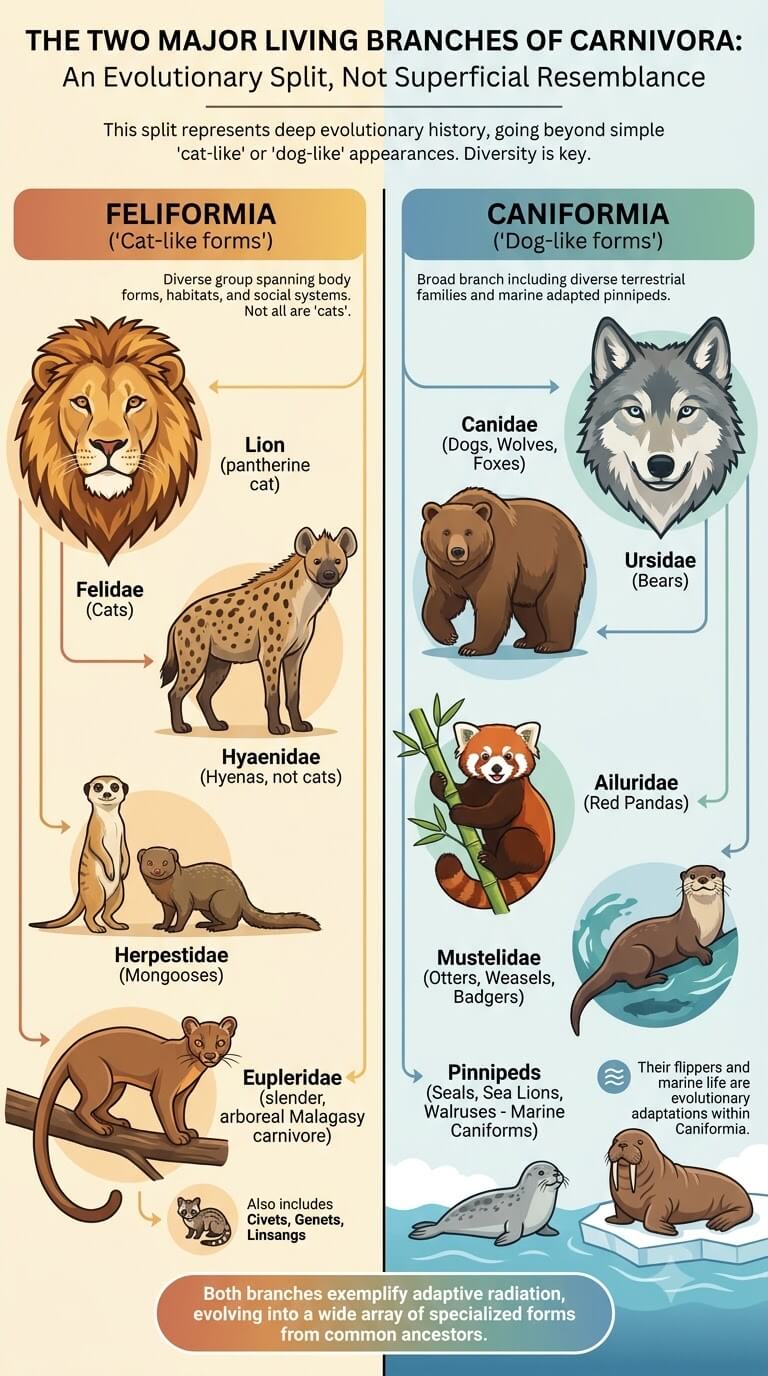
Living carnivorans are broadly divided into Feliformia and Caniformia. The split represents two major evolutionary branches, not simply animals that resemble modern house cats versus animals that resemble domestic dogs.
Feliformia in Brief
Feliformia includes the cat family Felidae, but it also contains hyenas, mongooses, civets and genets, Malagasy carnivorans such as the fossa, Asian linsangs, and the African palm civet. These groups span a wide range of body forms, diets, habitats, and social systems.
The feliform label therefore should not be read as “a kind of cat.” Hyenas are Hyaenidae, not Felidae. Mongooses are Herpestidae. Malagasy carnivorans are grouped in Eupleridae. The family names matter because they show how scientists distinguish branches within the larger suborder.
Caniformia in Brief
Caniformia includes Canidae, the family containing dogs, wolves, foxes, and their relatives, but the branch is much broader than canids. Bears belong to Ursidae. Red pandas belong to Ailuridae. Raccoons, coatis, and kinkajous are procyonids. Otters, weasels, badgers, and wolverines are mustelids. Skunks and stink badgers are mephitids.
Caniformia also includes the living pinniped families: true seals, eared seals such as sea lions and fur seals, and the walrus family. Their flippers and marine lifestyles make them look very different from terrestrial caniforms, yet their evolutionary placement is part of the same caniform radiation.
What Animals Belong to Carnivora?
The most useful way to understand the order is by its major family-level groups rather than by trying to memorize a long species list. Current taxonomic authorities may revise species boundaries and other details, but the familiar living lineages give a clear sense of the order’s breadth.
Familiar Feliform Examples
On the feliform side, family membership shows why the branch cannot be reduced to cats alone. Familiar examples include the following groups.
- Cats: domestic cats, lions, tigers, leopards, jaguars, cheetahs, lynxes, and many smaller wild cats.
- Hyenas: including spotted, brown, and striped hyenas, plus the aardwolf.
- Mongooses: a diverse family of mostly African and Asian carnivorans, including highly social and more solitary forms.
- Civets and genets: members of Viverridae, with varied diets and lifestyles.
- Malagasy carnivorans: the endemic Eupleridae, including the fossa and several mongoose-like species.
- Other feliform lineages: Asian linsangs and the African palm civet belong to their own family-level branches in modern classifications.
These examples immediately challenge the idea that Feliformia is just a collection of cat-shaped predators. Body size, social organization, feeding ecology, and locomotion vary considerably across the branch.
Familiar Caniform Examples Including Bears and Pinnipeds
The caniform side is just as varied. Several familiar families show how far this branch extends beyond dogs and foxes.
- Canids: wolves, coyotes, foxes, jackals, domestic dogs, and other dog relatives.
- Bears: including brown bears, American black bears, polar bears, and the giant panda.
- Mustelids: otters, weasels, martens, badgers, wolverines, and relatives.
- Skunks and stink badgers: members of Mephitidae.
- Procyonids: raccoons, coatis, kinkajous, and relatives.
- Red pandas: the living members of Ailuridae, separate from both bears and raccoons.
- Pinnipeds: true seals, sea lions and fur seals, and walruses.
Caniform diversity is a strong reminder that evolutionary relationship is not a contest in visual similarity. A fox, giant panda, sea otter, skunk, and walrus can all be caniform carnivorans without sharing one obvious “dog-like” body plan.
Examples That Break Common Assumptions
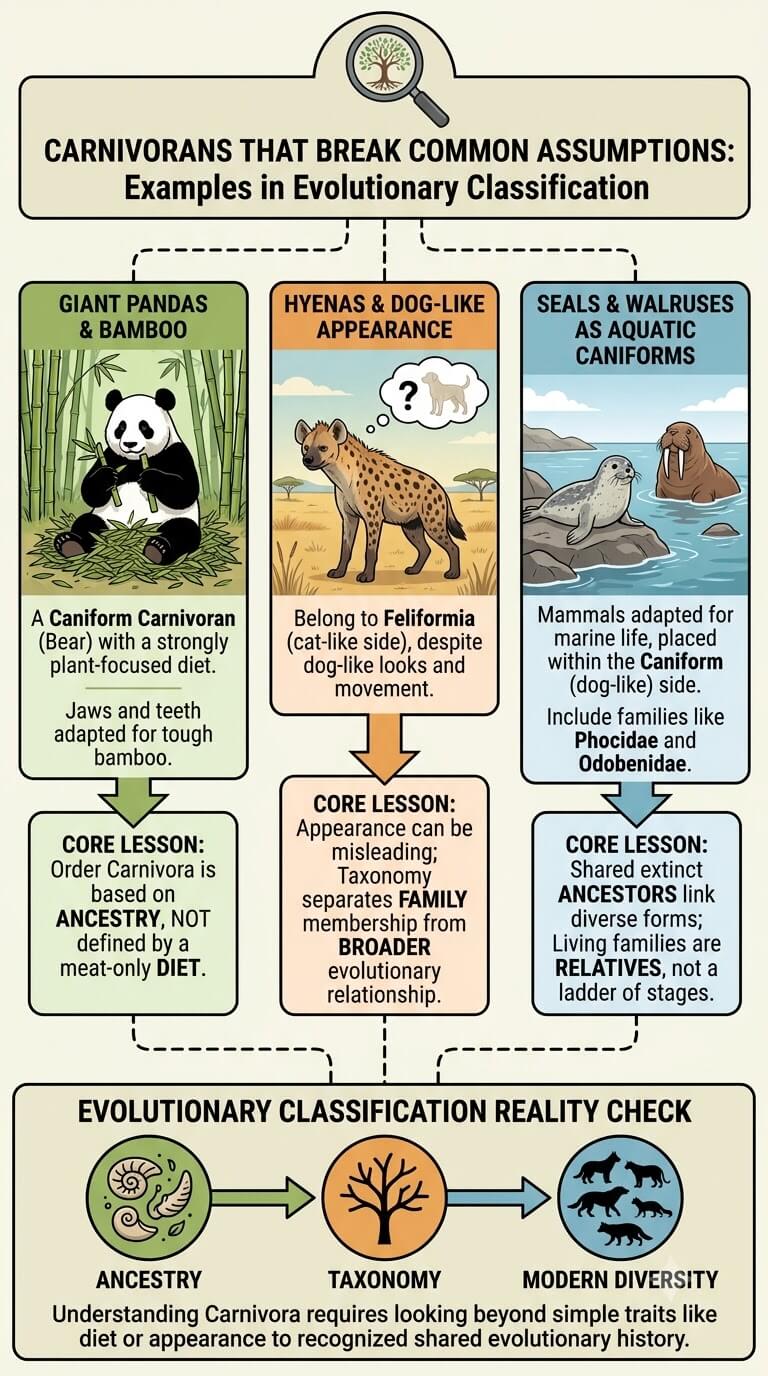
A few well-known carnivorans are especially useful for testing whether the definition has really clicked. Each one breaks a shortcut that seems reasonable until evolutionary classification is considered.
Giant Pandas and a Bamboo-Dominated Diet
The giant panda is a bear, and therefore a caniform carnivoran. Its strongly plant-focused diet does not change that ancestry. In the wild, giant pandas eat bamboo almost exclusively, and their jaws, teeth, and grasping structures support this specialized feeding style.
The Smithsonian National Zoo giant panda profile describes the species as a bear and explains its bamboo-focused feeding adaptations, including large molar teeth and powerful jaw muscles for crushing tough plant material. This is exactly why “carnivoran” cannot be defined as “a mammal that must mainly eat meat.”
Calling the panda a carnivoran does not mean bamboo is secretly animal food. It means dietary specialization can change dramatically within an evolutionary lineage while taxonomic membership remains based on ancestry.
Hyenas and Their Dog-Like Appearance
Hyenas are another useful correction to appearance-based classification. Their sloping backs, long legs, and endurance-oriented movement can remind people of canids, but hyenas belong to Hyaenidae within Feliformia.
This does not mean hyenas are “cats” in the family sense. It means hyenas and cats fall on the same major feliform side of the carnivoran split, while dogs and wolves fall on the caniform side. The distinction separates family membership from broader evolutionary relationship.
Seals and Walruses as Aquatic Caniforms
Seals, sea lions, and walruses are mammals adapted for marine life, but they are also carnivorans. Their aquatic bodies can hide that relationship from anyone expecting Carnivora to contain only four-legged terrestrial hunters.
NOAA Fisheries explains that seals, sea lions, and walruses are placed within Order Carnivora and recognizes the living pinniped families Phocidae, Otariidae, and Odobenidae. Modern mammal phylogeny places pinnipeds on the caniform side of the order.
The correct evolutionary statement is that pinnipeds and other caniform groups share extinct common ancestors. Seals did not evolve from modern bears or modern otters. Living families are relatives, not ancestor-and-descendant stages in a ladder.
Common Mistakes and Myths
Most confusion about carnivorans comes from treating a useful everyday word as though it were a complete classification rule. Two mistakes are especially common.
Carnivorous Mammal Is Not a Synonym for Carnivoran Mammal
A carnivorous mammal is any mammal whose diet is strongly based on animal tissue. A carnivoran mammal is a mammal classified within Carnivora. The two categories overlap, but they are not identical.
For instance, many wild cats are both carnivorans and dietary carnivores. Giant pandas are carnivorans but are not meat-dominated feeders. Toothed whales can be highly carnivorous feeders but belong to a different mammalian order. The terms answer different biological questions.
Carnivora Is Not a Group Defined by Meat-Eating Alone
The name Carnivora reflects the strong carnivorous heritage visible in many members, especially in characteristic dental anatomy, but modern diversity cannot be reduced to that ancestral theme. Bears have evolved varied diets, pandas specialized heavily on bamboo, some procyonids and viverrids make substantial use of fruit, and different lineages consume insects, aquatic prey, carrion, or mixed foods.
It is also inaccurate to assume that every carnivoran is an active predator, an apex predator, a pack hunter, or a threat to people. Those descriptions apply only in particular ecological contexts and to particular species or populations.
Edge Cases and Taxonomy Cautions
Classification is a scientific model of evolutionary relationships, so it is revised when evidence improves. That does not make taxonomy arbitrary. It means scientists test hypotheses about relationship against new data and update names or group boundaries when needed.
Common Names Do Not Always Match Family Boundaries
Common names are useful for conversation, but they can be misleading guides to ancestry. “Civet” is a good example. Many civets belong to Viverridae, yet the African palm civet belongs to Nandiniidae. Likewise, a red panda is not simply a small bear, and a sea otter is not a seal. Sea otters are mustelids.
The safest approach is to use common names for familiarity and family names for precision. When a classification claim matters, checking a current mammal-taxonomy authority is better than assuming the common name tells the whole story.
Modern Classification Can Change as Phylogenetic Evidence Improves
Phylogeny is the study of evolutionary relationships. Modern phylogenetic work combines evidence from anatomy, fossils, and DNA to test how groups branch from common ancestors. As datasets improve, species can be split or combined, genera can be revised, and family or subfamily boundaries can be reconsidered.
For a reader, the practical lesson is simple: family counts and species totals should be treated as dated scientific information rather than timeless numbers. The definition of a carnivoran, however, remains centered on membership in the evolutionary lineage recognized as order Carnivora.
How Classification, Teeth, and Diet Fit Together
Classification becomes easier to remember when anatomy and feeding are treated as related evidence rather than competing definitions. The major branches provide the evolutionary framework, while teeth and diet show how that framework has been modified.
Feliformia, Caniformia, and Family-Level Classification
Once the term “carnivoran” is clear, the next useful layer is understanding how Feliformia and Caniformia divide the living order. That comparison explains why hyenas sit with the feliform branch, why bears and red pandas are caniforms without being canids, and why pinnipeds belong within the same broad branch as terrestrial caniform families.
Family-level classification then adds precision. Felidae is not synonymous with Feliformia, and Canidae is not synonymous with Caniformia. A lion is both a felid and a feliform. A hyena is a feliform but not a felid. A wolf is both a canid and a caniform. A bear is a caniform but not a canid.
Carnassial Teeth and Diet Diversity
Carnassial teeth provide an anatomical window into carnivoran history, while dietary diversity shows how evolution can modify an inherited framework. In many cats, the shearing function is highly emphasized. In omnivorous bears, grinding and crushing surfaces are more important than in a cat. In giant pandas, powerful processing of fibrous bamboo is central to feeding. Pinniped teeth follow their own aquatic feeding specializations.
These differences make more sense once classification and diet are kept separate. The teeth tell part of the evolutionary and functional story, but no single tooth shape, prey item, or feeding behavior is the definition of a carnivoran.
FAQ
These short answers address the classification questions that most often follow once the carnivoran-versus-carnivore distinction is clear.
Are all meat-eating mammals carnivorans?
No. A meat-eating mammal can belong to another mammalian order. Toothed whales and dolphins, for example, consume animal prey but are cetaceans rather than carnivorans. “Meat-eating” describes feeding ecology, while “carnivoran” identifies membership in order Carnivora.
Is a giant panda really a carnivoran?
Yes. The giant panda belongs to the bear family Ursidae within Caniformia, so it is a carnivoran by ancestry and classification. Its bamboo-dominated diet is a specialized feeding adaptation and does not change its position in the mammalian tree.
Are seals part of Order Carnivora?
Yes. True seals, sea lions and fur seals, and walruses are pinnipeds within the caniform branch of Carnivora. Their marine bodies are highly modified for life in water, but their ancestry links them with other caniform carnivorans.
Final Thoughts
So, what is a carnivoran? It is a mammal whose evolutionary classification places it in order Carnivora, not simply an animal that eats meat. That definition includes familiar predators such as cats and wolves, flexible feeders such as bears and raccoons, the bamboo-specialized giant panda, and aquatic relatives such as seals and walruses.
Keeping carnivoran separate from carnivore makes the whole group easier to understand. Ancestry explains membership. Diet describes feeding. Features such as carnassial teeth, skull anatomy, and the Feliformia-Caniformia split help reveal the evolutionary history behind the order, but none should be turned into an oversimplified rule that ignores the remarkable variety of living carnivorans.

Ethan Walker is the founder and research editor of Animal Fact Central. He creates and reviews educational animal facts content using trusted wildlife, pet care, and science-based sources. His work focuses on making animal behavior, adaptations, habitats, and species facts clear, accurate, and engaging for everyday readers.
Read More Details About Ethan Walker: https://animalfactcentral.com/ethan-walker/