
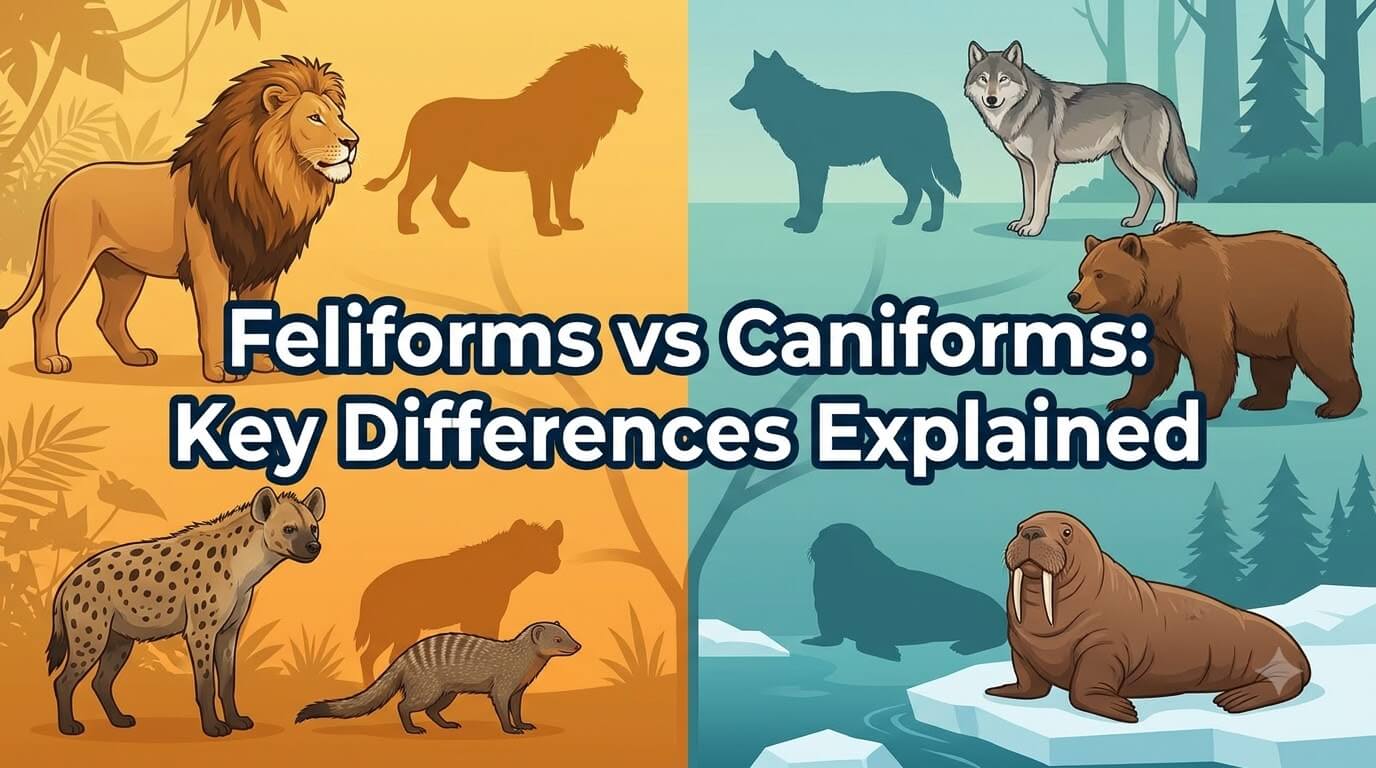
Feliforms and caniforms are the two major living branches of the mammalian order Carnivora. Feliformia includes cats, hyenas, mongooses, civets, Malagasy carnivorans, Asiatic linsangs, and the African palm civet. Caniformia includes dogs, bears, red pandas, raccoons, skunks, mustelids such as otters and badgers, plus seals, sea lions, and walruses.
The names are often translated as “cat-like” and “dog-like,” but appearance is not the rule that determines membership. A hyena is a feliform even though its long-legged silhouette can look dog-like. A walrus is a caniform even though its flippers and marine lifestyle look nothing like a wolf. The real distinction comes from evolutionary relationships supported by anatomy and modern phylogenetic evidence.
Understanding feliforms vs caniforms makes Carnivora much easier to organize. It also shows why diet, claws, body shape, and habitat are useful clues in some cases but poor universal definitions.
Quick Difference
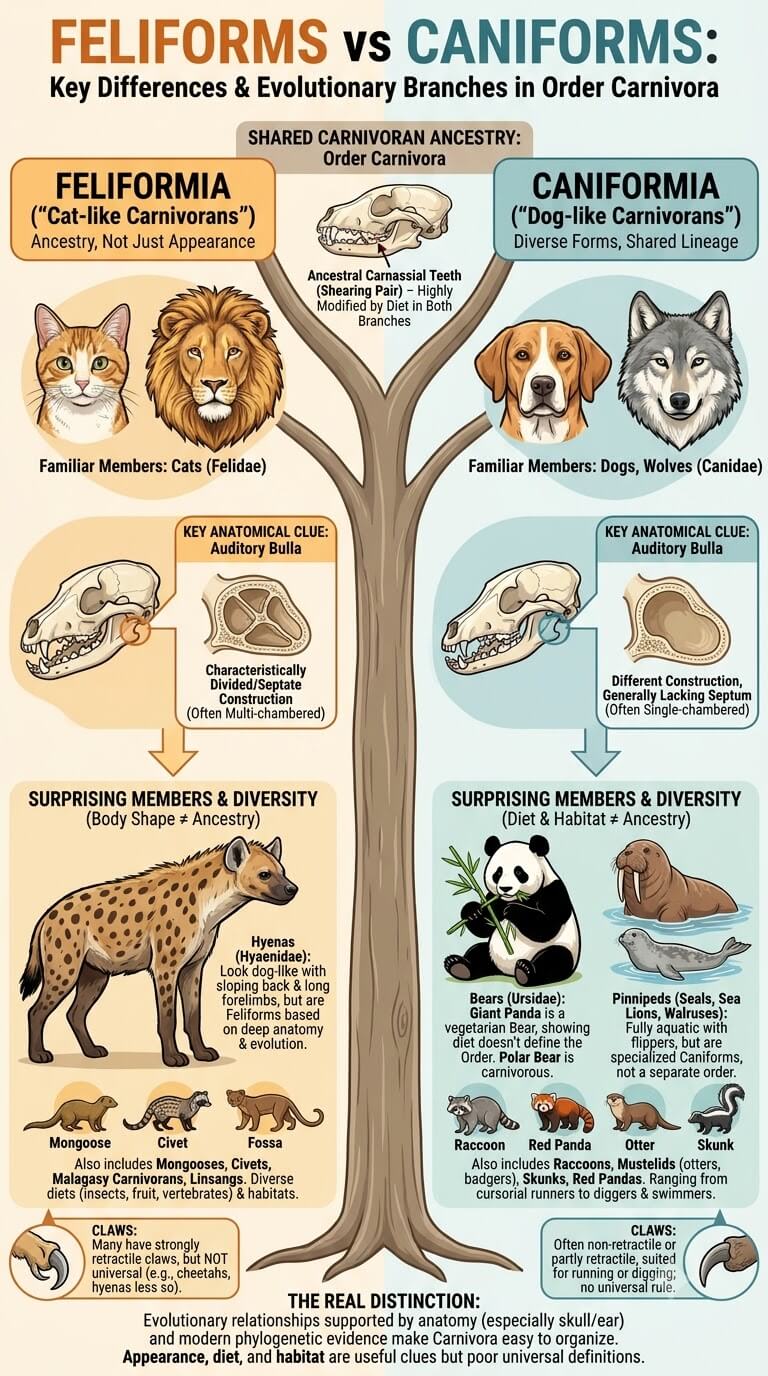
Feliformia is the branch of Carnivora that contains cats and their closer living carnivoran relatives, including hyenas, mongooses, civets, Malagasy carnivorans, Asiatic linsangs, and the African palm civet. Caniformia is the branch containing dogs and their closer living carnivoran relatives, including bears, mustelids, skunks, raccoons, red pandas, and pinnipeds.
The two branches share carnivoran ancestry, yet each contains a wide range of diets and body plans. Neither “looks like a cat” nor “looks like a dog” is enough to classify an animal correctly. Scientists use multiple lines of evidence, especially evolutionary relationships and details of the skull, teeth, and other anatomy.
Feliformia vs Caniformia Comparison Table
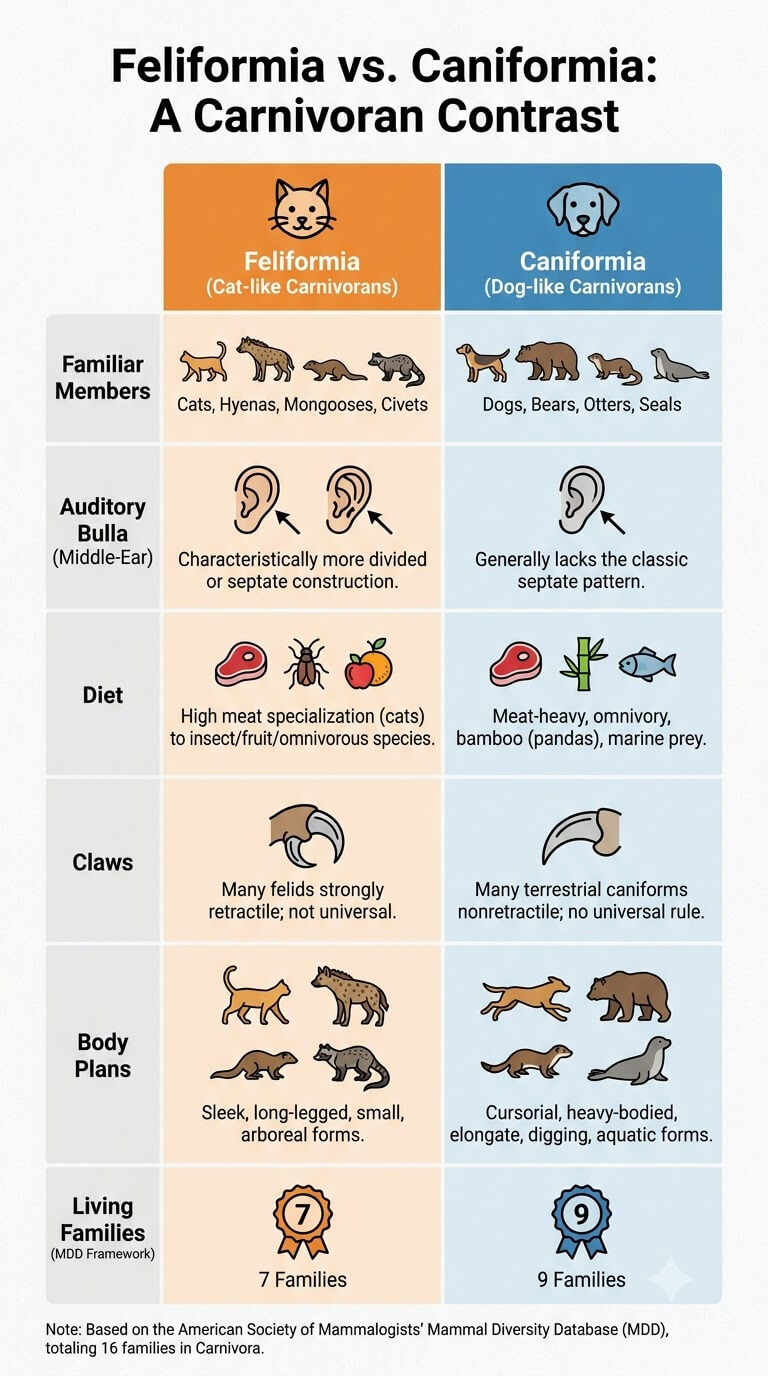
| Feature | Feliformia | Caniformia |
|---|---|---|
| Simple shorthand | Cat-like carnivorans | Dog-like carnivorans |
| Familiar members | Cats, hyenas, mongooses, civets | Dogs, bears, otters, raccoons, seals |
| Auditory-bulla tendency | Characteristically more divided or septate middle-ear bulla construction | Different bulla construction, generally lacking the classic feliform septate pattern |
| Diet | Ranges from highly meat-specialized cats to insect-eating, omnivorous, and fruit-eating species | Ranges from meat-heavy diets to omnivory, bamboo specialization, invertebrate feeding, and marine prey |
| Claws | Many felids have strongly retractile claws, but this is not universal across feliforms | Many terrestrial caniforms have nonretractile or partly retractile claws, but there is no universal claw rule |
| Body plans | Includes sleek cats, long-legged hyenas, small mongooses, and arboreal civet-like forms | Includes cursorial canids, heavy-bodied bears, elongate mustelids, climbers, diggers, and aquatic pinnipeds |
| Living families in current MDD framework | 7 | 9 |
The American Society of Mammalogists’ Mammal Diversity Database family list currently recognizes 16 families in Carnivora. The family list is useful because it makes the diversity of both branches visible without treating the familiar cat and dog families as if they represented the whole story.
Where the Two Groups Fit in Order Carnivora
Carnivora is a formal mammalian order. Within it, living species are divided into the two major suborders Feliformia and Caniformia. These names describe branches of a family tree, not feeding categories. A species belongs to one branch because of shared ancestry, not because it eats a particular food or has a certain personality.
Shared Carnivoran Ancestry
Feliforms and caniforms inherited many features from earlier carnivorans, including a dental pattern in which the upper fourth premolar and lower first molar form the classic carnassial pair. How strongly those teeth act like slicing blades varies greatly. Cats retain strongly shearing carnassials, while bears have broader crushing surfaces behind the main shearing region. Pinnipeds have further modified dental patterns suited to aquatic prey.
The Animal Diversity Web overview of Carnivora describes the order’s variable skulls and teeth while noting the carnassial pattern common to the group. That shared framework helps explain why a giant panda and a lion can belong to the same order despite very different diets.
Why Cat-Like and Dog-Like Are Useful but Incomplete Labels
The labels work best as memory aids. A domestic cat is a familiar feliform, and a domestic dog is a familiar caniform. Problems start when the shorthand is treated as a body-shape test.
Hyenas are the classic warning. Their sloping backs, long forelimbs, and endurance-oriented movement may remind people of canids, but hyenas are members of Hyaenidae within Feliformia. At the other extreme, seals and walruses have limbs transformed into flippers, yet they sit within the caniform branch. Evolution can modify body form dramatically while ancestry remains traceable through a broader combination of traits and genetic relationships.
Skull and Auditory-Bulla Differences in Plain English
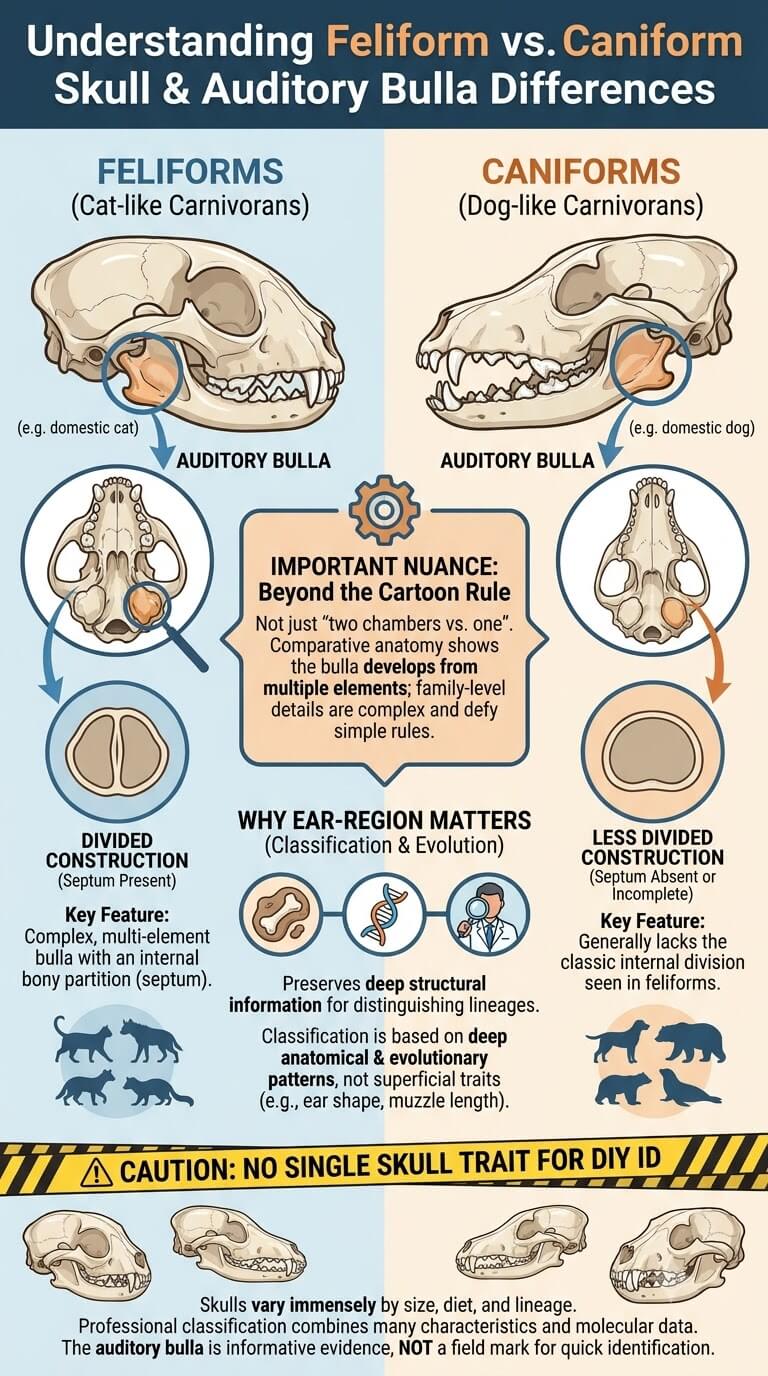
One of the traditional anatomical differences between feliforms and caniforms is found underneath the skull around the middle ear. The auditory bulla is a bony capsule associated with the middle-ear region. In feliforms, the bulla typically shows a more distinctly divided construction involving multiple bony elements and a septum. Caniforms show a different construction that generally lacks the classic feliform division.
This is a real anatomical distinction, but it is easy to oversimplify. Comparative work on carnivoran ear-region anatomy shows that the bulla develops from multiple elements and that family-level details can be complicated. The classic split remains useful for understanding the two branches, but it should not be reduced to a cartoon rule about “two chambers versus one” with no exceptions or developmental context.
Why Ear-Region Anatomy Matters to Classification
The bones around the ear are valuable to mammalogists and paleontologists because they preserve structural information that can help distinguish lineages. A foundational comparative study of the auditory bulla in Carnivora examined how its component bones contribute to carnivoran relationships. Later anatomical and molecular studies have refined the broader family tree, but the ear region remains an important part of the anatomical evidence.
For a general reader, the useful takeaway is simple: feliform and caniform classification is based on deep anatomical and evolutionary patterns, not on whether an animal has pointed ears, a long muzzle, or a catlike gait.
Why No Single Skull Trait Should Be Used as a DIY Identification Rule
Skulls change with body size, feeding style, muscle arrangement, and lineage. A short-faced felid, a bone-crushing hyena, an omnivorous bear, and a fish-eating seal place different demands on the head. Even within one branch, skull proportions can look very different.
That is why professional classification combines many characters and increasingly relies on molecular phylogenetics as well. The auditory region is informative, but it is not a field mark for identifying an unknown living mammal from a quick glance.
Teeth, Jaws, and Dietary Tendencies
Both branches descend from carnivorans with specialized shearing teeth, but tooth form has been reshaped by diet. Feliformia includes some of the most meat-specialized living mammals, especially felids, yet the branch also contains species that eat insects, fruit, eggs, small vertebrates, and mixed diets. Caniformia ranges even more obviously across feeding strategies, from predatory canids and polar bears to omnivorous raccoons, bamboo-feeding giant pandas, shellfish-eating sea otters, and marine pinnipeds.
Carnassial Heritage in Both Branches
Carnassials are cheek teeth that meet in a shearing action, somewhat like opposing blades. In a typical carnivoran arrangement, the upper fourth premolar and lower first molar form the main pair. They are not the same as canines. Canines are the prominent pointed teeth near the front of the mouth, while carnassials sit farther back.
Felids usually preserve a strong slicing emphasis because animal tissue dominates their feeding biology. Many caniforms retain more crushing or grinding area in the back of the tooth row, especially lineages with mixed diets. These are tendencies shaped by evolution, not a simple rule that all feliform teeth cut and all caniform teeth crush.
Why Diet Does Not Separate Feliformia From Caniformia
Diet is especially misleading as a classification tool. A giant panda belongs to Ursidae within Caniformia even though bamboo dominates its natural diet. Some civets and related feliforms consume substantial fruit. The aardwolf is a hyena relative that specializes heavily on termites rather than large vertebrate prey.
Likewise, being highly carnivorous does not make an animal a feliform. Many canids eat large amounts of animal prey, and pinnipeds capture fish, squid, crustaceans, or other marine animals depending on species. Taxonomy follows ancestry; diet describes how an animal obtains nutrition.
Claws, Limbs, and Locomotion
The body plans of feliforms and caniforms overlap more than the names suggest. Both branches contain runners, climbers, diggers, swimmers, and animals that combine several forms of movement. Limb proportions and claws often reflect what a species does in its habitat rather than serving as a clean suborder label.
Retractile Claws Are Not Universal in Feliforms
Retractile claws are strongly associated with cats, but even within Felidae the degree of retraction varies. Cheetah claws, for example, are less fully retractile than those of many other cats and help provide traction during rapid acceleration and turning. Outside Felidae, feliform claw arrangements are even more varied.
Hyenas do not walk around with classic cat-style retractile claws, and mongooses have their own limb and claw adaptations for running, digging, climbing, or handling prey. “Retractile claws equal Feliformia” therefore fails as a universal test.
Caniform Body Plans Range From Cursorial Dogs to Bears, Mustelids, and Pinnipeds
Canids often have long limbs and feet suited to efficient terrestrial travel, a pattern sometimes described as cursorial, meaning adapted for running. Bears are more heavily built and typically walk with much of the sole contacting the ground. Mustelids include elongated weasels, powerful diggers such as badgers, climbing martens, and streamlined otters.
Pinnipeds show how far caniform anatomy can be remodeled. Their limbs function as flippers and their bodies are streamlined for swimming. NOAA Fisheries notes that seals, sea lions, and walruses are pinnipeds within Carnivora. Their aquatic appearance does not erase their position among caniform carnivorans.
Scent Systems, Senses, and Communication Tendencies
People sometimes hear that caniforms are “smell animals” while feliforms are “vision animals.” That contrast can be useful in a narrow comparison, but it is too broad as a biological rule. Olfaction, hearing, vision, touch, and chemical communication matter across both branches, with emphasis varying by species and lifestyle.
Many canids and bears have large olfactory structures and use scent extensively. Many cats rely heavily on vision and hearing when hunting, but they also investigate odor and deposit scent marks. Mongooses, civets, hyenas, mustelids, skunks, and procyonids use chemical signals in different ways. Pinnipeds may combine visual, vocal, tactile, and olfactory information, especially around breeding or resting sites.
Useful Patterns Without Turning Them Into Absolute Rules
Comparative anatomy does show broad differences in skull shape and nasal anatomy among carnivoran lineages, but sensory performance cannot be ranked reliably with one label. Snout length, habitat, activity pattern, prey type, social system, and aquatic versus terrestrial life all influence how sensory structures are used.
A better question than “Which branch has the better sense of smell?” is “Which information matters most to this species in its environment?” A fox searching for hidden prey, a leopard stalking at dusk, a sea lion locating prey underwater, and a mongoose inspecting cover face very different sensory problems.
Major Feliform Families
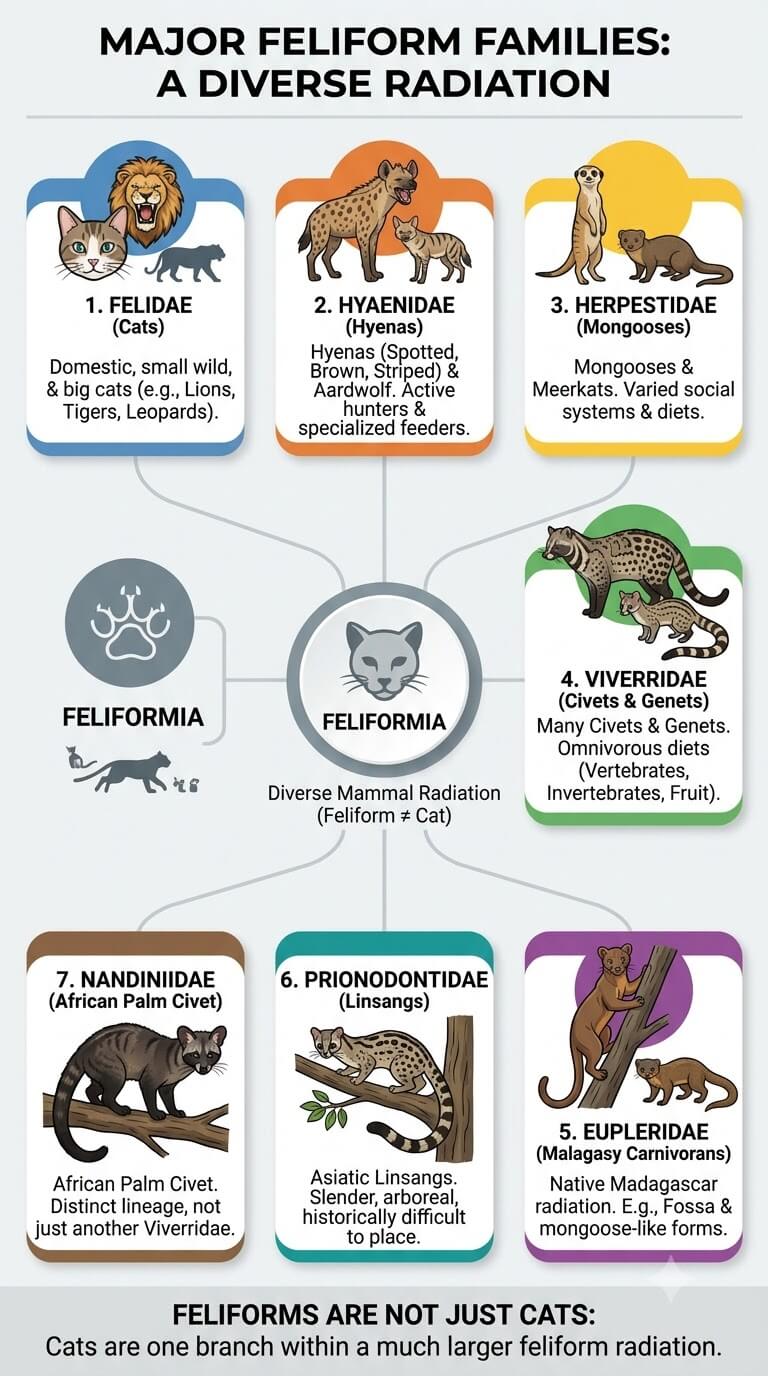
Current mammal taxonomy recognizes seven living feliform families. They are Felidae, Hyaenidae, Herpestidae, Viverridae, Eupleridae, Prionodontidae, and Nandiniidae. Common names are useful, but they can be deceptive, especially around civets and linsangs.
Cats, Hyenas, Mongooses, Civets, Malagasy Carnivorans, Linsangs, and African Palm Civet
- Felidae: domestic cats, small wild cats, and big cats such as lions, tigers, leopards, and jaguars.
- Hyaenidae: spotted, brown, and striped hyenas plus the aardwolf. The family contains both active hunters and species with very different feeding specializations.
- Herpestidae: mongooses, including meerkats. Not every mongoose has the same social system, diet, or relationship with venomous snakes.
- Viverridae: many civets and genets, with diets that may include vertebrates, invertebrates, and fruit.
- Eupleridae: the native Malagasy carnivoran radiation, including the fossa and several mongoose-like forms found naturally in Madagascar.
- Prionodontidae: Asiatic linsangs, slender arboreal feliforms that were historically difficult to place using appearance alone.
- Nandiniidae: represented by the African palm civet, a distinct feliform lineage rather than simply another member of Viverridae.
This family list is why “feliform” should never be treated as a synonym for “cat.” Cats are one branch within a much larger feliform radiation.
Major Caniform Families
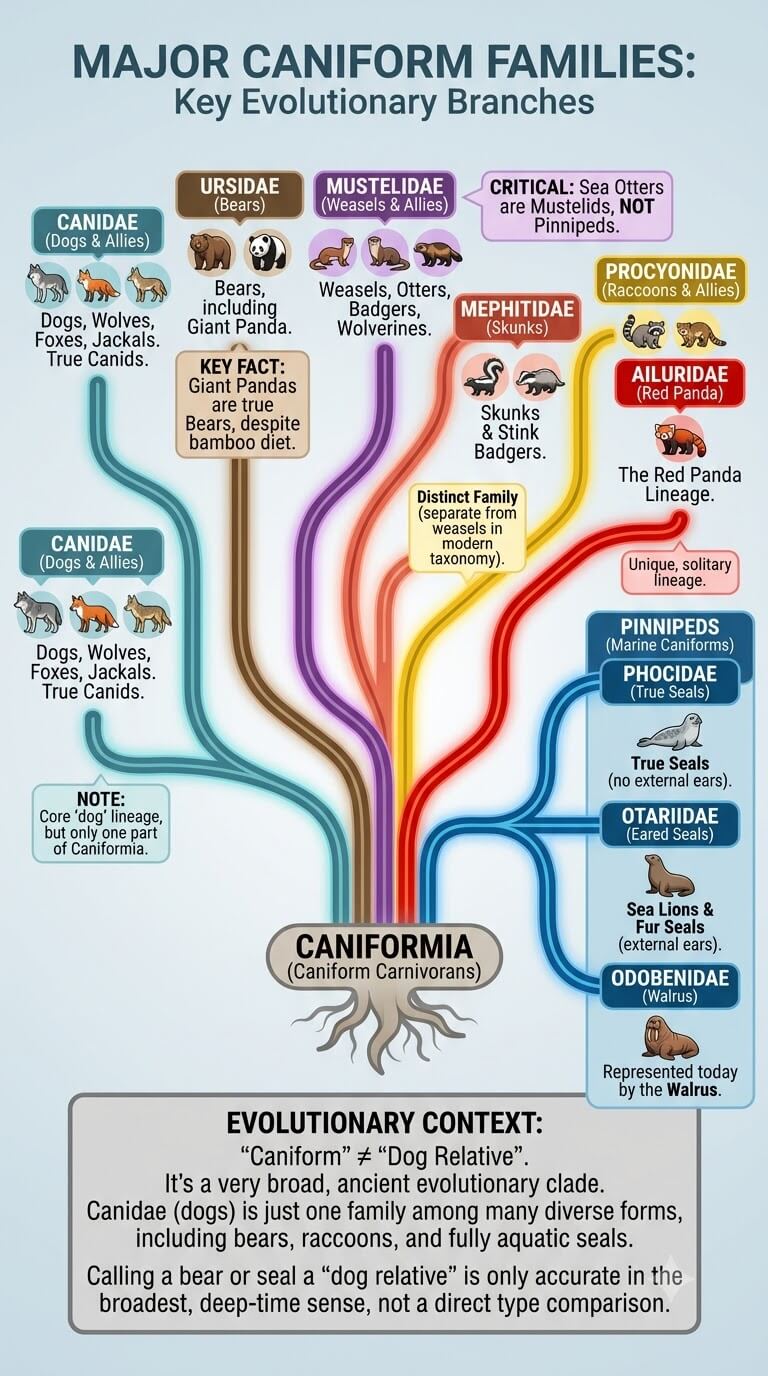
Current taxonomy recognizes nine living caniform families: Canidae, Ursidae, Mustelidae, Mephitidae, Procyonidae, Ailuridae, Phocidae, Otariidae, and Odobenidae. That list ranges from wolves and bears to tiny mustelids and fully marine seals.
Canids, Bears, Mustelids, Skunks, Procyonids, Red Panda, and Pinnipeds
- Canidae: dogs, wolves, coyotes, foxes, jackals, African wild dogs, and their relatives.
- Ursidae: bears, including the giant panda. Giant pandas remain bears and caniform carnivorans despite their bamboo-centered diet.
- Mustelidae: weasels, otters, badgers, martens, wolverines, and relatives. Sea otters are mustelids, not pinnipeds.
- Mephitidae: skunks and stink badgers, treated as their own family in modern classification rather than casually folded into the weasel family.
- Procyonidae: raccoons, coatis, kinkajous, and relatives.
- Ailuridae: the red panda lineage.
- Phocidae: true seals.
- Otariidae: sea lions and fur seals.
- Odobenidae: represented today by the walrus.
Caniformia is therefore much broader than Canidae. Calling every caniform “a dog relative” is acceptable only in a very broad evolutionary sense, not as a statement that bears, raccoons, or seals are types of dogs.
Surprising Examples That Expose the Limits of Appearance
The most memorable examples are the animals that seem to contradict the labels. They do not actually contradict the classification. Instead, they show how much body form can change after lineages diverge.
Hyenas Are Feliforms Despite Dog-Like Proportions
Hyenas belong to Hyaenidae in Feliformia. Their long forelimbs, powerful necks, and endurance-oriented movement can make them look more dog-like than cat-like, but resemblance does not override ancestry. They also should not be reduced to scavengers. Spotted hyenas, for example, are capable hunters, while the aardwolf follows a very different insect-focused feeding strategy.
Seals and Walruses Are Caniforms Despite Aquatic Bodies
Pinnipeds are caniform carnivorans whose ancestors became increasingly specialized for life in water. True seals, sea lions, fur seals, and walruses share a marine body plan shaped by swimming, yet they remain nested within the same broad caniform radiation that includes bears and musteloids.
This does not mean seals evolved from modern bears or modern otters. Living families are cousins on an evolutionary tree and share extinct ancestors. Modern species are not transitional steps leading directly to one another.
Red Pandas Are Caniforms but Not Bears or Raccoons
The red panda has a history of taxonomic confusion because its appearance and anatomy share features with several familiar groups. Modern classifications place it in its own family, Ailuridae, within Caniformia. The Smithsonian National Zoo red panda profile explains that genetic evidence supports Ailuridae as a distinct family related within the broader musteloid caniform radiation.
That placement makes the red panda a useful lesson in classification. It is not a miniature giant panda, not a bear, and not simply a raccoon. Similar-looking features can evolve or be retained in ways that do not map neatly onto common names.
Habitat and Diet Diversity Across Both Branches
Feliforms occupy tropical forests, savannas, deserts, woodlands, scrublands, mountains, and other terrestrial habitats. Some are strong climbers; others are primarily ground-dwelling. Their diets range from the meat specialization of cats to insects, fruit, and mixed foods in other families.
Caniforms extend across an equally dramatic range of settings. Foxes and mustelids live in deserts, forests, grasslands, tundra, and mountains. Raccoons and some canids adapt well to human-modified landscapes. Bears include forest species, a bamboo specialist, and the polar bear, which depends heavily on sea-ice ecosystems. Otters occupy freshwater and coastal systems, while pinnipeds feed at sea and use land or ice for activities such as resting, breeding, and nursing.
These patterns make habitat another poor way to separate the two suborders. There is no “feliform habitat” and no single “caniform diet.” The branches describe ancestry; ecological adaptations describe how particular lineages live.
Common Confusions and Myths
Most mistakes come from treating the two names as stricter than they are. The suffix “-form” suggests resemblance, but in modern use the terms refer to evolutionary groups. That distinction prevents several common classification errors.
Feliform Does Not Mean Member of Felidae
Felidae is the cat family. Feliformia is the larger branch that contains Felidae plus six other living families in the current MDD framework. A hyena, mongoose, fossa, genet, Asiatic linsang, or African palm civet can be a feliform without being a cat.
The same logic applies to behavior. Feliforms are not universally solitary, nocturnal, stealth hunters, or strict carnivores. Lion sociality, hyena clans, group-living mongooses, insect-specialized aardwolves, and fruit-eating viverrids show why one “cat-like lifestyle” cannot describe the entire branch.
Caniform Does Not Mean Member of Canidae
Canidae is the dog family. Caniformia is the larger branch containing Canidae and eight other living families in the current framework. Bears are caniforms but not canids. Red pandas are caniforms but belong to Ailuridae. Raccoons are procyonids. Otters are mustelids. Seals and walruses belong to pinniped families.
Caniforms also do not share one universal dog-like body, diet, claw type, social system, or sensory hierarchy. The contrast between a gray wolf, giant panda, sea otter, skunk, raccoon, and walrus makes that clear.
What the Two Branches Reveal About Carnivoran Evolution
Looking at feliforms and caniforms side by side reveals a basic evolutionary principle: related animals can diversify until outward resemblance becomes a poor guide to kinship. A lineage can become a powerful runner, an arboreal fruit eater, a bamboo specialist, a termite feeder, a shellfish forager, or a marine swimmer without leaving its place on the family tree.
Family-Level Diversity Adds the Missing Detail
Feliformia becomes easier to understand when its families are examined individually. Cats emphasize one set of predatory adaptations, hyenas another, while mongooses, viverrids, euplerids, linsangs, and the African palm civet broaden the picture with different diets, body sizes, habitats, and social systems.
Caniformia shows the same pattern. Canids, bears, mustelids, skunks, procyonids, red pandas, and pinnipeds each represent distinct evolutionary experiments. That family-level view explains more than a simple cat-versus-dog analogy ever could.
Teeth, Senses, and Habitat Often Reflect Ecology More Than the Branch Name
Features such as carnassial shape, snout length, olfactory anatomy, claw form, limb proportions, and swimming ability have been modified as lineages adapted to particular foods and environments. They are valuable pieces of biological evidence, but their meaning depends on context.
A carnivoran’s place in Feliformia or Caniformia tells you about ancestry. Its teeth tell you something about food processing. Its limbs reveal how it moves. Its senses help explain how it finds prey, mates, young, competitors, or safe habitat. Keeping those questions separate produces a more accurate picture of animal diversity.
FAQ
Are hyenas more closely grouped with cats or dogs?
Hyenas are feliform carnivorans, so in the modern Carnivora family tree they fall on the same major branch as cats rather than the caniform branch that contains dogs. That does not make hyenas cats. They belong to their own family, Hyaenidae. Their dog-like proportions are a good example of why body shape alone cannot determine evolutionary relationships.
Are bears caniforms even though they are not canids?
Yes. Bears belong to Ursidae, which is a family within Caniformia. Canidae is another caniform family containing dogs, wolves, foxes, coyotes, and relatives. “Caniform” names the larger evolutionary branch, while “canid” refers specifically to members of Canidae.
Why are seals classified as caniforms?
Seals are caniforms because pinnipeds belong within the caniform side of Carnivora based on evolutionary relationships. Their aquatic bodies are specialized for marine life, but they retain ancestry linking them with other caniform lineages. True seals belong to Phocidae, sea lions and fur seals to Otariidae, and walruses to Odobenidae.
Final Thoughts
The central difference in feliforms vs caniforms is ancestry, not appearance or diet. Feliformia contains cats and a diverse set of relatives such as hyenas, mongooses, civets, Malagasy carnivorans, linsangs, and the African palm civet. Caniformia contains dogs, bears, mustelids, skunks, raccoons, red pandas, and pinnipeds. Skull anatomy, especially the middle-ear region, helps illustrate the deep split, while modern taxonomy combines anatomical and molecular evidence.
The exceptions are what make the comparison most useful. Hyenas show that a feliform can look dog-like. Seals show that a caniform can become fully adapted to marine movement. Giant pandas show that a member of Carnivora does not need a meat-dominated diet. Once those examples are clear, the “cat-like versus dog-like” labels become helpful signposts rather than misleading rules.

Ethan Walker is the founder and research editor of Animal Fact Central. He creates and reviews educational animal facts content using trusted wildlife, pet care, and science-based sources. His work focuses on making animal behavior, adaptations, habitats, and species facts clear, accurate, and engaging for everyday readers.
Read More Details About Ethan Walker: https://animalfactcentral.com/ethan-walker/