

Animal teeth are not random. They are feeding tools shaped by what an animal eats, how it captures food, how much chewing it must do, and how quickly food needs to be swallowed before another animal steals it. A grazing horse, a hunting cat, a fruit-eating bear, a seed-cracking bird, and a shark all solve the same basic problem in very different ways: food has to be found, held, broken down, and moved into the body.
That is why teeth, jaws, beaks, and mouthparts can tell you a lot about diet. Flat molars often point toward grinding plant material. Sharp canines can help grip flesh or display strength. Chisel-like incisors may reveal gnawing, clipping, or scraping. But mouth anatomy is a clue, not a complete biography. Many animals eat differently by season, age, habitat, and opportunity.
This guide explains how animal teeth and diet fit together without turning every skull into a simple label. You will learn the major tooth types, how herbivores, carnivores, and omnivores use their mouths, why some animals have no typical teeth at all, and which mistakes to avoid when guessing what an animal eats.
Quick Answer
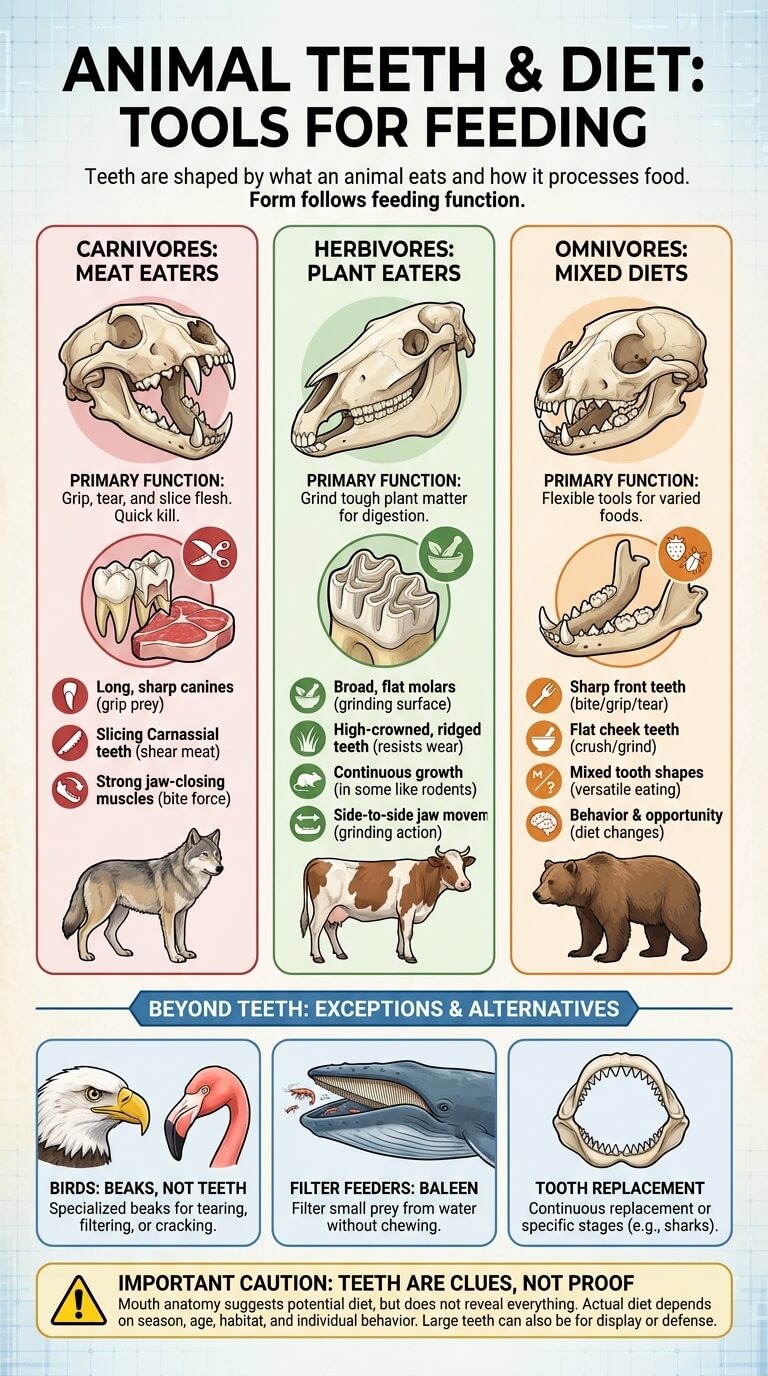
Animal teeth usually match diet because different foods require different feeding tools. Incisors cut or gnaw, canines grip or tear, and premolars and molars crush, slice, or grind. Herbivores often have broad grinding teeth, carnivores often have sharp gripping and slicing teeth, and omnivores usually have a mix. Still, teeth alone cannot prove an animal’s full diet.
| Mouth clue | What it often suggests | Important caution |
|---|---|---|
| Broad, flat molars | Grinding leaves, grass, seeds, or other plant matter | Some omnivores also have broad cheek teeth |
| Long, sharp canines | Gripping prey, tearing flesh, fighting, or display | Large canines do not always mean frequent meat eating |
| Chisel-like front teeth | Gnawing, clipping, scraping, or cutting food | Front teeth can also be used for grooming or digging |
| Hooked beak | Holding or tearing food, often in birds of prey or parrots | Beak shape also reflects handling, climbing, and other behaviors |
| Comb-like or sieve-like structures | Filtering small food from water or mud | These are not always true teeth |
Why Teeth Reveal What Animals Eat
Food creates mechanical problems. Grass is fibrous and wears down chewing surfaces. Meat can be slippery and must be gripped. Nuts and shells require pressure. Insects may need piercing, crushing, or picking out of bark. The mouth is often the first place where those problems are solved.
The University of Michigan’s Animal Diversity Web introduction to teeth explains that mammal teeth are modified for many jobs, including stabbing, crushing, grinding, slicing, and chopping food. That variety is one reason skulls can be so useful to scientists, museum educators, and naturalists.
Form follows feeding function
A tooth’s shape affects how forces move through food. A pointed tooth concentrates pressure into a small area, which helps puncture or hold. A broad tooth spreads pressure across a wider surface, which helps crush or grind. A blade-like edge shears, similar to scissors. A chisel-like front tooth scrapes, clips, or gnaws.
Jaws matter too. Teeth do not work alone. Carnivores that seize prey often need strong jaw-closing muscles, a stable bite, and teeth that fit like cutting tools. Grazers and browsers often need jaw movement that allows side-to-side grinding. Animals that crack shells need leverage and repeated force. The complete feeding system includes teeth, jaw joints, muscles, lips, tongue, digestive tract, and behavior.
Teeth vs beaks vs mouthparts
Mammals are famous for differentiated teeth, but not every animal feeds with a familiar set of incisors, canines, premolars, and molars. Birds use beaks. Baleen whales filter food with flexible plates rather than chewing teeth. Many insects feed with piercing, sponging, chewing, or sucking mouthparts. Octopuses have a beak-like structure, while some fish have crushing plates or specialized pharyngeal teeth deeper in the throat.
These different tools remind us that diet is bigger than teeth. A bird with no teeth can still slice fruit, pry seeds, spear fish, crack nuts, or tear meat depending on its beak, tongue, feet, and feeding behavior. A whale can grow to enormous size while eating tiny animals because its filtering equipment and feeding style are so efficient.
Why diet clues are helpful but not perfect
Teeth show what an animal is built to handle, not everything it will eat. A raccoon may have mixed teeth and eat fruit, insects, eggs, crayfish, and human leftovers. A panda has carnivore ancestry but mostly eats bamboo. A dog has carnivore-like teeth but may consume plant material in small amounts. A deer has grinding teeth for plants, yet young animals and mineral-seeking adults may occasionally chew unusual materials.
Diet also changes with age and habitat. A young predator may eat smaller prey than an adult. A bird may feed insects to chicks even if adults eat many seeds. A bear may eat berries in one season and salmon in another. Teeth give a strong first clue, but the best diet answer also considers stomach contents, feces, direct observation, stable isotope data, habitat, and seasonal food availability.
Main Types of Animal Teeth

Most mammals are heterodont, which means they have different tooth types in the same mouth. That is a major reason mammal skulls can look so informative. Instead of one repeated tooth shape, many mammals have a front-to-back toolkit: incisors, canines, premolars, and molars.
The Merck Veterinary Manual overview of animal dentition identifies teeth by class, including incisors, canines, premolars, and molars. Those categories are useful for understanding feeding, although the details vary widely among species.
Incisors for cutting and gnawing
Incisors sit at the front of the mouth in many mammals. They can clip grass, scrape bark, nip fruit, groom fur, or gnaw hard materials. Rodents are a classic example because their front incisors keep growing and are worn down by gnawing. Beavers use large incisors to cut wood, while squirrels use theirs to open nuts and seeds.
Grazing animals also rely on front teeth or equivalent cutting structures. Horses use incisors to crop grass close to the ground. Cattle lack upper front incisors, but they use lower incisors against a tough dental pad to grasp and tear vegetation. The exact setup differs, but the feeding problem is similar: plant material must be taken into the mouth before it can be processed.
Canines for gripping and tearing
Canines are often the most dramatic teeth in a skull. In many carnivores, they help seize prey and hold struggling animals long enough for the bite to matter. They may also help tear flesh after a kill. In cats and dogs, the canine teeth are obvious because they are long, pointed, and placed near the front corners of the mouth.
But canines are not only meat tools. Some herbivores and omnivores have enlarged canines used for fighting, display, defense, or social competition. The tusks of wild boars are modified canines. Hippos have huge canine teeth, yet they are not built like typical meat-eating predators. This is one reason large teeth should not automatically be read as aggression or a meat-heavy diet.
Premolars and molars for crushing, slicing, or grinding
Premolars and molars sit farther back in the mouth and do much of the heavy food processing. In plant eaters, cheek teeth often have broad surfaces, ridges, or high crowns for grinding tough vegetation. In many carnivores, some cheek teeth form slicing edges that shear meat. In omnivores, cheek teeth may be lower and bumpier, useful for crushing and grinding a wider range of foods.
Herbivore Teeth and Plant-Based Diets
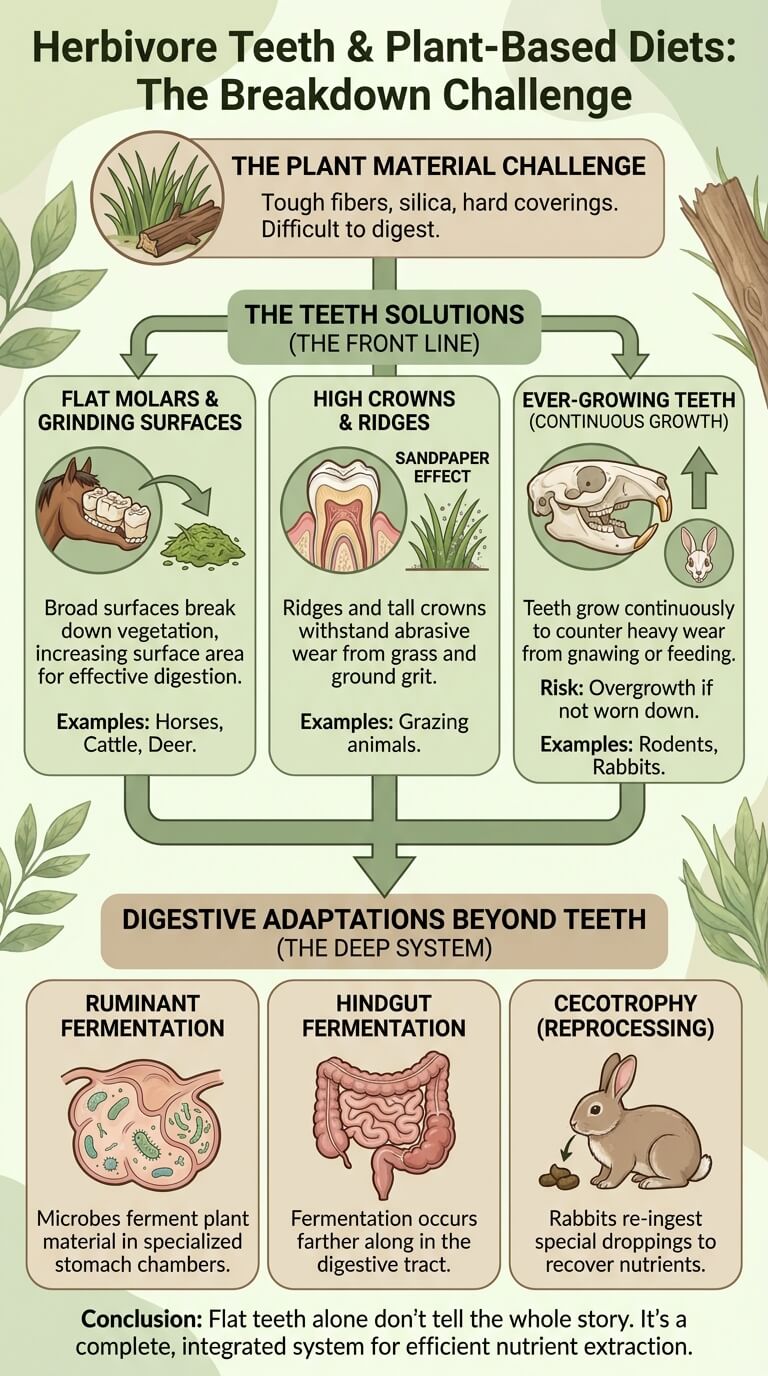
Plant material can be difficult food. Grass, leaves, bark, stems, and seeds often contain tough fibers, silica, hard coverings, or chemical defenses. Herbivores need mouths and digestive systems that can take in enough plant matter and process it efficiently. Teeth are only one part of that system, but they are a very visible part.
Flat molars and grinding surfaces
Many herbivores have cheek teeth built for grinding. Horses, cattle, deer, sheep, and many other plant eaters use broad tooth surfaces to break down vegetation before it moves deeper into the digestive tract. Grinding increases the surface area of food, which helps digestion work more effectively.
Some herbivore teeth have ridges, folds, or high crowns that help them withstand wear. This matters because grasses can be abrasive, especially when mixed with dust or grit from the ground. Over time, chewing plants can act like sandpaper. High-crowned teeth and continuous wear patterns help grazing animals keep feeding across a long life.
Ever-growing teeth in grazers and gnawers
Some animals face so much tooth wear that their teeth must keep growing or erupting throughout life. Rodents are the most familiar example. Their incisors grow continuously and are kept at a usable length by gnawing. Rabbits and many other lagomorphs also have teeth adapted to heavy wear from plant-based feeding.
Ever-growing teeth are useful, but they also create risk. If an animal cannot wear them down properly, teeth may overgrow and interfere with feeding. This is especially important in pet rabbits, guinea pigs, and other small mammals, where diet and veterinary care can affect dental health. For wild animals, the same principle shows how closely tooth growth, wear, and food choice are connected.
Digestive adaptations beyond teeth
Teeth begin the job, but plant digestion often depends on microbes and specialized gut structures. Cows and other ruminants ferment plant material in a multi-chambered stomach. Horses ferment plant material farther along in the digestive tract. Rabbits reprocess special droppings to recover nutrients. These strategies show why flat teeth alone do not tell the whole story.
Carnivore Teeth and Meat-Based Diets

Carnivores often have teeth that help capture, hold, kill, and process animal food. Meat is not abrasive like grass, but it moves, slips, tears, and spoils. A carnivore may need to secure prey quickly, cut flesh into swallowable pieces, or crack smaller bones. Different predators solve those problems in different ways.
Sharp canines and carnassial teeth
Many mammalian carnivores have long canines and specialized slicing teeth called carnassials. Carnassial teeth work like shears, cutting meat as the jaws close. They are especially clear in cats and dogs, although the exact tooth positions and shapes vary among carnivore groups.
The National Park Service guide to mammal teeth uses tooth shape to compare herbivores, carnivores, insectivores, and omnivores. That kind of comparison is useful because meat eaters often have sharper teeth than plant eaters, but it should still be interpreted with context.
Bite, grip, and tear adaptations
A predator’s mouth is not only a cutting device. It is also a holding device. Canines can puncture and grip, while jaw muscles provide the force needed to keep hold of prey. Some predators use a quick killing bite. Others hold, shake, tear, or swallow prey whole. Teeth, hunting style, prey size, and body shape all work together.
Why not all carnivores have the same teeth
A cat, seal, snake, owl, crocodile, and shark can all be meat eaters, but their mouths are not the same. Cats have sharp carnassials for shearing flesh. Seals may grip slippery fish. Snakes swallow prey whole. Owls use beaks and talons instead of mammal-style teeth. Crocodilians hold with cone-like teeth and often tear by body movement rather than chewing like mammals.
Shark teeth are especially varied. Some sharks have narrow teeth for grasping fish, while others have broad cutting teeth or crushing plates for harder prey. The Florida Museum’s guide to shark teeth notes that sharks can shed many thousands of teeth during a lifetime, which helps explain why fossil shark teeth are common in some places.
Omnivore Teeth and Flexible Diets

Omnivores eat both plant and animal foods, but that does not mean every omnivore eats the same mixture. Some lean heavily on fruit and insects. Some eat roots, carrion, eggs, nuts, small animals, and human food when available. Their teeth often show flexibility rather than specialization for one narrow food type.
Mixed tooth shapes
Many omnivores have a combination of sharper front teeth and broader cheek teeth. The sharper teeth help with gripping, biting, or tearing. The broader teeth help crush and grind. This mixed setup gives omnivores more options when food changes by season or location.
Animal Diversity Web’s page on the diversity of cheek teeth describes bunodont cheek teeth, which are low and rounded and often associated with broad diets. Humans, pigs, bears, and raccoons are familiar examples of animals with teeth suited to varied foods.
Seasonal and opportunistic feeding
That flexibility is not just a diet list. It affects behavior. Omnivores may spend more time exploring, digging, climbing, manipulating objects, or testing unfamiliar food. Their mouths allow them to use many foods, but their intelligence, senses, and habitat access often determine what they actually eat.
Examples from bears, pigs, raccoons, and humans
Bears are a good example of why tooth shape does not equal one exact menu. Their teeth show carnivore ancestry, yet many bear species eat large amounts of plant material. Pigs have strong snouts and mixed teeth that help them root, bite, and crush. Raccoons combine dexterous paws with a broad diet, which is one reason they do so well near people.
Animals Without Typical Teeth

Some of the most successful feeders on Earth do not use typical teeth at all. That does not make them less adapted. It means evolution found other mouth tools for the same feeding challenges.
Birds and beaks
Modern birds do not have teeth, but their beaks can be extremely specialized. A hawk’s hooked beak tears flesh. A hummingbird’s long bill helps reach nectar. A duck may use bill edges to strain food from water. A finch can crack seeds. A pelican can scoop fish. A woodpecker can chisel into bark and use its tongue to extract insects.
Cornell Lab of Ornithology’s Beaks lesson describes how bird beaks come in many shapes and sizes connected to feeding function. For a beginner naturalist, watching beak shape is often one of the easiest ways to guess what a bird might eat.
Baleen and filter feeding structures
Baleen whales do not chew prey with teeth. Instead, they use plates of baleen to filter small animals from water. Some engulf large volumes of water and then push it out through baleen, trapping krill or small fish. Others skim or strain food in different ways. The food may be tiny, but the feeding system is powerful and efficient.
Filter feeding shows that the most important question is not always, “What kind of teeth does it have?” Sometimes the better question is, “How does this animal separate food from water, mud, air, or sediment?” Flamingos, whale sharks, manta rays, mussels, and many other animals use filtering methods without relying on typical chewing teeth.
Insect mouthparts and suction feeders
Insects offer another set of mouth tools. Grasshoppers chew. Butterflies sip with a coiled proboscis. Mosquitoes pierce and draw fluids. Houseflies sponge liquid food. Dragonfly nymphs have specialized grasping mouthparts. These structures are not mammal teeth, but they still reveal diet and feeding behavior.
Suction feeders also appear outside insects. Some fish rapidly expand the mouth cavity to pull in prey with water. Many frogs use sticky tongues. Some marine animals scrape, rasp, drill, or suction food in ways that look nothing like chewing. Mouth anatomy is wonderfully diverse because food itself is diverse.
Common Mistakes and Myths
Teeth are exciting to study, but they are easy to overread. A single tooth, skull photo, or jaw shape can suggest a likely diet, yet it should not be treated as a perfect answer without more evidence.
Big teeth do not always mean aggressive behavior
Large teeth can be used for feeding, display, defense, competition, digging, or social signaling. Walrus tusks help with hauling out, display, and interaction. Boar tusks are used in fighting and defense. Hippo canines are enormous, but hippos feed mostly on grasses. Even in predators, large teeth are tools, not a personality trait.
Teeth alone do not prove an animal’s full diet
A skull can suggest a feeding category, but it cannot show everything the animal ate last week, last season, or in a different habitat. A carnivore may eat fruit. An herbivore may chew bone for minerals. An omnivore may specialize locally because one food source is abundant. Captive diets can also differ from wild diets when animal care teams balance nutrition carefully.
Some animals lose or replace teeth in unusual ways
Humans usually think of tooth replacement as baby teeth followed by adult teeth, but many animals follow different patterns. Sharks replace teeth throughout life. Rodent incisors grow continuously. Elephants replace molars in a sequence from back to front. Some animals have teeth only at certain life stages, and some lose functional teeth altogether.
Tooth replacement is part of feeding adaptation. If a tooth is likely to break, wear down, or fall out during feeding, a replacement system can be a major advantage. If an animal grinds abrasive food every day, tooth wear becomes one of the central pressures shaping its mouth.
| Myth | Better explanation |
|---|---|
| Sharp teeth always mean a dangerous predator | Sharp teeth may grip, pierce, display, or handle food, and behavior depends on context |
| Flat teeth mean an animal never eats animal food | Flat teeth often help with grinding, but some animals have mixed or flexible diets |
| Birds are limited because they have no teeth | Bird beaks, tongues, feet, and digestive systems can be highly specialized |
| A skull reveals the whole diet | A skull gives clues, but diet also depends on season, habitat, age, and opportunity |
Edge Cases and Exceptions
The most interesting animals are often the ones that break simple rules. These exceptions do not make tooth clues useless. They make them more accurate by reminding us to ask better questions.
Toothless mammals and specialized feeders
Anteaters and pangolins are mammals, but they do not use chewing teeth in the typical way. Their long tongues, sticky saliva, strong claws, and specialized skulls help them feed on ants and termites. The absence of teeth is not a weakness here. It is part of a different feeding solution.
Baleen whales are another powerful example. Their ancestors had teeth, but modern baleen whales feed with filtering plates. Their mouths are shaped around collecting vast numbers of small prey rather than biting large prey into pieces. In both cases, the missing teeth are just as informative as teeth would be.
Young animals with different diets from adults
Some animals change diet as they grow. Tadpoles and adult frogs often feed differently. Young fish may eat tiny plankton before shifting to larger prey or plant material. Young birds may receive insects from parents even when adults later eat many seeds or fruits. Juvenile reptiles may target smaller prey than adults because their mouth size and hunting ability are limited.
How Mouth Anatomy Fits the Bigger Feeding Picture
Teeth make the most sense when they are viewed as part of feeding ecology. Diet categories, hunting relationships, and filtering strategies all become easier to understand when you can see the mouth tools behind them.
Herbivores, carnivores, and omnivores
The classic diet categories are useful because they connect food type to anatomy. Herbivores often need cutting and grinding tools. Carnivores often need gripping and slicing tools. Omnivores often need flexible tools. But the categories become more accurate when you remember that animals can fall along a spectrum rather than into perfect boxes.
Predator-prey relationships
Predator and prey animals influence each other’s bodies over time. A predator’s teeth may become better at gripping or slicing, while prey may evolve armor, speed, toxins, burrowing habits, group defense, or camouflage. Teeth are part of that interaction, but they are not the whole contest. Senses, speed, stealth, defensive behavior, and habitat all matter.
Filter feeding animals
Filter feeders show a very different answer to the feeding problem. Instead of chasing one large prey animal or grinding tough plants, they separate many small food particles from water. Baleen, gill rakers, mucus nets, comb-like structures, and specialized body movements can all act as feeding equipment. In these animals, a lack of typical teeth may be the clue that matters most.
FAQ
What teeth do carnivores have?
Many mammalian carnivores have sharp canines for gripping prey and specialized cheek teeth for slicing meat. In cats and dogs, carnassial teeth help shear food as the jaws close. Not every carnivore has the same setup, though. Snakes, birds of prey, crocodilians, seals, and sharks use different mouth structures depending on how they capture and process prey.
Why do herbivores have flat teeth?
Many herbivores have flat or ridged cheek teeth because plant material often needs grinding. Chewing breaks leaves, grass, and stems into smaller pieces, which helps digestion. Some plant eaters also have high-crowned or continuously growing teeth because gritty or fibrous foods wear teeth down over time.
Can you tell an animal’s diet from its teeth alone?
You can often make a good first guess, but teeth alone are not enough for a complete answer. Tooth shape suggests what foods an animal is built to handle, but actual diet may change by season, age, habitat, and opportunity. The best answer combines teeth with observation, digestive anatomy, feeding signs, and known species behavior.
Do birds have teeth?
Modern birds do not have true teeth like mammals. They use beaks, tongues, feet, and digestive adaptations to handle food. Some birds have serrated bill edges or comb-like structures that may look tooth-like, but they are not the same as mammal teeth. Beak shape can still reveal a lot about diet.
Why do some animals keep replacing teeth?
Tooth replacement helps animals that damage or wear down teeth during feeding. Sharks replace teeth repeatedly because teeth can be lost while grabbing prey. Rodents have continuously growing incisors because gnawing wears them down. In animals that feed on abrasive or difficult foods, replacement or ongoing growth can be essential for survival.
Final Thoughts
Animal teeth and diet are connected because every meal creates a physical challenge. Some foods must be clipped, others pierced, crushed, filtered, scraped, swallowed whole, or ground for a long time. Teeth, jaws, beaks, and mouthparts are the tools animals use to solve those challenges.
The most useful habit is to look for patterns without forcing every animal into a simple category. Ask what the mouth is built to do, then ask what else you would need to know: habitat, season, age, behavior, digestive system, and feeding evidence. Teeth can open the story of an animal’s diet, but the full story is always bigger than the mouth.
Sharp teeth often matter most in predator and prey relationships, where catching, holding, or processing prey can affect survival.
Teeth are only one clue in how animals eat, because diet also depends on behavior, habitat, and available food.

Ethan Walker is the founder and research editor of Animal Fact Central. He creates and reviews educational animal facts content using trusted wildlife, pet care, and science-based sources. His work focuses on making animal behavior, adaptations, habitats, and species facts clear, accurate, and engaging for everyday readers.
Read More Details About Ethan Walker: https://animalfactcentral.com/ethan-walker/