
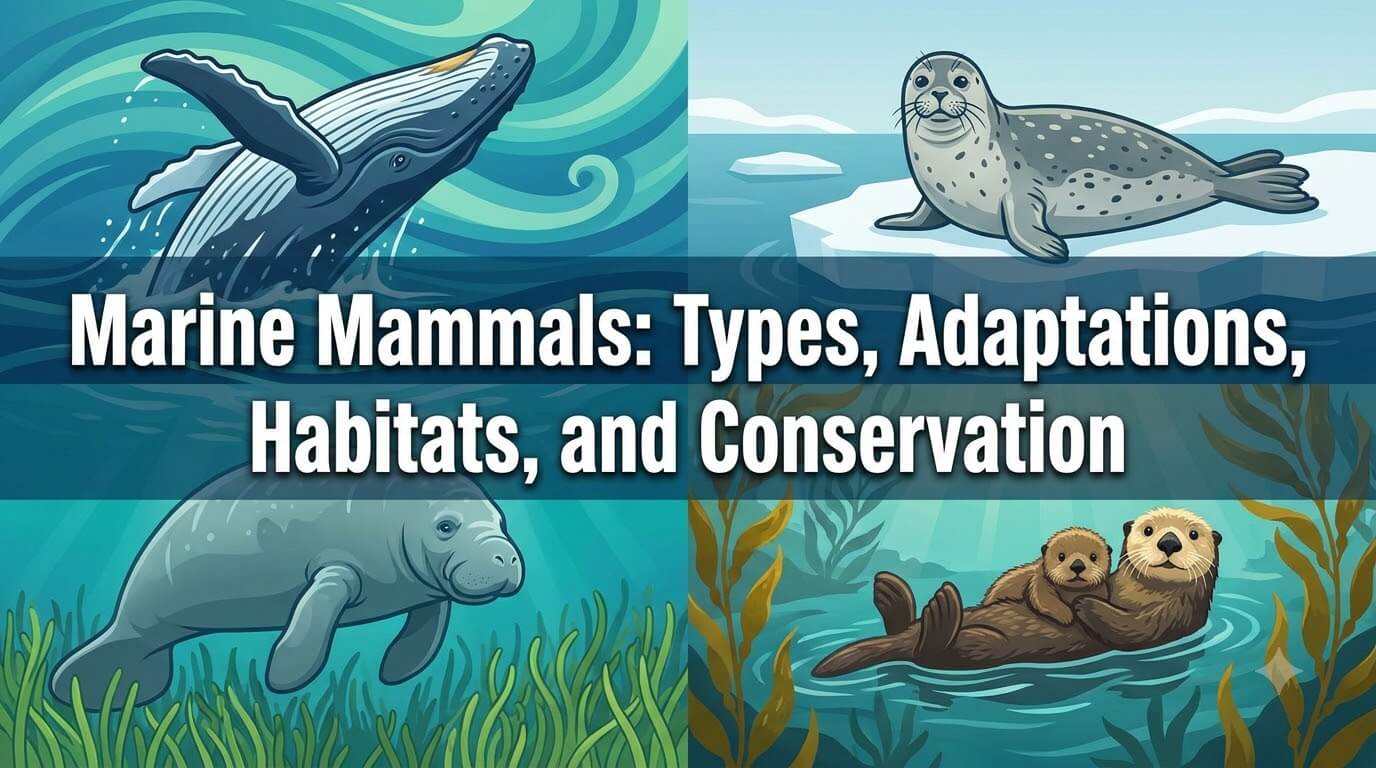
Marine mammals are mammals that depend on the ocean or other aquatic environments for much of their lives. They include whales, dolphins, porpoises, seals, sea lions, walruses, manatees, dugongs, sea otters, and polar bears. What unites them is not one branch of the mammal family tree. Instead, different mammal lineages adapted to aquatic life in different ways.
That distinction matters because a blue whale, a harbor seal, a manatee, and a sea otter solve the problems of living in water with different bodies, behaviors, and life histories. Some spend their entire lives in water. Others must return to land or ice to rest, breed, molt, or give birth. NOAA Fisheries uses the broad term marine mammals for mammals that rely on the ocean to survive and includes cetaceans, pinnipeds, sea otters, sirenians, and other marine-dependent mammals in that practical grouping. The agency’s marine mammal protection overview provides a useful starting point for understanding that diversity.
Quick Overview of Marine Mammals
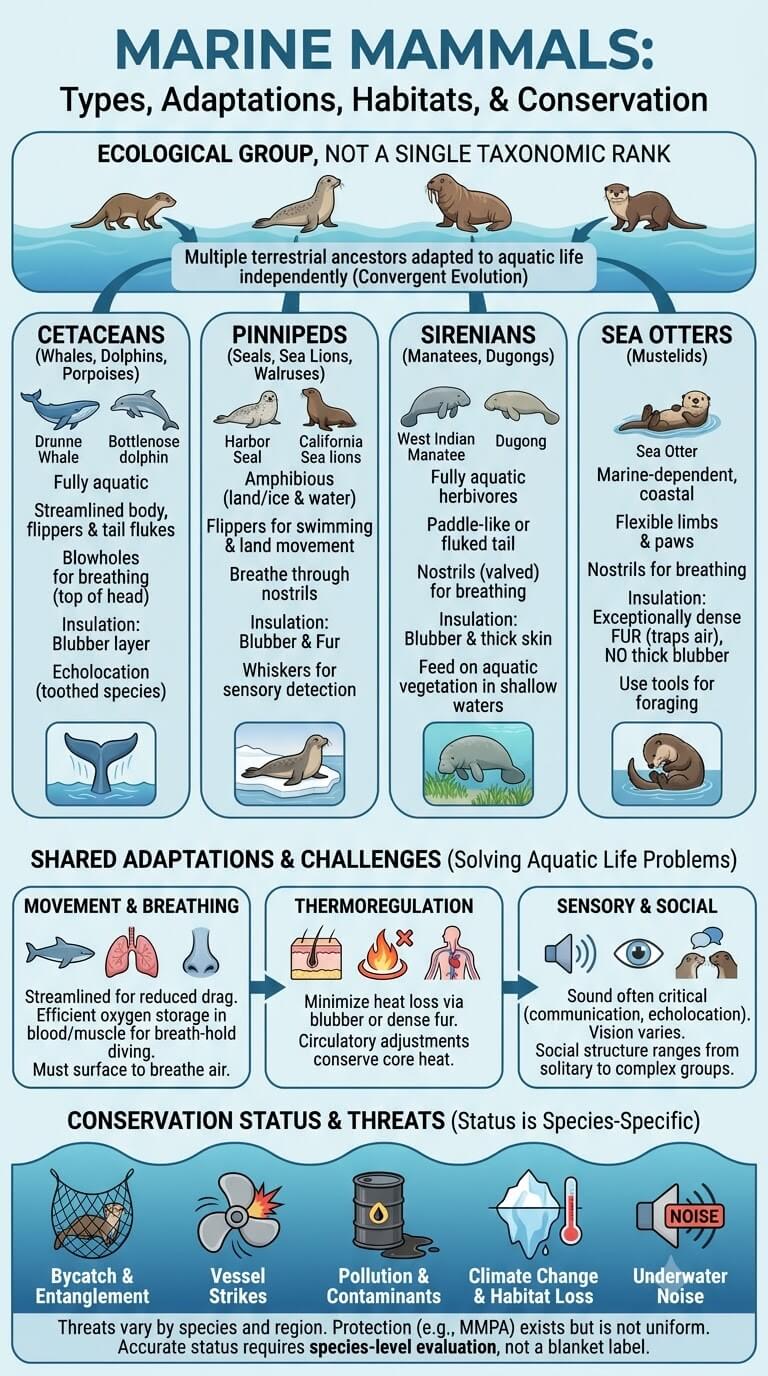
Marine mammals share the basic traits of mammals. They breathe air with lungs, maintain their own internal body temperature, produce milk for their young, and descend from mammalian ancestors. Living in water did not turn them into fish. It forced them to modify familiar mammalian systems for an environment where heat disappears quickly, movement creates heavy drag, oxygen is unavailable below the surface, and sound behaves very differently than it does in air.
The most familiar marine mammal groups are cetaceans, pinnipeds, sirenians, and sea otters. Cetaceans include whales, dolphins, and porpoises. Pinnipeds include true seals, sea lions, fur seals, and walruses. Sirenians include manatees and dugongs. Sea otters are mustelids, making them relatives of animals such as weasels and other otters rather than close relatives of seals or whales.
What Counts as a Marine Mammal?
An Ecological Group, Not a Single Taxonomic Rank
The phrase marine mammal describes a way of life more than a formal rank in biological classification. Whales are not simply enlarged seals, and seals are not a branch of the whale lineage. Their ancestors reached the water through separate evolutionary histories. This is a classic example of convergent evolution, in which unrelated or distantly related organisms develop similar solutions because they face similar environmental pressures.
Streamlined shapes appear again and again because moving through water efficiently favors reduced drag. Flippers appear in several lineages because broad, flattened limbs can steer or propel an animal in water. Insulation is essential because water carries heat away from the body efficiently.
Mammalian Traits That Marine Mammals Retain
A marine mammal still has lungs and must reach air. It is endothermic, meaning it generates enough metabolic heat to maintain a relatively stable internal temperature. Females produce milk, and young depend on that milk during early development. Hair is also part of the mammalian heritage, although its importance varies greatly. A sea otter depends heavily on dense fur for insulation, while adult cetaceans have very little external hair.
Different Degrees of Dependence on the Ocean
Marine mammals do not all depend on land in the same way. Cetaceans spend their entire lives in water. Pinnipeds typically feed at sea but come ashore or onto ice for important parts of their life cycle. Smithsonian Ocean’s overview of pinnipeds highlights this dual life, with seals, sea lions, and walruses adapted to both marine movement and time on land or ice.
Sea otters represent another pattern. They may feed, rest, groom, and raise pups in coastal waters while still retaining flexible limbs and fur as central parts of their survival strategy. Sirenians live in water full time, but their habitats are often shallow coastal, estuarine, riverine, or seagrass environments rather than the deep offshore waters used by many cetaceans.
The Main Marine Mammal Groups
Cetaceans: Whales, Dolphins, and Porpoises
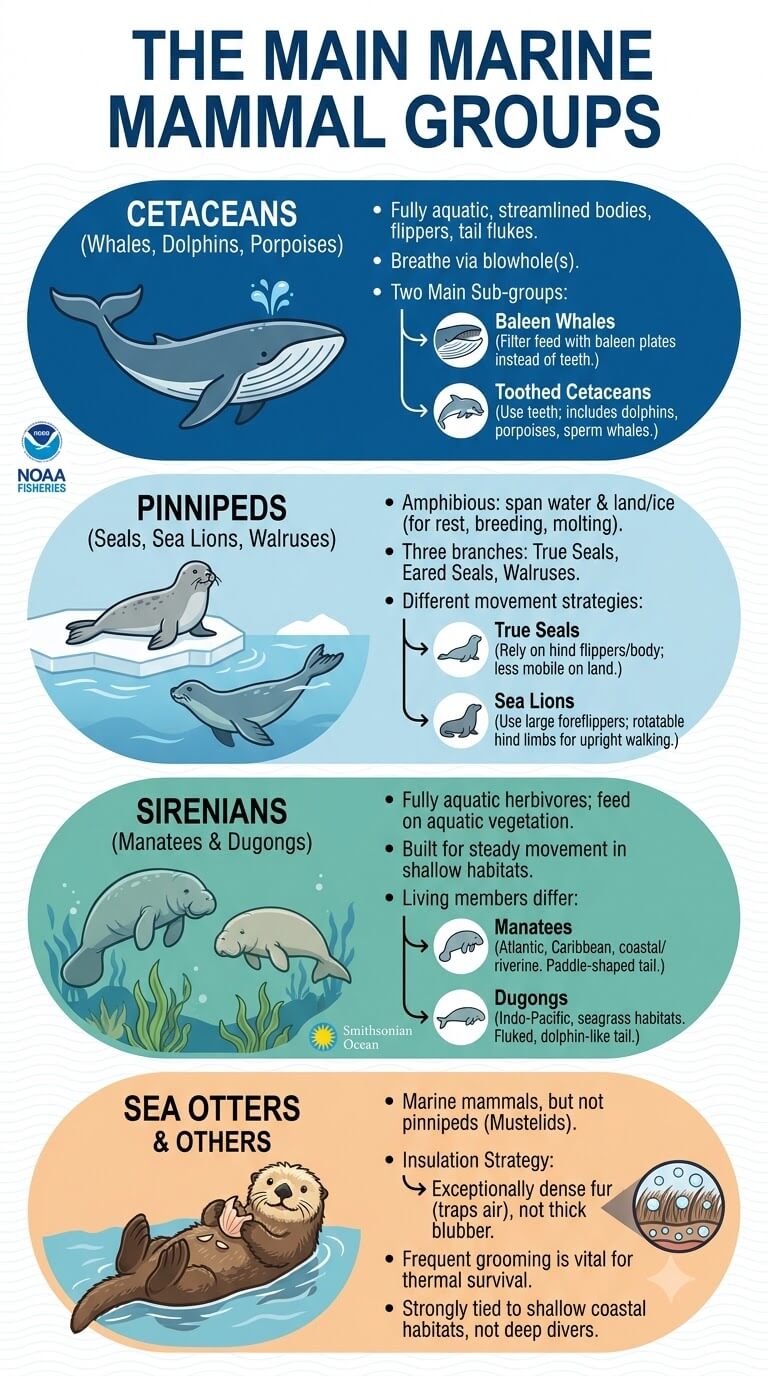
Cetaceans are the most fully aquatic marine mammals. Their bodies are streamlined, their forelimbs have become flippers, and propulsion comes mainly from powerful up-and-down movements of horizontal tail flukes. They breathe through one or two blowholes on top of the head, depending on the group.
Living cetaceans are broadly divided into baleen whales and toothed cetaceans. Baleen whales use flexible baleen plates rather than teeth to filter prey from water. Toothed cetaceans include dolphins, porpoises, sperm whales, beaked whales, killer whales, and several other groups. NOAA Fisheries’ whale and cetacean overview explains the main contrast between baleen and toothed forms.
Pinnipeds: Seals, Sea Lions, and Walruses
Pinnipeds are amphibious marine mammals, meaning their lives span both water and solid surfaces. They are highly specialized swimmers, but they still depend on land or ice for activities such as resting, breeding, giving birth, or molting. True seals, eared seals, and walruses are distinct branches within the pinniped grouping.
Their anatomy reflects different swimming and land-movement strategies. True seals rely strongly on their hind flippers and body movements in the water, while sea lions generate much of their thrust with large foreflippers. On land, sea lions can rotate their hind limbs under the body more effectively than true seals, which helps explain their more upright movement.
Sirenians: Manatees and Dugongs
Sirenians are fully aquatic herbivorous mammals. The living members are manatees and dugongs. They are built for steady movement through shallow aquatic habitats, where they feed heavily on aquatic vegetation. Smithsonian Ocean notes that living sirenians include manatees and the dugong, descendants of a much more diverse fossil history.
Manatees and dugongs are similar enough to be confused at first glance, but they differ in tail shape, skull structure, range, and feeding ecology. Manatees are associated with Atlantic, Caribbean, riverine, and coastal systems depending on species. Dugongs occur in the Indo-Pacific and are especially associated with seagrass habitats.
Sea Otters and Other Marine-Dependent Mammals
Sea otters are marine mammals, but they are not pinnipeds. They belong to the mustelid family. Their insulation strategy makes them especially distinctive because, unlike many marine mammals, they depend primarily on exceptionally dense fur rather than a thick blubber layer.
That fur must remain clean and able to trap air. Grooming is therefore not cosmetic behavior. It is part of the animal’s thermal survival system. Sea otters also show how a marine mammal can remain strongly tied to shallow coastal habitats rather than evolving the deep-diving body plan seen in many seals or cetaceans.
How Marine Mammals Evolved for Aquatic Life
Multiple Mammal Lineages Returned to Water Independently
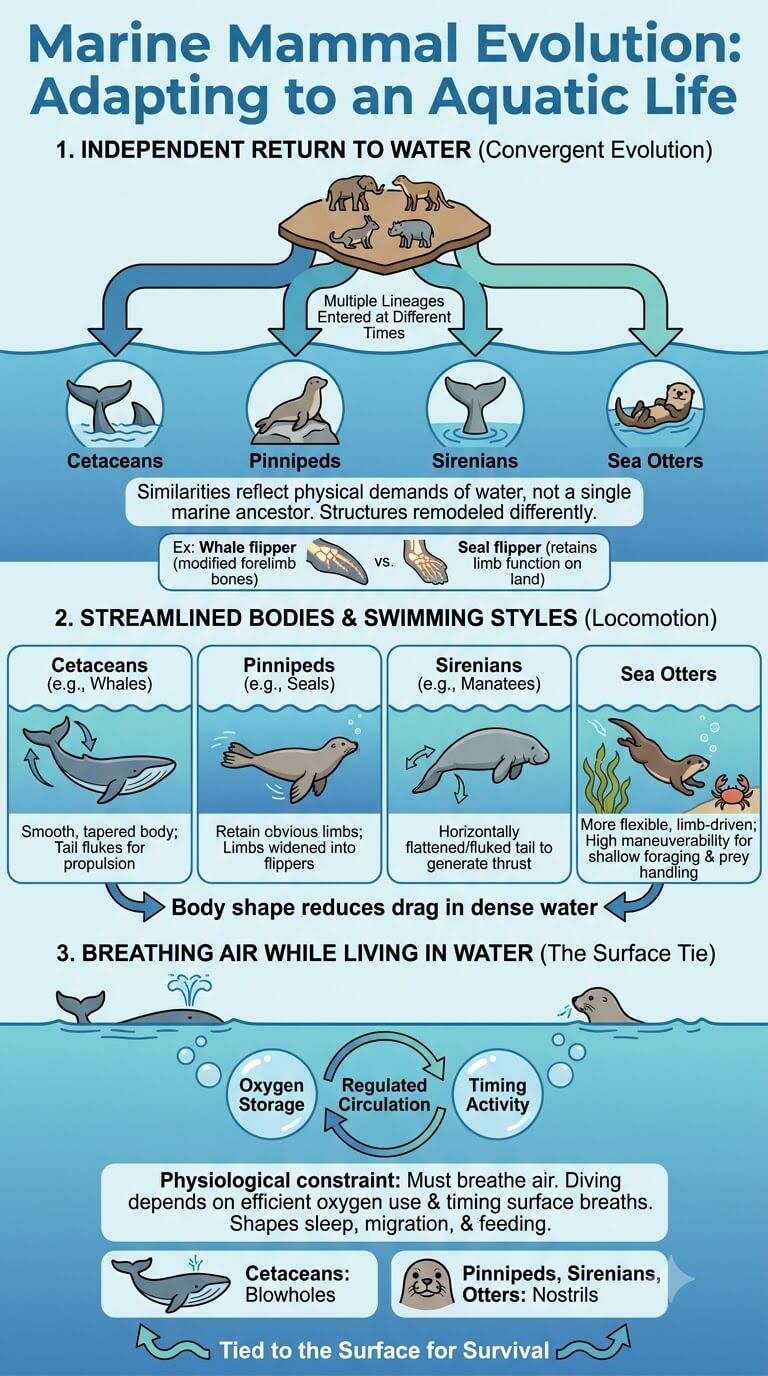
Marine mammals did not arise from one marine ancestor that later split into whales, seals, sea cows, and otters. Their terrestrial ancestors entered aquatic environments at different times and followed different evolutionary paths. As a result, the similarities we see today often reflect the physical demands of water rather than close relationship.
This explains why a whale flipper contains forelimb bones inherited from land-mammal ancestors, while a seal retains limbs that still function on land. Both can swim efficiently, but the structures were remodeled in different ways.
Streamlined Bodies, Limbs, and Swimming Styles
Water is far denser than air, so body shape has a major effect on swimming cost. Cetaceans reduce drag with smooth, tapered bodies and use tail flukes for propulsion. Pinnipeds retain more obvious limbs, but those limbs are widened into flippers. Sirenians also use a horizontally flattened tail or fluked tail to generate thrust, depending on the lineage.
Sea otters remain more flexible and limb-driven. Their movement suits shallow foraging habitats where maneuverability, diving to the seafloor, handling prey, and returning to the surface can matter more than sustained high-speed travel.
Breathing Air While Living in Water
Every marine mammal must solve the same basic problem: it cannot breathe while submerged. Diving therefore depends on storing and using oxygen efficiently, regulating circulation, and timing activity around surface breaths. Species differ enormously in the depths and durations they can manage, so broad statements about a single marine mammal diving limit are misleading.
Cetaceans surface through blowholes, while pinnipeds, sirenians, and sea otters breathe through nostrils. The need for air also shapes sleep, migration, feeding, and predator avoidance because even a deeply aquatic mammal remains physiologically tied to the surface.
How Marine Mammals Stay Warm, Dive, and Survive
Blubber, Fur, Body Size, and Heat Exchange
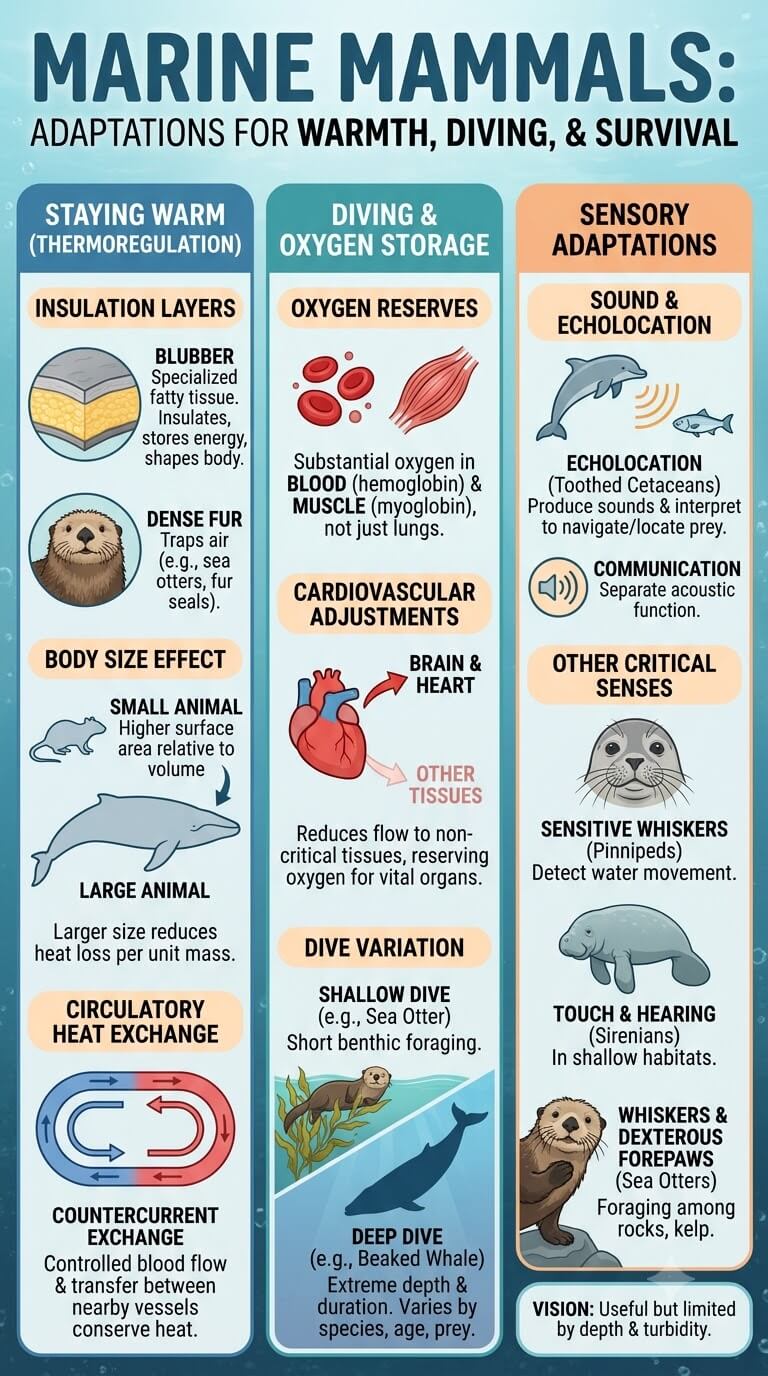
Cold water can draw heat from a warm body quickly. Many marine mammals reduce heat loss with blubber, a specialized layer of fatty tissue beneath the skin. Blubber can insulate, store energy, and influence body shape. Other species rely more heavily on fur. The Marine Mammal Center’s marine mammal overview describes the contrast between blubber-based insulation and dense fur in animals such as sea otters and fur seals.
Body size also matters. A large animal generally has less surface area relative to its volume than a small animal, which can reduce heat loss per unit of body mass. Circulatory systems can further conserve heat by controlling blood flow to flippers and other extremities and by transferring heat between nearby blood vessels.
Oxygen Storage and Breath-Hold Diving
Marine mammals do not rely only on air held in the lungs. Many diving species carry substantial oxygen reserves in blood and muscle, supported by hemoglobin and myoglobin. During dives, cardiovascular adjustments can reduce blood flow to less critical tissues and help reserve oxygen for organs such as the brain and heart.
There is no universal dive duration or depth for marine mammals. A sea otter making a short benthic foraging dive and a deep-diving beaked whale operate under very different ecological and physiological demands. Even within one species, dive behavior can vary with age, prey, location, and activity.
Sensory Adaptations for Life Underwater
Underwater vision can be useful, but light fades with depth and can be limited by turbidity. Sound often becomes especially important because it can travel efficiently through water. Toothed cetaceans use echolocation, producing sounds and interpreting returning echoes to investigate their surroundings and locate prey. Communication is a separate function, even when the same animal uses acoustic signals for both tasks.
Other marine mammals rely on different sensory combinations. Pinnipeds have sensitive whiskers that can help detect water movement. Sirenians use touch and hearing in shallow habitats. Sea otters use whiskers and dexterous forepaws while foraging among rocks, kelp, and bottom sediments.
How Marine Mammals Feed and Reproduce
Diet Diversity Across Major Groups
There is no single marine mammal diet. Baleen whales may filter small schooling fish or zooplankton. Toothed cetaceans capture fish, squid, and in some cases marine mammals. Pinnipeds eat a wide range of fish and invertebrates, with some species specialized for particular prey. Sea otters commonly take benthic invertebrates and other coastal prey. Sirenians are mainly herbivorous.
Feeding anatomy follows these differences. Baleen is suited to filtering. Teeth in toothed cetaceans are used for grasping prey rather than chewing in the human sense. Walrus tusks are not their primary tools for digging prey from the seafloor, while their sensitive whiskers and suction-feeding abilities are central to locating and extracting benthic food.
Nursing and Parental Care in Aquatic Environments
Like other mammals, marine mammals nourish young with milk. The logistics differ sharply by group. Cetacean calves nurse in the water and must coordinate swimming and breathing almost immediately after birth. Pinniped mothers may give birth on beaches, rocky shores, or sea ice, depending on species. Sea otter pups can spend early life floating at the surface while mothers forage nearby.
Parental strategies also vary in duration and intensity. Some mothers fast or reduce feeding during part of the nursing period, while others alternate foraging trips with care. It is safer to think of marine mammal reproduction as a range of solutions rather than one shared pattern.
Life on Land Versus Life Entirely at Sea
The place where a young animal is born reveals how deeply its lineage has adapted to water. Cetaceans and sirenians give birth in water. Pinnipeds generally give birth on land or ice. Sea otters give birth in the water or along coastal areas depending on circumstances, but their pups are strongly associated with the surface during early development.
Habitats and Global Distribution
Coastal Waters, Open Ocean, Estuaries, Rivers, and Sea Ice
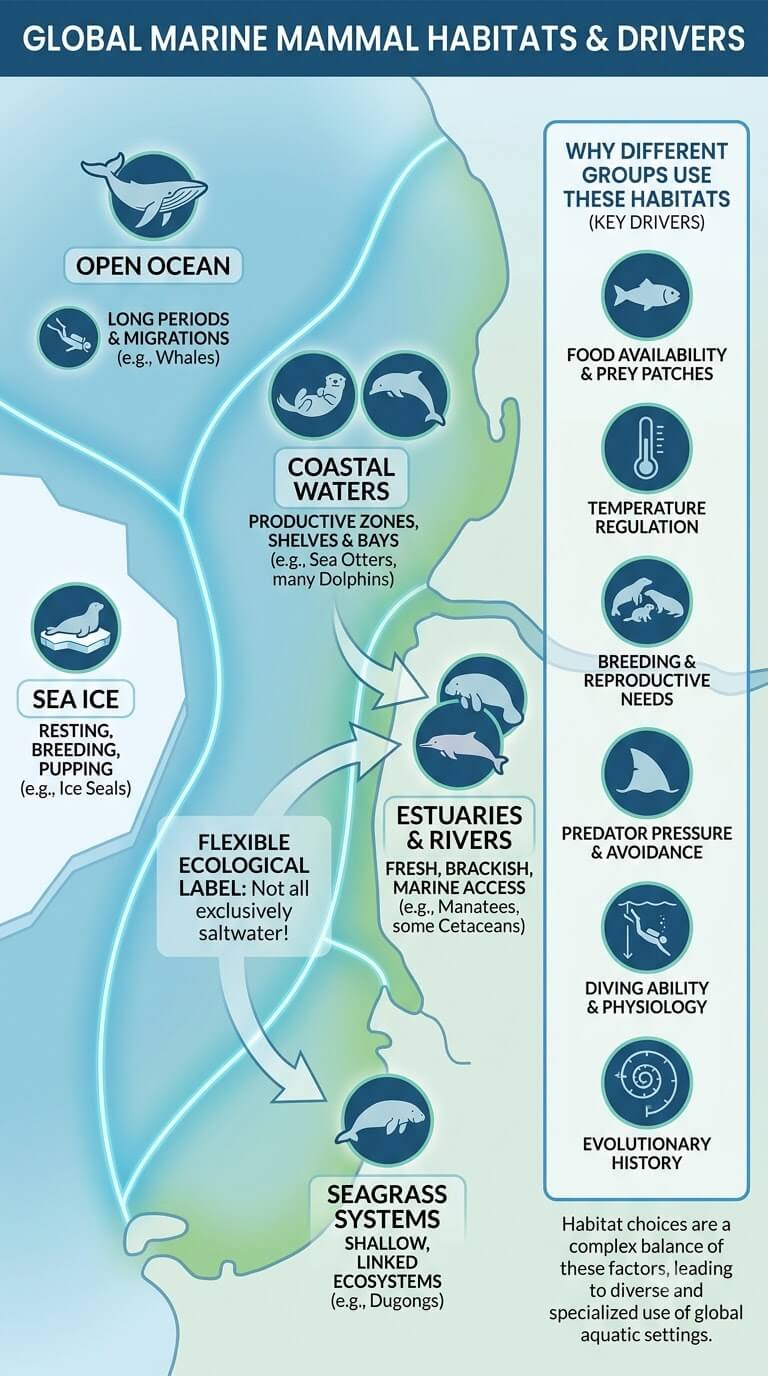
Marine mammals occupy nearly every major aquatic setting. Some whales spend long periods in open ocean. Many dolphins use continental shelves, bays, or estuaries. Ice seals depend on seasonal sea ice for resting, breeding, or pupping. Sea otters are strongly associated with productive coastal waters. Manatees may use rivers, springs, estuaries, and coastal habitats, while dugongs are closely linked with shallow seagrass systems.
Not every animal commonly included in discussions of marine mammals lives exclusively in salt water. Some cetaceans inhabit rivers, and manatees can move between fresh, brackish, and marine waters depending on species and region. The ecological label is therefore more flexible than the phrase might suggest.
Why Different Groups Use Different Marine Habitats
Habitat use reflects food, temperature, breeding needs, predator pressure, diving ability, and evolutionary history. A baleen whale that feeds on dense seasonal prey patches may travel across ocean basins, while a sea otter can meet most of its needs within a relatively narrow coastal zone. A seal may feed offshore but depend on a specific island, beach, or ice field for reproduction.
Communication, Sleep, and Social Life
Sound and Signaling Underwater
Sound plays a major role in the lives of many marine mammals, but the details vary by species. Baleen whales can produce powerful low-frequency calls. Dolphins use whistles and clicks in social and sensory contexts. Pinnipeds vocalize both in water and at breeding sites on land or ice. Sirenians and sea otters also produce vocal signals, although their acoustic systems differ from those of cetaceans.
Solving the Problem of Sleeping While Breathing Air
Sleep is complicated for an air-breathing animal living in water. Some cetaceans can rest one brain hemisphere at a time, a pattern called unihemispheric sleep, while maintaining enough control for breathing and movement. This mechanism should not be generalized to every marine mammal.
Seals and sea lions can sleep on land and also rest in water. Sea otters often float at the surface while resting. The amount and form of sleep can vary with species, environment, age, reproductive state, and whether the animal is traveling or feeding.
Social Behavior Varies Greatly Among Species
Marine mammals range from relatively solitary lifestyles to highly social groups with long-term relationships. Some dolphins form fluid associations. Some killer whale populations maintain stable family groups. Many pinnipeds gather densely at breeding sites even when they forage more independently at sea. Manatees are generally less group-oriented than many dolphins, although temporary aggregations can form where conditions concentrate animals.
Migration and Seasonal Movement
Feeding, Breeding, Prey, and Sea Ice
Migration allows some marine mammals to move between places that offer different seasonal advantages. A population may travel toward productive feeding grounds, warmer breeding areas, stable pupping sites, or suitable sea ice. Other species make shorter movements or remain within the same general region year-round.
Not all whales follow the familiar model of feeding in cold high-latitude waters and breeding in warm tropical waters. Migration patterns differ by species and population, and they can change as prey, climate, ice, or human activity changes.
Navigation Without One Simple Mechanism
Scientists have evidence that marine mammals can use learned routes, memory, environmental features, and sensory information during movement. Proposed navigation cues include coastline shape, bathymetry, sound, celestial information, and Earth’s magnetic field, but the importance of each cue differs and is not equally established for every species.
Long-distance travel is therefore not best explained by one “built-in GPS.” Navigation is likely a layered process shaped by sensory biology, experience, social learning, and environmental information.
Ecological Roles of Marine Mammals
Predators, Grazers, and Food-Web Relationships
Marine mammals occupy many positions in food webs. Killer whales can function as high-level predators. Seals and dolphins consume fish and squid. Baleen whales can remove large quantities of small prey during seasonal feeding. Sirenians graze aquatic vegetation. Sea otters can reduce populations of grazing invertebrates such as sea urchins, which can influence kelp forest structure.
Because marine mammals differ so much in diet and habitat, their ecological effects also differ. It is inaccurate to assign one ecosystem role to the entire group.
Whales and Nutrient Cycling
Some whales can influence nutrient movement through feeding, waste production, migration, and carcasses that transfer organic matter to deep-sea communities. These processes are part of a broader picture in which large animals can shape marine food webs and nutrient availability.
Major Conservation Challenges
Bycatch and Entanglement
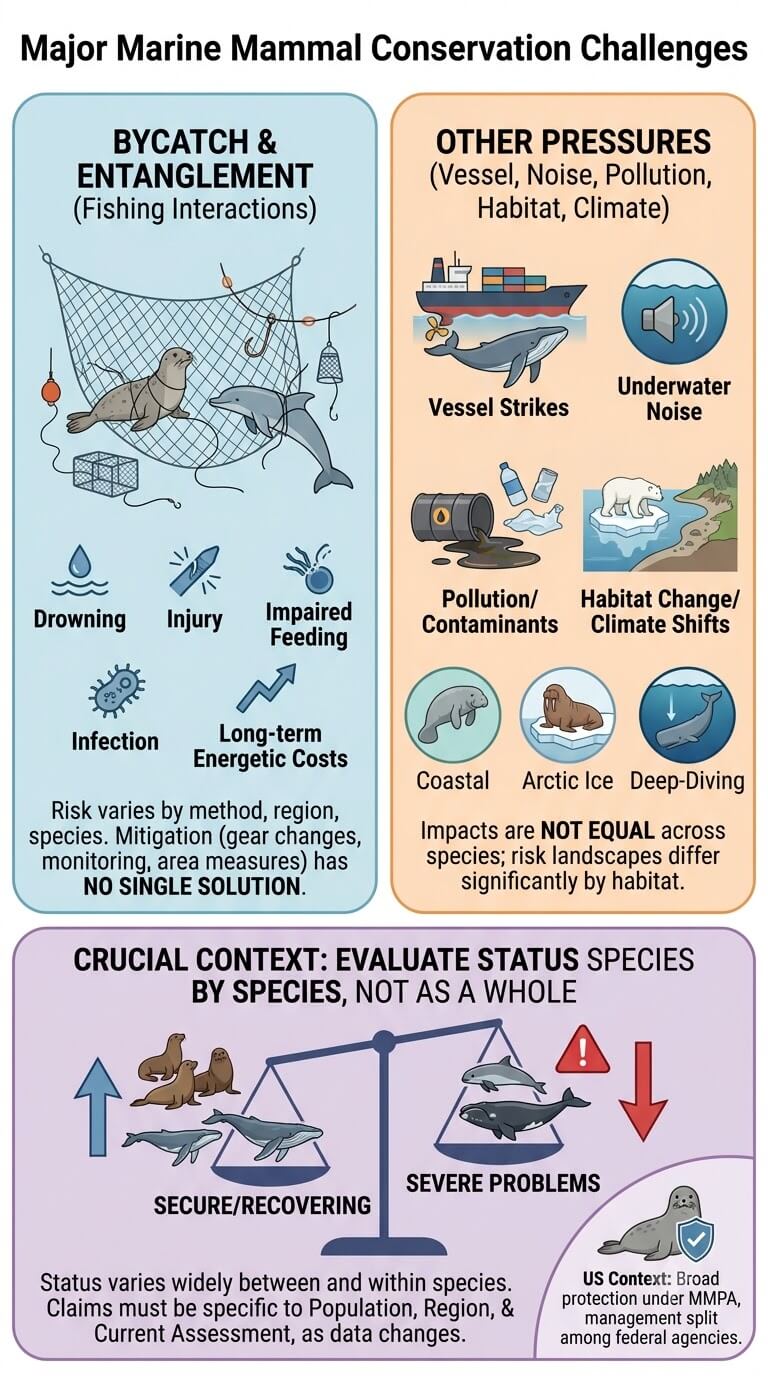
Fishing activity can affect marine mammals when animals become caught or entangled in nets, lines, traps, or other gear. The consequences can include drowning, injury, impaired feeding, infection, or long-term energetic costs. Risk varies greatly with fishing method, region, species, and behavior.
Reducing these interactions can involve gear changes, monitoring, seasonal measures, area management, and other strategies, but there is no single solution that fits every fishery or marine mammal population.
Vessel Strikes, Noise, Pollution, Habitat Change, and Climate Pressures
Marine mammals can also face vessel collisions, underwater noise, contaminants, oil spills, habitat degradation, prey changes, and climate-driven shifts in temperature or sea ice. These pressures do not affect all species equally. A coastal manatee, an Arctic ice seal, and a deep-diving whale experience very different risk landscapes.
In the United States, marine mammals receive broad federal protection under the Marine Mammal Protection Act, although management responsibility is split among federal agencies and additional protections may apply to particular species or populations. NOAA Fisheries’ Marine Mammal Protection Act summary explains the main federal roles and protections.
Why Conservation Status Must Be Evaluated Species by Species
It is incorrect to call marine mammals as a whole endangered. Some species or populations face severe conservation problems, while others are comparatively abundant or recovering. Status can also differ within a species when separate populations experience different threats.
Population estimates, legal listings, and threat assessments can change as new surveys and analyses become available. Current conservation claims should therefore be tied to the species, population, region, and assessment being discussed rather than copied from a broad group label. These biological differences also mean marine mammal conservation must be evaluated by species and population rather than through one universal threat or status.
Common Myths and Misunderstandings
Marine Mammals Are Not Fish
A whale’s streamlined body can resemble a fish because both must move efficiently through water, but the resemblance is functional rather than evidence of close relationship. Marine mammals breathe air, nurse young with milk, and belong to Mammalia. Fish use a very different evolutionary and physiological framework.
Not All Marine Mammals Live Entirely at Sea
Seals and sea lions regularly use land or ice. Some cetaceans live in freshwater rivers. Manatees may move through freshwater, estuarine, and coastal habitats. The important point is ecological dependence on aquatic or marine systems, not a rule that every individual must remain in salt water every moment of its life.
Dolphins Are Cetaceans, but Common Names Can Be Messy
Dolphins and porpoises are cetaceans, and several animals with “whale” in their common name belong to the dolphin family. Common names developed through history and culture, so they do not always line up cleanly with scientific classification. Taxonomy is the better guide when a name creates confusion.
Why Marine Mammal Groups Differ So Much
Classification Explains Body Plans
Understanding whether an animal is a cetacean, pinniped, sirenian, or mustelid helps explain what to expect from its anatomy and lifestyle. Cetaceans are fully aquatic. Pinnipeds maintain an amphibious life. Sirenians are aquatic herbivores. Sea otters retain a fur-dependent coastal strategy.
Physiology Explains the Limits of Aquatic Life
Breath-hold diving and heat conservation are not separate curiosities. They determine where an animal can feed, how long it can remain submerged, how much energy it spends, and which habitats are usable. Those pressures also interact with reproduction, sleep, migration, and prey availability.
Behavior and Conservation Depend on Species Context
Communication systems, social patterns, migration routes, and human threats are all species-specific. A useful rule for marine mammal biology is to be cautious whenever one striking fact is presented as universal. The group is too diverse for one whale, seal, or dolphin example to represent every member.
FAQ
Are all whales, dolphins, and seals marine mammals?
Whales, dolphins, and porpoises are cetaceans and are generally treated as marine mammals, including species that live in freshwater. Seals and sea lions are pinnipeds and are also marine mammals. Their dependence on water differs, however. Cetaceans are fully aquatic, while pinnipeds regularly use land or ice.
Is a marine mammal a scientific taxonomic group?
No. Marine mammal is an ecological grouping rather than a single formal taxonomic rank. Cetaceans, pinnipeds, sirenians, and sea otters come from different branches of Mammalia. Their similarities reflect both shared mammalian ancestry and separate adaptations to aquatic environments.
Do all marine mammals have blubber?
No. Blubber is a major insulation strategy in many cetaceans and pinnipeds, but it is not universal. Sea otters are the clearest counterexample because they depend primarily on dense fur that traps air and limits heat loss. Different marine mammal groups balance insulation, body size, metabolism, and circulation in different ways.
Final Thoughts
Marine mammals are best understood as a diverse set of mammal lineages that adapted to aquatic life through different evolutionary routes. Whales and dolphins became completely aquatic, pinnipeds retained a life divided between sea and solid ground, sirenians specialized as aquatic herbivores, and sea otters built a marine lifestyle around dense fur and coastal foraging. Their shared challenges include breathing air, conserving heat, moving efficiently through water, finding food, raising young, and responding to changing habitats. Looking at those challenges species by species gives a far more accurate picture than treating every marine mammal as a variation of the same animal.

Ethan Walker is the founder and research editor of Animal Fact Central. He creates and reviews educational animal facts content using trusted wildlife, pet care, and science-based sources. His work focuses on making animal behavior, adaptations, habitats, and species facts clear, accurate, and engaging for everyday readers.
Read More Details About Ethan Walker: https://animalfactcentral.com/ethan-walker/