
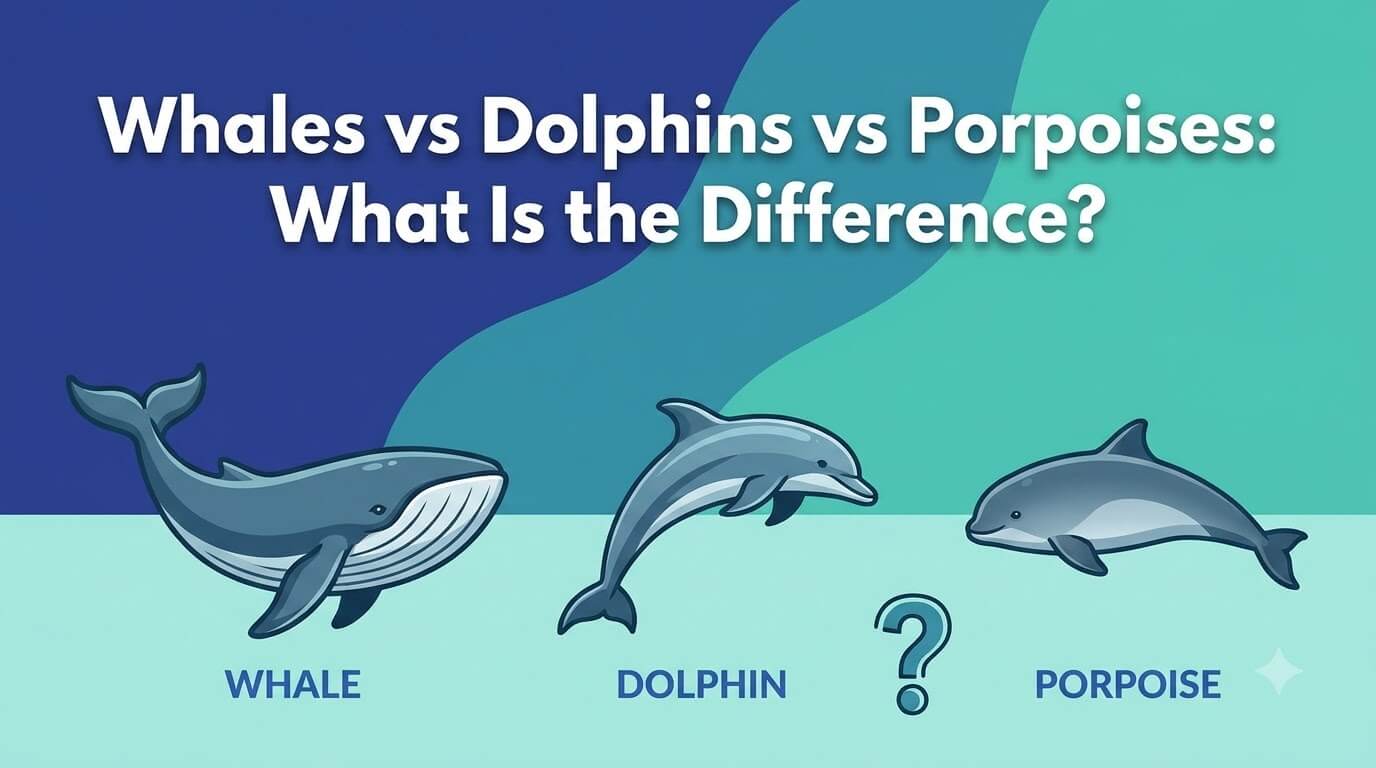
Whales, dolphins, and porpoises are all cetaceans, but those everyday names do not divide the group into three simple, equal taxonomic categories. Dolphins and porpoises are both toothed cetaceans, while animals commonly called whales include both baleen whales and several toothed cetaceans. That is why an orca can be called a killer whale and still belong to the dolphin family.
For a quick visual comparison, dolphins usually have longer, more defined beaks, cone-shaped teeth, and more curved dorsal fins, while porpoises tend to have shorter faces, spade-shaped teeth, and more triangular dorsal fins. Those clues are useful, but they are general patterns rather than rules that identify every animal at a glance. The word whale is even less precise as an identification label because it spans very different branches of the cetacean family tree.
Quick Difference
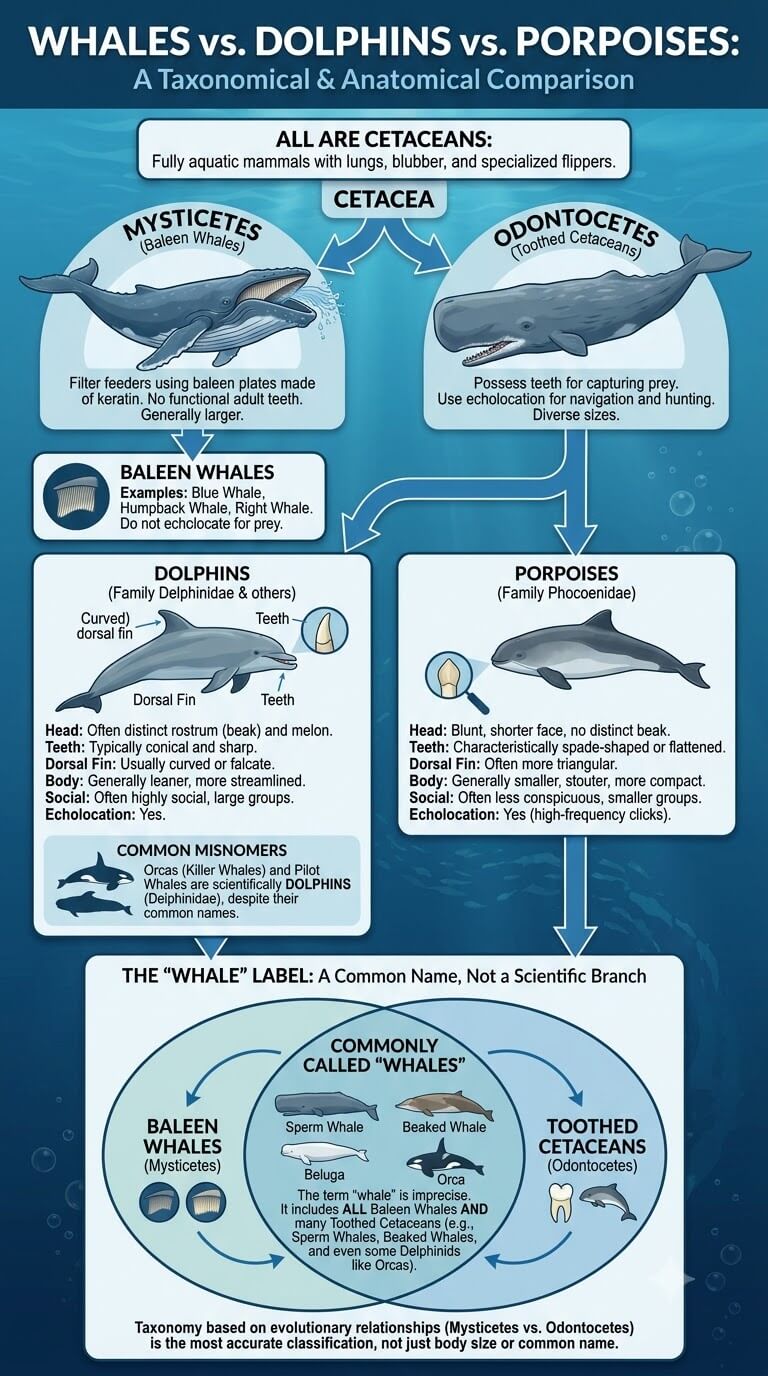
The simplest way to think about whales vs dolphins vs porpoises is to start with two levels of classification. First, cetaceans are divided into baleen whales, called mysticetes, and toothed cetaceans, called odontocetes. Dolphins and porpoises are odontocetes. Second, dolphins and porpoises belong to different families within that toothed branch.
NOAA’s cetacean overview describes the two major living branches as baleen and toothed cetaceans. Baleen whales filter prey with baleen plates, while toothed cetaceans have teeth. That framework immediately explains why “whale versus dolphin” is not a clean scientific split: many animals called whales are odontocetes, the same broad branch that contains dolphins and porpoises.
- Baleen whales: mysticetes that use baleen instead of teeth to filter prey from water.
- Dolphins: toothed cetaceans in dolphin families, with the best-known oceanic dolphins belonging to Delphinidae.
- Porpoises: toothed cetaceans in the family Phocoenidae.
- Animals called toothed whales: a broad set that includes sperm whales, beaked whales, belugas, narwhals, dolphins, porpoises, and others.
The Most Important Taxonomy Point First
All Three Are Cetaceans
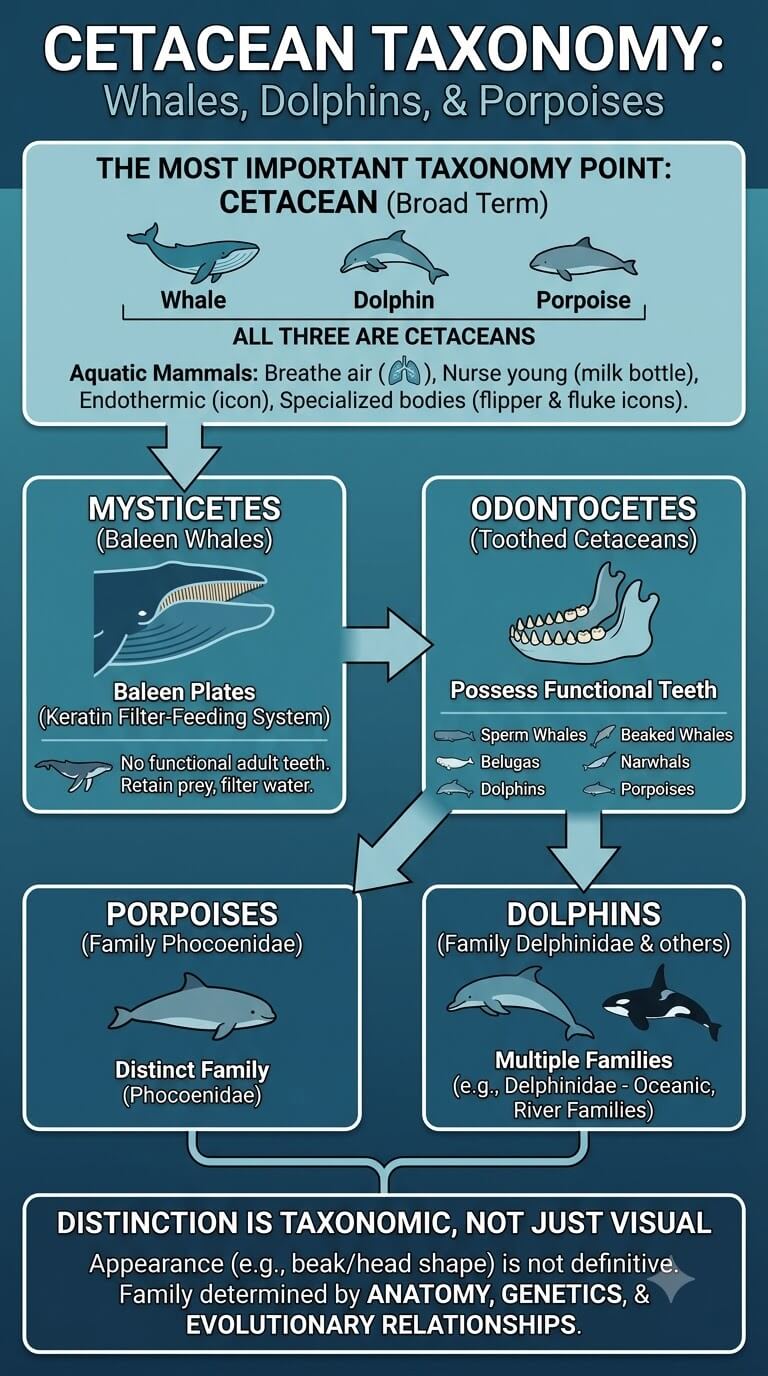
Cetacean is the broad biological term that includes whales, dolphins, and porpoises. Cetaceans are mammals that breathe air with lungs, nurse their young, regulate their body temperature internally, and are highly specialized for aquatic life. Their streamlined bodies, forelimbs modified into flippers, and horizontal tail flukes reflect that fully aquatic lifestyle.
Calling an animal a cetacean is usually more precise than relying on the words whale, dolphin, or porpoise alone. Common names were created through history, language, fishing and whaling traditions, and local usage. Scientific classification, by contrast, tries to describe evolutionary relationships.
Baleen Whales and Toothed Cetaceans
Living cetaceans fall into two major branches. Mysticetes are the baleen whales. Instead of functional adult teeth, they have flexible plates of baleen made largely of keratin, the same structural protein found in human hair and nails. They take in prey-rich water and use the baleen to retain prey while water leaves the mouth.
Odontocetes are the toothed cetaceans. This branch includes sperm whales, beaked whales, belugas, narwhals, dolphins, and porpoises. Their feeding methods vary widely, so “toothed” does not mean they all hunt the same way. The classification point is simply that they possess teeth rather than the baleen filter-feeding system of mysticetes. Cetaceans are one major branch within the much broader diversity of marine mammals, which also includes pinnipeds, sirenians, and sea otters.
Dolphins and Porpoises Are Different Families Within Toothed Cetaceans
Dolphins and porpoises are not interchangeable names for the same animals. Porpoises belong to Phocoenidae. Many familiar marine dolphins, including bottlenose dolphins and orcas, belong to Delphinidae, often called the oceanic dolphin family. Other dolphin families also exist, especially among river dolphins, so “dolphin” itself covers more than one family.
This is why the most dependable distinction is taxonomic, not just visual. A rounded head does not automatically make an animal a porpoise, and a prominent beak does not by itself prove that an animal is a dolphin. External appearance can guide identification, but family membership is determined through anatomy, genetics, and evolutionary relationships.
Comparison Table: Whales, Dolphins, and Porpoises
| Feature | Animals commonly called whales | Dolphins | Porpoises |
|---|---|---|---|
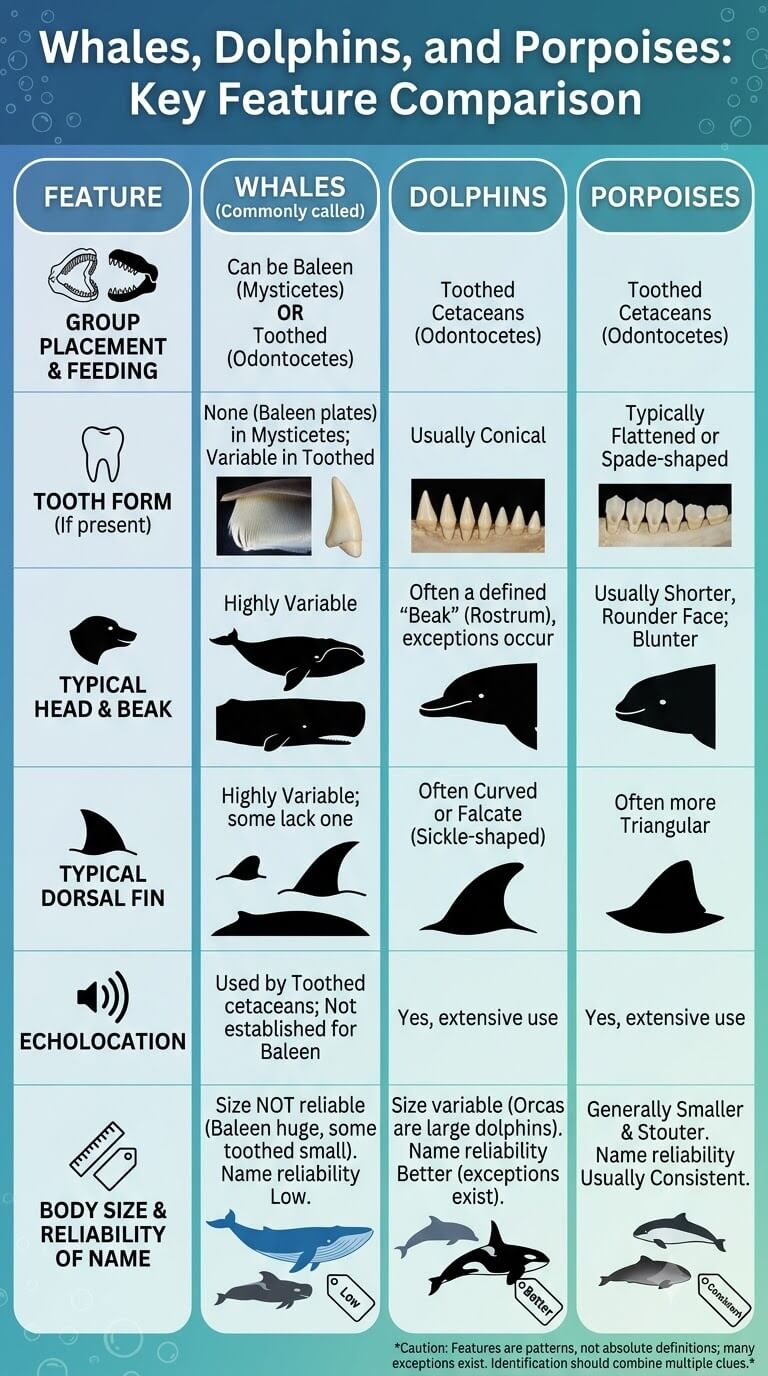
| Broad placement | Can be baleen or toothed cetaceans | Toothed cetaceans | Toothed cetaceans |
| Feeding structure | Baleen in mysticetes; teeth in toothed forms | Teeth | Teeth |
| Typical head pattern | Highly variable | Often a more defined beak, but exceptions occur | Usually shorter, rounder face |
| Typical tooth form | None in baleen whales; variable in toothed whales | Usually conical | Typically flattened or spade-shaped |
| Typical dorsal fin pattern | Highly variable; some species lack one | Often curved or falcate | Often more triangular |
| Echolocation | Used by toothed cetaceans, not established as the feeding/navigation system of baleen whales | Yes, as toothed cetaceans | Yes, as toothed cetaceans |
| Common-name reliability | Low for taxonomy | Better, but some dolphins are called whales | Usually more taxonomically consistent |
Typical Body Size and Shape
Size is one of the least reliable ways to separate these names. Many famous baleen whales are enormous, so people often assume that “whale” means large and “dolphin” means small. That fails quickly. Orcas are dolphins even though they are much larger than many cetaceans with whale in their common name. Some dolphins are compact, while others are robust and large-bodied.
Porpoises are generally smaller and more compact than many familiar oceanic dolphins. NOAA’s current dolphin and porpoise identification guide describes dolphins as typically longer and leaner, and porpoises as smaller and stouter. The word “typically” matters because real species do not all conform to a single silhouette.
Teeth Versus Baleen
The first feeding distinction is between mysticetes and odontocetes, not between whales and dolphins. A humpback or blue whale has baleen. A sperm whale has teeth. A dolphin has teeth. A porpoise has teeth. That makes “whales have baleen, dolphins have teeth” incorrect.
Within toothed cetaceans, tooth shape can help separate dolphins and porpoises. Dolphins generally have conical teeth, while porpoises characteristically have more flattened, spade-shaped teeth. Tooth shape is highly useful in anatomy and taxonomy, although it is not a practical field mark for someone observing a healthy wild animal from a respectful distance.
Head, Beak, and Dorsal-Fin Patterns
Dolphins often have a distinct rostrum, the projecting part of the skull commonly called a beak. Porpoises tend to have shorter, blunter faces without the same pronounced beak. Dolphins also often have curved, sickle-shaped dorsal fins, while many porpoises have more triangular fins.
These are pattern-based clues, not definitions. Some dolphins have very short or poorly defined beaks. Dorsal fins also vary among dolphin species, and some cetaceans have no dorsal fin at all. A confident identification should combine body shape, head form, dorsal fin, coloration, location, group behavior, and species range rather than depend on one feature.
Social and Acoustic Traits
Dolphins are often described as more social and more visibly active around boats than porpoises, but behavior should not be treated as a diagnostic rule. Group size, curiosity, surfacing style, and vocal behavior vary with species, population, age, activity, and environmental conditions. Harbor porpoises, for example, are often comparatively inconspicuous at the surface, but other cetaceans can also be difficult to spot.
Both dolphins and porpoises use sound extensively. Their acoustic systems are especially important because water can carry sound over useful distances even where visibility is poor. The details of calls and echolocation signals vary markedly among species.
What Makes a Whale a Whale?
Why Whale Is Not One Simple Taxonomic Category
The word whale is a common-name category, not a single taxonomic family. It is applied to all baleen whales and to many toothed cetaceans. Some animals called whales are closer relatives of dolphins than they are of baleen whales. That is not a contradiction. It reflects the difference between everyday naming and biological classification. Whatever their common name, cetaceans remain air-breathing mammals, and their diving physiology determines how they manage oxygen between trips to the surface.
The sperm whale, for example, is an odontocete rather than a baleen whale. Belugas and narwhals are also toothed cetaceans. Orcas and pilot whales carry whale in their names while belonging to Delphinidae. For readers, the useful question is not “Is it called a whale?” but “Where does it sit within Cetacea?”
Baleen Whales Versus Toothed Whales
Baleen whales include groups such as rorquals, right whales, and gray whales. Their feeding anatomy centers on baleen and large-volume capture or filtering of relatively small prey, although the exact feeding technique differs among species.
Toothed whales use teeth and include a much wider variety of body sizes, prey types, and hunting strategies. They also include the cetaceans known to use echolocation. This division is biologically meaningful in a way that a simple “whale versus dolphin” split is not.
What Makes a Dolphin a Dolphin?
Delphinid Diversity
Delphinidae contains many of the marine animals people immediately recognize as dolphins, but the family is more varied than the classic long-beaked bottlenose shape suggests. Some delphinids have obvious beaks; others have blunt or rounded heads. Body size, color pattern, dorsal-fin shape, diet, habitat, and social organization also vary considerably.
That diversity is why the dolphin label should not be reduced to a checklist such as “small, playful, long nose.” Those traits fit some familiar species, but they do not define the whole family. A scientifically useful definition starts with ancestry and family membership.
Why Some Animals Called Whales Are Actually Dolphins Taxonomically
The orca is the clearest example. NOAA Fisheries identifies the killer whale as the largest member of Delphinidae. Pilot whales, false killer whales, pygmy killer whales, and melon-headed whales are other delphinids whose common names contain whale.
These names are historically established and are not “wrong” in ordinary usage. The mistake happens only when a common name is assumed to define evolutionary relationship. Calling an orca a whale is normal English. Saying it is not a dolphin because its name says whale would be taxonomically misleading.
What Makes a Porpoise a Porpoise?
Family-Level Distinction
Porpoises belong to Phocoenidae, a distinct family of odontocetes. That family-level identity separates them from dolphins regardless of whether an individual happens to look dolphin-like from a distance. Harbor porpoises, Dall’s porpoises, and other porpoise species share a closer evolutionary relationship with one another than with delphinids.
A NOAA harbor porpoise profile places the species in Phocoenidae and describes the compact body, short blunt beak, and triangular dorsal fin that make it a useful reference for the general porpoise body plan. Other porpoises differ in details, so one species should not stand in for every member of the family.
Body Shape, Teeth, and Head Form
The classic porpoise combination is a compact body, a short rounded face, a triangular dorsal fin, and spade-shaped teeth. This combination is more informative than any single feature. A distant dorsal fin can be distorted by viewing angle, waves, or partial surfacing, while head shape may not be visible at all.
Porpoises also tend not to display the long rostrum associated with many dolphins. Even so, “no beak equals porpoise” is unsafe as a universal rule because several dolphin species also have blunt heads. Identification is strongest when anatomy, geography, and the overall animal are considered together.
Teeth, Baleen, and Feeding Context
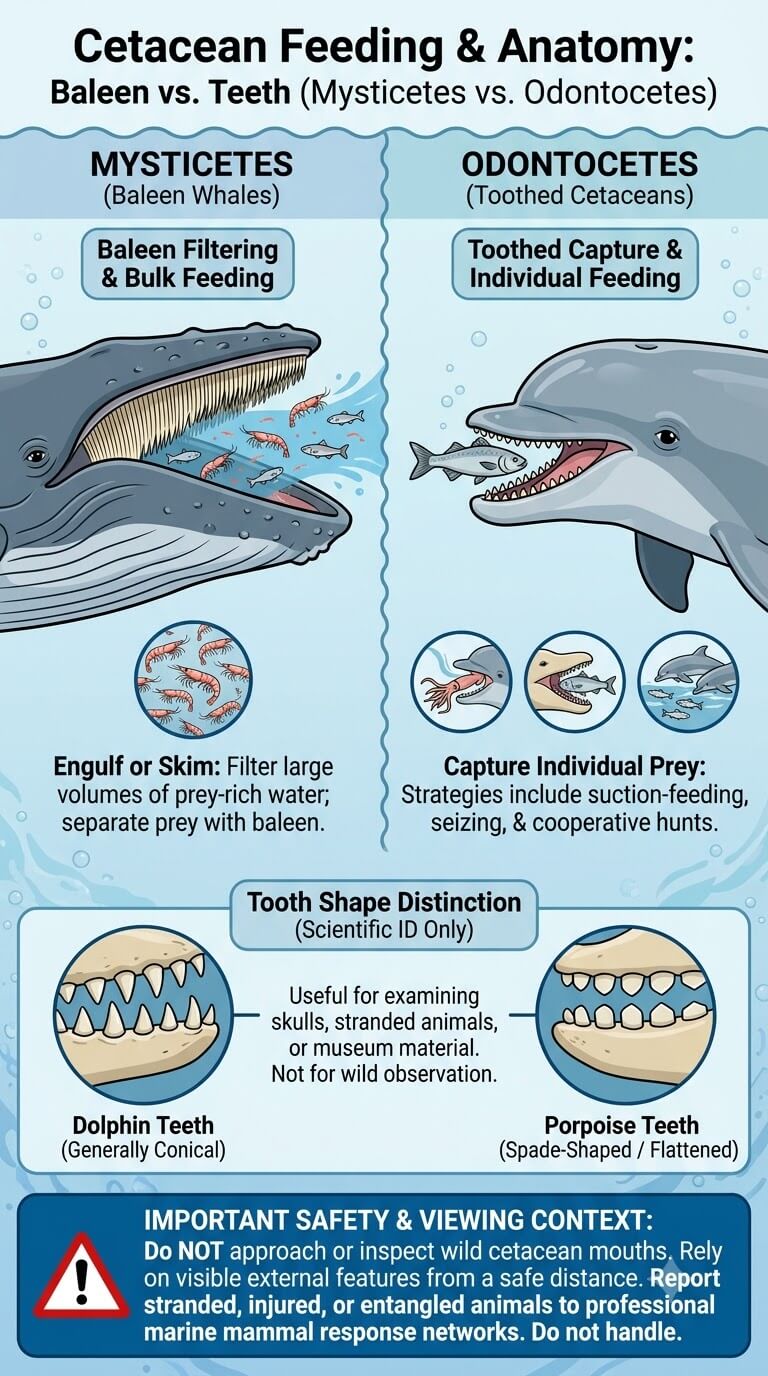
Baleen Filtering Versus Toothed-Cetacean Feeding
Baleen and teeth represent two very different feeding toolkits. Baleen whales can engulf or skim prey-rich water and separate prey from water with baleen. Toothed cetaceans capture individual prey, although they may suction-feed, seize prey with their jaws, cooperate during hunts, or use other species-specific strategies.
These structures also help explain why cetacean classification matters biologically. Baleen is tied to the mysticete branch, while teeth characterize odontocetes. Feeding behavior is more varied than the structures alone, but the anatomy reflects a deep evolutionary split.
Why Tooth Shape Can Help Distinguish Dolphins and Porpoises
Dolphin teeth are generally conical, while porpoise teeth are characteristically flattened in a way often described as spade-shaped. This difference is useful to scientists examining skulls, stranded animals, museum material, or clinical cases.
It is not a reason to approach or attempt to inspect a wild cetacean’s mouth. For normal wildlife viewing, visible external features and local species knowledge are safer and more useful. A stranded, injured, or entangled cetacean should be reported to the appropriate marine mammal response network rather than handled by an untrained observer.
Echolocation and Communication
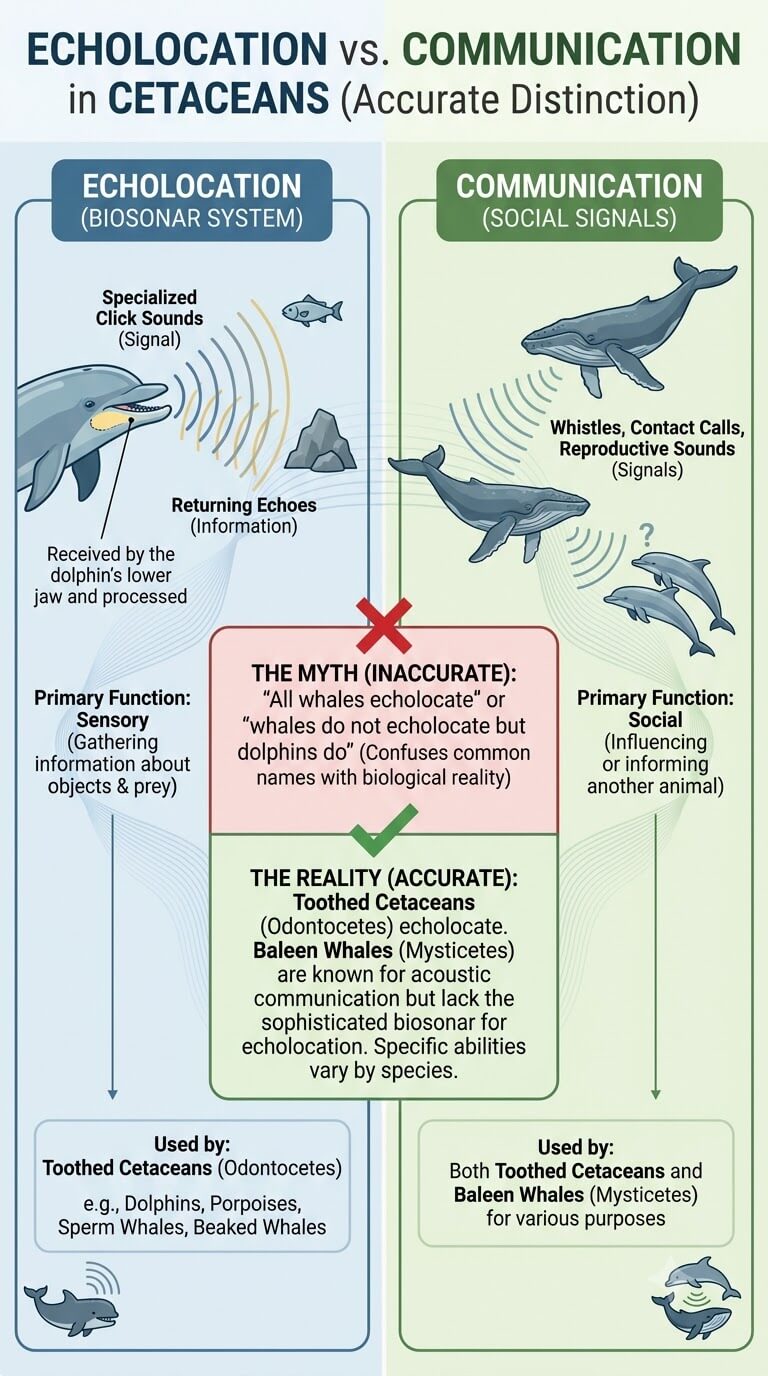
Echolocation in Toothed Cetaceans
Odontocetes use specialized click sounds for echolocation, a biological sonar system in which returning echoes provide information about objects and prey. Dolphins and porpoises are therefore echolocating cetaceans. Other odontocetes, including sperm whales and beaked whales, also use echolocation.
NOAA’s marine mammal acoustics research distinguishes the sound patterns of mysticetes and odontocetes and notes echolocation clicks among toothed cetaceans. This is another reason “whales do not echolocate but dolphins do” is inaccurate. Some animals commonly called whales are odontocetes and do echolocate.
Communication Is Not the Same Thing as Echolocation
Echolocation and communication both use sound, but they serve different functions. Echolocation is primarily a sensory process used to gather information from echoes. Communication involves signals that can influence or inform another animal, such as contact calls, whistles, or reproductive sounds.
The same species can use different sounds for different purposes. A dolphin’s echolocation clicks should not automatically be interpreted as “talking,” and a social whistle should not be described as sonar simply because both are acoustic. Keeping those functions separate prevents exaggerated claims about cetacean language.
Avoiding the Myth That All Whales Echolocate
Baleen whales produce and respond to sound, but the sophisticated biosonar system documented in odontocetes is not the standard sensory system used to define mysticetes. Saying “all whales echolocate” therefore mixes common names with biological branches.
A better statement is that toothed cetaceans use echolocation, while baleen whales are well known for acoustic communication and other sound-based behavior. Specific sensory abilities should still be described at the species level when precision matters.
Social Behavior and Lifestyle
Why Broad Behavioral Rules Have Exceptions
Popular comparisons often say dolphins are social and porpoises are shy. That can be a useful first impression for some familiar species, but it is too simple as biology. Cetacean social systems range from small, fluid associations to stable family groups and large temporary aggregations. The pattern depends on species, ecology, prey, sex, age, and population.
Surface behavior can also mislead observers. An animal that does not leap or bow-ride is not necessarily a porpoise, and a cetacean traveling in a group is not necessarily a dolphin. Behavior should support an identification, not replace anatomy and range.
Group Size and Sociality Vary by Species
Some dolphins frequently form conspicuous groups, but delphinids differ widely in grouping patterns. Harbor porpoises are often observed alone or in small groups, yet larger aggregations can occur when local conditions concentrate animals. Even within one species, group size can change with feeding, travel, reproduction, and predator risk.
Social behavior is therefore one of the most interesting differences to study after an animal has been identified, but one of the weaker tools for making the initial identification by itself.
How to Tell a Dolphin From a Porpoise
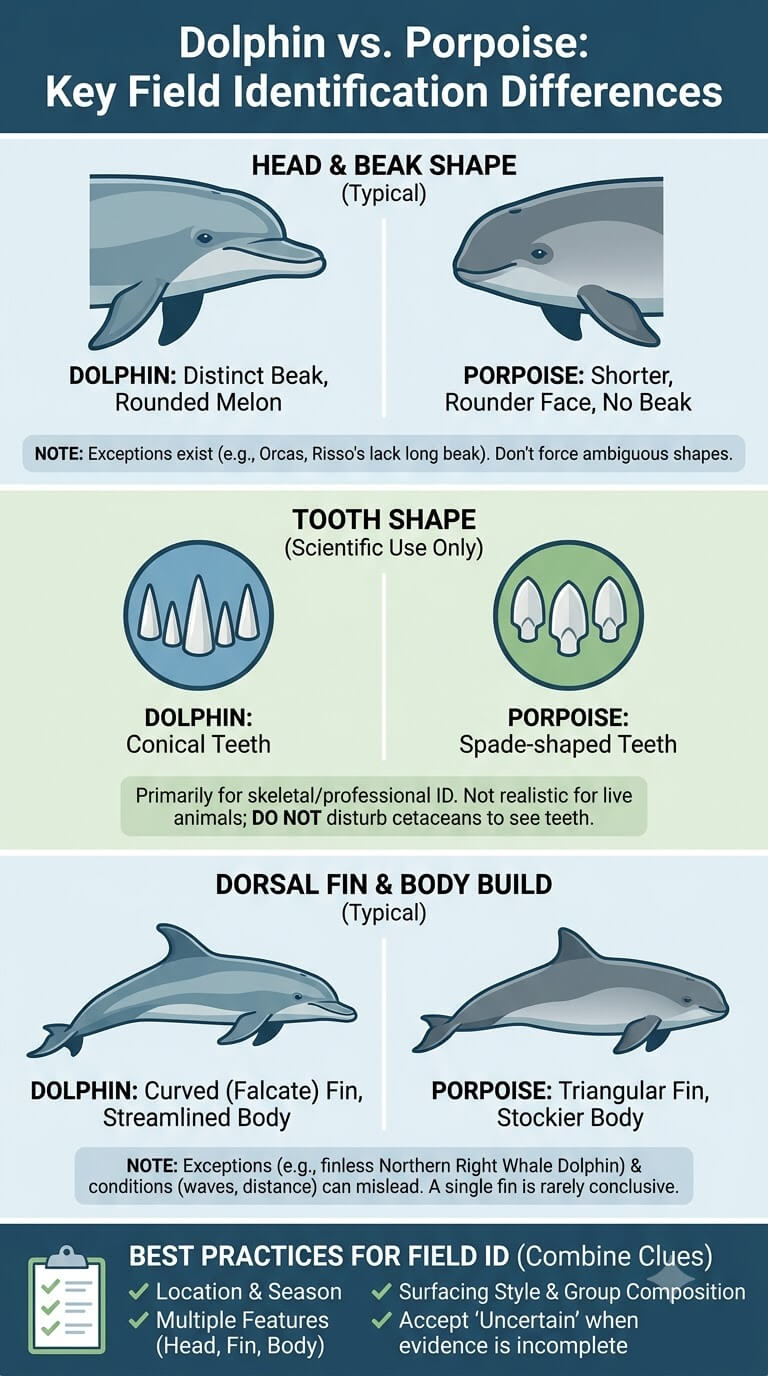
Head and Beak Shape
When the head is visible, look first for the rostrum. Many dolphins show a distinct beak projecting in front of the rounded forehead, or melon. Porpoises generally have shorter, rounder faces without that pronounced projection.
Do not force the rule when the head shape is ambiguous. Risso’s dolphins, orcas, pilot whales, and several other delphinids do not fit the stereotypical long-beaked dolphin profile. In those cases, coloration, dorsal-fin form, overall size, geographic range, and expert field guides become more important.
Tooth Shape When Examined Scientifically
Conical dolphin teeth and spade-shaped porpoise teeth are among the clearest anatomical differences between the groups. They are especially valuable in skeletal identification and professional examination.
For a living wild animal, tooth shape is usually not a realistic identification feature. Cetaceans should be observed without trying to induce an open mouth, lure them closer, or change their behavior.
Dorsal Fin and Body Build
Many dolphins have a curved or falcate dorsal fin and a relatively streamlined body. Many porpoises have a more triangular dorsal fin and a stockier body. Used together, those features can be helpful when an animal surfaces clearly.
Exceptions matter. The northern right whale dolphin lacks a dorsal fin, and dolphin species vary in fin shape. Waves, distance, and the fraction of the body visible above water can also create false impressions. A single fin should rarely be treated as conclusive.
Why Field Identification Can Still Be Difficult
Wild cetaceans often surface for only seconds, and observers may see only a back, fin, blow, or brief head profile. Juveniles can have different proportions from adults. Light, sea state, and distance change how colors and shapes appear. Several species may also occur in the same region.
The best identification process combines several clues: location, season, approximate scale, head profile, dorsal-fin shape, body pattern, surfacing style, and group composition. Good wildlife identification includes being comfortable with “uncertain” when the evidence is incomplete.
Common Naming Confusions
Killer Whales as Dolphins
An orca is both a killer whale in common English and a dolphin in taxonomic terms. Its scientific placement in Delphinidae is more informative about relationship than the word whale in its common name.
This is not a technical trick. It is a normal result of common names and scientific names serving different purposes. Common names help people communicate. Taxonomy organizes biological relationships.
Pilot Whales as Dolphins
Pilot whales are another useful example. They belong to Delphinidae, so they are part of the oceanic dolphin family even though their common name says whale. False killer whales and pygmy killer whales show the same naming pattern.
Once this pattern is understood, cetacean names become less confusing. The label on the animal is a clue to history and usage, not a guaranteed statement of family membership.
Why Common Names Persist
Common names often predate modern genetic and evolutionary classification. They may refer to body size, shape, local tradition, behavior, resemblance, or historical hunting categories. Scientists generally do not replace every familiar name each time evolutionary relationships are refined.
That is why both vocabularies are useful. “Killer whale” remains a recognizable common name, while “member of Delphinidae” answers the scientific relationship question.
Common Myths and Mistakes
Dolphins Are Not Separate From Cetaceans
Dolphins are cetaceans. Treating cetacean as a synonym for “whale but not dolphin” creates an unnecessary category error. The term Cetacea includes whales, dolphins, and porpoises.
Not Every Large Cetacean Is a Baleen Whale
Large size does not define mysticetes. Sperm whales and orcas are odontocetes. Conversely, some animals commonly called whales are much smaller than the biggest delphinids. Feeding anatomy and evolutionary relationship, not body size, separate the major branches.
Size Alone Cannot Define the Groups
“Whales are big, dolphins are medium, porpoises are small” may work as a rough childhood shortcut, but it breaks down in real cetacean diversity. Size ranges overlap, and common names are inconsistent. Better clues include taxonomic family, feeding anatomy, teeth, head form, and a combination of external features.
Why Classification Matters for Feeding and Sound
The Cetacean Family Tree Explains More Than Names
Knowing whether a cetacean is a mysticete or odontocete immediately tells you something important about its feeding structures and sensory biology. Knowing whether an odontocete belongs to a dolphin or porpoise family adds another layer of anatomical and evolutionary context.
This is why classification is more useful than memorizing a list of superficial differences. It connects visible traits to ancestry and helps explain why two animals can look somewhat alike while differing in tooth form, acoustic behavior, and evolutionary history.
Sound Use Reflects Both Shared Ancestry and Species Differences
Dolphins and porpoises share the odontocete echolocation system, but they do not all produce identical signals or live the same social lives. Likewise, baleen whales share a broad mysticete heritage while producing very different calls and songs across species.
The next level of understanding therefore comes from moving from broad group labels to species-specific biology. Classification gives the map, but individual species provide the detail.
FAQ
Is an orca a whale or a dolphin?
Both descriptions can be used, but they answer different questions. “Killer whale” is the established common name. Taxonomically, the orca belongs to Delphinidae, the oceanic dolphin family, so it is a dolphin in terms of evolutionary classification. It is also an odontocete, or toothed cetacean.
Can porpoises echolocate?
Yes. Porpoises are odontocetes, and echolocation is a defining sensory ability of toothed cetaceans. They produce specialized high-frequency clicks and use returning echoes to gather information about their surroundings and prey. The exact acoustic characteristics differ among species, so frequency values should not be generalized from one porpoise to all others.
Are dolphins smaller than every whale?
No. The word whale is not a size class, and common names do not line up neatly with body size. Orcas are large dolphins, while some cetaceans called whales are smaller than the largest delphinids. Size can help narrow an identification, but it cannot define whether a cetacean is a whale, dolphin, or porpoise.
Final Thoughts
The clearest answer to whales vs dolphins vs porpoises is that all three belong to Cetacea, but the names operate at different levels of precision. Baleen whales form one major cetacean branch. Dolphins and porpoises are both toothed cetaceans, yet they belong to different families and usually differ in head shape, teeth, dorsal-fin form, and body build. Animals such as orcas and pilot whales show why common names cannot be treated as a perfect taxonomic key.
For everyday identification, use several visible clues together and accept uncertainty when an animal is distant. For biological understanding, start with the cetacean family tree. It explains why dolphins and porpoises can look similar but remain distinct, why some “whales” have teeth, and why a killer whale can also be a dolphin without any contradiction.

Ethan Walker is the founder and research editor of Animal Fact Central. He creates and reviews educational animal facts content using trusted wildlife, pet care, and science-based sources. His work focuses on making animal behavior, adaptations, habitats, and species facts clear, accurate, and engaging for everyday readers.
Read More Details About Ethan Walker: https://animalfactcentral.com/ethan-walker/