
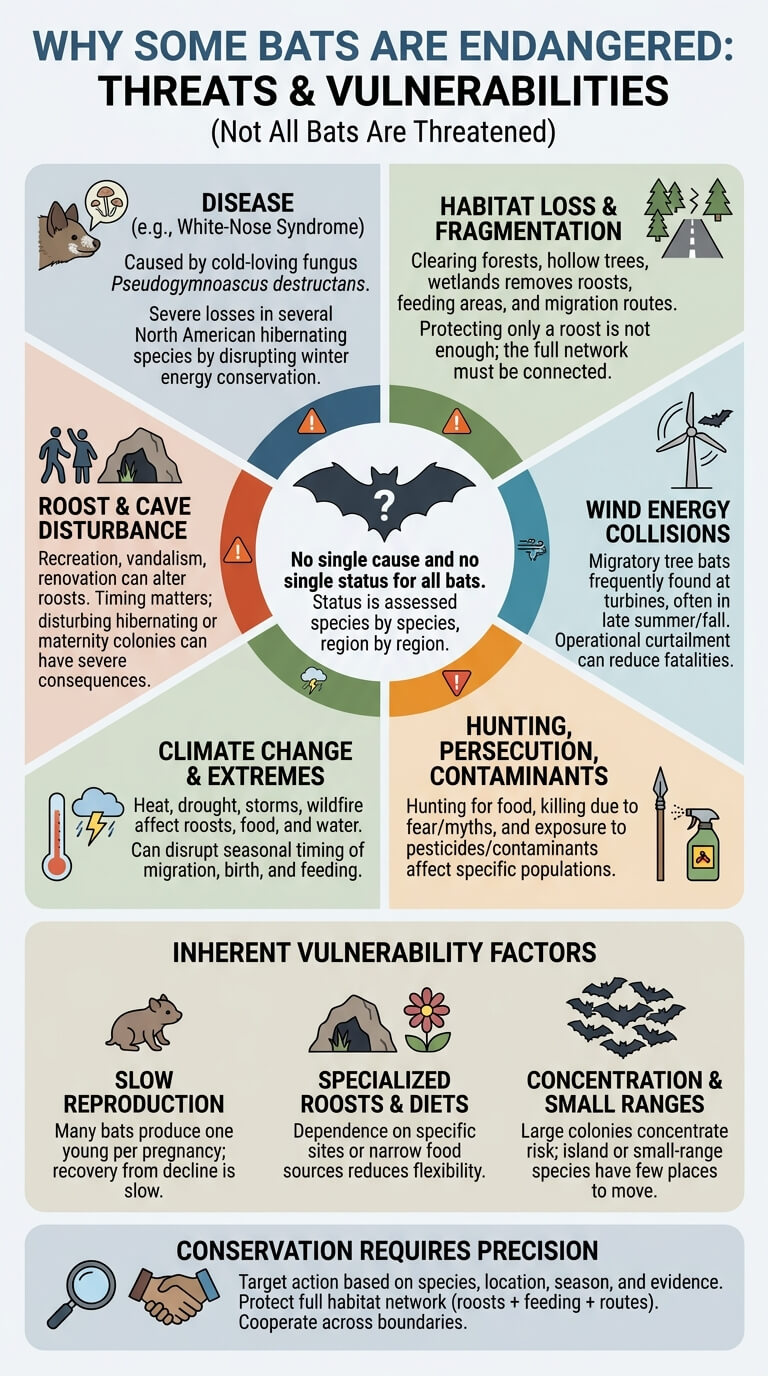
Some bats are endangered because their populations have been reduced by habitat loss, disturbance at essential roosts, disease, hunting, persecution, contaminants, climate-related extremes, and collisions with wind turbines. The combination differs sharply among species. A cave-dependent bat on a small island may face a completely different risk pattern from a widespread tree-roosting bat that migrates across a continent.
It is therefore inaccurate to say that all bats are endangered. The order Chiroptera contains about 1,500 recognized species, and their assessed conditions range from relatively secure to threatened, endangered, critically endangered, or too poorly known for a confident conclusion. Even within one species, a regional population can decline while another population remains more stable.
Understanding why bats are endangered requires three questions: Which species or population is being discussed? What evidence shows a decline or elevated extinction risk? Which pressures are acting in that place and season? Those questions lead to conservation that protects the right roosts, feeding areas, migration routes, and life stages instead of applying one solution to every bat.
Quick Answer
Some bat species are threatened, while others are not
Bat conservation status is assigned species by species. A small-range island flying fox may be threatened by storms, hunting, and forest loss. A North American hibernating bat may be declining primarily because of white-nose syndrome. A migratory tree bat may face substantial risk near wind facilities during late summer and fall. Other bats remain widespread enough that current evidence does not place them in a threatened category.
The word endangered also has more than one use. In ordinary conversation, it can mean “in danger.” In conservation science and law, it refers to a defined category under a particular system. A species listed as Endangered on the IUCN Red List is not automatically protected under the U.S. Endangered Species Act, and a federally listed U.S. species may have a different global Red List category.
Status must be checked by species, region, and date
Assessments change when new surveys, taxonomy, threats, or population estimates become available. The IUCN Red List assessments evaluate extinction risk using evidence such as population trend, geographic range, fragmentation, and the number of mature individuals. National and state agencies use their own legal or management frameworks.
A responsible status statement names the species, the assessment system, and preferably the assessment date. It should not convert concern about bats as a group into a claim that every bat population is collapsing.
How Bat Conservation Status Is Assessed
Global assessments, legal listings, and local trends answer different questions
A global assessment estimates extinction risk across a species’ entire known range. A national legal listing determines whether a species meets criteria established by that country’s law. State or provincial lists may identify regional priorities. Local monitoring can reveal whether a colony, hibernation site, or migration corridor is changing even when the species remains widespread elsewhere.
These systems should complement one another, but they are not interchangeable. A local decline may justify immediate habitat management without proving global endangerment. Conversely, a species with a small worldwide range may be globally threatened even if it remains common at one protected site.
Range, abundance, trend, fragmentation, and evidence quality matter
Conservation biologists examine how much area a species occupies, whether that area is shrinking, how populations are connected, and whether numbers are rising, stable, or falling. They also consider the speed of change, the severity of known threats, and whether the species depends on a few irreplaceable places.
Evidence quality matters because bat counts are difficult. A survey may record calls but not identify every call to species. A winter count may cover only accessible caves. A summer colony can move among trees or buildings. Genetic sampling, radio tracking, mark-recapture studies, thermal cameras, acoustic detectors, and repeated site counts each provide different pieces of the picture.
Data deficiency does not mean safety
Some bats live in remote forests, high mountains, islands, deserts, or politically difficult regions where long-term monitoring is limited. Others are hard to distinguish acoustically or visually. A Data Deficient assessment means there is not enough information to judge risk confidently. It does not mean the species is secure, and it does not automatically mean it is threatened.
Better information can change priorities. Discovering that a supposed widespread species is actually several small-range species may reveal hidden vulnerability. Improved surveys can also show that a species is more common than previously believed. Conservation decisions should be updated as evidence improves.
Why Some Bats Are Especially Vulnerable
Slow reproduction can limit recovery
Many bats produce one young per pregnancy, although litter size and reproductive timing vary. Females of some species do not reproduce every year, and juveniles may face high mortality before reaching adulthood. This life history can make recovery slow after a severe decline because a population cannot replace large losses as quickly as many small rodents or insects can.
Long lifespan does not cancel that vulnerability. A long-lived adult can contribute offspring over many years, but adult mortality becomes especially costly when few young are produced. Threats that repeatedly remove breeding adults can change population trajectories even when each event appears modest.
Specialized roosts and seasonal sites create bottlenecks
A bat may need warm maternity roosts in summer, cool and stable hibernation sites in winter, safe swarming areas in fall, and connected feeding habitat throughout the active season. Losing one part of that annual cycle can affect survival or reproduction even if other habitat remains.
The northern long-eared bat illustrates how a widespread species can still become highly imperiled when a major threat reaches much of its range. The U.S. Fish and Wildlife Service species profile identifies white-nose syndrome as the predominant threat behind its dramatic decline and federal endangered listing.
Large colonies can concentrate risk
Thousands or even millions of bats may use a major cave, mine, tree stand, or maternity site. Large colonies can be efficient for social information, mating, thermoregulation, and raising young, but concentration also means that one disturbance, storm, disease event, or habitat alteration can affect many animals at once.
Concentration is not the same for every species. Some bats roost alone beneath bark or leaves. Others shift among many small sites. Conservation planning needs to know whether a site holds a large fraction of a regional population or is one option among many.
Small ranges and specialized diets reduce flexibility
Island species, cave specialists, and bats tied to a narrow vegetation zone may have few places to move when conditions change. Nectar bats can depend on seasonal flowering routes. Fruit bats may rely on particular forest plants. Insectivorous bats can be affected when aquatic or terrestrial prey communities change.
Specialization is not automatically harmful. It becomes risky when a required food, roost, or climate condition declines faster than the bat can shift its behavior or range.
Habitat Loss and Fragmentation
Forests, hollow trees, wetlands, and feeding areas can disappear together
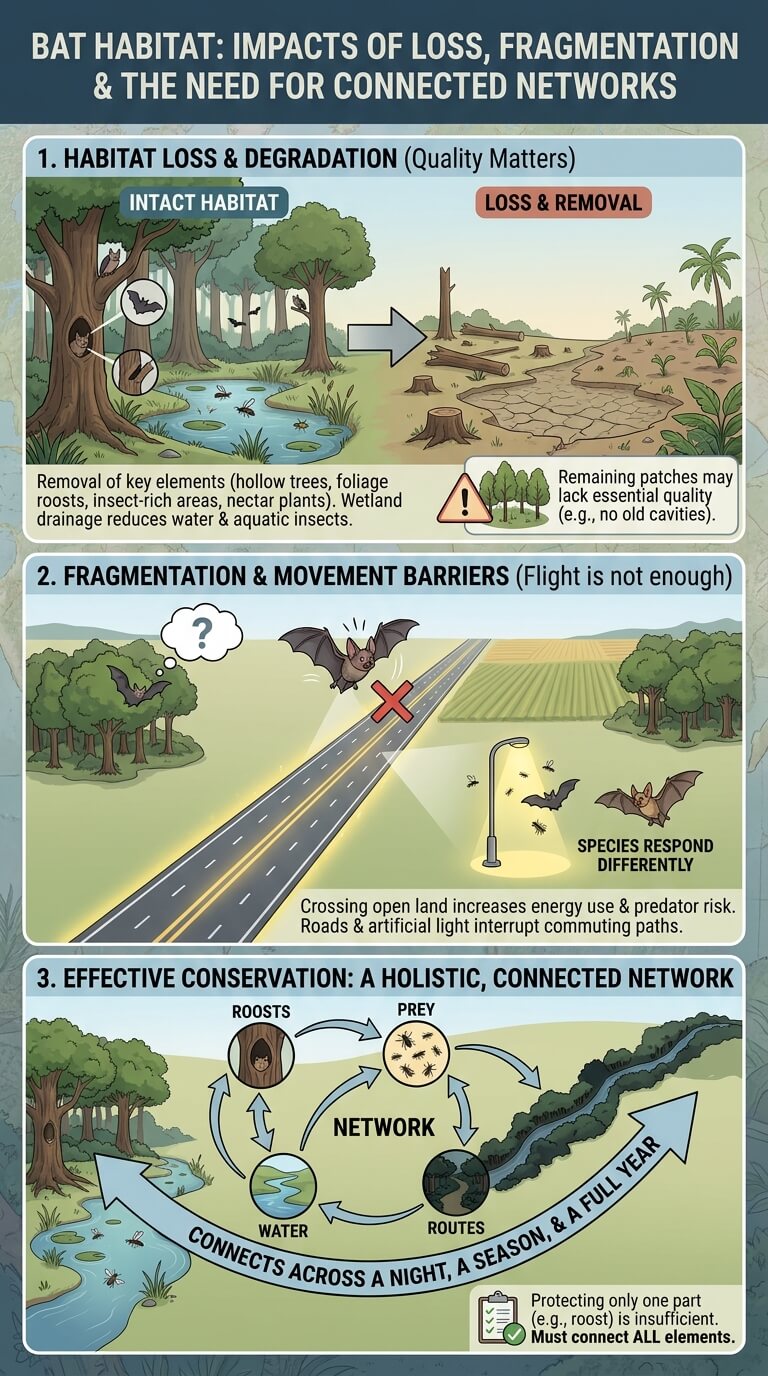
Forest removal can eliminate tree cavities, loose bark, foliage roosts, sheltered flight paths, and insect-rich feeding areas. Wetland drainage and changes to streams can reduce drinking sites and aquatic insects. In tropical regions, clearing can remove fruiting and flowering plants that support nectar and fruit bats.
Habitat quality matters as much as total area. A remaining forest patch may lack old trees with suitable cavities. A river corridor may still exist but be brightly lit or separated from roosts by wide roads. A cave may remain physically intact while surrounding feeding habitat is degraded.
Fragmentation changes movement and exposure
Bats can fly, but flight does not make fragmentation irrelevant. Crossing open land can increase energy use or exposure to predators. Roads can interrupt familiar commuting paths. Artificial lighting can repel some species from routes and feeding areas while attracting insects and a different set of bats to risky locations.
Species respond differently to edges and cities. Some use bridges, buildings, parks, and reservoirs. Others avoid open or brightly lit areas. A landscape that appears suitable to people may still be difficult for a slow-flying forest specialist to cross.
Roosts, prey, water, and routes form one habitat network
Protecting only a roost entrance is not enough if bats cannot reach food or water. Likewise, restoring feeding habitat may have limited value if maternity trees are removed before young can fly. Effective habitat conservation connects the places used across a night, a season, and a full year.
Roost and Cave Disturbance
Human activity can affect bats without destroying a cave
Recreation, tourism, vandalism, mining, quarrying, renovation, tree cutting, and repeated close approach can alter or disturb roosts. Light, noise, airflow changes, smoke, and physical contact may matter even when the structure remains standing.
Disturbance is most serious when bats have limited alternatives. A maternity colony needs conditions that help pups grow before they can fly. Hibernating bats depend on stored fat and may pay a high energetic cost when forced to arouse. Swarming sites can be important for mating and movement between summer and winter areas.
Timing determines the consequence
The same activity can have different effects in different seasons. Work near an empty roost may cause little direct harm, while sealing an occupied structure can trap adults or flightless young. Entering a winter hibernation site can wake bats when insects are unavailable. Removing a hollow tree during the maternity season can destroy a nursery site.
This is why wildlife agencies use seasonal work windows, site surveys, and species-specific permits. The correct timing depends on local bats, climate, and law rather than a single nationwide calendar.
Conservation structures must match bat needs
Cave gates can reduce vandalism and human disturbance, but a poorly designed gate may restrict flight, change airflow, or alter temperature and humidity. Artificial roosts can help in some settings, yet they do not replace every natural cavity or cave. Their temperature, size, sun exposure, predator access, and placement influence whether bats use them safely.
White-Nose Syndrome
A cold-loving fungus infects hibernating bats
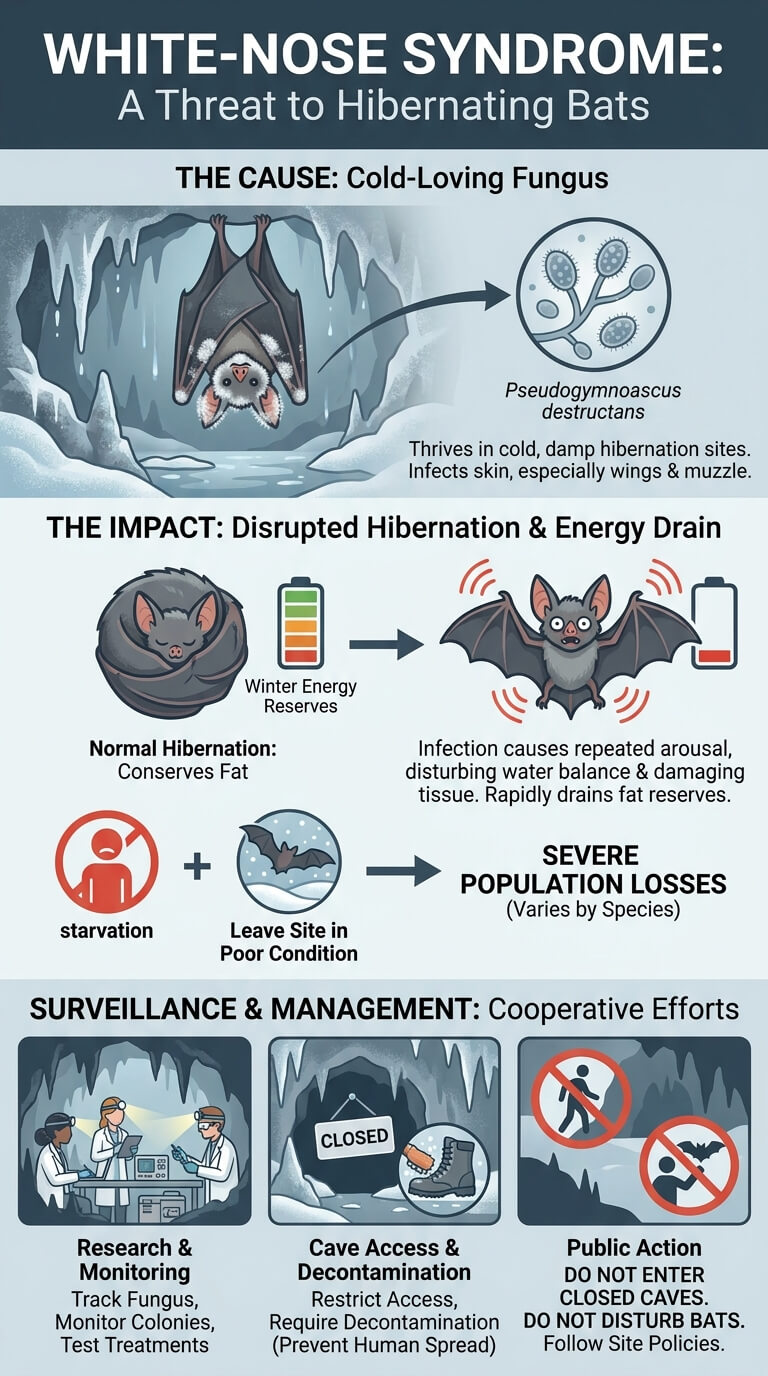
White-nose syndrome is caused by the fungus Pseudogymnoascus destructans. It grows in cold, damp hibernation environments and damages exposed skin, especially the wings and muzzle. The disease has caused severe losses in several North American hibernating species, but susceptibility and population effects differ among bats.
The official White-nose Syndrome Response Team species summary distinguishes bats with confirmed disease from species on which the fungus has been detected without confirmed disease. That distinction prevents the presence of the pathogen from being treated as proof of the same outcome in every species.
Repeated arousal can drain winter energy
Hibernating bats lower body temperature and metabolism to conserve fat while insects are scarce. Infection can disrupt normal hibernation, increase arousal, disturb water balance, and damage wing tissue. A bat that uses its reserves too quickly may starve or leave the hibernation site in poor condition.
Temperature, humidity, body condition, immune response, hibernation pattern, and species biology all affect disease outcome. Some populations have shown signs of persistence or partial recovery, but that does not mean the disease is over or that all affected species are recovering at the same rate.
Surveillance and management require cooperation
Researchers track the fungus, monitor colonies, test possible treatments, and study surviving bats. Cave managers may restrict access or require decontamination to reduce the chance that people move fungal material on clothing and equipment. Policies vary by site and should be followed exactly.
People should not enter closed caves or attempt to treat wild bats. Disease management is carried out by trained teams because disturbing hibernating colonies can add another pressure to animals already conserving limited energy.
Wind Energy and Bat Collisions
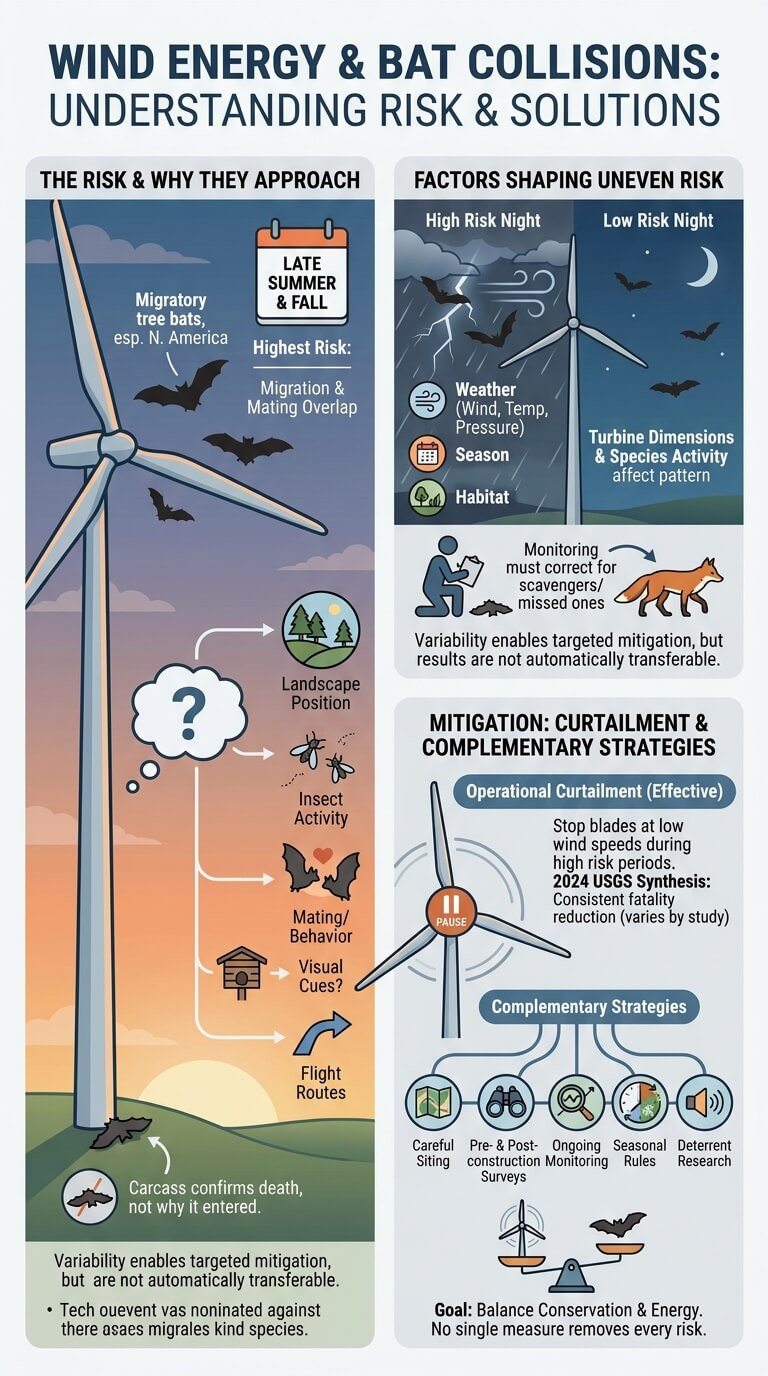
Migratory tree bats are frequently found at turbines
Bat deaths occur at wind facilities in several parts of the world. In North America, migratory tree-roosting species make up a large share of recorded fatalities. Risk often rises during late summer and fall, when migration and mating activity overlap with turbine operation.
Scientists continue to study why bats approach turbines. Possible influences include landscape position, insect activity, exploratory behavior, mating, roost-like visual cues, and flight routes. A carcass beneath a turbine confirms mortality but does not by itself reveal why the bat entered the rotor-swept area.
Weather, season, and site design shape risk
Fatalities are not evenly distributed across every night or turbine. Wind speed, temperature, atmospheric pressure, season, nearby habitat, turbine dimensions, and species activity can affect the pattern. Monitoring must also correct for carcasses missed by searchers or removed by scavengers.
This variability creates opportunities for targeted mitigation. It also means that a result from one facility should not be copied to every landscape without testing.
Operational curtailment can reduce fatalities
Curtailment changes turbine operation during periods of higher bat risk, often by preventing blades from spinning at relatively low wind speeds. A 2024 USGS synthesis of curtailment studies found a consistent reduction in bat fatalities across the evidence reviewed, while also emphasizing variation among studies and the need to balance conservation with energy production.
Careful siting, preconstruction surveys, postconstruction monitoring, seasonal operating rules, and continued research on deterrents can further improve decisions. No single measure removes every risk.
Climate Change and Extreme Weather
Heat, drought, storms, wildfire, and flooding affect different bats differently
Extreme heat can raise temperatures inside tree cavities, buildings, and caves. Drought can reduce drinking water and insect production. Wildfire can destroy roost trees, but lower-intensity fire can also create snags and open foraging space in some ecosystems. Storms and flooding can damage caves, coastal forests, island habitat, and food plants.
The direction of an effect depends on species and place. A warm maternity roost can support juvenile growth up to a point, while excessive heat can become dangerous. A fire may create future roost trees in one forest but remove the only occupied stand in another.
Changing seasons can disrupt timing
Bats time migration, pregnancy, lactation, hibernation, and feeding around temperature and food. If insects emerge earlier, flowers shift their blooming period, or drought reduces fruit, bats may encounter a mismatch between energy demand and food availability.
Range shifts are also limited by roost availability and geography. A species cannot simply move northward or uphill if suitable caves, forests, food plants, or migration corridors are absent.
Multiple pressures can reinforce one another
A population weakened by disease may be less able to absorb a severe winter or drought. Habitat fragmentation can limit movement during a heat wave. Turbine exposure can affect migratory bats already facing reduced roost habitat. Conservation assessments increasingly consider these interactions rather than treating each threat as isolated.
Hunting, Persecution, Trade, and Human Conflict
Hunting pressure is regional and species-specific
Fruit bats and flying foxes are hunted for food in parts of Africa, Asia, and the Pacific. The effect depends on harvest level, enforcement, cultural context, alternative livelihoods, and the reproductive rate and range of the species. A harvest that appears small can be serious for a slow-reproducing island population concentrated at a few roosts.
Conservation programs are more likely to succeed when they work with local communities and recognize food security, tradition, land rights, and the ecological role of bats. Rules without practical local support may move hunting rather than reduce it.
Fear and conflict can lead to deliberate killing
Bats may be persecuted because of myths, concern about disease, damage to fruit crops, noise, odor, or colonies in buildings. Poisoning, burning roosts, sealing occupied openings, and destroying maternity sites can kill large numbers and may violate wildlife laws.
Education should not dismiss legitimate concerns. It should separate normal bat behavior from actual exposure, crop, or building problems and direct people toward trained wildlife, agricultural, or public-health professionals.
International trade rules cover selected bats
Some bat taxa are included in the CITES Appendices, which regulate international trade for listed wildlife. CITES coverage is not a declaration that all bats are endangered, and domestic laws may add other protections or restrictions.
Pesticides, Contaminants, and Prey Declines
Exposure can occur directly or through food
Bats may encounter pesticides in treated landscapes, contaminated insects, water, or roost materials. Metals and persistent chemicals can accumulate in tissues depending on the compound and exposure route. Effects may include mortality, reduced body condition, impaired reproduction, or subtle physiological changes, but results cannot be generalized from one chemical to all pesticides.
Dose, timing, bat species, age, diet, and study design matter. Finding a chemical residue proves exposure, not necessarily that it caused a population decline. Strong conclusions connect measured exposure with a plausible biological effect and population evidence.
Prey loss may reduce feeding opportunities
Insectivorous bats depend on abundant prey during pregnancy, lactation, migration, and recovery from hibernation. Changes in pesticide use, wetland condition, artificial light, weather, and vegetation can alter insect communities. Broad concerns about insect decline are relevant, but bat impacts need local measurements of prey, diet, activity, and demographic change.
Conservation Actions That Help Bats
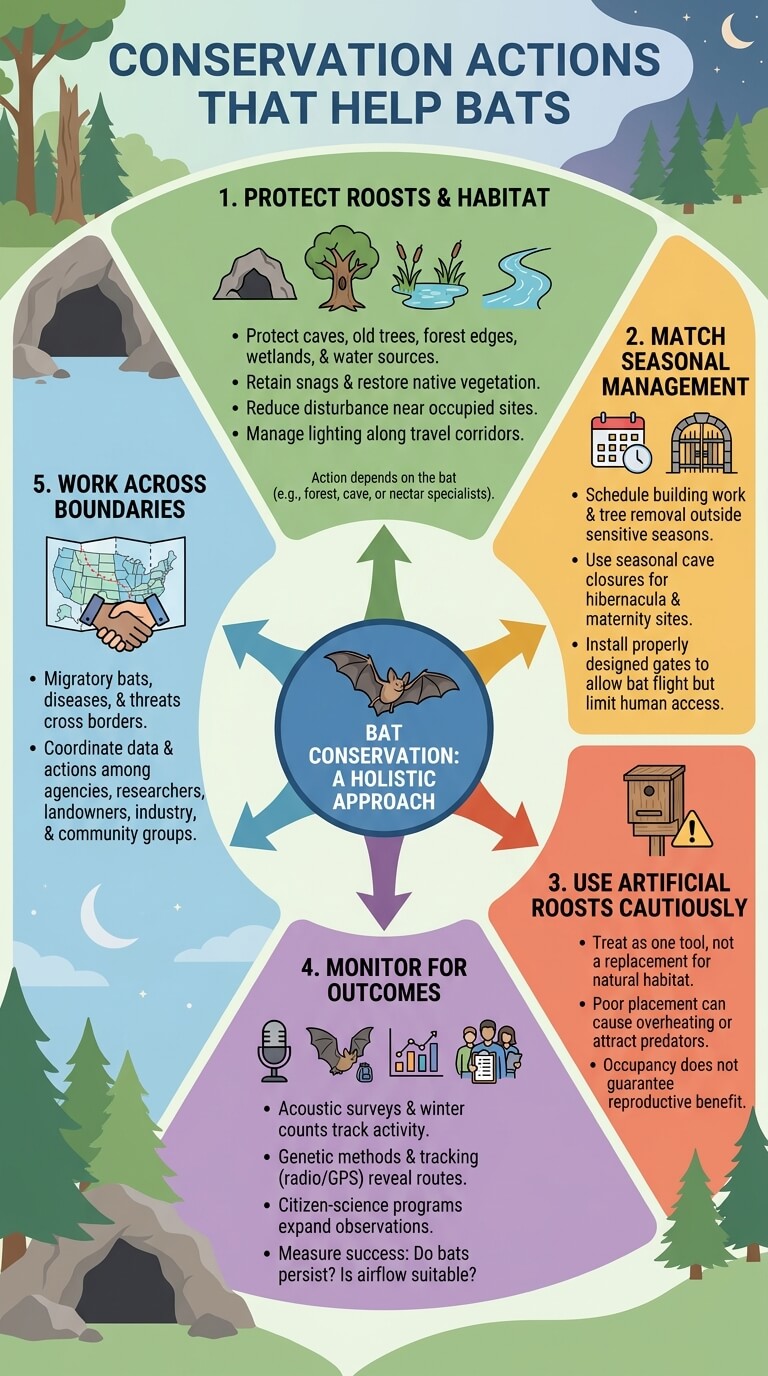
Protect the full network of roosts and feeding habitat
Effective conservation can include protecting caves, old trees, forest edges, wetlands, riparian corridors, water sources, flowering plants, fruiting trees, and migration routes. Land managers may retain snags, reduce disturbance near occupied sites, restore native vegetation, or manage lighting along travel corridors.
The best action depends on the bat. A forest-roosting species may benefit from retaining large trees and connected woodland. A cave specialist may need secure entrances and undisturbed surrounding feeding habitat. A nectar bat may require seasonal flowering resources across a long route.
Match seasonal management to bat biology
Cave closures can protect hibernacula or maternity sites during sensitive periods. Properly designed gates may allow bat flight while limiting human access. Building work and tree removal can be scheduled after surveys and outside locally important seasons when agencies recommend it.
Artificial roosts are sometimes useful, but they should be treated as one tool rather than a replacement for natural habitat. Poorly placed boxes can overheat or attract predators, and occupancy does not automatically prove reproductive benefit.
Monitoring shows whether an action works
Acoustic surveys record activity. Winter counts track some hibernating colonies. Genetic methods can estimate connectivity and effective population size. Radio tags and GPS devices reveal routes and habitat use for bats large enough to carry them safely. Citizen-science programs can expand observations when volunteers follow standardized methods.
Monitoring should measure the outcome that matters. Installing a gate is not success by itself. Managers need to know whether bats still enter, whether airflow remains suitable, and whether the population persists.
Conservation works best across boundaries
Migratory bats cross states and countries. Disease, trade, wind development, and habitat change also cross administrative borders. Agencies, Indigenous nations, landowners, researchers, energy companies, farmers, cavers, rehabilitators, and community groups often need to coordinate data and actions.
What Readers Can Do Safely
Reduce disturbance and support habitat
- Obey cave and mine closures, decontamination rules, and posted seasonal restrictions.
- Keep a respectful distance from roosts and avoid bright lights, loud noise, smoke, or repeated close approach.
- Retain native vegetation, mature trees, and safe water sources where local land guidance supports them.
- Reduce unnecessary outdoor lighting and direct essential lights downward.
- Report unusual mortality or important roost observations through a state wildlife agency or approved monitoring program.
- Support conservation organizations and land projects that use species-specific evidence.
Do not touch, move, poison, or seal in bats
Wild bats should not be handled by untrained people. Do not enter a roost to collect guano, move pups, or apply chemicals. Do not block an opening until professionals have determined whether bats are present and whether young or protected species could be trapped.
Use public-health guidance after direct contact
Conservation does not require ignoring health precautions. The CDC guidance on bat encounters advises avoiding direct contact and contacting health or animal-control authorities when a bite, scratch, possible saliva exposure, or uncertain contact may have occurred. This article does not replace an exposure assessment by a healthcare or public-health professional.
Common Misunderstandings
All bats are endangered
False. Some species are in high-risk categories, some are legally listed in particular countries, some are declining without a threatened listing, and others are currently considered less at risk. The correct statement names the species and assessment.
One threat affects every bat equally
White-nose syndrome mainly threatens susceptible hibernating species in affected regions. Wind turbines disproportionately kill certain migratory and open-air species at many North American facilities. Hunting is a major pressure for some fruit bats but irrelevant to many insectivorous bats in the United States. Threat profiles must be matched to biology and geography.
Bat conservation means accepting unsafe contact
False. Protecting bats and protecting people are compatible. Safe conservation avoids handling, uses professional exclusion when needed, follows disease precautions, and preserves colonies without trapping animals inside buildings or exposing people and pets.
How Habitat, Seasons, and Ecosystem Roles Shape Risk
Roost specialization determines where bats are exposed
A cave specialist may be vulnerable to tourism and disease. A tree-roosting migrant may encounter forestry changes and turbines. A city-tolerant species may gain artificial roosts but face renovation, lighting, roads, and conflict with residents. Knowing where a bat sleeps is only the first step; managers also need its feeding and movement habitat.
Hibernation and migration create different danger periods
Hibernation concentrates bats and limits their winter energy budget, increasing sensitivity to disturbance and white-nose syndrome. Migration moves bats across unfamiliar landscapes and can increase exposure to storms, habitat gaps, and wind facilities. Some species use torpor, short-distance movement, or flexible seasonal strategies instead.
Declines can change ecological processes
Bat losses may reduce insect predation, pollination, seed dispersal, or nutrient transport, depending on which species disappear. The ecological effect is not identical everywhere, but conserving bat diversity helps retain the range of functions performed by insect-eating, fruit-eating, nectar-feeding, and other bats. “Protecting bats can also protect the ecological roles they perform, including insect predation, pollination, and seed dispersal.”
FAQ
How many bat species are endangered?
There is no single timeless number. Taxonomy changes, new species are described, and assessments are updated. “Endangered” may also refer to the IUCN category or a national legal category. The most accurate approach is to search the current IUCN Red List for global categories and the relevant government wildlife database for legal status, then record the species and assessment date.
Which bats are affected by white-nose syndrome?
White-nose syndrome has been confirmed in multiple hibernating bat species in North America, while the fungus has been detected on additional species without confirmed disease. Effects range from severe population decline to limited detected impact. Current species lists and maps should be checked through the White-nose Syndrome Response Team because the disease distribution continues to change.
Why do wind turbines kill some bats?
Bats can collide with moving blades, but the behavior that brings them close to turbines is still being studied. Seasonal migration, mating activity, insects, landscape position, weather, and possible attraction to tall structures may contribute. Mortality is especially associated with several migratory tree bat species in North America, and operational curtailment can reduce risk during high-activity conditions.
Are bats legally protected in the United States?
Protection varies. Species listed under the Endangered Species Act receive federal protection, and other federal rules may apply on particular lands or projects. States can protect additional bats, regulate handling, or restrict disturbance of caves and wildlife. A bat that is not federally endangered may still be protected by state law, local rules, permit requirements, or property regulations.
Final Thoughts
Why are bats endangered? There is no single cause and no single status for all bats. Some populations are reduced by disease, others by habitat loss, hunting, roost disturbance, turbines, contaminants, climate extremes, or several pressures acting together. Slow reproduction, specialized roosts, small ranges, and seasonal concentration can make recovery difficult.
Good bat conservation starts with precision. Identify the species, location, season, and evidence. Protect the roost and the surrounding network of food, water, and movement routes. Use disease and turbine mitigation where those threats are documented. Respect public-health precautions without turning fear into persecution. That approach protects bats as living populations and preserves the ecological work they perform.

Ethan Walker is the founder and research editor of Animal Fact Central. He creates and reviews educational animal facts content using trusted wildlife, pet care, and science-based sources. His work focuses on making animal behavior, adaptations, habitats, and species facts clear, accurate, and engaging for everyday readers.
Read More Details About Ethan Walker: https://animalfactcentral.com/ethan-walker/