

Seals and sea lions are both pinnipeds, but they are not the same kind of animal. The quickest clue is usually the ears: sea lions have visible external ear flaps, while true seals have ear openings without an outer flap. Their flippers and movement provide an even stronger comparison. Sea lions can rotate their hind flippers under the body and support themselves on all four flippers on land, while true seals usually move on land by flexing and undulating their bodies because their hind flippers cannot rotate forward in the same way.
Those differences are not just identification tricks. They reflect two distinct pinniped families that have evolved different compromises between swimming efficiently and moving on land. A useful NOAA Fisheries seal and sea lion comparison highlights ears, flippers, swimming, and land locomotion as the most dependable features for general identification. Size, coat color, and behavior can help in some situations, but none of those is reliable by itself.
Quick Difference
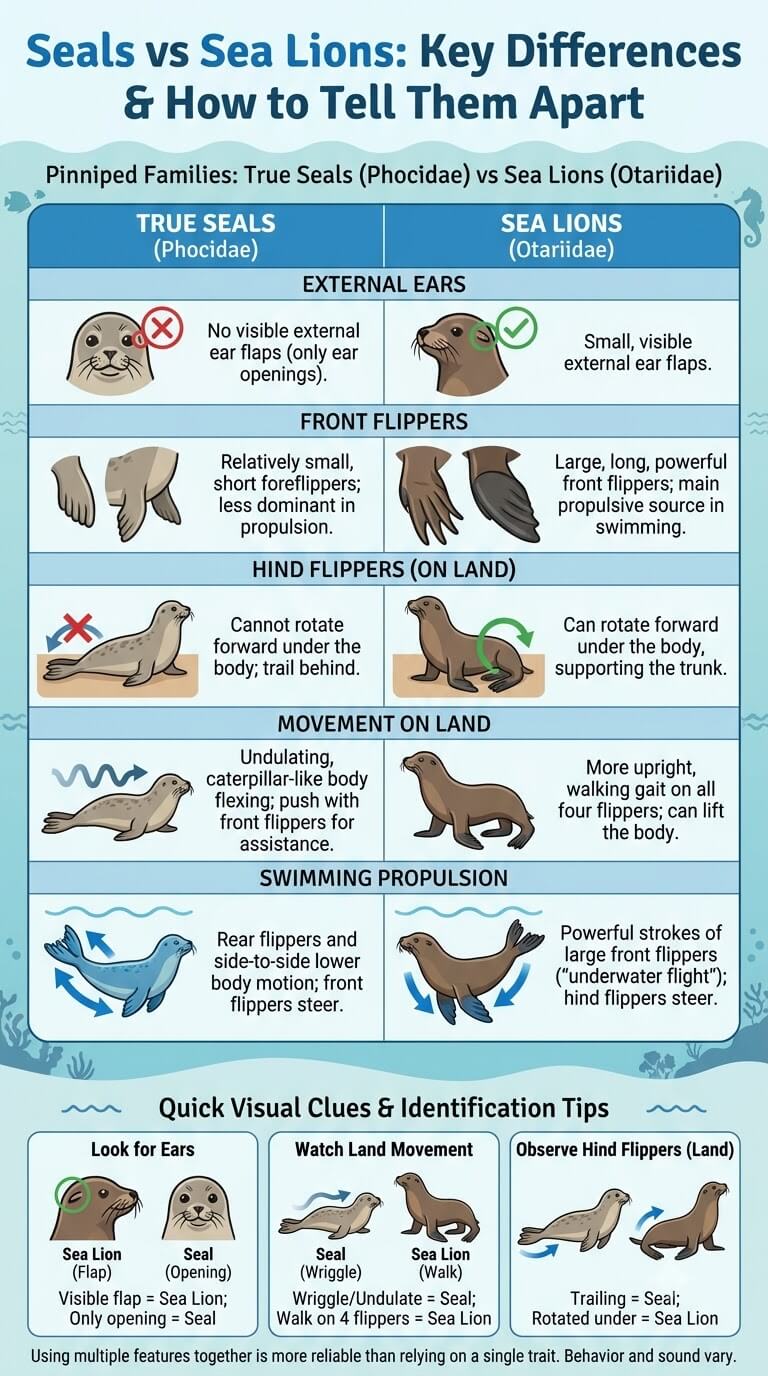
A true seal belongs to the family Phocidae. It has no visible external ear flap, usually has relatively small front flippers, and relies heavily on its rear flippers and lower body for propulsion in the water. On land, it cannot bring the hind flippers underneath the body to walk on them.
A sea lion belongs to the family Otariidae, which also includes fur seals. Sea lions have small but visible external ear flaps, large front flippers, and hind flippers that can rotate forward under the body. They use their front flippers as the main source of propulsion while swimming and can move on land with a more upright, four-flipper gait.
If you see only the head, look for ear flaps. If you see the animal moving on land, watch the hind flippers. If you see it swimming clearly underwater, the main propulsive flippers can offer another clue. Using several features together is better than relying on a single impression.
Seal vs Sea Lion Comparison Table

| Feature | True seals | Sea lions |
|---|---|---|
| Family | Phocidae | Otariidae |
| External ears | Ear openings, no external ear flaps | Small visible external ear flaps |
| Front flippers | Generally shorter and less dominant in propulsion | Large and powerful |
| Hind flippers on land | Cannot rotate under the body in the sea lion manner | Can rotate forward under the body |
| Movement on land | Body undulation or caterpillar-like motion | Can support the body and move on all four flippers |
| Main swimming propulsion | Rear flippers and side-to-side lower-body motion | Large front flippers |
| Typical vocal impression | Often grunts, growls, hisses, or other calls depending on species | Many sea lions are conspicuously vocal, including barking calls |
| Examples | Harbor seal, gray seal, elephant seals, monk seals | California sea lion, Steller sea lion, Australian sea lion |
External Ears
The side of the head is often the easiest place to start. True seals do have ears and can hear, but the outer ear is reduced to a visible opening rather than a projecting flap. Sea lions have small external pinnae, the familiar flap of tissue that gives their larger family the common label “eared seals.” The Marine Mammal Center’s comparison emphasizes this feature because it can be recognized even when the rest of the animal is partly hidden.
Front and Hind Flippers
Sea lions usually have long, broad front flippers that play a major role in generating thrust underwater. Their hind flippers are also flexible at the hips and can be positioned under the body on land. True seals generally have smaller foreflippers, and their rear limbs are directed backward in a way that works well for swimming but limits four-limbed walking on shore.
Movement on Land
A sea lion can lift much of its trunk away from the ground and step forward using all four flippers. A true seal cannot simply copy that movement. Instead, it bends and extends the trunk, pushes with the foreflippers, and uses a rolling or caterpillar-like motion to travel over beaches, rocks, snow, or ice. The motion may look awkward to people, but it is normal locomotion for the animal.
Swimming Style
Both groups are highly capable swimmers, yet they produce thrust differently. Sea lions mainly “fly” through the water with large strokes of the front flippers while the hind flippers help with steering. True seals generate much of their forward motion with side-to-side movements of the hindquarters and rear flippers, while the front flippers help maneuver.
Posture and Vocal Behavior
Sea lions often look more upright on land because their limb arrangement lets them raise the torso and turn more freely. Many familiar sea lion species are also highly vocal at crowded haul-out sites. True seals may appear lower and more streamlined when ashore and often seem quieter to casual observers. Vocal behavior varies by species, season, age, and social context, so sound should be treated as supporting evidence rather than a universal rule.
What Counts as a True Seal?
True seals are members of Phocidae. They are sometimes called earless seals, although that name can be misleading because they are not deaf and they do have functional ears. What they lack is the external ear flap. Harbor seals, gray seals, monk seals, leopard seals, weddell seals, and elephant seals are among the many animals in this family.
The Phocid Body Plan
The phocid body is strongly specialized for aquatic movement. The rear portion of the body contributes much of the swimming power, while the comparatively short foreflippers assist with control. When a true seal is stretched out in the water, the body can appear torpedo-shaped, with the hind flippers extending behind it.
This body form does not mean true seals are helpless on land. They routinely haul out to rest, breed, give birth, nurse pups, molt, or avoid conditions in the water. Their method of getting around is simply different from that of sea lions.
Hind Flippers and Land Locomotion
The inability to rotate the hind flippers forward is one of the most useful functional differences. For example, NOAA notes that the pelvic anatomy of harbor seals prevents them from bringing the hind flippers beneath the pelvis to walk like sea lions. Their familiar undulating movement is normal, not evidence that the animal is stranded because its rear end seems immobile. The NOAA Fisheries harbor seal profile specifically warns observers not to mistake this locomotion for injury.
What Counts as a Sea Lion?
Sea lions belong to Otariidae. That family also contains fur seals, which means “sea lion” and “otariid” are not interchangeable terms. All sea lions are otariids, but not all otariids are sea lions. Fur seals share the external ear flaps and mobile hind flippers that distinguish the family from true seals.
Sea Lions Within the Eared-Seal Family
Otariids are often called eared seals because of their external ear flaps. In sea lions, the coat is generally dominated by coarser hair rather than the especially dense underfur associated with animals commonly called fur seals. Taxonomy and common names can make this group confusing, so visible ears alone tell you “otariid” more confidently than they tell you “sea lion” if a fur seal could be present.
External Ear Flaps and Rotating Hind Flippers
Sea lions combine visible pinnae with a flexible hind-limb arrangement that lets the rear flippers swing underneath the body. This makes terrestrial movement more versatile. The animal can turn, climb over uneven surfaces, and travel through crowded colonies without dragging the entire rear half of the body in the way a true seal does.
The Easiest Visual Clues

Good identification works like a short checklist rather than a snap judgment. Start with the head, then look at limb proportions, then watch how the animal moves. If the view is poor, it is better to stay uncertain than to force an identification from color or size.
Look for External Ear Flaps
Visible ear flaps strongly point toward an otariid, meaning a sea lion or fur seal. A smooth-sided head with only ear holes supports identification as a true seal. This remains useful across many species because the distinction is rooted in family-level anatomy rather than seasonal coat color.
Watch How the Animal Uses Its Hind Flippers
On land, the hind flippers are often decisive. Sea lions can rotate them forward and place them under the trunk. True seals keep the hind limbs directed behind the body and move by flexing the trunk. Even a few seconds of movement can be more informative than a still photograph.
Compare Front-Flipper Size and Posture
Sea lions tend to show long front flippers that look capable of supporting the body. True seals usually have shorter foreflippers that appear less prominent. The distinction is easiest in a side-by-side comparison because perspective can make any single flipper look larger or smaller than it really is.
How They Move on Land
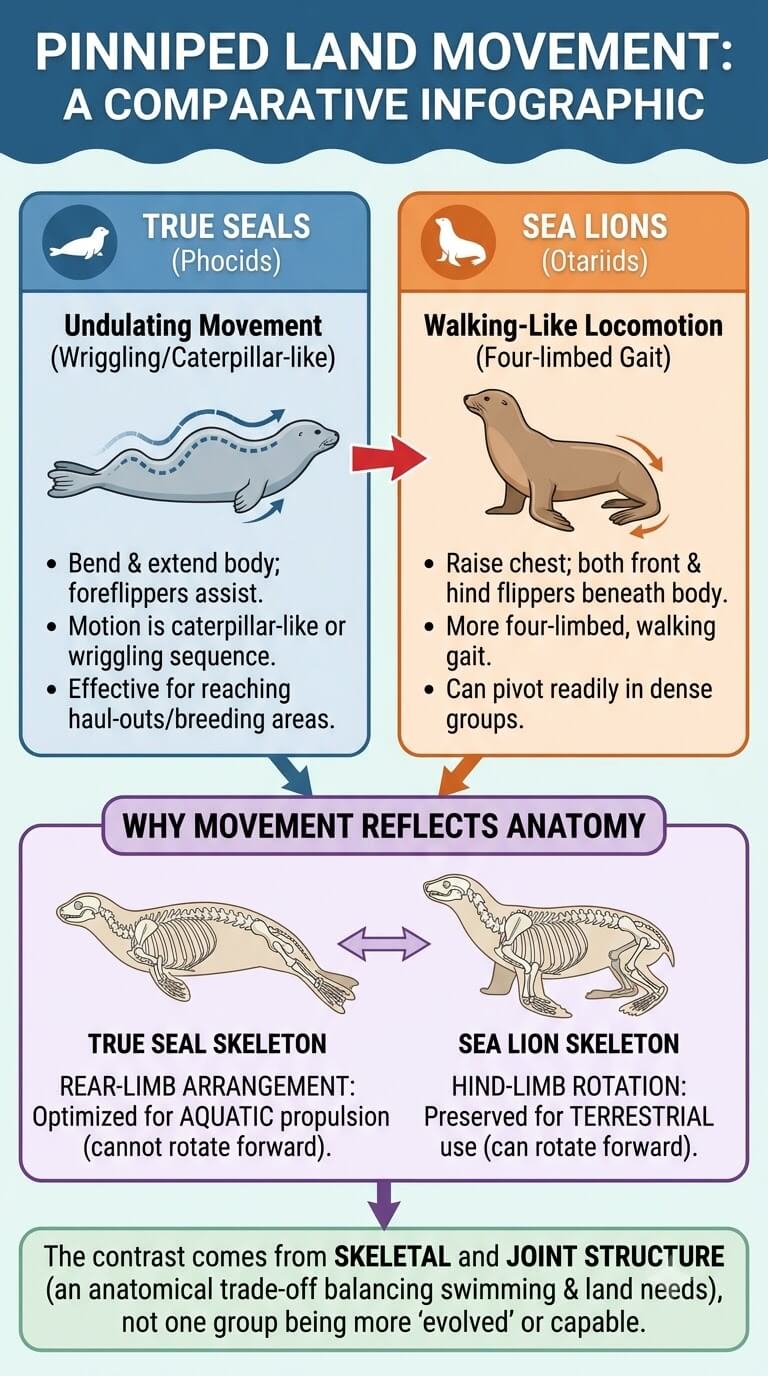
Pinnipeds split their lives between water and solid surfaces to different degrees, and their locomotion reveals where each family places its anatomical trade-offs. A body that excels at one type of movement does not have to look equally graceful in another.
Undulating Movement in True Seals
True seals travel over land by bending and extending the body while using the foreflippers for assistance. Depending on the species and surface, the movement may look like wriggling, bouncing, or a caterpillar-like sequence. This system can carry them surprisingly far when they need to reach a haul-out location, breeding area, or safer position.
Walking-Like Locomotion in Sea Lions
Sea lions can place both front and hind flippers beneath the body and raise the chest. That gives them a gait that looks much more like four-limbed walking. They can also pivot readily, which is useful in dense social groups where animals need to move around one another on beaches and rocky haul-outs.
Why Land Movement Reflects Anatomy
The contrast comes from skeletal and joint structure, not from one group being more evolved or more capable. True seals retain a rear-limb arrangement optimized for aquatic propulsion, while otariids preserve greater hind-limb rotation for terrestrial use. Each pattern works within a different balance of swimming, resting, breeding, and movement on land.
How They Swim
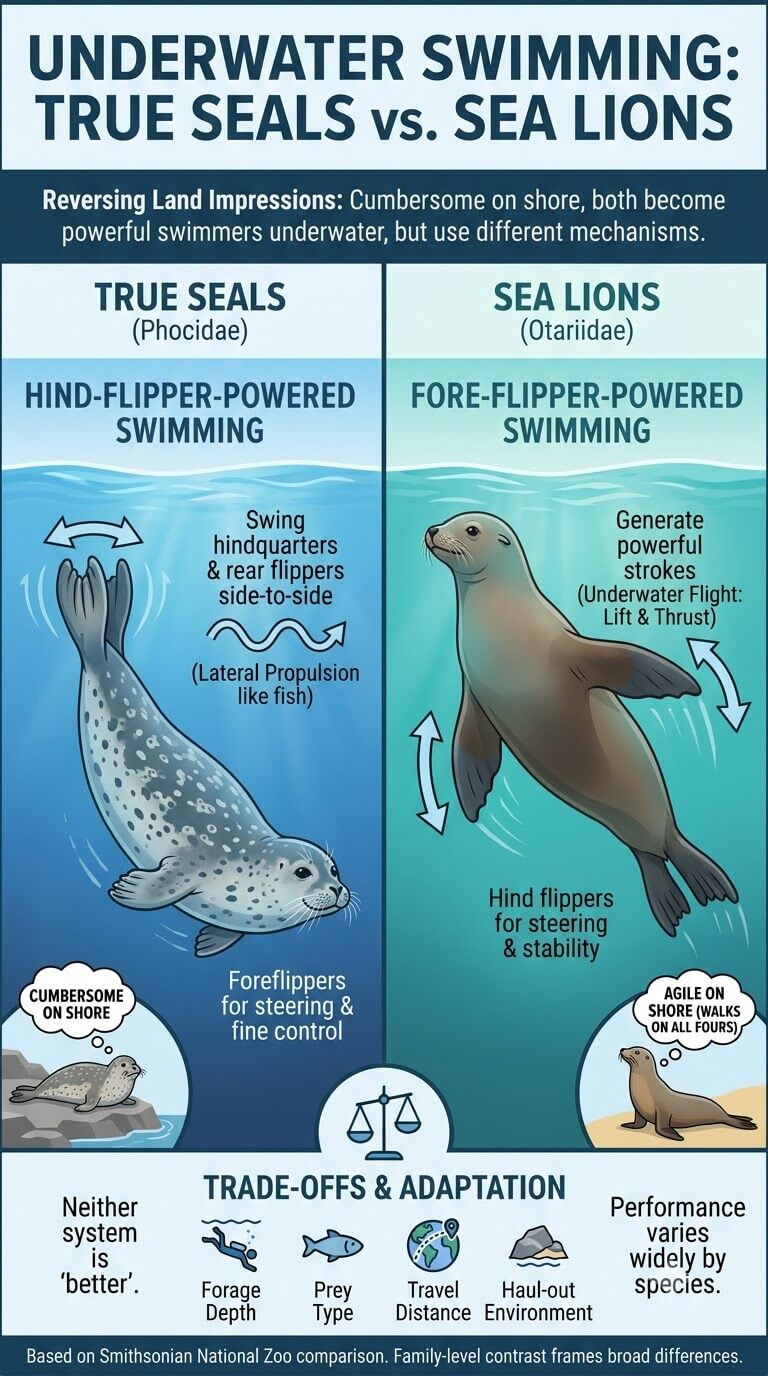
Underwater, the difference reverses the impression people get on land. True seals that seem cumbersome on shore become smooth, powerful swimmers, and sea lions convert their broad front flippers into underwater wings. The Smithsonian National Zoo describes this contrast clearly in its seal and sea lion swimming comparison.
Hind-Flipper-Powered Swimming in True Seals
True seals swing the hindquarters from side to side and use the rear flippers together to create thrust. The movement resembles the lateral propulsion used by many fish, although the anatomy is completely different. The foreflippers contribute to steering and fine control rather than acting as the main engine.
Fore-Flipper-Powered Swimming in Sea Lions
Sea lions generate powerful strokes with their front flippers. The motion is often compared with underwater flight because the forelimbs sweep through the water in a way that produces lift and thrust. The hind flippers function mainly in steering and stability rather than supplying the primary propulsive force.
Trade-Offs Between Aquatic and Terrestrial Movement
Neither swimming system is simply “better.” Different species forage at different depths, pursue different prey, cross different distances, and use different haul-out environments. The family-level contrast provides a useful framework, but performance varies widely within both groups.
Sound and Social Behavior

People often recognize sea lions by sound before they notice their ears or flippers. California sea lions, for example, are famous for loud barking calls around piers and crowded rookeries. True seals also communicate vocally, and some species produce striking calls, so the stereotype of “loud sea lion, silent seal” is too simple.
Why Sea Lions Often Appear More Vocal
Many sea lion breeding colonies and haul-outs contain large numbers of animals packed into limited space. Vocal signals help animals maintain contact, advertise, threaten rivals, or coordinate mother-pup recognition. The repeated barking heard from some sea lions is therefore tied to social context, not merely to anatomy.
Variation Within Both Groups
True seals produce grunts, growls, hisses, moans, trills, knocks, and other sounds depending on species. Some communicate extensively underwater. Sea lion species also differ in call structure and social organization. Sound can support identification when the species is familiar, but it should not override clear anatomical evidence.
Representative Species
Examples help make the family distinction concrete, but they can also reveal why simple stereotypes fail. Pinnipeds range from small coastal seals to massive elephant seals, from tropical monk seals to ice-associated species, and from familiar pier-hauling sea lions to wide-ranging fur seals.
Harbor and Elephant Seals as True Seals
Harbor seals are classic phocids: they lack external ear flaps, have short foreflippers, and move on land by undulating rather than walking on rotated hind flippers. Elephant seals are also true seals, even though their enormous size can overturn the casual idea that seals are always smaller than sea lions.
California and Steller Sea Lions
California sea lions show the visible ears, broad foreflippers, rotating hind limbs, and conspicuous barking behavior that make sea lions easy to recognize. Steller sea lions share the same family-level features but differ in size, range, coloration, ecology, and social details. Identification should begin with anatomy before moving to species-level traits.
Fur Seals as Eared Seals but Not Sea Lions
Fur seals are the most important exception for beginners. They have external ear flaps and can rotate their hind flippers underneath the body because they are otariids, just like sea lions. Yet they are conventionally called fur seals rather than sea lions. This is why a visible ear flap tells you the animal is an eared seal but does not, by itself, prove it is a sea lion.
Where Walruses Fit
Walruses belong in the same broad pinniped grouping as seals and sea lions, but they are neither true seals nor sea lions. Their distinctive tusks make adults relatively easy to separate visually, but their anatomy also illustrates that pinnipeds contain more than two branches.
The Third Living Pinniped Family
Walruses belong to Odobenidae. NOAA describes pinnipeds broadly as seals, sea lions, and walruses, while distinguishing phocids and otariids by ear and flipper anatomy. The broader NOAA Fisheries seals and sea lions overview is useful for placing these families in the same marine mammal group without treating them as identical.
Why Walruses Are Neither True Seals Nor Sea Lions
Walruses have their own evolutionary branch and a body plan adapted to a different lifestyle. They should not be used as an intermediate form between seals and sea lions. The three living pinniped families are separate lineages, each with its own anatomical specializations.
Common Mistakes and Myths
Most identification errors come from over-relying on a trait that varies within a family or from using everyday names as if they were precise scientific categories. The best approach is to start with features that reflect family-level anatomy.
Calling Every Pinniped a Seal
In casual speech, people sometimes use “seal” for almost any pinniped. That is understandable, but it can blur the distinction between true seals, sea lions, fur seals, and walruses. In a biological comparison, “true seal” is the clearest term for Phocidae.
Using Size Alone to Identify the Animal
Size is unreliable because both families include a broad range of body sizes, and sex and age can also matter. Elephant seals provide an obvious warning against the rule that seals are always smaller. Perspective in photographs makes size judgments even less dependable.
Assuming Behavior Is a Perfect Identification Tool
A barking animal on a crowded pier may very well be a sea lion, but behavior changes with species, season, threat level, reproductive state, and habitat. Resting animals may not display their normal gait, and swimming animals may be visible for only a moment. Anatomy remains the safer starting point.
Edge Cases and Difficult Identifications
Field identification is easiest when an adult animal is close enough to view safely, fully visible, and actively moving. Real wildlife encounters often provide a distant head, a silhouette in rough water, or a sleeping body on a beach. Uncertainty is normal.
Fur Seals and Common-Name Confusion
Fur seals can look sea-lion-like because they share the same family. Visible ears, strong front flippers, and the ability to walk on all four flippers are expected. Distinguishing a fur seal from a sea lion then requires more specific knowledge of coat structure, proportions, range, and species characteristics.
Young Animals and Viewing Angle
Pups and juveniles may have proportions, coats, and body sizes that differ from adults. Wet fur can alter color and apparent texture. An ear flap can also disappear from view if the head is turned. Photographs taken from directly in front or behind can hide exactly the features a field guide asks you to inspect.
What These Differences Reveal About Pinniped Life
The seal-versus-sea-lion comparison is useful beyond naming an animal. It shows how closely related marine mammals can solve the same basic problems with different anatomy. Both must swim efficiently, surface to breathe, rest or reproduce on solid substrates, manage body heat, locate prey, and avoid danger, yet the balance between water and land has taken different forms.
Pinniped Anatomy and Amphibious Life
Sea lions retain exceptional mobility on land for a marine mammal, while true seals give up much of that walking ability in exchange for a hind-body system highly specialized for swimming. Both still depend on haul-out sites for important parts of their life cycles, which is why beaches, rocks, sea ice, and other resting areas can be biologically important even for animals that feed at sea.
Flippers Also Help With Heat Management
Flippers are not just locomotor structures. Because they contain blood vessels and have relatively large surface area, pinnipeds can alter circulation to help manage heat exchange. Species, weather, activity, and whether the animal is in water or on land all influence how heat is gained or lost, so a flipper posture should not be interpreted with one universal rule.
Watching Seals and Sea Lions Safely
A hauled-out seal may look vulnerable because it lies flat and moves awkwardly, but resting on shore is normal for many pinnipeds. A sea lion may look accustomed to people around a marina, but that does not make it domesticated. Wild pinnipeds can bite, become stressed, or abandon resting behavior when people crowd them.
NOAA marine life viewing guidance advises people to keep a safe and respectful distance from wild seals and sea lions and to contact an appropriate marine mammal response organization if an animal appears sick or injured rather than approaching it. The same caution protects pups, because a nearby mother may be temporarily at sea and human disturbance can complicate normal reunion behavior.
FAQ
Can seals walk on land?
True seals can travel over land, but they do not walk in the sea lion sense. Their hind flippers cannot rotate forward underneath the body, so they move by flexing and undulating the trunk while using the foreflippers for assistance. This can look like wriggling or a caterpillar-like motion. Sea lions can support themselves on all four flippers and take more distinct steps.
Do sea lions have ears?
Yes. Sea lions have functional ears plus small external ear flaps visible on the sides of the head. True seals also have ears and can hear, but they lack those projecting outer flaps and instead show small ear openings. The phrase “earless seal” refers to the missing external flap, not to an absence of hearing organs.
Are fur seals seals or sea lions?
Fur seals are otariids, the same family that contains sea lions. They are not true seals in the family Phocidae. That is why fur seals have external ear flaps, large front flippers, and mobile hind flippers that can rotate under the body. Their common name preserves the word “seal,” but their family-level anatomy is much closer to sea lions.
Final Thoughts
The clearest seal vs sea lion difference comes from combining anatomy and movement. True seals lack external ear flaps, have relatively small front flippers, drive much of their swimming with the rear body and hind flippers, and move over land by undulating. Sea lions have visible ear flaps, large front flippers that power swimming, and hind flippers that rotate under the body so they can move on all four limbs. Size, color, social behavior, and sound can add context, but they are secondary clues. Once you recognize the family-level differences, even confusing cases such as fur seals and walruses become easier to place without forcing every pinniped into the same category.

Ethan Walker is the founder and research editor of Animal Fact Central. He creates and reviews educational animal facts content using trusted wildlife, pet care, and science-based sources. His work focuses on making animal behavior, adaptations, habitats, and species facts clear, accurate, and engaging for everyday readers.
Read More Details About Ethan Walker: https://animalfactcentral.com/ethan-walker/