

Marine mammals stay warm in cold water by controlling how quickly heat leaves the body and by producing enough metabolic heat to replace what is lost. Most whales and many seals rely heavily on blubber, sea otters depend much more on exceptionally dense fur, and many species use blood-vessel arrangements that conserve heat in flippers, fins, tails, or other exposed areas. Body size, activity, habitat, and food intake also affect the balance.
The challenge is serious because water carries heat away from a warm body far more effectively than air under comparable conditions. A marine mammal cannot simply rely on being warm-blooded. It needs insulation, controlled circulation, an appropriate body shape, and enough energy to keep its core temperature within a workable range.
Quick Answer
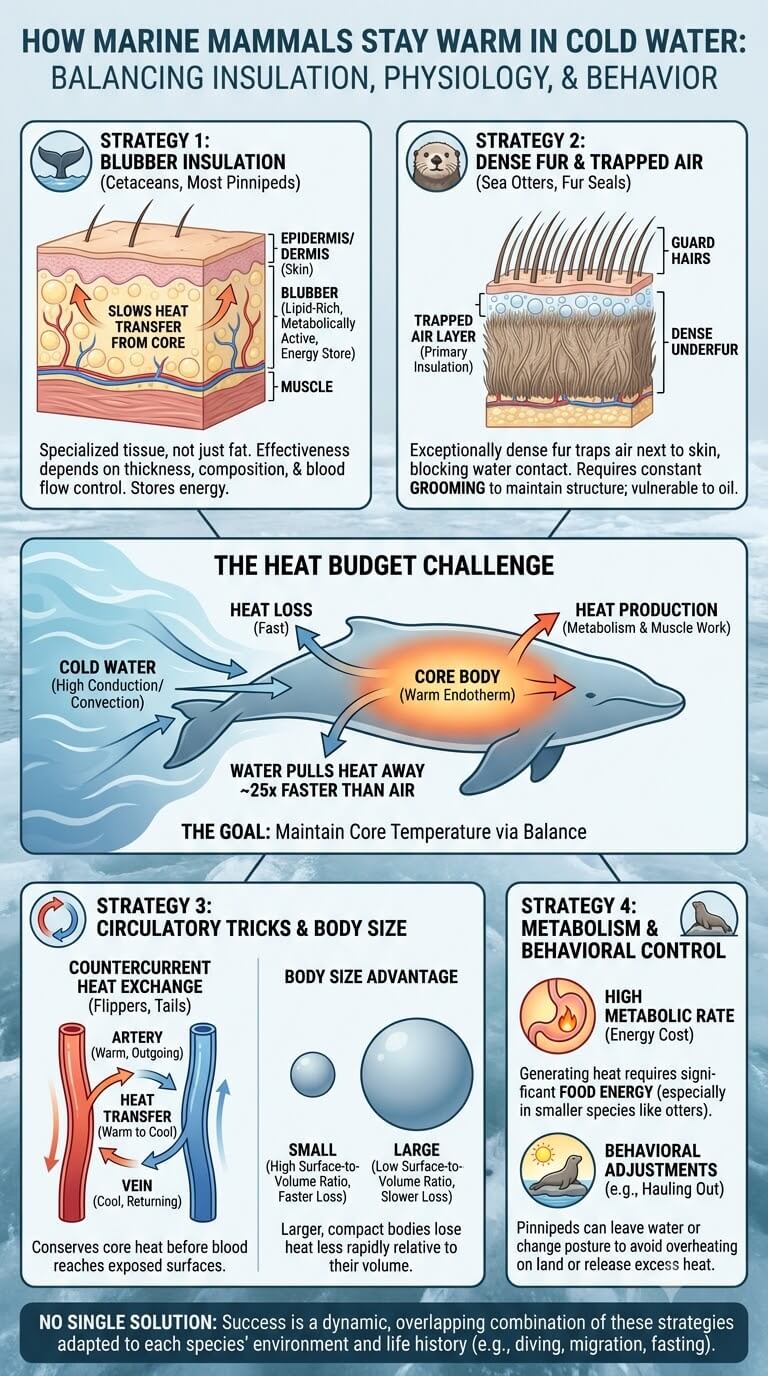
There is no single cold-water adaptation shared in the same form by every marine mammal. Cetaceans generally combine a streamlined body with blubber and circulatory control. Pinnipeds use blubber to varying degrees, with fur also important in some species. Sea otters are unusual because dense fur and trapped air do much of the insulating work that thick blubber performs in many other marine mammals. Sirenians have blubber and vascular adaptations, but their thermal biology helps explain why some populations are strongly limited by cold water.
A useful way to think about marine mammal thermoregulation is as a heat budget. Heat enters the budget through metabolism and muscular work. Heat leaves mostly through conduction and convection to the surrounding water. Insulation and blood-flow control slow that loss, while behavior can increase or decrease exposure.
Why Water Makes Heat Loss So Difficult
Marine mammals are endotherms, meaning they generate metabolic heat and regulate body temperature internally. In cold water, however, the temperature difference between the animal’s warm tissues and the environment creates a strong pathway for heat loss.
Water Pulls Heat Away Quickly
Heat can move from a marine mammal to the water by conduction across tissues and skin and by convection as moving water carries warmed water away from the body surface. A review of thermal physiology in diving marine mammals identifies conduction and convection as the dominant heat-transfer routes underwater.
This helps explain why insulation is so important. A layer of tissue or trapped air with low thermal conductivity slows the movement of heat from the warm core toward the colder environment. The system does not stop heat loss completely. It reduces the rate enough that metabolic heat production can keep pace.
Endothermy Creates an Energy Demand
Producing heat costs energy. If an animal loses more heat than its metabolism can replace for too long, core temperature will fall. Maintaining a stable internal temperature therefore connects directly to feeding ecology. An animal that spends more energy staying warm must obtain that energy from food.
This connection is especially obvious in smaller marine mammals. Their bodies have more surface area relative to internal volume than very large whales, so heat can be lost across a larger surface relative to the amount of heat-producing tissue inside.
The Main Marine Mammal Insulation Strategies
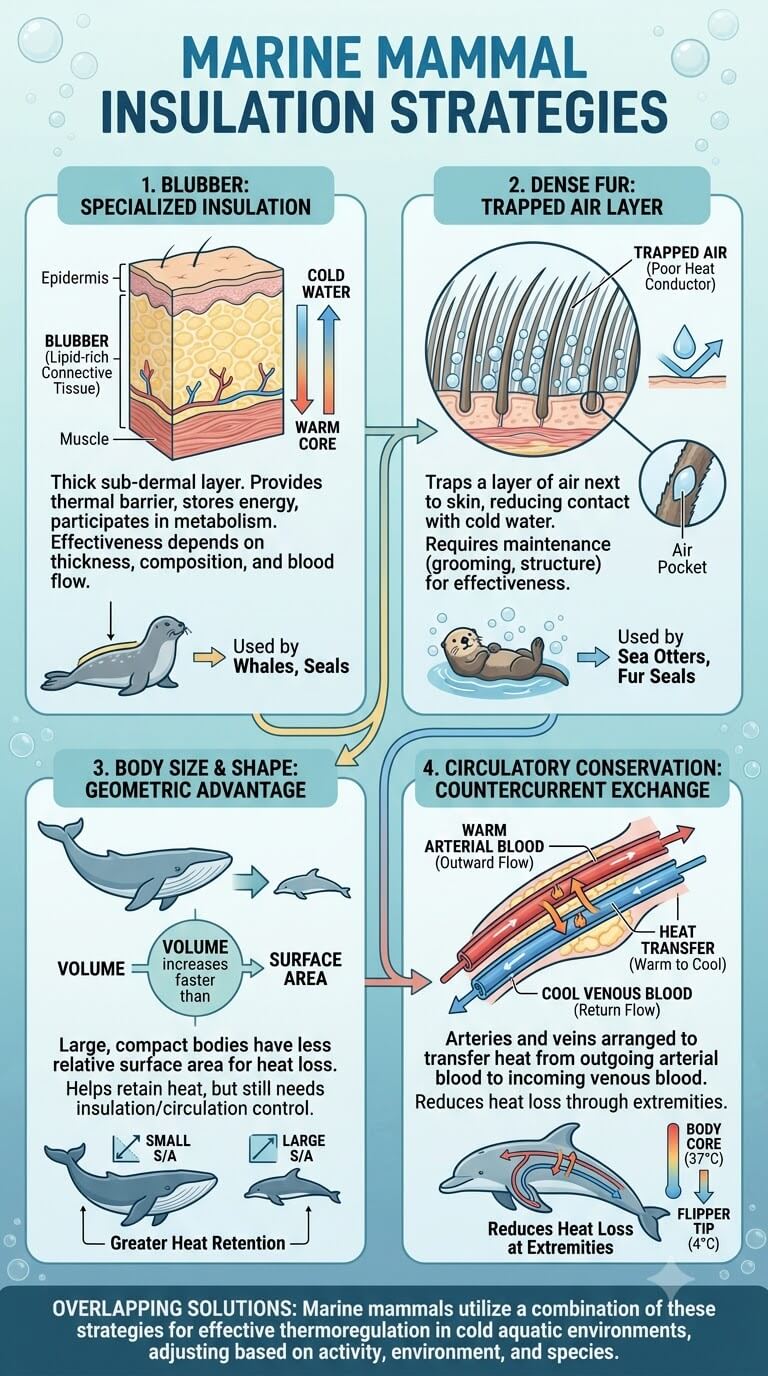
Marine mammals use several overlapping solutions rather than one universal cold-water system. Insulation may come from blubber, fur, or both. Circulation can be adjusted to retain or release heat, and body proportions influence how much surface is exposed to the water.
Blubber
Blubber is a specialized layer of lipid-rich connective tissue beneath the skin. It provides thermal insulation in many cetaceans and pinnipeds, but it is not simply an inert blanket. Marine mammal blubber can also store energy and participate in metabolic and physiological processes.
NOAA’s educational overview of how marine mammals stay warm emphasizes blubber as a major insulating layer in animals such as whales and seals. Its effectiveness depends not just on thickness but also on tissue composition, blood flow, body region, and the temperature gradient across it.
Dense Fur
Fur insulates differently. Rather than relying mainly on a thick layer of subcutaneous fat, dense fur can trap a layer of air close to the skin. Air conducts heat poorly, so maintaining that trapped layer reduces direct contact between cold water and the warm skin surface.
Fur-based insulation works only if the coat maintains the physical structure needed to hold air. Grooming, fur condition, contaminants, and pressure can change how well that system performs.
Body Size and Shape
Large, compact bodies lose heat differently from small bodies. As body dimensions increase, volume rises faster than surface area. This means a large whale generally has less surface area per unit of body volume than a small marine mammal.
That geometric advantage can support heat retention, but size alone does not guarantee comfort in cold water. A large animal still needs insulation and circulation control, and it may face the opposite problem during intense activity: getting rid of excess heat.
Circulatory Heat Conservation
Blood carries heat as well as oxygen. By adjusting circulation near the skin and within appendages, marine mammals can change how rapidly internally generated heat reaches colder body surfaces.
In many species, arteries and veins are arranged so that heat can transfer from warm arterial blood traveling outward to cooler venous blood returning toward the core. This is called countercurrent heat exchange. It can reduce the amount of heat lost through an exposed flipper, fin, or tail while allowing blood to continue circulating.
How Blubber Works
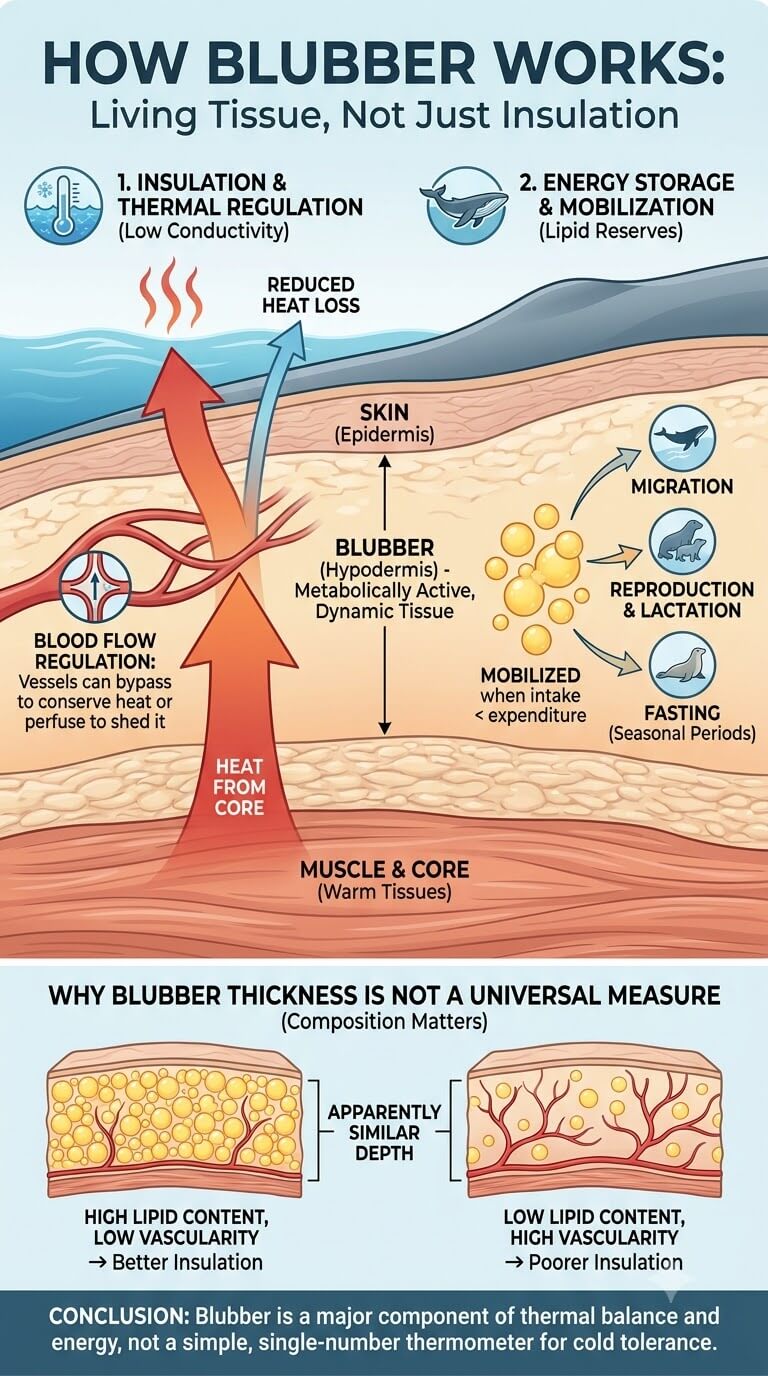
Blubber is most useful when understood as living tissue with several jobs. Its insulating value is important in cold water, but animals also draw on stored lipids during periods of high energetic demand, fasting, reproduction, or migration.
Insulation Beneath the Skin
The thermal role of blubber comes largely from its relatively low conductivity compared with highly perfused tissues such as muscle. Heat produced in the core must pass through this layer before reaching the skin and surrounding water.
The amount of heat crossing blubber changes with the temperature difference between inner and outer tissues and with the properties of the blubber itself. Blood vessels can partly alter the effective insulation by carrying warm blood closer to the skin or reducing that flow.
Energy Storage and Other Functions
Blubber contains lipid reserves that can be mobilized when energy intake falls below expenditure. This is especially important for species that experience seasonal feeding, prolonged migrations, fasting during breeding, or the energetic demands of pregnancy and lactation.
Research on cetacean blubber metabolism shows that blubber is metabolically organized tissue rather than a passive slab of fat. That is one reason simple statements such as “thicker blubber equals better insulation” miss much of the biology.
Why Blubber Thickness Is Not a Universal Measure
Blubber thickness varies across the body and can change with nutritional condition and season. The composition of the tissue also matters. Two animals with apparently similar blubber depth may differ in lipid content, vascular supply, body size, and exposure to cold.
For general readers, the safest conclusion is that blubber is a major component of thermal balance in many marine mammals, not a single-number thermometer for cold tolerance.
How Fur Can Replace Heavy Blubber
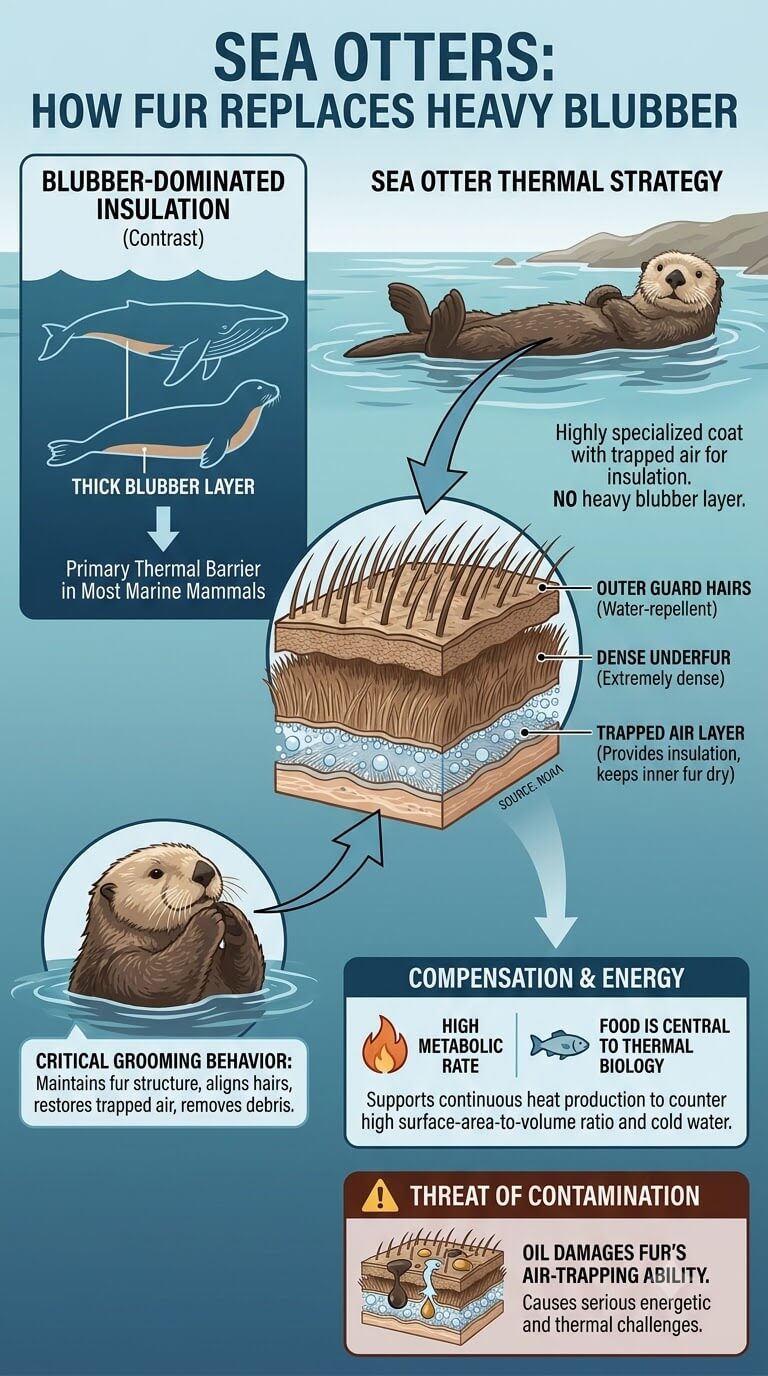
Sea otters offer the clearest contrast to blubber-dominated insulation. They are relatively small marine mammals, and their thermal strategy depends heavily on a highly specialized coat combined with substantial metabolic heat production.
Trapping Air Near the Skin
A sea otter’s coat has outer guard hairs and an extremely dense underfur. When the coat is in good condition, grooming helps maintain trapped air within the fur. NOAA’s sea otter anatomy overview explains that this trapped-air system helps keep the inner fur dry and provides insulation in cold water.
This design works only when water is kept from penetrating all the way to the skin. If the structure of the fur is disrupted, its thermal resistance can decline sharply.
Sea Otters as a Fur-Dependent Extreme
Sea otters do not depend on a thick blubber layer the way many whales and seals do. Their small size makes that lack of heavy blubber especially demanding because they have a relatively high surface-area-to-volume ratio.
To compensate, sea otters pair their coat with a high metabolic rate. Food is therefore central to thermal biology. The energy obtained from prey helps support the continuous heat production needed to live in cold coastal water.
Grooming and Fur Condition
Grooming is not cosmetic for a sea otter. It helps align hairs, distribute natural oils, remove debris, and restore the air-trapping structure of the coat. An otter may spend substantial time maintaining its fur because insulation depends on that physical condition.
Oil contamination is particularly dangerous because it can damage the fur’s ability to trap insulating air. Even when an animal is not immediately poisoned by a contaminant, loss of fur function can create a serious energetic and thermal challenge.
Body Size, Shape, and the Surface-Area Problem
Geometry changes the cost of staying warm. A compact body keeps more heat-producing tissue behind each unit of exposed surface, while long thin appendages provide potential pathways for heat loss.
Surface Area Relative to Volume
As an animal becomes larger, its volume increases faster than its surface area. This gives very large marine mammals a thermal advantage in cold water because a smaller fraction of their body mass is directly associated with the external surface.
That relationship helps explain why enormous whales can maintain warm internal tissues despite living in cold oceans. It does not mean large size evolved only for thermoregulation, but heat balance is one of the biological consequences of size.
Larger Bodies and Heat Retention
A large body can retain heat so effectively that shedding excess heat becomes important during hard swimming or feeding. Flippers, fins, flukes, and other less-insulated regions can serve as adjustable thermal windows where increased blood flow allows more heat to escape.
Heat conservation and heat dumping are therefore two sides of the same system. An animal living in cold water still needs a way to avoid overheating when muscles generate large amounts of heat.
Why Smaller Marine Mammals Need Different Solutions
Smaller species cannot rely as heavily on body size to slow heat loss. Sea otters compensate with fur and high metabolic output. Small pinnipeds may combine fur, blubber, behavior, and activity in different proportions.
Young animals can face additional challenges because they are smaller than adults and may not yet have adult body composition, fur, or blubber characteristics. Thermal strategies can therefore change with age.
Countercurrent Heat Exchange
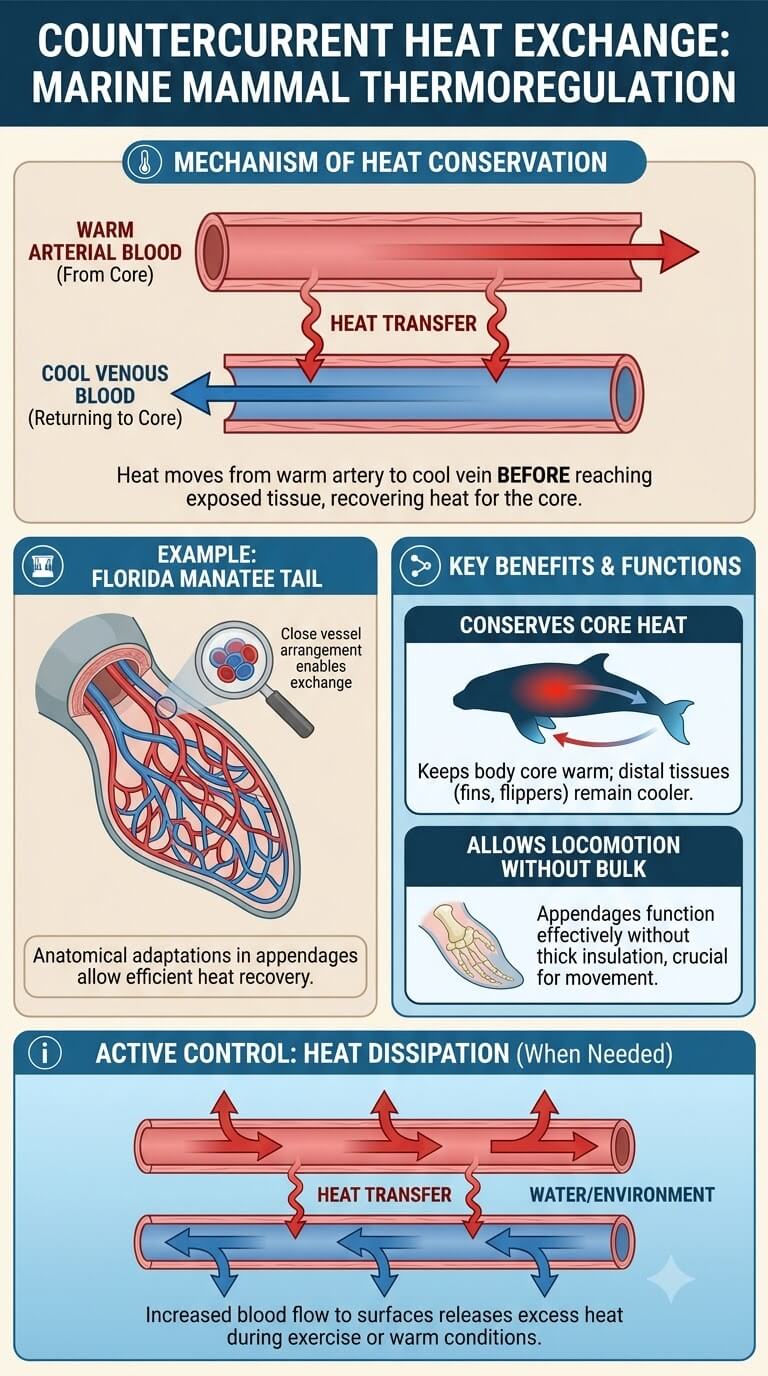
Countercurrent heat exchange is one of the most elegant ways marine mammals conserve heat without eliminating circulation to exposed tissues. It depends on the close arrangement of vessels carrying blood in opposite directions.
Conserving Heat in Flippers and Tails
Warm arterial blood leaving the body core can pass close to cooler venous blood returning from an appendage. Heat moves from the warmer vessel to the cooler one before the arterial blood reaches the most exposed tissue. The returning venous blood then carries some of that recovered heat back toward the core.
Florida manatees provide a well-studied example. Anatomical research on vascular heat conservation in the manatee tail describes vessel arrangements capable of countercurrent heat exchange in this large aquatic appendage.
Heat Transfer Between Arteries and Veins
The effectiveness of countercurrent exchange depends on vessel geometry, blood flow, and temperature differences. The system does not make the appendage warm. In fact, conserving core heat can allow distal tissues to remain cooler than the body’s interior.
This is useful because fins, flippers, and tails are important for locomotion and cannot simply be buried under thick insulation everywhere. Vascular control allows them to function while limiting unnecessary heat loss.
When Animals Need to Release Heat
The same appendages that conserve heat can also help dissipate it. Increasing blood flow to exposed or lightly insulated surfaces carries warm blood outward, where heat can move into the surrounding environment.
This becomes important during exercise, warm-water exposure, or time spent on land. Thermoregulation is therefore active control rather than permanent maximum insulation.
Metabolism and Heat Production
Insulation only slows heat loss. It cannot create heat. Marine mammals also need metabolic processes that replace the energy leaving the body.
Fueling Endothermy
Cells release heat while converting food energy into biological work. Basal metabolism, digestion, organ function, and muscle activity all contribute to heat production. The amount required for thermal balance rises when environmental heat loss increases.
This is one reason prey availability can influence more than body condition. An animal with poor access to food may have less energy available for both activity and thermoregulation.
Activity and Muscular Heat
Swimming muscles generate heat while they work. During sustained activity, that heat can contribute to maintaining body temperature, reducing how much additional heat must be generated solely for thermoregulation.
But activity can eventually produce excess heat. A well-insulated animal exercising hard may need to increase blood flow to thermal windows so that heat can escape.
Why Food Availability Matters
Small marine mammals with high rates of heat loss can be particularly sensitive to the energetic cost of thermoregulation. Sea otters are a strong example because their fur-based insulation is paired with high energy requirements and frequent feeding.
Large fasting animals face a different problem. They may rely on stored energy in blubber while reducing activity or using behavioral strategies that help conserve energy during periods when they are not feeding.
How Major Marine Mammal Groups Differ
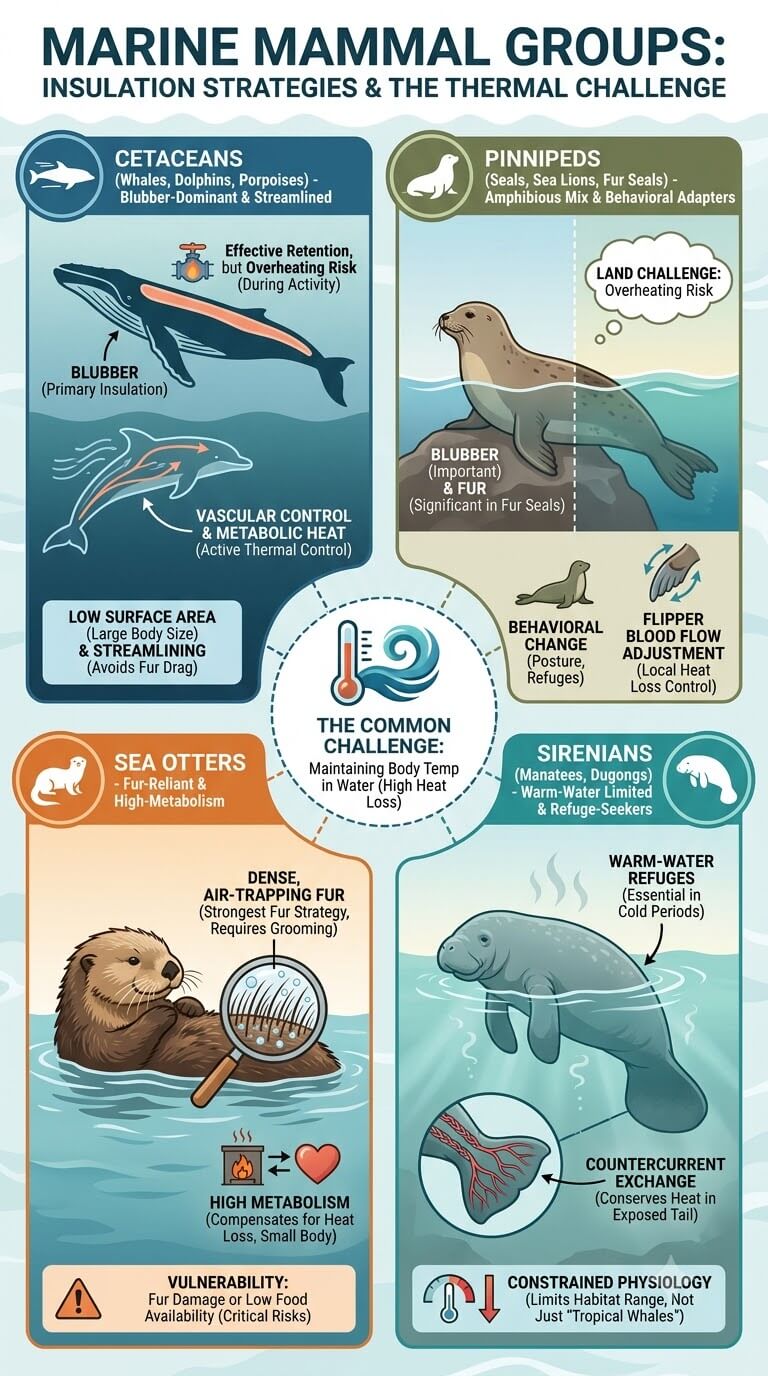
The same physical challenge has produced different solutions across marine mammal lineages. Those differences are easier to understand by comparing the dominant insulation strategy rather than assuming every species is built like a whale.
Cetaceans
Whales, dolphins, and porpoises generally lack a thick external fur coat and rely strongly on blubber, body shape, vascular control, and metabolic heat. Their streamlined bodies limit drag, while the absence of large furry surfaces avoids problems associated with maintaining an air-trapping coat during continuous swimming.
Very large whales also benefit from low surface area relative to body volume. In cold-adapted species, substantial insulation and body size can make heat retention so effective that releasing heat during activity becomes an important part of thermal control.
Pinnipeds
Seals, sea lions, and fur seals combine insulation strategies in different proportions. Blubber is important across pinnipeds, but fur can contribute significantly in fur seals and some other species. Their amphibious lives create an unusual thermal problem because insulation that works well in water can lead to overheating on land.
Pinnipeds can respond behaviorally by changing posture, entering water, resting, or choosing cooler surfaces. Blood flow through flippers can also change, giving them a way to adjust heat loss without altering the whole body’s insulation.
Sea Otters
Sea otters represent the strongest fur-based strategy among the core marine mammal groups. Their dense coat traps air, while grooming maintains that insulating layer. Their metabolism helps make up for the heat that still escapes from a relatively small body.
This combination also creates vulnerability. Anything that reduces fur function or food availability can raise the cost of maintaining body temperature.
Sirenians and Warm-Water Constraints
Manatees and dugongs have blubber and vascular adaptations, but they are not simply tropical versions of whales. Florida manatees in particular are well known for using warm-water refuges during cold periods.
The presence of countercurrent exchange in a manatee tail shows that these animals can conserve heat in exposed tissues, yet physiological adaptations have limits. Habitat temperature can still shape where a population can safely spend winter.
Keeping Warm During Dives and Seasonal Movement
Thermal balance continues while an animal dives, travels, rests, and feeds. Blood-flow changes used during diving can interact with heat conservation, while seasonal habitat choices can reduce the cost of maintaining body temperature.
Blood Flow and Dive Physiology
During breath-hold diving, marine mammals can reduce circulation to selected peripheral tissues. That helps manage oxygen stores and can also reduce heat transfer toward the skin and appendages.
The two functions should not be treated as identical. A cardiovascular response that conserves oxygen may affect heat balance, but the exact pattern depends on species, activity, depth, water temperature, and which tissues are working.
Temperature, Depth, and Activity
Water temperature can change with depth, season, and oceanographic conditions. A foraging animal may therefore move through different thermal environments during one dive. Exercise produces heat at the same time, making the net thermal effect difficult to predict from depth alone.
Researchers often need biologging instruments, heat-flux measurements, body-temperature data, and activity records to understand what actually happens inside a free-ranging animal.
Habitat Choice as Part of Thermal Strategy
Animals can regulate heat behaviorally as well as physiologically. Moving to warmer water, hauling out on land, resting at the surface, altering activity, or using sheltered habitat can change thermal exposure.
This does not mean every migration is driven by temperature. Feeding, reproduction, prey movement, sea ice, and learned routes may be more important in many species. Temperature is one factor among several that can shape movement.
Common Myths and Mistakes
Marine mammal insulation is often reduced to a few memorable slogans. Those shortcuts can be useful starting points, but several are too simple to be accurate.
Not All Marine Mammals Depend Mainly on Blubber
Sea otters show why the statement “marine mammals stay warm with blubber” is incomplete. Their fur and high metabolic output are central to their thermal strategy.
Even among blubber-bearing mammals, the contribution of fur, body size, activity, and circulation differs. A fur seal and a large baleen whale are solving the same heat-loss problem with different proportions of the available tools.
Thick Blubber Does Not Make an Animal Immune to Cold
Insulation reduces heat transfer but does not eliminate it. Cold tolerance depends on the whole heat budget, including body size, tissue properties, blood flow, metabolic heat, nutritional state, behavior, and exposure time.
Conversely, heavy insulation can create a heat-dissipation challenge during intense activity or warm conditions. Thermal adaptations work best when they can be adjusted.
Fur Alone Is Not Enough Without Maintenance
A dense coat is effective only while it retains its insulating structure. For sea otters, grooming helps preserve the layer of trapped air that keeps cold water away from the skin.
This is why fur contamination is more than a cleanliness problem. Damaged insulation can force an animal to spend more metabolic energy staying warm, even before other toxic effects are considered.
Edge Cases and Trade-Offs
Thermoregulation changes with age, season, molt, reproductive state, nutrition, weather, and whether an animal is in water or on land. The most interesting cases often appear where one adaptation creates a cost in another setting.
Molting Pinnipeds
Pinnipeds periodically replace hair and outer skin layers. Molting can alter time spent ashore and change how animals use their environment. The thermal consequences vary by species because fur structure, blubber, molt pattern, and climate are different.
For that reason, it is better to discuss molt as a period of changing insulation and behavior than to assume all seals become poorly insulated in the same way.
Young Animals and Developing Insulation
Newborn and juvenile marine mammals may have body proportions, fur, or blubber that differ from adults. Some pups depend on specialized natal coats or rapidly accumulate blubber during nursing. Others enter water before adult insulation is fully developed.
Age therefore matters when interpreting cold tolerance. An adult’s thermal strategy cannot always be applied directly to a newborn.
Overheating on Land or in Warm Conditions
Pinnipeds show the clearest example of an insulation trade-off because many leave the water to rest, molt, mate, or give birth. Air removes heat less efficiently than water, so a body built to conserve heat at sea can become too warm on shore.
Animals may spread flippers, change posture, seek shade, move toward water, or increase peripheral blood flow. These behaviors reveal an important principle: staying warm is only half of thermoregulation. The animal must also be able to cool itself.
Temperature Shapes Habitat and Diving
Thermoregulation is closely connected with other parts of marine mammal life. The need to conserve heat affects energetic costs, while diving and habitat choice can change how much heat the body loses.
Diving Changes Both Oxygen and Heat Flow
During a dive, changes in circulation can simultaneously influence oxygen delivery and the movement of heat. An animal cannot optimize one system without affecting the other.
This interaction helps explain why diving physiology varies with activity. A slowly gliding animal may conserve both oxygen and heat differently from one chasing prey with powerful muscular contractions.
Seasonal Temperature Can Limit Habitat
Some marine mammals tolerate extremely cold environments, while others remain restricted to warmer regions despite being fully aquatic. Insulation is only one part of that difference. Metabolism, body size, food availability, reproductive biology, and evolutionary history all contribute.
Temperature can therefore help define the usable habitat of a species without being the only force controlling distribution or migration.
FAQ
These questions address some of the most common misunderstandings about marine mammal thermoregulation.
Do dolphins have blubber?
Yes. Dolphins are cetaceans and have a layer of blubber beneath the skin. That tissue contributes to insulation and energy storage. Its thickness and composition vary by species, body region, age, nutritional condition, and environmental demands, so there is no single blubber measurement that represents all dolphins.
Why do sea otters need such dense fur?
Sea otters are relatively small marine mammals and do not rely on a thick insulating blubber layer like many whales and seals. Their dense fur traps air near the skin, reducing heat transfer to cold water. They also have high metabolic demands, so keeping the coat clean and properly groomed is essential to their thermal balance.
Can seals overheat on land?
Yes. A seal or sea lion that is well insulated for cold water can face excess heat on land, especially during warm weather or intense activity. Pinnipeds can alter posture, blood flow, activity, and access to water to help release heat. The exact response varies among species and conditions.
Final Thoughts
How marine mammals stay warm depends on more than a layer of fat. Cold-water survival is a balance among insulation, body size, blood flow, metabolism, behavior, and food energy. Blubber slows heat loss in many whales and pinnipeds. Sea otters use a dense, air-trapping coat backed by high metabolic heat production. Countercurrent exchange helps conserve heat in exposed appendages, while adjustable circulation can also release heat when an animal becomes too warm. These strategies differ among cetaceans, pinnipeds, sea otters, and sirenians, showing that marine mammals have evolved several workable solutions to the same physical problem of living in water that constantly draws heat away.

Ethan Walker is the founder and research editor of Animal Fact Central. He creates and reviews educational animal facts content using trusted wildlife, pet care, and science-based sources. His work focuses on making animal behavior, adaptations, habitats, and species facts clear, accurate, and engaging for everyday readers.
Read More Details About Ethan Walker: https://animalfactcentral.com/ethan-walker/