

Marine mammals can spend remarkable amounts of time underwater, but they do not breathe there. Whales, dolphins, seals, sea lions, manatees, dugongs, and sea otters all use lungs and must return to the surface for air. Their diving ability comes from managing a limited oxygen supply efficiently, not from extracting oxygen from seawater.
The most capable divers combine several adaptations. They can exchange air quickly at the surface, carry substantial oxygen in the blood and muscles, alter heart rate and circulation during a dive, tolerate falling oxygen levels, and deal with the increasing pressure that compresses air spaces as they descend. Different species combine these tools in different ways, so there is no single marine mammal dive pattern.
Quick Answer
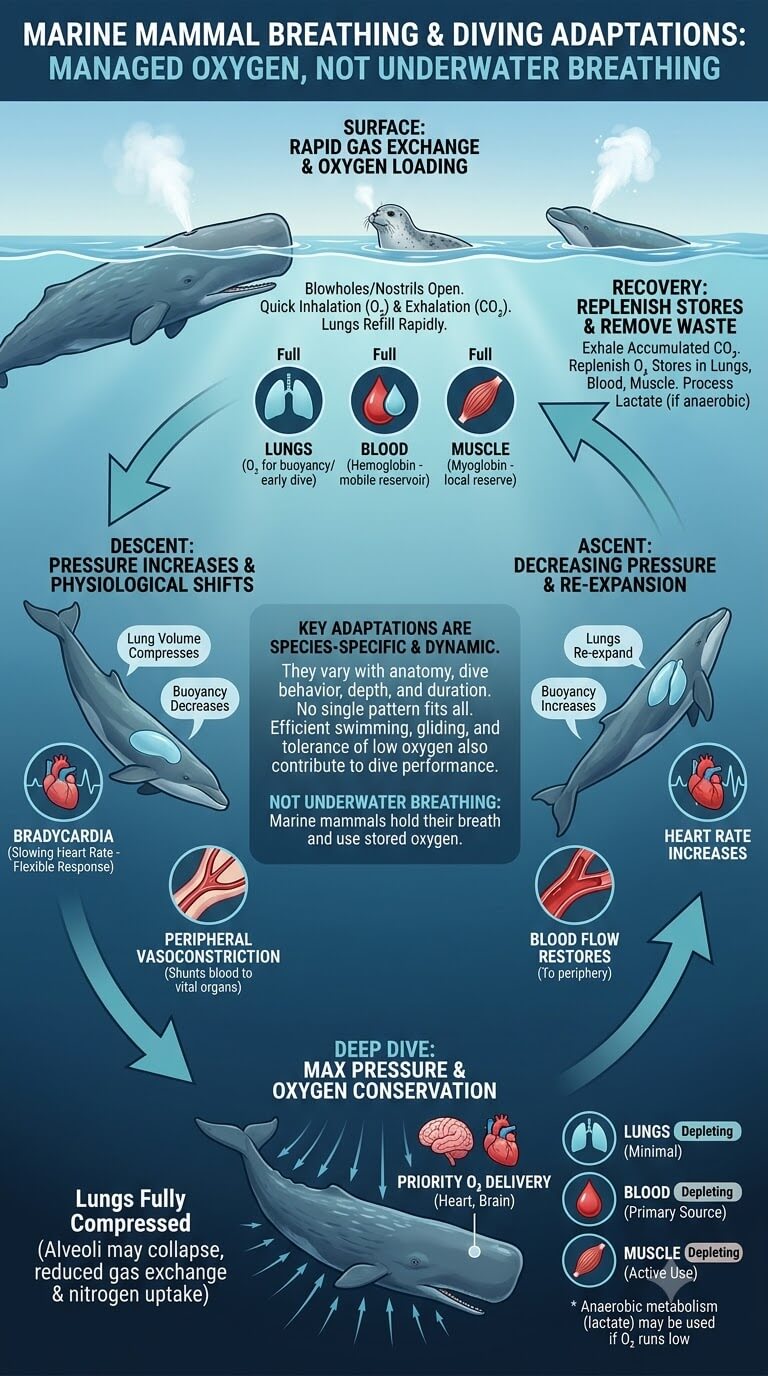
Marine mammals breathe air into lungs before or between dives. Once submerged, oxygen already inside the body supports their tissues. Hemoglobin carries oxygen in the blood, while myoglobin stores oxygen within muscle. During many dives, the cardiovascular system reduces blood flow to some tissues and adjusts heart rate so that oxygen use is matched to the animal’s activity.
Deep diving also changes the lungs themselves. Rising water pressure compresses air spaces, and in some species gas exchange becomes greatly reduced when the alveoli, the tiny gas-exchanging sacs of the lungs, compress or collapse. The depth at which this happens is not universal. It varies with anatomy, inhaled air volume, dive behavior, and species.
The Basic Challenge: Mammals Need Air but Feed and Travel Underwater
Diving creates a basic conflict. A marine mammal may need to chase prey, search the seafloor, travel, socialize, or avoid danger underwater, but every dive begins with a finite supply of oxygen. At the same time, swimming muscles continue to use energy and the brain and heart still require oxygen-rich blood.
Lungs Instead of Gills
Marine mammals inherited lungs from terrestrial mammal ancestors. Their respiratory surfaces are built to exchange gases with air rather than water. This is why even the most aquatic cetaceans must break the surface. NOAA Fisheries identifies whales as cetacean marine mammals, a group that includes whales, dolphins, and porpoises, in its overview of whales and other cetaceans.
Living in water has changed how those lungs are used, but not the fundamental requirement to breathe atmospheric oxygen. A sperm whale and a harbor seal may differ enormously in body form and dive behavior, yet neither can remain underwater indefinitely.
Surface Breathing as a Core Constraint
Time at the surface is part of the diving problem. A foraging animal gains access to prey underwater but cannot stay submerged once available oxygen and carbon dioxide balance become limiting. It must eventually interrupt the dive, surface, ventilate the lungs, and prepare for the next descent.
How Marine Mammals Breathe at the Surface

Surface breathing is not simply a pause between underwater activities. It is an active exchange period in which oxygen enters the body and carbon dioxide leaves. Marine mammals that spend most of their lives at sea have respiratory systems and breathing behavior suited to repeating that cycle many times.
Rapid Gas Exchange Between Dives
Cetaceans can move air through their respiratory system very rapidly. In controlled measurements of bottlenose dolphins, researchers recorded extremely high respiratory flow rates during voluntary and maximal breaths. The study on cetacean lung mechanics and pulmonary function showed that dolphin lungs and airways can support fast ventilation, although exact flow values from one study should not be treated as universal for every cetacean.
Blowholes in Cetaceans
Whales, dolphins, and porpoises breathe through blowholes on the top of the head. This position lets them expose only a small part of the body to air. Muscular control closes the respiratory opening while the animal is submerged and opens it for breathing at the surface.
The visible “blow” of a whale is not a fountain of seawater expelled from the lungs. It is mainly warm, moist respiratory air that cools and condenses after leaving the blowhole, sometimes mixed with droplets or seawater around the opening. The appearance of a blow varies with species, weather, viewing angle, and breathing force.
Nostrils and Breathing in Pinnipeds and Other Groups
Seals and sea lions breathe through nostrils rather than blowholes. Their nostrils remain closed during submersion and open when they surface. Because pinnipeds also spend time on land or ice, their respiratory anatomy is less externally specialized than the blowhole arrangement of fully aquatic cetaceans.
Where Marine Mammals Store Oxygen
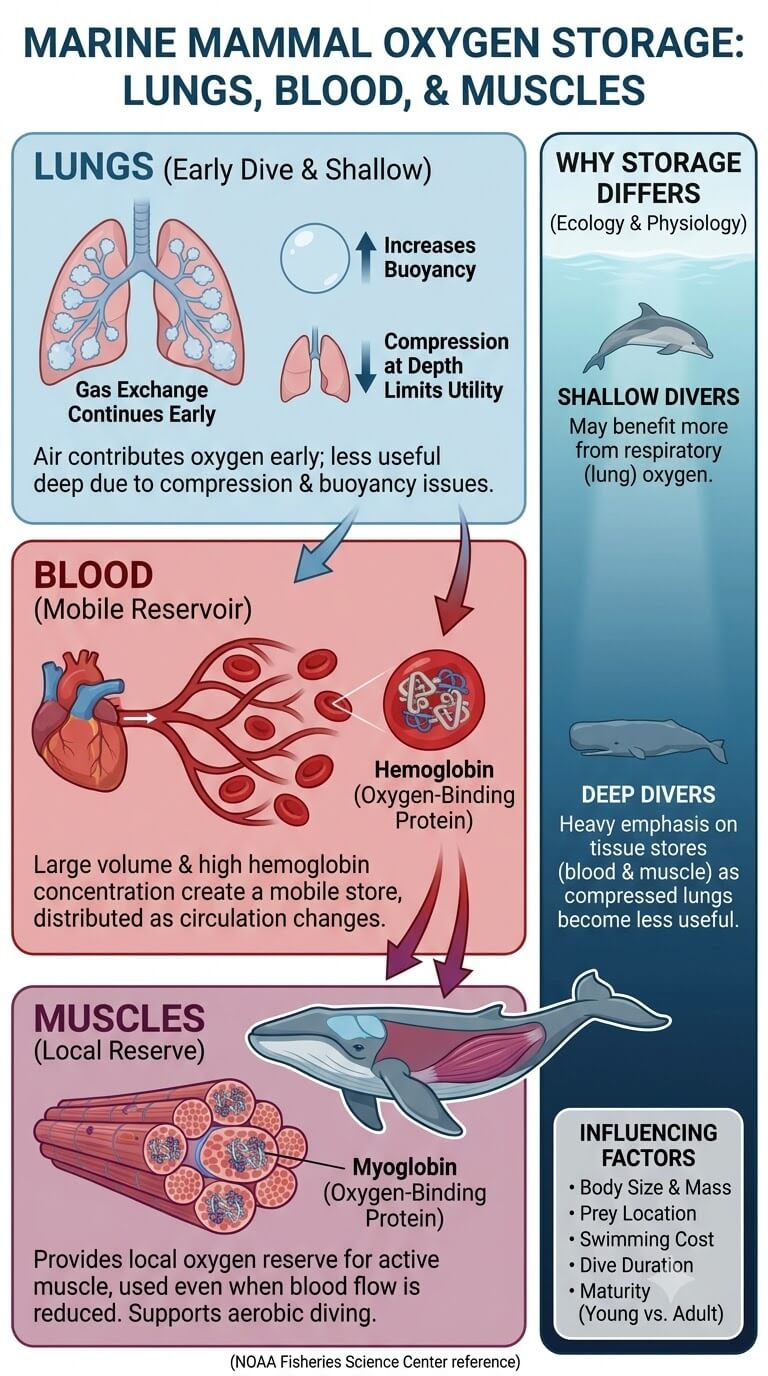
The lungs are only one part of the oxygen supply. Diving mammals also carry oxygen in the blood and muscles, and some accomplished divers depend heavily on those tissue stores. The relative importance of lungs, blood, and muscle varies among species.
Oxygen in the Lungs
Air in the lungs can contribute oxygen early in a dive while gas exchange continues. However, carrying more air is not automatically better. Air increases buoyancy near the surface, and compression at depth changes how gases move between lungs, blood, and tissues.
Blood Volume and Hemoglobin
Hemoglobin is the oxygen-binding protein inside red blood cells. Many strong marine mammal divers have large blood oxygen stores because they have substantial blood volumes, high hemoglobin concentrations, or both. Blood therefore acts as a mobile oxygen reservoir that can be distributed among tissues as circulation changes.
Muscle Myoglobin
Myoglobin is an oxygen-binding protein inside muscle cells. It gives active muscle a local oxygen reserve that can be used even when blood flow is reduced. NOAA’s Northwest Fisheries Science Center describes myoglobin as an important oxygen store supporting aerobic diving in its cetacean muscle biochemistry research.
Why Oxygen Storage Differs Among Species
There is no universal recipe for how much oxygen should sit in lungs, blood, or muscle. Deep divers often place especially heavy emphasis on tissue oxygen stores because compressed lungs become less useful for gas exchange at depth, while shallower divers may continue to benefit more from respiratory oxygen. The balance also changes as young animals grow and their muscles and blood mature.
Diving capacity reflects ecology as much as anatomy. A species that routinely makes long, deep foraging dives is under different selection pressures from one that feeds in shallow coastal water. Body size, muscle mass, blood volume, prey location, swimming cost, and how much time an animal spends diving all affect the value of different oxygen stores.
What Happens to the Heart and Circulation During a Dive
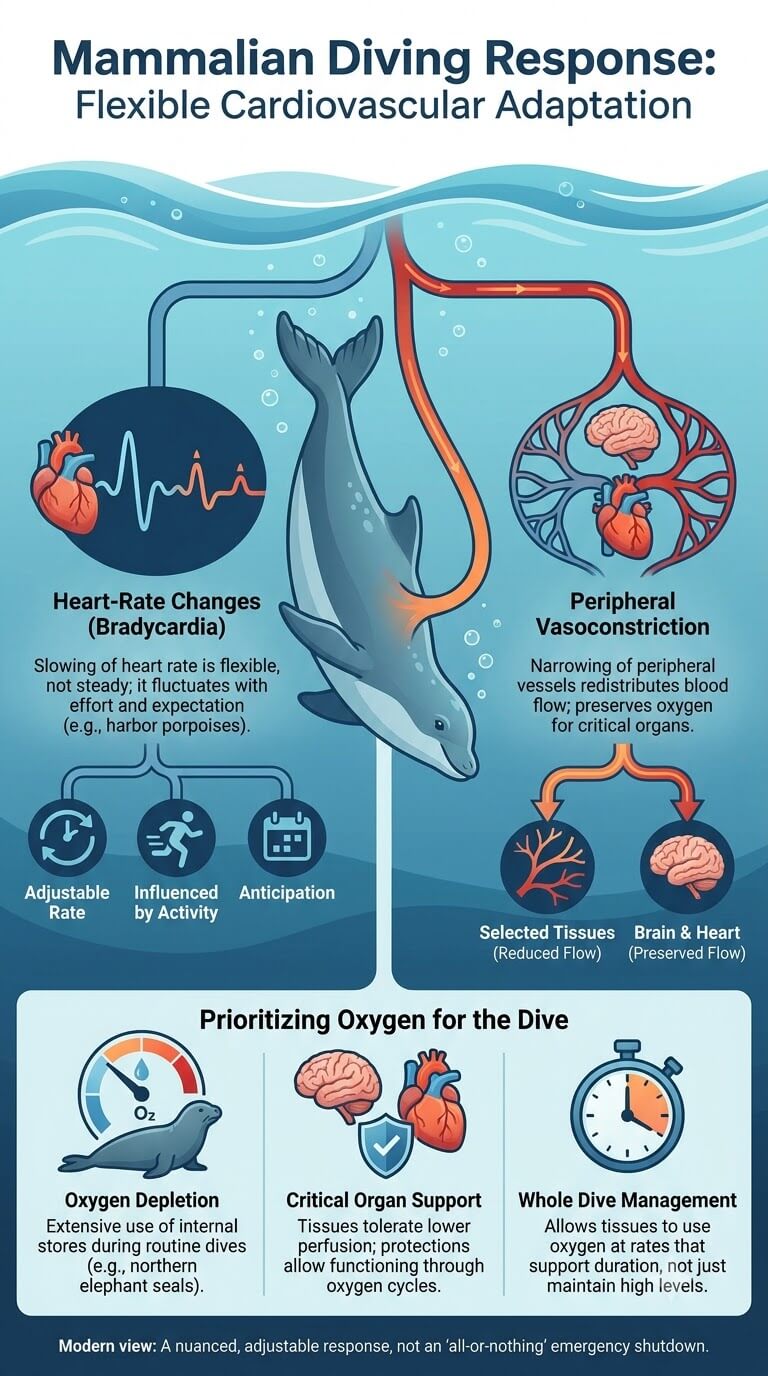
One of the best-known features of mammalian diving physiology is the dive response. It includes changes in heart rate and blood vessel tone that help control where oxygen-rich blood goes. In free-ranging or voluntarily diving animals, however, the response is flexible rather than an all-or-nothing shutdown.
The Diving Response
Older descriptions sometimes portrayed the dive response as an emergency reflex that simply shuts off blood flow to most of the body. Modern measurements show a more nuanced picture. Marine mammals can adjust cardiovascular responses depending on depth, expected dive duration, exercise, feeding, and other demands.
Heart-Rate Changes
Bradycardia means a slowing of heart rate. It is common during breath-hold diving, but heart rate does not necessarily remain steadily low throughout a dive. It can rise and fall with activity and anticipation. Experimental work showed that harbor porpoise dive heart rate was influenced by exercise and expectations, illustrating how adaptable the response can be.
Peripheral Vasoconstriction
Vasoconstriction is narrowing of blood vessels. During diving, increased resistance in peripheral vessels can reduce blood flow to selected tissues and help preserve oxygen delivery to the heart and brain. The degree of constriction can vary rather than remaining fixed.
Prioritizing Oxygen for Critical Organs
Oxygen management is not simply about keeping blood oxygen as high as possible. It is about allowing tissues to use available oxygen at rates that support the whole dive. Some organs tolerate reduced perfusion better than others, and marine mammals have physiological protections that help them function during repeated cycles of lower oxygen and restored blood flow.
Researchers studying free-diving northern elephant seals have directly measured major declines in blood oxygen during routine dives. Their work on blood oxygen depletion in elephant seals shows just how extensively some marine mammals can use their internal stores while remaining capable, active divers.
How Marine Mammals Handle Pressure
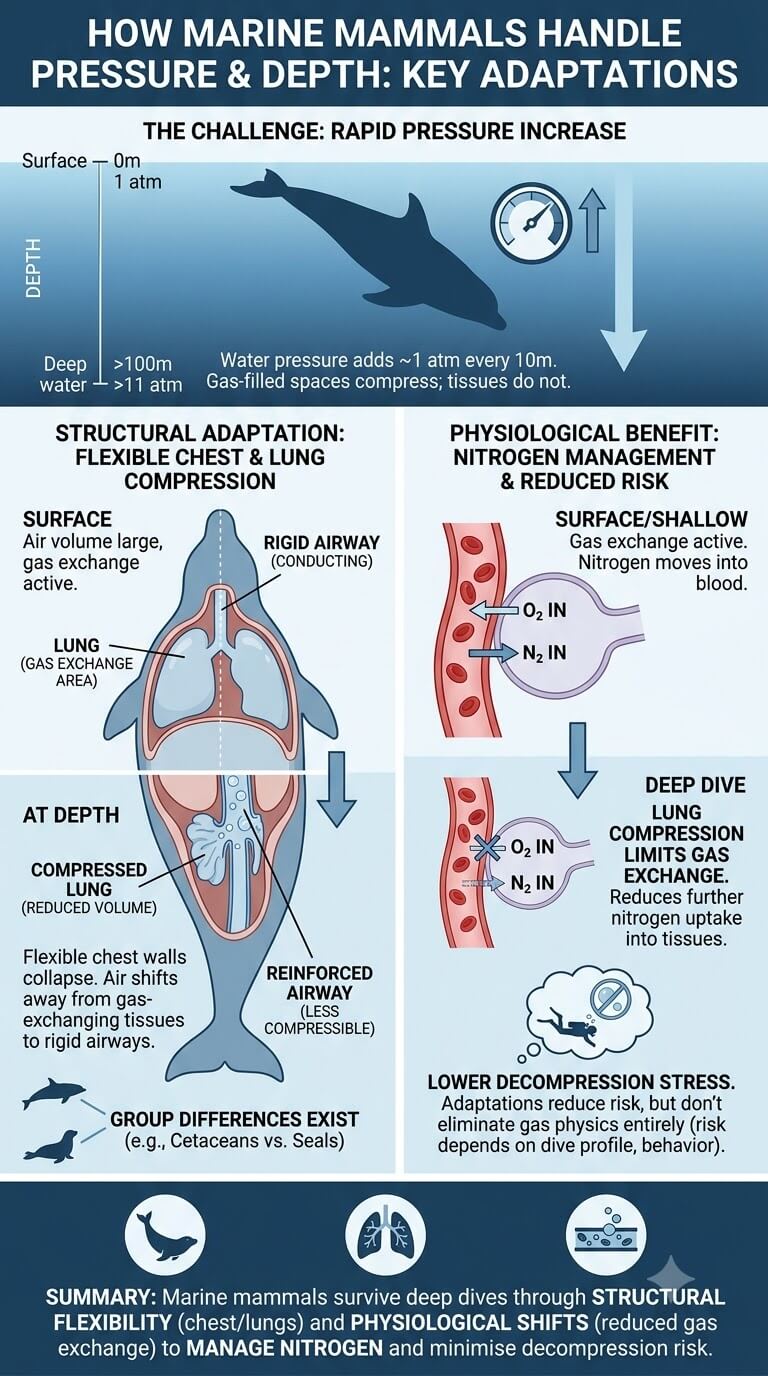
Every 10 meters or so of seawater adds roughly another atmosphere of pressure, so deep divers experience rapid compression of gas-filled spaces. Marine mammal tissues are mostly water and do not compress dramatically, but air in the respiratory tract follows different physical rules.
Compression of Air Spaces
As depth increases, lung air is compressed into a smaller volume. Flexible chest walls and respiratory tissues can accommodate substantial changes. Air may shift away from the gas-exchanging portions of the lung toward more rigid conducting airways.
Lung and Chest Adaptations
Marine mammal lungs are not simply human lungs scaled to a larger body. Structural properties of lungs, airways, and thorax differ among marine mammal groups. Cetaceans have reinforced conducting airways and highly compliant lung tissues, while seals and sea lions have their own combinations of flexible chest walls and airway structure.
When Gas Exchange Decreases at Depth
In a deep dive, compression can reduce or stop effective gas exchange in parts of the lung. A study of a free-diving California sea lion found arterial oxygen patterns consistent with major reduction of gas exchange at depth and later re-expansion during ascent. The research on lung compression in a diving sea lion also showed that the apparent collapse depth changed with dive depth, supporting the idea that inhaled air volume matters.
Nitrogen Management Without Oversimplifying Decompression Risk
Pressure affects nitrogen as well as oxygen. While pulmonary gas exchange continues, nitrogen from inhaled air can move into blood and tissues. As the gas-exchanging parts of the lung compress, that transfer can be reduced, which changes the animal’s exposure during the deepest part of a dive.
Reducing gas exchange at depth can limit further nitrogen movement from the lungs into the blood. That is one reason lung compression has long been considered important for reducing decompression stress in deep divers.
It is still too simple to say marine mammals cannot experience gas-related problems. Modern research indicates that nitrogen uptake and bubble formation depend on dive profile, repetitive diving, lung behavior, blood flow, and unusual disturbances. Their adaptations reduce risk under normal conditions, but they do not make gas physics disappear.
How Marine Mammals Use Oxygen Efficiently
Storing oxygen is only half of the solution. The animal also has to control the rate at which that oxygen is spent. Efficient locomotion, cardiovascular regulation, and tolerance of low oxygen all contribute to dive performance.
Streamlined Movement and Controlled Effort
Swimming costs energy, and the faster or harder an animal works, the faster oxygen is consumed. Many divers use prolonged gliding during parts of descent or ascent when buoyancy and body momentum make it efficient. Streamlined shapes reduce drag and lower the energy cost of forward movement.
Aerobic Dive Limits as a Physiological Concept
Aerobic metabolism uses oxygen to produce energy. If a dive remains largely aerobic, the animal can avoid accumulating large amounts of lactate from anaerobic metabolism. Scientists sometimes estimate a calculated aerobic dive limit by comparing usable oxygen stores with estimated oxygen consumption.
When Anaerobic Metabolism Becomes More Important
If oxygen delivery cannot fully meet tissue demand, some energy can be produced anaerobically. This pathway can support activity for a limited period, but it produces metabolic consequences that must be dealt with after the dive, including lactate processing.
Diving Strategies Across Marine Mammal Groups
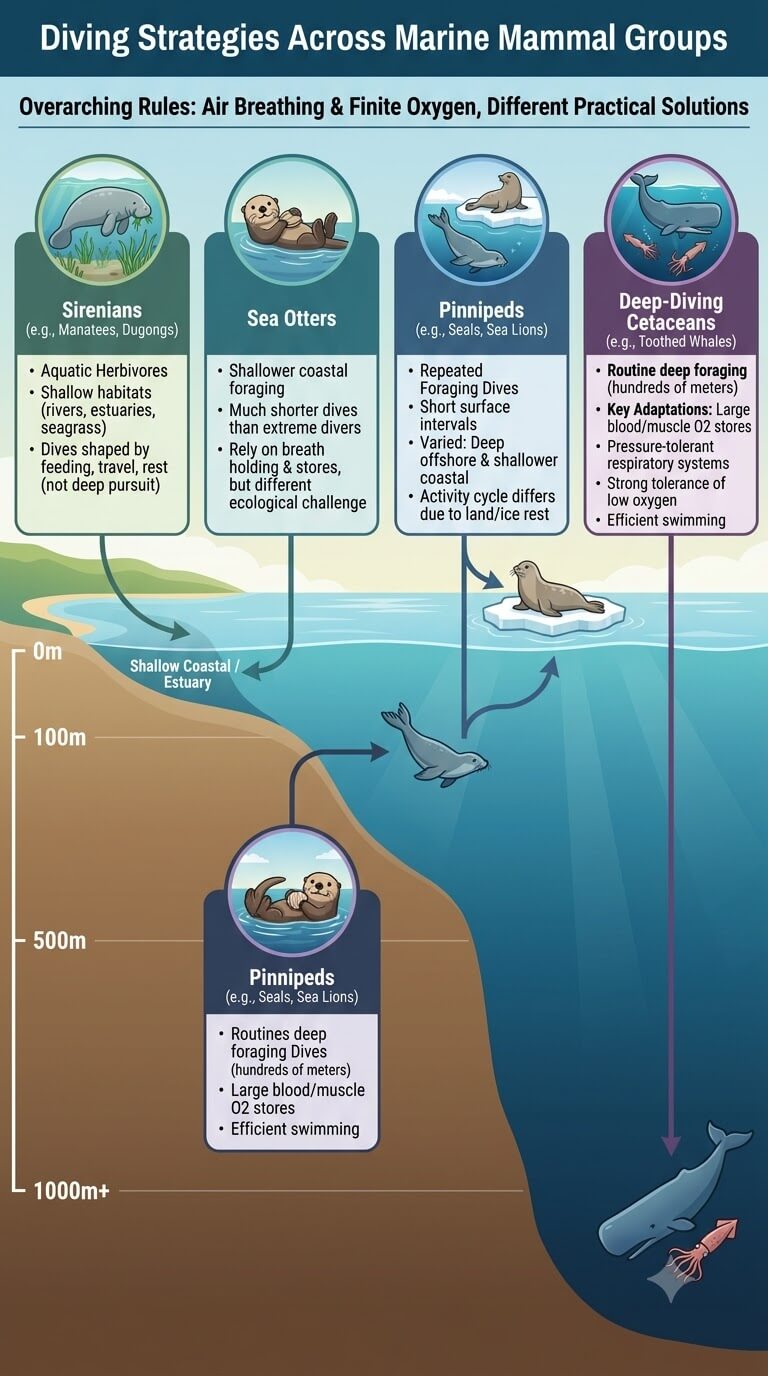
Marine mammals span a huge range of body sizes and ecological roles. Their diving physiology follows the same basic rules of air breathing and finite oxygen, but the practical solutions differ.
Deep-Diving Cetaceans
Some toothed whales routinely forage at great depths, where prey may be hundreds of meters or more below the surface. Their diving strategy emphasizes large blood and muscle oxygen stores, efficient swimming, pressure-tolerant respiratory systems, and strong tolerance of low oxygen.
Pinnipeds and Repeated Foraging Dives
Seals and sea lions often make repeated dives separated by relatively short surface intervals. Some species specialize in deep offshore foraging, while others feed in shallower coastal or shelf waters. Because pinnipeds can also rest and breed on land or ice, their overall activity cycle differs from that of fully aquatic cetaceans.
Sea Otters and Shallower Coastal Diving
Sea otters generally forage in coastal waters and make much shorter dives than extreme cetacean or seal divers. They still rely on breath holding, oxygen stores, and cardiovascular responses, but their ecological challenge is different.
Sirenians and Different Diving Demands
Manatees and dugongs are aquatic herbivores rather than deep-diving predators. Much of their activity occurs in relatively shallow rivers, estuaries, and coastal seagrass habitats. Their dives are shaped more by feeding, travel, rest, and surfacing needs than by repeated pursuit of deep prey.
Depth, Duration, and the Trade-Offs of Diving
Deep does not automatically mean long, and long does not automatically mean physiologically harder. Dive performance depends on how an animal uses its time underwater and how much energy it spends getting to, operating at, and returning from depth.
Body Size, Activity, and Oxygen Stores
Larger animals can often carry larger absolute oxygen stores, and their mass-specific metabolic rates may differ from those of smaller animals. But body size alone does not predict dive ability. Blood volume, hemoglobin, myoglobin, muscle mass, lung behavior, swimming efficiency, and ecological strategy all contribute.
Foraging Payoff Versus Recovery Time
A profitable dive must return enough benefit to justify its energy cost and time. A predator may descend far enough to reach dense prey, then limit chase time so enough oxygen remains for ascent. A benthic feeder may spend longer near the seafloor if prey is predictable and swimming costs are low.
After surfacing, the animal must restore oxygen and remove excess carbon dioxide. If a dive relied heavily on anaerobic metabolism, recovery may also involve processing accumulated lactate. These costs influence when another dive can begin.
Why Record Values Are Species-Specific
Maximum depth and breath-hold records are tempting to compare, but they can be misleading. Tags may capture an exceptional dive rather than a routine one, sample sizes may be small, and better instruments can change reported records over time.
Surfacing and Recovery
The surface interval completes the dive cycle. A marine mammal that reaches air has solved the immediate problem of access to oxygen, but its body still has to restore gas balance and prepare for whatever comes next.
Reoxygenation
Recovery does not mean that every oxygen compartment instantly returns to its pre-dive state. The respiratory system refills first, while blood and muscle oxygen are restored through continuing circulation. The pace depends on how much of those stores were used and how active the animal remains at the surface.
Fresh air replaces oxygen that was removed from the respiratory system and allows blood oxygen levels to rise again. Rapid ventilation can speed this process, while repeated breaths increase the amount of oxygen available for the next dive.
Managing Carbon Dioxide
Carbon dioxide accumulates as tissues metabolize fuel. Breath holding allows carbon dioxide levels to rise, and surfacing provides an opportunity to remove it through the lungs.
Why Breathing Patterns Vary by Species and Activity
A whale traveling steadily near the surface, a seal recovering between benthic dives, and a sea otter repeatedly collecting prey from the bottom have different activity patterns. Their breathing rhythms reflect those differences.
Common Myths and Mistakes
Diving physiology is full of simplified explanations that sound intuitive but miss important details. Three misconceptions are especially common.
Marine Mammals Do Not Breathe Underwater
Marine mammals are not using dissolved oxygen from seawater. They are holding their breath and using oxygen already stored in lungs, blood, and muscle. Even animals capable of very long dives must eventually surface.
They Do Not Simply Fill Their Lungs as Much as Possible
More air can provide respiratory oxygen, but it also changes buoyancy and gas exchange under pressure. Some marine mammals adjust inhaled volume, and some seals may dive after partial exhalation. The optimal starting volume depends on the species and the type of dive.
Not Every Species Has the Same Dive Response
Heart-rate reduction and peripheral vasoconstriction are important patterns, but their intensity varies. A foraging animal may need more blood flow to active muscle than a quietly submerged animal. Voluntary dives are physiologically dynamic.
Edge Cases and Scientific Uncertainty
Modern biologging has revealed much more about what marine mammals do underwater, but measuring physiology in a free-ranging animal remains difficult. Researchers often combine tag data, blood measurements, respiratory studies, controlled experiments, and mathematical models.
Extreme Divers
Species known for very deep or long dives receive disproportionate attention because they test the limits of mammalian physiology. Their adaptations are valuable for understanding oxygen management, but they should not be generalized to dolphins, sea lions, otters, or sirenians that live very different lives.
Young Animals and Development of Diving Ability
Calves and pups may not begin life with adult oxygen stores or adult diving skill. Myoglobin concentration, blood properties, muscle development, body composition, and experience can change as an animal grows.
Limits of Studying Free-Ranging Animals
Researchers cannot directly measure every organ during a natural dive. Instruments must be small enough not to interfere with behavior, and many physiological measurements are possible only in trained animals, temporarily handled animals, or a limited number of wild individuals.
As a result, broad mechanisms such as oxygen storage and the cardiovascular dive response are well supported, while exact values for a particular species may still have substantial uncertainty. Good explanations separate established mechanisms from record claims and model-based estimates.
How Diving Physiology Shapes Daily Life
Breathing and diving are connected to many other parts of marine mammal biology. A finite oxygen supply affects where animals can feed, how they rest, how they move through cold water, and how long they can remain away from the surface.
Thermoregulation During Dives
Blood-flow changes influence both oxygen delivery and heat transfer. Reducing circulation to peripheral tissues can help conserve oxygen, but it can also change how heat moves between the body core, skin, and flippers. Marine mammals have to manage both challenges at once.
Sleep, Surfacing, and the Need to Breathe
The requirement to breathe air also shapes rest. Cetaceans cannot simply stop surfacing for an ordinary mammalian sleep period, while pinnipeds may switch between sleeping on land and resting in water. The same need to surface for air also constrains marine mammal sleep, especially when rest occurs in water rather than on land.
FAQ
These questions address some of the most common points of confusion about marine mammal breathing and dive physiology.
Do whales breathe through their mouths?
Cetaceans breathe through blowholes, which connect to the respiratory tract. Their mouths are used for feeding rather than normal breathing. This separation is especially useful for animals that feed underwater because it reduces the need to coordinate breathing through the same opening used to capture prey.
How do marine mammals avoid running out of oxygen?
They cannot avoid oxygen depletion forever. Instead, they begin dives with oxygen stored in the lungs, blood, and muscles, then manage those stores through cardiovascular adjustments, efficient swimming, and tolerance of falling oxygen levels. A dive ends before the animal’s physiology can no longer safely support continued activity.
Does every marine mammal experience the same diving response?
No. Slower heart rate and altered peripheral blood flow are widespread components of breath-hold diving, but their strength and timing vary with species, activity, dive depth, duration, and expectation. A marine mammal can adjust its response rather than using one fixed pattern on every dive.
Final Thoughts
Understanding how marine mammals breathe and dive starts with one simple fact: they are air-breathing mammals operating in an environment where they cannot inhale. Their solution is a coordinated system rather than a single superpower. Fast surface ventilation replenishes oxygen. Hemoglobin and myoglobin expand the usable stores in blood and muscle. Heart rate and circulation shift with the demands of the dive. Flexible lungs and airways respond to pressure, while behavior determines how quickly the oxygen budget is spent. The details vary widely among whales, dolphins, seals, sea lions, otters, manatees, and dugongs, which is why species-specific evidence matters more than dramatic record numbers.

Ethan Walker is the founder and research editor of Animal Fact Central. He creates and reviews educational animal facts content using trusted wildlife, pet care, and science-based sources. His work focuses on making animal behavior, adaptations, habitats, and species facts clear, accurate, and engaging for everyday readers.
Read More Details About Ethan Walker: https://animalfactcentral.com/ethan-walker/