

Marine mammals communicate underwater mainly through sound because sound can travel efficiently through water even when visibility is poor. Whales use calls and, in some species, songs. Dolphins and other toothed whales use whistles, burst-pulsed sounds, and clicks. Pinnipeds such as seals and sea lions can vocalize both underwater and in air, while sirenians and sea otters also produce social calls. The details differ greatly among species.
One of the most important distinctions is between communication and echolocation. Communication sends information to another animal. Echolocation is an active sensing system in which an animal produces a sound and analyzes returning echoes to learn about objects or prey. A dolphin may use whistles socially and clicks for echolocation, but the two functions should not be treated as the same behavior.
Quick Answer
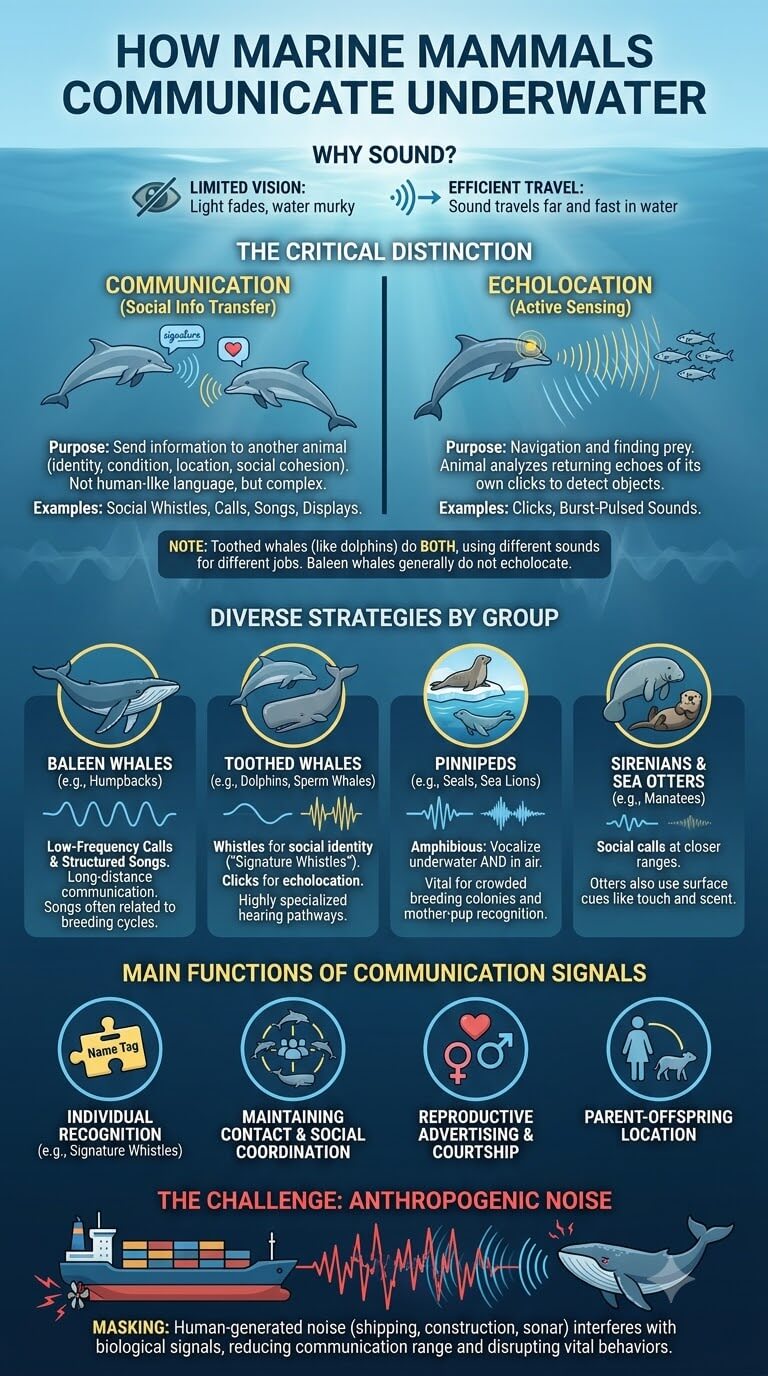
Marine mammals communicate underwater with calls, whistles, clicks, pulses, trills, barks, and other sounds. The exact signal depends on the group, the species, and the situation. NOAA Fisheries notes that baleen whales commonly produce low-frequency pulses, moans, and whoops, toothed whales produce whistles and echolocation clicks, and pinnipeds produce sounds such as growls, trills, and barks in its overview of marine mammal acoustics.
These signals can help animals maintain contact, coordinate social behavior, recognize individuals, advertise reproductive condition, locate offspring, or respond to rivals. The scientific challenge is that hearing a sound does not automatically reveal its exact meaning. Researchers must connect recordings with behavior, identity, location, and context before drawing conclusions.
Why Sound Works So Well Underwater
Ocean water often limits vision. Light fades with depth, suspended sediment can make coastal water murky, and animals may be separated by distances too large for visual signals to work reliably. Sound provides another channel.
Light Fades but Sound Can Travel Far
Sound is a vibration transmitted through a medium. In seawater, its speed and propagation depend on temperature, salinity, depth, frequency, and the surrounding environment. Some low-frequency sounds can travel long distances, while higher-frequency signals may attenuate more quickly.
This does not mean every whale call can be heard across an ocean. Communication range depends on source level, frequency, background noise, water conditions, and the receiver’s hearing. A signal may be physically detectable farther away than it remains biologically useful.
Water Changes How Animals Produce and Receive Signals
Marine mammals evolved auditory systems suited to underwater sound. Toothed whales have highly specialized pathways for receiving high-frequency sound, and their skulls contain tissues that help conduct sound toward the auditory structures. Baleen whales use a different cranial design and generally communicate at lower frequencies.
Pinnipeds face a dual challenge because many need to hear both in air and underwater. Their communication systems must work across two acoustic environments with very different physical properties.
Communication Is Not the Same as Echolocation
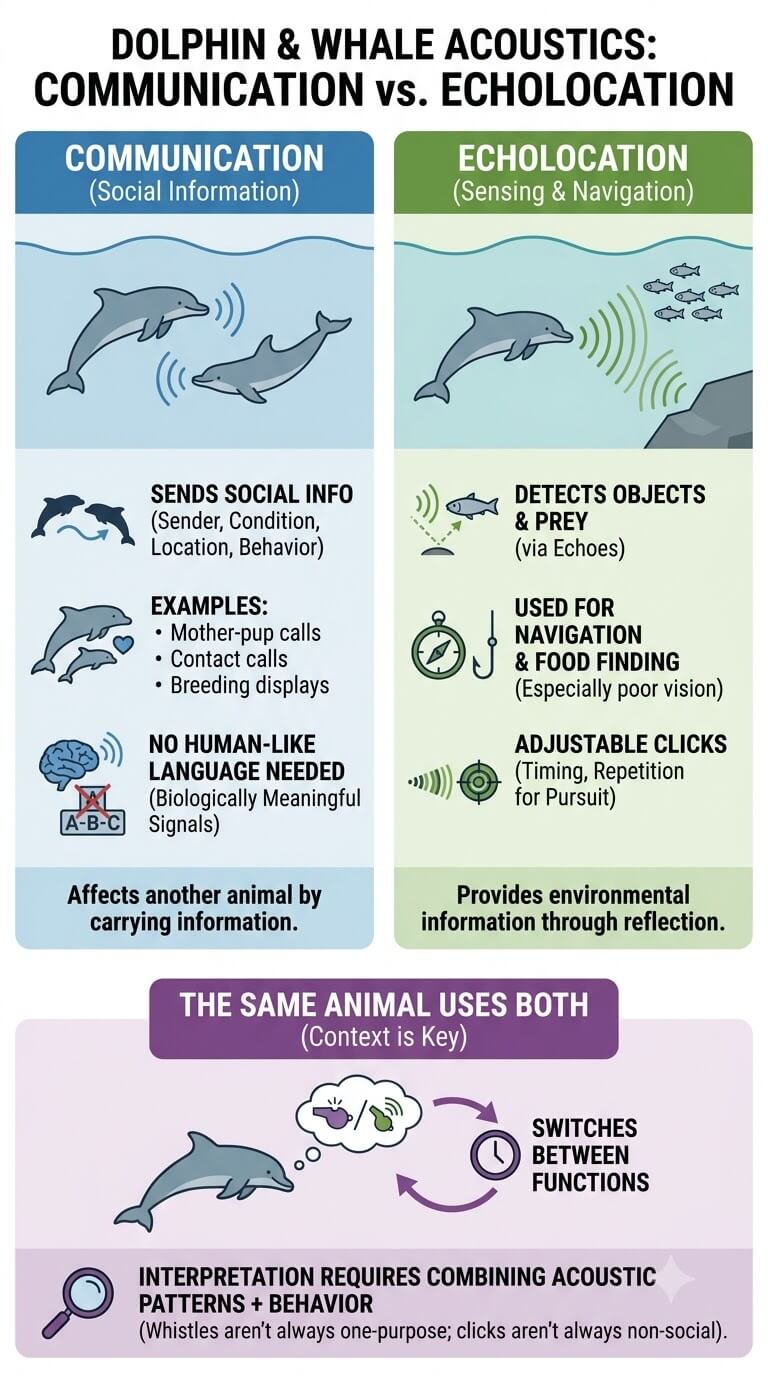
This distinction prevents one of the most common misunderstandings about dolphins and whales. A sound can be produced socially, for sensing, or for multiple functions depending on the species and context.
Communication Sends Social Information
A communication signal affects another animal by carrying information about the sender, its condition, its location, its behavior, or the social situation. A mother calling to a pup, a dolphin maintaining acoustic contact with a companion, and a breeding male producing repeated displays are all communication examples.
Researchers do not need to assume human-like words or grammar to recognize communication. Signals can be meaningful biologically without resembling human language.
Echolocation Helps Detect Objects and Prey
Echolocation works through echoes. The animal emits a click or click sequence, sound reflects from an object, and the returning echo provides information about the environment. NOAA describes odontocete echolocation clicks as part of the acoustic repertoire used for navigation and finding food.
The system is especially useful where vision is limited. Toothed whales can adjust click timing and repetition as they approach prey, producing rapid sequences during the final stages of a pursuit. This sensing role is different from broadcasting a social message to another dolphin.
The Same Animal May Use Both for Different Purposes
A bottlenose dolphin may whistle during social interactions and use clicks while searching for or approaching a target. The animal can therefore switch between communication and active sensing over short periods.
Clicks are not automatically non-social, and whistles are not automatically one-purpose signals. The safest interpretation comes from combining acoustic patterns with the behavior occurring at the same time.
Whale Calls and Songs
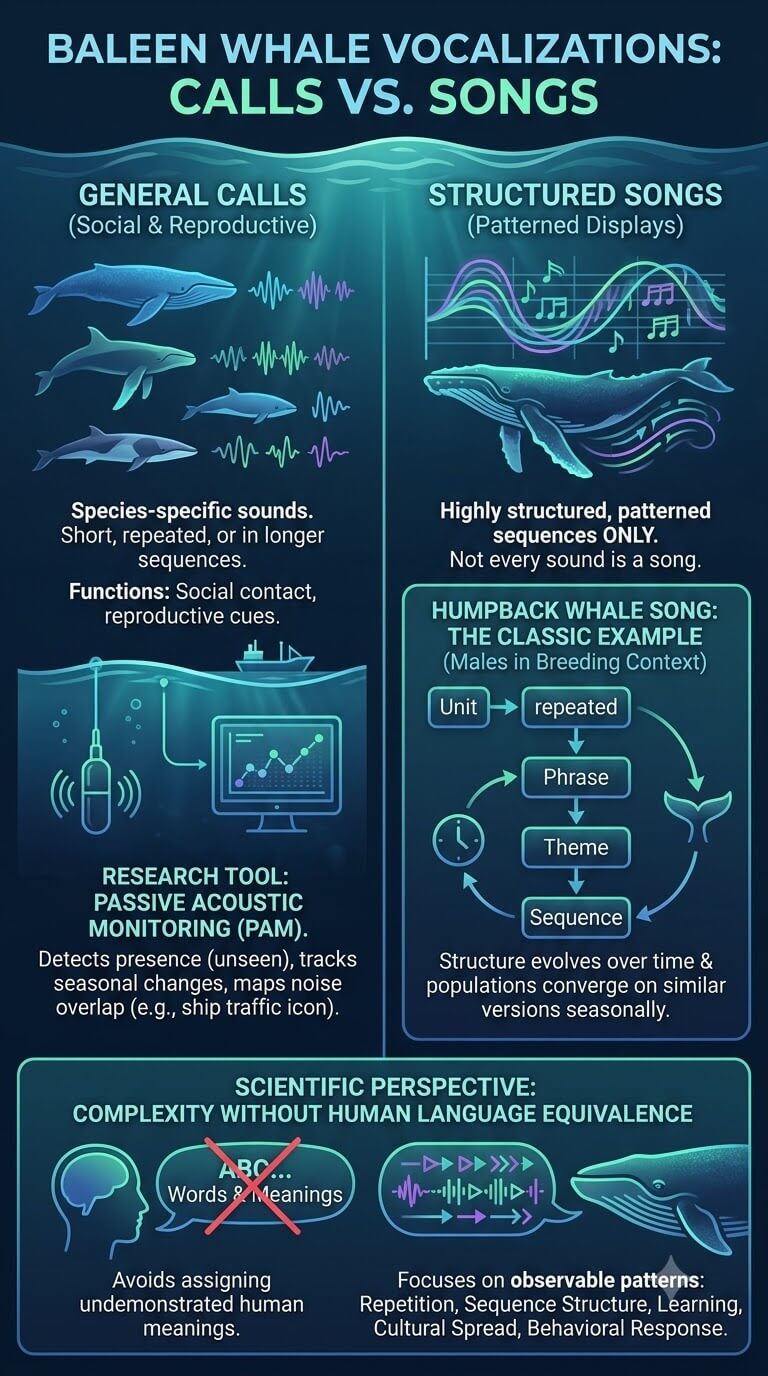
Baleen whales are among the best-known underwater vocalizers. Their sounds range from simple calls to highly structured sequences. The term song is appropriate only for particular patterned vocal displays, not for every whale sound.
Baleen Whale Vocalizations
Baleen whales produce species-specific calls that can serve social and reproductive functions. Some calls are short and repeated, while others occur in longer sequences. Researchers use these sounds not only to study behavior but also to detect whales that may be difficult to see at the surface.
Passive acoustic monitoring can reveal when vocalizing whales are present, how calling changes through a season, and where acoustic activity overlaps with ship traffic or other noise sources.
Repeated Song Patterns in Some Species
Humpback whales are the classic example of whale song. Males produce long, structured sequences made from repeated units, phrases, and themes. Song structure can change over time, and whales within a population may converge on similar versions during a season.
Song is most strongly associated with breeding contexts, but scientists continue to study its precise functions. It is safer to describe humpback song as part of a complex mating system than to claim it has one proven meaning.
Social and Reproductive Context Without Calling It Human Language
Whale vocal systems can be complex without being equivalent to human language. Repetition, sequence structure, learning, and population-level change are scientifically interesting on their own.
Researchers test specific questions such as whether a call changes with group composition, whether a song variant spreads culturally, or whether a receiver changes behavior after hearing a signal. This approach avoids assigning human meanings that have not been demonstrated.
Dolphin Whistles and Clicks
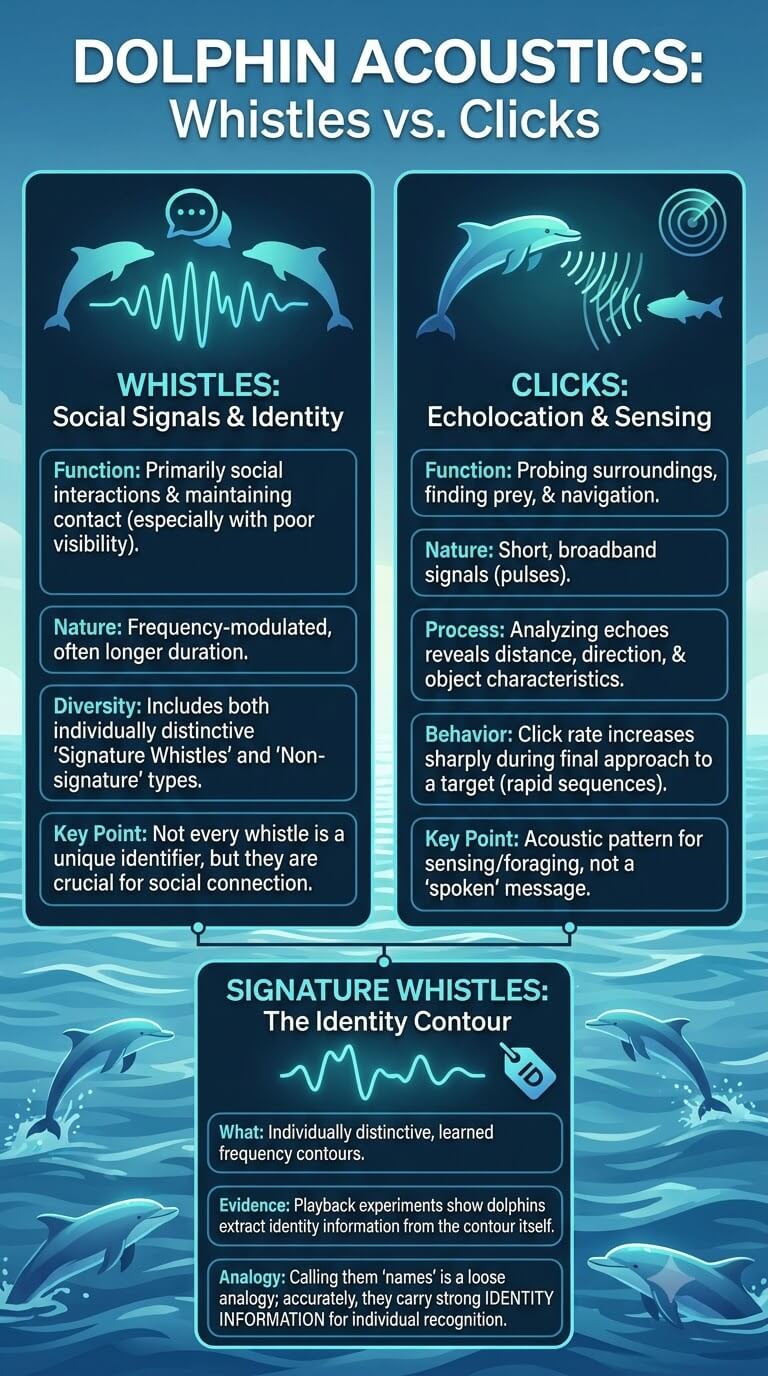
Dolphins are especially useful for understanding the difference between social calls and echolocation because both are prominent parts of their acoustic behavior.
Whistles as Social Signals
Bottlenose dolphins produce frequency-modulated whistles that are common during social interactions. These sounds can help maintain contact when animals separate or move through water where visual contact is poor.
Whistle repertoires include both individually distinctive and non-signature types. That diversity makes it inaccurate to say that every dolphin whistle is an individual identifier.
Clicks and Echolocation
Echolocation clicks are short, broadband signals used by toothed whales to probe their surroundings. By analyzing echoes, the animal can obtain information about distance, direction, and characteristics of objects or prey.
As a dolphin closes on prey, click rate may increase sharply. These rapid click sequences are often associated with the final approach to a target. The acoustic pattern is part of sensing and foraging, not simply a spoken-style message.
Signature Whistles and Individual Recognition
Bottlenose dolphins develop individually distinctive signature whistles. Playback experiments show that dolphins can extract identity information from the learned frequency contour itself, even when ordinary voice cues are removed. The peer-reviewed study on identity information in dolphin signature whistles provides strong evidence that these signals function in individual recognition.
Calling signature whistles “names” can be useful as a loose analogy, but it goes beyond what the signal literally is. Scientists can say confidently that the whistle carries identity information. Whether every human-language comparison is appropriate is a separate question.
Porpoises and Other Toothed Cetaceans
Toothed whales include dolphins, porpoises, sperm whales, beaked whales, belugas, narwhals, and several other lineages. Their acoustic systems share some broad features but differ dramatically in frequency, signal structure, and social use.
Echolocation Clicks
Porpoises are echolocating odontocetes. Some species use very high-frequency, narrow-band clicks rather than the broader click patterns familiar from many dolphins. These differences can help scientists identify groups acoustically.
Beaked whales also produce distinctive echolocation signals during deep foraging dives. Because many beaked whales are difficult to observe visually, acoustic detection is especially valuable for studying their presence and behavior.
Communication Signals
Not every toothed whale relies on a dolphin-like whistle repertoire. Sperm whales, for example, produce patterned click sequences called codas during social interactions in addition to echolocation clicks used during foraging.
The acoustic vocabulary of toothed whales is therefore diverse. Group labels such as odontocete describe ancestry and broad sensory traits, not one standardized communication system.
Why Frequency and Signal Structure Vary by Species
Body size, anatomy, habitat, hearing sensitivity, prey, group structure, and the physical environment can all shape acoustic signals. A low-frequency call designed to remain detectable over distance solves a different problem from a high-frequency echolocation click used for detailed sensing.
This is why hearing-frequency ranges should be checked species by species. One frequency value for “dolphins” or “whales” can easily become misleading.
How Pinnipeds Communicate
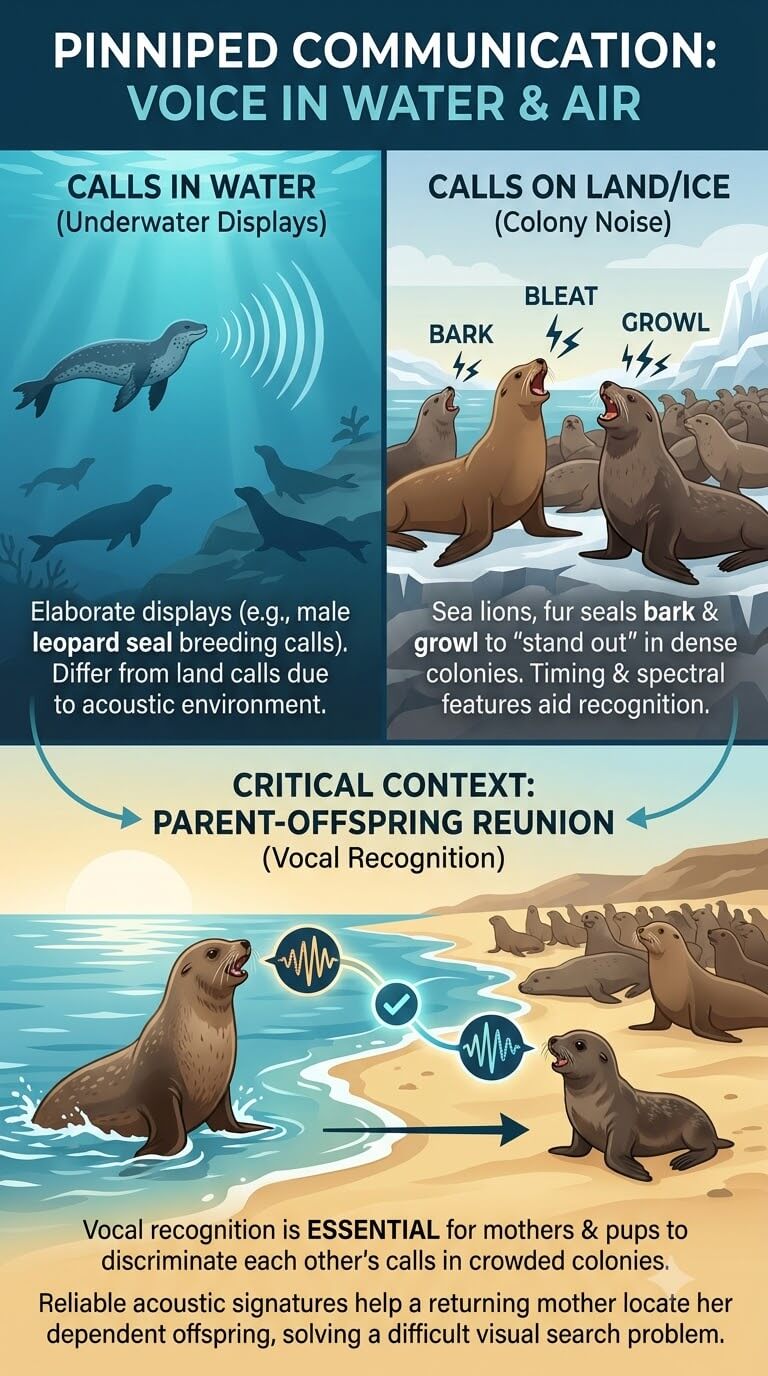
Seals and sea lions communicate in both water and air. Breeding colonies can be noisy environments, and vocal signals may help individuals locate mates, pups, mothers, or competitors among many nearby animals.
Calls in Water
Some pinnipeds produce elaborate underwater displays. Male leopard seals, for example, make repeated underwater calls during the breeding season. Other species vocalize while swimming, diving, or interacting near haul-out sites.
Underwater calls may differ from the calls an animal uses on land because the acoustic environment and social context are different.
Calls on Land or Ice
Sea lions and fur seals are well known for barking, bleating, growling, and other calls at breeding colonies. True seals also vocalize, although their repertoires and social systems differ.
Calling in dense colonies can help an animal stand out acoustically even when many bodies look similar from a distance. Signal timing and spectral features can carry information that supports recognition.
Breeding and Parent-Offspring Contexts
Vocal recognition is especially important for mothers and pups in some pinniped species. Research on fur seals shows that females and pups can discriminate one another’s calls in crowded colonies, where visual identification alone may be difficult.
This is a communication problem with immediate biological consequences. A mother returning from foraging must reunite with her own dependent offspring, and a reliable acoustic signature can help narrow the search.
Sirenians and Sea Otters Also Use Sound
Whales and dolphins dominate public discussion of underwater acoustics, but they are not the only vocal marine mammals.
Sirenian Vocal Communication
Manatees produce calls used in social contexts, including interactions between mothers and calves. Their vocalizations are generally much less powerful than the long-range calls of large baleen whales, but they can still support contact and recognition at biologically relevant distances.
Background noise matters. Research on Florida manatees has shown that changing ambient noise can affect how detectable manatee calls are, which illustrates that even relatively quiet vocal systems operate within an acoustic environment.
Sea Otter Vocal Signals
Sea otters use airborne vocalizations in social situations and may produce calls while floating at the surface. Their communication system is not built around long-range underwater song or echolocation.
For sea otters, body posture, touch, scent, and close-range vocal behavior can all contribute to social interactions. Describing this mixed communication system is more accurate than forcing every marine mammal into a whale-style acoustic model.
Different Groups Solve Different Communication Problems
A baleen whale may need a signal that travels through open water. A fur seal mother may need to recognize one pup within a crowded colony. A dolphin may need to identify companions while moving through a fluid social group. A manatee calf may need to maintain contact with its mother.
Communication systems are shaped by these different problems, which is why the most useful comparison focuses on function and context rather than asking which species has the “most advanced” language.
How Marine Mammals Recognize Individuals
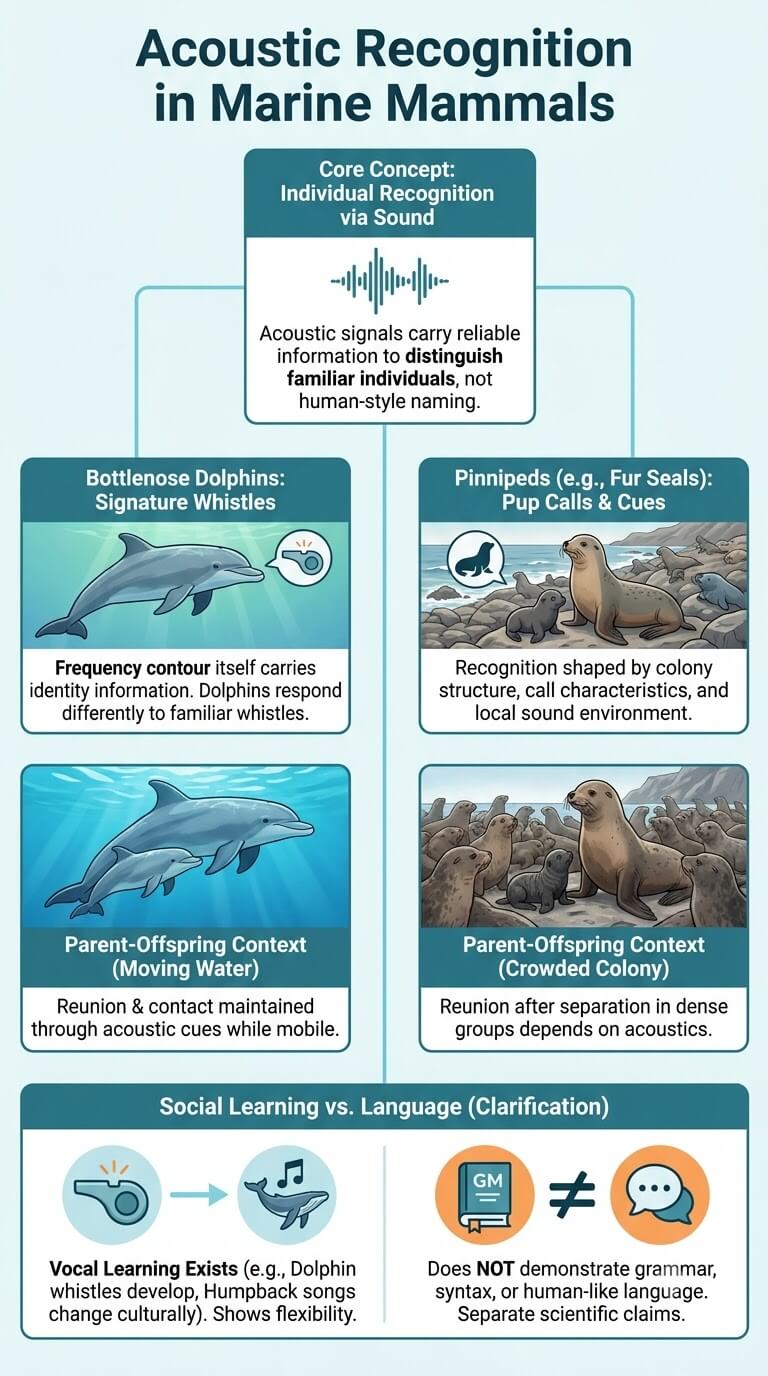
Individual recognition is one of the clearest ways sound supports social organization. It does not require human-style naming. An acoustic signal can contain enough reliable information for a receiver to distinguish one familiar animal from another.
Vocal Identity Cues
Bottlenose dolphin signature whistles are a particularly strong example because experimental work shows that the frequency contour itself carries identity information. Dolphins can respond differently to whistles associated with familiar individuals.
Pinnipeds can use different acoustic cues. A mother’s ability to recognize her pup’s call can be shaped by the species’ colony structure, call characteristics, and the local sound environment.
Parent-Offspring Recognition
Parent-offspring communication is valuable when young animals are mobile or surrounded by many similar individuals. Calls can help reunite mothers and pups after separation and help maintain contact during vulnerable early life stages.
The specific mechanism differs. A dolphin mother and calf operate in moving water, while a fur seal pair may reunite in a crowded breeding colony. Both depend on acoustic information, but the selective pressures are not identical.
Social Learning Without Overstating Language
Some marine mammals learn vocal patterns. Bottlenose dolphin signature whistles develop through vocal learning, and humpback whale songs can change culturally across populations.
Vocal learning is important evidence of behavioral flexibility. It does not by itself demonstrate grammar, syntax, or human-like language. Those are separate scientific claims requiring much more specific evidence.
How Underwater Noise Can Interfere
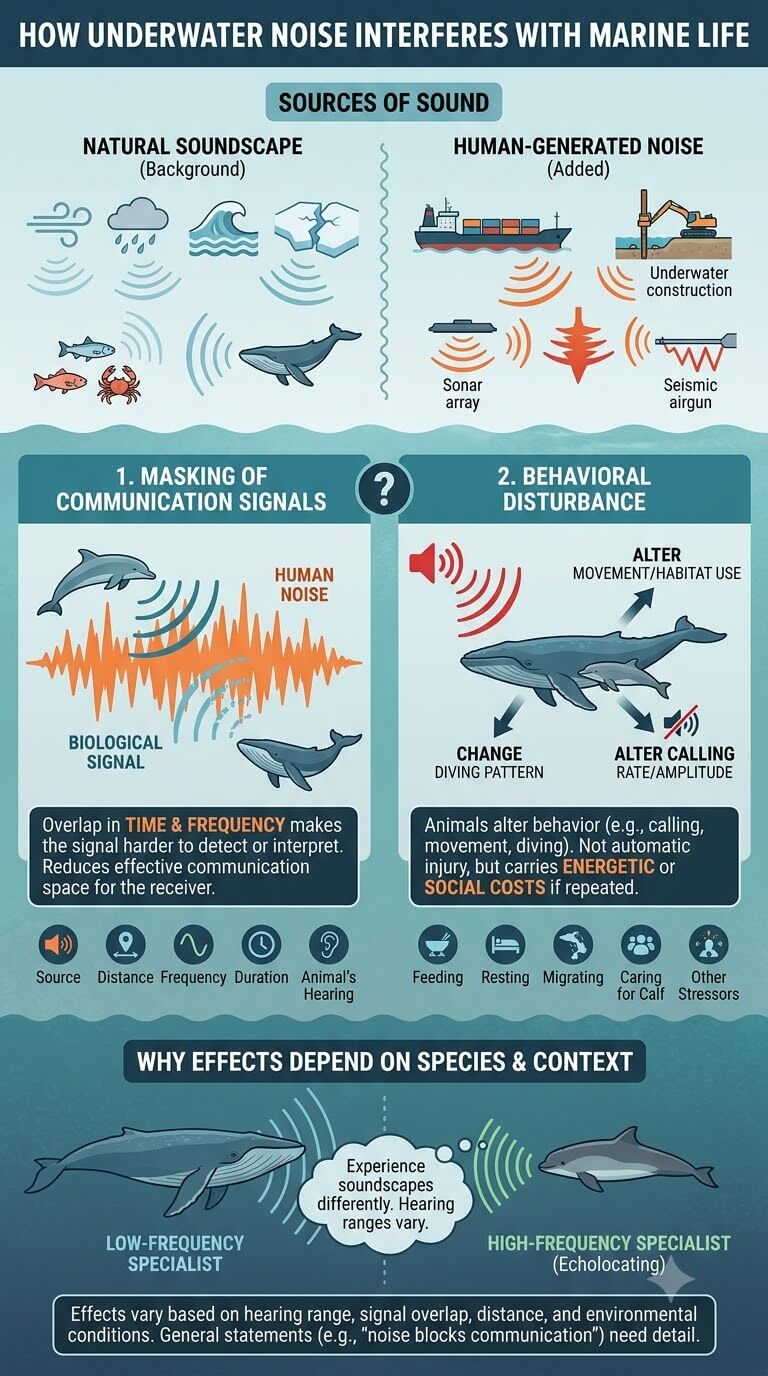
The ocean is naturally noisy. Wind, rain, waves, ice, earthquakes, fish, crustaceans, and other marine animals all contribute sound. Human activities add vessel noise, construction, sonar, seismic sources, and other signals.
Masking of Communication Signals
Masking occurs when background sound makes another signal harder to detect or interpret. If human-generated sound overlaps a marine mammal call in time and frequency, the receiver may have less effective communication space.
NOAA explains that anthropogenic ocean noise can interfere with the ability of marine animals to hear biologically important sounds in its guidance on ocean noise and marine life. The effect depends on the source, distance, frequency, duration, and the animal’s hearing.
Behavioral Disturbance
Animals may alter calling rate, call amplitude, movement, diving, or habitat use when exposed to noise. A behavioral response is not automatically proof of injury, but it can still carry energetic or social costs if important activities are interrupted repeatedly.
Responses are context-dependent. The same sound may produce different effects depending on whether an animal is feeding, resting, migrating, caring for a calf, or already exposed to other stressors.
Why Effects Depend on Species and Context
Marine mammals do not hear the same frequency ranges equally well. A low-frequency baleen whale and a high-frequency echolocating porpoise experience a soundscape differently.
That is why statements such as “ship noise blocks whale communication” need detail. Noise may mask some signals strongly, have little overlap with others, or cause effects that vary with distance and environmental conditions.
How Scientists Study Marine Mammal Sounds
Scientists need to know not only what sound was recorded, but who produced it and what was happening at the time.
Hydrophones
A hydrophone is an underwater microphone. Researchers deploy individual hydrophones, arrays, autonomous recorders, drifting systems, or animal-borne tags to capture sound.
Long-term passive acoustic monitoring can detect vocal species through darkness, bad weather, and seasons when visual surveys are difficult. NOAA describes sound as a key tool for locating and studying marine mammals in its Sounds in the Ocean marine mammal resource.
Tags and Behavioral Observation
Tags can record sound together with depth, acceleration, orientation, and movement. When researchers combine these data with visual observations, they can ask whether a call occurred during feeding, social contact, travel, courtship, or another behavior.
This contextual approach is essential because similar-looking signals may have different functions, and one signal type may occur in multiple situations.
Matching Sounds to Behavioral Context
Playback experiments provide another method. Researchers can broadcast controlled sounds and measure whether an animal approaches, changes behavior, or shows recognition.
These studies require careful ethical and experimental design because sound exposure itself can influence behavior. Strong conclusions usually come from converging evidence rather than one recording or one reaction.
Common Myths and Mistakes
Marine mammal acoustics is often described with human-language metaphors that are memorable but too confident.
Echolocation Is Not the Same as Communication
Echolocation is active sensing through emitted sounds and returning echoes. Communication is information transfer between animals. A dolphin can do both, sometimes within the same behavioral sequence.
Not All Whales Echolocate
Toothed whales use echolocation. Baleen whales produce many important acoustic signals, but they are not generally considered echolocating animals in the same established sense as dolphins, porpoises, sperm whales, and other odontocetes. The acoustic contrast is especially useful within cetaceans because whales, dolphins, and porpoises do not all use sound in the same way.
Claims that humpback song is sonar remain hypotheses rather than a settled explanation of baleen whale song.
Complex Communication Does Not Automatically Mean Human-Like Language
Marine mammals can learn calls, recognize individuals, copy signals, and produce complex sequences. Those abilities are impressive without needing to call them sentences or conversations.
Scientists can test identity coding, turn-taking, sequence structure, learning, and context directly. Claims about grammar or language require additional evidence and should not be inferred simply from acoustic complexity.
Where the Evidence Is Still Limited
Researchers have recorded marine mammals for decades, yet interpreting meaning remains harder than detecting sound.
Interpreting Meaning From Recorded Calls
A spectrogram can show frequency, duration, rhythm, and repetition, but it does not translate a signal. Meaning has to be inferred through experiments and repeated behavioral associations.
For some well-studied signals, such as bottlenose dolphin signature whistles, functions are strongly supported. For many other call types, scientists can describe when and where they occur without claiming to know a precise message.
Species Differences in Hearing and Production
Hearing sensitivity and vocal production vary widely among marine mammals. Even closely related species may use different frequencies or repertoires.
Researchers therefore build species-specific audiograms, sound catalogs, and behavioral datasets rather than assuming one acoustic profile represents an entire group.
Why Frequency Ranges Need Species-Specific Sources
Frequency numbers are easy to copy into fact lists but easy to misuse. A range reported for one dolphin species, one call type, or one testing method may not apply to another.
For a general explanation, signal categories are usually more useful than a long list of exact kilohertz values. Precise numbers belong where a species-specific source and context make them meaningful.
Sound Shapes Social Life and Survival
Underwater communication connects directly with feeding, movement, reproduction, parental care, and conservation. Sound is not an isolated ability. It is part of how marine mammals operate in an environment where visual contact can disappear quickly.
Communication and Sensory Biology Work Together
A toothed whale may listen for companions, echolocate toward prey, and monitor environmental sounds during the same dive. Baleen whales may use calls while traveling through areas where individuals are separated by substantial distances.
The auditory system must therefore support both social information and environmental awareness, although the balance differs by lineage.
Acoustic Habitat Can Be Altered by Human Activity
When background noise changes, the useful distance of a call may shrink, or an animal may alter when and how it vocalizes. This makes acoustic habitat part of marine mammal conservation.
The consequences cannot be summarized as one universal noise threshold. Species, signal frequency, sound source, exposure duration, distance, behavioral state, and local acoustics all influence risk.
FAQ
These questions address common confusion about whale sounds, dolphin echolocation, and pinniped hearing.
Do whales talk to each other?
Whales communicate with one another using species-specific calls and, in some species, structured songs. The word “talk” is acceptable as a casual analogy, but it should not imply that whale communication has been shown to use human-like words, grammar, or sentences. Researchers can demonstrate communication and signal functions without making that stronger claim.
Do dolphins use echolocation to communicate?
Echolocation is primarily a sensing system based on emitted clicks and returning echoes. Dolphins also produce social whistles and other sounds for communication. Acoustic behaviors can overlap in time, and some clicks may occur in social situations, but echolocation and communication are biologically different functions.
Can seals hear underwater?
Yes. Pinnipeds have auditory systems capable of functioning underwater, and many species also hear in air. Their sensitivity differs by species and environment. That dual capability fits their amphibious lifestyle, in which feeding and travel may happen underwater while breeding, resting, or social interactions can occur on land or ice.
Final Thoughts
How marine mammals communicate underwater depends on the animal and the problem it needs to solve. Baleen whales use calls and, in some species, elaborate songs. Dolphins use whistles for social communication and clicks for echolocation, with signature whistles providing a well-supported example of individual identity coding. Pinnipeds vocalize in both aquatic and terrestrial settings, often using calls for breeding or parent-offspring recognition. Sirenians and sea otters also use sound, although their systems are less dominated by long-range underwater acoustics. Across these groups, the safest scientific approach is to separate communication from echolocation, distinguish proven functions from appealing language analogies, and recognize that noise can alter an animal’s acoustic environment without affecting every species in the same way.

Ethan Walker is the founder and research editor of Animal Fact Central. He creates and reviews educational animal facts content using trusted wildlife, pet care, and science-based sources. His work focuses on making animal behavior, adaptations, habitats, and species facts clear, accurate, and engaging for everyday readers.
Read More Details About Ethan Walker: https://animalfactcentral.com/ethan-walker/