
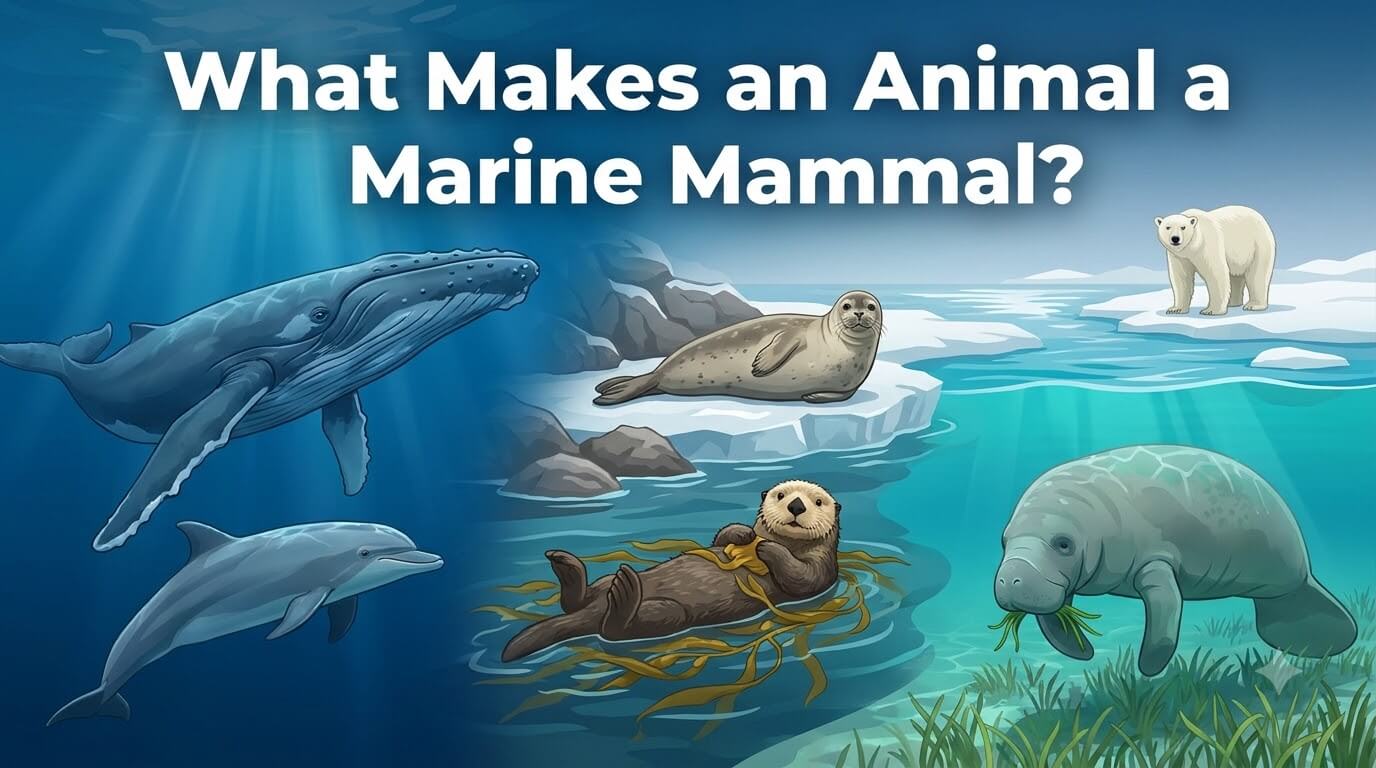
A marine mammal is a mammal whose life depends strongly on the ocean or other aquatic environments. That definition includes animals that never need to come ashore, such as whales and dolphins, as well as animals that divide their lives between water and land or ice, such as seals and sea lions. It also includes groups with very different evolutionary histories, including manatees, dugongs, sea otters, walruses, and polar bears.
The important point is that marine mammal is an ecological description, not a single taxonomic rank. These animals are united by how much they depend on aquatic habitats, not because they all belong to one close branch of the mammal family tree. NOAA Fisheries describes marine mammals as mammals that rely on the ocean to survive and notes that some are fully aquatic while others return to land or ice for parts of their lives in its overview of marine mammal protection.
That creates an interesting biological combination. Marine mammals still carry the defining features of mammals, including lungs, air breathing, internal heat production, mammary glands, and hair at some stage of development. At the same time, different lineages have evolved very different ways to swim, conserve heat, find food, dive, rest, reproduce, and move between aquatic and terrestrial environments.
Quick Answer
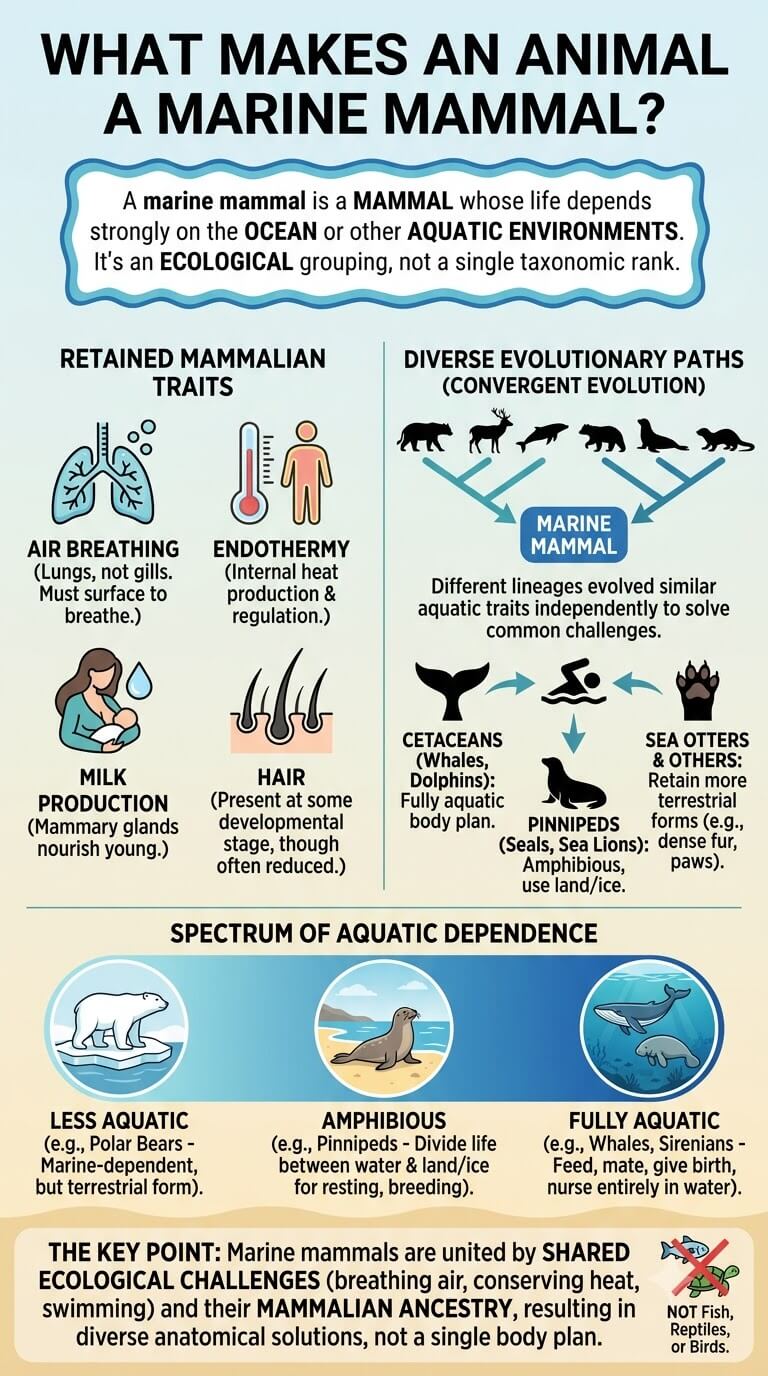
What makes an animal a marine mammal is not simply that it can swim or that it lives near the sea. A marine mammal must first be a mammal, and it must also depend substantially on marine or aquatic ecosystems for important parts of its life.
Whales and dolphins represent the fully aquatic end of the spectrum. They feed, travel, mate, give birth, and nurse their young in the water. Pinnipeds, the group that includes seals, sea lions, and walruses, spend much of their lives at sea but usually use land or ice for resting, breeding, molting, or giving birth. Sea otters are even more closely tied to coastal water than most other otters, yet their anatomy still looks much more like that of a furry mustelid than a streamlined whale. Manatees and dugongs are fully aquatic herbivorous mammals, while polar bears are terrestrial in body form but depend heavily on marine food webs and sea ice.
This range of lifestyles is why there is no single body shape, swimming method, or insulation system that defines every marine mammal.
Why the Definition Is More Complicated Than It Sounds
Marine Mammal Is an Ecological Grouping
Biologists classify animals taxonomically by evolutionary relationships. Mammals belong to the class Mammalia, but marine mammals are spread across several mammalian orders and families. The term therefore works more like an ecological label: it gathers together mammals that face many of the same environmental problems because they depend on water, especially marine water.
Those problems include breathing air while feeding underwater, reducing heat loss in water, moving efficiently through a dense medium, finding prey or vegetation in aquatic habitats, and reproducing while living partly or entirely in water. Different groups solve these problems in different ways.
This distinction matters because grouping animals by habitat can create false impressions about relatedness. A seal and a dolphin are both marine mammals, but a seal is not a close type of dolphin. A sea otter is a marine mammal, but it remains part of the weasel family. A manatee is not a seal, even though both can be large, rounded, and aquatic.
It Is Not a Single Branch of the Mammal Family Tree
The ancestors of major marine mammal groups entered aquatic environments independently. Cetaceans, pinnipeds, and sirenians are classic examples of separate mammalian lineages that evolved many similar aquatic traits under similar environmental pressures. Comparative genomic research describes these lineages as an important case of convergent evolution in marine mammals.
Convergent evolution occurs when distantly related organisms independently evolve similar features because they face similar challenges. Streamlined bodies are an obvious example. Sharks, dolphins, and extinct marine reptiles can all have body shapes that reduce drag in water, but that similarity does not mean they share a recent common ancestor with that same body form.
The same logic applies within marine mammals. Whales evolved a fully aquatic body plan along one evolutionary path. Seals and sea lions retained the ability to move and reproduce on land or ice. Sea otters entered marine life much more recently and rely heavily on dense fur rather than the thick blubber typical of many cetaceans and pinnipeds. Similar habitat pressures can therefore produce overlapping solutions without making the animals one taxonomic group.
The Mammalian Traits Marine Mammals Still Have
Lungs and Air Breathing
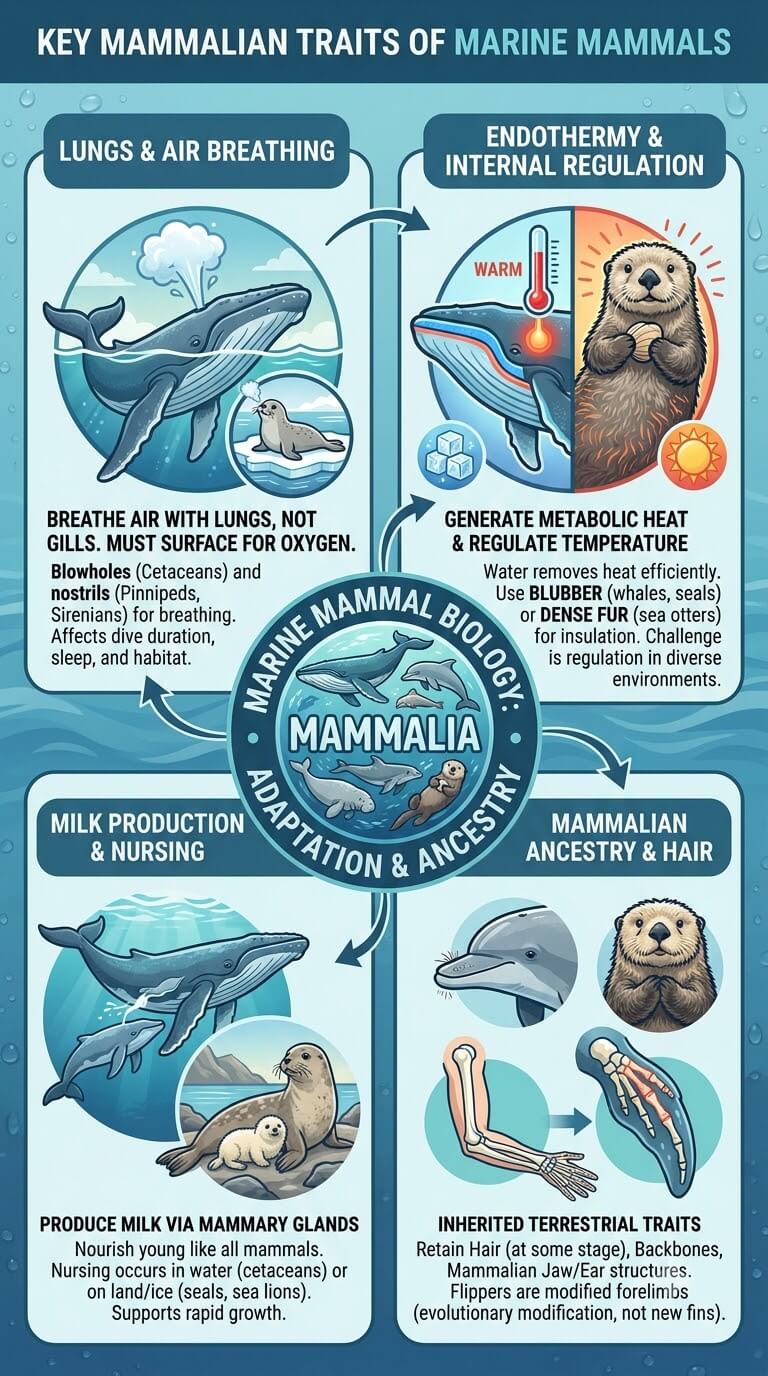
Marine mammals breathe with lungs, not gills. No matter how specialized they become for aquatic life, they must obtain oxygen from the atmosphere. A whale may spend long periods below the surface, but it must eventually return to breathe. A seal can sleep or forage underwater, but it also relies on air. A manatee has to surface even though its entire life can be spent in water.
Air breathing shapes nearly every part of marine mammal life. It affects dive duration, feeding strategy, sleep, migration, predator avoidance, and where an animal can rest. Cetaceans have nostrils modified into blowholes on the top of the head, which allows them to breathe at the surface without lifting the entire face out of the water. Pinnipeds, sea otters, and sirenians retain different external arrangements, but the underlying requirement is the same: oxygen must come from air.
Endothermy and Internal Temperature Regulation
Marine mammals are endothermic, meaning they generate much of their body heat metabolically and regulate internal temperature within a functional range. This is one of the reasons aquatic life can be so demanding. Water removes heat from a warm body much more efficiently than air, especially when the surrounding water is cold.
Different groups reduce that heat loss in different ways. Many whales, seals, and sea lions use substantial layers of fat called blubber. Sea otters rely far more on exceptionally dense fur that traps insulating air. Body size, blood flow, metabolism, posture, activity, and habitat choice can also influence heat balance.
Endothermy does not mean marine mammals are unaffected by temperature. Warm-water species can be limited by cold conditions, while heavily insulated animals can face overheating when they are active on land. The challenge is regulation, not simply staying as warm as possible.
Milk Production and Nursing
The defining feature behind the word Mammalia is the presence of mammary glands. Female marine mammals produce milk for their young, just as terrestrial mammals do. Nursing may happen entirely in the water in whales and dolphins, while many seals and sea lions nurse pups on land or ice.
For fully aquatic cetaceans, reproduction has to work without a nest, den, or stable shoreline. Newborns must begin functioning in a three-dimensional water environment immediately, including surfacing to breathe. Smithsonian Ocean notes that whales share basic mammalian traits such as breathing air, having hair, and producing milk for young in its explanation of whale anatomy and physiology.
The exact nursing pattern varies greatly among species. The common thread is not where nursing occurs but that mothers nourish their young with milk produced by mammary glands.
Mammalian Ancestry, Hair, and Other Inherited Traits
Hair can be easy to overlook on a whale, yet hair is part of mammalian biology. Mammals have hair at some stage of development, even when adults later retain only small amounts. Cetaceans are a good example: many have very little visible hair as adults because blubber has become more important for insulation.
Other inherited mammalian features remain as well. Marine mammals have backbones, mammalian jaw and ear structures, and lungs that reflect their terrestrial ancestry. Their flippers are not equivalent to fish fins in an evolutionary sense. In whales, for example, the front flippers are modified forelimbs with the same deep skeletal origin as the forelimbs of other mammals.
Evolution modifies existing structures rather than designing an animal from scratch. A whale flipper, a seal flipper, and a sea otter forepaw reveal different histories even though all can contribute to swimming.
How Dependent Must an Animal Be on the Marine Environment?
Fully Aquatic Marine Mammals
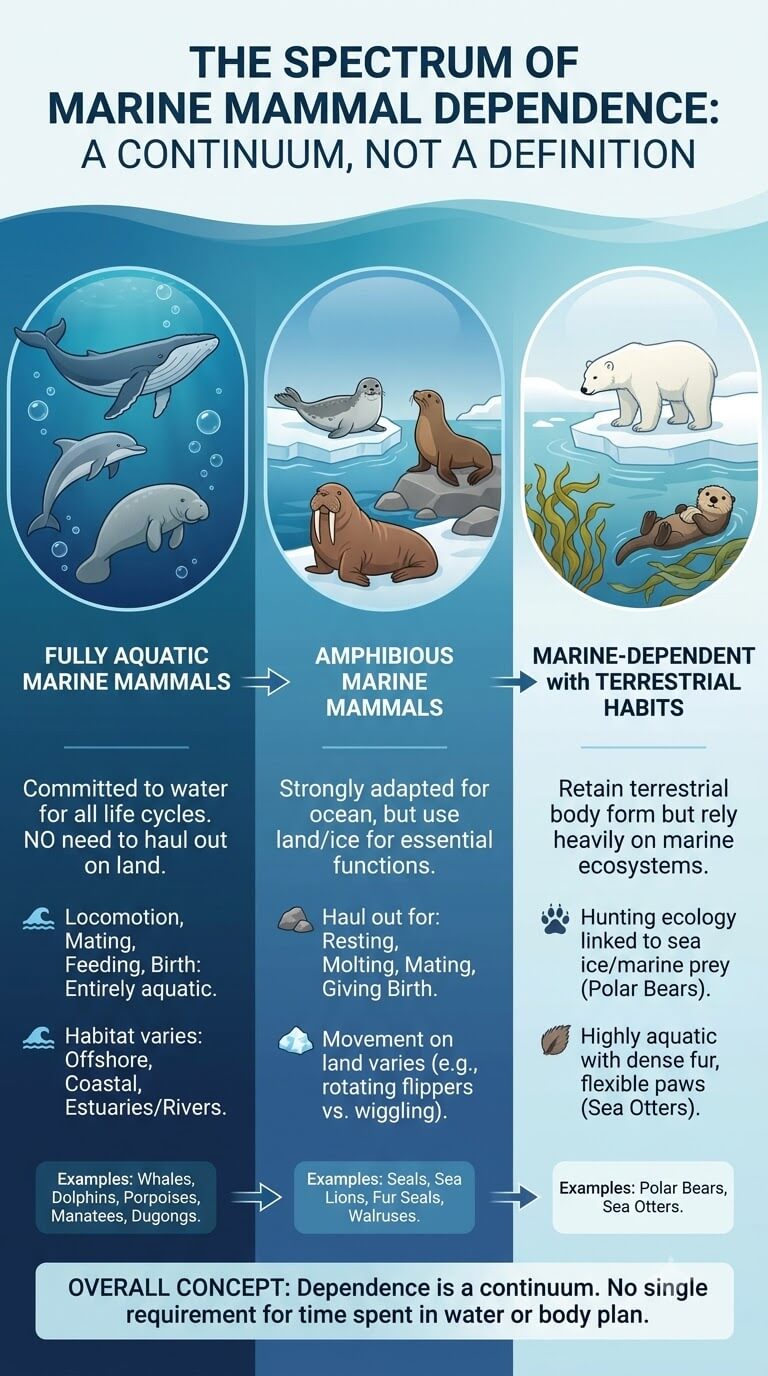
Whales, dolphins, porpoises, manatees, and dugongs are among the clearest examples of mammals whose bodies and life cycles are committed to water. They do not normally need to haul out on land to rest or give birth. Their locomotion, mating, feeding, and parental care all function in aquatic environments.
Even within this category, however, habitat is not identical. Some cetaceans live offshore, some favor continental shelves or coastal waters, and some live in estuaries or rivers. Sirenians are generally associated with shallower aquatic habitats where plant food is available. Fully aquatic therefore describes dependence on water, not one universal ocean habitat.
Amphibious Marine Mammals That Use Land or Ice
Pinnipeds show why a simple land-versus-water definition fails. Seals, sea lions, fur seals, and walruses are strongly adapted for feeding and moving in the ocean, but they still make important use of land or ice. Many haul out to rest, molt, mate, or give birth.
Smithsonian Ocean’s overview of seals, sea lions, and walruses illustrates how pinniped anatomy works in both settings. Sea lions and walruses can rotate their rear flippers beneath the body for more effective movement on land, while true seals move very differently ashore.
Their time on land does not make them less legitimately marine mammals. Their feeding ecology, swimming adaptations, insulation, and much of their daily activity remain tied to marine environments.
Marine-Dependent Mammals That Retain More Terrestrial Habits
At the other end of the dependence spectrum are mammals that retain a more familiar terrestrial body form but still depend heavily on marine ecosystems. Polar bears are the clearest example in most broad marine mammal definitions because their hunting ecology is strongly connected to sea ice and marine prey.
Sea otters occupy a different position. They are highly aquatic and spend much of their lives in coastal marine water, but they still have a mustelid body plan, flexible paws, and extremely dense fur rather than a whale-like shape. Smithsonian researchers describe the sea otter as almost entirely aquatic and emphasize its unusual fur-based insulation in a National Zoo account of sea otter adaptation and evolutionary history.
These examples show why marine dependence is best understood as a continuum. There is no requirement that every member spend the same percentage of time in water or use the same body plan.
Why Whales, Seals, Manatees, and Sea Otters All Qualify
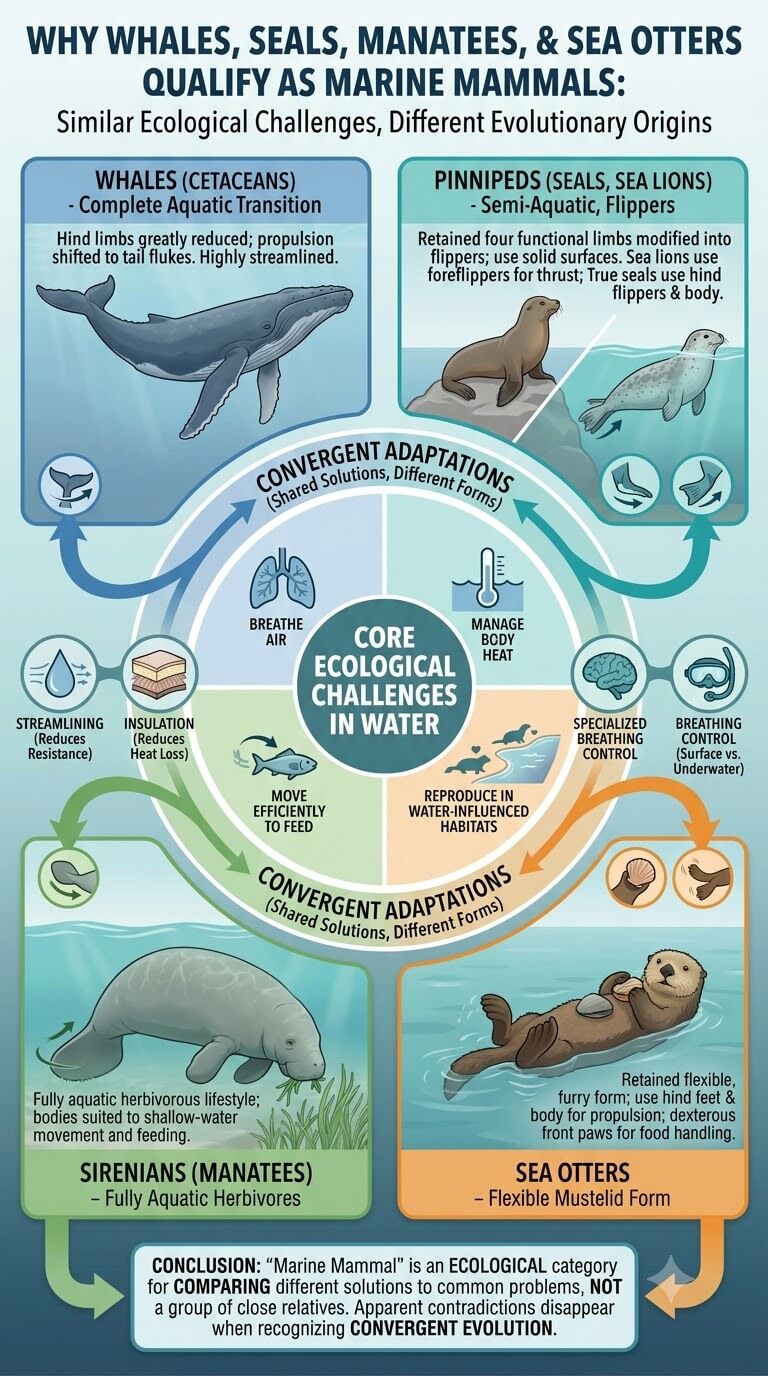
Similar Ecological Challenges, Different Evolutionary Origins
A whale, a harbor seal, a manatee, and a sea otter look different because they come from different mammalian lineages and have taken different evolutionary routes into aquatic life. Yet all face versions of the same core challenges: they must breathe air, manage body heat in water, move efficiently enough to feed, and reproduce successfully in habitats strongly influenced by water.
For whales, the transition became so complete that the hind limbs were greatly reduced and propulsion shifted to the tail flukes. Pinnipeds retained four functional limbs modified into flippers and still use solid surfaces. Sirenians evolved a fully aquatic herbivorous lifestyle with bodies suited to shallow-water movement and feeding. Sea otters retained far more of the flexible, furry form seen in other mustelids.
The term marine mammal is useful precisely because it lets us compare those different solutions without pretending the animals are close relatives.
Convergent Adaptations Without Close Taxonomic Relationship
Several aquatic traits have evolved repeatedly. Streamlining reduces resistance during swimming. Insulation reduces heat loss. Changes in limbs improve propulsion or steering. Specialized control of breathing helps animals alternate between surface respiration and underwater activity.
But convergence rarely produces identical animals. Cetaceans rely primarily on tail-powered propulsion. Sea lions generate much of their thrust with the foreflippers. True seals rely more on the hind flippers and body. Sea otters use their hind feet and flexible bodies while retaining dexterous front paws for handling food.
When readers recognize convergent evolution, the apparent contradiction disappears: marine mammals can be biologically diverse and still belong in one useful ecological category.
Marine Mammals Versus Other Ocean Animals
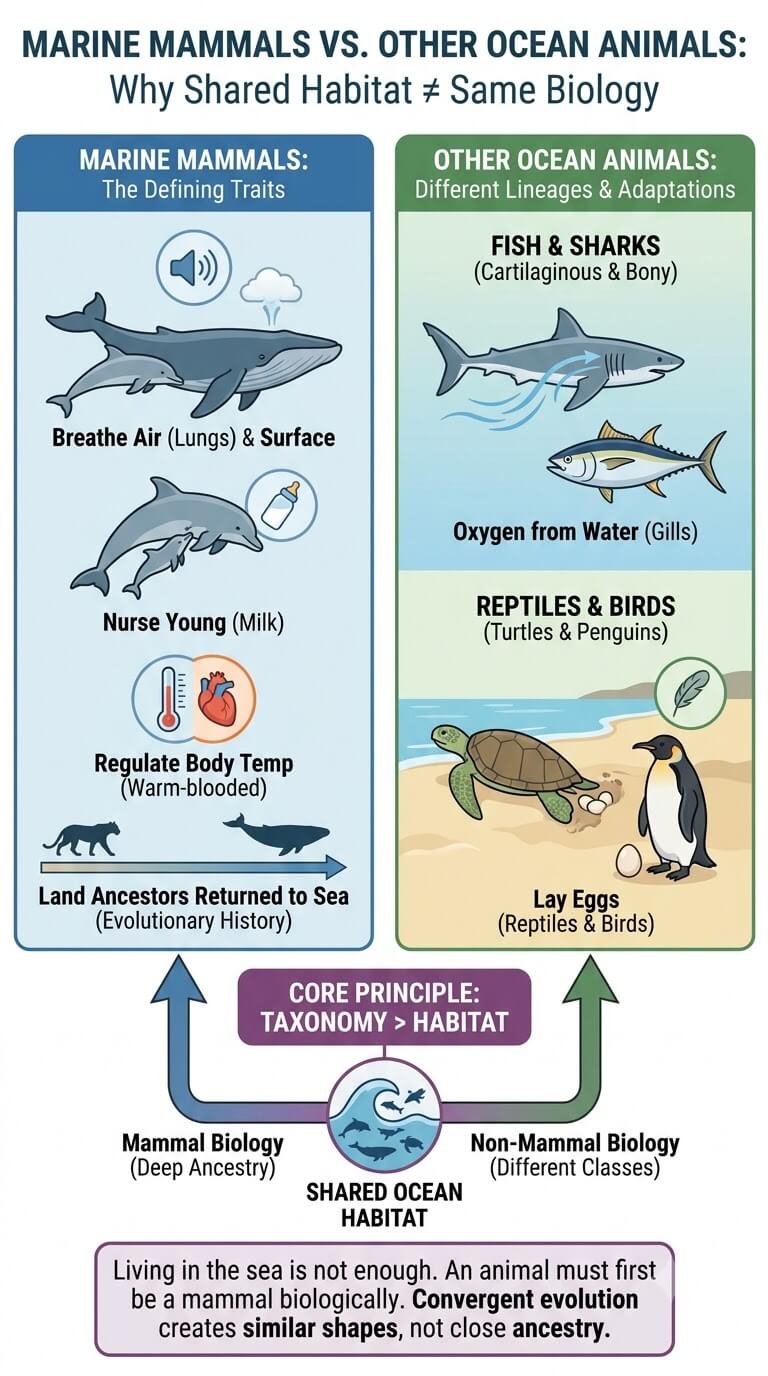
Why Fish and Sharks Are Not Marine Mammals
Fish and sharks can share habitats with marine mammals and may even resemble them in overall body shape, but they belong to different vertebrate lineages. Sharks are cartilaginous fishes, while familiar bony fishes form other fish groups. They obtain oxygen from water with gills rather than surfacing to breathe through lungs.
A dolphin’s streamlined shape can make it look superficially fishlike, but its biology tells a different story. It breathes air, nurses its young, regulates body temperature as a mammal, and has forelimbs transformed into flippers. Similar swimming shapes reflect the physics of moving through water more than close ancestry.
Why Sea Turtles and Penguins Are Not Marine Mammals
Sea turtles are reptiles and penguins are birds. Both can be highly dependent on marine ecosystems, yet ecological dependence does not change their taxonomic identity. Sea turtles retain reptilian traits and lay eggs. Penguins have feathers, lay eggs, and belong to the bird lineage.
This is a useful test for the definition. Living in the sea is not enough. The animal must first be a mammal. Only then does the question of marine dependence become relevant.
Why Habitat Alone Does Not Define Mammal Status
An animal’s habitat can change dramatically over evolutionary time while its deeper ancestry remains traceable. Whales moved from terrestrial ancestors into aquatic life, but they did not become fish. Smithsonian’s fossil-based overview explains that whale ancestors returned to the sea after earlier vertebrates had moved onto land.
That evolutionary history is why terms such as marine mammal are best layered on top of taxonomy rather than used instead of it. Taxonomy tells us what an animal is related to. Ecology tells us how and where it lives.
What Marine Mammals Had to Adapt for Aquatic Life
Breathing at the Surface
Aquatic living does not remove the mammalian need for air. Instead, natural selection favors ways to make surface breathing efficient and underwater oxygen use economical. Cetacean blowholes sit on top of the head. Diving species can alter heart rate and blood flow during submergence. Pinnipeds can close their nostrils and spend substantial time underwater before resurfacing.
These adaptations do not make marine mammals capable of breathing water. They make air breathing compatible with a life that may be spent mostly below the surface.
Moving Efficiently Through Water
Water is much denser than air, so drag matters. Fully aquatic marine mammals tend to have streamlined shapes with fewer protruding structures. Their limbs, tails, or flippers provide propulsion and control.
The exact mechanism depends on ancestry. Cetaceans use horizontal tail flukes that move mainly up and down. Pinnipeds use paired flippers, with different groups emphasizing foreflippers or hind flippers. Sea otters have broad hind feet and a flexible trunk. Sirenians use powerful tails, with manatees and dugongs differing in tail shape.
Those differences are a reminder that there is no single marine mammal blueprint.
Managing Heat Loss and Diving
Cold water creates a thermal problem, while diving creates a respiratory one. Blubber, dense fur, body size, metabolic heat, and specialized circulation can all help with temperature control. Oxygen stored in the lungs, blood, and muscles supports underwater activity, while cardiovascular adjustments can help conserve oxygen during dives.
How strongly each mechanism is developed depends on species and lifestyle. A deep-diving whale faces a different challenge from a coastal sea otter, and a tropical manatee faces different thermal limits from an ice-associated seal. Marine mammal adaptations should therefore be discussed as a set of solutions shaped by habitat and ancestry, not as a checklist that every species possesses equally.
Common Mistakes and Myths
Assuming Every Ocean-Living Mammal Is Equally Aquatic
Some marine mammals are fully committed to water, while others move regularly onto land or ice. A blue whale cannot haul out on a beach to rest, but seals routinely haul out as part of normal behavior. Sea otters spend enormous amounts of time in coastal water yet retain a body plan that is much less transformed than that of cetaceans.
Thinking in terms of degrees of dependence is more accurate than dividing animals into only “water mammals” and “land mammals.”
Treating Marine Mammal as a Taxonomic Rank
There is no formal taxonomic level called Marine Mammalia that contains all ocean-dependent mammals. Cetaceans, pinnipeds, sirenians, sea otters, and polar bears are distributed across different branches of Mammalia.
This is similar to other ecological groupings that are useful without being single evolutionary units. The label describes how animals interact with an environment, while their scientific classification describes ancestry.
Assuming All Marine Mammals Have the Same Adaptations
Blubber is common, but sea otters depend much more on fur. Echolocation occurs in toothed cetaceans, but it is not a universal marine mammal trait. Some species routinely dive deep, while others spend much of their time in relatively shallow water. Some give birth in the ocean, while many pinnipeds give birth on land or ice.
The safest rule is to treat broad marine mammal traits as patterns, then check the biology of the specific group or species before making a universal claim.
Edge Cases and Degrees of Marine Dependence
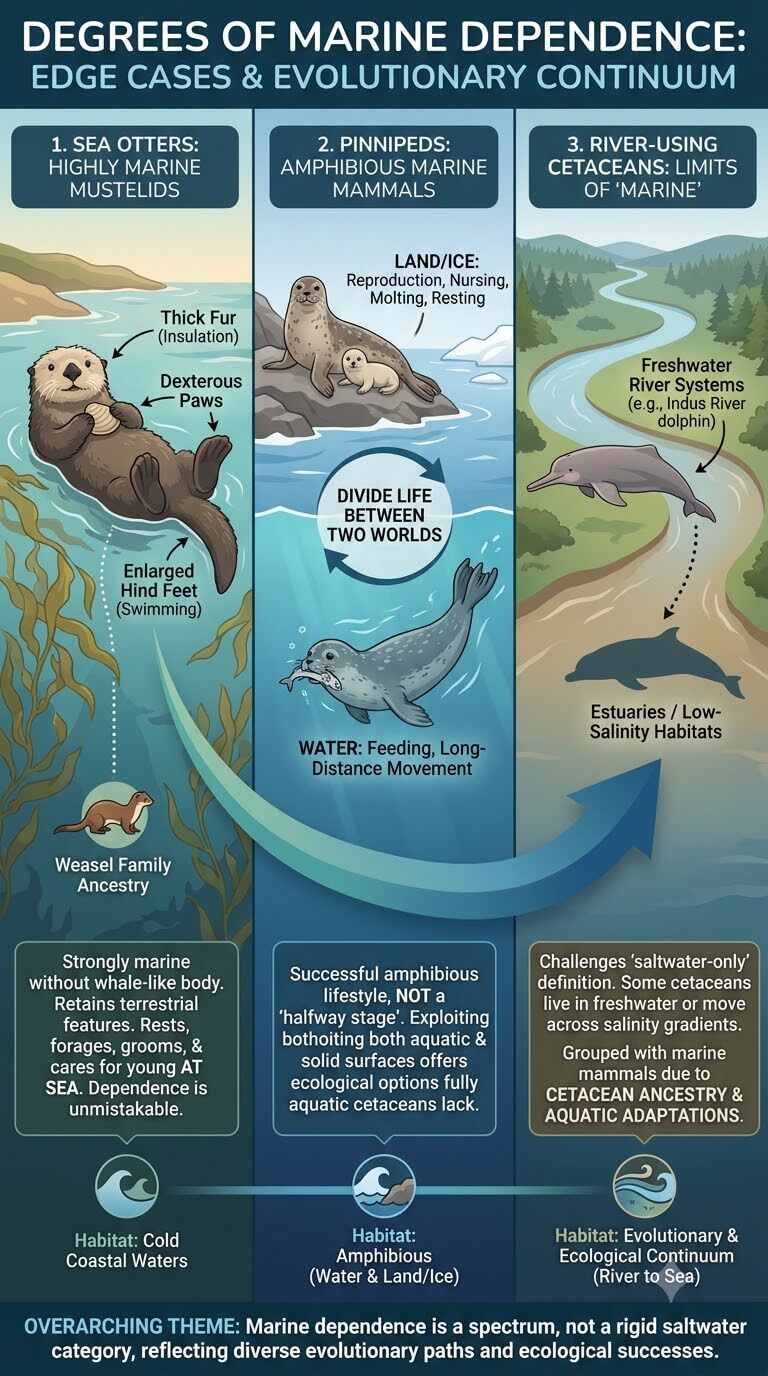
Sea Otters as Highly Marine Mustelids
Sea otters are one of the best examples of how a mammal can become strongly marine without evolving a whale-like body. They belong to the weasel family and retain thick fur, dexterous paws, and a flexible body. Their hind feet are enlarged for swimming, and their dense coat provides crucial insulation in cold coastal water.
They can rest, forage, groom, and care for young at sea, which makes their dependence on marine ecosystems unmistakable even though their anatomy still reveals their terrestrial relatives.
Pinnipeds as Amphibious Marine Mammals
Pinnipeds divide important parts of life between two physical worlds. Water is usually central to feeding and long-distance movement, while land or ice can be central to reproduction, nursing, molting, and resting.
This amphibious pattern is not a halfway stage waiting to become whale-like. It is a successful lifestyle in its own right. Being able to exploit both aquatic and solid surfaces gives pinnipeds ecological options that fully aquatic cetaceans do not have.
River-Using Cetaceans and the Limits of the Word Marine
The word marine can sound as though salt water is mandatory, but cetaceans complicate that assumption. Some dolphin lineages live in freshwater river systems, and other cetaceans use estuaries or move between marine and low-salinity habitats. NOAA Fisheries describes the Indus River dolphin as a cetacean that lives in a river system.
For broad educational discussions, river dolphins are often considered alongside marine mammals because they share cetacean ancestry and many aquatic adaptations. This is one reason a rigid saltwater-only definition can be less useful than recognizing the evolutionary and ecological continuum.
Why This Definition Helps Explain Marine Mammal Biology
Major Groups Make More Sense When Ancestry Comes First
Once marine mammal is understood as an ecological grouping, the major groups stop looking like a confusing collection of unrelated names. Cetaceans include whales, dolphins, and porpoises. Pinnipeds include true seals, eared seals such as sea lions and fur seals, and walruses. Sirenians include manatees and dugongs. Sea otters belong to the mustelid family, while polar bears belong to the bear family.
The groups share aquatic pressures, but each carries a different evolutionary starting point. That is why their bodies can solve the same problem in strikingly different ways.
Breathing, Heat Retention, and Swimming Reflect Different Solutions
Understanding the definition also makes it easier to compare adaptations without assuming uniformity. Every marine mammal must breathe air, but not every one has a blowhole. Every marine mammal regulates body temperature as a mammal, but not every one depends mainly on blubber. Every marine mammal must move through or around aquatic habitat, but propulsion can come from tail flukes, foreflippers, hind flippers, broad feet, or a combination of structures.
Those contrasts are more informative than a simple list of traits. They show how evolution can preserve mammalian identity while reshaping anatomy and behavior for life in water.
FAQ
Do marine mammals have to live in salt water?
Not in every practical use of the term. Most marine mammals depend on ocean or coastal ecosystems, but cetaceans include species that live in freshwater rivers. Some other cetaceans regularly use estuaries and river mouths. Because of these exceptions, biologists and educators often discuss freshwater cetaceans with marine mammals while being clear about their actual habitat.
The better definition is based on mammalian ancestry plus strong aquatic dependence, rather than treating salinity as the only deciding factor.
Are marine mammals born in the water?
Some are, but not all. Whales, dolphins, manatees, and dugongs are fully aquatic and give birth in water. Many pinnipeds give birth on land or ice, where mothers can nurse pups before the young spend more time at sea. Sea otters can give birth in the water, while the reproductive patterns of other marine-associated mammals differ again.
Birth location therefore reflects the biology of each lineage. It is not a defining feature of marine mammals as a whole.
Do all marine mammals have hair?
Hair is a mammalian trait, but it can be reduced dramatically. Sea otters and fur seals have conspicuous coats, while adult whales and dolphins may have very little visible hair. Cetaceans still show hair during development or retain small specialized hairs in some species.
What matters is mammalian ancestry and development, not whether an adult animal looks furry. Aquatic evolution can reduce external hair when other insulation systems, especially blubber, become more important.
Final Thoughts
What makes an animal a marine mammal is the combination of two things: it is biologically a mammal, and its life depends strongly on aquatic environments, especially the ocean. That means it still breathes air, produces internal body heat, inherits mammalian structures, and nurses its young, even when evolution has transformed its body for swimming, diving, feeding, or resting in water.
The category is broad because marine mammals did not arise from one marine ancestor. Whales, seals, sirenians, sea otters, and other marine-dependent mammals reached aquatic life along different evolutionary paths. Their similarities show how powerful the challenges of life in water can be, while their differences reveal the many ways a mammal can meet those challenges.

Ethan Walker is the founder and research editor of Animal Fact Central. He creates and reviews educational animal facts content using trusted wildlife, pet care, and science-based sources. His work focuses on making animal behavior, adaptations, habitats, and species facts clear, accurate, and engaging for everyday readers.
Read More Details About Ethan Walker: https://animalfactcentral.com/ethan-walker/