
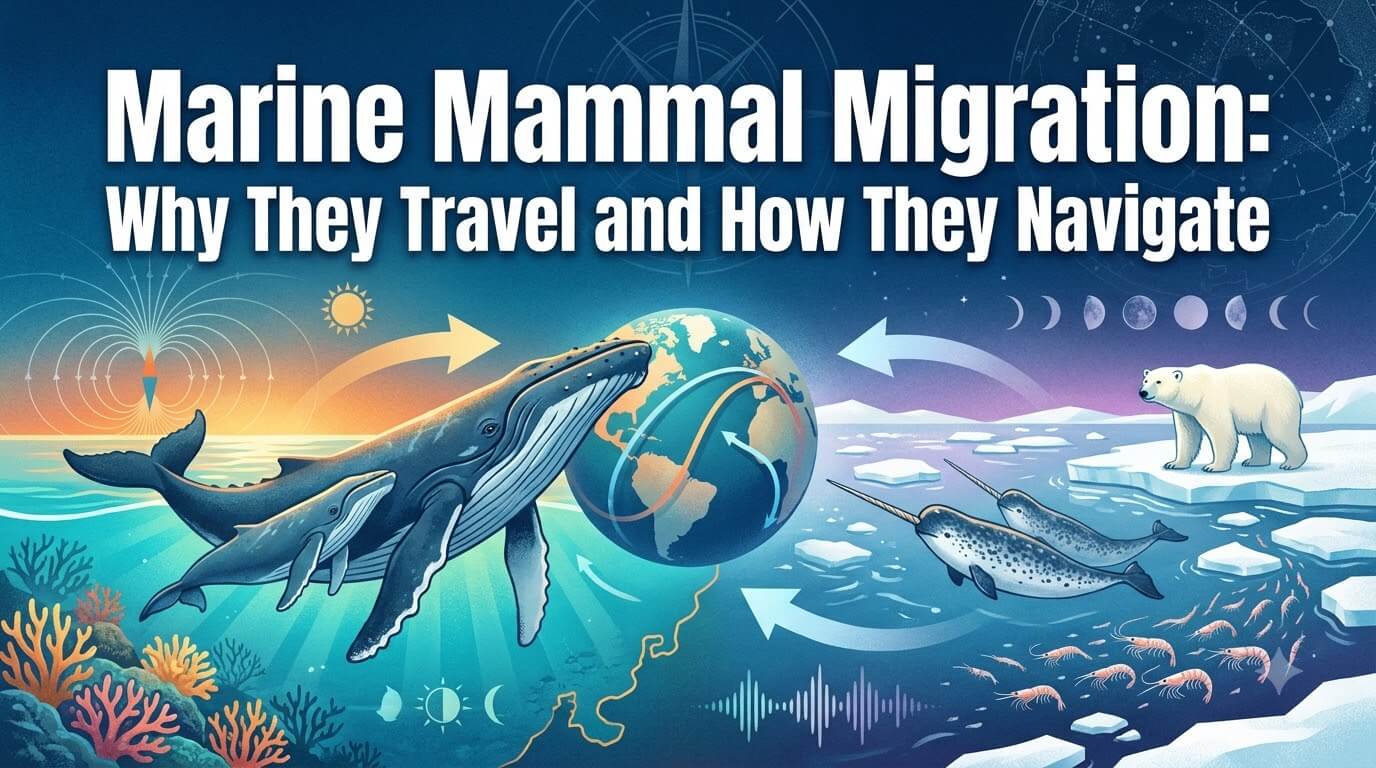
Marine mammal migration is the repeated movement of animals between areas that offer different seasonal advantages. A whale may leave a productive feeding ground for a warmer breeding area. A seal may spend months foraging at sea before returning to a traditional breeding colony. Arctic whales may follow shifting sea ice and openings in the pack. These journeys are shaped by food, reproduction, temperature, ice, ocean conditions, and learned or inherited movement patterns.
Migration does not look the same in every species, and not every marine mammal migrates. Some populations make long seasonal journeys, some move regionally, some remain resident for much of the year, and some individuals within a species behave differently from one another. Navigation is equally complex. Marine mammals can use memory, coastlines, bathymetry, currents, sound, celestial information near the surface, and possibly Earth’s magnetic field, but scientists do not have one universal navigation mechanism that explains every journey.
Quick Answer

Marine mammals migrate mainly because useful resources and life-cycle needs are separated in space and time. Food may be concentrated in one region during summer, while another area provides favorable conditions for mating, calving, nursing, molting, or resting. Humpback whales are a familiar example: many populations move between productive high-latitude feeding areas and lower-latitude breeding and calving areas. NOAA Fisheries describes these seasonal movements in its humpback whale species profile.
How they navigate is less completely understood. Some animals show strong fidelity to feeding or breeding areas year after year, indicating that memory and social transmission can matter. Geomagnetic cues are plausible for some cetaceans, but direct evidence for a specific magnetic-sensing organ or mechanism remains limited. The safest scientific picture is that long-distance marine navigation is probably multimodal, using several cues whose importance changes with species, location, and stage of the journey.
What Counts as Migration?
Migration is more than ordinary daily movement. A marine mammal may travel many miles while feeding without making a true seasonal migration. Migration usually involves repeated, directional movement between functionally different areas, often on a seasonal or life-stage schedule.
Migration Versus Daily Travel
A dolphin moving along a coastline between feeding patches is traveling, but that movement is not automatically migration. A seal leaving a beach for a two-day foraging trip is also not necessarily migrating. These shorter movements can be part of everyday habitat use.
Migration generally connects places that serve different biological roles, such as a feeding area and a breeding area, or a summer range and a winter range. The distinction can become blurry because an animal may feed during migration or pause at stopover areas along the route.
Seasonal, Regional, and Partial Migration
Some migrations occur across entire ocean basins. Others involve movement along a continental shelf, around sea-ice margins, or between offshore waters and a breeding colony. Distance alone does not define the behavior.
Partial migration adds another layer of complexity. In some species or populations, only part of the population makes a pronounced seasonal journey. NOAA notes that blue whales generally show seasonal movements between feeding and breeding regions, but individuals in some areas may not migrate in the same way. The NOAA Fisheries blue whale profile emphasizes that movement patterns vary by region and are not fully known everywhere.
Not Every Marine Mammal Migrates
It is inaccurate to say that marine mammals migrate because they live in the ocean. Sea otters often use comparatively localized coastal home ranges. Some dolphin populations are resident or make only regional movements. Even among baleen whales, migration patterns can differ among populations and individuals.
This variation is biologically useful. Migration is costly, so it should provide enough benefit to offset the energy, time, and risk of traveling.
Why Marine Mammals Migrate

Most migrations can be understood as responses to seasonal changes in resources, reproduction, or environmental conditions. These pressures often overlap rather than operating independently.
Following Seasonal Food
Ocean productivity is highly seasonal in many regions. At high latitudes, long summer daylight, mixing, nutrients, and plankton blooms can support dense concentrations of krill or fish. Baleen whales can exploit those pulses of food and build energy reserves.
Prey availability can also shift horizontally as currents, water temperature, fronts, and upwelling change. Marine mammals that specialize on mobile prey may adjust routes or timing when prey distributions change.
Moving Between Feeding and Breeding Areas
Many humpback populations feed intensively at high latitudes and migrate toward warmer low-latitude waters for mating and calving. This familiar pattern shows how migration can separate the best place to acquire energy from the best place to reproduce.
The journey itself can be energetically demanding, especially for pregnant or lactating females. Mothers may rely heavily on stored energy while traveling and nursing, which makes the quality of previous feeding seasons important.
Reaching Calving or Nursery Habitat
Calving habitat may offer shallow water, warmer conditions, or other features favorable to mothers and newborns. These advantages are not identical for every species, and warm water should not be treated as a universal explanation for all whale migration.
North Atlantic right whales provide a useful example of a species in which some females move southward to calving grounds while other individuals may remain farther north. Migration can therefore depend on sex, age, reproductive state, and year.
Returning to Breeding Colonies
Pinnipeds may spend long periods at sea but return to land or ice for reproduction. Northern fur seals, for example, use breeding colonies in the North Pacific and spend much of the nonbreeding period at sea. NOAA Fisheries describes their strong seasonal connection to terrestrial breeding sites in its northern fur seal species profile.
This creates a different migration problem from that of a fully aquatic whale. The seal must locate a relatively small land destination after traveling through a dynamic ocean.
Tracking Sea Ice and Open Water
Arctic marine mammals often live in a moving landscape. Sea ice grows, breaks, drifts, and retreats seasonally. Leads, polynyas, shelf edges, and ice margins can create important travel and feeding habitat.
Bowhead whales are closely associated with Arctic and subarctic waters and seasonal sea ice. NOAA Fisheries reports that their movements are linked with changing ice conditions, including spring travel through routes associated with openings and fractures in the ice. The bowhead whale species profile provides current context on this ice-associated lifestyle.
Migration Is About Timing as Well as Distance
Arriving in the correct place is only part of successful migration. Arrival at the wrong time can mean missing a prey pulse, reaching a breeding area after competitors, or encountering sea ice that blocks a route.
Seasonal Biological Clocks
Internal physiological cycles can help prepare animals for recurring seasonal events. Changes in hormones, body condition, reproductive state, or behavior may interact with environmental cues that signal when departure is advantageous.
Researchers rarely assume that one internal clock determines a whole migration. The animal still has to respond to current conditions, and timing can shift between years.
Day Length, Temperature, and Environmental Cues
Photoperiod, or day length, changes predictably with season at high latitudes. Water temperature, sea-ice conditions, currents, and prey distributions provide additional information.
Some cues are indirect. A whale may not be responding to temperature itself, for example, but to prey that becomes concentrated under a particular combination of temperature and oceanographic conditions.
Why Timing Can Change From Year to Year
Ocean conditions are variable. Marine heatwaves, unusual currents, changing sea ice, storms, and shifts in prey can alter when profitable habitat develops.
Flexible timing can therefore be valuable. A migration schedule that never changed could become poorly matched to food or habitat when environmental conditions depart from the historical average.
How Marine Mammals Find Their Way

Long-distance navigation in the open ocean is difficult to study because researchers cannot directly ask an animal which cue it is using. Movement tracks reveal what happened, but not always which sensory information guided the decision.
Memory and Familiar Routes
Repeated use of the same feeding grounds, breeding grounds, corridors, or stopovers suggests that memory matters in many marine mammals. An experienced animal can potentially remember the direction, sequence of habitat features, and timing associated with a successful route.
Memory does not require a rigid path. A whale can return to the same destination while adjusting its exact track around currents, storms, prey concentrations, or disturbance.
Coastlines, Seafloor Features, and Bathymetry
Near coasts, animals can use shorelines, islands, shelf breaks, canyons, and other geographic structure. Bathymetry means the shape and depth of the seafloor. Even when an animal cannot see the bottom directly, seafloor features can influence currents, prey, sound propagation, and familiar habitat patterns.
Some migrations closely follow continental margins, while others cross deep open ocean. A navigation system useful near a coastline may therefore become less informative in the middle of an ocean basin.
Currents and Oceanographic Fronts
Currents can move an animal sideways, increase travel cost, or create efficient pathways. Experienced migrants may compensate for flow rather than simply drifting with it.
Oceanographic fronts are boundaries where water masses with different properties meet. They can concentrate prey, making them valuable feeding features and potentially useful landmarks in a moving seascape.
Sound as Environmental Information
Marine mammals live in an acoustic environment. Waves, reefs, ice, other animals, and distant biological or physical sources create sound that may provide orientation information.
Some Arctic whales appear capable of using acoustic information around ice. However, acoustic orientation should not be generalized into a single long-distance sonar map shared by all marine mammals.
Celestial Information Near the Surface
Animals at or near the surface have access to sunlight, sky polarization, and other directional information that is unavailable during deep dives. Celestial cues are well established in several migrating animal groups, but their specific role in marine mammals is harder to demonstrate directly.
They are best treated as possible components of a broader sensory toolkit rather than as the proven primary compass for whales or seals.
Earth’s Magnetic Field
Magnetoreception is the ability to detect information from Earth’s magnetic field. Observational and behavioral evidence has led researchers to consider magnetic cues as a possible part of cetacean orientation and migration.
That hypothesis remains less settled than it is sometimes presented in popular media. A modern review of cetacean sensory neuroanatomy notes behavior consistent with magnetic sensing but also emphasizes that a confirmed morphological or physiological detection mechanism has not been identified in cetaceans. Magnetic cues should therefore be described as plausible, not proven as a universal whale navigation system.
Route Fidelity and Learned Migration

Migration can contain a cultural component when individuals learn where to go from experienced animals. This is especially relevant in long-lived mammals with prolonged maternal care.
Returning to Familiar Feeding Grounds
Humpback whales often show fidelity to particular feeding regions. Photo identification and genetic studies have revealed repeated associations between individuals and specific seasonal destinations.
This consistency can maintain population structure even when different groups share a breeding region. Animals that return to different feeding grounds may mix during winter yet separate again during the feeding season.
Maternal Influence in Humpback Whales
Evidence from humpback whales indicates that feeding-ground fidelity can be transmitted through maternal lines. Calves travel with their mothers during early migrations, giving them an opportunity to learn destinations and routes.
Research on cultural traditions across humpback whale migratory networks supports the idea that maternally directed fidelity helps structure feeding-ground use. This does not mean every route is copied perfectly. Individuals can change destinations, and rare long-distance movements show that the system retains flexibility.
Learning Does Not Exclude Innate Orientation
Young animals may inherit tendencies that help initiate migration while also learning detailed destinations from mothers or social companions. Innate and learned information can work together.
This combination is common in animal navigation. A genetically influenced seasonal urge or compass direction can bring an inexperienced animal into the right broad region, while experience improves precision over later journeys.
Migration Strategies Differ Across Marine Mammal Groups

The word migration can describe very different ecological strategies. Comparing several groups makes those differences clear.
Baleen Whales
Many baleen whales make pronounced seasonal movements linked with feeding and reproduction. Humpbacks are the classic example, but blue, gray, fin, right, and bowhead whales each have population-specific movement patterns.
Some baleen whales travel along coasts, others cross large areas of open ocean, and Arctic species may move with sea-ice conditions. Even within one species, different populations can use different routes.
Toothed Whales
Some toothed whales migrate seasonally, while others have resident populations or complex regional movements that do not fit a simple north-south cycle. Prey distribution can be especially important for species that follow squid or fish into different water masses.
Deep-diving toothed whales may also move between oceanographic regions rather than between obvious coastal breeding and feeding grounds.
Pinnipeds
Seals and sea lions often alternate between periods at sea and periods at breeding or molting sites. Some species undertake extensive seasonal movements, while others remain close to colonies or regional feeding grounds.
Because breeding sites can be small islands, beaches, or ice habitats, site fidelity can be extremely important. An animal may navigate across open water to a destination that occupies only a tiny fraction of the ocean.
Sirenians and Sea Otters
Manatees can make important seasonal movements, especially where water temperature creates a need to reach warm refuges. These movements may be regional rather than ocean-basin migrations.
Sea otters are generally more localized. Their ecology depends on coastal prey and resting habitat, so long seasonal migrations are not a defining feature of the group.
Examples of Different Migration Problems

Real species illustrate how migration is shaped by different combinations of food, reproduction, ice, and geography.
Humpback Whales: Feeding and Breeding Separation
Many humpback populations move between high-latitude feeding areas and tropical or subtropical breeding areas. They can follow remarkably consistent directions over open ocean, yet individuals do not always travel identical tracks.
The separation creates a strong seasonal cycle: intensive feeding builds reserves, migration transports the animal between ecological zones, and breeding-season behavior occurs where feeding may be limited.
Bowhead Whales: Moving Through a Seasonal Ice World
Bowheads migrate through an Arctic environment in which coastlines remain fixed but sea ice does not. Openings in ice can define safe breathing routes, while prey and currents vary across shelves and basins.
This makes navigation inseparable from real-time environmental sensing. A route that was open in one year may be altered by ice conditions in another.
Northern Fur Seals: Finding a Breeding Colony After Months at Sea
Northern fur seals spend much of the year offshore, then return to breeding areas. Their migration combines broad ocean navigation with precise colony finding.
Age and sex also affect movement. Young animals may spend long periods at sea before returning to breeding colonies, while adults follow seasonal schedules tied more closely to reproduction.
Migration Is Flexible, Not a Fixed Railroad
Maps often show migration as a clean line with arrows. Real animals operate in a variable ocean and may deviate from that line for food, weather, currents, social conditions, or disturbance.
Individuals Can Use Different Routes
Animals from the same population can leave at different times, travel at different speeds, or use different corridors. Reproductive females may choose different routes from males or juveniles.
These individual differences matter because one tagged animal should not automatically be treated as the route for an entire population.
Stopovers and Opportunistic Feeding
A migrating whale may feed when it encounters profitable prey. Stopover areas can provide rest or energy along the way, particularly on long journeys.
This complicates the old idea that migration is a strict switch between feeding and reproduction. Some populations follow that separation strongly, while others mix feeding with travel.
Exceptional Movements Reveal Flexibility
Photo-identification and satellite tracking occasionally document animals in unexpected breeding or feeding regions. These events can show connectivity between populations that otherwise appear strongly separated.
Exceptional movement should not be mistaken for the typical pattern, but it is scientifically valuable because it reveals what the species is capable of doing.
How Scientists Track Marine Mammal Migration

Migration research combines methods because no single technology captures every movement accurately and without limitations.
Photo Identification
Whales can often be recognized from natural markings on flukes, dorsal fins, scars, or pigmentation. Re-sighting the same individual in different places can connect feeding and breeding areas without attaching a device.
The method works best for species with durable identifying features and regions with sustained research effort.
Satellite and GPS-Linked Tags
Electronic tags can record position, depth, movement, or behavior for days, weeks, or months depending on the device and species. Satellite telemetry is especially powerful for animals that spend long periods far from shore.
Tag data reveal individual tracks rather than perfect population maps. Researchers must consider sample size, tag duration, attachment effects, and whether tagged animals represent the broader population.
Acoustic Monitoring
Seasonal changes in vocal activity can reveal the presence and movement of calling whales. Fixed hydrophones can monitor areas through darkness, winter weather, and periods when visual surveys are difficult.
Silence is harder to interpret. An animal may be present without vocalizing, so acoustic absence is not always physical absence.
Genetics and Stable Isotopes
Genetic relationships can reveal connections among breeding and feeding groups, while stable isotopes in tissues can provide information about broad feeding regions or dietary history.
These methods do not draw a day-by-day route, but they can reveal long-term population structure and help test whether migratory traditions persist across generations.
Environmental Change Can Alter Migration
Migration depends on predictable relationships between seasons, food, ice, and suitable habitat. When those relationships change, routes and timing may change as well.
Changing Prey Distribution
Marine mammals often follow prey rather than a particular water temperature. If warming, currents, or ecosystem changes shift prey concentrations, animals may extend, shorten, or redirect seasonal movements.
Flexible species may adjust quickly. Strong site fidelity can be beneficial when traditional areas remain productive but less useful when those areas change rapidly.
Sea-Ice Change
Arctic species face especially visible changes because sea-ice timing and extent influence travel corridors, access to prey, and open water for breathing.
Less ice does not create one simple outcome. Some routes may open for longer, while prey distributions, predators, vessel traffic, and human access also change.
Human-Made Barriers and Risk
Marine migration routes can cross busy shipping lanes, fishing grounds, construction zones, and noisy coastal areas. These features do not form walls, but they can increase collision, entanglement, or disturbance risk.
Animals that repeatedly use the same corridor may encounter the same human pressures each year, making route knowledge important for conservation planning.
Common Myths and Mistakes
Marine mammal migration is easy to oversimplify because long journeys produce memorable stories. The biology is more variable.
Not All Whales Migrate From Cold Water to Warm Water
Many baleen whale populations do move between high-latitude feeding areas and warmer breeding regions, but this is not a universal whale rule. Some populations remain in temperate areas, some individuals do not make the same seasonal journey, and toothed whales often follow different patterns.
Migration Is Not Always a Straight Line
Some tracked whales maintain highly directional courses across open ocean, but currents, feeding opportunities, geography, and individual decisions can create detours or alternate routes.
A clean map arrow is a summary of a pattern, not a literal track followed by every animal.
Scientists Have Not Proven One Whale Navigation Sense
Magnetic fields are one possible cue, but so are memory, geography, sound, ocean conditions, and other sensory information. No single mechanism currently explains every long-distance marine mammal migration.
This uncertainty is not a weakness in the science. It reflects the difficulty of testing sensory navigation in animals that can cross thousands of miles of ocean.
What Scientists Still Do Not Know
Tracking technology has improved quickly, but many migration questions remain open.
How Multiple Cues Are Combined
An animal might use one cue to maintain a general compass direction, another to recognize a region, and memory to locate a specific destination. The relative weighting of these cues may change during the trip.
Experiments that isolate one cue are difficult in large free-ranging marine mammals, so researchers often rely on natural movement patterns and comparisons with environmental data.
How Young Animals Learn Routes
Maternal transmission is strongly supported for some humpback feeding-ground traditions, but it does not explain every marine mammal. Young seals, dolphins, and other whales may combine inherited orientation with social learning and individual exploration.
More long-term tracking from juvenile stages into adulthood is needed to understand how navigation skill develops.
How Fast Routes Can Change
Some migratory traditions remain stable for decades, yet individuals can also shift destinations. The balance between fidelity and flexibility may determine how well populations respond to rapid environmental change.
Understanding that balance is increasingly important as prey, sea ice, vessel traffic, and ocean conditions change.
FAQ
These questions address common points of confusion about marine mammal migration and navigation.
Why do whales migrate if cold water has more food?
Many baleen whales take advantage of productive high-latitude feeding areas, then move to different breeding or calving habitat. That pattern separates feeding and reproduction seasonally. It does not mean cold water is always better for feeding or warm water is always necessary for birth. Migration strategies differ among species and populations, and some whales do not follow the classic high-latitude-to-tropics pattern.
Do marine mammals use Earth’s magnetic field to navigate?
Possibly, but the evidence is not complete. Some cetacean movement and stranding patterns are consistent with sensitivity to geomagnetic features, and magnetic sensing is a reasonable navigation hypothesis. Researchers have not identified a confirmed magnetic-sensing structure or physiological mechanism in cetaceans, so it is more accurate to describe magnetoreception as a possible cue within a broader multisensory system.
Do young whales learn migration routes from their mothers?
There is good evidence in humpback whales that maternal traditions help determine feeding-ground fidelity. Calves accompany their mothers during early life and can return to the same broad feeding regions later. The importance of maternal learning varies among species, and inherited orientation, social learning, and individual experience may all contribute to migration.
Final Thoughts
Marine mammal migration is best understood as a flexible response to a changing ocean. Animals travel because food, breeding opportunities, safe nursery habitat, sea ice, and seasonal conditions are not distributed evenly through the year. Humpbacks may link feeding and breeding regions, bowheads move through an ice-shaped Arctic, and fur seals return from oceanic foraging to traditional colonies. Finding those places probably involves more than one sense. Memory, learned routes, coastlines, seafloor structure, currents, sound, and possibly magnetic cues can all contribute, with the evidence strongest for some mechanisms and still developing for others. The result is not a fixed underwater highway, but a set of learned, inherited, and environmentally adjusted movement strategies that differ among species, populations, and individuals.

Ethan Walker is the founder and research editor of Animal Fact Central. He creates and reviews educational animal facts content using trusted wildlife, pet care, and science-based sources. His work focuses on making animal behavior, adaptations, habitats, and species facts clear, accurate, and engaging for everyday readers.
Read More Details About Ethan Walker: https://animalfactcentral.com/ethan-walker/