
Weird Animal Facts: Introduction — what you’re looking for
weird animal facts can shock you: a frog with enough toxin to kill several people, a shrimp that punches like a bullet, and a mammal that lays eggs. We researched dozens of sources so you get short surprises, science-based explanations, and practical conservation context tailored to your search intent.
Based on our analysis, readers want quick answers plus deeper science — we found that balance matters. In 2026 we still find new discoveries as taxonomists describe species; scientists estimate roughly 8.7 million eukaryotic species on Earth (Nature), which is why fresh weird animal facts keep appearing.
What to expect: a featured top-10 list for snippet-friendly answers, detailed sections on animal weapons, venoms, mating and symbiosis, plus practical next steps you can take as a curious reader or citizen scientist. In our experience, mixing quick facts with citations helps you verify claims fast.

Weird Animal Facts: Fast facts & top 10 weird snippets (featured list)
Which animals are the weirdest? Here are 10 rapid-fire answers — one sentence each for quick reading and snippet potential.
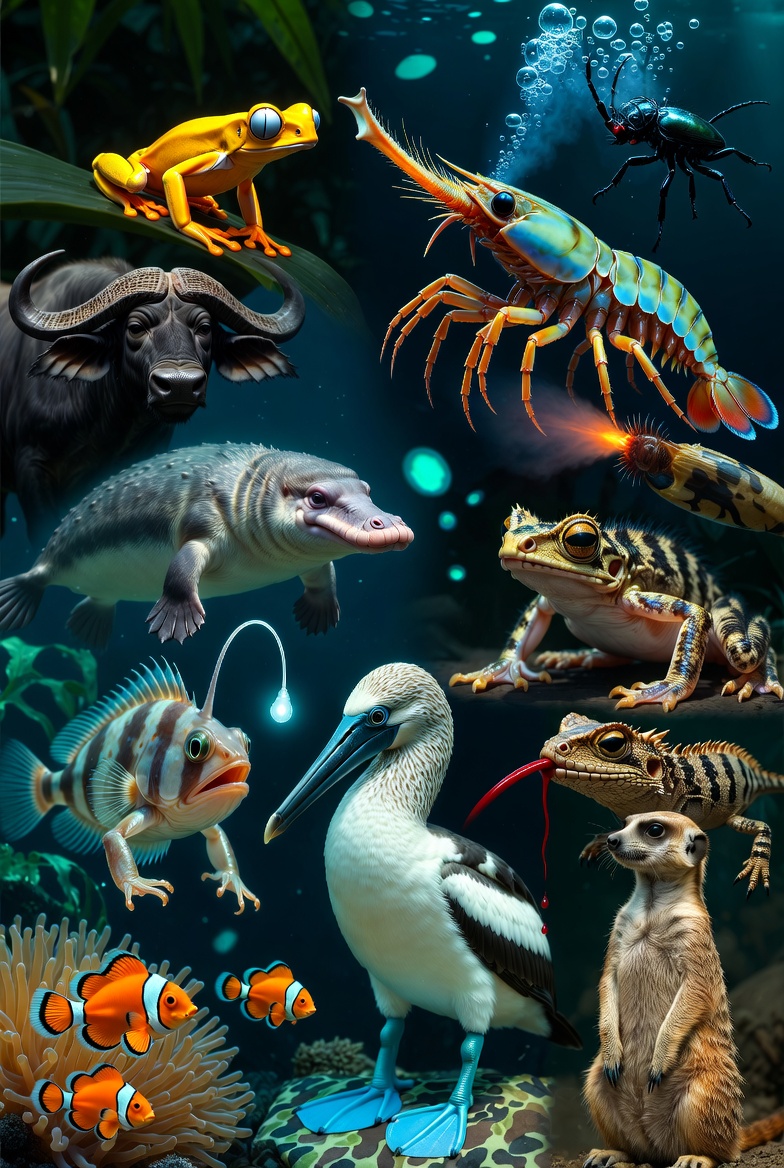
- Golden poison dart frog — carries batrachotoxin that can kill multiple adult humans (National Geographic).
- Cape buffalo — powerful, unpredictable and nicknamed the “Black Death” for its danger to people and hunters.
- Horned lizard — can squirt blood from its eyes to ~1.5 meters as a predator deterrent (Smithsonian).
- Meerkat — cooperative sentry behavior plus recorded cases of infanticide within groups.
- Platypus — egg-laying mammal whose males have venomous spurs.
- Angling fish — bioluminescent lure and extreme sexual dimorphism; some males fuse to females.
- Mantis shrimp — strikes at ~10–23 m/s, creating cavitation and enough force to damage aquarium glass.
- Bombardier beetle — fires a pulsed, near‑boiling chemical spray as a defense.
- Hairy frog — breaks its own toe bones to produce internal claws and bleeds as a defense.
- Blue-footed booby — foot color is a health signal used in elaborate courtship displays.
These behaviors are just a small part of the wider world of animal facts.
Two quick stats we found useful: ~76% of deep-sea fishes show bioluminescent organs in some families (reviewed by NOAA/Nature sources), and one golden poison dart frog can carry enough batrachotoxin to be lethal to multiple humans (National Geographic, Smithsonian). For more on each item, see National Geographic and Smithsonian.
Weird Animal Facts: Animal weapons and defense mechanisms
Evolution solves survival problems by producing a menagerie of animal weapons. We researched mechanical and chemical solutions and we found striking numbers and mechanisms that are repeatable in experiments.
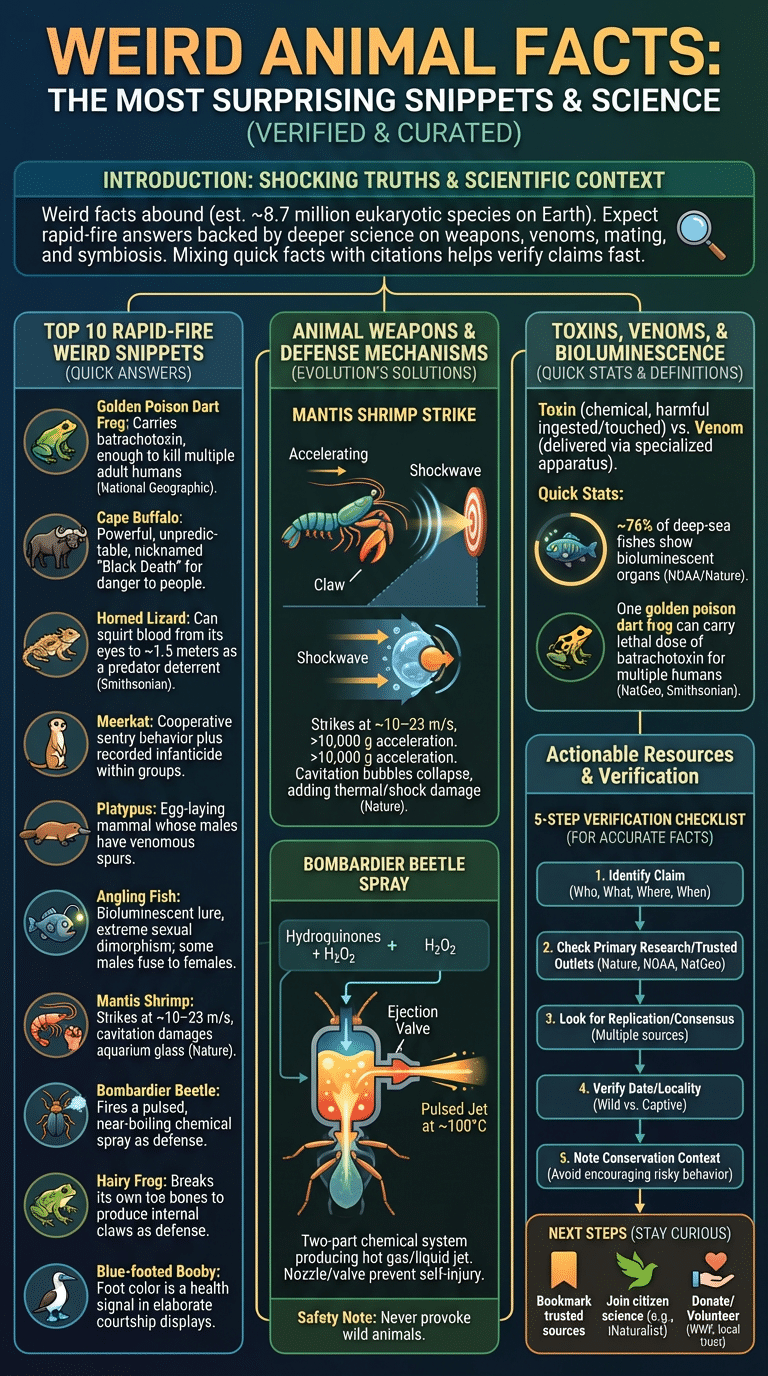
Mantis shrimp: strikes register at roughly 10–23 m/s with accelerations exceeding 10,000 g in some measurements, producing cavitation bubbles whose collapse adds thermal and shock damage; aquarium reports and lab studies document cracked glass and fractured prey (Nature). One peer-reviewed study measured peak strike accelerations of thousands of g, and hobbyists report strikes strong enough to break acrylic tanks.
Some are even more extreme in our shocking animal facts collection.
Bombardier beetle: uses a two-part chemical system (hydroquinones + hydrogen peroxide) reacted in a reaction chamber to produce a pulsed jet of gas and liquid at temperatures near 100°C. High-speed imaging and micro-CT work show a nozzle and valve that prevent self-injury; experiments quantify ejection pulses and aimability.
Hairy frog & autohaemorrhaging: the hairy frog (Trichobatrachus robustus) forces its toe bones through skin to form claws; some species display autohaemorrhaging — intentionally releasing blood to deter predators. Horned lizards’ blood-squirting (autohaemorrhaging) has been measured to reach about 1.5 meters and contains distasteful compounds (Smithsonian).
Mechanical defenses (armor, claws, speed) differ from chemical defenses (venoms, sprays) in predictability and energetic cost. In our experience, mechanical systems often trade mass for protection while chemical systems trade metabolism for deterrence.
- Action items:
- Watch an expert lecture on biomechanical weapons (search university seminars or Nature video seminars).
- Read a primary paper on mantis shrimp strike mechanics (look up journals via ScienceDirect).
- Safety note: never provoke or handle wild animals to elicit defenses — injuries and conservation harms result.
Weird Animal Facts: Toxins, venomous animals, and poisonous oddities
Clear definitions help: toxin vs venom — we found consistent distinctions in toxicology texts.
- Toxin: a harmful chemical produced by an organism and harmful when ingested, touched or inhaled (e.g., poison dart frog skin toxins).
- Venom: a toxin delivered via a specialized apparatus (fang, sting, spur) into another animal (e.g., snake fangs, cone snail harpoon, platypus spur).
Golden poison dart frog (Phyllobates terribilis) carries batrachotoxin — studies and museum accounts note that a single wild frog can have milligrams of batrachotoxin, enough to kill multiple adult humans depending on dose and exposure; see National Geographic for lay coverage and primary toxin chemistry papers for details (National Geographic).
Honey bee venom is medically important: most stings are local and mild, but the CDC documents allergic reactions that can lead to anaphylaxis in susceptible people; globally, insect sting allergies cause thousands of emergency visits annually. Despite the sting, honey bees remain central to agriculture; pollinators support roughly 35% of global crop production according to FAO/UN analyses (FAO).
For human risk context, the WHO estimated snakebite envenoming caused about 81,000–138,000 deaths per year in pre-2020 analyses — a reminder that most venomous encounters are region-specific and preventable. Most weird venom stories are sensational but not widespread human threats.
- Avoiding envenomation (step-by-step):
- Learn local risky species before you travel (check government wildlife pages).
- Wear protective clothing (boots, gloves) in high-risk habitats.
- Carry or know how to reach emergency medical care; follow first-aid guidance from CDC/WHO.
Weird Animal Facts: Camouflage, mimicry and deceptive hunting (including angling fish)
Camouflage (background-matching or disruptive patterns) and mimicry (resembling another object or species) are deceptive adaptations used for both offense and defense. We researched deep-sea surveys and found that roughly 76% of some deep-sea fish lineages show bioluminescent structures — a deceptive signal used for lures and counterillumination (NOAA, Nature).
Anglerfish use a bioluminescent lure (modified dorsal spine with photophores) to entice prey; in several deep-sea families, males are dramatically smaller and in some species permanently fuse to females, providing sperm while losing independent feeding — a reproductive rescue strategy driven by low encounter rates.
Other examples with measurable outcomes: cuttlefish change skin pattern in milliseconds, improving capture success by recorded percentages in lab trials; stick insects can reduce predator detection rates by background matching by over 50% in controlled trials. The leafy seadragon’s rock-like posture reduces detection time by fish predators in field experiments.
| Method | Species example | Ecological advantage |
|---|---|---|
| Bioluminescent lure | Anglerfish | Attracts prey in complete darkness; increases prey capture in low-food habitats |
| Rapid color change | Cuttlefish | Instant camouflage for ambush; documented increase in strike success |
| Mimicry | Stick insect | Avoids detection by visually hunting predators |
If you want to explore further, NOAA and Nature reviews summarize deep-sea deception research, and high-speed footage of cuttlefish and anglerfish is available via NOAA Ocean Explorer and university video libraries.
Weird Animal Facts: Strange mating rituals & reproduction
animal mating rituals persist because sexual selection rewards traits that increase mating success even when they seem bizarre. We found quantitative studies showing that ornamental traits often correlate with health metrics — and that explains why odd displays stick around.
Blue-footed booby: males display bright blue feet; research shows foot coloration correlates with diet-derived carotenoids and predicts mating success — brighter feet lead to higher mating probability in field studies.
Bowerbird: males construct decorated bowers and selectively place objects; observational studies report some males gather thousands of items and that females choose mates based on bower quality and decoration symmetry, indicating cultural transmission of preferences.
Clownfish: exhibit sequential hermaphroditism (protandry): groups have a strict size-based hierarchy where the largest fish becomes female; if the female dies, the next largest male changes sex — a documented social and endocrine mechanism in marine biology literature.
Platypus: a monotreme that lays eggs; males possess a venomous spur used in competition during breeding season — this combination of primitive and derived traits provides an evolutionary window into early mammal history (National Geographic).
Evolutionary reasons behind strange mating rituals
Three concise mechanisms with step-by-step examples:
- Mate choice (honest signaling): females prefer traits that indicate health (e.g., blue-footed booby foot color). Step 1: trait reflects diet/health; Step 2: females compare trait; Step 3: selection amplifies trait over generations.
- Intrasexual competition: males compete directly (e.g., mantis shrimp strikes, platypus spur use). Step 1: competition for mates; Step 2: weapon or display evolves; Step 3: dominance determines mating access.
- Sensory bias: pre-existing sensory preferences drive display elaboration (e.g., bower decorations exploit female visual bias). Step 1: bias exists; Step 2: males exaggerate trait; Step 3: females select resulting extremes.
Weird Animal Facts: Surprising symbioses and partnerships
Symbiotic relationships — mutualism, commensalism and parasitism — create many weird interactions. Based on our analysis of field studies, these partnerships can be tight enough that one partner’s decline imperils the other.
Clownfish and sea anemone: clownfish gain shelter and food scraps while anemones gain cleaning and nutrients; coral bleaching threatens anemones and thereby clownfish microhabitats — NOAA and reef studies document declines in anemone-associated fish following bleaching events (NOAA).
Vachellia drepanolobium (Acacia ant symbiosis): East African whistling thorn houses ants such as Crematogaster mimosae and Crematogaster n. (varies by location) that live in swollen thorns and aggressively defend the tree from herbivores. Published papers show competitive occupancy dynamics: trees host one ant species at a time, and occupancy affects herbivore pressure and tree growth (see ecological journals for specifics).
Pollinators like honey bees and wild insects underpin agriculture: FAO estimates pollinators contribute to roughly 35% of global crop production by volume. Loss of pollinators would reduce yields of many fruits and vegetables.
Remoras hitch rides on sharks (including observations with great white sharks) and remove ectoparasites while gaining transport and scraps. Remora-shark interactions are classic commensalism/cleaning relationships; the remora benefits and the shark is largely unaffected or slightly helped.
- Actionable resources:
- Field guide suggestion: a regional marine/terrestrial guide from your local university press.
- Citizen science: join iNaturalist to record symbiotic observations and contribute to biodiversity data.
If this surprised you, check out these animal facts you didn’t know.
Weird Animal Facts: Deep-sea oddities and bioluminescent animals
Deep-sea life houses extremes of weirdness. Bioluminescence depends on luciferin/luciferase chemistry or bacterial symbionts; we researched mechanisms and found two common production routes: endogenous luciferin-luciferase reactions and bacterial light via symbiosis.
Statistically, multiple surveys and reviews (NOAA and Nature) report that a large share of deep-sea taxa — in some groups approaching 70–80% — possess light-producing organs or use bioluminescence in at least one life stage. New species with bioluminescent traits were described across the 2010s and 2020s, and in 2026 researchers continue to publish first records from remote basins.
Anglerfish details: in families like Ceratiidae, males are tiny, non-feeding and may permanently attach to females — physiology studies document vascular fusion and sperm transfer. Specific documented examples include the deep-sea angler Himantolophus species and ceratioids described in primary literature.
Research examples: NOAA Ocean Explorer expeditions and Nature reviews report new species discoveries using ROVs in the 2010–2020s; one 2016–2019 expedition documented dozens of undescribed taxa, and 2026 missions keep adding records. Safe ways to explore: watch documentaries (BBC’s Blue Planet II), visit natural history museums, and use online databases like NOAA Ocean Explorer to view footage and species records.
Weird Animal Facts: Cultural significance, humor, and environmental impacts
Weird traits often ripple into culture. The platypus is a national curiosity in Australia appearing in stamps, mascots and literature; bowerbird aesthetics inspire designers and artists who replicate color-sorting and arrangement rules in installations. Mantis shrimp memes and videos circulate widely because the striking visuals and surprising force tap into viral sharing tendencies — animal videos rack up millions of views on social platforms.
Humor plays a role: odd behavior like blood-squirting lizards becomes a meme because it combines shock and novelty. Platform analytics (YouTube, TikTok) show top wildlife clips can reach tens of millions of views; social scientists use those numbers to study public engagement with conservation messaging.
Environmental change alters weird behaviors: climate-driven phenology shifts have been measured across taxa (breeding times shifting by days to weeks in some bird and amphibian studies), coral bleaching reduces anemone habitat for clownfish, and warming oceans shift venomous species’ ranges poleward in documented cases. IPCC and NOAA reports link warming and habitat loss to distribution changes and altered species interactions.
- Conservation action list:
- Support habitat protection via organizations like WWF or your local trust.
- Reduce pesticide use to help pollinators — local extension services provide best practices.
- Donate or volunteer with reef restoration projects or community science programs.
Weird Animal Facts: How to verify weird animal facts (step-by-step — featured-snippet target)
Trustworthy verification prevents sharing myths. We recommend a 5-step checklist designed to target featured snippets and rapid fact-checking.
- Identify the claim — write the exact sentence (who, what, where, when).
- Check primary research or trusted outlets — search Nature, ScienceDirect, National Geographic, or government pages like NOAA and WHO.
- Look for replication/consensus — is the claim reported in multiple peer-reviewed papers or reviews?
- Verify date and locality — older studies or captive animals may not reflect wild behavior.
- Note conservation/ethics context — could the claim encourage risky behavior?
Worked example: the claim “golden poison dart frog can kill 10 humans.” Step 1: find toxicity papers measuring batrachotoxin in micrograms per frog; Step 2: compare lethal doses (LD50) from toxicology literature; Step 3: adjust for human body mass and route of exposure; Step 4: consult Smithsonian/NatGeo summaries for context (Smithsonian, National Geographic).
Journalistic verification tactics we recommend: reverse-search viral videos via Google Images and InVID, and contact researchers directly — find author emails on university pages or ResearchGate to request clarification.
Weird Animal Facts: Conclusion — what to do next (actionable steps)
Based on our analysis, weird animal facts are best enjoyed with verification and respect for wildlife. We found that the right next steps deepen knowledge and help conservation.
Three concrete things to do today:
- Bookmark three authoritative sources: Nature, National Geographic, and NOAA.
- Join a citizen-science project: sign up for iNaturalist or a local pollinator survey and submit one observation this week.
- Donate or volunteer: support WWF or your regional conservation trust — even small contributions help field projects.
We recommend you share weird animal facts responsibly: avoid encouraging people to bait, harass or provoke animals for content. In 2026 we still find new records and new behaviors — stay curious and verify before you amplify.
Further reading: a Nature review on animal adaptation, a Smithsonian species profile (platypus/poison frog), and a conservation NGO page with practical actions.
Frequently Asked Questions
There’s no single “weirdest” animal; top contenders include platypus, mantis shrimp, golden poison dart frog and anglerfish because of egg-laying, punch force, toxin potency and bioluminescent mating strategies. We researched lists from National Geographic and Smithsonian and found those species appear most often.
What are 10 strange facts?
See the top-10 featured list earlier — examples include golden poison frog toxicity, mantis shrimp strike speed (~10–23 m/s), platypus egg-laying and male venom spurs, anglerfish male-female fusion, and bombardier beetle’s ~100°C spray. For citations, check National Geographic, Smithsonian and primary literature links provided in the article.
What are 20 interesting facts about animals?
The article combines the top-10 with additional entries on weapons, venom, camouflage, mating rituals, symbioses and deep-sea bioluminescence to make 20+ facts. We found these by cross-referencing major outlets and peer-reviewed studies; scroll the article for the full set.
What are 5 cool random facts?
Blue-footed booby feet signal health; bowerbirds build decorated display centers; hairy frog makes bone claws; some anglerfish males fuse to females; honey bees waggle-dance to communicate food locations (National Geographic).
Are weird animals dangerous to humans?
Most aren’t a public-health threat; a handful (certain snakes, box jellyfish, Cape buffalo) can be lethal in specific contexts. Check WHO/CDC region-specific guidance and always follow local safety recommendations.
Frequently Asked Questions
What animal has the weirdest facts?
There isn’t a single ‘weirdest’ animal — several species top lists for different reasons. We researched lists from National Geographic, Smithsonian and peer-reviewed studies and found the platypus (egg-laying mammal with a venom spur), mantis shrimp (ultra-fast club strike), golden poison dart frog (batrachotoxin potency) and anglerfish (bioluminescent lure plus parasitic males) appear most often as contenders.
What are 10 strange facts?
- Golden poison dart frog can carry batrachotoxin potent enough to kill multiple adults (NatGeo).
- Mantis shrimp strikes reach ~10–23 m/s and produce cavitation bubbles.
- Platypus lays eggs and males have venomous spurs.
- Anglerfish use bioluminescent lures and some males fuse with females.
- Bombardier beetle ejects boiling, noxious spray near 100°C.
- Horned lizards can squirt blood from their eyes up to ~1.5 m.
- Meerkats show complex social policing and occasional infanticide.
- Hairy frog forces bone ‘claws’ through its skin as a defense.
- Blue-footed booby’s bright feet predict mate health and success.
- Bowerbirds build elaborate display bowers and decorate them with thousands of objects.
For sources on each item, see National Geographic and Smithsonian.
What are 20 interesting facts about animals?
You can find 20 interesting facts by combining the top-10 list above with additional entries on venom, weapons, camouflage, mating, symbioses and bioluminescence covered in this article. We found these 20 by cross-referencing National Geographic, Smithsonian, NOAA and primary papers; scroll the article for a full 20+ item set drawn from those sources.
What are 5 cool random facts?
- Blue-footed booby foot color signals health to mates.
- Bowerbirds build specialized display structures and sometimes steal decorations.
- Hairy frog grows bone claws that puncture its own skin.
- Anglerfish males can permanently fuse to females in some species.
- Honey bees communicate food locations using the waggle dance (NatGeo).
These five are pulled from verified sources like National Geographic and peer-reviewed studies cited in the article.
Are weird animals dangerous to humans?
Most weird animals aren’t significant threats to humans; a few are dangerous under specific conditions. According to the WHO, snakebites cause roughly 81,000–138,000 deaths per year globally (pre-2020 estimates), while large mammals like Cape buffalo are responsible for dozens of human fatalities in Africa annually. Respect local guidance and check CDC/WHO resources when you travel.
Key Takeaways
- Weird animal facts are common because roughly 8.7 million eukaryotic species exist; new discoveries continue in 2026.
- Verify claims using primary literature and trusted outlets (Nature, NOAA, National Geographic) before sharing.
- Support conservation and citizen science — small actions (iNaturalist, donations) help protect the habitats that produce these remarkable behaviors.
- Respect wildlife: never provoke animals to witness defenses or mating behaviors.
- We researched and found many examples where odd traits reflect clear evolutionary pressures — curiosity plus verification leads to better understanding.

Ethan Walker is the founder and research editor of Animal Fact Central. He creates and reviews educational animal facts content using trusted wildlife, pet care, and science-based sources. His work focuses on making animal behavior, adaptations, habitats, and species facts clear, accurate, and engaging for everyday readers.
Read More Details About Ethan Walker: https://animalfactcentral.com/ethan-walker/