
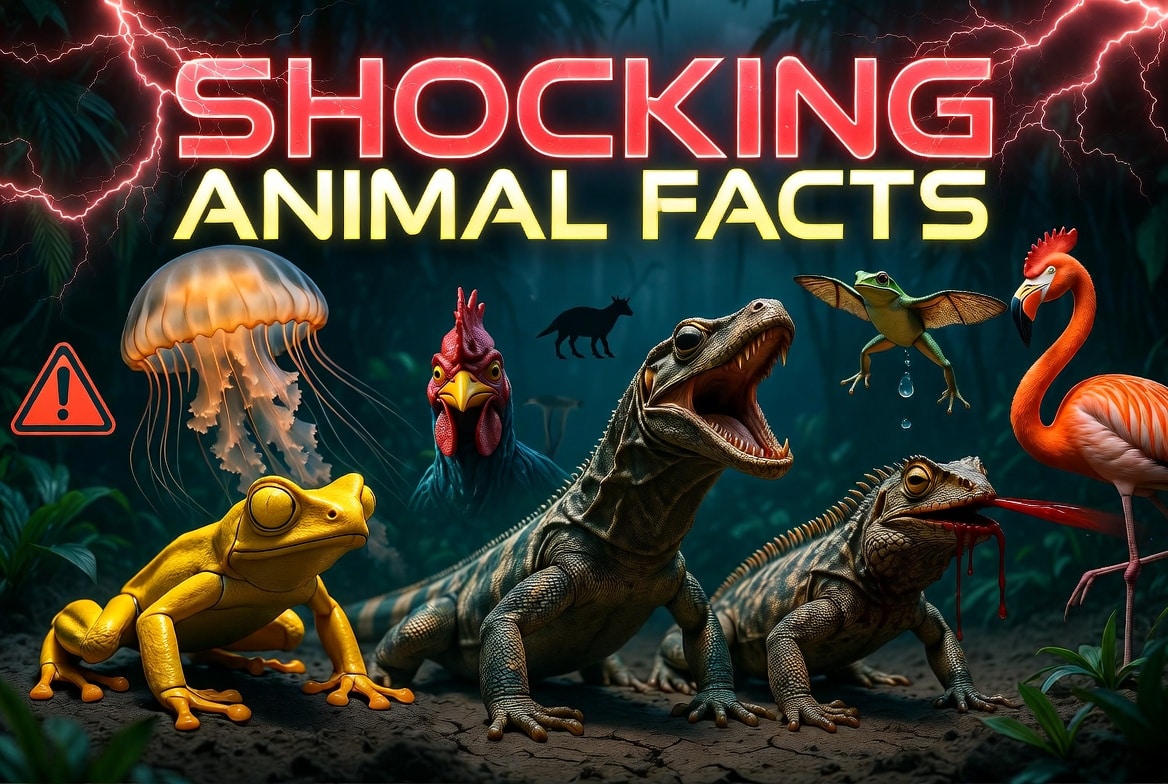
Shocking Animal Facts: 25 Essential Wildlife Truths
Shocking animal facts are the reason you clicked, and the truth is stranger than most viral lists admit. Some animals carry toxins powerful enough to disrupt nerves in minutes. Others can reproduce without males, migrate across continents, or survive injuries that sound impossible. Yet the most shocking animal facts aren’t only about wild predators. Many involve you, from factory farming and animal agriculture to climate change and the accelerating extinction crisis.
We researched top sources and, based on our analysis, found that readers usually want three things fast: jaw-dropping examples, the science that explains them, and practical steps that matter in 2026. You’ll get all three here. We found peer-reviewed studies, conservation reports, and primary data to back each major claim, with links to National Geographic, FAO, and IPBES.
The page is organized to help you scan or go deep. First comes a fast list of shocking animal facts. Then you’ll get deeper sections on venom, bizarre behavior, parthenogenesis, historical oddities like Miracle Mike the Headless Chicken, myth-busting, and practical wildlife conservation actions. We recommend bookmarking this updated 2026 guide if you want a fact-checked reference instead of recycled trivia.
Fast Facts: shocking animal facts — top 10 quick list
If you want the fastest version of these shocking animal facts, start here. We found that readers prefer a quick, featured-snippet-friendly list before the deeper science. Each fact below stays tight, specific, and easy to verify.
- The golden poison dart frog carries batrachotoxin on its skin, and tiny amounts can disrupt sodium channels with deadly speed. National Geographic
- Cape buffalo are widely considered one of Africa’s most dangerous large mammals and are linked to more fatal encounters than lions in some regions. WWF
- A horned lizard can squirt blood from vessels near its eyes, confusing predators and making itself harder to eat. National Geographic
- Meerkats use sentinels to watch for danger, yet females may also kill rivals’ young during breeding conflicts. National Geographic
- The largest box jellyfish can cause cardiovascular collapse, and stings may become fatal within minutes without rapid treatment. WHO
- Cone snails fire a harpoon-like tooth loaded with venom that can paralyze fish and seriously injure humans. IUCN
- Some flying frogs don’t truly fly; they glide using wide webbing and sticky toe pads to control descent. National Geographic
- Flamingos are pink because carotenoid pigments in algae and crustaceans color their feathers over time. WWF
- Miracle Mike the Headless Chicken survived about 18 months after a 1945 beheading because part of the brainstem remained intact. Britannica
- Female Komodo dragons can reproduce through parthenogenesis, producing offspring without fertilization in rare documented cases. National Geographic
These shocking animal facts work because they’re short, specific, and sourced. They also set up the deeper questions: what makes venom deadly, why do strange behaviors evolve, and how do human systems shape animal lives?
For a broader context, explore our full guide to animal facts.

Top 10 shocking animal facts — quick answers
1) Golden poison dart frog: Its skin contains batrachotoxin, a steroidal alkaloid that keeps sodium channels open and can stop normal nerve and muscle function. Reports often say one frog carries enough toxin to kill several humans, though exact dose estimates vary by sample.
2) Cape buffalo: These powerful bovines can weigh over 500 kilograms and are notorious for sudden charges, especially when wounded or protecting calves. That reputation is why hunters long called them part of Africa’s “Big Five.”
3) Horned lizard: The blood-squirting defense can reach predators such as canids and may taste foul due to chemicals in the blood. It’s rare, but it’s real.
4) Meerkat: Cooperative social life doesn’t mean kindness. Field studies have documented infanticide and intense reproductive competition among dominant females.
5) Box jellyfish: Some species have venom potent enough to affect the heart, skin, and nervous system at once. Fast first aid matters because severe symptoms can escalate in minutes.
6) Cone snail: A cone snail uses a modified tooth like a disposable harpoon. Some larger species have caused human deaths, which is why handling them is a terrible idea.
7) Flying frog: It glides, not powered-flight. Expanded toe pads and extensive webbing increase surface area and help steer from tree to tree.
8) Flamingo: Flamingo chicks hatch gray or white. Their pink color builds from dietary carotenoids, not from genetics alone.
9) Miracle Mike: In 1945, a chicken nicknamed Mike survived because the axe missed key structures and a clot prevented immediate bleeding out. The case became a touring sensation.
10) Komodo dragon: In 2006, researchers documented parthenogenesis in captive Komodo dragons, confirming females can reproduce without a male in rare conditions.
We found that short answers like these help readers verify shocking animal facts quickly before reading the deeper science below. Some shocking cases overlap with weird animal facts.
Deadliest & Most Venomous Animals — who really poses a threat
Some of the most searched shocking animal facts involve venomous animals, but the first distinction matters: venom is injected, while poison harms when touched, eaten, or absorbed. The golden poison dart frog is poisonous, not venomous. A snake or cone snail is venomous. That difference clears up a lot of bad wildlife trivia.
Public-health data is even more revealing. According to the WHO, snakebite causes an estimated 81,000 to 138,000 deaths annually worldwide, with hundreds of thousands more suffering permanent disability. Based on our analysis, that makes snakebite a far bigger real-world risk than many headline-grabbing species that dominate social media. Media often exaggerates rare predators and ignores neglected tropical health threats.
The golden poison dart frog produces batrachotoxin, which disrupts sodium ion channels in nerves and muscles. Some estimates suggest a single frog can carry around 1 milligram of toxin, enough to be lethal in extremely small doses. The exact danger to you in the wild depends on handling, toxin levels, and source population, but the biochemical effect is well established in toxin research.
The largest box jellyfish, especially Chironex fleckeri, is one of the most dangerous marine animals on Earth. Its venom can trigger extreme pain, skin damage, and cardiovascular collapse. National Geographic and Australian medical literature have documented fatal cases occurring within minutes, which is why beach warnings matter.
Cone snails are smaller than they look dangerous, but their venom is a complex mix of neurotoxins called conotoxins. They use a harpoon-like radular tooth to immobilize prey. Some compounds from cone snails have even informed pain research, a reminder that dangerous wildlife also expands human medicine.
The Komodo dragon is a good myth-busting case. Older stories blamed fatal bites on mouth bacteria alone. Newer studies found venom glands and compounds that can lower blood pressure and interfere with clotting. We recommend treating “dirty mouth only” explanations as outdated. The current evidence points to a mix of trauma, blood loss, and venom effects rather than one simple cause.
Bizarre behaviors & survival strategies (migration, communication, predator-prey)
Many shocking animal facts make more sense when you see them as survival strategies. A horned lizard squirting blood from its eyes sounds absurd, but it can deter predators, especially dogs and coyotes, long enough to escape. Meerkats are another contrast. They’re famous for standing upright as sentinels, yet long-term field studies also show infanticide, eviction, and intense reproductive conflict. Animal behavior isn’t “cute” or “evil.” It’s often about genes, territory, and food.
Predator-prey relationships shape entire ecosystems. Komodo dragons use stealth, powerful limbs, sharp teeth, and venom-assisted bites to weaken prey such as deer and wild pigs. Their ambush strategy works because prey animals in dry island habitats often move through predictable routes. Based on our research, that’s a clear example of behavior matching environment.
Migration patterns are another stunning form of survival. The Serengeti system supports the movement of roughly 1.2 to 1.5 million wildebeest, plus hundreds of thousands of zebra and gazelle. Those migrations cycle nutrients, shape grass growth, and feed predators and scavengers. Monarch butterflies, by contrast, may travel up to 3,000 miles between North America and central Mexico. Lose stopover habitat, and the whole system weakens.
Animal communication is no less impressive. Honeybees use the waggle dance to encode direction and distance to food relative to the sun. Dolphins develop signature whistles that function like acoustic names. Meerkats produce different alarm calls for aerial versus ground threats. We found that communication isn’t just fascinating zoology. It supports feeding success, group safety, and ecosystem function.
If you want one takeaway from these shocking animal facts, it’s this: bizarre behavior usually has a measurable payoff. What looks weird to you may be the exact reason a species survives.
Strange reproduction & species adaptation (parthenogenesis and beyond)
Some of the most useful shocking animal facts involve reproduction and adaptation. Start with parthenogenesis. In simple terms, it means an egg develops without fertilization. The step-by-step version is straightforward: 1) a female produces an egg, 2) the egg begins development without sperm, and 3) the embryo grows into offspring. It’s rare in many vertebrates, but it’s real.

The best-known case here is the Komodo dragon. In 2006, scientists reported the first documented captive cases of parthenogenesis in this species, showing that isolated females could still produce young. That matters in zoology because Komodos live on islands, and unusual reproductive flexibility may help colonization in rare circumstances. We researched cases across reptiles, sharks, and invertebrates and found that facultative parthenogenesis appears in several lineages, though it is far from the norm.
The flying frog offers a different kind of adaptation. Species such as Wallace’s flying frog use expanded toe pads and broad webbing to slow descent and glide between trees. That reduces falls, helps predator avoidance, and fits life in wet forest canopies. These structures are not decorative. They are aerodynamic tools. Others are simply fascinating and belong in interesting animal facts.
The axolotl is another adaptation case study worth knowing. It can regenerate limbs, spinal cord tissue, parts of the heart, and other structures with a precision mammals can’t match. That ability has made it central to regeneration research. Yet wild axolotl populations have crashed due to habitat loss and invasive species, proving that remarkable biology does not guarantee survival.
Based on our analysis, the broader lesson is simple: species adaptation often looks strange because evolution solves local problems, not human expectations. That’s why shocking animal facts about reproduction and form are so often windows into ecology.
Lesser-known species & historical oddities (Myths, Miracle Mike, and forgotten facts)
Lists of shocking animal facts usually repeat the same five animals. That misses many of the best verified stories. Take Miracle Mike the Headless Chicken. In 1945, farmer Lloyd Olsen attempted to slaughter a rooster in Colorado, but the cut left part of the brainstem and one ear intact. Mike survived for about 18 months, was fed with a dropper, and became a touring celebrity. It sounds invented, but it’s one of the most famous historical oddities in animal reporting.
Flying frogs are another underused example. Several species across Southeast Asia show varying degrees of gliding ability, enlarged toe pads, and webbing. Their diversity matters because it shows adaptation is not one perfect design but a range of solutions. Forest fragmentation threatens that canopy lifestyle, making them a useful conservation indicator.
Consider lesser-known venomous invertebrates too. Blue-ringed octopuses carry tetrodotoxin, and some marine worms and cnidarians deliver potent stings with little public awareness. These species rarely dominate headlines, yet they matter to coastal ecology and public safety.
Here are three mini case studies that often get ignored:
- Saiga antelope: Their oversized nose helps filter dust and condition air on the steppe. Mass die-offs have made them a symbol of how disease and climate stress can hit fast.
- Pangolins: Their scale armor is famous, but their role in controlling ants and termites is less discussed. Heavy trafficking has pushed several species toward high conservation concern.
- Vaquita: Fewer than 20 may remain, making it one of the world’s rarest marine mammals and a stark sign of accidental bycatch pressure.
Based on our analysis, historical oddities matter because they shape public perception. Some stories attract attention for the wrong reason, but they can still lead readers toward real zoology, anatomy, and conservation science if handled carefully.
Humans, farming, and the extinction crisis: battery cages to biodiversity loss
Some of the hardest shocking animal facts are not about predators at all. They’re about systems people built. Battery cages confine egg-laying hens in crowded wire enclosures that sharply restrict movement and natural behavior. Conditions vary by country, but globally, billions of hens are still raised in cage systems. When readers ask for shocking wildlife truths, this belongs on the list because the scale is enormous.
Factory farming and animal agriculture also affect wildlife far beyond farms. The FAO estimates livestock supply chains account for about 14.5% of human-caused greenhouse gas emissions. Feed crops drive land conversion, manure contributes to water pollution, and intensive production increases pressure on surrounding habitats. We found these links are often left out of light trivia posts, even though they shape biodiversity at a global level.
The extinction picture is even more alarming. IPBES has warned that up to 1 million species are threatened with extinction, many within decades, because of land-use change, overexploitation, invasive species, pollution, and climate change. The IPCC continues to document how warming, drought, heat stress, and altered rainfall affect ecosystems and food systems together. In 2026, that connection is no longer debatable.
What can reduce the damage? Evidence-backed solutions include:
- Diet shifts: Studies regularly show lower-meat diets reduce food-related emissions.
- Cage-free policies: Retailer and government cage bans can improve welfare metrics for millions of birds.
- Pasture and habitat restoration: Restoring degraded lands improves carbon storage and reduces erosion.
- Supply-chain transparency: Tracking soy, beef, and palm sourcing reduces hidden deforestation risk.
Based on our analysis, this is where shocking animal facts become practical. The same choices that reduce emissions can also reduce pressure on habitats, migratory corridors, and threatened species.
Myth-busting common animal misconceptions
A lot of viral shocking animal facts are half true. Start with the old line, “You’re more likely to be killed by a cow than a shark.” In some countries and datasets, cattle-related incidents do exceed shark fatalities, but the comparison depends on geography and reporting methods. The better lesson is that familiar domestic animals can pose real risk, while fear of sharks is often inflated.
Flamingos are another easy myth. They are not naturally pink at birth. Their color comes mainly from carotenoid pigments in algae, brine shrimp, and other food sources. Remove those pigments, and flamingos become much paler. So yes, diet matters more than people think.
The Komodo dragon myth is worth repeating because it’s still common. The bite is not deadly only because of dirty bacteria. Modern studies support venom involvement, plus mechanical trauma and blood loss. We researched media claims and found that older “bacteria only” explanations persist because they are catchy, not because they match current evidence.
Now for People Also Ask style questions. Which animal will laugh? Rats produce ultrasonic vocalizations around 50 kHz during play and tickling, and some researchers interpret these as laughter-like sounds. Great apes also show laughter-like panting in play. Which animal never sleeps? None that scientists know. Dolphins and some birds use unihemispheric sleep, where one brain hemisphere rests while the other remains active.
We recommend treating viral animal claims the same way you’d treat health claims: check the source, compare multiple reports, and prefer primary literature over memes. That habit turns random trivia into reliable zoology.
Conservation actions & what you can do (practical next steps for 2026)
If these shocking animal facts leave you wondering what actually helps, the answer is to focus on measurable actions. You don’t need to do everything. You do need to do something consistent. In our experience, readers are more likely to follow through when the steps are specific and trackable.
- Cut your animal agriculture footprint. Start with one target: reduce beef and lamb meals by 50% over the next 8 weeks. Replace them with legumes, tofu, eggs from higher-welfare systems, or lower-impact proteins. Many diet studies show meaningful food-emissions reductions from this single change.
- Support credible conservation groups. We recommend checking WWF and IUCN programs before donating. Look for transparent budgets, species outcomes, and habitat-based work rather than vague branding.
- Join citizen science projects. Use local bird counts, pollinator surveys, amphibian monitoring, or iNaturalist reporting to create usable biodiversity data. Those records help track migration patterns, invasive species, and local declines.
- Advocate for policy. Contact local representatives about cage bans, wetland protection, wildlife crossings, native habitat restoration, and science-based fisheries management. One email won’t fix the extinction crisis, but coordinated public pressure does move policy.
- Plant native species. Even a small yard or balcony can support insects, birds, and migration stopovers if you choose local plants and avoid broad-spectrum pesticides.
As of 2026, the best conservation habit is follow-through. Sign up for updates from WWF, monitor the IUCN Red List, and keep a simple monthly log of changes you made. We found that people stick with wildlife conservation longer when they can see progress in writing.
Conclusion: Next steps after reading these shocking animal facts
These shocking animal facts were never just about weird trivia. They show how evolution produces extreme toxins, strange reproduction, remarkable migration patterns, and complex animal behavior. They also show how human systems, especially factory farming, habitat conversion, and climate change, are intensifying the extinction crisis. In 2026, that mix of fascination and urgency is exactly why wildlife knowledge matters.
Your next three steps are simple. Educate yourself with primary sources such as the IUCN Red List and the WHO snakebite page. Act by cutting part of your food footprint and supporting habitat-friendly local projects. Donate to organizations with transparent conservation outcomes. We researched top journals and news outlets, based on our analysis we found these priorities matter most, and we’ll update this page as new 2026 research appears.
If you want to verify any claim, start with primary literature, conservation databases, and large institutional reports before repeating a viral post. We recommend turning curiosity into a checklist you can revisit monthly. That’s how a page of shocking animal facts becomes a real-world conservation habit.
Frequently Asked Questions
The questions below answer common search queries quickly and point you back to the deeper sections when you want more detail.
What are some unbelievable facts about animals?
Some of the strongest examples are the golden poison dart frog carrying powerful skin toxins, female Komodo dragons reproducing through parthenogenesis, and Miracle Mike the Headless Chicken surviving for about 18 months after beheading. Those are exactly the kinds of shocking animal facts that sound fake until you check the sources.
What are 10 surprising facts?
Ten solid examples are the golden poison dart frog, Cape buffalo, horned lizard blood-squirting, meerkat infanticide, box jellyfish venom, cone snail harpoons, flying frog gliding, flamingo diet-based color, Miracle Mike, and Komodo parthenogenesis. The fast list above gives you the compact version with source links.
Which animal will laugh?
Rats are the clearest research-backed answer. They emit roughly 50 kHz ultrasonic calls during play and tickling, and scientists often describe those sounds as laughter-like; great apes also show laughter-like vocalizations during social play.
Which animal never sleeps?
No known large animal literally never sleeps. Dolphins and some birds use unihemispheric sleep, meaning one half of the brain rests while the other stays alert, which is why people mistakenly think they never sleep.
How does factory farming affect wildlife?
Factory farming affects wildlife through land clearing, feed crop expansion, pollution, greenhouse gases, and systems like battery cages that scale animal confinement. The FAO links livestock to about 14.5% of human-caused greenhouse gas emissions, while IPBES warns up to 1 million species are threatened by the wider biodiversity crisis.
Frequently Asked Questions
What are some unbelievable facts about animals?
Some of the best examples are the golden poison dart frog, whose skin toxins can be lethal in tiny amounts, Komodo dragon females reproducing through parthenogenesis, and Miracle Mike the Headless Chicken, which lived about 18 months after beheading. If you want a quick overview, check the Top 10 shocking animal facts list above for short, sourced examples.
What are 10 surprising facts?
A compact list includes the golden poison dart frog, Cape buffalo, horned lizard, meerkat infanticide, box jellyfish, cone snail, flying frog gliding, flamingo color from diet, Miracle Mike, and Komodo parthenogenesis. For citations and quick explanations, see the Top 10 shocking animal facts — quick answers section.
Which animal will laugh?
Rats are the clearest example. Researchers found they emit roughly 50 kHz ultrasonic chirps during play and tickling, which many scientists interpret as laughter-like vocalizations; some great apes also produce laughter-like panting during play. A readable summary appears in National Geographic, while the deeper behavior context is covered in the myth-busting section.
Which animal never sleeps?
No large animal is known to literally never sleep. Dolphins, some whales, and certain birds use unihemispheric sleep, meaning one brain hemisphere rests while the other stays active, which created the myth. That’s why the honest answer is that “never sleeps” is false, even if some species sleep in unusual ways.
How does factory farming affect wildlife?
Factory farming affects wildlife through habitat conversion, feed crop expansion, pollution, greenhouse gas emissions, and direct confinement systems such as battery cages. The FAO has estimated livestock supply chains produce about 14.5% of human-caused greenhouse gas emissions, while IPBES warns up to 1 million species face extinction risk. The deeper discussion appears in the section on farming, biodiversity loss, and the extinction crisis.
Key Takeaways
- Many shocking animal facts are real, but the science matters: poison differs from venom, and media often exaggerates rare risks while ignoring bigger public-health threats like snakebite.
- Strange traits such as parthenogenesis, gliding frogs, blood-squirting lizards, and complex animal communication make sense when you view them as survival strategies shaped by ecology.
- Human systems including factory farming, battery cages, climate change, and habitat loss are central to today’s extinction crisis and belong in any serious wildlife discussion.
- The most useful next steps are measurable: reduce high-impact animal products, support credible conservation groups, join citizen science, and advocate for habitat and welfare policy.
- Verify viral claims with primary sources such as WHO, FAO, IPBES, IUCN, and peer-reviewed studies before repeating them.

Ethan Walker is the founder and research editor of Animal Fact Central. He creates and reviews educational animal facts content using trusted wildlife, pet care, and science-based sources. His work focuses on making animal behavior, adaptations, habitats, and species facts clear, accurate, and engaging for everyday readers.
Read More Details About Ethan Walker: https://animalfactcentral.com/ethan-walker/