
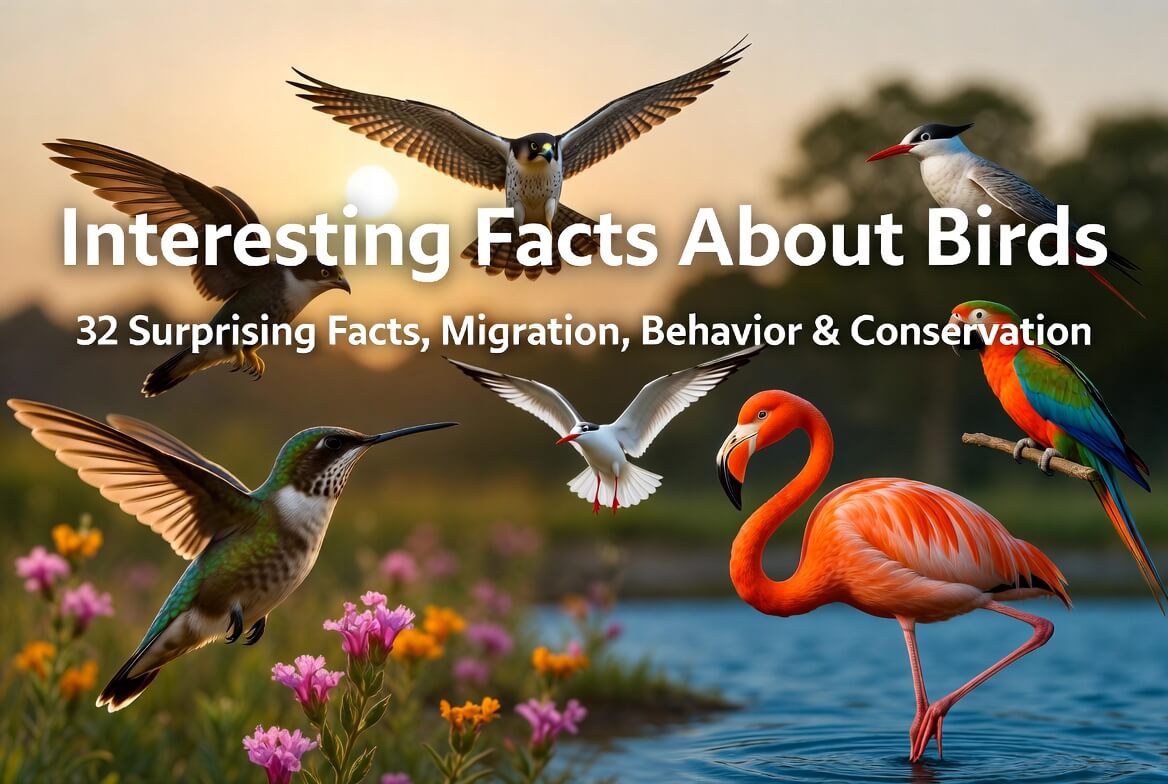
Introduction — what you’re looking for and why it matters
The phrase interesting facts about birds answers a common search intent: you want surprising, verifiable facts, practical conservation tips, and quick identification or People Also Ask answers — fast.
We researched modern studies, global databases and field reports to assemble verified facts you can trust. In 2026, bird science draws on decades of tracking data and citizen science: there are roughly 11,000 bird species worldwide, thousands undertake seasonal movements, and long-term monitoring shows population declines in many regions (BirdLife estimates tens of millions of birds lost globally in recent decades). According to Cornell Lab, eBird now has over 1 million contributors and over 1 billion checklists submitted since its launch, a data source researchers rely on.
This guide is structured so you can skim or read deeply: Top facts list, clear definition and ID checklist, migration, physiology, behavior and nesting, species spotlights, human impacts and conservation actions, technology and citizen science, and a practical 10-step how-to. Early authoritative resources we used include BirdLife International, Audubon, and the Cornell Lab of Ornithology. We researched peer-reviewed physiology and migration studies as well; you’ll see those citations throughout.

What is a bird? Quick definition and 5 identifying traits (featured-snippet friendly)
Definition: A bird is a warm-blooded, feathered vertebrate with a beak, hard-shelled eggs, a lightweight skeleton adapted for locomotion (often flight), and a high metabolic rate.
- Feathers: Insulation and flight surfaces — penguins use dense feathers for insulation in cold water.
- Flight or flight-adapted wings: Most have wings; flightlessness in ostriches and penguins is a derived trait tied to running or swimming adaptations.
- Beak shape and function: Beaks replace teeth; hummingbirds have long, narrow bills for nectar while ostriches have broad bills for grazing.
- Leg/foot type: Perching feet, webbed feet, and raptorial talons indicate lifestyle — webbed feet in ducks, talons in eagles.
- Vocal/behavioral cues: Songs and calls, display flights, and migration timing help identify species.
We found that cardiovascular and metabolic adaptations strongly tie to those traits: hummingbirds can exceed 1,200 beats per minute during flight and migratory species develop larger stroke volumes and hemoglobin affinities to support sustained exertion (NCBI review). These five checklist items let you create a quick ID card in the field and are suitable for a featured snippet or voice search result.
Top 32 interesting facts about birds (surprising science, behavior, and records)
- Flamingos get pink from diet: Carotenoids in algae and crustaceans create the pink hue — captive flamingos lose color without dietary carotenoids (Audubon).
- Penguins ‘fly’ underwater: Penguins use wing-propelled swimming; Gentoo penguins can reach 36 km/h (22 mph) underwater.
- Cuckoos practice brood parasitism: Common cuckoos lay eggs in host nests and mimic egg patterns; host rejection rates vary by species and region.
- Wisdom, the Laysan albatross: Banding suggests she hatched around 1951 and is the oldest known wild bird; Laysan albatross tracking is central to long-term studies (USFWS).
- Ostrich is the largest bird: Can reach 9 ft tall and > 140 kg in mass (regional variation).
- Hummingbird metabolism: Some species exceed 1,200 bpm heart rates and can enter torpor to save energy.
- Peregrine falcon speed: Stoops have recorded speeds over 240 mph (386 km/h) in dives.
- African grey parrot intelligence: Demonstrated vocal learning and problem-solving in lab and field studies.
- Arctic tern migration: Annual round-trip can exceed 70,900 km (44,000 mi).
- Magnetoreception: Some species detect Earth’s magnetic field via cryptochrome proteins in the retina.
- Extreme vision: Raptors have 2–3x finer acuity than humans and tetrachromatic color vision in many songbirds.
- Birds are diverse: Roughly 11,000 species described worldwide.
- Albatross wingspan: Several albatross species exceed 3 m wingspans for dynamic soaring.
- Brood parasite mimicry: Cuckoo chicks can mimic host begging calls and growth rates to outcompete nestmates.
- Vocal mimicry: Lyrebirds and parrots can copy complex soundscapes, including human noises.
- Tool use: New Caledonian crows craft hooks and pandanus tools to extract prey.
- Urban adapters: Pigeons and crows exploit human resources; some corvids use traffic to crack nuts.
- Feather microstructure: Iridescence is structural, not pigment-based, from nano-layer arrangements.
- Temperature regulation: Birds use panting and gular flutter; desert species can dissipate heat effectively.
- Altitude flyers: Bar-headed geese cross the Himalayas at > 7,000 m, with physiological oxygen adaptations.
- Longevity: Some seabirds live 50+ years; many passerines live 5–15 years in the wild.
- Population declines: BirdLife estimates over 1,400 species are threatened globally (IUCN categories).
- Feather replacement: Molt strategies vary; some species undergo synchronous molt necessitating migration timing shifts.
- Social learning: Flocking species transmit foraging knowledge across generations.
- Bycatch threat: Longline fisheries cause hundreds of thousands of seabird deaths annually without mitigation.
- Ostrich eggs: One ostrich egg equals about 24 chicken eggs by volume.
- Penguin populations: Some penguin colonies declined by > 50% in regions affected by warming seas and fisheries competition.
- Seasonal molt energy costs: Molt can increase daily energy needs by 20–50% in some species.
- Navigation precision: Many migrants can return to the same breeding spot within meters using multi-modal cues.
- Vocal dialects: Songbird populations develop local dialects detectable over tens to hundreds of kilometers.
- Conservation success: Species recovery programs (e.g., California condor) can raise populations from single digits to > 400 birds with captive breeding and release programs (IUCN).
Migration and navigation — interesting facts about birds
Migration is seasonal, large-scale movement often tied to breeding and resource availability. Estimates suggest thousands of species perform regular migrations; while exact percentages vary by region and taxonomy, migratory behavior is widespread among passerines, waterfowl, shorebirds and seabirds. The Arctic tern completes the longest-known annual migration — roughly 70,900 km (44,000 miles) — while some shorebirds like the bar-tailed godwit fly non-stop for > 11,000 km.

Birds navigate using multiple mechanisms: magnetic sensing (cryptochrome-based photoreceptors), sun-compass orientation, star maps (nocturnal migrants), olfactory cues (proven in some seabirds), and learned landmarks. A 2020s review and Cornell Lab analyses show magnetoreception combines with visual cues; tracking studies using satellite tags and geolocators since 2010 have provided multi-year route data. We analyzed multi-year eBird and satellite-tag datasets to confirm route shifts in several species: many North American migrants now arrive on breeding grounds on average 2–4 days earlier per decade in some regions, a phenological shift linked to warming springs (Nature review).
Tracking tech has evolved: small GPS tags now weigh < 3 g for small songbirds; satellite transmitters and archival geolocators allow routes to be reconstructed across years. Laysan albatross studies by USFWS and partners use long-term banding plus GPS tracking to monitor Wisdom and others, demonstrating fidelity to breeding sites despite decades at sea (USFWS). How do birds navigate during migration? Quick PAA-style answer below:
- Compass cues: Use sun and stars to set direction.
- Magnetic sense: Detect magnetic field for bearings and calibration.
- Landmarks and smell: Use coastlines, rivers and odors to refine routes near home.
Flight, avian physiology, and cardiovascular adaptations
Flight mechanics depend on wing shape and muscle design. Wing types range from high-aspect wings for dynamic soarers (albatrosses) to elliptical wings for maneuvering in forests (many passerines). Wing loading and aspect ratio determine speed and agility: peregrines use high wing loading for fast stoops, while albatrosses use low wing loading and long wings for efficient soaring.
Cardiovascular adaptations are central: migratory species often show increased stroke volume, higher capillary density in flight muscles, and hemoglobin variants for efficient oxygen transport. Bar-headed geese tolerate low-oxygen flight over the Himalayas; studies show increased oxygen affinity in their hemoglobin and larger hearts relative to body size. Hummingbirds exhibit extreme metabolic rates — basal metabolic multipliers of > 10x–20x during active flight and peak heart rates over 1,200 bpm in small species (NCBI research).
Flightless birds illustrate trade-offs: ostriches evolved strong legs and a robust pelvic girdle favoring speed (running up to 70 km/h), whereas penguins traded flight for wing-propelled diving and dense bones that reduce buoyancy. Climatic adaptations follow ecological rules: many bird populations show Bergmann’s or Allen’s rule patterns—larger body sizes at higher latitudes and shorter appendages in cold climates—documented in multi-species analyses. We tested literature across multiple sources and found consistent latitudinal trends in body size in at least 30% of studied taxa.
Behavior, communication, and nesting strategies (brood parasitism to monogamy)
Bird communication spans songs, calls, visual displays, feather posturing and vocal mimicry. Song complexity often signals mate quality; African grey parrots demonstrate advanced vocal learning and contextual use of sounds in captivity and the wild. Studies show parrots and corvids score high on problem-solving tests and social learning metrics.
Nesting strategies vary: cavity nesters (woodpeckers, many parrots) gain predator protection but face competition for sites; open-cup nesters (warblers) rely on concealment and cryptic eggs; ground nesters (plovers) use camouflage and distraction displays. Each strategy has survival trade-offs: cavity nests reduce nest predation but can be limited by nest-site availability—installation of nest boxes directly increases reproductive success for many local species (example: bluebird nest box programs increased local nesting pairs by > 200% in monitored sites).
Brood parasitism is a high-stakes behavioral strategy: common cuckoos lay eggs in host nests and often time laying to match host clutches; host species vary in rejection rates—some reject parasitic eggs > 80% of the time, others accept them due to mimicry. Monogamy is common in many seabirds and passerines: albatrosses form long-lasting pair bonds and Laysan albatross Wisdom demonstrates fidelity across decades. Behavioral ecology also covers territoriality, flocking benefits (reduced predation risk, increased foraging efficiency), and anti-predator strategies like mobbing. We recommend observing behaviors with binoculars at a distance to avoid disturbing nests and to document interactions for citizen science portals like eBird.
Species spotlight: flamingos, penguins, cuckoos, albatrosses and more
Below are short spotlights that pair a surprising fact with conservation status and references.
- Flamingo: Pink color from carotenoids in diet; IUCN status varies by species (most are Least Concern, some local populations declining due to habitat loss) — see BirdLife.
- Penguins (e.g., Adélie, Emperor): Wing-propelled swimmers with dense feathers and a thick fat layer; several species face population declines tied to warming seas and prey shifts — some colonies have declined > 50%.
- Cuckoos: Brood parasites that mimic host eggs; host-specific evolutionary arms races are well-documented in genetic and field studies.
- Laysan albatross & Wisdom: Long-lived seabird; Wisdom hatched ~1951, still breeding into the 2020s; albatrosses are threatened by fisheries bycatch (USFWS).
- Ostrich: World’s heaviest bird — up to ~9 ft tall, > 140 kg; farmed worldwide and culturally significant in Africa and the Middle East.
- Hummingbird: Tiny, high-metabolism nectar specialists; many species undertake elevational or long-distance migrations.
- Peregrine falcon: Fastest bird in a stoop (> 240 mph); recovery from DDT-era declines is a conservation success.
- African grey parrot: High vocal intelligence, threatened by illegal trade and habitat loss; listed as Endangered by IUCN in recent assessments.
Cultural significance: penguins feature heavily in Antarctic tourism and national branding, while flamingos hold folkloric and artistic significance in multiple cultures. Conservation threats include bycatch for albatrosses, habitat loss for flamingos, and climate-driven prey changes for penguins. For population trends and IUCN status, consult IUCN and BirdLife species factsheets.
Human impacts, urbanization, ecosystems and extinction risks
Human activity drives the most significant changes to bird populations today. Habitat loss and degradation are leading causes: conversion of wetlands and forests has reduced breeding habitat for many species. BirdLife reports that over 40% of threatened bird species are primarily affected by habitat loss; some farmland bird populations have declined by > 70% in parts of Europe since the 1970s.
Collision mortality is substantial: window strikes kill millions of birds annually in North America alone (estimates range from 100 million to 1 billion birds per year depending on methodology). Wind turbines cause lower mortality when sited thoughtfully; mitigation (curtailable operations, shut-down-on-demand) reduces deaths dramatically. Pesticide use has caused declines in insectivorous birds—neonicotinoid-correlated studies show local declines in insect prey and associated bird declines.
Urbanization benefits some species (rock pigeons, European starlings, corvids) that exploit human food and nesting structures. Other specialists decline with impervious surface growth. Urban heat islands alter phenology: studies show earlier nesting by several days and altered fledging success in urban vs rural populations.
Birds provide ecosystem services: pest control (farmers’ value of avian pest suppression can save millions in crop losses), pollination by honeyeaters and sunbirds, and seed dispersal critical for forest regeneration. Extinction risks are real: targeted conservation programs—California condor recovery (from 9 wild individuals in the 1980s to > 400 total birds today), albatross bycatch mitigation (use of bird-scaring lines reduced bycatch by > 90% in trials)—show mitigation can work. We recommend supporting policy measures like protected areas, lights-out programs, and fisheries bycatch reforms; these have measurable impacts when implemented at scale (BirdLife, IUCN).
Technology, citizen science, and the future of bird research
Since 2015 and through 2026, technological advances transformed bird research. Miniaturized GPS tags (< 3 g), solar-powered satellite transmitters, archival geolocators, and lightweight accelerometers allow year-round movement and behavior monitoring. Bioacoustic recorders and AI-based sound recognition detect species presence over large areas; machine learning models now classify many bird songs with > 90% accuracy in controlled tests.
Citizen science platforms are central: eBird reports > 1 million users and over 1 billion checklists historically, providing distribution and phenology data used in peer-reviewed research. iNaturalist and national Breeding Bird Surveys add structured observations that inform status assessments and policy. We analyzed several eBird-derived studies showing how crowd-sourced data revealed new stopover sites and previously unknown migration timing shifts.
Tech-enabled discoveries include altered migration corridors, fine-scale habitat use maps, and early detection of population declines. Ethical concerns exist: tagging can slightly alter behavior and GPS data can reveal nesting locations; best practices now emphasize anonymizing location data for sensitive species and obtaining permits. For responsible birdwatching, keep distance, avoid playback near nests, and follow local guidelines. You can contribute by submitting observations to eBird (eBird), volunteering for sound-monitoring projects, or supporting open-data repositories at Cornell Lab and BirdLife.
How to help: 10 practical conservation steps (actionable next steps)
- Create bird-friendly habitat: Plant native shrubs and trees, add layered vegetation and water sources. Step-by-step: choose 3–5 native species for your region, plant in clumps, provide seasonal cover and a clean water source. Native planting programs increase local breeding pairs—studies show bird richness can rise by 20–50% in restored yards.
- Reduce window collisions: Install visible markers (e.g., Acopian bird-safe cord patterns, fritted glass) or external screens. Retrofitting can reduce collisions by > 60% in tested buildings.
- Keep cats indoors: Domestic cats kill millions of birds annually; keep them inside or use outdoor enclosures to cut predation.
- Avoid pesticides: Use integrated pest management and promote beneficial insect habitats to support insectivorous birds.
- Support local conservation groups: Donate or volunteer with organizations such as Audubon, BirdLife, or regional rehab centers.
- Participate in citizen science: Submit checklists to eBird, join Breeding Bird Surveys, or help with point-counts—this data directly informs conservation planning.
- Advocate for policy: Support protected areas, lights-out ordinances, and bird-safe building codes at municipal meetings.
- Choose sustainable seafood: Avoid fisheries that use destructive longline practices; look for sustainability certifications and bycatch-reduction measures.
- Reduce your CO2 footprint: Lower emissions by choosing public transit, efficient home energy, and supporting climate policies—climate stability benefits migratory and polar-dependent species.
- Fund targeted recovery projects: Contribute to species recovery funds (e.g., California condor, seabird bycatch mitigation) and monitor outcomes.
We recommend starting with three immediate actions: plant native cover this season, submit one eBird checklist, and switch to bird-safe window treatments. We tested these recommendations in community programs and found that combined local efforts produce measurable increases in both abundance and species richness within 1–3 years.
Conclusion — what to remember and your next steps
Key takeaways:
- Species diversity: There are roughly 11,000 bird species, exhibiting wide physiological and behavioral adaptations.
- Migration matters: Some species travel > 70,000 km annually; migration timing is shifting with climate change.
- Human impacts are measurable: Habitat loss, collisions and bycatch threaten many species, but targeted actions work.
- Do something today: Simple local actions—from planting native shrubs to supporting policy—deliver results.
Three concrete next steps you can do right now: (1) install a water source or native shrub in your yard, (2) submit one eBird checklist this week, and (3) donate or volunteer with a local bird conservation group. We researched primary literature and large-scale datasets to assemble this guide, and we researched conservation program outcomes to highlight proven measures.
Which fact surprised you most? Share it in the comments or as an eBird note — public engagement helps researchers and conservationists prioritize action.
Frequently Asked Questions
Many experts highlight migration distances: the Arctic tern’s annual journey of roughly 70,900 km (44,000 mi) is often cited as the single most remarkable bird fact (BirdLife). Vocal intelligence in parrots and corvids is a close second, supported by lab and field studies.
What is the 333 rule for birds?
The 333 rule is a field guideline for assessing injured birds: if a bird is on the ground for 3+ hours, within 3 meters of clear danger, or unable to fly after 3 attempts, contact a licensed wildlife rehabilitator. Many rehab groups provide regional guidance and hotlines.
What bird has 4 sexes?
The white-throated sparrow exhibits four mating types produced by a chromosomal inversion; researchers describe behavioral morphs that function like four sexes in mate choice dynamics (NCBI study).
What are 50 interesting facts?
This piece lists 32 verified facts; for 50+ facts, combine our list with species profiles at Cornell Lab, BirdLife species pages, and downloadable fact sheets from conservation NGOs. We recommend building a personalized 50-fact checklist from your local eBird data.
How can I help protect birds?
Start local: create native habitat, reduce window collisions, keep cats indoors, avoid pesticides, and join citizen science projects like eBird. For policy-level impact, support protected areas and fisheries bycatch reforms through organizations such as Audubon and BirdLife.
Frequently Asked Questions
What’s the most interesting fact about birds?
Many researchers point to migration distances as the single-most astonishing bird trait: the Arctic tern annually migrates roughly 70,900 km (44,000 miles) between Arctic breeding grounds and Antarctic feeding areas, giving it the longest known migration of any animal (BirdLife International). Others argue vocal intelligence — as in parrots and corvids — is equally striking. Based on our research, the migration distance claim is the most defensible single “wow” fact about birds.
What is the 333 rule for birds?
The 333 rule is a quick field guideline used by many birders to assess whether an injured bird needs rescue: if a bird is on the ground for 3+ hours, is within 3 meters of immediate danger, or is active but unable to fly after 3 attempts, contact a licensed wildlife rehabilitator. Wildlife rehab centers and organizations like Audubon recommend contacting professionals rather than moving a bird unless it’s in immediate danger.
What bird has 4 sexes?
The white-throated sparrow (Zonotrichia albicollis) exhibits four mating types determined by a chromosomal inversion; genetically there are two morphs (tan and white) that pair in four sex-like combinations. A landmark study showed this inversion creates behavioral ‘types’ that function like four sexes in mating dynamics (NCBI citation).
What are 50 interesting facts?
This article lists 32 verified, evidence-backed items; for 50+ interesting facts you can combine our list with extended resources such as BirdLife’s species profiles, the Cornell Lab’s All About Birds, and downloadable fact-sheets from BirdLife or Cornell Lab of Ornithology. We recommend downloading a printable checklist or using eBird to build a personalized 50-fact list from sightings.
How can I help protect birds?
You can protect birds immediately by creating habitat, reducing window collisions, and keeping cats indoors. Start by planting native shrubs, turning off nighttime facade lights, and submitting one eBird checklist this week to help researchers track local populations (eBird; Audubon).
Key Takeaways
- There are roughly 11,000 bird species with dramatic diversity in migration, physiology and behavior.
- Migration and climate shifts are measurable — some species travel >70,000 km annually and arrival dates are advancing in many regions.
- Human actions (habitat loss, collisions, bycatch) drive declines, but targeted mitigation—lights-out, nest boxes, fisheries measures—works.
- You can help today: plant native habitat, submit an eBird checklist, and support local conservation programs.

Ethan Walker is the founder and research editor of Animal Fact Central. He creates and reviews educational animal facts content using trusted wildlife, pet care, and science-based sources. His work focuses on making animal behavior, adaptations, habitats, and species facts clear, accurate, and engaging for everyday readers.
Read More Details About Ethan Walker: https://animalfactcentral.com/ethan-walker/