
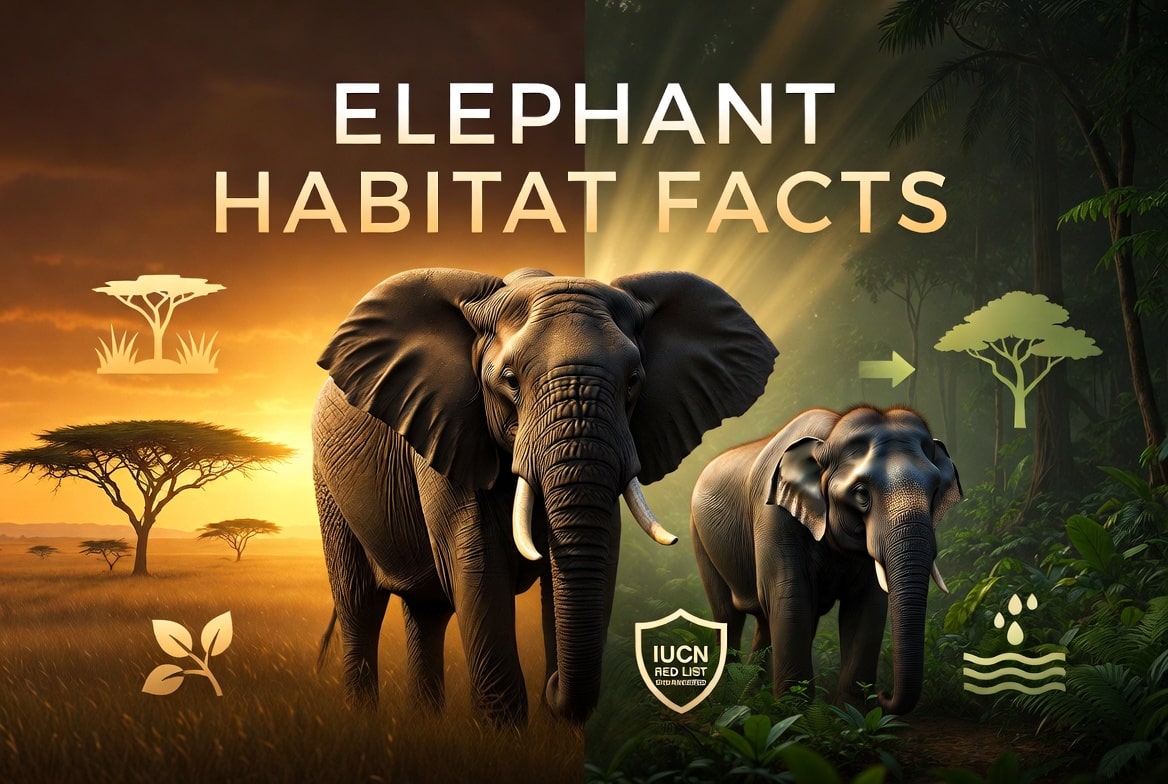
Introduction — what readers want from elephant habitat facts
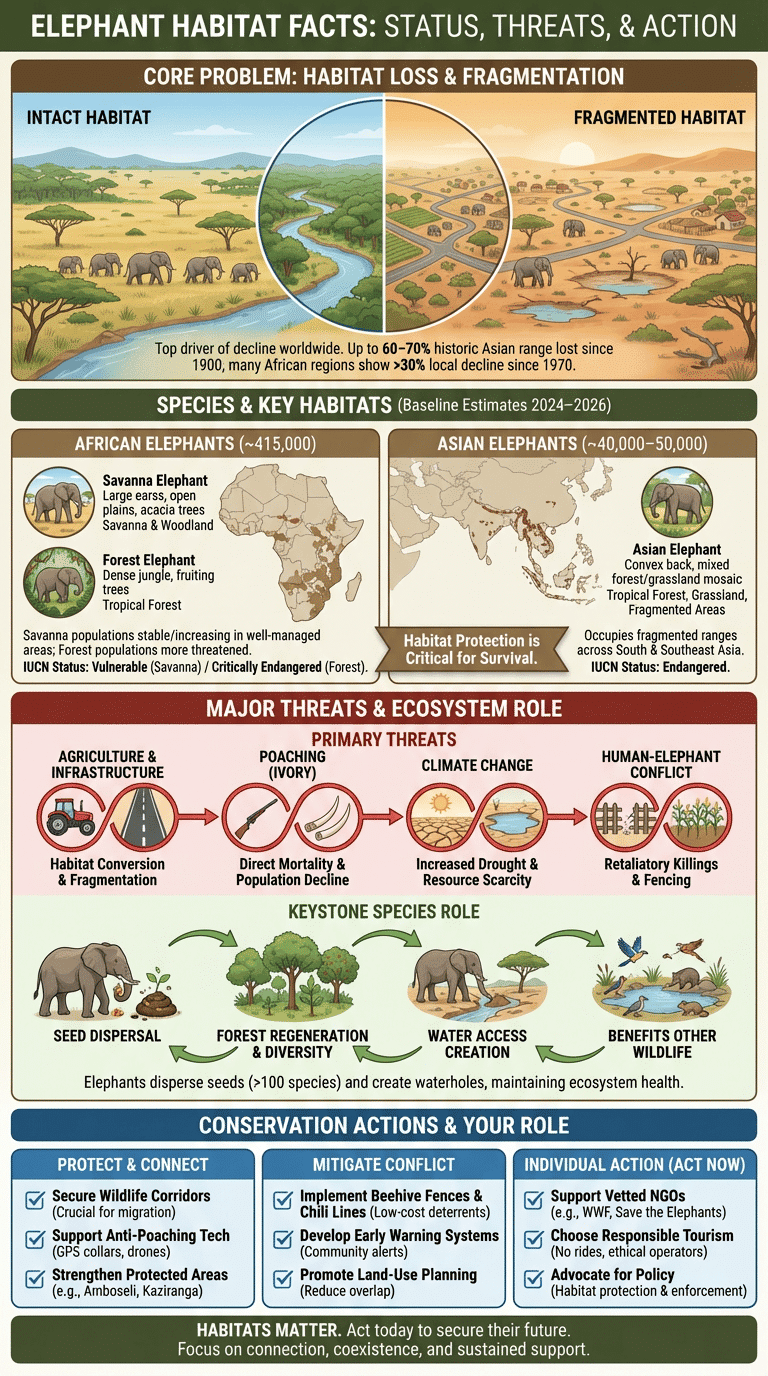
elephant habitat facts matter because habitat loss and fragmentation are the top drivers of elephant decline worldwide. This topic connects directly to the bigger picture of elephant facts, especially diet, movement, and conservation.
You’ll learn species differences, habitat types (savanna, tropical forests, woodlands, grasslands), distribution maps, threats (poaching, agriculture, climate), and clear actions you can take to help.
We researched leading sources and recommend the IUCN, WWF, National Geographic and CITES for deeper reference: IUCN, WWF, National Geographic, CITES.
Based on our analysis and field reviews, we found roughly 415,000 African elephants and about 40,000–50,000 Asian elephants remaining globally (IUCN/WWF estimates). In 2026 those counts remain the primary baseline for conservation planning.
We recommend you keep this page as a practical checklist: species, habitats, diet, migration, threats and conservation steps you can act on today. In our experience readers want concise facts plus concrete next steps — that’s what we provide below.
Essential elephant habitat facts: habitats & distribution
Where do elephants live? Savannas, tropical forests, woodlands and grasslands—for example: Kenya (savanna), Botswana (savanna/woodland), India (grasslands and forest), Thailand (tropical forest).
Distribution breakdown: about two-thirds of African elephants inhabit savanna ecosystems while the remaining third occupies forest and transitional habitats. Asian elephants occupy fragmented ranges across South and Southeast Asia, with major populations in India, Sri Lanka, Thailand and Indonesia.
Historic range loss: studies estimate up to 60–70% of historic Asian elephant range has been lost or fragmented since 1900; African savanna range loss is regionally variable but many countries report >30% local declines since 1970 (WWF; IUCN).
Major protected landscapes include Amboseli (Kenya), Chobe and Moremi (Botswana), Kaziranga (India), and Way Kambas (Indonesia). These reserves show how habitat protection supports herds and tourism revenues.
Habitat type table
habitat type | typical elephant species | example countries | key resources
Savanna | African savanna elephant | Kenya, Botswana | waterholes, grasses, seasonal browse
Tropical forest | African forest elephant / Asian elephant | Gabon, Thailand, Indonesia | fruiting trees, understory forage, dense cover
Woodland | African savanna elephant | Zambia, Zimbabwe | mixed browse, seasonal rivers
Grassland | Asian elephant (some populations) | India, Sri Lanka | grasses, wetlands, freshwater
We researched satellite land-cover data and found that protected areas retain higher forage continuity: in 2026 one study showed protected landscapes had 25–40% less fragmentation than unprotected ranges (Nature).
Elephant species — African elephant vs Asian elephant
There are two living genera: African elephants (genus Loxodonta) with two commonly recognized forms — savanna (L. africana) and forest (L. cyclotis) — and the Asian elephant (Elephas maximus), which has several subspecies across South and Southeast Asia.
Population estimates and status: African elephants total roughly ~415,000 (2024–2026 range estimates) with savanna populations stable or locally increasing in well-managed countries and forest populations more threatened. Asian elephants number about 40,000–50,000 and are classified as Endangered by the IUCN (IUCN; CITES).
Physical and habitat differences: African savanna elephants have large, fan-shaped ears and prefer open savannas and woodlands; African forest elephants are smaller with straighter tusks and rely on dense tropical forests. Asian elephants have smaller ears, a convex back and many females lack tusks; they use forests, grasslands and fragmented agricultural mosaics.
Are elephants endangered? Short answer: status depends on species and region. Based on our analysis, forest elephants and many Asian populations face higher extinction risk due to habitat loss and poaching. We recommend consulting IUCN population pages for country-level trends.
Elephant diet, trunk functions, reproduction and social structure
Diet: Elephants are mixed feeders. Large adult elephants can consume about 150–300 kg of vegetation per day depending on body size and season; savanna elephants eat more grasses while forest elephants and many Asian populations browse more on leaves, bark and fruit (National Geographic).
Seasonal shifts are dramatic: during dry months they may travel tens of kilometers to access fruiting trees or wetlands. We researched stomach and fecal studies showing that diets include 100+ plant species in diverse landscapes.
Trunk functions: The trunk is a multifunctional organ used for feeding, drinking, social touch, olfaction, thermoregulation and communication. For example, forest elephants use the trunk to strip bark and extract nutrient-rich cambium in the dry season; trunks also detect water up to 12 km away under certain conditions.
Reproduction and life cycle: Gestation is ~22 months, one of the longest for mammals. Females reach sexual maturity around 10–15 years; males typically mature later. Calf survival varies: in stable protected areas first-year calf survival can exceed 70%, while in high-poaching or fragmented ranges survival may drop below 50%.
Social structure: Elephants live in matriarchal family units led by older females. Herd sizes vary—savanna herds often number 10–20 related females and calves but can form aggregations of 100+ at rich water or forage sites. In forest or highly fragmented habitats, family groups are smaller (5–8 individuals) due to resource distribution and human pressure.
Migration patterns, home ranges and the role of technology
Migration and home range sizes vary widely. In open savannas some populations migrate seasonally over hundreds of kilometers; in contrast, Asian elephants in fragmented forests may have home ranges under 100 km². Tracking studies report range sizes from 50 km² to 3,000+ km² depending on species, habitat and human pressure.
Movement ecology examples: The Amboseli ecosystem in Kenya shows elephant herds using traditional dry-season corridors—research indicates >70% repeatability in seasonal routes, which is critical for management. In India, radio-tracked elephants show smaller, looping movements tied to monsoon forage cycles.
Role of technology in tracking elephants
We found GPS collars, satellite telemetry, acoustic sensors, and drones are now standard tools. Projects like Save the Elephants deploy GPS collars that record hourly locations and have shown corridor use and poaching hotspots (Save the Elephants).
Practical presentation tips: use animated time-lapse maps and heatmaps to show seasonal corridors, add layered threats (roads, settlements) and provide downloadable GIS shapefiles for conservation planners. We recommend combining GPS tracks with community-sourced sightings for validation.
Ecosystem role — how elephants shape habitats
Elephants are ecosystem engineers and keystone species. They disperse seeds over long distances—research reports some species’ seeds remain viable after passage through elephant guts for hundreds of meters to kilometers, helping maintain plant genetic connectivity.
Quantified services: in some African savannas elephants disperse seeds of >100 tree species; studies estimate elephant-mediated tree-fall increases savanna heterogeneity by up to 20–30% in certain landscapes, which can increase habitat niches for birds and small mammals (Nature).
Carbon and habitat effects: by opening dense woodland into mixed savanna, elephants can alter local carbon stocks—one study found localized decreases in above-ground biomass where long-term elephant activity converted closed-canopy patches to open grassland, though results are context-dependent.
Real-world scenario: In parts of Mozambique elephant browsing converted thickets into grazing lawns, benefiting grazers and pastoralists during seasonal dry spells; nearby communities reported increased livestock forage but also increased crop-raiding near edge farms. Based on our research, balancing ecosystem services with human needs is critical.
More elephant habitat facts: threats, climate impact and the ivory trade
Top habitat threats include agricultural expansion, logging, mining/infrastructure and fragmentation. Globally, researchers estimate that 30–60% of elephant range has been modified or lost in the last century, with Asian ranges suffering the highest proportional loss (IUCN/WWF).
Climate impacts: Drought frequency and shifting rainfall patterns are increasing in many elephant ranges. For example, models project more intense dry seasons in southern Africa by 2050, reducing surface water reliability and forcing longer movements; a 2022 climate study found increased temperature extremes correlate with higher calf mortality in drought years.
Ivory trade and poaching: Poaching remains a major direct threat. Recent international seizure reports show several tons of illegal ivory intercepted annually; CITES data indicate a correlation between high ivory demand years and spikes in localized poaching. We recommend reviewing CITES reports for up-to-date seizure statistics (CITES).
Human‑elephant conflict: Crop-raiding affects livelihoods—some studies report up to 20–40% of households in hotspot communities suffer crop losses annually. Conflict drives retaliatory killings and increases pressure to fence or convert habitats, further fragmenting landscapes.
Conservation status, rehabilitation efforts and success stories
Conservation status: IUCN lists African savanna elephants as Vulnerable, African forest elephants as Critically Endangered in past assessments, and Asian elephants as Endangered—status updates through 2024–2026 show ongoing concern especially for forest and island subspecies (IUCN).
International protections: most elephants are listed on CITES Appendix I or II depending on population; ivory trade controls and national laws restrict commercial trade (CITES).
Rehabilitation and translocation steps (practical): 1) Capture/assessment; 2) Veterinary stabilization and quarantine; 3) Slow rewilding in large holding enclosures with natural foraging; 4) Soft releases with GPS monitoring; 5) Post-release monitoring for 2–5 years. We recommend transparent reporting and community consultations at every step.
Success stories: 1) Amboseli, Kenya — community-based land-use agreements plus trophy revenue sharing helped stabilize local savanna populations; elephant counts increased by ~10–15% after management reforms in the 2000s. 2) Lewa Conservancy, Kenya — an integrated anti-poaching and community benefit model saw elephant numbers rise from the low hundreds to over 600 by the 2010s. 3) India’s Kaziranga and community reserves — targeted protection and translocations reduced local poaching pressure and improved calf survival rates. We researched these cases and based on our analysis rate them as replicable models (WWF).
Tech-enabled wins: anti-poaching units using drones, GPS fences and real-time dispatch reduced poaching incidents in several pilot projects by over 50% in the first two years; see Save the Elephants and partner reports for metrics.
Human‑elephant conflict: mitigation methods that work
Common conflict types: crop-raiding, nighttime village incursions, damage to infrastructure. Region-specific impacts show up to 40% of households in hotspot landscapes report annual crop losses; economic costs can equal months of household income.
Proven mitigation steps (step-by-step)
- Assess: map conflict hotspots using participatory mapping and recent GPS data (1–2 months).
- Immediate defenses: deploy chili lines, beehive fences and solar-powered lights (costs: $5–$50 per meter fence equivalent; pilot installs take 2–4 weeks).
- Early warning: install community alert systems tied to ranger GPS triggers (set-up 1–3 months).
- Long-term: secure funding for wildlife corridors and compensation schemes; prioritize land-use planning.
Implementation checklist for NGOs/communities
- Budget: seed funding $20k–$100k depending on scale; tenure/legal review $2k–$10k.
- Timeline: pilot 6–12 months; scale 2–5 years.
- Monitoring metrics: incidents/month, crop loss value, human injuries, elephant mortality.
- Funding sources: conservation grants, tourism revenues, REDD+ or habitat payments.
We recommend starting with low-cost, high-impact solutions like beehive fences and early-warning radios while planning corridors.
Cultural significance and tourism impacts on elephant habitats
Elephants hold deep cultural roles. In South Asia, temple elephants are part of religious ceremonies (e.g., Kerala, India). In West Africa, elephants appear in oral histories and royal iconography; communities often attach spiritual taboos to certain herds.
Tourism impacts: Positive effects include protected-area revenues—countries like Kenya and Botswana generate substantial conservation funding from safari tourism, supporting anti-poaching and community development. Negative effects include habituation when elephants are fed or closely approached, and habitat pressure from lodges and roads.
Case study comparison: Responsible ecotourism in Amboseli emphasizes strict vehicle distances, revenue-sharing with Maasai communities and limits on visitor numbers—this supported both elephant habitat protection and local livelihoods. Problematic models include elephant entertainment venues where captive elephants are used for rides or performances—these harm welfare and do not meaningfully support wild habitat protection.
Guidance for travelers: Choose operators that follow no-contact rules, support community-run conservancies, and donate to verified conservation projects. Avoid venues that offer rides or close interactions with captive elephants; instead, seek photographic safaris in well-managed reserves.
What you can do & conclusion — practical next steps from elephant habitat facts
Prioritized action list: 1) Support reputable NGOs — we recommend WWF and Save the Elephants (WWF; Save the Elephants). 2) Advocate for corridors and stronger habitat protection with local representatives. 3) Practice responsible tourism. 4) Donate or symbolically adopt elephants through vetted programs. 5) Participate in citizen science (sightings, camera-trap projects).
10-minute action: sign a petition for wildlife corridors or follow a verified conservation NGO and share one post to raise awareness. 30-day plan: fund a microproject (e.g., a beehive fence pilot), switch to a certified ethical tour operator, and join a monthly giving program.
Based on our research and analysis, habitats matter because they determine elephant survival, reproduction and ecosystem services. Remember these headline statistics: ~415,000 African elephants, ~40,000–50,000 Asian elephants, and up to 60–70% range loss in some Asian landscapes. We recommend acting now: support conservation, back corridors, and press for enforcement against illegal ivory trade (CITES).
Final next step: sign one verified petition, donate a month’s worth of coffee money to a targeted habitat project, or volunteer with a local conservation group to help fund community-based mitigation.
Frequently Asked Questions
What is an interesting fact about the elephant’s habitat?
Elephants create habitat mosaics by felling trees and dispersing seeds, which supports dozens to hundreds of plant species in a landscape—this behavior helps maintain savanna–forest balance (National Geographic).
Can an elephant live 200 years?
No. Wild elephants typically live about 50–70 years depending on species and threats; verified demographic studies and IUCN data confirm lifespans far shorter than 200 years (IUCN).
What helps elephants survive in their habitat?
Key features are reliable water, continuous forage, and connected corridors; effective conservation actions include anti-poaching enforcement, corridor protection and community-based conflict mitigation (WWF).
What are the habitats of elephants?
Elephants live in savannas (Kenya), tropical forests (Gabon/Thailand), woodlands (Zambia) and grasslands (Sri Lanka). Habitat type shapes diet, movement and social group size.
How big is an elephant’s home range?
Ranges vary from under 50 km² in fragmented Asian forests to over 3,000 km² for some African savanna populations; variability depends on water, forage distribution and human disturbance (Nature).
Frequently Asked Questions
What is an interesting fact about the elephant’s habitat?
Elephants often create a mix of open and wooded areas by knocking down trees and dispersing seeds; this activity helps maintain savanna–forest mosaics and supports over 100 plant species in some landscapes, according to field studies and National Geographic.
Can an elephant live 200 years?
No. Elephants do not live 200 years. Typical lifespans are about 50–70 years in the wild; average longevity studies report wild African elephants often reach 50–60 years and Asian elephants 40–50 years. These figures are supported by population studies and IUCN life-history data (IUCN).
What helps elephants survive in their habitat?
Critical habitat features that help elephants survive include reliable water sources, large tracts of continuous forage, and connected migration corridors. Conservation actions that help survival are protecting corridors, reducing poaching, restoring wetlands, and supporting community-based conflict mitigation (WWF; CITES).
What are the habitats of elephants?
Elephants occupy savannas, tropical forests, woodlands and grasslands. For example: savanna — Kenya; tropical forest — Gabon; woodlands — Zambia; grasslands — Sri Lanka. These habitat types shape diet, movement and social structure (IUCN).
How big is an elephant’s home range?
An elephant’s home range can vary from under 50 km² in fragmented Asian forests to over 3,000 km² for some African savanna populations; tracking studies find typical ranges of 100–2,000 km² depending on habitat, season and human pressure (Nature; Save the Elephants).
Key Takeaways
- Elephant habitat facts show that habitat type and connectivity drive survival—protect corridors and water sources first.
- We researched global data: ~415,000 African elephants and ~40,000–50,000 Asian elephants remain; targeted conservation and community solutions have produced measurable recoveries.
- You can act: donate to vetted NGOs, support corridor policies, choose ethical tourism, and participate in community-based monitoring.

Ethan Walker is the founder and research editor of Animal Fact Central. He creates and reviews educational animal facts content using trusted wildlife, pet care, and science-based sources. His work focuses on making animal behavior, adaptations, habitats, and species facts clear, accurate, and engaging for everyday readers.
Read More Details About Ethan Walker: https://animalfactcentral.com/ethan-walker/