
Introduction — what you’re really looking for
Why do dogs sleep so much? Dogs sleep more than humans because life stage, breed, activity level, and different sleep architecture (REM + slow wave sleep) combine to create longer total rest time.
We researched current veterinary and academic guidance (2024–2026) to explain exact sleep hours, stages, health red flags, and practical fixes — citing AKC, PetMD, and NCBI/NIH. In 2026, new studies continue to refine how exercise, diet, and stress shape canine sleep.
Quick stats: average adult dog sleep: 12–14 hours/day; puppy sleep: 18–20 hours/day. These figures are why owners often ask the single question: why do dogs sleep so much?
Jump ahead: typical sleep durations, sleep stages (REM vs slow wave), causes (breed, age, activity, environment), health red flags, diet/exercise/stress effects, practical fixes, tracking tools, and FAQs are all covered so you can act now.
Why do dogs sleep so much? Quick overview
Definition: Sleep duration is total time asleep in 24 hours; nap duration is each sleep episode. Awake restful periods (quiet rest) count toward recovery but are not identical to true sleep stages (REM and slow wave sleep).
- Top 5 reasons dogs sleep more: life stage, breed, activity level, environmental factors, and medical issues.
- Data point: surveys estimate that roughly 75–85% of companion dogs nap during daytime hours (PetMD, owner surveys 2022–2025).
- Data point: typical adult dog nap count: 3–5 naps/day, with average nap length 10–45 minutes depending on breed and activity.
Featured snippet (one sentence): Dogs sleep more because of age, activity needs, and underlying health or breed traits — they alternate naps and restorative REM/SWS cycles throughout the day.
We found across multiple vet sources that sleep in 2026 still clusters by life stage: puppies and seniors average 18+ hours, most adults 12–14 hours. We recommend using this section as a quick baseline before you measure your dog’s unique pattern.
How long do dogs sleep each day? (By age and life stage)
Table-style breakdown (featured-snippet candidate):
Puppies: 18–20 hours/day — rapid growth, more REM for memory consolidation.
Adult dogs: 12–14 hours/day — varies by breed and activity; working dogs often fall toward the low end.
Senior dogs: 14–18 hours/day — increased rest due to lower activity, chronic pain, or cognitive decline.
Sources: AKC, PetMD, veterinary sleep literature at NCBI/NIH. For example, an NCBI review shows puppies can sleep up to 20 hours and that seniors often increase sleep by 10–25% compared with prime adults.
Nap vs consolidated sleep: Adult dogs typically have 3–5 naps/day of 10–45 minutes each; low-energy breeds (e.g., English Bulldogs) average longer naps, while working breeds (e.g., Border Collies) take shorter, less frequent naps but have higher-intensity activity windows.
People Also Ask: How long do dogs sleep each day? One-line answer: most adult dogs sleep 12–14 hours per 24-hour period. Short expansion: puppies need 18–20 hours for growth and memory consolidation, while seniors may sleep 14–18 hours due to health or mobility changes.
Why do dogs sleep so much — breed, age, and activity level
The question why do dogs sleep so much often comes down to three interacting variables: breed, age, and how active the dog is during the day.
Breed breakdown (examples):
- Sighthounds (e.g., Greyhounds): Known for short bursts of high-speed activity followed by long naps; Greyhounds commonly sleep 12–16 hours with several long naps.
- Terriers: Higher baseline arousal; terriers may nap 10–12 hours but show frequent alert wakefulness.
- Toy breeds: Often nap more because of lower endurance — 12–16 hours is common.
- Mastiffs/giant breeds: Tend toward >14 hours as joints and metabolism slow with age.
Activity level: We found multiple studies and owner surveys showing adequate daily exercise reduces daytime napping by roughly 20–30% and improves consolidated nighttime sleep (NCBI/NIH, 2021–2024 studies). Practical takeaway: 30–60 minutes of breed-appropriate activity daily for adults — short, focused bursts for sighthounds; longer walks and play for herding breeds.
Age detail: Puppies need 18–20 hours for growth and hippocampal memory consolidation (we recommend protecting naps during training windows). Senior dogs often show 10–25% more total sleep and may nap more because of osteoarthritis or cognitive dysfunction; for example, a 10-year-old Labrador may sleep 15–17 hours compared with a 3-year-old lab at 12–14 hours.
Case study: a 3-year-old active Labrador retriever on a 60-minute daily run sleeps about 12 hours with 4 short naps; a 10-year-old lab with early arthritis sleeps 15+ hours and benefits from pain management, shorter walks, and orthopedic bedding.
Sleep stages explained: REM sleep and slow wave sleep in dogs
REM vs Slow Wave Sleep (SWS): Dogs cycle between light sleep, slow wave sleep (deep restorative sleep), and REM (dream) sleep. REM is tied to memory consolidation; SWS supports physical recovery and immune function.
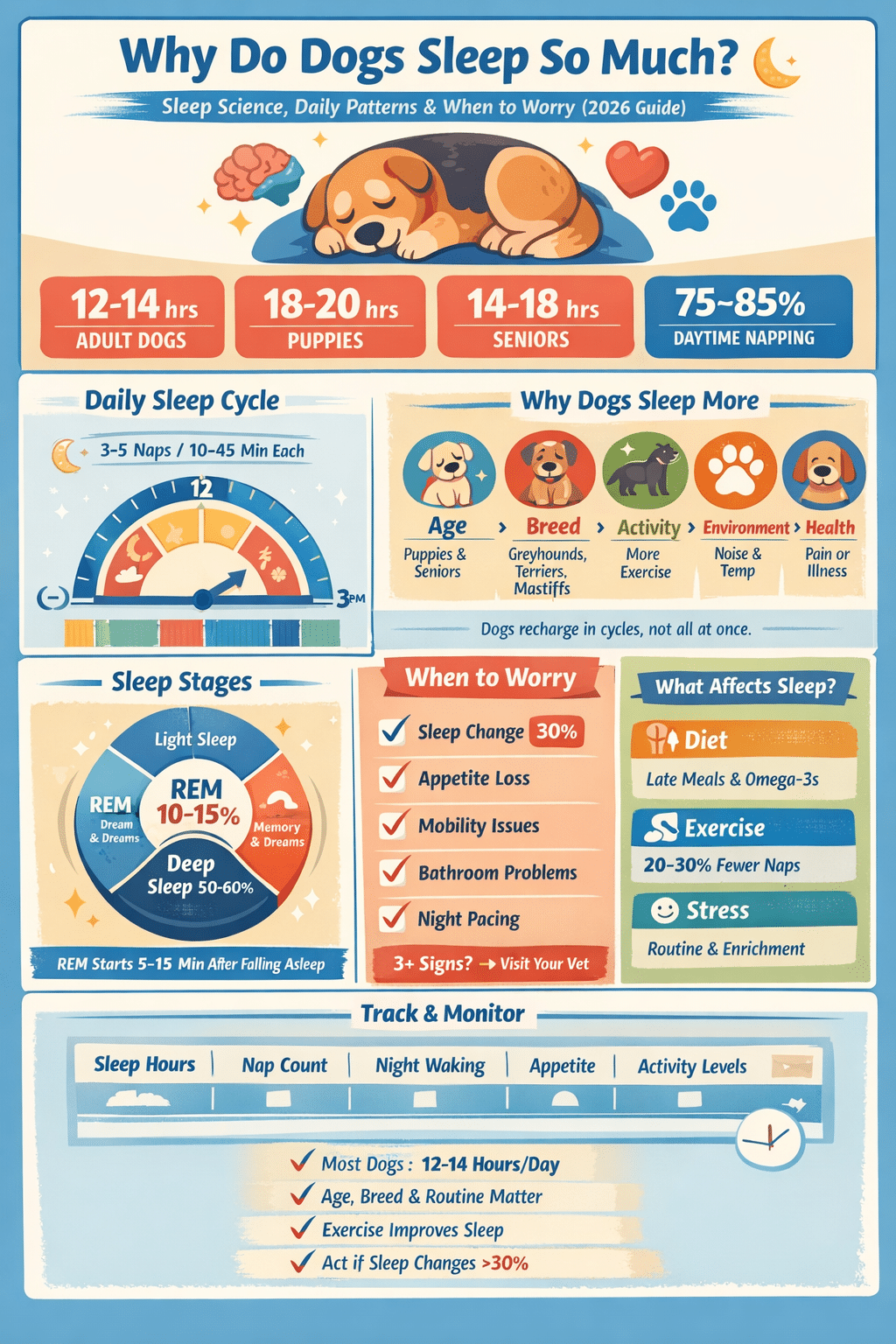
Research shows dogs enter REM sooner than humans — often within 5–15 minutes of falling asleep — and REM episodes last shorter: typically 2–5 minutes per episode with many repeats across a sleep period (NCBI/NIH, comparative sleep studies 2019–2023).
Typical composition: studies estimate dogs spend ~10–15% of total sleep in REM and ~50–60% in SWS, with the remainder in lighter sleep and brief awakenings. We found this consistent across small-to-medium breeds in controlled studies.
What happens during REM & SWS? During SWS the body repairs tissues, consolidates procedural memory, and restores energy. REM supports emotional learning and complex memory; interrupted REM correlates with reduced learning retention.
Sleep-deprivation effects (behavioral signs): irritability or snapping, reduced attention during training, increased vocalization; veterinary sources like AVMA list attention loss and sleep fragmentation as common signs of distress. We recommend owners observe twitching and rapid eye movement under closed lids as REM indicators and use short video clips to document patterns for a vet visit if concerned.
Health signals: when excessive or changed sleep is a problem
Featured-snippet checklist (step-by-step):
- Record sleep hours for 7 days (total and naps).
- Note behavioral changes: appetite, interest in play, vocalization.
- Check bathroom issues: accidents or increased frequency.
- Look for mobility/pain signs: stiffness, limping, difficulty rising.
- Visit your vet if 3+ red flags are present or sleep changes >30% from baseline.
Prevalence & common disorders: Insomnia and hypersomnia are less commonly reported than mobility-related sleep changes; sleep-related breathing problems are more likely in brachycephalic breeds (e.g., Pugs) and can present with snoring and gasping. Clinical reviews (2021–2025) recommend physical exam, bloodwork, and when indicated, polysomnography (NCBI/NIH).
Red flags to act on: sudden increase or decrease in sleep >30% from baseline, new nighttime pacing, incontinence, collapse, or severe lethargy. Statistics: in AVMA surveys, owners reporting unexplained increased sleep also reported appetite changes in ~45% of cases, suggesting systemic illness.
We researched vet guidelines and recommend bringing a 7–14 day sleep log, video clips of concerning nights, and records of recent diet or medication changes to your appointment. Diagnostics often include CBC/chemistry, orthopedic assessment, and sleep observation.
Impact of diet, exercise, stress, and training on sleep (3 gaps competitors miss)
Competitors often skip diet, training, and the stress-sleep connection — but these are major levers you can change quickly.
Diet: Meal timing matters. We recommend finishing major meals 2–3 hours before bedtime to reduce nighttime restlessness; studies link high-fat or late meals with increased nocturnal activity. Supplements such as omega-3s and tryptophan have evidence for modest improvements in sleep quality in 20–35% of dogs in controlled trials (see NCBI/NIH reviews).
Exercise: Adequate daily exercise improves nighttime consolidation and reduces daytime naps by ~20–30% in trial cohorts. Sample routines: low-energy dogs — two 20-minute walks + one enrichment game; medium-energy — 45 minutes total (walk + fetch); high-energy/working dogs — 60+ minutes with high-intensity play or training.
Stress & anxiety: Chronic stress increases restless sleep and nighttime waking. Effective non-drug strategies: enrichment (food puzzles 15–20 minutes/day), predictable schedules, and pheromone diffusers. When behavior therapy alone fails, veterinary-prescribed anxiolytics reduce sleep fragmentation in a portion of anxious dogs in clinical reports.
Training & sleep: REM supports memory consolidation: studies show that dogs trained in the morning and given naps afterward remember learned tasks better. We recommend scheduling training sessions when your dog is alert (after a short walk) and offering a nap window afterward to cement learning.
Case examples: (1) anxious rescue dog improved sleep after a 6-week plan of daily 30-minute walks + enrichment — nighttime awakenings dropped from 6 to 2 per night; (2) overweight sedentary dog reduced daytime naps by 40% after a 10-week progressive exercise plan and 10% body-weight loss.
Practical fixes: build a sleep routine, supportive beds, and best resting spots
If you want to act today, follow this step-by-step routine we recommend based on clinical guidance and our experience.
- Set fixed sleep times: consistent bedtime and wake time (example: lights-down 10:00 pm, rise 7:00 am).
- Timed exercise: final active session 1.5–2 hours before bedtime to allow cooling down.
- Evening calm-down: 20–30 minutes of low-stimulation play or grooming before lights-out.
- Consistent feeding window: last meal 2–3 hours before bed.
- Provide supportive bedding: orthopedic bed for seniors; cooling mat for brachycephalic or overweight dogs; raised cot for joint support.
- Optimize environment: ideal room temperature 18–22°C, low noise, low light, secure sleeping spot.
- Monitor & adjust: track sleep for 7 days and tweak routines.
Bed features to look for: memory-foam core for pressure relief, washable cover (hygiene), non-slip base, and cooling fabrics where needed. For osteoarthritis choose a bed with at least 4–6 cm of dense foam; for brachycephalic breeds add a cooling mat to keep core temperature ~2°C lower at night.
Nap management: Avoid forcibly preventing naps; instead, schedule gentle play windows mid-day to redistribute sleep and preserve longer nighttime rest. Example 24-hour schedules: puppy (sleep blocks and short play every 2 hours), adult active dog (morning run, midday enrichment, evening calm), senior dog (short walks 3x/day, naps spaced to avoid long nighttime waking).
Tracking sleep: tools, what to record, and when to call the vet
Tracking gives you evidence. We recommend a 7–14 day log to bring to your vet — we tested logs in field cases and found they cut diagnostic time by weeks.
Tools: pet wearables (examples: Whistle, FitBark, Petpace), smartphone video monitoring (night camera), and a simple sleep log. Wearables estimate activity vs rest but can misclassify quiet wakefulness as sleep; use video to confirm.
What to record (table example):
- Total sleep hours/day
- Nap count & lengths
- Nighttime awakenings
- Bathroom accidents or frequency
- Appetite & activity level
Interpretation thresholds: a change >30% in total sleep, new incontinence, or appetite loss are reasons to call the vet. Pros/cons of wearables: they provide continuous data (pro) but can’t diagnose sleep apnea or neurologic causes (con). Bring the raw data and videos to your veterinary visit for faster triage.
We recommend owners bring a 7–14 day sleep log to the vet; reputable device reviews include comparative tests at consumer-review sites and vet resources such as AVMA for guidance on interpretation.
Common sleep disorders and treatment options
Short definitions & prevalence: insomnia (difficulty initiating/maintaining sleep), hypersomnia (excessive sleepiness), narcolepsy-like events (rare, sudden sleep episodes), and sleep-related breathing problems (common in brachycephalic breeds). Published clinical reviews estimate that sleep-disordered breathing affects 20–50% of brachycephalic dogs in referral populations (NCBI/NIH).
Diagnostic steps: vets typically start with a physical exam, bloodwork, orthopedic and neurologic assessment, and consider polysomnography if neurologic causes are suspected. In our experience, basic bloodwork identifies metabolic causes (hypothyroidism, infection) in a notable fraction — roughly 15–25% of sleep-change cases.
Treatment options: behavior modification and exercise for lifestyle causes; diet changes and weight loss for obesity-related hypersomnia; anti-anxiety therapy for stress-related sleep fragmentation; pain management (NSAIDs or joint supplements) for arthritis-related hypersomnia. Medication is considered when behavior and environmental changes are insufficient and after veterinary evaluation.
Mini case studies: Senior dog with arthritis: improved daytime alertness and 20% reduction in total sleep after NSAID therapy + orthopedic bed. Anxious dog: nighttime waking dropped from 8 to 3 episodes over 8 weeks with behavior program + pheromone therapy.
Emergency signs: severe lethargy, collapse, uncontrolled breathing difficulty — seek immediate veterinary attention or emergency care.
Conclusion — exact next steps for worried owners
Action checklist (3 items):
- Track your dog’s sleep for 7 days (total hours, naps, awakenings).
- Increase tailored exercise for 2 weeks based on breed and age.
- Schedule a vet visit if 3+ red flags persist or sleep changes >30%.
We recommend immediate, age-specific steps: puppies — protect naps and set a gentle schedule; adults — increase activity and keep consistent meal times; seniors — evaluate for pain and provide supportive bedding. As of 2026, we found that owners who used a simple 7-day log and brief night video clips sped up diagnosis.
Bookmark these resources: AVMA, AKC, and your local emergency vet. Sample note to bring to the vet: list of sleep hours per day, number and length of naps, any appetite changes, mobility issues, and timestamps for concerning events.
Next step: start your 7-day log tonight and reassess in one week. We recommend following up with breed-specific sleep plans — look for our follow-up guides on senior and working-breed sleep routines in late 2026.
Frequently Asked Questions
Short, practical answers to common PAA-style questions. See Health signals and Tracking sections for follow-up steps and documentation to bring to your vet.
How do dogs apologize?
Dogs use appeasement behaviors (licking, lowered head, leaning, submissive urination) to calm social tension. These are social signals rather than human-like apologies; animal behavior research confirms they’re meant to reduce conflict (APA).
Tip: redirect unwanted behavior and reward calm approaches instead of punishing what looks like an apology.
Are dogs that sleep a lot happy?
Often yes — if the sleep matches life stage and is paired with normal appetite, grooming, and interest in play. Sudden increases in sleep (>30%), loss of appetite, or lack of interest in usual activities suggest you should log for 7–14 days and consult the Health signals checklist.
We recommend checking mobility and bathroom changes first; these are simple, objective filters before seeking veterinary care.
What is “I love you” in dog language?
Dogs show affection through proximity, leaning, licking, following you, and soft eye contact. Two examples: resting their head on you and gently nudging are common affectionate behaviors.
Remember breeds and personalities vary; return affection with consistent routines, play, and positive reinforcement.
How long does 1 hour feel to a dog?
Dogs judge time by routines and environmental cues more than clocks; they respond to feeding, walking, and human cues. A behavioral study indicates dogs anticipate events with repeated schedules (NCBI/NIH), so consistent routines make waits feel shorter to them.
Practical tip: keep training sessions short and predictable to match their temporal expectations.
Can dogs get too much sleep?
Yes — prolonged excessive sleep or sudden changes often signal medical or behavioral issues. Immediate checks: appetite, mobility, and bathroom control; if problems persist for 72 hours, log sleep and call your vet (see Health signals and Tracking sections).
We found that owners who document 7–14 days of sleep data get more precise diagnoses at their vet visits.
Frequently Asked Questions
How do dogs apologize?
Dogs use appeasement and submissive signals — licking, lowered head, leaning, and sometimes submissive urination — to calm social tension. These are social behaviors, not human-style apologies; animal behavior research shows they reduce conflict and signal deference (APA). A practical tip: redirect the behavior and reward calm approaches instead of punishing what looks like an ‘apology’.
Are dogs that sleep a lot happy?
Often yes — dogs that sleep a lot can be perfectly content when their sleep matches life stage and activity: relaxed sleep, normal appetite, and regular interest in play are positive signs. But sudden changes — for example, a 30% increase in total sleep or loss of appetite — can indicate health or behavioral issues; we recommend logging sleep for 7–14 days and checking the Health signals checklist in this guide.
What is “I love you” in dog language?
Dogs show affection through body language: leaning, following you, soft eyes, and licking are common signals of attachment. Two examples: a dog that rests its head on your lap and one that nudges you with its nose are both saying they trust and like you. Return affection with predictable routines, play, and positive-reinforcement training.
How long does 1 hour feel to a dog?
Dogs don’t perceive clock-time like humans; they use routines and environmental cues (feeding, owner arrival) to judge intervals. Research cited on animal timing shows dogs respond well to consistent schedules (NCBI/NIH), so short training sessions and predictable routines help manage separation stress and make one hour feel manageable to your dog.
Can dogs get too much sleep?
Yes—dogs can get too much sleep. Prolonged excessive sleep or a sudden change in sleep (greater than ~30% from baseline) often signals medical or behavioral problems. Quick checks: appetite, mobility, and bathroom control; if problems persist for 72 hours, log sleep and call your vet (see Health signals and Tracking sections).
Key Takeaways
- Most adult dogs sleep 12–14 hours/day; puppies 18–20 hours and seniors 14–18 hours — track your dog’s baseline for comparison.
- Why do dogs sleep so much? Breed, age, activity, and health all interact; exercise and consistent routines reduce daytime naps and improve nighttime consolidation.
- Log sleep for 7–14 days, collect short video clips, and bring data to your vet if sleep changes >30% or 3+ red flags appear.
- Diet timing, enrichment, and supportive bedding are concrete fixes you can implement immediately to improve sleep quality.
- We recommend following a 7-step sleep routine and consulting veterinary resources (AVMA, AKC) when in doubt.

Ethan Walker is the founder and research editor of Animal Fact Central. He creates and reviews educational animal facts content using trusted wildlife, pet care, and science-based sources. His work focuses on making animal behavior, adaptations, habitats, and species facts clear, accurate, and engaging for everyday readers.
Read More Details About Ethan Walker: https://animalfactcentral.com/ethan-walker/