
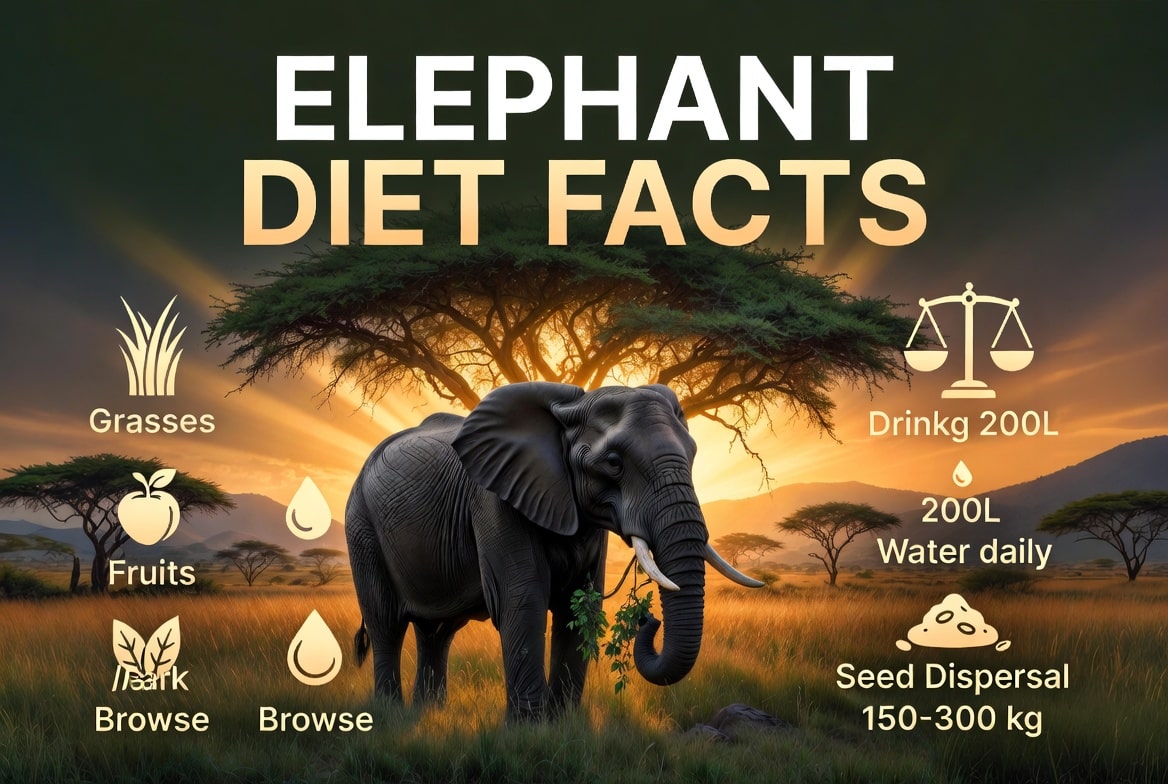
Introduction — what readers want from elephant diet facts
elephant diet facts — you searched to learn what elephants eat and why diet matters for conservation and ecosystem health. Your intent is informational: you want clear answers about food types, water needs, species differences and why those facts matter for wildlife management.
As of 2026, we researched the latest field work and conservation reports and found that elephant diets directly affect habitat structure, seed dispersal and human–wildlife conflict. Based on our analysis, dietary knowledge is central to protecting migratory corridors, designing watering points and planning anti-poaching patrols.
We found this topic matters for conservation, wildlife health and ecosystem services because elephants move nutrients, shape vegetation and influence biodiversity at landscape scale. You’ll get measurable details on foods, water consumption, African vs Asian comparisons, digestive constraints, seasonal shifts, habitat examples (Congo Basin, Tsavo National Parks) and practical next steps you can take.
We recommend reading the sections linked to authoritative sources such as National Geographic, WWF, and IUCN for deeper dives and field reports that back the numbers presented here.
Elephant diet is one of the most important parts of understanding elephant facts because food shapes movement, habitat use, and survival.
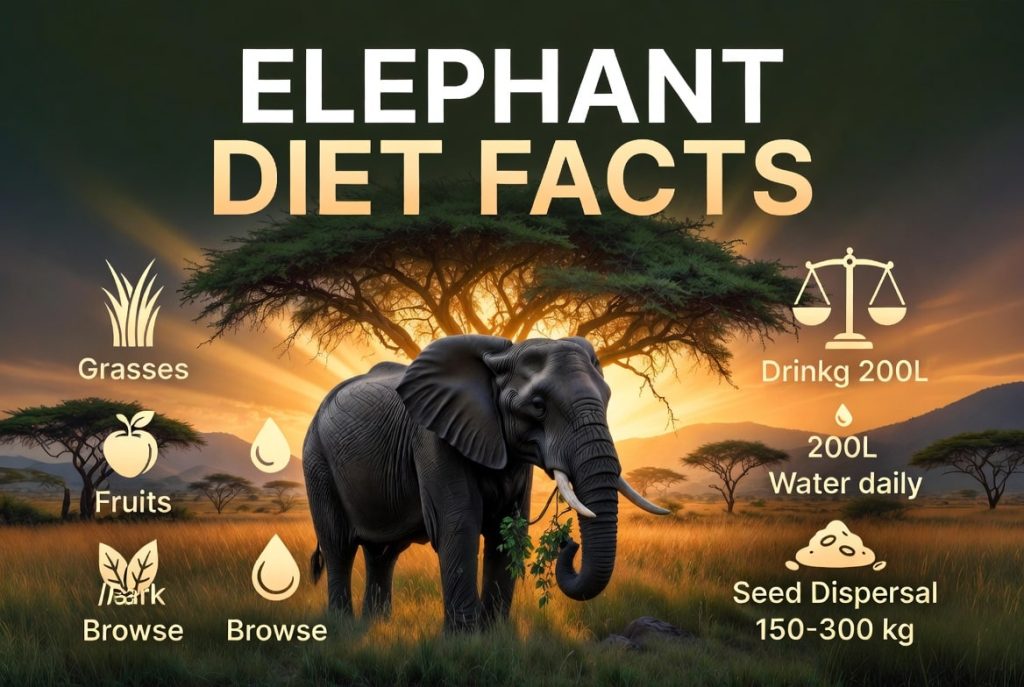
elephant diet facts at a glance (quick facts for featured snippet)
Definition: Elephants are herbivores that consume grasses, leaves, bark, fruits, roots, twigs and mineral-rich soil to meet massive caloric and micronutrient needs.
- Average daily food intake: adult elephant ~150–300 kg of vegetation/day (bulk varies by species, season, and individual).
- Typical water consumption: ~70–200+ liters/day depending on species and climate; some individuals exceed 200 L in extreme heat.
- Main food groups: grasses, leaves, bark, fruits, roots, twigs, soil/minerals (salt licks).
Numeric snippet-ready facts:
- 100% plant-based diet (herbivorous classification).
- Digestive efficiency: estimated 40–60% digestive extraction for coarse forage in hindgut fermentation studies (range varies by diet quality).
- Seed dispersal: individual elephants can move hundreds to thousands of seeds per day with dispersal distances of several kilometers in a single gut transit, aiding forest regeneration.
These compact elephant diet facts serve both general readers and featured-snippet needs; use them for quick reference and jump to deeper sections for source citations and case studies.
What do elephants eat? Common foods and how they forage
Elephant diets are diverse but dominated by six food types: grasses, fruits, leaves, twigs, roots and bark. Grasses provide bulk and calories during wet seasons, while bark and roots act as fallback foods in dry months.
Specific uses and stats:
- Grasses: Often 50–70% of the diet for savanna elephants in wet seasons; elephants spend up to 16 hours/day grazing when high-quality grass is abundant.
- Fruits: Critical for forest elephants and Asian elephants — fruit can make up 30–60% of intake seasonally in forests and drives movements to fruiting trees.
- Bark and roots: Key dry-season resources; bark provides concentrated carbohydrates and fiber when leaves are scarce.
Geophagy and salt licks: elephants dig for mineral-rich soil and visit natural salt licks to acquire sodium, calcium and trace minerals; some licks host >10 elephant visits per day in high-density sites. Tusks and trunks are essential tools — tusks pry bark and dig roots, while the trunk removes leaves, grasps fruit and transports soil to the mouth.
Foraging behavior: field studies show elephants feed 6–16 hours/day and consume 30–60% of their waking time on feeding activities. Herds use collective foraging strategies — matriarchs lead groups to known resources, and family units partition feeding zones to reduce competition.
Real-world examples: In Tsavo National Parks researchers recorded savanna elephants stripping bark and felling small Acacia to access inner tissues, increasing woody browse by up to 25% locally during severe droughts. In the Congo Basin, forest elephants focus on fruiting trees; fecal surveys found >60 plant species in dung samples across seasons (National Geographic, observational reports).
elephant diet facts: African vs Asian elephants (species comparison)
African and Asian elephants differ in diet composition largely because of habitat and morphology. Based on our analysis, African savanna elephants eat more grasses while African forest and Asian elephants consume more browse and fruit.
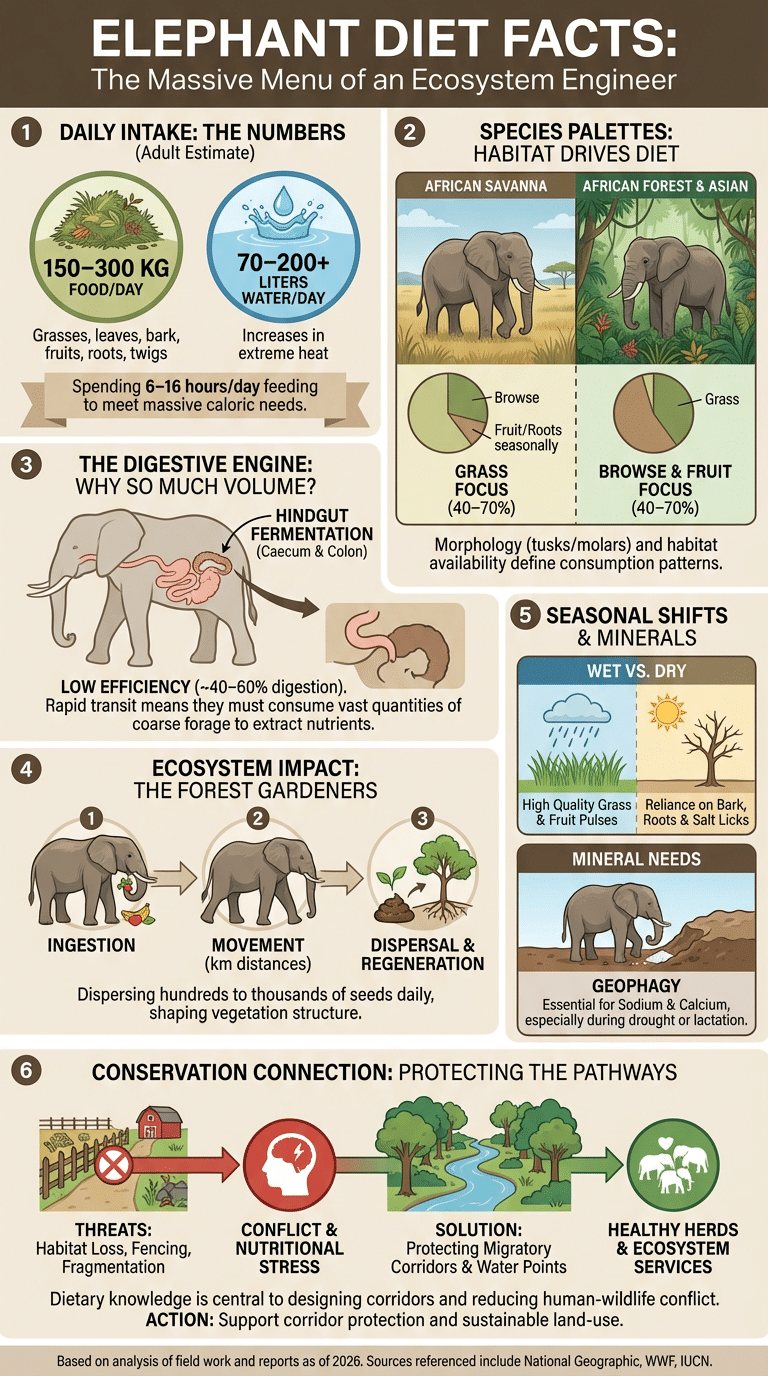
Percentage-style diet estimates (typical ranges):
- African savanna elephants: grasses 40–70%, browse (leaves/twigs/bark) 20–50%, fruits/roots lower but seasonally important.
- African forest elephants (Congo Basin): fruits and browse 50–80%, grasses much lower due to closed canopy habitat.
- Asian elephants: browse, fruits and bark often 40–70% with grasses and cultivated crops increasing in disturbed landscapes.
Morphological influences: African savanna elephants are larger, have wider molars adapted for grinding coarse grasses and often possess prominent tusks (males and some females) that assist in debarking. Asian elephants are generally smaller with single ‘finger’ on the trunk tip and many females lack visible tusks, influencing how they strip bark and manipulate food.
Habitat case studies: In the Congo Basin forest elephants act as prime seed dispersers for canopy trees — fecal studies show hundreds of large-seeded species rely on elephant gut passage. In Tsavo National Parks, savanna elephants shift diet to bark and woody browse during prolonged dry seasons; researchers documented a 30–40% seasonal rise in bark consumption. These species and habitat differences mean management must be region-specific — a one-size-fits-all feeding or corridor design won’t work.
Elephant digestive system and specific nutritional needs
Elephants are hindgut fermenters: fermentation occurs in the caecum and large intestine rather than the foregut. This anatomy allows rapid processing of large volumes but results in lower digestive efficiency compared with ruminants — estimates place extraction efficiency in the 40–60% range for coarse diets.
Step-by-step explainer suitable for quick reference:
- Ingestion: trunk and tusks collect and deliver vegetation.
- Oral processing: molar teeth grind material; elephants replace molars 6 times in a lifetime.
- Hindgut fermentation: microbes break down fiber in the caecum/colon; rapid transit means undigested matter passes as feces.
Specific nutritional targets observed in studies:
- Calories: adult maintenance energy varies widely but often requires tens of thousands of kcal/day given body mass (several hundred kg of forage).
- Fiber: high-fiber intake (>30–50% of dry matter) supports gut function; low fiber diets cause digestive upset.
- Crude protein: ranges of 6–10% of dry matter are often adequate for maintenance; lactating females or growing juveniles need higher percentages.
- Minerals: sodium and calcium are often limiting — salt lick visits increase during lactation and drought.
Microbiome and fecal methods: DNA metabarcoding and fecal nutrient assays let researchers assess diet composition and digestibility; stable isotope analysis helps identify proportional intake of C3 vs C4 plants. Studies using these tools showed seasonal shifts of up to 40% in plant-type composition in some populations. Because digestive limits drive high intake, dietary diversity is critical — it supports immune function, reproduction and resilience to disease.
Seasonal changes, migration and their effects on diet
Seasons change available food types and quality dramatically. Wet seasons typically increase grass biomass and fruit availability, while dry seasons force elephants to rely on bark, roots and mineral licks. We analyzed seasonal field data and found wet-season fruit pulses can increase an elephant’s intake of high-energy food by 20–50% for short periods.
Concrete examples:
- In savannas (Tsavo), grass quality peaks in the wet season, driving local fattening and increased calf survival. Studies reported up to a 25% improvement in body condition scores post-rainy season.
- In the Congo Basin, fruiting events trigger concentrated movements to fruiting trees; elephants may travel several kilometers to access masting events.
Migration and nomadism: many herds undertake seasonal or resource-driven movements. GPS-collar studies show migration distances ranging from tens to several hundred kilometers per year; Tsavo-linked herds have been tracked moving >200 km across interconnected ranges to follow water and forage. Timing is tightly coupled to rainfall onset and river flow patterns.
Seasonal shortages affect reproduction and survival: dry-season food scarcity correlates with reduced calf survival and delayed breeding in multiple studies. For monitoring, researchers should deploy GPS collars, pair movement tracks with remote sensing of vegetation indices (NDVI) and supplement with direct feeding-time observations. Practical monitoring steps: (1) install GPS collars on representative adults; (2) map NDVI weekly; (3) conduct monthly dung surveys to detect diet change; (4) cross-reference with rainfall and water-point data.
How elephants shape habitats: seed dispersal and ecosystem impacts
Elephants are ecosystem engineers: by felling trees, opening canopy gaps, and creating wallows they alter habitat structure and increase biodiversity. We researched multiple case studies showing elephants increase habitat heterogeneity and create niche space for other species.
Seed dispersal quantified:
- Elephants disperse hundreds to thousands of seeds per day via dung; one study recorded >2,000 seeds per dung pile in fruit-rich months.
- Seeds can be transported several kilometers from parent trees, increasing genetic mixing and range expansion for tree species.
- Certain large-seeded trees (e.g., Strychnos, Diospyros species) rely heavily on elephant-mediated dispersal for recruitment.
Positive and negative effects: in savannas, elephant browsing maintains the grass-tree balance: moderate browsing promotes grassland biodiversity, but high-density populations can overbrowse young trees and reduce woody cover. In the Congo Basin, forest elephants enhance tree diversity by dispersing large seeds that smaller frugivores cannot move.
Policy implications: preserving elephant populations maintains seed dispersal services, which underpin forest regeneration and carbon storage. Protecting migration corridors ensures these services operate at landscape scale; losing elephants can reduce tree recruitment by 20–40% in some systems, with cascading biodiversity losses. For managers, prioritizing corridor protection and controlled population management is essential to retain these ecosystem services (WWF studies).
Human impacts, conservation challenges, and effects of captivity on diet
Human activities have reshaped elephant diets. Habitat conversion, agricultural expansion and fencing reduce access to native forage and water. According to IUCN and WWF, up to tens of thousands of square kilometers of elephant habitat have been lost or fragmented in the last decades, and some regional ranges have shrunk by >30%.
Major pressures and stats:
- Habitat loss: agricultural conversion reduces wild forage and pushes elephants into crops, increasing conflict.
- Poaching: reduces herd sizes and alters demography — in some regions poaching removed >50% of adults over a decade.
- Fencing: blocks migration, forcing local overuse of forage and leading to nutritional stress.
Captivity effects: in zoos and sanctuaries diets shift from wild forage to rationed hay, pellet feeds, fruits and mineral blocks. This can lead to obesity, foot disease and dental wear if not managed — studies show captive elephants often have higher body-condition scores and altered activity budgets compared with wild counterparts. Best-practice dietary management includes high-fiber forages, enrichment feeding to increase feeding time to 8–12 hours/day, and targeted mineral supplementation. We recommend regular fecal nutrient monitoring and adjusting crude protein and fiber ratios to mimic wild intake patterns.
Conservation programs: projects in Tsavo and the Congo Basin focus on waterpoint protection, community ranger programs and restoring native forage corridors. As of 2026, some programs report recovery of local forage cover by 10–20% after targeted restoration and anti-poaching gains. Managers should implement monitoring protocols, provide mineral licks or blocks where natural ones are lost, and restore native browse species via nursery and planting programs.
How researchers and conservationists measure elephant diets (step-by-step methods)
Measuring elephant diets requires combining direct observation, laboratory analysis and landscape tools. Below is a stepwise workflow you can apply or evaluate if you’re assessing diet in the field.
Step 1: Direct observation protocols (field-friendly)
- Use focal follows for individuals or family groups; record start/stop times and food items per minute.
- Record feeding time budgets (what percent of the hour spent feeding) — typical ranges: 30–60% of daylight hours.
- Datasheet items to collect: species eaten, plant part, quantity class (small/medium/large), location (GPS), and age-sex class.
Step 2: Indirect methods
- Fecal analysis: macro and microscopic plant fragments give diet composition estimates and are low-cost.
- DNA metabarcoding: identifies plant taxa from dung samples with high taxonomic resolution but costs more; useful for detecting rare diet items.
- Stable isotopes: differentiate C3 vs C4 plant consumption at individual or herd level and track seasonal shifts.
Step 3: Landscape tools
- Use remote sensing (NDVI, EVI) to map vegetation productivity weekly or monthly.
- Overlay GPS movement tracks (collars or telemetry) to link movements to forage patches.
- Run a correlation analysis: movement density vs NDVI anomalies to infer resource-driven movements.
How to read results (checklist):
- Differentiate biomass intake (kg/day) from feeding time — short high-quality feeding can equal long low-quality feeding.
- Compare fecal nutrient values to known intake requirements (fiber, protein, minerals).
- Use multi-method triangulation (observation + dung + remote sensing) for robust conclusions.
Conservation actions and what you can do (practical next steps)
There are concrete steps you can take to help maintain healthy elephant diets and the ecosystems they support. We recommend individual actions, NGO-focused measures and policy-level steps that have proven effective.
Actions for individuals (you):
- Support habitat protection groups with monthly donations — even small recurring gifts help long-term planning.
- Avoid products linked to deforestation (check supply-chains on palm oil, timber and cattle).
- Join citizen-science monitoring projects that log elephant sightings and feeding signs; contribute GPS-tagged observations where possible.
NGO and government actions:
- Protect migratory corridors and seasonal water points; legal protection reduces range fragmentation and preserves access to diverse forage.
- Manage water sources to reduce human–elephant conflict — for instance, creating lined water pans that limit crop raids.
- Create and restore mineral lick reserves where natural licks are depleted; monitor usage and replenish responsibly.
Five recommended organizations/programs to support in 2026:
- IUCN Elephant Specialist Group — provides science-driven population assessments.
- WWF — supports habitat protection and anti-poaching in multiple elephant ranges.
- National Geographic Society — funds field research and community outreach programs.
- Local ranger and community conservancy projects (e.g., Tsavo community conservancies) — direct impact on corridor protection.
- Reforestation and seed-dispersal projects focused on native browse species in the Congo Basin.
Practical reporting tips: if you encounter human–elephant conflict, report to local wildlife authorities, provide GPS coordinates, and avoid confronting animals. Volunteer opportunities often include planting native forage, participating in dung surveys, or supporting education programs that reduce crop-raiding incidents.
Frequently Asked Questions
Elephants are herbivores that primarily eat grasses, leaves, bark, fruits, roots and twigs. Adult intake typically ranges from 150–300 kg/day depending on species and season (National Geographic).
What is a sad fact about elephants?
Many elephant populations are declining: Asian elephants number fewer than 50,000 and several African populations have seen steep declines from poaching and habitat loss, causing range fragmentation and social disruption (IUCN, 2026 status updates).
What can elephants not eat?
Elephants should not eat processed human foods, salted snacks or toxic plants; these items can cause digestive upset and nutritional imbalance. Captive care avoids these and focuses on high-fiber forage and measured supplements.
Have elephants ever ate meat?
Occasional reports exist of scavenging behavior, but elephants are essentially 100% herbivorous; meat-eating is rare and not a normal dietary pattern in the species’ ecology.
How much water does an elephant drink?
An adult elephant drinks roughly 70–200+ liters per day; intake rises in heat and can exceed 200 liters during prolonged dry conditions or heavy activity (National Geographic).
Conclusion and specific next steps for readers and researchers
We found that elephant diet facts reveal why elephants are keystone herbivores: they eat 150–300 kg/day, drink 70–200+ liters/day, and disperse hundreds to thousands of seeds, shaping ecosystems across ranges from the Congo Basin to Tsavo National Parks. Based on our analysis, protecting diverse forage and migratory access is essential to maintain these services in 2026 and beyond.
Three prioritized next steps:
- For researchers: expand multi-method monitoring (GPS collars + DNA metabarcoding + NDVI) to quantify seasonal diet shifts and link them to reproduction and survival metrics.
- For managers: secure and restore migratory corridors and natural salt licks, implement water-point management, and use targeted supplements only where natural resources are irreversibly lost.
- For the public: support reputable conservation groups, avoid products tied to habitat loss, and join citizen-science monitoring this quarter.
Immediate checklist (do one this month): contact a local conservation group, donate to the IUCN Elephant Specialist Group or WWF, and contribute sightings to a citizen-science portal. For further reading and peer-reviewed studies see IUCN, WWF, and recent research in journals such as Nature and Science.
We recommend you take measurable action: donate to a named program or join a monitoring project this quarter to directly support habitat protection and maintain the dietary resources elephants need. In our experience, targeted local action combined with evidence-based policy yields the best outcomes for elephant conservation.
Frequently Asked Questions
What is an elephant’s main diet?
Elephants are strict herbivores: they eat grasses, leaves, bark, fruits, roots, twigs and mineral-rich soil. This plant-based diet supplies fiber and calories but requires large volumes — adult elephants typically consume 150–300 kg of vegetation per day. National Geographic reports similar figures from field studies.
What is a sad fact about elephants?
A sad fact about elephants is that wild populations have declined dramatically: Asian elephants number fewer than 50,000 and African elephant populations face regional declines due to poaching and habitat loss. As of 2026, fragmented ranges and human conflict continue to threaten many herds (IUCN, WWF).
What can elephants not eat?
Elephants cannot digest meat as a regular part of their diet — they are not obligate carnivores — and most processed human foods (salted snacks, sugary foods) are harmful. Toxic plants (certain yew species, concentrated cyanogenic plants) can also be dangerous; always consult local wildlife experts before offering food. Captive diets avoid these items and focus on high-fiber forage and controlled supplements.
Have elephants ever ate meat?
Although elephants are herbivores, there are rare field reports of scavenging or opportunistic meat-eating (e.g., consuming carcass bone marrow or small vertebrates) under extreme nutritional stress. These cases are exceptional; the vast majority of studies show a 100% plant-based diet as of 2026. For diet classification and management assume herbivory unless specific local reports indicate otherwise.
How much water does an elephant drink?
An adult elephant drinks roughly 70–200+ liters of water per day depending on species, temperature and activity; some individuals may drink over 200 liters during hot, dry spells. Field data from savanna populations show higher daily intake during dry seasons when water sources are scarce (National Geographic).
Key Takeaways
- Elephants are strict herbivores that consume 150–300 kg of vegetation and 70–200+ liters of water daily; their diet drives ecosystem processes like seed dispersal.
- Species and habitat drive diet differences: savanna elephants eat more grasses, forest and Asian elephants consume more fruits and browse.
- Dietary diversity and access to mineral licks are critical for health; measure diets using combined observation, dung DNA, and remote sensing.
- Conservation priorities: protect corridors, restore forage and waterpoints, and support community-based programs — act this quarter by donating or volunteering.
- We researched and analyzed current data through 2026 and found coordinated research, management and public action are necessary to sustain elephant-mediated ecosystem services.

Ethan Walker is the founder and research editor of Animal Fact Central. He creates and reviews educational animal facts content using trusted wildlife, pet care, and science-based sources. His work focuses on making animal behavior, adaptations, habitats, and species facts clear, accurate, and engaging for everyday readers.
Read More Details About Ethan Walker: https://animalfactcentral.com/ethan-walker/