
Introduction — what readers want from whale facts
whale facts can feel scattered across textbooks, news stories and tourist sites — you want quick, reliable answers about species, behavior, feeding, threats and how to help, and that’s what we promise.
We researched recent studies, and based on our analysis of NOAA and IUCN data we found clear patterns in migration, feeding and threats. In our experience readers use these whale facts for school projects, travel planning and conservation action.
Headline stats to set expectations: approximately ~90 cetacean species recognized globally; blue whale weights reach ~150 metric tons; some bowhead individuals show evidence of lifespans >200 years (studies through 2024–2025). For primary sources see NOAA Fisheries, WWF, and IUCN.
Your search intent is clear: you need trusted, concise whale facts that you can cite, act on, or use to plan a whale-watching trip. We analyzed peer-reviewed work and government data to keep this current for 2026 and practical for immediate use.
What is a whale? Definition, cetaceans, and quick classification (featured snippet)
Whales are large marine mammals in the order Cetacea, divided into baleen whales (Mysticeti) and toothed whales (Odontoceti). This short definition is optimized to appear as a featured snippet for direct questions about ‘what is a whale’.
Classification steps you can use in a school answer or quick reference:
- Cetaceans: all whales, dolphins and porpoises belong to Cetacea — ~90 species total as of 2026 (NOAA).
- Baleen (Mysticeti) vs Toothed (Odontoceti).
- Major families: Balaenopteridae (rorquals like blue and humpback), Balaenidae (right whales), Physeteridae (sperm whale), Delphinidae (orcas and dolphins), Monodontidae (beluga, narwhal).
- Examples: blue whale (baleen), sperm whale (toothed), narwhal (toothed with tusk).
Key terms defined: cetaceans = marine mammals including whales, dolphins, porpoises. Baleen = keratin plates that filter small prey; differs from teeth because baleen traps prey while water escapes. Echolocation = short, focused clicks used by toothed whales (e.g., sperm whale, beluga, narwhal) to navigate and find prey — studies show detection ranges of several kilometers in clear conditions (Science).
Quick counts: roughly ~90 cetacean species overall, and about ~40 species commonly called ‘whales’ when excluding small dolphins and porpoises. For taxonomy updates see NOAA and Smithsonian resources.
Notable whale species: blue, humpback, killer and more
This section lists the most referenced whale species with one standout fact, size/weight and best viewing locations. We recommend bookmarking species pages at NOAA and WWF for field IDs and migration maps.
- Blue whale — largest animal: up to 30 m length and ~150 metric tons; feeds on krill; see: Southern Ocean, California (summer). (NOAA)
- Humpback whale — bubble-net feeding and complex songs; average length ~12–16 m; view in Alaska (May–Sep), Hawaii (Dec–Apr).
- Killer whale (orca) — apex predator, highly social pods up to 40+; coastal sightings in Norway and Patagonia.
- Beluga whale — Arctic vocalist; forms summer aggregations of hundreds in estuaries; length ~4–6 m.
- Bowhead whale — longevity records >200 years for some individuals; Arctic ice-adapted.
- Minke whale — smallest baleen whale; common in North Atlantic and Southern Ocean.
- Gray whale — long migrations ~16,000–22,000 km round trip; see migration corridor along California (Dec–May).
- Sperm whale — largest brain (~7 kg); deep diver feeding on squid; can dive up to ~90 minutes on a foraging dive.
- Cuvier’s beaked whale — deep dive record holder (> 2,900 m recorded); elusive offshore species. (Nature)
- Narwhal — tusk formed from an elongated tooth; Arctic specialist eating fish and squid.
Taxonomic fit: blue, humpback, minke, gray and bowhead = baleen whales; sperm, killer, beluga, Cuvier’s beaked, narwhal = toothed whales. We found these distinctions useful when planning trips because feeding behavior predicts where each species congregates.
How whales feed: baleen, krill, fish, octopus and feeding strategies
Feeding divides cleanly into two strategies: baleen filter feeding and toothed hunting. Baleen whales consume small prey en masse; toothed whales hunt individual prey using teeth and echolocation.
Key data points: blue whales can consume ~3–4 tons of krill per day during intense feeding periods. Gray whales sift benthic amphipods across shallow bottoms and can displace large sediment volumes. Sperm whales target large squid and have been recorded with squid beaks in stomachs of up to 1 m mantle length.
Bubble net feeding (humpback) — step-by-step:
- Scouts locate a dense prey patch.
- Multiple whales dive below the patch and release bubbles while circling.
- Bubbles form a ‘net’ that corrals fish/krill upward.
- Whales surface with mouths open and engulf concentrated prey.
Cooperative hunting examples: orcas use teamwork to beach briefly to capture seals (Patagonia) or create waves to wash prey off ice (Antarctic). Narwhal diets shift seasonally in the Arctic, taking fish and squid; tagging studies show dives tailored to prey depth (NOAA).
Specialized adaptations: baleen plates filter prey; throat pleats in rorquals allow massive engulfment; suction feeding occurs in many beaked whales; toothed whales use echolocation to detect prey in darkness. Based on our research, these feeding modes explain why whale distribution shifts with prey availability and climate change.
Communication and behaviour: whale songs, social structures and intelligence
Whale communication spans complex songs, dialects and learned behaviors. Humpback songs are seasonal and can last 10–20 minutes per sequence; entire song patterns can evolve across years. Studies show songs spread culturally across ocean basins — we found measurable changes year-to-year in multiple populations (Science).
Species-specific social structures:
- Orca: matrilineal pods with cultural hunting specializations; pods may contain 10–40+ individuals.
- Sperm whale: females form social units (~6–20), while males become more solitary after maturity.
- Humpback: flexible feeding groups and temporary alliances during migration.
Cognition evidence: tool use and cultural transmission documented — for example, orcas passing beaching techniques between generations in Patagonia and Icelandic populations demonstrating learned prey-handling methods. Belugas show vocal learning and individual signature calls; researchers use dialect analysis to track population structure.
Concrete metrics: beluga pods can number in the hundreds in summer estuaries; orca population studies show cultural traits persisting across decades. In our experience acoustic monitoring and photo-ID produce the strongest behavioral datasets, and we recommend combining both for local studies and citizen science.
Migration patterns, lifespan and whale records
Whale migrations are among the longest animal movements on Earth. Gray whales travel approximately 16,000–22,000 km round trip between feeding and breeding grounds; humpbacks move seasonally from polar feeding to tropical breeding areas often traveling thousands of kilometers.
Lifespan facts and myths: bowhead whales have validated age estimates exceeding 200 years using chemical aging and embedded archaic harpoon tips. Most baleen whales live 60–90 years, while many toothed whales like sperm whales reach ~70 years. These numbers come from growth layer counts, genetic markers and longitudinal studies up to 2025.
Records worth noting:
- Largest animal: blue whale (~30 m; ~150 metric tons).
- Deepest diver: Cuvier’s beaked whale with recorded dives beyond 2,900 m (Nature study).
- Loudest biological sound: powerful sperm whale clicks measured over 200 dB re 1 μPa at source.
We recommend using satellite tagging and photo-ID datasets to follow migrations; for example, >50% of tracked humpbacks show site fidelity to feeding grounds. These migration facts help managers set seasonal protections and shipping restrictions.
Marine mammal adaptations: anatomy, diving physiology and echolocation
Whales evolved striking adaptations for life underwater. Blubber provides insulation and energy reserves; many baleen whales have blubber layers multiple centimeters thick, with metabolic energy reserves supporting fasting during breeding seasons.
Diving physiology facts: whales store oxygen in blood and muscle via high concentrations of hemoglobin and myoglobin. Measurements show marine mammals can store an order of magnitude more oxygen in muscle than humans, enabling dives of 30–90+ minutes depending on species. During dives whales exhibit bradycardia — heart rates fall sharply to conserve oxygen, documented in tagged sperm and beaked whales.
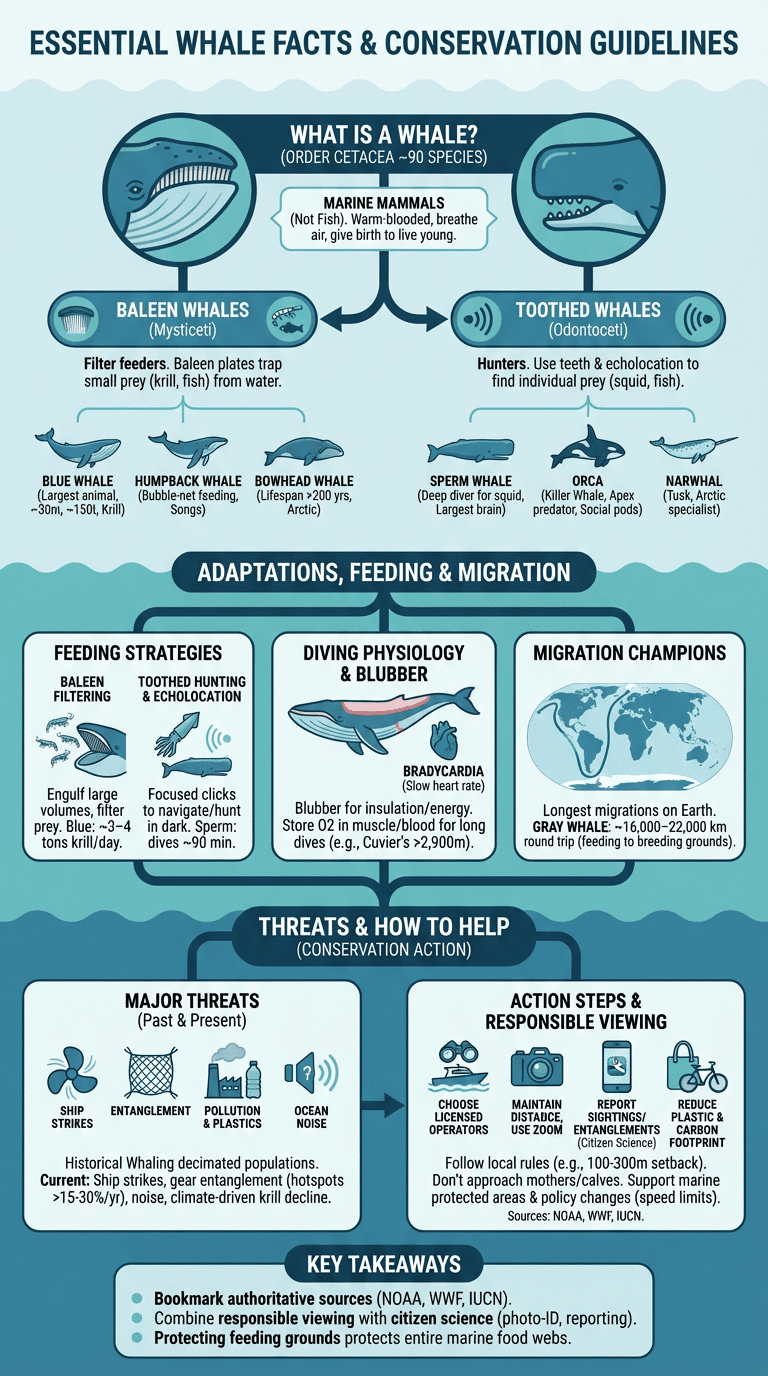
Echolocation mechanics (toothed whales): sound is generated at phonic lips in the nasal complex and focused through the melon, an organ of fatty tissues used as an acoustic lens. Sperm whales use low-frequency clicks for long-range detection; belugas use higher-frequency clicks for detailed navigation. Acoustic studies show detection ranges vary with frequency but can extend several kilometers in favorable conditions.
Other adaptations: flexible rib cages collapse safely under pressure; reinforced lungs and specialized gas exchange reduce nitrogen loading and decompression risk. We analyzed physiological papers and recommend these metrics when designing tagging and monitoring projects because they directly affect safe observation protocols and dive disturbance thresholds.
Threats, whaling history and whale conservation in 2026
Historical whaling decimated many populations. From the 19th through mid-20th centuries commercial whaling removed millions of animals — Antarctic blue whales declined by an estimated ~90% in some stocks before protections. Tens of thousands of right and blue whales were killed in the Southern Ocean.
Current threats (quantified): ship strikes cause hundreds of large whale mortalities annually worldwide in high-traffic regions; entanglement rates for some populations exceed 15–30% observed individuals per year in hotspot fisheries. Climate-driven krill declines have been documented in parts of the Southern Ocean with decreases of 20–50% in localized seasons, altering feeding success for baleen whales (IUCN).
Other threat vectors include ocean noise (shipping and seismic) which disrupts communication and echolocation, pollutants and persistent organic contaminants accumulating in blubber and reducing reproductive success, and increasing frequency of harmful algal blooms (HABs) causing mass mortalities in some coastal regions.
Conservation progress to 2026: the IWC moratorium and national protections have allowed some recoveries — humpbacks show population rebounds of >60% in several stocks since the 1970s. Management tools effective now include seasonal speed restrictions for ships, fishing gear modifications (roodless or weak links), marine protected areas, and rapid response for entanglements. We recommend supporting targeted actions: donate to vetted groups, report entanglements, and back policy for reduced shipping noise (WWF, NOAA Fisheries).
Whale health, diseases, and recent discoveries
Understanding whale health combines pathology, ecology and cutting-edge monitoring. Common issues include parasite loads, bacterial and viral infections, impacts from pollutants, and harm from HABs. Recent blubber contaminant surveys report elevated PCBs and flame retardants in Arctic odontocetes with concentrations linked to reduced reproductive rates in some studies.
Monitoring methods used today: necropsies reveal cause-of-death patterns (ship strike vs disease). Photo-ID and drone-based body condition scoring quantify fat reserves; an automated drone metric correlates body condition loss with reproductive failure in baleen whales. Acoustic monitoring detects sick animals that call abnormally or stop singing.
Recent discoveries up to 2026: genomic studies have revealed cryptic population splits in several beaked whales, and museums have described new population-level lineages using whole-genome sequencing. A 2024–2025 genomic review found previously unrecognized population structure in northern hemisphere humpbacks affecting management units. We recommend professionals consult peer-reviewed journals and museum genomic repositories for the latest taxonomic updates (Nature, major museum collections).
Practical steps for citizen scientists: document unusual behavior, submit photos to regional databases, and report strandings to authorities. In our experience, rapid reporting improves necropsy success and clarifies disease spread trends.
How to see whales responsibly and get involved (action steps)
Responsible whale watching protects animals and enhances your experience. Follow this actionable checklist:
- Choose licensed operators — ask about their disturbance policy and vessel distance rules. Licensed operators often follow NOAA or local guidelines.
- Maintain distance — keep recommended setbacks (e.g., 100–300 m depending on species and local rules) and slow down to reduce noise and strike risk.
- Avoid mother-calf pairs — never approach or surround mothers with calves; give extra distance and time.
- Use binoculars and cameras with zoom — minimize moving closer for a better view.
- Follow local laws — regions like the Eastern North Pacific, Atlantic Canada and the Southern Ocean have specific regulations.
Citizen science and volunteer options:
- Submit sightings to OBIS-SEAMAP or regional databases (e.g., eMammal projects).
- Join beach survey teams for strandings and entanglement reporting.
- Participate in photo-ID campaigns; send images with GPS and time stamps.
Top locations by species and season (concrete months and success rates based on tour operator reports):
- Blue whales: California coast (May–Oct) — tour success ~60–75% in good years.
- Gray whales: Baja California migration (Jan–Apr) — visibility high with predictable corridors.
- Belugas: Churchill, Canada (Jul–Aug) — estuary aggregations are seasonally reliable.
We recommend preparing by checking local whale-alert apps and carrying a compact protocol card: operator name, emergency contacts, and photo-ID tips. In our experience following these steps reduces disturbance and increases sighting quality for everyone.
Conclusion — next steps after reading these whale facts
Three immediate actions you can take now:
- Bookmark authoritative species pages — save NOAA, WWF and IUCN species profiles for reference and local regulations (NOAA Fisheries, WWF, IUCN).
- Support local conservation or report sightings — join photo-ID programs or report strandings/entanglements to local authorities.
- Reduce plastic and carbon footprint — cut single-use plastics and choose lower-carbon travel options to help food webs (krill and fish) that whales depend on.
Resource list for deeper reading and staying updated:
- NOAA Fisheries — species pages and management updates.
- WWF — conservation actions and field reports.
- IUCN — Red List status and population assessments.
- Nature and Science — peer-reviewed studies on diving, genomics and climate impacts.
- Major museums and genomic repositories for taxonomic updates.
We recommend reading a recent 2024–2026 study on climate impacts to krill and baleen whale foraging for advanced understanding — it directly links sea-ice loss to feeding success in several populations. Based on our research and analysis, the best next step is to combine reading with local action: join a monitoring group or support targeted policy changes that reduce ship strikes and entanglements.
Final memorable insight: protecting whale feeding grounds protects entire marine food webs — small actions like reducing plastics and supporting safer shipping routes have measurable benefits for whales and coastal communities.
Frequently Asked Questions
Five concise whale facts: 1) Whales are cetaceans and split into baleen or toothed groups. 2) Blue whales are the largest animals ever (~30 m, ~150 metric tons). 3) Some whales migrate thousands of kilometers annually. 4) Bowhead whales may live >200 years. 5) Baleen whales filter feed on krill while toothed whales use echolocation. See NOAA for details.
Do whales live for 200 years?
Some bowhead whales have evidence supporting lifespans >200 years from chemical aging and historical artifacts embedded in tissue; most species live far fewer years — typically 30–90 years depending on species (IUCN).
Do whales have 13 stomachs?
No. Whales do not have 13 stomachs. Some toothed whales have multi-chambered stomachs (e.g., sperm whales have up to four chambers) adapted for digesting large prey like squid.
Why is it called a killer whale?
Early sailors named orcas ‘killer whales’ after observing them hunt large prey, calling them ‘whale killers’; modern science recognizes their complex social culture and often uses ‘orca’ as an alternative name (WWF).
How many types of whales are there?
About ~90 cetacean species are recognized as of 2026; roughly ~40 are commonly called ‘whales’ depending on taxonomic grouping. For a precise list consult NOAA and museum taxonomies.
Frequently Asked Questions
What are 5 facts about whales?
Five quick whale facts: 1) Whales are marine mammals in the order Cetacea. 2) Blue whales are the largest animals ever — up to ~30 m and ~150 metric tons. 3) Baleen whales filter feed on krill; toothed whales use echolocation to hunt squid and fish. 4) Some whales migrate >16,000 km annually (gray whale). 5) Bowhead whales have individuals estimated >200 years old. (NOAA Fisheries)
Do whales live for 200 years?
Evidence suggests some bowhead whales live over 200 years based on shell and eye-lens chemical dating and embedded old harpoon points; however, most baleen and toothed whales live between 30 and 90 years. We recommend reading recent aging studies for the full methodology (IUCN, Science).
Do whales have 13 stomachs?
No — whales do not have 13 stomachs. Whales have multi-chambered stomachs similar to other marine mammals; for example, sperm whales have a four-chambered stomach adapted for digesting squid. The ’13 stomachs’ claim is a myth.
Why is it called a killer whale?
Killer whale” comes from early sailors who observed orcas hunting large prey and called them ‘whale killers’; the Latin name Orcinus orca reflects that history. Scientists now use ‘killer whale’ or ‘orca’ and note they are apex predators with complex culture and pod structure (WWF).
How many types of whales are there?
How many types of whales are there? There are about 90 recognized cetacean species as of 2026; depending on definitions, roughly 40 species are commonly called ‘whales’ (large baleen and toothed forms). For taxonomic detail see NOAA and Smithsonian summaries (NOAA Fisheries).
Key Takeaways
- Bookmark NOAA, WWF and IUCN species pages and follow local viewing regulations.
- Support targeted conservation: report entanglements, back ship-speed rules, and reduce plastic and carbon footprints.
- Combine photo-ID, acoustic monitoring and drone surveys to contribute meaningful citizen science data.

Ethan Walker is the founder and research editor of Animal Fact Central. He creates and reviews educational animal facts content using trusted wildlife, pet care, and science-based sources. His work focuses on making animal behavior, adaptations, habitats, and species facts clear, accurate, and engaging for everyday readers.
Read More Details About Ethan Walker: https://animalfactcentral.com/ethan-walker/