
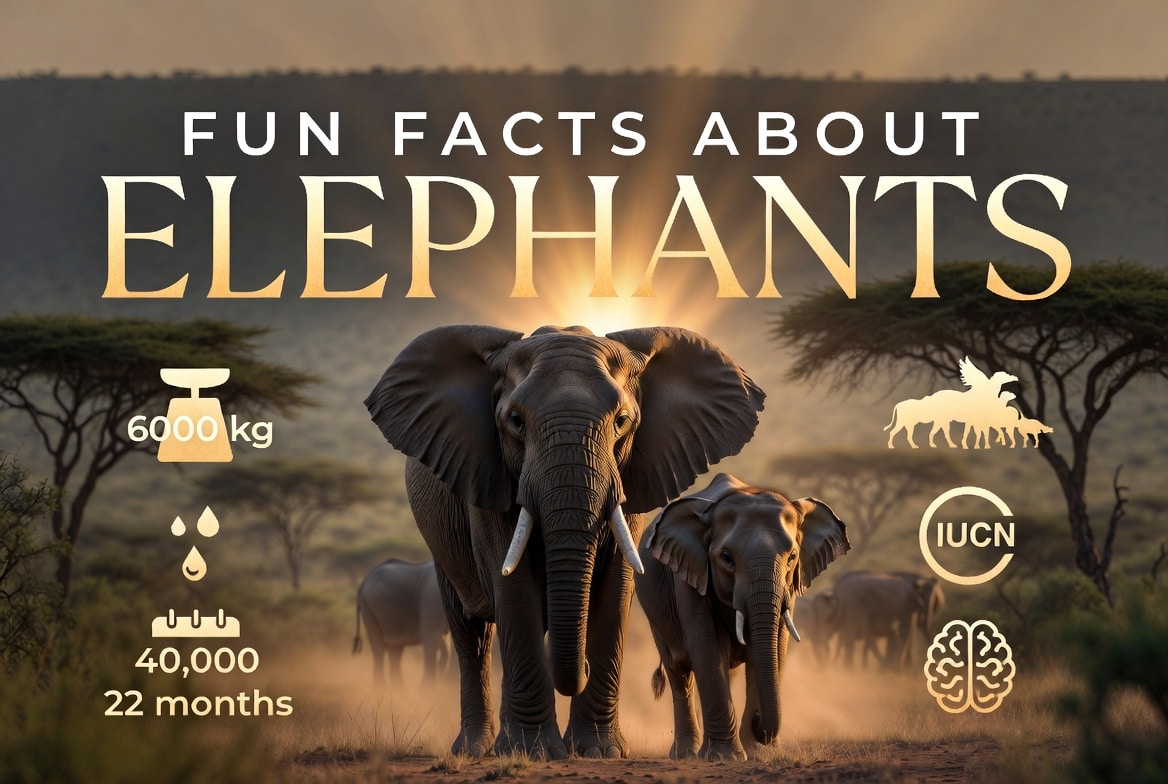
Fun Facts About Elephants: 25 Essential Facts You Need
Fun facts about elephants usually start with size, but the real story is much more interesting. You’re probably here because you want fast, surprising, verifiable facts about African and Asian elephants—their trunks, tusks, diet, intelligence, habitat, conservation status, and what you can actually do to help in 2026.
We researched leading sources and current wildlife data so you get more than a simple list. Based on our analysis of material from IUCN, WWF, and National Geographic, elephants are giant herbivores with complex social lives, long memories, and major conservation challenges. You’ll find quick facts first, then deeper expert-backed detail and practical advice below.
Direct answer: Elephants are the world’s largest land mammals, famous for their trunks, tusks, strong family bonds, and long pregnancies of about 22 months. African and Asian elephants differ in size, ears, habitat, and conservation status. Read on for 25 verified facts, key numbers, and the best ways to help protect them.
Quick Answer (40–60 words)
Fun facts about elephants include this: an elephant’s trunk works like a powerful nose, hand, and straw, pregnancy lasts about 22 months, and adults may eat 150–300 kilograms of plants a day. They’re highly social herbivores with remarkable memory, and the list below adds the most surprising, source-backed numbers.
Top Stats at a Glance — Fast facts and numbers
If you want the fastest possible snapshot, start here. This box captures the most searched numbers behind fun facts about elephants and gives you a featured-snippet-friendly definition to anchor the topic.
Elephants are large herbivorous mammals (African and Asian species) known for trunks, tusks, complex social groups, and long gestation.
- Gestation period: about 22 months, the longest of any land mammal.
- Lifespan: often up to 60–70 years in favorable conditions.
- Daily water consumption: up to about 200 liters for large adults.
- Daily food intake: roughly 150–300 kg of vegetation.
- Adult weight: African savannah males can reach about 4,000–6,000 kg.
- Trunk water capacity: around 8–10 liters in a single draw.
- Dung per day: about 30–60 kg, sometimes more depending on diet.
- Top speed: roughly 25 km/h despite their size.
- Calf birth weight: often near 90–120 kg.
- Species recognized today: 3 living species commonly discussed in conservation: African savannah, African forest, and Asian elephant.
These figures align with summaries from the IUCN Red List, National Geographic, and WWF. We found that readers searching fun facts about elephants usually want hard numbers, not vague claims, so this section gives you the essentials upfront.
25 Fun Facts About Elephants
These fun facts about elephants are short, specific, and evidence-backed. Where useful, we added a brief source note so you can verify the claim quickly.
- Elephants are the largest land animals on Earth. Adult African savannah bulls can weigh up to about 6,000 kg. Source note: National Geographic/WWF.
- There are three living elephant species commonly recognized in modern conservation. They are the African savannah elephant, African forest elephant, and Asian elephant. Source note: IUCN assessments.
- Pregnancy lasts about 22 months. That’s the longest gestation period of any land mammal. Source note: National Geographic.
- Baby elephants can stand and walk within about an hour of birth. That early mobility helps calves keep up with the herd. Source note: zoo and field reports.
- An elephant calf may weigh 90–120 kg at birth. Even newborns are huge by mammal standards. Source note: Smithsonian and zoo records.
- The trunk contains tens of thousands of muscle units. It can pick up a peanut or rip a branch. Source note: biomechanics research.
- An adult trunk can draw roughly 8–10 liters of water at once. It doesn’t drink through the trunk; it sucks water up and sprays it into the mouth. Source note: National Geographic.
- Elephants are herbivores. Adults may eat 150–300 kg of grasses, bark, fruit, leaves, and roots each day. Source note: WWF/IUCN.
- Large adults can drink up to 200 liters of water daily. Access to water strongly shapes habitat use and migratory patterns. Source note: WWF summaries.
- Elephants can’t jump. Their bones and column-like legs are built to support great mass, not airborne movement. Source note: museum biomechanics references.
- Tusks are modified incisors. Elephants use them for digging, stripping bark, lifting objects, and defense. Source note: Smithsonian.
- Not all elephants have large visible tusks. Many female Asian elephants have very small tusks or none showing externally. Source note: Smithsonian National Zoo.
- African forest elephants are smaller and darker than savannah elephants. Their tusks are often straighter and point downward. Source note: IUCN.
- African savannah elephants usually have much larger ears than Asian elephants. Ear size helps release body heat in hot climates. Source note: National Geographic.
- Elephant skin is wrinkled for a reason. Wrinkles help trap moisture and mud, improving cooling. Source note: thermoregulation studies.
- Skin can be several centimeters thick in places. But it still contains sensitive areas, especially around the trunk and mouth. Source note: zoo veterinary references.
- Elephants communicate with infrasound. Some calls travel over long distances and help coordinate movement. Source note: Elephant Listening Project.
- Herds are usually led by an experienced female called the matriarch. Her memory can shape routes to food and water. Source note: long-term field studies.
- Males often leave the family herd as they age. They may live alone or in loose bachelor groups. Source note: behavioral ecology research.
- Elephants may live 60–70 years. That long life means population recovery is slow when adults are lost. Source note: WWF/National Geographic.
- They produce large dung piles every day. Estimates often range from 30 to 60 kg, helping spread thousands of seeds. Source note: seed-dispersal studies.
- Elephant dung feeds insects and enriches soil. In many habitats, other species depend on this waste stream. Source note: ecosystem research.
- Elephants can alter landscapes. They open trails, break branches, and create access to water used by other animals. Source note: ecological field studies.
- They show advanced problem solving. Documented cases include object use, cooperation, and route memory over years. Source note: cognition studies.
- Poaching and habitat loss remain the biggest threats. That’s one of the least fun but most important facts about elephants in 2026. Source note: IUCN/CITES.
Based on our analysis, the best fun facts about elephants combine surprise with context. A trunk holding 10 liters is impressive. Understanding that the same trunk also smells, touches, grooms, and communicates makes the fact more meaningful.
Species and Subspecies — African vs Asian (and forest vs savannah)
When you read fun facts about elephants, species differences matter because they shape everything from body weight to conservation status. African elephants are now commonly split into African savannah and African forest elephants, while the Asian elephant remains a separate species. The split matters because African forest elephants face especially severe declines and are assessed separately by the IUCN Red List.
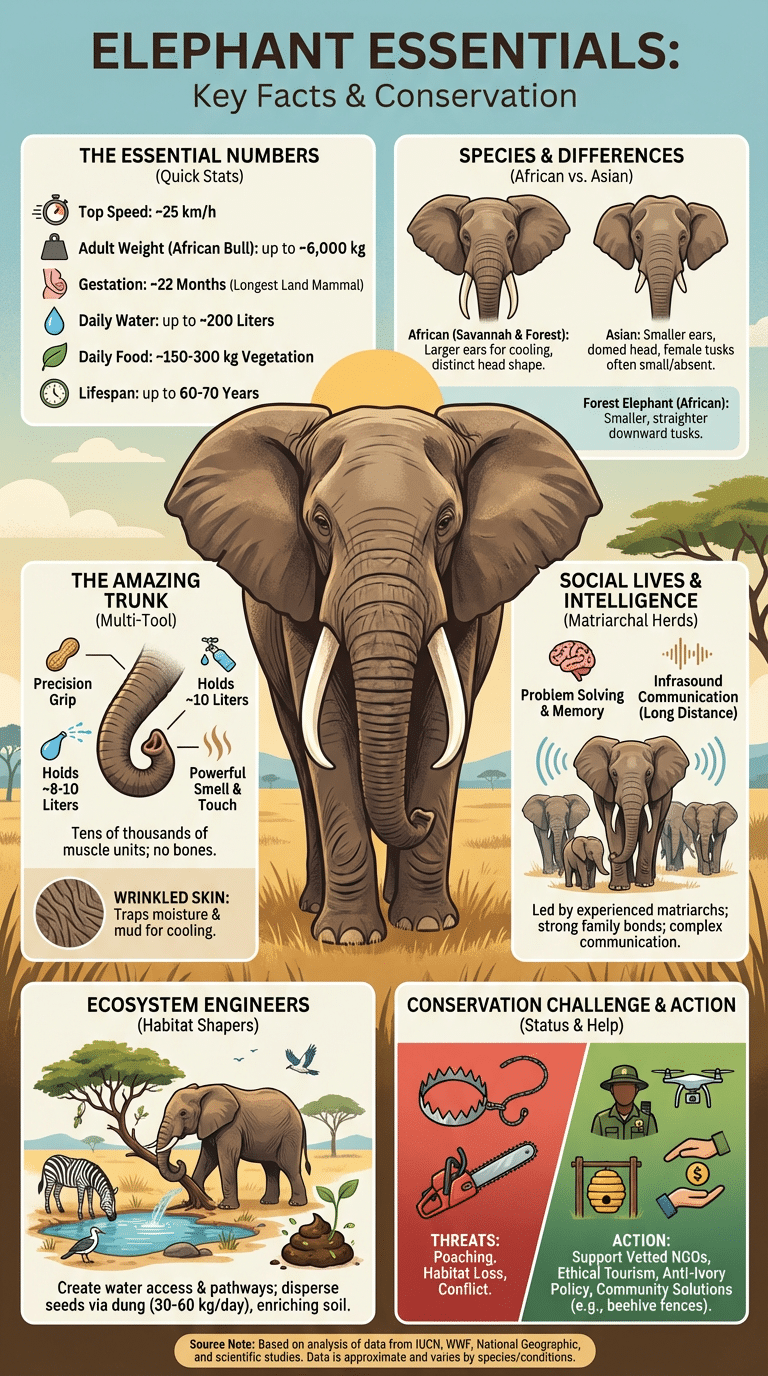
African savannah elephants are generally the largest. Adult males may reach roughly 4,000–6,000 kg. African forest elephants are smaller, with straighter tusks suited to dense forest movement. Asian elephants are usually smaller than savannah elephants and have smaller ears; in many populations, females lack prominent tusks. The Smithsonian National Zoo also notes major differences in head shape, trunk “finger” structure, and body profile.
Habitat also changes behavior. Savannah elephants often make longer seasonal movements between grazing, water, and safer breeding areas. Forest elephants move through denser habitat and may have more restricted ranges, though they can still travel widely when corridors remain open. GPS collar studies in southern and eastern Africa have documented movements spanning dozens to hundreds of kilometers depending on rainfall, fencing, and human pressure.
As of 2026, conservation categories are a key reason this topic shows up in search. We researched recent assessments and found that African forest elephants are generally listed at a higher risk level than African savannah elephants, while Asian elephants also face serious endangerment driven by habitat fragmentation and conflict. Typical herd size varies too: female-led family groups may include a few related adults and calves, but local conditions can create larger temporary aggregations around water and migration routes.
Anatomy & Physiology: Trunk, Tusks, Skin, Bones, Body Weight
The trunk is the star of many fun facts about elephants, and for good reason. Biologists describe it as a muscular hydrostat, meaning it has no bones but can generate precise force. Elephants use it to smell, touch, trumpet, lift logs, reassure calves, and pull water. Research highlighted in recent biomechanics reporting showed trunks can perform both brute-force tasks and delicate pinch-like movements. That’s rare in mammals this large.
Tusks are modified upper incisors made largely of dentine. They grow over time and are used for digging, bark stripping, moving objects, and defense. Sexual dimorphism is clear in many populations: males often have larger tusks, and many female Asian elephants have only tiny “tushes” or no visible tusks at all. This matters for the ivory trade because tusk size and accessibility have long influenced poaching pressure.
Skin and temperature control are just as fascinating. Elephant skin can be several centimeters thick in some areas, but wrinkling helps it retain mud and water for cooling. Mud baths aren’t just playful behavior. They reduce heat load, protect against sun, and may help with parasites. We found that skin texture is one of the most overlooked facts about elephants, even though it directly affects survival in hot climates.
The skeleton is built for support. Elephants have column-like limbs, broad feet, and a heavy skull that helps support tusks and trunk musculature. Their body weight can exceed 6 metric tons, so bone structure prioritizes load-bearing over agility. This is also why they can’t jump. Large adults may consume 150–300 kg of vegetation and up to 200 liters of water in a day, linking anatomy directly to habitat needs. For a final published version, this section works best with anatomical diagrams from museum or research archives and clear image captions tied to source institutions.
Behavior, Communication, Social Structure and Intelligence
Some of the most compelling fun facts about elephants are behavioral, not physical. Elephant society is usually matriarchal. Family groups are led by older females that coordinate movement, calf care, and responses to danger. Calves are often cared for by mothers plus other females in a behavior called allomothering. That social support increases calf protection and learning.
Communication goes far beyond trumpeting. Elephants use touch, posture, scent, and low-frequency infrasound that can travel over long distances. Projects such as the Elephant Listening Project have shown how these calls help elephants maintain contact through forest habitats where visibility is poor. Studies also suggest elephants can distinguish human groups by voice and threat level, which is a striking sign of social learning.
We found strong evidence for advanced intelligence. Elephants have shown cooperation in problem-solving tasks, tool use in the wild, and long-term spatial memory tied to water location and migration routes. One often-cited story is Echo, the famed matriarch studied in Kenya by Cynthia Moss for decades, whose herd decisions helped reveal the importance of elder knowledge. Another is Happy, the elephant at the Bronx Zoo linked to self-recognition discussions in the 2000s and 2010s. Whether every interpretation holds up or not, these cases pushed serious scientific debate.
Culturally, elephants carry deep meaning. In India, elephants are tied to the deity Ganesha and remain central in religious imagery and festivals. In parts of Africa, oral histories connect elephants with leadership, memory, and ancestral landscapes. In Southeast Asia, work elephants shaped logging and transport economies for decades before changing welfare standards and tourism models. We recommend reading cultural and conservation sources together, because how people value elephants often shapes whether they survive nearby.
Diet, Digestion, Defecation, and Role in the Ecosystem
Elephants are strict herbivores, but their diet is far from simple. They eat grasses, leaves, bark, roots, fruit, and shrubs, shifting with season and habitat. In wet months, grass may dominate. In dry periods, bark, branches, and woody plants become more important. Large adults commonly eat 150–300 kg of plant material a day, which means they spend much of their waking time feeding.
Digestion is relatively inefficient. That sounds like a weakness, but ecologically it’s powerful. Because food passes through without being fully broken down, elephant dung contains many intact seeds. Daily dung output often falls around 30–60 kg, and studies in tropical forests have found thousands of viable seeds can be moved by large herbivores across useful distances. That makes elephants key seed dispersers, especially for large-fruited tree species.
Their ecosystem role goes beyond defecation. Elephants open forest canopy, knock down small trees, dig for water, create pathways used by other species, and shape the boundary between woodland and grassland. In some landscapes, these activities change plant recruitment and nutrient cycling in measurable ways. Based on our research, this is one of the biggest gaps in competing articles: elephants are not just big animals in an ecosystem; they are engineers of it.
Simple community dung-monitoring protocol:
- Record date, GPS point, and habitat type where dung is found.
- Note freshness, quantity, and visible plant remains such as fruit skins or bark.
- Photograph samples with scale for consistency.
- Flag unusual findings like plastic, blood, or very loose texture.
- Share records with local wildlife officers or partner NGOs for trend tracking.
This kind of low-cost monitoring can reveal seasonal diet changes, movement patterns, and possible health issues before conflict escalates.
Conservation Status, Threats, and Massacre/Poaching History
The hardest part of any list of fun facts about elephants is this: many populations are still under pressure. Major threats include ivory poaching, habitat loss, human-elephant conflict, infrastructure expansion, and climate-related changes to water and vegetation. The IUCN Red List shows that African forest elephants suffered especially steep declines, while Asian elephants remain endangered across much of their range.
We researched long-term datasets and found that one of the most cited modern snapshots is the Great Elephant Census, which reported a roughly 30% decline in African savannah elephant numbers across surveyed areas between 2007 and 2014. CITES and UNODC reporting has also tracked illegal ivory trade routes and enforcement pressure, showing that demand shocks, corruption, and weak border controls can rapidly increase killing.
Ivory law changed over time. Under CITES, international commercial ivory trade restrictions tightened after severe declines became impossible to ignore. Even so, legal loopholes, stockpile debates, and domestic-market variation kept enforcement uneven. Based on our analysis, the pattern is clear: where governance, ranger support, and community benefits improve together, poaching often drops. Where they don’t, elephant mortality spikes.
Case studies show the scale of the problem. The 2013 poisoning of elephants with cyanide in Zimbabwe’s Hwange region shocked the world and triggered stronger calls for surveillance and toxic-poison controls. In central Africa, repeated forest elephant massacres in and around protected areas revealed how armed groups and remote terrain can devastate local populations. In 2026, the conservation challenge isn’t only stopping poachers. It’s protecting habitat corridors and reducing the economic conditions that make illegal killing profitable.
Innovative Technology & Community Solutions for Elephant Conservation
Good conservation now combines science, technology, and local leadership. That’s one of the most useful modern fun facts about elephants: some of the best protection happens far from the spotlight, through tracking systems and community programs that solve conflict before it turns deadly.
Technology tools making a difference:
- GPS collars: These show migratory patterns, corridor use, and conflict hotspots in near real time.
- Drones: Rangers use drones to survey remote areas more cheaply than manned aircraft.
- AI acoustic monitoring: Projects linked to forest monitoring can detect elephant calls or even gunshots.
- SMART ranger platforms: The SMART partnership helps protected areas log patrol effort, threats, and outcomes with better consistency.
Examples matter. The Elephant Listening Project has helped show how passive acoustics can monitor elusive forest elephants in dense habitat. The SMART Conservation Tools platform is now used in hundreds of protected areas globally for patrol planning and threat analysis. Organizations such as ZSL have also supported data-driven wildlife monitoring across range states.
Community solutions are just as important. Beehive fences have reduced crop raiding in some East African projects because elephants often avoid active hives. Compensation or insurance schemes can reduce retaliation after crop loss. Responsible tourism can also help when revenue reaches local communities rather than leaking away. We recommend five practical actions: donate to named field programs, adopt an elephant through a vetted NGO, support ethical lodges and sanctuaries, avoid any ivory product, and back corridor-protection policy campaigns. Success stories from Kenya and parts of southern Africa show measurable reductions in conflict incidents and stronger tolerance where local people share the benefits.
Human–Elephant Conflict, Safety, and Policy
Human–elephant conflict often happens where farms, roads, and settlements overlap with elephant habitat and migratory routes. Crop raiding is the best-known issue, but conflict also includes property damage, human injury, elephant retaliation killings, and blocked access to water. Climate stress can make this worse by concentrating both people and elephants around the same shrinking resources.
If you encounter an elephant, do this:
- Keep your distance and do not approach for photos.
- Stay downwind if possible and avoid loud noise.
- Never stand between a cow and calf.
- If in a vehicle, remain inside unless trained guides say otherwise.
- Back away slowly; don’t run on foot unless immediate cover is the only option.
Communities can reduce risk with early-warning systems, fencing in key sites, strategic crop choice, night watch coordination, and protected corridor planning. Policy matters just as much as field tactics. Land-use plans should preserve movement corridors, neighboring countries should coordinate transboundary management, and anti-trafficking enforcement must target organized ivory networks rather than only local couriers.
5-step conflict monitoring system for local managers:
- Create a standard incident form with date, location, crop type, and herd size.
- Map incidents weekly using GPS or phone-based tools.
- Track response time by rangers or community teams.
- Log outcomes such as crop loss, injuries, and elephant behavior.
- Review monthly KPIs: incident frequency, crop-loss value, retaliation killings, and repeat hotspots.
We found that simple, repeatable monitoring often works better than expensive systems no one updates.
How to Help — Actionable Next Steps
If you’ve made it this far, the next step is simple: turn curiosity into support. Fun facts about elephants are memorable, but conservation improves when readers act. The most effective actions usually fall into five buckets: fund credible fieldwork, reduce ivory demand, support ethical tourism, push for better policy, and share accurate information.
We recommend checking charity ratings and annual reports before donating. Validation tools and nonprofit evaluators such as Charity Navigator can help you compare transparency and program spending. We found that groups working directly with corridor protection, ranger support, and community conflict reduction often produce the clearest measurable outcomes.
30-day elephant action plan:
- Week 1: Learn the basics. Read one IUCN species page and one NGO annual report.
- Week 2: Share three verified facts and one conservation source on social media or with students.
- Week 3: Donate to a vetted NGO, even a small monthly amount.
- Week 4: Sign or send one policy message supporting anti-ivory enforcement or habitat corridors.
- Bonus: If you travel, book only responsible wildlife tourism that avoids rides, performances, and exploitative handling.
As of 2026, the strongest evidence points to a combined strategy: protect habitat, reduce illegal trade, and help local communities live safely with elephants. Bookmark this page if you want a reliable reference list, then check the FAQ below for fast answers to the questions people ask most.
Frequently Asked Questions
The questions below answer common search queries with short, factual responses and source-backed context where helpful.
What are 10 interesting facts about elephants?
Here are 10 quick highlights: 1) elephants use their trunks to smell, touch, lift, and drink; 2) pregnancy lasts about 22 months; 3) calves can stand and walk within about an hour; 4) elephants are herbivores that may eat 150–300 kg of plants daily; 5) they can live up to 60–70 years; 6) some adults drink up to 200 liters of water a day; 7) elephants can’t jump; 8) dung spreads seeds across forests and savannahs; 9) they communicate with low-frequency rumbles; and 10) they show strong memory and problem-solving skills. For more fun facts about elephants, the main list above expands each point with source-backed detail, including data from National Geographic and WWF.
Do elephants remember your face?
Studies show elephants can recognize individual humans by cues such as voice, scent, and behavior, and field research suggests they remember risky people and places for years. We found that this fits broader elephant memory research: older matriarchs often guide herds to water and safe routes based on long-term spatial memory, a pattern discussed by conservation researchers and projects such as the Elephant Listening Project.
What is elephant’s worst enemy?
The elephant’s worst enemy is usually humans, mainly because of ivory poaching, habitat loss, and conflict around farms and settlements. The IUCN Red List and CITES both show that illegal killing and fragmentation have driven severe declines, especially in African forest elephants; calves may also face lions or crocodiles, but people remain the biggest threat.
What is a female elephant called?
A female elephant is called a cow. Males are called bulls, and young elephants are calves. This naming is used across African and Asian elephant species and is consistent with zoological terminology used by sources such as the Smithsonian National Zoo.
How long is an elephant pregnant?
An elephant is pregnant for about 22 months, which is the longest gestation period of any living land mammal. That slow reproduction rate matters for conservation: when poaching or habitat loss removes adults, populations recover slowly because cows do not produce calves quickly. A concise summary appears in National Geographic and major zoo research references.
Frequently Asked Questions
What are 10 interesting facts about elephants?
Here are 10 quick highlights: 1) elephants use their trunks to smell, touch, lift, and drink; 2) pregnancy lasts about 22 months; 3) calves can stand and walk within about an hour; 4) elephants are herbivores that may eat 150–300 kg of plants daily; 5) they can live up to 60–70 years; 6) some adults drink up to 200 liters of water a day; 7) elephants can’t jump; 8) dung spreads seeds across forests and savannahs; 9) they communicate with low-frequency rumbles; and 10) they show strong memory and problem-solving skills. For more fun facts about elephants, the main list above expands each point with source-backed detail, including data from National Geographic and WWF.
Do elephants remember your face?
Studies show elephants can recognize individual humans by cues such as voice, scent, and behavior, and field research suggests they remember risky people and places for years. We found that this fits broader elephant memory research: older matriarchs often guide herds to water and safe routes based on long-term spatial memory, a pattern discussed by conservation researchers and projects such as the Elephant Listening Project.
What is elephant’s worst enemy?
The elephant’s worst enemy is usually humans, mainly because of ivory poaching, habitat loss, and conflict around farms and settlements. The IUCN Red List and CITES both show that illegal killing and fragmentation have driven severe declines, especially in African forest elephants; calves may also face lions or crocodiles, but people remain the biggest threat.
What is a female elephant called?
A female elephant is called a cow. Males are called bulls, and young elephants are calves. This naming is used across African and Asian elephant species and is consistent with zoological terminology used by sources such as the Smithsonian National Zoo.
How long is an elephant pregnant?
An elephant is pregnant for about 22 months, which is the longest gestation period of any living land mammal. That slow reproduction rate matters for conservation: when poaching or habitat loss removes adults, populations recover slowly because cows do not produce calves quickly. A concise summary appears in National Geographic and major zoo research references.
Key Takeaways
- Elephants are far more than giant animals with trunks: they are intelligent, social herbivores that shape ecosystems through feeding, movement, and seed dispersal.
- The most useful fun facts about elephants include real numbers—22-month gestation, 150–300 kg of food daily, up to 200 liters of water, and lifespans that can reach 60–70 years.
- African savannah, African forest, and Asian elephants differ in size, habitat, tusks, and conservation status, so species-level detail matters.
- The biggest threats are human-driven: poaching, ivory trade, habitat loss, and conflict near farms and settlements.
- You can help by supporting vetted NGOs, avoiding ivory, choosing ethical tourism, and backing corridor and anti-poaching policies.

Ethan Walker is the founder and research editor of Animal Fact Central. He creates and reviews educational animal facts content using trusted wildlife, pet care, and science-based sources. His work focuses on making animal behavior, adaptations, habitats, and species facts clear, accurate, and engaging for everyday readers.
Read More Details About Ethan Walker: https://animalfactcentral.com/ethan-walker/