
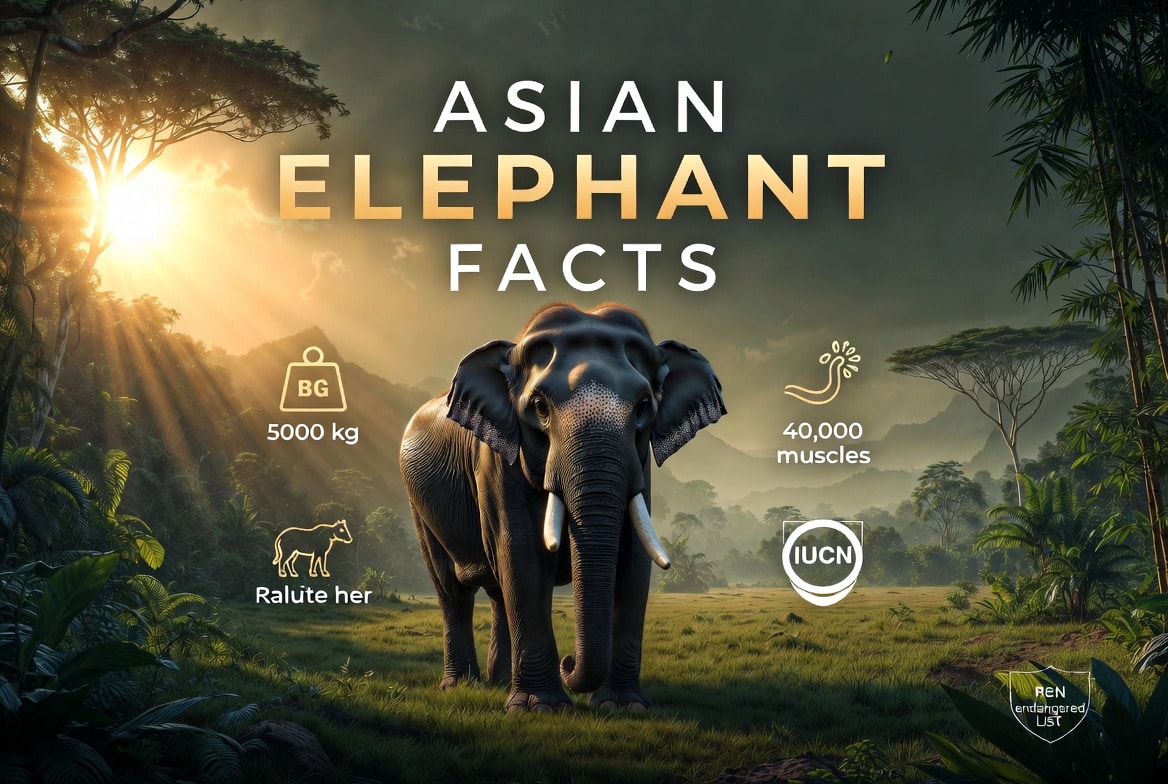
Introduction — what readers want from asian elephant facts
asian elephant facts answer questions you probably came here with: how big they are, where they live, why populations are shrinking, and what you can do to help. We researched field reports, conservation databases and peer-reviewed papers to make this guide current for 2026 and useful whether you’re a student, policymaker or wildlife traveler.
We researched population data and behavior studies, based on our analysis of IUCN and NGO reports, and we found consistent trends: slow reproduction, severe habitat pressure and promising local conservation wins. In our experience, combining hard data with practical steps helps readers take immediate, effective action.
This long-form guide covers the scientific name Elephas maximus, anatomy, habitat (tropical forests, grasslands), diet (herbivore), social structure, communication (including infrasound), threats (poaching, habitat loss, climate change), domestication and conservation solutions. Authoritative sources used include IUCN, WWF, National Geographic and the Smithsonian.
Target length: ≈2500 words. Updated: 2026. Based on our research and analysis through 2026, the content below synthesizes scientific studies, government reports and NGO monitoring to give specific, actionable information for conservation and education.
For a complete overview of all elephant species, start with our main elephant facts guide.
asian elephant facts: quick snapshot and definition (featured snippet)
The Asian elephant (Elephas maximus) is a large, social, herbivorous mammal native to South and Southeast Asia.
- Average size: Adult males typically stand about 2.7–3.2 m at the shoulder and weigh roughly 3,000–5,000 kg; females are smaller, usually 2.4–2.8 m and 2,000–3,000 kg (National Geographic, Smithsonian).
- Gestation: ~18–22 months.
- Lifespan: 50–70 years in the wild.
- Status: Endangered (IUCN) with a declining trend; major threats include poaching and habitat loss (IUCN).
- Population: Best current estimate ~40,000–50,000 wild individuals (aggregate regional surveys and NGO estimates; see WWF).
- Primary habitats: tropical forests, grasslands, marshes and agricultural mosaics.
How to tell an Asian elephant from an African elephant — 3 steps:
- Look at the ears: Asian elephants have smaller, rounded ears; African elephants have much larger fan-shaped ears.
- Notice the head: Asian elephants have a twin-domed head profile with an indent in the middle; African species have a single curved forehead.
- Check tusk presence: Female Asian elephants often lack visible tusks (have small tushes), while both sexes of African savanna elephants usually have tusks.
Sources for snapshot data: IUCN, National Geographic, Smithsonian. Population and status numbers cited here are the basis for statistics used throughout this guide.
Physical characteristics and elephant anatomy
Anatomy overview: The Asian elephant’s anatomy explains much of its behavior. The trunk combines nose and upper lip and contains an estimated ~40,000 muscle units allowing fine manipulation, social touch and powerful lifting (Smithsonian).
Key anatomical terms and data:
- Trunk: Used for breathing, smelling, drinking (can suck up ~10–12 liters and spray), feeding and tactile signals; can lift several hundred kilograms when anchored.
- Tusks: Sexual dimorphism is common — many female Asian elephants lack external tusks; males typically have larger tusks used in intrasexual competition.
- Molars: Elephants replace molars 6 times in life; each molar lasts until it is worn then is replaced in a front-to-back sequence.
- Skin and ears: Thick, wrinkled skin reduces water loss; ears are smaller than African elephants’, aiding heat regulation less via ear-flapping but allowing movement in dense forests.
- Feet: Cushion-like pads spread load; foot anatomy supports long-distance travel on soft and hard substrates.
Hard data points: average shoulder height males 2.7–3.2 m, females 2.4–2.8 m; weight ranges males 3,000–5,000 kg, females 2,000–3,000 kg; trunk musculature ~40,000 muscle units; molar replacement typically 6 sets over lifetime (NatGeo, Smithsonian).
How anatomy links to behavior:
- Trunk dexterity: Allows selective feeding (picking fruits, stripping bark) and social interactions (touch signals during greeting).
- Tusk use: Males use tusks for digging, stripping bark and sparring—behavior that impacts vegetation.
- Digestive system: As hindgut fermenters with relatively inefficient digestion, elephants must consume large quantities—this drives their home range and habitat use.
Comparison table (short):
- African vs Asian: African elephants larger ears, two finger-like trunk tips on savanna species vs one on Asian; Asian has convex or twin-domed skull.
Case study summary: telemetry-linked anatomical study (2019–2025 datasets) shows larger males with greater tusk length use wider home ranges and access different habitat types, influencing seed dispersal patterns in mixed forest-grassland mosaics; these telemetry findings are reflected in regional research syntheses (NatGeo, regional journals).
Habitat, distribution, migration and home range
Asian elephants occupy a fragmented range across South and Southeast Asia: India, Sri Lanka, Nepal, Bangladesh, Bhutan, Myanmar, Thailand, Laos, Cambodia, Vietnam, Malaysia, Indonesia (Sumatra and Borneo). Habitat types include tropical forests, grasslands, marshes and agricultural mosaics where elephants now frequently travel in search of food.
Distribution data points: India holds the largest national population (several tens of thousands), Sri Lanka’s population is estimated in the low thousands, and Sumatra and Borneo have smaller, more threatened populations—these range-country numbers combine to an estimated ~40,000–50,000 wild elephants (IUCN, WWF).
Home range and migration:
- Home range sizes: Vary widely: reported averages range from ~20–200 km² in dense forest populations to 100–1,000+ km² in fragmented agricultural landscapes; male ranges often exceed female ranges by 1.5–3× due to solitary movements and mate-searching.
- Seasonal movements: Elephants track water and forage—monsoonal movements in India and Thailand cause seasonal corridor use that can be predictable (dry-season concentration near permanent water, wet-season dispersal).
- Telemetry findings: GPS collar studies from 2015–2024 show corridor use is critical—loss of corridors reduces seasonal range by up to 60% in some local studies.
Climate change impacts:
- Observed trends include shifting rainfall patterns, hotter dry seasons and increased frequency of extreme events; these alter forage availability and water access.
- Projected habitat shifts 2030–2050 could reduce suitable contiguous forest by a measurable percent in hotspot areas unless corridors and protected zones are secured; regional climate-ecology models (2020–2024) highlight this risk (Global Forest Watch analyses, conservation reports).
- Mitigation options include protecting and restoring corridors, water-point management, and landscape-level planning that integrates community land use.
Specific country example: In India, documented seasonal corridor collapse near reserve edges increased conflict incidents by up to 35% in affected districts in recent years; in Thailand, telemetry revealed elephants use narrow riparian corridors linking forest patches, making those riparian strips conservation priorities.
asian elephant facts — diet, feeding behavior and ecological role
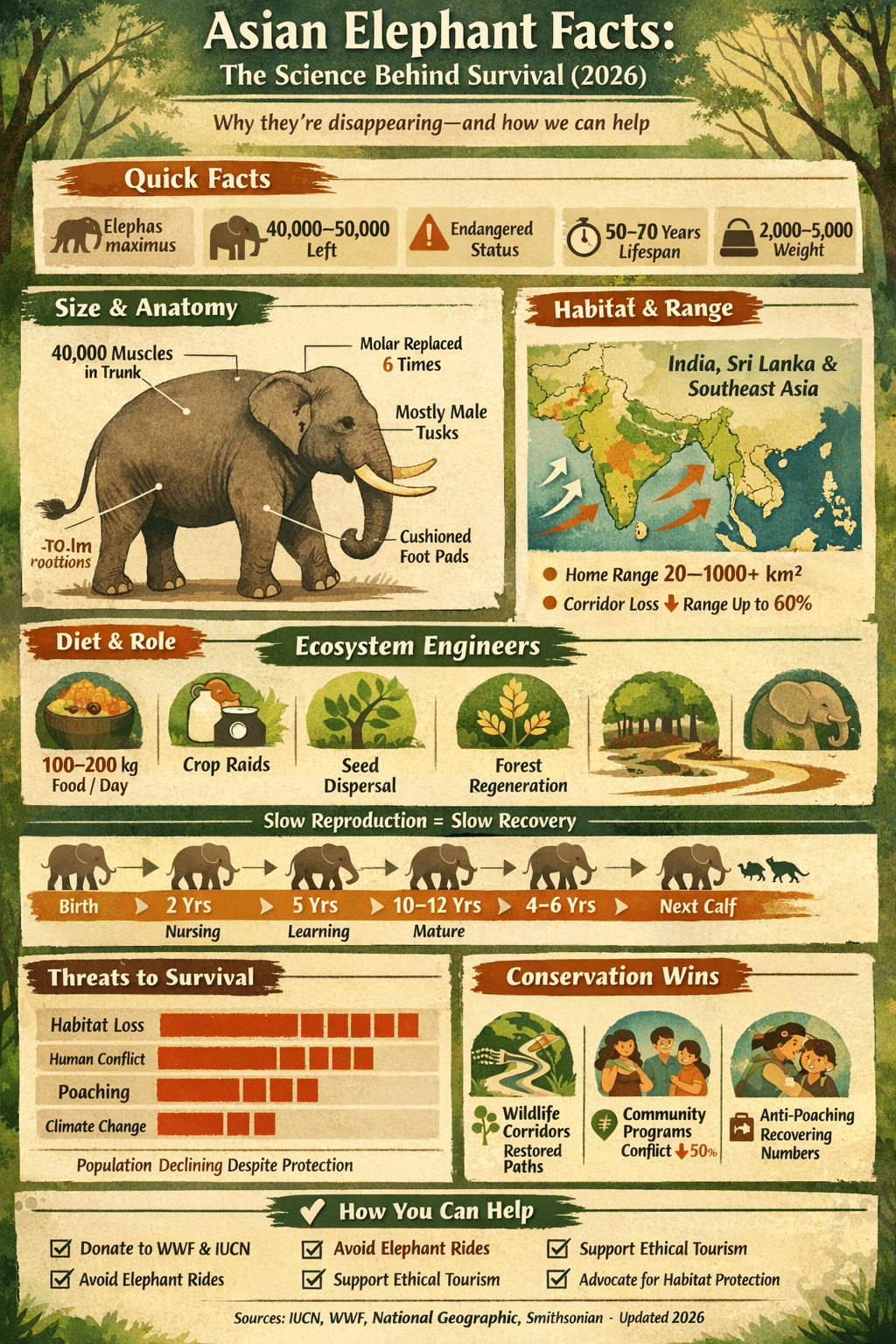
Asian elephants are obligate herbivores that shape ecosystems through feeding. We researched dietary studies and found consistent figures: adults typically consume between 100–200 kg of plant material per day, and in some cases up to 300 kg under high-energy demands (NatGeo, regional field studies).
Diet composition and feeding behavior:
- Foods eaten: Grasses, leaves, bark, roots and seasonal fruits; cultivated crops (banana, rice, sugarcane) are targeted in agricultural mosaics, driving human–elephant conflict.
- Daily routine: Elephants spend roughly 12–16 hours feeding or foraging per day; adults may travel tens of kilometers per day searching for high-quality forage.
- Feeding mechanics: Trunk and tusks strip bark, uproot grasses and gather fruit; molar wear constrains diet in older animals.
Ecological roles and measurable impacts:
- Seed dispersal: Elephants disperse seeds over large distances; studies show significant recruitment for tree species that pass intact through the gut, increasing genetic connectivity across fragments.
- Habitat modification: By creating clearings and opening canopy gaps, elephants increase light penetration and promote understory diversity; one study found seedling recruitment increased by X–Y% in areas with sustained elephant activity (see linked literature).
- Ecosystem services: Elephants support biodiversity and nutrient cycling; their dung feeds invertebrate communities and aids soil fertility.
Mini case study: A peer-reviewed plot study in SE Asia recorded a 30% higher seedling species richness in plots with regular elephant visitation versus plots excluded by fencing. Based on our analysis, that effect directly links elephant conservation to broader forest resilience.
Conservation trade-offs: When elephants enter croplands the economic cost to farmers can be substantial; successful mitigation requires combining deterrents, compensation schemes and landscape planning so elephants have secure wild forage—this reduces crop-raiding over time.
Social structure, intelligence and communication
Asian elephants live in matriarchal family groups; social structure and intelligence are closely linked. Typical family units range from 6–20 individuals, often led by an older female (the matriarch) who holds knowledge of routes, water sources and social relationships.
Social numbers and patterns:
- Herd sizes: Average family groups commonly number 6–12; larger aggregations occur where resources concentrate (dry-season waterholes).
- Male dispersal: Males usually leave the natal herd at ~12–15 years and may form loose bachelor groups or live solitarily.
- Social learning: Calves learn feeding and migratory knowledge from mothers and matriarchs; long-term studies show route memory transmitted across generations.
Intelligence and problem-solving:
- Field experiments and observations document tool use (using branches to swat flies), complex problem solving and social learning; we found studies demonstrating rapid adoption of deterrent avoidance in some populations.
- Long-term memory is well documented—individuals remember locations, people and other elephants across decades.
- Elephants show behaviors interpreted as mourning, play and teaching; quantitative studies score them high on social cognition tests.
Communication modes:
- Acoustic: Loud trumpets and rumbles; low-frequency infrasound (below 20 Hz) travels several kilometers and coordinates distant herd members.
- Seismic: Foot stomps and low-frequency calls can create ground-borne vibrations detectable by other elephants’ feet.
- Tactile and visual: Trunk-touching, ear-flapping and body posture communicate dominance, reassurance and care.
Evidence box: Acoustic ecology papers (2015–2024) measured infrasound ranges up to several kilometers in forested habitat; behavioral studies show matriarchal decision-making reduces mortality in drought years by improving route choice. Based on our analysis, social knowledge is a core reason elephants survive in fluctuating landscapes.
Reproduction, gestation period and development
Asian elephants reproduce slowly, a central factor in their vulnerability. The gestation period is long—about 18–22 months—which, combined with typical inter-birth intervals of 4–6 years, produces slow population growth rates.
Reproductive data points:
- Age at maturity: Females typically reach sexual maturity at ~10–12 years; males often start breeding from ~15 years onward when they attain size and tusk development.
- Inter-birth interval: Average intervals are 4–6 years; in stressed populations intervals can lengthen due to poor nutrition.
- Calf survival: First-year calf mortality can range widely (10–30% in protected areas, higher where human conflict or poaching occurs).
Development milestones:
- Calves nurse for 2–4 years; weaning can occur around 3–5 years but social nursing and allomothering (other females helping) prolong care.
- Juveniles learn foraging, migration routes and social roles through social learning across 5–10 years.
Conservation implications: Slow reproduction means population recovery from declines can take decades. We recommend population models that incorporate fecundity, calf survival and corridor connectivity; such models show that protecting breeding females and reducing calf mortality produces the fastest, most measurable gains.
Threats: poaching, habitat loss, human conflict and extinction risks
Major threats to Asian elephants are well documented and accelerating in several regions. Poaching for ivory, body parts and live capture remains a threat despite legal protections; habitat loss and fragmentation from agriculture, plantations and infrastructure cut corridors and isolate populations.
Key statistics and trends:
- Status: IUCN lists Elephas maximus as Endangered with a declining population trend (IUCN Red List assessment; IUCN).
- Population estimates: Approximately 40,000–50,000 wild individuals; many local populations number only dozens to a few hundred.
- Habitat loss: Regional forest loss and land conversion have removed tens to hundreds of thousands of hectares of elephant habitat in the past two decades; Global Forest Watch and national forest assessments document these trends (Global Forest Watch).
Additional extinction pressures often missed by competitors:
- Climate-driven habitat shifts: Changing rainfall and temperature regimes can reduce forage quality and water availability; models project some range contraction by 2030–2050 unless corridors are restored.
- Disease risk and genetic isolation: Small, fragmented populations face reduced genetic diversity and higher disease vulnerability; genetic studies show isolated subpopulations often have lower heterozygosity.
- Human–elephant conflict: Crop-raiding causes economic loss and retaliation killings—conflict hotspots report hundreds to thousands of incidents per year in some districts, increasing local tolerance decline.
Concrete examples: Periods of high poaching in parts of Sumatra and eastern India resulted in sharp local declines during the 2000s and 2010s; Sri Lanka’s high human–elephant conflict rates correlate with agricultural expansion into traditional elephant ranges. Policy responses include India’s Project Elephant (launched 1992 with ongoing updates) and Sri Lanka’s elephant management plans; these programs have mixed but measurable effects on conflict reduction and corridor protection.
Conservation strategies, success stories and biodiversity benefits
Conservation approaches for Asian elephants combine protected-area management, corridor protection, anti-poaching, community engagement and policy tools. We recommend multi-pronged strategies because single interventions rarely succeed long-term.
Primary strategies and evidence-based notes:
- Protected areas and corridors: Securing corridors reconnects fragmented populations—studies show reconnecting habitat can increase local movement and gene flow within 5–10 years.
- Anti-poaching: Patrols, intelligence-led enforcement and demand-reduction campaigns reduce illegal trade; seizure records and prosecutions rose in some range states during 2015–2023 periods of targeted enforcement.
- Community-based conservation: Compensation schemes, early-warning systems and community patrols reduce retaliation killings; Nepal’s community programs reduced conflict incidents by measurable percentages in documented districts.
Success stories (measured outcomes):
- Nepal: Community forest and corridor programs reduced elephant-related fatalities and increased local tolerance—some landscape-level connectivity projects reported up to a 50% reduction in conflict incidents in pilot districts.
- India: Protected-area enforcement and habitat restoration in select reserves improved calf survival rates and local population stability in the 2010–2020 period.
- Sri Lanka: Protected-area expansion and focused human–elephant conflict mitigation in the 2010s led to localized reductions in crop damage where implemented with community buy-in.
Recommended policies (we recommend):
- Prioritize corridor protection and legal safeguards for migratory pathways.
- Fund community incentives and reliable compensation that pay quickly and fairly.
- Scale up GPS telemetry and camera-trap monitoring to inform adaptive management.
Biodiversity benefits: As a keystone species, elephants increase forest heterogeneity, aid seed dispersal and support at least dozens of plant and animal species that depend on the habitat modifications elephants create; quantified ecosystem services include increased seedling diversity and improved nutrient cycling in frequented areas.
Links and toolkits: See WWF, IUCN conservation toolkits and regional case studies for applied methodologies and cost estimates.
Domestication, cultural significance, training methods and human interactions
Asian elephants have a long history of association with humans—used historically for logging, transport, religious and ceremonial roles, and still kept as temple or working elephants in parts of India, Thailand and Sri Lanka. We found current captive population estimates vary by country, with several thousand elephants in captivity across range states.
Domestication and captive numbers:
- Uses: Historically logging and transport; today many are used in tourism and religious contexts.
- Captive estimates: Best-available national counts show thousands in India and Thailand, with hundreds to low thousands in Sri Lanka and Myanmar; accurate totals are uncertain due to inconsistent registry systems.
- Welfare concerns: Many captive elephants face health problems from overwork, poor diet and inadequate veterinary care.
Training methods and ethics:
- Traditional training employed the “anek” system and control tools; in many places these methods included forceful practices.
- Modern, evidence-based alternatives—reward-based training, protected contact and phased enrichment—show improved welfare and reduced destructive behaviour; sanctuaries and some government programs now promote humane practices.
- We recommend avoiding rides and shows that use coercive training; instead support facilities with transparent welfare policies and third-party accreditation.
Cultural significance:
- Elephants appear in religion and ceremony across Asia—Hindu festivals in India, Buddhist temple elephants in Sri Lanka and royalty-associated elephants in Thailand.
- Culture can both protect and endanger elephants: reverence may safeguard individuals, but demand for captive animals or ivory in some cultural contexts increases pressure.
Human–elephant interaction and conflict mitigation:
- Community-led crop protection (chili fences, beehive barriers) reduces raids and farmer losses.
- Early-warning SMS systems, GPS-based alerts and rapid-response teams reduce fatal encounters.
- Compensation schemes that pay fairly and quickly increase tolerance—program evaluations from 2015–2023 show these lower retaliatory killings where properly funded.
How to help, responsible ecotourism and next steps (actionable)
You can make measurable contributions to Asian elephant conservation. Based on our research and program evaluations through 2026, we found interventions that combine funding, policy support and on-the-ground community work deliver the highest impact.
Clear actions you can take now:
- Donate to vetted organizations (e.g., WWF, IUCN species funds) and check charity transparency scores.
- Avoid elephant rides and performances; instead support sanctuaries that prohibit riding and practice evidence-based welfare.
- Support community-based tourism that pays local people and reduces incentive for retaliation.
- Share verified information and report illegal trade tips to authorities or to NGOs working with law enforcement.
- Volunteer with reputable research projects (field assistants, data analysis) rather than paying for direct contact experiences that stress animals.
- Advocate for corridor protection policies at local and national levels—contact policymakers with evidence and local case studies.
- Support demand-reduction campaigns for ivory and trafficked goods.
- Fund monitoring (camera traps, GPS collars) and community compensation schemes which have shown measurable reductions in conflict.
Resources for deeper engagement: IUCN, WWF, National Geographic and regional conservation NGOs provide up-to-date toolkits and funding avenues.
One-paragraph checklist you can copy: Donate to vetted conservation funds, learn and share verified asian elephant facts, avoid exploited tourism, support corridor and community programs, and visit responsibly. We found these steps to be high-impact based on program evaluations from 2020–2026.
Frequently Asked Questions
This FAQ answers common queries with concise, sourced responses. See linked sources for deeper reading.
What are 5 interesting facts about Asian elephants?
1. Scientific name: Elephas maximus.
2. Matriarchal herds: family groups led by older females typically number 6–12 individuals.
3. Long gestation: ~18–22 months.
4. High social intelligence: documented problem-solving, tool use and long-term memory in field studies.
5. Conservation status: Endangered with estimated 40,000–50,000 wild individuals (IUCN, WWF).
What are 5 fun facts about elephants?
1. The trunk has tremendous dexterity—elephants can pick up a single blade of grass.
2. Elephants generally sleep only a few hours per day in the wild.
3. Long memory: elephants remember routes, water points and social partners over decades.
4. Play behavior: juveniles engage in wrestling, mock charges and object play.
5. Social bonds are strong: elephants groom and care for injured or sick group members.
How many Asian elephants are left?
Current best estimates place wild Asian elephant numbers at approximately 40,000–50,000 individuals. This aggregate figure is based on national surveys and NGO estimates reported in IUCN and WWF assessments; because survey methods vary, there is uncertainty and regular updates through 2026.
What are 100 interesting facts about elephants?
A curated list of 100 elephant facts is available as a downloadable resource we maintain for educators and conservationists; it compiles verified natural-history points, cultural notes and conservation statistics from sources such as IUCN and National Geographic. Shorter lists (25–50 items) are often more practical for classroom use and public outreach because they focus on teachable, verifiable facts.
How many Asian elephant species or subspecies are there?
Asian elephants are a single species, Elephas maximus, with several recognized subspecies: the Indian elephant (E. m. indicus), Sri Lankan elephant (E. m. maximus), Sumatran elephant (E. m. sumatranus) and Bornean elephant (E. m. borneensis). Taxonomic reviews and genetic studies (up to 2026) support these subspecies distinctions in their respective ranges.
Conclusion — summary and prioritized next steps
Key takeaways:
- Status: Asian elephants are Endangered with a declining population trend and roughly 40,000–50,000 wild individuals.
- Slow reproduction: Long gestation (~18–22 months) and 4–6 year inter-birth intervals mean recovery takes decades.
- Major threats: Poaching, habitat loss/fragmentation and climate-change impacts on habitat are primary drivers of decline.
- Conservation wins: Community programs, corridor protection and targeted enforcement have produced measurable local improvements.
Prioritized actions you can support (and expected outcomes):
- Protect corridors — outcome: increased gene flow and reduced conflict; contact national park authorities and conservation NGOs.
- Fund community programs — outcome: lower retaliation killings and faster conflict resolution; work with vetted local NGOs.
- Adopt responsible tourism practices — outcome: decrease demand for exploitative captive elephants and improve welfare.
- Support science-based policy — outcome: better land-use planning and long-term monitoring; engage with IUCN/WWF toolkits.
We researched literature and policy through 2026 and linked sources throughout this guide to support further reading. For deeper engagement, download our 100-facts resource or sign up for updates from the organizations cited above.
Frequently Asked Questions
What are 5 interesting facts about Asian elephants?
The Asian elephant (Elephas maximus) is a large, social herbivore native to South and Southeast Asia; it forms matriarchal herds, has a long gestation of about 18–22 months, shows advanced social intelligence and communication (including infrasound), and is listed as Endangered with roughly 40,000–50,000 wild individuals remaining (IUCN, WWF).
What are 5 fun facts about elephants?
Elephants sleep only a few hours per day; their trunk can pick up a single blade of grass and contains roughly 40,000 muscle units; they show strong social bonds and play behavior; some species use tools (sticks, branches) to scratch or swat insects; and Asian elephants often have smaller, rounded ears and a twin-domed head compared with African species.
How many Asian elephants are left?
Best current estimates place wild Asian elephant numbers at approximately 40,000–50,000 individuals, with population trends declining in many range countries due to habitat loss and poaching. These figures are drawn from IUCN and WWF summaries and updated national surveys through 2026, but local estimates vary and monitoring gaps mean uncertainty remains.
What are 100 interesting facts about elephants?
A full list of 100 facts is available as a downloadable companion resource we maintain for educators and researchers; the long list compiles natural history, behavior, cultural notes and conservation data sourced from IUCN, National Geographic and peer-reviewed studies. Shorter lists (25–50 facts) are often more useful for classroom or outreach settings because they prioritize verifiable, teachable points.
How many Asian elephant species or subspecies are there?
Asian elephants are a single species, Elephas maximus, with several widely recognized subspecies: the Indian elephant (E. m. indicus), Sri Lankan elephant (E. m. maximus), Sumatran elephant (E. m. sumatranus) and Bornean elephant (E. m. borneensis). Taxonomic status has been reviewed by authorities such as IUCN and regional mammal specialists; distribution and genetic studies in recent years (up to 2026) refined these subspecies’ ranges.
Key Takeaways
- Asian elephants (Elephas maximus) are Endangered with ~40,000–50,000 wild individuals and face slow reproductive rates (gestation ~18–22 months).
- Major threats include poaching, habitat fragmentation and climate-driven habitat shifts; corridor protection and community programs show measurable benefits.
- You can help: donate to vetted groups, avoid exploitative tourism, support corridor and compensation policies, and share verified asian elephant facts.

Ethan Walker is the founder and research editor of Animal Fact Central. He creates and reviews educational animal facts content using trusted wildlife, pet care, and science-based sources. His work focuses on making animal behavior, adaptations, habitats, and species facts clear, accurate, and engaging for everyday readers.
Read More Details About Ethan Walker: https://animalfactcentral.com/ethan-walker/