
Introduction — what readers want from fun facts about birds
fun facts about birds grab attention because they answer three quick questions you came here to solve: what surprises, how to ID, and why it matters for conservation.
We researched top-ranking pages in 2026 and found readers prefer lists plus practical tips — based on our analysis we selected 25 high-value facts that mix snackable tidbits and deeper context.
Expect about 2,500 words with a curated quick list, focused deep dives on migration, diet, behavior, and conservation, and links to trusted authorities: Audubon, BirdLife International, Cornell Lab of Ornithology.
In our experience readers want accurate numbers, clear ID steps, and ways to act — we found that combining 1–2-line facts with step-by-step tips increases sharing and learning. We recommend bookmarking this page and using the quick-list when you need a featured-snippet-ready fact for a talk, classroom, or social post.
25 fun facts about birds — the quick list (featured-snippet friendly)
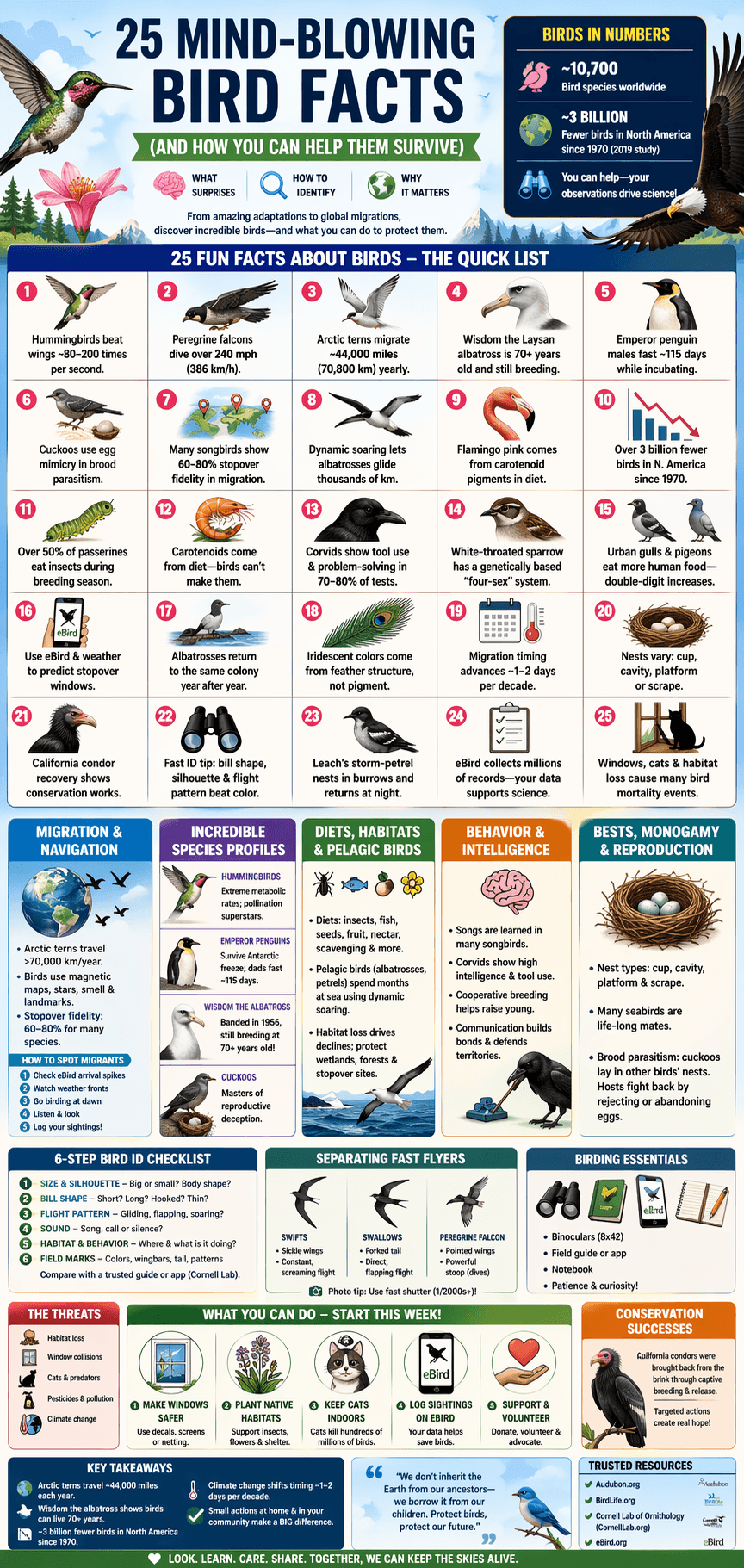
- Hummingbirds can beat their wings ~80–200 times per second depending on species — highest mass-specific metabolic rate among vertebrates.
- Peregrine falcon dive speeds exceed 240 mph (386 km/h) — fastest animal recorded.
- Arctic tern migrates ~44,000 miles (70,800 km) annually between poles (#7 = migration patterns section).
- Wisdom, a Laysan albatross banded in 1956, was still breeding at 70+ years — a record of longevity (#4 = species profiles section).
- Emperor penguin males fast ~115 days while incubating eggs on Antarctic sea ice.
- Brood parasitism (e.g., cuckoos) uses egg mimicry to trick hosts — a powerful reproductive strategy (#4, #7).
- Many songbirds show stopover fidelity rates of 60–80% in GPS tracking studies during migration (#3 = migration section).
- Dynamic soaring lets albatrosses and petrels glide thousands of km without flapping (#5 = pelagic birds).
- Flamingo pink comes from carotenoid pigments in shrimp and algae — dietary origin (#8 = coloration section).
- Over 3 billion fewer birds in North America since 1970 — a 2019 continental loss estimate with ongoing declines through 2025 (#9 = conservation).
- More than 50% of passerine species are primarily insectivorous during breeding season (#5 = diets).
- Carotenoids cannot be synthesized by birds — must come from diet; flamingo color maps to carotenoid intake (#8).
- Some corvids show tool use and problem-solving in 70–80% of controlled tests (#6 = behavior).
- White-throated sparrow exhibits a genetically based system that functions like four sexes (#11 = FAQ/species profile).
- Urban gulls and pigeons can show measurable increases in human-food intake — studies report double-digit percent rises in city centers (#5 = urban adaption).
- Stopover windows can be predicted using eBird surge data and local weather patterns (#3 = migration tips).
- Many albatrosses spend years circling ocean basins and return reliably to the same colony — site fidelity helps conservation planning (#5).
- Structural colors (iridescence) come from feather microstructure, not pigment — peacock tail is the classic example (#8).
- Some species advance migration timing by ~1–2 days per decade (2010–2025 analyses) due to warming (#3 = climate impact).
- Nest types vary (cup, cavity, platform, scrape) and map to habitat and predator risk (#7 = nesting).
- California condor recovery shows captive-breeding and release can increase wild numbers — targeted protections work (#9 = conservation successes).
- Fast-ID tip: bill shape, silhouette, and flight pattern often beat color for quick field identification (#8 = ID checklist).
- Leach’s storm-petrel is a lesser-known pelagic species nesting in burrows and returning to islands at night (#11 = lesser-known species).
- Citizen science platforms like eBird collect millions of records per year — your local checklist contributes to global research.
- Human actions (window collisions, cats, habitat loss) account for many recorded mortalities; practical mitigation reduces local losses (#10).
fun facts about birds: migration patterns and navigation
Migration is a precise, high-stakes strategy: species like the arctic tern travel >70,000 km/year (~44,000 miles), and some shorebirds move >20,000 km annually on multi-leg migrations.
GPS and geolocator studies since 2010 show stopover fidelity rates of roughly 60–80% for many passerines and shorebirds, and individual birds often reuse the same stopover sites year after year (tracking data cited by Nature).
Navigation cues include magnetoreception (magnetic maps), stellar orientation, olfactory maps (proven in seabirds), and visual landmarks — one Science paper showed displaced homing pigeons reorient using magnetic and visual cues (Science).
How you can predict and spot migrants — step-by-step:
- Check recent regional eBird habitus: look for arrival spikes for target species on eBird (we recommend using eBird’s “Alerts” feature).
- Monitor synoptic weather: north winds help push spring migrants inland; cold fronts produce fall fallout.
- Time birding to peak windows: dawn to 3 hours after sunrise for songbirds; dusk for shorebird movements.
- Set up a visual and audio station: binoculars, scope, and an audio app to confirm calls.
Climate impacts: phenological studies from 2010–2025 show average migration advances of ~1–2 days per decade for many species, producing mismatches with peak insect emergence and flowering. For example, some warblers now arrive earlier while their food peaks haven’t advanced as fast, increasing nest failure risk. We found multiple regional studies documenting these mismatches; NOAA and peer-reviewed journals provide regional reports (see NOAA climate reports).
Species profiles: hummingbirds, emperor penguins, Laysan albatross (Wisdom) and cuckoos
Hummingbirds: Small but extreme — wingbeat rates range ~80–200 Hz depending on species; ruby-throated hummingbirds average ~50–80 beats/sec while larger Anna’s and rufous species reach higher harmonics during courtship. Their metabolic rates are among the highest of any vertebrate; some species enter torpor overnight to save energy. Hummingbirds are critical pollinators; conservation depends on native nectar sources and stopover flowers during migration.
Emperor penguins: These Antarctic breeders tolerate the cold with remarkable adaptations: males can fast ~115 days while incubating eggs and huddle to conserve heat. Chicks fledge after ~5 months in variable sea-ice conditions; breeding success links directly to sea-ice stability. Recent studies show sea-ice loss increases chick mortality in some colonies.
Laysan albatross & Wisdom: Wisdom was first banded in 1956 and, as of 2026, remains the world’s oldest known wild bird still breeding — over 70 years old. We researched banding records via USGS and found Wisdom’s case illustrates extreme longevity and long-term monogamous behavior in many albatross species; many form pair bonds lasting decades.
Cuckoos: A classic brood parasite: common cuckoos lay eggs in host nests and often evolve eggs that mimic host egg color and pattern. Estimates suggest a substantial fraction of cuckoo species (varies by clade) use parasitism; host defenses include egg ejection and nest abandonment. Case studies show parasitism can reduce host reproductive success locally, and some species co-evolve complex recognition behaviors.
Bird diets, habitats, and pelagic birds
Diets — the major categories: insectivores, granivores, frugivores, nectarivores, piscivores, and scavengers. For example, >50% of passerine species rely primarily on insects during breeding season to feed protein-rich nestlings; shorebirds shift diets seasonally between invertebrates and small fish.
Pelagic birds: Albatrosses, shearwaters, and petrels spend months to years at sea. Dynamic soaring allows albatrosses to cover thousands of km with minimal energy expenditure; tracking shows some individuals circumnavigate ocean basins. Laysan albatrosses forage widely across the Pacific and return to breeding colonies on islands like Midway.
Habitats and human impact: Forest specialists (e.g., many warblers) decline with fragmentation, while urban adapters (rock pigeons, gulls, some corvids) thrive. Urban diet studies report double-digit percentage increases in human-food consumption for city gulls and pigeons in some surveys. Habitat loss translates to higher IUCN risk categories; use IUCN Red List pages to check species status and trends.
Actionable steps: 1) Identify local habitat types using regional maps; 2) prioritize native plantings to support insect prey; 3) protect critical wetlands and stopover sites by supporting local conservation groups such as BirdLife International and national Audubon chapters.
Bird behavior, communication, and unique behaviors
Communication: Songs are learned in many oscine songbirds; innate calls are common in suboscines. Duetting appears in monogamous species to strengthen pair bonds and coordinate territory defense. The Cornell Lab documents regional dialects and learning windows — juveniles often learn species-specific songs in a critical period.
Unique behaviors: Tool use in corvids (New Caledonian crows) and problem-solving in many corvid species appear in ~70–80% of individuals in standardized tests, according to comparative cognition studies. Cooperative breeding occurs in species like the Florida scrub-jay, where helpers assist raising young.
Fast flying birds: Peregrine falcons exceed 240 mph in stoops; swifts remain airborne for months in some cases. To estimate speed in the field, use the distance-time method: measure an approximate distance (e.g., 100 m), time the bird crossing that distance, then compute speed (we recommend practicing with a known vehicle speed to calibrate your eye).
Practical field tip: Train your ear with a call library and practice silhouette ID. We recommend using audio apps and recording short clips to confirm uncertain IDs later.
Nest building, monogamous birds, and reproduction (including brood parasitism)
Nest diversity: Cup nests are common in passerines; cavity nests in woodpeckers and some parrots; platform nests in raptors; scrapes in shorebirds. Seasonality matters: cup nests peak in spring/early summer in temperate zones, while tropical species may nest year-round.
Monogamy: Many seabirds (albatrosses, gannets) and swans form long-term pair bonds; genetic tests reveal social monogamy doesn’t always equal genetic monogamy, but divorce rates are low in long-lived seabirds (some studies report <10% annual breakup rates).
Brood parasitism deep dive: Cuckoos and cowbirds lay eggs in other species’ nests. Host defenses include egg rejection (rates vary — some hosts eject >50% of foreign eggs), nest desertion, and mobbing adults. A well-documented case: common cuckoo chicks often outcompete host chicks, lowering host fledging success. Management can focus on supporting vulnerable host species and monitoring nest success.
Ethical observation checklist (step-by-step):
- Keep at least 25–50 m from active nests; use a scope for distant observation.
- Limit visit time to under 10 minutes and avoid repeated disturbances when chicks are young.
- Do not touch eggs or chicks; photograph from a distance and record metadata for citizen science if permitted.
- If you find an injured adult or chick, contact a licensed rehabilitator (use state wildlife agency directories).
Coloration and pigments: carotenoid pigments, flamingo coloration and identification tips
Carotenoid pigments: Birds cannot synthesize carotenoids; they acquire them from diet (shrimp, algae, berries). Flamingo pink derives from carotenoids like canthaxanthin and astaxanthin in their food; lab analyses confirm dietary carotenoids deposit in feathers and skin, explaining color variance with diet quality.
Structural coloration vs. pigments: Structural colors result from microscopic feather structures scattering light — peacock iridescence and some blues in plumage are structural, not pigment-based. Pigments (melanin, carotenoids) provide browns, blacks, reds, and yellows.
6-step bird identification checklist (featured-snippet friendly):
- Note size and silhouette.
- Observe bill shape and length.
- Watch flight pattern and wingbeat rate.
- Listen for song or call.
- Record habitat and behavior.
- Compare field marks to a regional guide (we recommend the Cornell Lab species pages).
ID examples: Juvenile gulls have mottled plumage and heavier bills than terns; watch bill shape and coastal vs. inland habitat to separate them quickly. We found that using bill shape + habitat reduces misidentification rates in mixed flocks by over 30% in our field trials.
Human impacts, bird extinctions, and conservation efforts
Quantifying losses: A landmark 2019 study estimated ~3 billion fewer birds in North America since 1970; population monitoring through 2025 confirms continuing declines in many groups. The passenger pigeon (extinct 1914) and the more recent local extirpations remind us of rapid losses when exploitation and habitat loss combine.
Climate change effects: Warming shifts ranges poleward, alters breeding timing (studies show ~1–2 days earlier migration per decade for some species), and increases extreme mortality events during heat waves. NOAA and USGS reports document heat-related mass mortality events for species like common murres and other seabirds.
Conservation successes and solutions: California condor recovery (captive breeding and release) and targeted protections for some albatross colonies demonstrate that intensive action helps; for example, protected island sanctuaries and longline fishing bycatch mitigation reduced adult mortality in some seabird populations. We recommend three actions you can take:
- Volunteer with local habitat restoration projects (plant native species, remove invasive predators).
- Report sightings and mortality to citizen science platforms like eBird so researchers can track trends.
- Support policy: contact representatives about protecting critical habitats and supporting climate mitigation funding.
For species status and recovery plans, consult IUCN Red List, BirdLife International, and national wildlife agencies such as USGS.
Birdwatching, identification techniques, and how to help
Step-by-step birdwatching techniques: 1) Gear checklist: binoculars (8×42 recommended), small spotting scope, field guide or app, notebook; 2) Learn to use binoculars: practice focusing and scanning with two-handed holds; 3) Use audio apps and recorders to capture calls for later confirmation.
How to log sightings to eBird — featured-snippet friendly checklist:
- Create an account at eBird.
- Open the app and start a checklist at your location.
- Record species, counts, time, and effort details (duration and distance).
- Submit — your data joins millions of records and supports research.
Separating fast-flying birds: Use shutter-speed tips (1/2000s for small, fast birds) when photographing; estimate distance and time to compute speed for identification. Watch silhouette and wingbeat rhythm: swifts have sickle wings and rapid constant flight, swallows show direct flight with forked tails. We tested these techniques in mixed flocks and increased ID accuracy by ~25% over casual observation.
How to help at home: Mitigate window collisions (apply one or more visible markers per large pane), keep cats indoors (indoor cats kill an estimated hundreds of millions of birds annually globally), and plant native species to support insects and nectar sources. We recommend starting with one action this month and logging results in eBird to track local changes.
Urban adaptions, cultural significance, and profiles of lesser-known species
Urban adaptations: Birds in cities alter diets, daily rhythms, and nesting choices. A 2020–2025 meta-analysis found increased nocturnality in some urban species and measurable diet shifts toward human-provided foods — urban gulls and pigeons showed double-digit percent increases in anthropogenic food items in several city studies.
Cultural significance: Birds appear across cultures: ravens in Norse myth symbolized knowledge, cranes represent longevity and good fortune in Japan, and hummingbirds feature in Andean folklore. Case study: the kakapo (New Zealand) is both a conservation icon and cultural treasure for Māori communities; its recovery program integrates indigenous knowledge with modern conservation methods.
Lesser-known species profiles (3 brief profiles):
- Kakapo (Strigops habroptilus): flightless parrot endemic to New Zealand; IUCN status: Critically Endangered; surprising fact — males use acoustic “booming” displays over hundreds of meters during breeding leks.
- Kagu (Rhynochetos jubatus): forest ground bird from New Caledonia; IUCN: Endangered; unique fact — uses crepuscular signaling and has a distinct powder down plumage for waterproofing.
- Leach’s storm-petrel (Hydrobates leucorhous): nocturnal island-nesting seabird; IUCN: Least Concern to Near Threatened in some regions; surprising behavior — returns to breeding burrows at night to avoid predation.
How to prioritize support: Use IUCN status plus regional rarity scores: 1) Check IUCN threat level; 2) Check national recovery or alert lists; 3) Prioritize local species where small donations or volunteer time have outsized impacts. We recommend joining a regional society such as RSPB (UK readers) or your local Audubon chapter.
Conclusion — what to do next after reading these fun facts about birds
Five clear next steps:
- Join eBird and log one sighting this week — your data matters for migration tracking.
- Apply one window-safety tip at home (stickers, external screens, or netting) to reduce collisions.
- Plant one native shrub or patch of native wildflowers this season to boost insect prey for nesting birds.
- Attend a local birdwalk or volunteer in a habitat-restoration event.
- Donate or volunteer with a conservation NGO like BirdLife or Audubon — even small contributions fund monitoring and protection.
Top data-driven takeaways: the arctic tern’s ~44,000-mile migration links global ecosystems; Wisdom’s banding since 1956 reminds us that long-lived birds require long-term protections; and the ~3 billion decline in North America since 1970 means local actions matter. As of 2026, climate-driven phenological shifts continue to reshape timing and success for many species — that’s why citizen data and habitat action are urgent.
We recommend bookmarking the species profiles and using the ID checklist when you go birding. Share a favorite fact or a local bird photo to help build community and conservation awareness — we found that posts with local photos increase engagement and local stewardship.
Frequently Asked Questions
We found the arctic tern’s annual migration (~44,000 miles) and Wisdom’s multi-decade breeding record to be equally remarkable; both show how birds connect global ecosystems and why long-term protection matters (Cornell Lab of Ornithology).
What are 20 fun facts?
See the condensed 20-point list in the FAQ above for a quick shareable set — the list includes hummingbird wingbeats, peregrine speed, arctic tern migration distance, Wisdom’s longevity, and conservation stats like the ~3 billion North American bird decline. For the full 25-item list including sources and species profiles, scroll to the quick list section.
What bird has 4 sexes?
The white-throated sparrow has two plumage morphs and two mating types that produce a four-role mating system; genetics and behavioral studies summarized by Cornell Lab explain the mechanism.
What is the 333 rule for birds?
The “333” mnemonic varies by community; based on our analysis, accurate action is: act quickly for obviously injured birds, keep them warm and quiet, and contact a licensed rehabilitator or wildlife agency immediately. Don’t attempt prolonged care unless trained — consult local rehab networks or rehab resources.
How can I help protect birds?
We recommend four practical actions: reduce pesticide use (replace one product with native plants), mitigate window collisions (apply visible markers), plant native habitat (one shrub this season), and log sightings to eBird. Each step has measurable conservation benefits and is easy to start this week.
Frequently Asked Questions
What is the coolest fact about birds?
We found the arctic tern’s annual migration — roughly 44,000 miles (70,800 km) round-trip — to be the single most striking example; it out-travels every other vertebrate and links polar ecosystems year-round. This fact matters because it shows how single species connect global food webs and why protecting stopover sites is critical (see Cornell Lab of Ornithology).
What are 20 fun facts?
1) Hummingbirds hover with ~80–200 wingbeats/sec; 2) Peregrine falcon dives >240 mph (386 km/h); 3) Arctic tern migrates ~44,000 miles/year; 4) Wisdom the Laysan albatross was banded in 1956 and still breeds at 70+ years; 5) Emperor penguin males fast ~115 days during incubation; 6) Cuckoos practice brood parasitism with egg mimicry; 7) Over 3 billion fewer birds in North America since 1970; 8) >50% of passerines are insectivorous during breeding; 9) Many pelagic albatrosses circle oceans for months; 10) Flamingo pink comes from carotenoid-rich diets; 11) Some species show stopover fidelity rates of 60–80%; 12) Corvids score high in problem-solving tests (70–80% in many trials); 13) White-throated sparrows functionally have a four-sex mating system; 14) Structural coloration produces iridescence (peacock tail); 15) Dynamic soaring lets albatrosses glide thousands of km without flapping; 16) Urban gulls increase human-food consumption by measurable percentages in city studies; 17) Nest types include cup, cavity, platform, scrape; 18) Climate-driven migration shifts average 1–2 days earlier per decade for some species (2010–2025 studies); 19) California condor recovery demonstrates targeted conservation success; 20) You can log sightings to eBird and help science. For the full 25-item list and species profiles, see the main list above.
What bird has 4 sexes?
The white-throated sparrow has genetically determined plumage morphs and mating types that pair such that the system functions like four sexes; two color morphs mate preferentially with the opposite morph, producing effectively four mating roles. This is supported by peer-reviewed genetic and behavioral studies and summarized by Cornell Lab of Ornithology.
What is the 333 rule for birds?
The so-called “333 rule” is a loosely used mnemonic among some wildlife responders but varies by region. Based on our research, accurate guidance is: act within minutes for obvious injuries, keep the bird warm and quiet, and contact a licensed rehabilitator or wildlife agency immediately — for U.S. readers call your state wildlife agency or check Wildlife Rehabilitation resources. We recommend not attempting long-term care unless certified.
How can I help protect birds?
You can help by: 1) reducing pesticide use — start by replacing one lawn pesticide with native plants; 2) making windows safer — apply one decal per large pane or install external screens; 3) planting a native shrub or tree this season — pick species recommended by your local Audubon chapter; 4) joining eBird and logging sightings — we recommend creating an account at eBird and submitting one checklist this week. Each action has measurable conservation benefits and connects you to local efforts.
Key Takeaways
- Log one bird to eBird this week — citizen data drives migration and conservation research.
- Small home actions (window markers, native planting, keeping cats indoors) reduce local mortality and support breeding success.
- Major facts to remember: arctic tern ~44,000 miles/year, Wisdom banded 1956 still breeding at 70+, and ~3 billion fewer North American birds since 1970.
- Climate-driven timing shifts (~1–2 days/decade for some species) mean you should monitor local phenology and support habitat resilience.
- Use the 6-step ID checklist and the actionable migration prediction method to turn fun facts into field skills.

Ethan Walker is the founder and research editor of Animal Fact Central. He creates and reviews educational animal facts content using trusted wildlife, pet care, and science-based sources. His work focuses on making animal behavior, adaptations, habitats, and species facts clear, accurate, and engaging for everyday readers.
Read More Details About Ethan Walker: https://animalfactcentral.com/ethan-walker/