
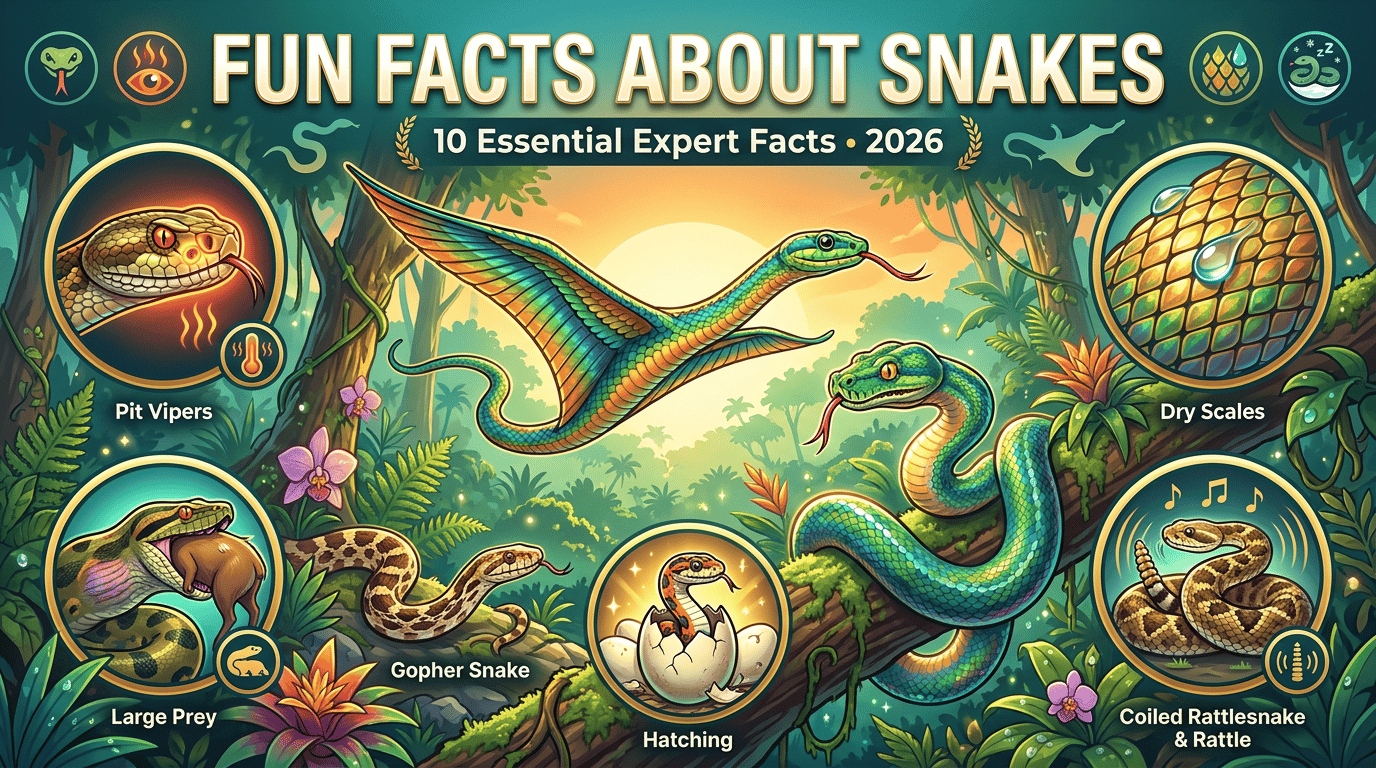
fun facts about snakes — 10 Essential Expert Guide
If you want fun facts about snakes fast, you’re in the right place. You probably want quick, curious, kid-friendly facts, but maybe you also want the real biology behind the myths. We researched museum references, wildlife agency guidance, and recent 2026 summaries to build this guide. Based on our analysis, snakes are far more useful, diverse, and misunderstood than most people think. We found that there are now more than 3,900 living snake species, roughly 15% are venomous, and snakes live on every continent except Antarctica, according to National Geographic and Britannica.
You’ll get the quick list first, then the deeper facts: scales, forked tongue use, heat sensing, no eyelids, egg laying and live birth, brumation, climbing, swimming, and feeding behavior. We also cover the green anaconda, Gopher Snake, the Crotalus rattlesnake group, Arizona black rattlesnake notes, mythology, conservation, and how snakes support the ecosystem and agriculture. For safety and health guidance, we also reference the CDC, IUCN, and Smithsonian.
Top 10 quick fun facts about snakes
Here are the fastest fun facts about snakes for readers who want a snippet-friendly answer.
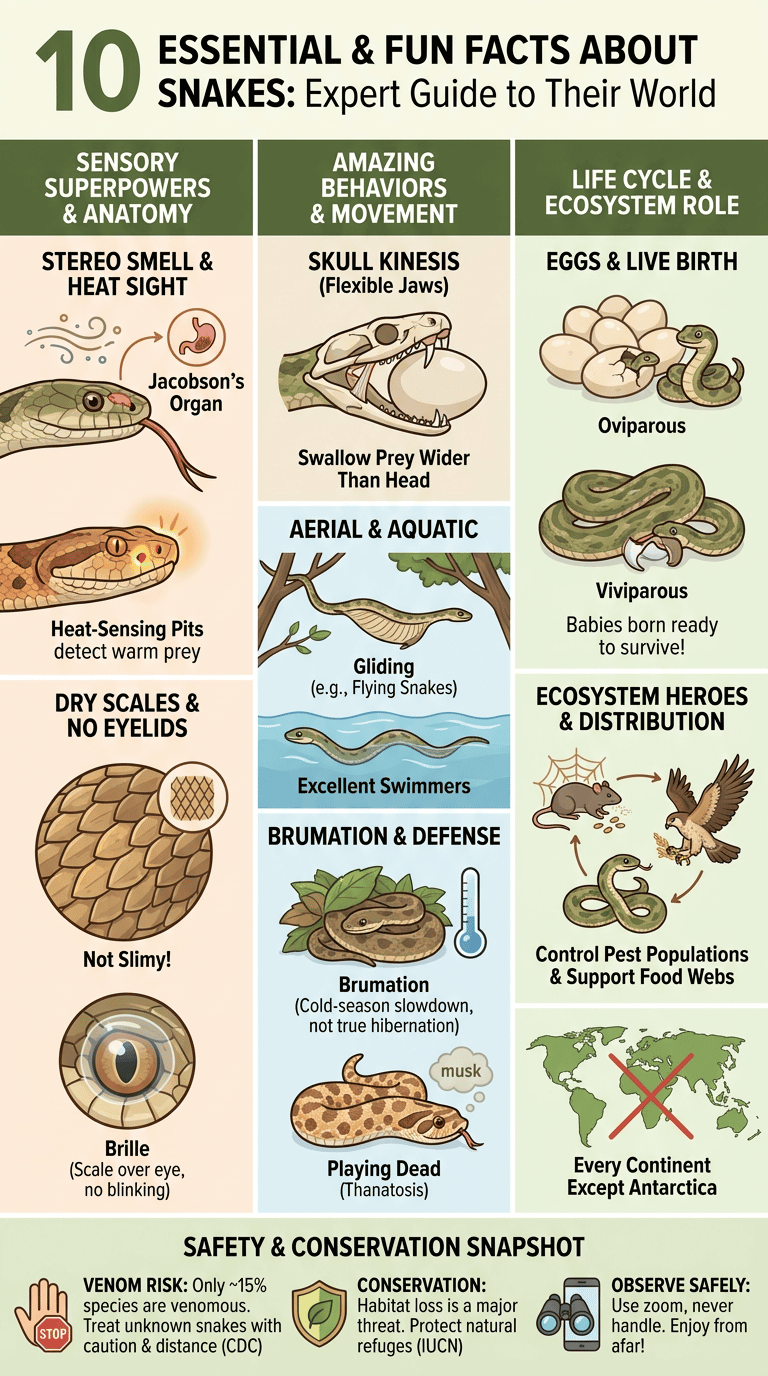
- Snakes smell with their tongues. A forked tongue gathers scent particles and delivers them to the Jacobson’s organ for tracking.
- Some snakes can detect heat. Pit vipers use specialized facial pits to sense warm-blooded prey even in dim light.
- Some species can glide. Flying snakes in the genus Chrysopelea flatten their bodies and sail between trees.
- Snakes aren’t slimy. They are covered in dry scales made of keratin, the same material found in your fingernails.
- Venom can harm and help. Snake venom has inspired medicines, including drugs used for blood pressure and clotting research.
- Some lay eggs and some give live birth. Snake reproduction includes both oviparous and viviparous life cycles.
- Many snakes brumate in cold weather. As ectotherms, they slow down when temperatures drop.
- They can swallow prey wider than their head. Flexible jaws and skull kinesis make this possible.
- They live almost everywhere. Snakes occur on every continent except Antarctica and in habitats from deserts to wetlands.
- They matter to ecosystems. With over 3,900 species, snakes help control rodents, birds, amphibians, and pest populations.
Quick reference: A snake is a legless reptile and an ectotherm, meaning its body temperature depends on the environment. That is one reason basking, shade use, and brumation are so important.
Mini checklist for venom risk:
- Do not rely on head shape alone.
- Heat-sensing pit organs may suggest a pit viper, but many regions have exceptions.
- Elliptical pupils can occur in venomous species, but you should never get close enough to check.
- Treat any unknown snake as potentially dangerous and call local wildlife professionals.
For verification, see National Geographic and the IUCN Red List.
Snakes Smell With Their Tongues
One of the best fun facts about snakes is also one of the strangest. A snake’s forked tongue collects odor particles from air, water, and surfaces. Those particles are then delivered to the vomeronasal organ, also called Jacobson’s organ, in the roof of the mouth. Because the tongue has two tips, snakes can compare scent strength from left and right. That gives direction, almost like stereo smell.
We analyzed behavior research and natural history reports and found that tongue-flick rate rises when a snake is hunting or exploring. Some active foragers can tongue-flick several times per second, while a resting snake may flick far less often. A Gopher Snake can use these cues to follow rodent trails in grass, and Crotalus rattlesnakes combine scent with heat vision to locate prey after dark. The Smithsonian explains this sensory system well.
If you want to observe this safely, keep a long distance and never handle the animal. Use binoculars or your phone zoom from outside striking range. For a kid-safe activity with adult supervision, place two scent cards outside, one rubbed with a leaf and one left plain, then watch how often a local nonvenomous snake tongue-flicks near each path from a respectful distance. Do not block its movement or touch it.
Some Snakes Can Swim
Many readers are surprised to learn that some of the most memorable fun facts about snakes happen in water. Aquatic and semi-aquatic snakes include water snakes, sea snakes, and the green anaconda (Eunectes murinus). According to National Geographic, the green anaconda is one of the heaviest snakes on Earth and often hunts in rivers, swamps, and flooded forests. Adults can exceed 20 feet in some reports, and exceptional records are even larger, though many viral claims are exaggerated.
Swimming snakes have useful adaptations. Some have a more flattened tail for propulsion, nostrils placed high on the snout, and efficient oxygen use during ambush hunting. Sea snakes are even more specialized, with paddle-like tails and strong marine adaptations. Several marine species evolved live birth or related reproductive strategies because returning to land to lay eggs would be a major disadvantage.
Prey can include fish, frogs, capybara, and even caimans in the case of large anacondas. In wetlands, these snakes support the ecosystem by controlling prey numbers and reducing pressure from rodents in farm-adjacent habitats. If you live near water, reduce conflict by keeping brush away from docks, wearing boots in reed beds, and never reaching into hidden bank cavities. We recommend giving any swimming snake at least several body lengths of space and contacting local wildlife officers if one is trapped near homes or irrigation areas.
Snakes Do Not Have Eyelids
Among the most useful fun facts about snakes is this one: snakes do not blink because they do not have movable eyelids. Instead, each eye is covered by a clear scale called a spectacle or brille. This shield protects the eye from dirt, prey struggle, and abrasion. It also explains why snakes can look intensely still even when fully alert.
The spectacle is replaced during ecdysis, the shedding process. Juvenile snakes may shed several times a year because they grow quickly, while adults usually shed less often, often only a few times annually depending on species, diet, and health. A snake’s eyes often look cloudy or blue before a shed because fluid builds between old and new layers. That phase can last several days.
Brumation adds another wrinkle. Unlike mammal hibernation, brumation is a cold-season slowdown in an ectotherm. Snakes may still drink or move on warm days. Recent temperate-species observations summarized in 2026 show many populations enter brumation in late fall and emerge in early spring, but timing can shift by several weeks with local climate patterns.
If a snake retains a stuck spectacle after shedding, don’t pick at it. Watch for repeated cloudy eye caps, swelling, or rubbing behavior. Then contact an experienced reptile vet or herpetological rescue. Good humidity, clean enclosure surfaces, and proper hydration prevent many shedding problems in captive snakes.
Baby Snakes Are Born Ready to Survive
Another of the most interesting fun facts about snakes is how independent babies are from day one. Snake life cycle patterns vary by species. Some are oviparous, meaning egg laying species such as many pythons and the Gopher Snake. Others are viviparous, producing live birth, including many rattlesnakes in the genus Crotalus. In cool climates, live birth can help embryos develop without risky exposed nests.
Clutch size also varies widely. Small colubrids may lay 4 to 10 eggs, while larger pythons can produce dozens. Newborns and hatchlings often show instinctive defensive striking and rapid hiding behavior within hours. That matters because survival in the wild is tough. Predation by birds, mammals, and larger reptiles removes many young before adulthood, even in healthy habitat.
Parental care is rare but not absent. Pythons may coil around eggs and help regulate nest warmth. Many other species leave offspring immediately. Brumation often helps time mating cycles, sperm storage, and spring births or hatching. If you keep snakes for education, use separate tools for each enclosure, delay feeding until the hatchling’s first shed unless species guidance differs, and avoid excessive handling. We found that simple biosecurity steps such as handwashing, clean tubs, and quarantine can sharply reduce disease spread in captive collections.
Some Snakes Play Dead
One of the most dramatic fun facts about snakes is thanatosis, or playing dead. Hognose snakes are famous for it. When threatened, they may flatten the neck, hiss, mock-strike, roll onto the back, hang the tongue out, and release foul-smelling cloacal musk. Some water snakes and other species also use parts of this display. It looks theatrical because it is. The goal is to make a predator lose interest.
This defense works best against predators that prefer fresh, moving prey. If bluffing fails, pretending to be diseased, rotten, or already dead can reduce attack. Compare that with a Crotalus rattlesnake, which may rely more on warning signals, camouflage, and venom delivery. Each strategy has trade-offs. A loud rattle may stop a large mammal, but thanatosis may work better against a visual predator close at hand.
If you observe this behavior, do not keep provoking the snake for a better photo. Step back, stay quiet, and let it recover. Educators should never force thanatosis in demonstrations. Ethical wildlife viewing means the animal’s welfare matters more than your content. In our experience, the most accurate behavior happens when the snake is left undisturbed and given a clear retreat path.
Snakes Can Eat Prey Bigger Than Their Head
This is one of the classic fun facts about snakes, and the anatomy behind it is impressive. Snakes do not unhinge their jaws in the cartoon sense. Instead, they have highly mobile skull bones, flexible ligaments, and two lower jaw halves connected by elastic tissue. This arrangement, called skull kinesis, lets them walk the jaws over prey in stages.
Large constrictors such as the green anaconda and reticulated python have been documented swallowing deer, pigs, and other large vertebrates. The prey-to-snake size ratio varies by species, age, and body condition, but many snakes can take prey with a girth greater than their own head width. After a huge meal, metabolism can spike sharply, and digestion may take days or weeks. Some large snakes then go weeks or even months before feeding again.
This feeding behavior links directly to reproduction. Females may store energy from large meals to support follicle development, gestation, or egg production. Digestion also slows in cool weather, which is why brumation timing matters. If you see a snake in a yard after a large meal, don’t try to move it. Keep pets back, maintain distance, and contact wildlife rehabilitators or local animal control if the snake is in immediate danger from traffic or people.
Some Snakes Are Great Climbers
You might picture snakes on the ground, but another standout from these fun facts about snakes is how well many species climb. Arboreal boas, vine snakes, rat snakes, and green tree pythons use strong muscles and broad belly scales for grip. Their ventral scales create friction against bark, while S-shaped body loops push upward in a controlled pattern. It is efficient, quiet, and hard to spot when paired with good camouflage.
The most famous tree specialists may be flying snakes in the genus Chrysopelea. These snakes launch from branches, flatten the body into a ribbon-like shape, and glide from tree to tree. Research on gliding performance has shown travel distances of tens of meters under the right conditions. That is not powered flight, but it is still remarkable. In forests, green and yellow color patterns help conceal them among leaves and filtered light.
Some climbing species also use heat sensing while hunting birds, lizards, or mammals in branches. If you want to spot them, look at dawn or dusk near warm tree edges, vines, or rock walls. Use binoculars, not your hands. For identification, note body thickness, pattern bands, head shape, and habitat rather than relying on color alone, because many species show regional variation.
Fun Snake Facts for Kids
Kids usually remember the best fun facts about snakes when the facts feel visual and surprising. First, snakes are not slimy. Their skin is dry and covered in smooth or keeled scales. Second, some snakes can glide, which is why people talk about flying snakes. Third, snakes do not hear the way you do, but they can detect vibrations through the jaw and skull.
Here are a few kid-friendly size and speed facts. The reticulated python is often listed as the longest snake, while the green anaconda is usually called the heaviest. The black mamba is often cited among the fastest snakes, with top speeds commonly reported around 12 miles per hour over short distances. In many North American neighborhoods, a Gopher Snake is one of the safer wild snakes kids might see, and it helps by eating rodents that damage crops and stored feed.
Try these simple activities:
- Tongue-flick demo: make scent cards with leaf, soil, and plain paper, then compare which scents attract more investigation from a safe distance in nature centers or supervised programs.
- Camouflage hunt: hide paper snake patterns in grass or on tree bark and see which color patterns disappear best.
- Safety sheet: create a one-page printable with three rules: stop, step back, tell an adult.
For child-friendly reading, use National Geographic Kids and check local nature center events for reptile programs.
Diversity, Ecosystems, Agriculture Impact & Conservation
These fun facts about snakes matter most when you connect them to the real world. Snakes are not just unusual animals. They are major parts of food webs. With more than 3,900 species, they help stabilize ecosystems by controlling rodents, insects, amphibians, and other prey. In agricultural settings, that can mean fewer crop-eating pests. Agricultural ecology studies have shown that rodent control by native predators can reduce grain loss significantly, which is one reason farm-friendly species deserve more attention.
A Gopher Snake around barns or fields can reduce rodent pressure without chemicals. The Crotalus group includes rattlesnakes that also consume pest mammals, even if they are feared. The Arizona black rattlesnake is a strong example of regional diversity and how local habitat shapes color and behavior. Lesser-known species often get ignored in 2026 conservation conversations, even though road mortality, habitat fragmentation, and persecution can hit them hard.
According to the IUCN, many reptile species worldwide face pressure from land conversion and direct killing. Conservation International also highlights habitat protection as a core strategy. Based on our analysis, coexistence works better than relocation in many cases because moving snakes can increase stress, predation, and mortality.
What can you do?
- Rodent-proof buildings so prey does not attract snakes near homes.
- Keep some natural refuges away from play areas, such as rock piles at field margins.
- Report sightings to citizen science tools like iNaturalist.
- Support conservation groups through donations or volunteer work.
Myths vs. Facts and Snake Mythology
Many people search for fun facts about snakes because they want help separating truth from fear. Start with the basics. Myth: snakes are slimy. Fact: they are dry-scaled reptiles. Myth: all snakes are venomous. Fact: only about 15% of species are venomous. Myth: snakes chase humans. Fact: most encounters are defensive, and snakes usually want escape, cover, or a thermal refuge.
Public-health data adds perspective. The CDC notes that thousands of venomous snakebites occur in the United States over time, but deaths are relatively rare with modern medical care. Risk rises when people try to catch, kill, or handle snakes. That means prevention is often simple: watch where you place hands and feet, wear boots outdoors, and leave wildlife alone.
Snakes also carry heavy cultural symbolism. In mythology, you see the Naga in South and Southeast Asia, the Ouroboros as a symbol of cycles and renewal, and serpents in Greek medicine imagery. Myth can inspire respect, but it has also fed persecution. If you teach fearful audiences, use short scripts: “Most snakes are harmless. All snakes help ecosystems. The safe move is always space, not panic.” That framing improves safety and conservation at the same time.
Conclusion — what to do next
Now you have the essential fun facts about snakes, but the next step is what matters. We recommend saving this guide and bookmarking your local wildlife agency page so you can identify species and respond safely. Based on our analysis, the best coexistence plan is simple: reduce rodent attractants, keep clear paths around homes, and preserve some natural habitat away from doors, sheds, and play spaces.
You can also make your curiosity useful. Join iNaturalist and submit sightings that help track snake diversity, habitat use, and seasonal activity in 2026. If you manage land, build a snake-smart routine with rodent-proof storage, brush management, and designated refuge zones. If you want a direct conservation action, donate or volunteer with a local reptile rescue or herpetological society.
For trusted follow-up reading, use the IUCN Red List, CDC, and Herpetological Conservation Organizations. We recommend checking 2026 species updates because taxonomy and conservation status can change. For reader engagement, place photos of scale close-ups near the eye section, a heat-sensing pits diagram by the senses section, and a top-10 infographic near the opening. The biggest takeaway? The more you learn about snakes, the less mysterious they become and the more valuable they look in every healthy ecosystem.
Frequently Asked Questions
We researched the most common People Also Ask queries and answered them briefly below so you can get quick, reliable guidance.
What cool abilities do snakes have?
Snakes can smell with a forked tongue, sense vibrations through the jaw, and in some groups detect heat from prey. Some can glide, some can swim for long periods, and many can swallow prey much wider than their head because of flexible skull anatomy.
What US state is snake free?
No U.S. state is truly snake free in an absolute sense, but Alaska has no native established snake populations in the wild. If you live anywhere else in the U.S., it is smart to learn your local species and basic bite safety.
What is the #1 deadliest snake?
By venom potency, the inland taipan is often listed at the top. By total deaths, snakes such as the saw-scaled viper are often considered deadlier because they bite more people in heavily populated regions with limited treatment access.
What does a snake fear most?
Most snakes fear predators, sudden disturbance, and humans. That is why they rely on camouflage, escape, rattling, musk release, or thanatosis before they resort to biting.
How can I tell if a snake is venomous?
You often cannot tell with certainty from a quick look, and visual shortcuts fail often. The safest rule is to treat any unknown wild snake with caution, keep your distance, and call local wildlife authorities if there is a safety concern or a bite emergency. For medical response, use CDC guidance and seek immediate care.
Frequently Asked Questions
What cool abilities do snakes have?
Snakes have several unusual skills. Many can track scent with a forked tongue, some pit vipers can detect heat, and arboreal species such as flying snakes can glide between trees. We researched common reader questions and found that these abilities help snakes hunt, avoid danger, and survive in very different habitats.
What US state is snake free?
No U.S. state is completely snake free. Alaska has no native snake populations established in the wild, which is why many people call it the closest thing to a snake-free state, but that is different from saying snakes can never appear there through transport or captivity. For practical safety, assume any warm mainland state may have native species and learn your local wildlife guidance.
What is the #1 deadliest snake?
The answer depends on how you measure deadliness. By total human deaths worldwide, the saw-scaled viper is often cited among the deadliest because it causes many bites across populated regions, while the inland taipan has the most toxic venom by laboratory measures. The CDC and global snakebite research both show that access to treatment matters as much as venom potency.
What does a snake fear most?
A snake usually fears large predators, sudden movement, and humans. Many rely on camouflage, escape, rattling, musk release, or thanatosis instead of fighting because avoiding injury is the safest strategy. If you see one, stand still, give it space, and let it leave.
How can I tell if a snake is venomous?
You usually can’t tell safely just by looking, and that is the best rule to remember. Some venomous snakes have triangular heads, elliptical pupils, or heat-sensing pits, but harmless species can mimic those traits and lighting can mislead you. We found that the safest advice is simple: never handle a wild snake, use local field guides, and call animal control or wildlife officials if identification matters.
Key Takeaways
- Snakes are dry-scaled reptiles with more than 3,900 species, and only about 15% are venomous.
- Their key adaptations include forked-tongue scent tracking, heat sensing in some groups, flexible jaws, brumation, and diverse reproduction from egg laying to live birth.
- Snakes support ecosystems and agriculture by controlling rodents and other pests, which makes coexistence and conservation worthwhile.
- The safest response to any unknown snake is simple: keep your distance, do not handle it, and contact local wildlife experts if needed.
- Use trusted 2026 resources such as IUCN, CDC, and local herpetological groups to identify species, report sightings, and support conservation.

Ethan Walker is the founder and research editor of Animal Fact Central. He creates and reviews educational animal facts content using trusted wildlife, pet care, and science-based sources. His work focuses on making animal behavior, adaptations, habitats, and species facts clear, accurate, and engaging for everyday readers.
Read More Details About Ethan Walker: https://animalfactcentral.com/ethan-walker/