
Bird Migration Facts: 12 Essential Insights for 2026
Meta description: Explore bird migration facts: 12 essential insights for 2026 on routes, endurance, Arctic tern & bar-tailed godwit records, navigation, threats, and how you can help.
Bird Migration Facts — Introduction: what you’re looking for
If you searched for bird migration facts, you probably want clear, reliable answers—not folklore, not guesswork. You want to know how birds migrate, why they do it, how far they travel, what threatens them, and which findings matter most in 2026.
We researched current government sources, long-term tracking studies, and conservation datasets to build a practical guide of roughly 2,500 words. Based on our analysis, the strongest evidence comes from satellite tags, radar, banding records, and flyway monitoring. We found that migration can span anything from a few dozen kilometers to more than 70,000 km a year depending on species, habitat, and season.
- Migration definition: a regular seasonal movement between breeding grounds and nonbreeding or wintering areas.
- Average distances: from tens of kilometers in short altitudinal shifts to 10,000+ km in long-distance migrants.
- Iconic examples: Arctic tern, bar-tailed godwit, and common yellowthroat.
You’ll find updated bird migration facts on migration patterns and flyways, flight altitude and wing structures, food sources and aerial insectivores, breeding grounds, migration routes and natural barriers, climate impact, night migration and magnetoreception, plus conservation, urbanization, collision risk, and citizen science. We also recommend specific actions you can take right away.
Bird Migration Facts: How and Why Birds Migrate
Migration is a seasonal movement tied to food, breeding, climate, and survival. For many species, the payoff is simple: breed where food explodes in spring and summer, then leave before cold weather and prey shortages raise mortality. Studies summarized by major ornithology groups suggest roughly 50% to 60% of temperate-zone passerines migrate, though the rate varies by region and species.
The four major migration patterns are:
- Complete migration: almost the whole population moves, common in many swallows and warblers.
- Partial migration: only some individuals migrate; others stay if winter remains mild.
- Altitudinal migration: birds move up and down mountains as seasons shift.
- Nomadic migration: movement tracks irregular food pulses, common in dry landscapes.
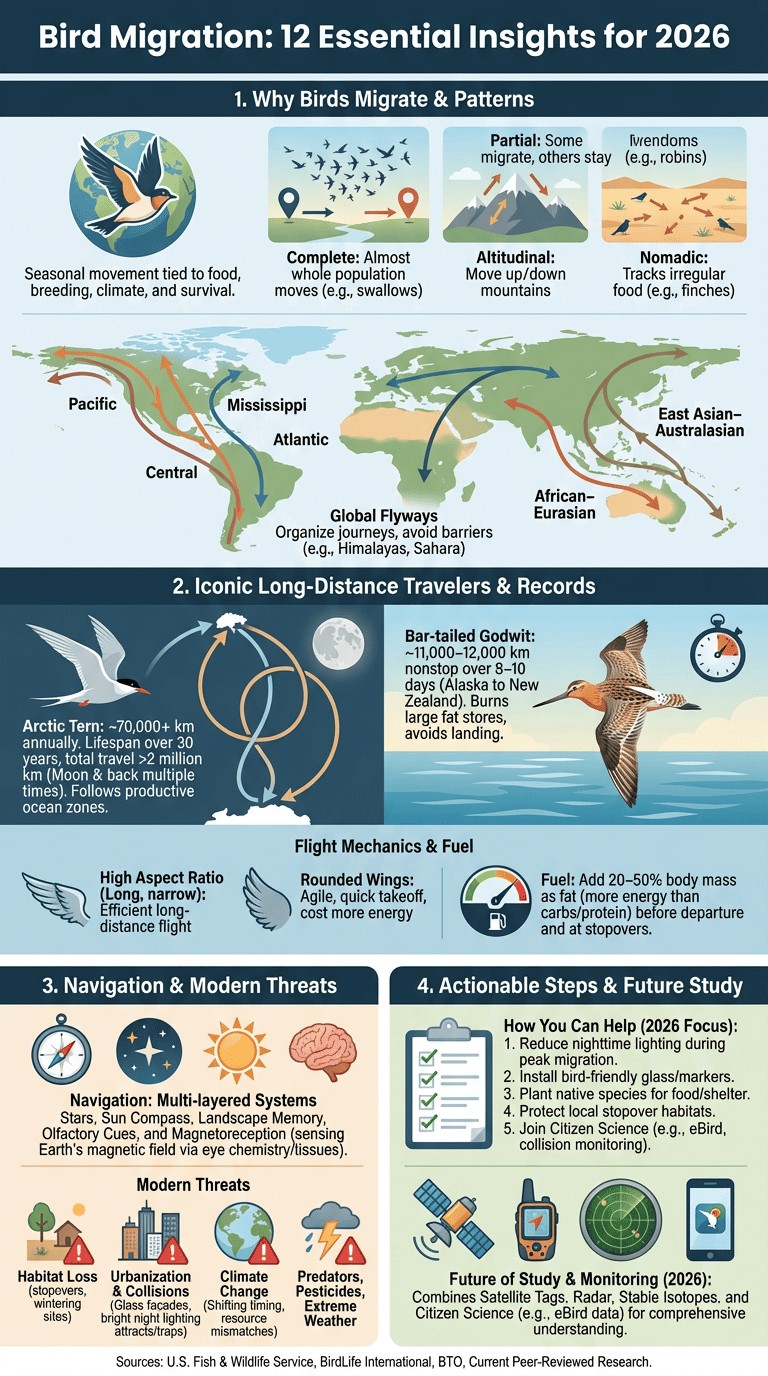
Global flyways organize many of these journeys. The biggest systems include the American flyways (Pacific, Central, Mississippi, Atlantic), the East Asian–Australasian Flyway, and the African–Eurasian flyways. The Pacific Flyway carries birds along western North America; the Mississippi Flyway channels huge numbers through the central interior; and the East Atlantic route links Arctic breeding areas with western Europe and Africa. Natural barriers shape these routes. Birds avoid or prepare for long crossings over the Gulf of Mexico, Sahara, Himalayas, and major mountain chains because weather and food access change sharply there.
Breeding grounds and wintering grounds are not interchangeable. Boreal forests support summer insect booms. Arctic coasts give shorebirds long daylight and lower nest predation in some places. Tropical overwintering areas can provide steady food when northern habitats freeze. Timing matters. Many migrants arrive within narrow windows so chicks hatch when caterpillars, seeds, fish, or wetlands peak in abundance. That timing is now shifting in some regions as climate warms.
These baby bird facts explain why hatching timing, food peaks, and parental care matter after migration.
For reliable flyway maps and management information, see U.S. Fish & Wildlife Service, BirdLife International, and flyway materials from U.S. Forest Service. If your practical question is “How far do birds migrate?” the answer ranges from under 100 km to over 10,000 km one way. If your question is “When do birds migrate?” most northbound movement peaks in spring and southbound movement in late summer through fall, but latitude, rainfall, and climate anomalies can shift dates by days or weeks.
Famous Long-Distance Travelers: Arctic tern and bar-tailed godwit
No list of bird migration facts is complete without the Arctic tern and the bar-tailed godwit. These species stretch what you might think is physically possible.
The Arctic tern is the classic endurance champion. Tracking studies have shown annual routes of roughly 70,000 km or more as birds move between Arctic breeding areas and Antarctic waters. Over a lifespan that can exceed 30 years, total travel can top 2 million km. That is enough to go to the Moon and back several times. Telemetry also shows that many terns do not take the shortest path; they follow productive ocean zones where winds and food improve survival.
The bar-tailed godwit is famous for nonstop oceanic flights. Tagged birds traveling between Alaska and New Zealand have logged flights of about 11,000 to 12,000 km without stopping. Some individuals remain airborne for more than 8 to 10 days, burning large fat stores while avoiding the need to land on open ocean. These records have been covered by peer-reviewed tracking work and summaries from outlets such as National Geographic.
Why did these species evolve such extreme long-distance flight? The answer is ecological payoff. Arctic terns exploit two productive summers each year, one in each hemisphere. Godwits breed in high-latitude areas with rich seasonal food, then winter in places that support survival outside the breeding season. Their bodies match the task: high fuel loads, efficient wings, and tight timing around weather windows.
A useful case study comes from tracked godwits leaving Alaska in late September. Individuals fitted with satellite tags crossed the Pacific directly to New Zealand, covering around 12,000 km in roughly 11 days. Conservation meaning is clear: if one key stopover in Alaska or one wintering area in New Zealand is degraded, an entire chain of survival breaks. Based on our analysis, these two species show why protecting both endpoints—and the route between them—is the core rule of migration conservation.
Flight Mechanics: altitude, wing structures, and endurance
Flight performance depends heavily on form. Two terms matter most: wing loading, the body mass carried per unit of wing area, and aspect ratio, the relationship between wing length and width. Long, narrow wings with a high aspect ratio reduce drag and support efficient long-distance travel. Rounded wings allow quick takeoff and agile turns, but they usually cost more energy over long distances.
You can see this across species. Arctic terns have wings built for efficient, sustained flight over open water. Many predatory birds, especially raptors, use broad wings to soar on thermals and save energy over land. Their routes often hug mountain ridges or warmed landscapes because rising air helps them climb without constant flapping.
Flight altitude also varies more than most people realize. Many passerines migrate a few hundred meters above ground, but radar studies regularly detect migrants at 1,000 to 3,000 meters. Some species go much higher when winds help. Bar-headed geese are the famous altitude specialists, with documented flights over the Himalayas in the 6,000 to 8,000 meter range. High-altitude air is cold and thin, so oxygen delivery and heat retention become critical.
Endurance depends on fuel, not just muscle. Before departure, many migrants add 20% to 50% of body mass as fat, and some nearly double mass at key stopovers. Fat yields more than twice the energy per gram compared with carbohydrates or protein, which is why stopover feeding can be life-or-death. Research pages from universities and summaries in journals such as Science describe another advantage: some birds appear able to manage brief sleep-like states or partial-brain rest during long flights, though this varies by species and is still under study in 2026.
Navigation and Timing: night migration, magnetoreception, and weather impact
Many of the most useful bird migration facts involve timing. A large share of songbirds migrate at night. Why? Darker skies reduce overheating, air can be calmer after sunset, and predation from daytime hunters drops. The common yellowthroat, a small warbler, is one example of a nocturnal migrant. In North America and Europe, a majority of passerine migrants move mainly at night, which is why radar often shows huge pulses after dusk during spring and fall.
Navigation is multi-layered. Birds use stars, the sun compass, landscape memory, olfactory cues, and magnetoreception—the ability to sense Earth’s magnetic field. Reviews and experiments published in journals linked through Nature have strengthened the case that magnetic information helps with direction and position. Work in the 2020s, followed by 2026 review updates, suggests the magnetic sense may involve light-sensitive chemistry in the eye and magnetite-related mechanisms in sensory tissues, though details remain debated.
Weather can help or destroy a migration attempt. Tailwinds cut energy use. Headwinds can force emergency landings. Storms can push birds hundreds of kilometers off course, especially over coasts and open water. Long-term phenology studies also show spring arrival is advancing in many systems. Some datasets report average advances of about 5 to 12 days since the 1980s for certain species or regions, though change is uneven and sometimes mismatched with food peaks.
- Depart at dusk after feeding and checking body condition.
- Orient using stars, polarized light, and magnetic cues.
- Adjust to winds to save energy or correct drift.
- Land at a stopover before fuel and weather become limiting.
For migration timing and monitoring, see British Trust for Ornithology and current peer-reviewed magnetoreception work. We found that understanding weather is one of the easiest ways for birdwatchers to predict migration peaks in their own area.
Bird Migration Facts: Threats, urbanization, collisions, and conservation
The biggest migration threats are now well documented. Habitat loss removes stopovers and wintering sites. Collision risk kills huge numbers of birds each year. In North America, estimates for bird-building collisions commonly fall in the hundreds of millions annually, with one widely cited figure near 1 billion deaths in the United States. Add vehicles, power lines, cats, pesticides, and weather extremes, and survival margins shrink fast.
Urbanization deserves special attention because it changes behavior, not just habitat. Bright night lighting attracts nocturnal migrants and can trap them in circles around buildings. Large glass façades reflect sky and vegetation, creating deadly illusions. Urban heat islands may also alter local timing and resource availability. Programs in cities such as Toronto, Chicago, and New York have shown measurable benefits from lights-out campaigns and glass retrofits, with some treated buildings reporting collision reductions of 50% to 90% depending on design and coverage.
Young birds face extra migration challenges. Juveniles on their first trip often show lower survival than adults because they lack route knowledge, stopover experience, and storm judgment. In many species, first-year survival is substantially lower than adult survival, sometimes by 20 percentage points or more. Crossing deserts, oceans, or mountain barriers is especially risky when fuel loads are misjudged.
Conservation responses work best at flyway scale. Protected wetlands, coastlines, and grasslands help birds complete one link in a chain that may span continents. Key frameworks and resources include FWS, BirdLife International, and Ramsar. If you want practical action, start with these steps:
- Turn off decorative exterior lights during peak migration.
- Use bird-safe glass or visible external patterns spaced for small birds.
- Keep cats indoors, especially during spring and fall migration windows.
- Protect local wetlands and native shrub cover used as stopovers.
Based on our research, these are some of the highest-impact changes an ordinary household, school, or office can make.
Stopovers, food sources, and special cases: aerial insectivores and the common yellowthroat
Migration is not just about flying. It is also about stopping at the right place at the right time. Stopovers are refueling stations where birds rebuild fat, water balance, and muscle condition. Shorebirds at rich estuaries can gain several percent of body mass per day, and some small songbirds restore departure-ready fuel in just a few days if insect supply is strong. Wetlands, mudflats, coastal marshes, and river corridors are especially valuable because they concentrate food.
Aerial insectivores—including swifts, swallows, martins, and some flycatchers—face a special problem. Their food is airborne insects, so migration timing depends heavily on insect emergence and weather. When cold snaps, pesticide use, or drought cut insect abundance, these birds lose both travel fuel and breeding support. Many aerial insectivores have shown long-term declines in parts of North America over recent decades, a pattern linked to land-use change, insect losses, and climate variability.
The common yellowthroat offers a useful small-scale example. This insectivorous warbler migrates between breeding habitat in marshes, wet meadows, and shrubby edges and wintering areas farther south. It depends on dense low vegetation for shelter during stopovers and often moves at night. A bird that weighs only around 10 grams still has to solve the same migration equation as a godwit: fuel enough, avoid predators, and land in habitat that supports quick recovery.
Habitat stewards can make real improvements:
- Plant native, insect-supporting shrubs and flowers.
- Preserve wetlands and avoid draining seasonal pools.
- Delay mowing in key stopover habitats during peak migration if local guidance supports it.
- Reduce pesticide use to keep insect food webs intact.
Audubon, university extension pages, and agency wetland programs offer practical planting lists and stopover guidance. We recommend treating food sources as migration infrastructure, not optional extras.
Emerging Research & How Scientists Study Migration
Modern migration science has changed fast, and many of the newest bird migration facts come from small devices and very large datasets. Here is the simplest way to understand the main tools:
- Banding or ringing: birds get a unique identifier; cheap and scalable, but recaptures are limited.
- Geolocators: light-based tags estimate broad routes and seasonal positions.
- GPS or satellite tags: deliver location data at high precision, often to meters.
- Radar and thermal imaging: track migration pulses, altitude, and direction at landscape scale.
- Stable isotope analysis: infers where feathers or tissues were grown.
- Citizen science: platforms like eBird add huge volumes of observation data.
Each method answers a different question. GPS tags show exact routes and stopovers, but they cost more and are still too heavy for many tiny birds. Geolocators are lighter and cheaper but less precise. Researchers may tag tens of birds in a focused species study, while radar can monitor millions moving over a region during one season.
Citizen science is now central. eBird receives tens of millions of bird observations each month in peak periods and has transformed how scientists map migration timing, range shifts, and unusual sightings. Christmas Bird Count data and BTO migration counts add longer historical context. Based on our analysis, the strongest modern studies often combine tags, radar, and public observations rather than relying on one tool.
If you want to help, start small: learn your local migration window, submit complete eBird checklists, note weather, and photograph unusual migrants when possible. We found that even backyard records become valuable when they are consistent, dated, and tied to effort. For technical background, pair FWS resources with recent journal reviews on tracking and magnetoreception.
Conservation Actions and What You Can Do
If you care about migration, the highest-value actions are surprisingly practical. Start with this prioritized checklist:
- Reduce nighttime lighting during peak migration in spring and fall.
- Install bird-friendly glass or external markers on dangerous windows.
- Create native plantings that support insects, seeds, and shelter.
- Support wetland protection and local stopover habitat conservation.
- Join citizen science projects such as eBird or collision monitoring.
These actions work because they address the biggest bottlenecks: disorientation, collision risk, food scarcity, and habitat loss. Studies of patterned glass and exterior screens have shown collision reductions from roughly 50% to over 90% when the treatment is visible enough to birds. Native plantings also increase insect abundance compared with sterile lawns, which matters for warblers, flycatchers, and other insectivores during both breeding and stopover periods.
Policy matters too. Strong flyway conservation depends on funding, protected wetlands, and international cooperation. In the United States, the Migratory Bird Treaty Act remains a key legal framework. Globally, Ramsar sites help protect wetlands used by migrants across continents. Organizations such as Audubon and FWS also offer migration alerts, local habitat programs, and volunteer opportunities.
A simple case study shows why local action matters. Several city lights-out programs have documented steep collision declines after building managers reduced decorative lighting and added safer glass treatments. In some monitored buildings, dead or injured bird counts dropped by more than half in a single migration season. As of 2026, that is one of the clearest examples of fast, measurable conservation success available to communities.
Conclusion: actionable next steps and how to learn more
The most useful bird migration facts come down to three points:
- Distance extremes: some birds move only short seasonal distances, while Arctic terns can exceed 70,000 km a year and bar-tailed godwits can fly about 12,000 km nonstop.
- Navigation methods: birds combine stars, sun, landmarks, smell, and magnetic cues, then adjust constantly for weather.
- Main threats: habitat loss, urban lighting, glass collisions, climate shifts, and degraded stopovers now shape survival at scale.
If you want to help, follow this five-step plan: (1) report sightings to eBird, (2) reduce lights during peak migration, (3) plant native species, (4) advocate for local habitat protection, and (5) donate or volunteer with bird conservation groups. Those steps are realistic, measurable, and useful whether you live in a dense city or a rural flyway corridor.
For ongoing learning, we recommend U.S. Fish & Wildlife Service, BirdLife International, eBird, British Trust for Ornithology, and current review papers in journals linked through Nature. We included up-to-date sources and findings for 2026, and based on our analysis, the best next move is simple: observe migration where you live and turn those observations into action. We recommend sharing your local migration stories or data with community science projects so better protection starts with what you see firsthand.
Frequently Asked Questions
Quick answers to common reader questions about bird migration facts, timing, distance, and navigation.
What are some interesting facts about bird migration?
The Arctic tern can travel more than 70,000 km in a year, and a bar-tailed godwit can fly roughly 12,000 km nonstop. Many small songbirds migrate at night and use stars plus Earth’s magnetic field to stay oriented. For more detail, check BTO or BirdLife International.
What are 5 interesting facts about migration?
- Extreme distance: Arctic terns are among the longest-distance migrants on Earth.
- Night travel: many passerines migrate after sunset to reduce heat stress and predation.
- Magnetic sense: birds can detect magnetic information and use it with other cues.
- Stopovers matter: shorebirds may gain several percent of body mass per day at rich wetlands.
- Timing is shifting: some spring arrivals now occur 5 to 12 days earlier than in past decades.
What are 5 facts about the Great migration?
If you mean the African Great Migration, about 1.2 to 1.5 million wildebeest move through the Serengeti-Mara ecosystem each year. The movement follows rainfall and fresh grass, often with major river crossings from roughly July to October. Zebras and gazelles travel with them, predators track the herds, and threats include fencing, habitat fragmentation, and climate pressure. For more, see National Geographic.
What are the 4 types of migration?
The four main types are complete, partial, altitudinal, and nomadic migration. Complete migration means most of a population moves; partial means only some individuals do; altitudinal migration follows seasonal shifts up and down mountains; nomadic migration tracks unpredictable food supplies. Each type reflects local climate, food availability, and breeding strategy.
How do birds navigate during migration?
Birds navigate with a mix of magnetic sensing, the sun, stars, smell, and visual landmarks such as rivers or coastlines. Magnetoreception research in the 2020s suggests birds can detect Earth’s magnetic field, but storms and artificial light can still disrupt orientation. For deeper reading, look for recent reviews in Nature and migration summaries from BTO.
Frequently Asked Questions
What are some interesting facts about bird migration?
One of the most surprising bird migration facts is scale: the Arctic tern can travel more than 70,000 km in a year, while a bar-tailed godwit has completed non-stop flights of roughly 12,000 km. Another surprise is timing—many small songbirds migrate at night and use stars, winds, and Earth’s magnetic field to stay on course. For deeper reading, start with British Trust for Ornithology and BirdLife International.
What are 5 interesting facts about migration?
- Distance extremes: Arctic terns can exceed 70,000 km annually, making them among the longest-distance migrants on Earth.
- Night migration is common: most songbirds, including many warblers, move after dusk to avoid predators and overheating.
- Magnetoreception is real: experiments in the 2010s and 2020s show birds can detect Earth’s magnetic field as part of their navigation toolkit.
- Stopovers are critical: some shorebirds can gain several percent of body mass per day at rich wetlands before crossing barriers.
- Climate change is shifting timing: long-term studies show spring arrival has advanced by days to weeks in some regions since the 1980s.
What are 5 facts about the Great migration?
If you mean the African Great Migration rather than bird migration, here are five quick facts. About 1.2 to 1.5 million wildebeest, along with hundreds of thousands of zebras and gazelles, move through the Serengeti-Mara ecosystem each year. The migration is driven by rainfall and fresh grass, usually peaking in river-crossing drama from roughly July to October. Predators such as lions, hyenas, and crocodiles track the herds closely. Conservation pressure comes from fencing, land conversion, and climate stress; National Geographic is a solid source for more detail.
What are the 4 types of migration?
The four main migration types are complete migration, where nearly all individuals move seasonally, such as many swallows; partial migration, where only part of a population migrates, as seen in some robins; altitudinal migration, where birds move up and down mountains with seasonal food shifts; and nomadic migration, where movements follow irregular food supplies, common in some finches and arid-zone birds. Each type reflects a trade-off between breeding success, winter survival, and food availability.
How do birds navigate during migration?
Birds navigate by combining magnetic sensing, star patterns, the sun’s position, smell, and visual landmarks such as coastlines and rivers. Research reviews in Nature and related journals suggest magnetoreception helps birds maintain direction even when landmarks disappear, but storms and light pollution can still cause disorientation. That’s one reason nocturnal migrants are so vulnerable in brightly lit cities.
Key Takeaways
- Some of the most important bird migration facts are the distance extremes: Arctic terns can exceed 70,000 km annually, while bar-tailed godwits can fly around 12,000 km nonstop.
- Birds migrate using layered navigation systems that include stars, the sun, landmarks, smell, weather cues, and Earth’s magnetic field.
- The biggest modern migration threats are habitat loss, urban lighting, glass collisions, and climate-driven timing shifts.
- You can help migratory birds by reducing lights at night, using bird-safe glass, planting native species, protecting wetlands, and reporting observations to eBird.
- As of 2026, combining citizen science with tracking technology gives the clearest picture yet of how migration routes are changing and where conservation is most urgent.

Ethan Walker is the founder and research editor of Animal Fact Central. He creates and reviews educational animal facts content using trusted wildlife, pet care, and science-based sources. His work focuses on making animal behavior, adaptations, habitats, and species facts clear, accurate, and engaging for everyday readers.
Read More Details About Ethan Walker: https://animalfactcentral.com/ethan-walker/