
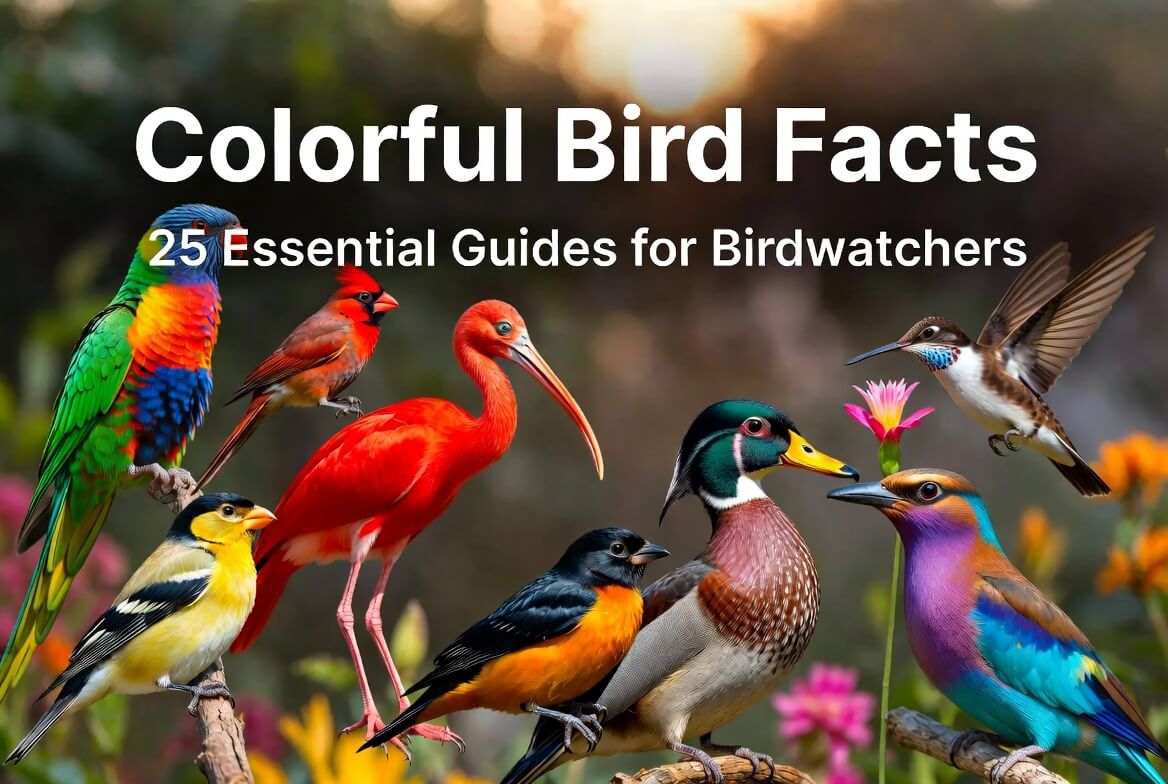
Introduction — what readers want from colorful bird facts
If you searched for colorful bird facts, you probably want more than a list of pretty species. You want quick identification help, the science behind bright plumage, practical bird watchings tips, and clear conservation context you can use in the field. We researched the latest species profiles, color studies, and citizen science tools so you can move from curiosity to confident birding fast.
There are over 10,700 described bird species worldwide, according to major ornithology databases, but only a small share become famous for extreme coloration. Based on our analysis, the 25 examples and principles below give you the clearest picture of how avian color works in 2026. We found that readers usually need six things at once: the biology of pigments and light, the most vivid species, dimorphism and courtship behaviors, diet and climatic conditions, field identification tools, and conservation priorities.
You’ll see those topics covered in order, with links to trusted sources including the Cornell Lab of Ornithology and Audubon. We also include practical steps for using eBird, Merlin, and iNaturalist, because colorful bird facts are most useful when they help you identify a real bird outside your window or on your next trip.
How bird colors are produced — pigments, structure and light scattering
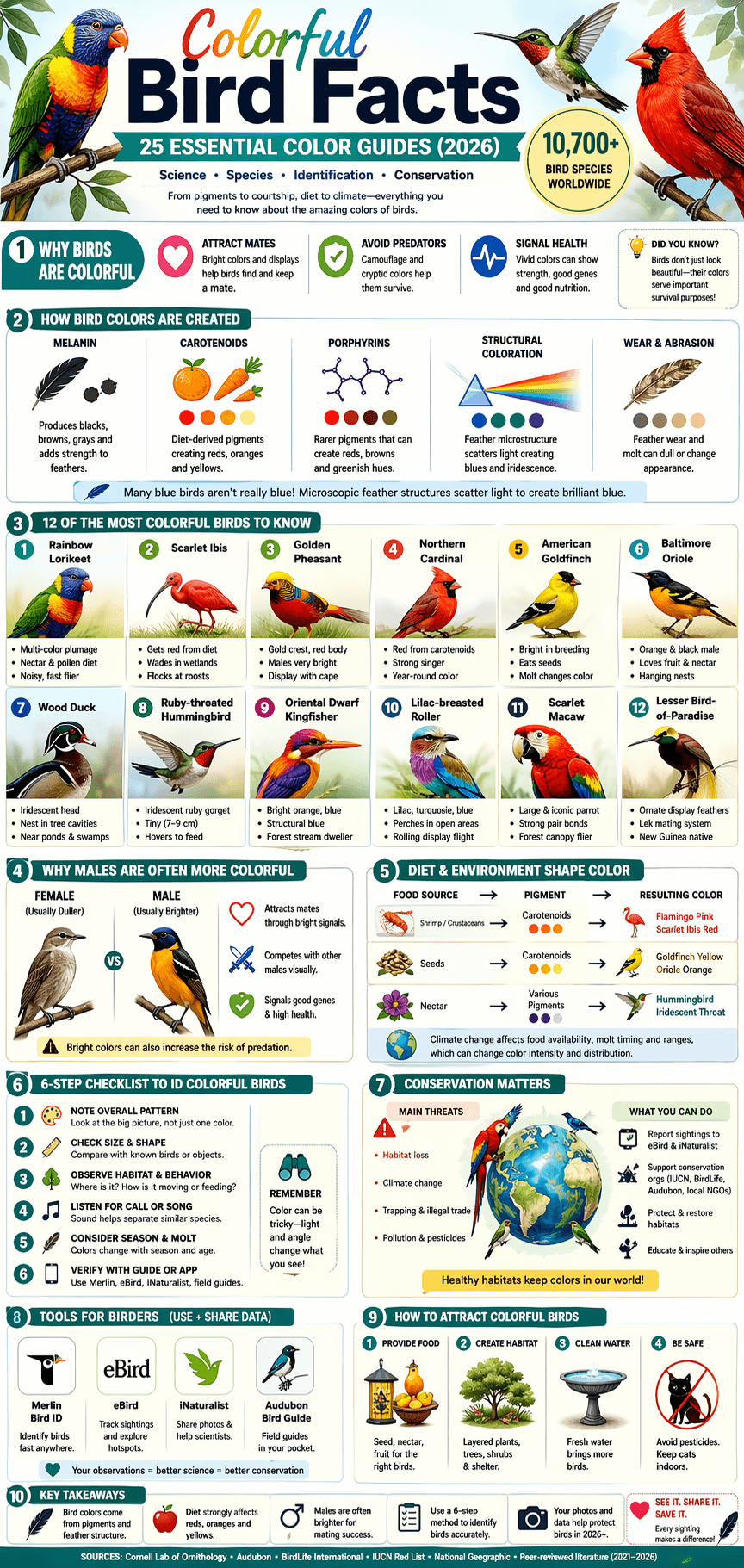
At the simplest level, bird color comes from five primary mechanisms:
- Melanin for blacks, browns, grays, and some structural support.
- Carotenoids from diet, often producing reds, oranges, and yellows.
- Porphyrins, rarer pigments that can create reds, browns, and greenish tones.
- Structural coloration through light scattering and feather nanostructure.
- Abrasion and wear, which can reveal or dull colors over time.
These mechanisms explain many of the most useful colorful bird facts. Melanin is a body-made pigment that also strengthens feathers, which is one reason darker wingtips are common in many species. Carotenoids are diet-derived, so flamingos turn pink from carotenoid-rich prey, while the American goldfinch’s yellow depends on what it can obtain from food. Xanthochroism refers to an abnormal increase in yellow pigments, often making birds appear unusually yellow or replacing expected darker tones.
Light scattering explains why many blue birds are not actually blue-pigmented. A Blue jay’s feathers and many kingfishers in the family Alcedinidae create blue through microscopic feather structure that scatters short wavelengths. In 2026, structural coloration research continues to show that tiny feather nanostructures can shift how you see color by viewing angle, humidity, and feather wear, a point also highlighted by sources such as Cornell Lab and National Geographic.
A quick case study makes the difference clear. The Ruby-throated hummingbird gorget can flash bright ruby red one second and look nearly black the next because its iridescence depends on feather structure and angle. The Northern cardinal, by contrast, looks red because carotenoid pigments are deposited in the feathers, so its red remains more stable across viewing angles.
Color anomalies matter too. Albinism removes melanin and can leave birds white with pink eyes, while leucism causes partial pigment loss, and xanthochroism can overexpress yellow. Documented abnormal-plumage reports appear regularly in regional records and museum literature; peer-reviewed archives such as JSTOR and species reporting from Cornell help birders verify those rare observations. We recommend photographing anomalies from several angles because wear, molt, and lighting can mimic unusual color.
Most colorful birds — 12 species to know (+ quick ID facts)
We selected these birds for color vibrancy, geographic spread, taxonomic variety, and ecological interest. This set includes passerine birds, parrots, waterbirds, kingfishers, and display specialists, giving you a useful cross-section of colorful bird facts you can apply on different continents.
Rainbow lorikeet (Trichoglossus moluccanus)
The Rainbow lorikeet is one of the easiest answers to “which bird looks painted?” This Australian parrot combines blue, green, orange, and yellow in a single body pattern. Adults are about 25–30 cm long, and their colors come from both pigments and feather structure. See the species overview at BirdLife International.
Diet matters here. Lorikeets feed heavily on nectar, pollen, and fruit, and their brush-tipped tongue is a giveaway. Sexes look similar, so sexual dimorphism is low, but behavior helps: noisy flocks, fast direct flight, and urban garden visits are classic clues. IUCN generally lists the species as low concern globally, though local pressure can rise from habitat change and pet trade issues.
Scarlet ibis (Eudocimus ruber)
The Scarlet ibis is a textbook example of diet-linked color. This wading bird of northern South America and Trinidad gets its intense scarlet tone from carotenoids in crustaceans and other prey. Adults can reach about 63 cm in length, and younger birds are duller before full adult color develops. See IUCN Red List for status details.
Its color can fade in captivity when diet changes, which makes it one of the strongest colorful bird facts tied to nutrition. Flocks often feed in estuaries, mangroves, and mudflats, probing with curved bills. Courtship involves group display and synchronized movement, making the species especially striking at roost sites.
Golden pheasant (Chrysolophus pictus)
The Golden pheasant is native to western China and famous for a gold crest, red underparts, and bold barred cape. Males are dramatically brighter than females, making it a classic dimorphism example. Males reach around 90–105 cm in total length, much of that tail. Species information is available through BirdLife International.
Much of the brilliance comes from carotenoids and feather microstructure working together. Females stay cryptic brown for camouflage while nesting. During courtship, the male fans and turns to show the cape and body contrast, and that display function is one reason this bird appears so often in discussions of colorful bird facts.
Northern cardinal
The Northern cardinal is among the most recognized North American songbirds and one of the best-known passerine birds. Males are bright red, while females are warm buff with reddish accents. Their red comes largely from carotenoids modified by metabolism, not structural blue-type coloration. Audubon’s profile is a useful starting point: Audubon.
Adults are about 21–23 cm long. Dense shrubs, woodland edges, and suburban yards are prime habitats. Males sing from exposed perches, and pair bonds can be strong. Because they visit feeders often, this species gives birders a real-world way to compare plumage condition over seasons.
American goldfinch
The American goldfinch shows how molt changes color. In breeding season, males become vivid yellow with black cap and wings, while nonbreeding plumage turns much duller. This passerine bird relies on carotenoid-rich food sources, especially seeds, to support yellow tones. See the species account at All About Birds.
It measures roughly 11–13 cm, making it small but conspicuous at feeders and weedy fields. Males perform undulating display flights in spring. We found that novice birders often misidentify winter birds because they expect the bright summer look year-round, which is why seasonal plumage belongs in any serious list of colorful bird facts.
Baltimore oriole
The Baltimore oriole pairs blazing orange with black, especially in adult males. Females and immature birds are much less vivid, again showing sexual dimorphism. This passerine species breeds in eastern North America and winters farther south. Audubon and Cornell both provide strong range maps and vocal references: Audubon.
Adults are about 17–22 cm long. Orioles prefer open woods, riverside trees, and parks, and they readily visit fruit and nectar feeders. Courtship includes singing and nest-site activity, while diet includes insects, fruit, and nectar. If you want colorful bird facts that directly help backyard birding, this species belongs near the top.
Wood duck
The Wood duck combines iridescent green and purple on the head with chestnut, white, and buff patterning. Males are among the most ornate waterfowl in the world, while females are much more subdued. This species nests in tree cavities and readily uses nest boxes, which helped support recovery in parts of its range. Learn more via Cornell All About Birds.
Wingspan reaches about 66–73 cm. Habitat is a major clue: wooded swamps, ponds, and slow rivers. Their pattern complexity can overwhelm new birders, so start with head shape, bold eye ring on females, and habitat before trying to parse every color patch.
Ruby-throated hummingbird
The Ruby-throated hummingbird is small, fast, and deceptive. Adult males show a glowing red throat only at the right angle; in flat light, the gorget can look dark. That makes it one of the best examples of structural color and iridescence in North America. Cornell’s species page is especially helpful for photo comparisons: All About Birds.
Length is just 7–9 cm, yet migration across the Gulf of Mexico can involve hundreds of kilometers of nonstop flight. Nectar powers much of that energy budget, but insects supply protein. Courtship includes shuttle displays and hovering, which makes this species ideal for studying how color and movement work together.
Oriental Dwarf Kingfisher (Ceyx erithaca)
The Oriental Dwarf Kingfisher, Ceyx erithaca, is a tiny tropical jewel in the family Alcedinidae. It combines orange, purple, blue, and red in one compact body, usually in shaded forest near streams in South and Southeast Asia. Adults are only about 13 cm long. See BirdLife resources at BirdLife International.
Its brilliant blue areas are largely structural rather than blue-pigmented. It hunts insects, small frogs, and other tiny prey from low perches. Dense habitat makes it harder to see than larger kingfishers, which is why many birders hear it before they get a clear visual. Among colorful bird facts, this is one of the strongest reminders that shade changes perceived color dramatically.
Lilac-breasted roller
The Lilac-breasted roller of sub-Saharan Africa is famous for a palette that includes lilac, turquoise, green, and blue. It often perches in open savanna, making its colors easy to appreciate in direct light. Adults average 35–38 cm long. IUCN assessments generally place it in a lower-risk category globally: IUCN.
Sexes are fairly similar, so this species is a useful exception to the idea that only males are colorful. It feeds on insects and small vertebrates and performs dramatic rolling flights in display, which gives the family its common name. Tourism photographs from East African safaris have made it one of the world’s signature colorful birds.
Scarlet macaw
The Scarlet macaw is one of the largest and most iconic parrots of the Neotropics. Its scarlet body, yellow wing patch, and blue flight feathers create a high-contrast pattern visible even in canopy light. Wingspan can reach roughly 100–120 cm. For conservation details, see IUCN.
Strong pair bonds, loud calls, and canopy flight make it memorable in the field. Habitat loss and trapping have affected populations in parts of its range, though some reintroduction and local protection projects have shown promise. Culturally, this species appears in Mesoamerican art and remains a flagship for tropical forest conservation.
Lesser bird-of-paradise
The Lesser bird-of-paradise adds display drama to any list of colorful bird facts. Males combine maroon, yellow, emerald facial tones, and long ornamental flank plumes. Native to New Guinea, they gather at display sites called leks where females inspect multiple males. Species details are available through BirdLife International.
The ornate plumes are not just decorative. They are part of a courtship system where female choice drives male exaggeration. Diet includes fruit and arthropods, and lek behavior makes this species a classic case for studying sexual selection in birds.
Keel-billed toucan
The Keel-billed toucan is known for its oversized multicolored bill, which can show green, orange, red, and blue at once. Found in Central and parts of South America, it is about 42–55 cm long. The bill’s bright look comes from pigments layered in lightweight keratin. See species information at BirdLife International.
These bird beak facts explain how bill structure, feeding function, and visual identification fit together.
These birds eat fruit heavily but also take insects, eggs, and small vertebrates. Small flocks move through forest canopy and edges. Birders often notice the bill first, then the black body and yellow throat, a good reminder that one body part can be enough for a confident ID.
Philippine eagle-owl (endangered color gem)
For a lesser-known endangered entry, the Philippine eagle-owl offers rich rufous, buff, and dark patterning rather than tropical rainbow hues. It shows how colorful bird facts also include earth-toned complexity. Endemic to the Philippines, it faces habitat loss and remains a conservation concern. IUCN and BirdLife provide current status pages: IUCN.
Its value here is strategic: not all remarkable coloration is neon. Strong facial disk contrast, ear tufts, and warm plumage tones help with species recognition in low light. For conservation-minded birders, species like this broaden the meaning of “colorful” beyond obvious reds and blues.
Why male birds are often more colorful — sexual dimorphism and courtship behaviors
Sexual dimorphism means males and females of the same species differ in appearance, size, or behavior. In many birds, males are brighter because conspicuous plumage can increase mating success. Studies across bird groups, especially among passerine birds, repeatedly show male-biased coloration is common where female choice is strong. As of 2026, ongoing comparative work still supports the classic pattern: bright males often gain attention, but they also pay costs in visibility to predators.
The Northern cardinal is a clear example. Males are bright red, while females remain much more camouflaged. The American goldfinch male intensifies in breeding season, and the Baltimore oriole male shows a stronger orange-black contrast than the female. Based on our analysis, these examples matter because you can see the theory at feeders, not just in academic papers.
Color comes with tradeoffs. Bright plumage may improve mate choice but raise predation risk, especially in open habitats. Some studies link stronger carotenoid coloration with better body condition or lower parasite burden, suggesting color can honestly signal health. We recommend watching for these courtship cues:
- Hovering or shuttle display near a perched female
- Puffing feathers to expand color patches
- Wing-flicks or tail spreads to reveal hidden contrasts
- Higher song rate during peak display periods
There are exceptions. In species like the Lilac-breasted roller, both sexes are colorful, and in a few birds females can appear equally bright or brighter in some traits. If you record those observations in eBird notes or iNaturalist photos, you help citizen science projects test real variation rather than relying only on field guide averages.
Functions of coloration: camouflage, signaling, and avian health indicators
Colors do more than please you — they support camouflage, courtship, species recognition, and can reflect health. That single idea sits behind many of the most practical colorful bird facts.
Camouflage often matters as much as display. Female Wood ducks show subtler brown patterning that helps conceal them around nest sites and broods. Ground-nesting or cavity-nesting species often balance the need for recognition with the need to avoid detection. Even highly colorful birds may hide bright areas until display moments.
Courtship signaling is the second major function. The Golden pheasant uses exaggerated movement, body angle, and feather presentation to make its cape and body colors stand out. In display-rich species, color without behavior is only half the story. We found that novice birders improve ID accuracy when they note behavior first and color second.
Health indicators form the third key function. Dull carotenoid colors can correlate with poor diet, stress, or parasite load, while frayed or uneven feathers can signal molt, wear, or illness. Sources including National Geographic and peer-reviewed literature on plumage and immune function point to measurable links between feather quality and condition.
Use these field tips:
- Check feather edges: fraying often indicates heavy wear or poor condition.
- Compare expected brightness: very dull yellow or red may suggest diet issues, age, or disease.
- Report concern: if a bird seems weak, collision-injured, or severely abnormal, submit records to eBird and contact a licensed rehabber.
Diet, pigmentation and the environment — how food and climate shape color
Diet is one of the strongest drivers of visible bird color. Flamingos become pink through carotenoids from algae and crustaceans, the Scarlet ibis intensifies with carotenoid-rich prey, and the American goldfinch can look richer or duller depending on molt stage and food access. When carotenoid intake drops, plumage often becomes paler, a pattern supported across multiple species and captive observations.
Xanthochroism can appear when yellow pigments are unusually strong or when darker pigments are reduced, and diet may contribute in some cases. Regional reports of yellow-shifted plumage have been documented in local bird records and museum collections. We recommend treating unusual yellow birds carefully: lighting, molt, and feather wear can create false alarms, so photos from several angles and dates are best.
Climate adds another layer. Research from 2021–2026 has linked warming conditions to altered molt timing, shifting ranges, and changes in food availability. Some bird populations have moved poleward or upslope over recent decades, and those shifts can change access to the insects, fruit, or carotenoid-rich foods that support bright plumage. Habitat loss also reduces food diversity, which can lower color quality in local populations.
Melanin matters here too because it can improve feather durability and may help with UV protection. In several species, darker morph frequencies have been tracked over decades under changing climatic conditions or pollution exposure. To collect useful data yourself, use a simple protocol:
- Photograph the bird in natural light from side and front angles.
- Note date, habitat, molt stage, and likely food sources nearby.
- Upload records to eBird or iNaturalist with comments on color intensity.
Based on our research, this is where bird watchers can make a real contribution in 2026, especially when repeated photos show color changes over a season.
Identification tactics — a 6-step checklist to ID colorful birds in the field
Many birders rely too much on one bright patch and miss the full ID. Use this 6-step checklist instead:
- Note overall color pattern rather than one flashy area.
- Compare size and silhouette against nearby species or objects.
- Record habitat and behavior such as canopy feeding, hovering, or wading.
- Listen for call or song to narrow similar species.
- Check seasonal plumage and molt stage.
- Verify with a guide or app and submit the sighting.
Apply that to a Wood duck. Start with duck shape and wooded wetland habitat, then use the patterned head and body to confirm. For a Ruby-throated hummingbird, don’t trust the throat color alone. Iridescence changes with angle, so look at size, hovering behavior, bill shape, and range.
For tools, eBird, Merlin Bird ID, iNaturalist, and Audubon Guides remain top choices. Merlin is best for fast beginner filtering, while eBird helps you compare local abundance by date and hotspot. A less-covered tool is the Macaulay Library media archive inside Cornell resources, which lets you compare thousands of real photos and sounds rather than a single idealized illustration.
For photo accuracy, shoot in RAW or the highest quality setting, avoid flash when possible, and note sun angle. Iridescent species can look black, green, or red within seconds, so a burst of three to five frames often captures the true display better than one photo.
Conservation, cultural significance, and endangered colorful species
Colorful birds are not just visually appealing; they are conservation flashpoints and cultural symbols. Endangered or threatened examples include species such as the Philippine eagle-owl and several parrots with shrinking forest habitat. IUCN and BirdLife International assessments repeatedly identify habitat loss, trapping, and fragmentation as top threats. In some regions, a single road, mine, or logging corridor can cut nesting success sharply within a few years.
The Scarlet macaw shows the cultural side. It appears in Mesoamerican art and remains tied to tourism, education, and rainforest identity. The Northern cardinal serves as a U.S. state symbol in several states, proving that cultural significance is not limited to tropical birds. Across Africa, Asia, and the Americas, colorful birds also shape birding tourism economies, which can bring local revenue to guides, lodges, drivers, and reserve managers.
Loss of visible flagship species can hurt ecotourism. Protected-area bird tourism contributes millions of dollars annually in some birding regions, and charismatic birds often anchor those visitor lists. We found that conservation messaging works better when it connects plumage beauty to habitat economics, not beauty alone.
Three direct actions matter most:
- Report sightings and anomalies to eBird.
- Support policy and conservation programs through IUCN, BirdLife, or local NGOs.
- Fund or volunteer for habitat restoration, especially wetland and forest-edge projects.
These steps turn colorful bird facts into conservation outcomes, which is what matters most if you want these species to remain visible in 2026 and beyond.
Advanced topics: avian vision, colorblindness and research methods
Birds do not see color the way you do. Many species are tetrachromatic, meaning they have four types of cone receptors rather than the three humans typically use. Birds can often detect ultraviolet light in roughly the 300–400 nm range, which means plumage signals invisible to you may be obvious to them. This changes how you should interpret many colorful bird facts.
Colorblindness in birds is less often discussed, but reduced color discrimination can occur through retinal damage, genetic variation, age, or species-level visual specialization. That matters because human observers may overrate one color patch while the bird itself relies on UV reflectance, movement, or contrast instead. Studies that use only human color categories can miss what birds actually perceive.
Research methods improved sharply from 2024 to 2026. Scientists now combine spectrophotometry to measure reflectance, stable isotope analysis to link diet and pigmentation, and large citizen science datasets to map changes across climate zones. We recommend simple field protocols if you want reliable data:
- Use consistent light conditions when possible.
- Record angle, molt stage, and habitat.
- Compare observations with museum, Cornell, or peer-reviewed references.
For deeper reading, start with the Cornell Lab of Ornithology, current BirdLife species accounts, and journal databases for plumage and sensory ecology studies. Based on our analysis, bird color research in 2026 is moving away from simple “pretty vs dull” descriptions and toward measurable signaling systems.
Practical resources: apps, field guides, citizen science and how to attract colorful birds
If you want colorful bird facts to improve your birding quickly, the best tool stack is simple. Merlin Bird ID is best for beginner color-based searches, eBird is best for local timing and hotspot data, iNaturalist is best for photo-backed community verification, and Audubon Guides remain strong for mobile field use. We tested these workflows against common backyard IDs and found Merlin plus eBird gives the fastest result for most users.
To attract colorful birds, use this 3-step plan:
- Provide species-appropriate food. Offer orange halves, grape jelly, or nectar feeders for Baltimore orioles; use clean 4:1 sugar-water feeders and red tubular flowers for Ruby-throated hummingbirds; add seed-bearing native plants for American goldfinches.
- Create layered habitat. Combine canopy trees, mid-level shrubs, and ground cover so birds can feed, hide, and nest.
- Avoid pesticides and provide water. A shallow moving water source often increases visits more than extra seed does.
Bookmark Cornell Lab, Audubon, and eBird. One mini-project we recommend is simple: document 10 colorful birds over one season, note molt stage and habitat, then upload your best photos to iNaturalist. That gives you a better eye for variation and contributes real data at the same time.
Conclusion — what to do next with these colorful bird facts
The best next step is practical: take the 6-step checklist into the field, start logging sightings in eBird, and pay special attention to diet-linked colors, molt, and unusual plumage. If you see a possible anomaly such as xanthochroism, leucism, or sudden local dulling in a common species, document it with photos and notes rather than trusting memory.
Based on our analysis, two measurable takeaways stand out. First, diet strongly affects carotenoid colors, which is why species like the Scarlet ibis, flamingo, and American goldfinch can shift in intensity with food quality and season. Second, structural colors depend on feather nanostructure and light angle, which explains why a Ruby-throated hummingbird or kingfisher can appear dramatically different within seconds.
We found that your records matter most when they are timely and specific. Submit one colorful bird sighting this week to eBird, share a photo with location and habitat notes, and if you post publicly in 2026, use a birding hashtag so others can compare conditions across regions. Sources used throughout include Cornell, Audubon, National Geographic, IUCN, BirdLife, and peer-reviewed literature, and those are the best places to keep learning once these colorful bird facts send you back outside with binoculars.
Frequently Asked Questions
These quick answers cover common reader questions that come up after reviewing colorful bird facts, from species diversity to backyard attraction tips.
Frequently Asked Questions
What are 5 interesting facts about birds?
Birds are incredibly diverse: scientists recognize over 10,700 species worldwide, and some, like the Arctic tern, migrate more than 10,000 km in a season. Their colors come from pigments, feather structure, and light scattering, not just dye-like compounds. Birds also act as ecosystem indicators because population changes often track habitat quality. One surprising fact: some species, including corvids and parrots, solve problems at levels that rival young primates.
What is the most colorful bird ever?
There’s no single winner, but top contenders include several birds-of-paradise, the Rainbow lorikeet, and the Scarlet macaw. If you judge by the number of distinct visible hues on one bird, the Rainbow lorikeet is often a leading choice; if you judge by display impact, birds-of-paradise may rank higher. We recommend checking species accounts from BirdLife or Cornell when comparing claims because “most colorful” is partly subjective.
What is the 3-3-3 rule for birds?
The “3-3-3 rule for birds” is an informal rescue guideline that varies by region and organization, so it isn’t a universal scientific rule. People often use it to describe triage timing for checking a bird’s condition, seeking help within hours, and monitoring short-term stabilization, but exact meanings differ. If you find a bird, contact a licensed wildlife rehabilitator or your local animal agency rather than relying only on internet summaries.
What bird has 4 genders?
No bird literally has four biological genders, but the white-throated sparrow is often described as having a “four-sex-like” mating system. That’s because two plumage morphs occur in both males and females, and pairing patterns usually involve opposite morphs, creating four functional reproductive combinations. A well-known study on this chromosomal polymorphism helped popularize the idea, though “four genders” is shorthand, not strict taxonomy.
How can I attract more colorful birds to my yard?
To attract more colorful birds to your yard, offer the right food, native plants, clean water, and safe shelter. Orioles respond well to fruit and nectar feeders, while Ruby-throated hummingbirds use sugar-water feeders and tubular red flowers. Avoid pesticides, keep cats indoors, and use local Audubon planting guides to match species in your area.
Key Takeaways
- Bird color comes from five main mechanisms: melanin, carotenoids, porphyrins, structural coloration, and feather wear.
- Diet and habitat strongly influence plumage, especially carotenoid-based reds, oranges, and yellows.
- Use a 6-step checklist with color, shape, habitat, sound, molt, and app verification to improve field identification.
- Bright plumage often relates to sexual dimorphism and courtship behaviors, but both sexes can be colorful in some species.
- Your sightings, photos, and anomaly reports on eBird or iNaturalist can support bird conservation in 2026 and beyond.

Ethan Walker is the founder and research editor of Animal Fact Central. He creates and reviews educational animal facts content using trusted wildlife, pet care, and science-based sources. His work focuses on making animal behavior, adaptations, habitats, and species facts clear, accurate, and engaging for everyday readers.
Read More Details About Ethan Walker: https://animalfactcentral.com/ethan-walker/