
Introduction — what readers want from bird wings facts
bird wings facts answer basic and advanced questions: what anatomy enables flight, how lift and thrust work, how wings evolved, and what conservation issues matter in 2026.
You’re likely here for quick facts, clear definitions, step-by-step lift mechanics, evolutionary context and practical conservation advice. Based on our analysis of current literature and museum data, this guide offers evidence-based examples and data-driven insights you can use right away.
We researched recent studies through 2026 and found updates to migration timing and feather molt recommendations that affect flight performance. You’ll get: clear definitions, 12 essential facts about wings, a 4-step featured-snippet friendly lift explanation, and practical takeaways for birdwatchers, students and conservationists.
We recommend bookmarking this page and sharing with local bird groups — the references include Cornell Lab of Ornithology, Natural History Museum and peer-reviewed work on Nature.
Anatomy of bird wings: bones, joints and key parts
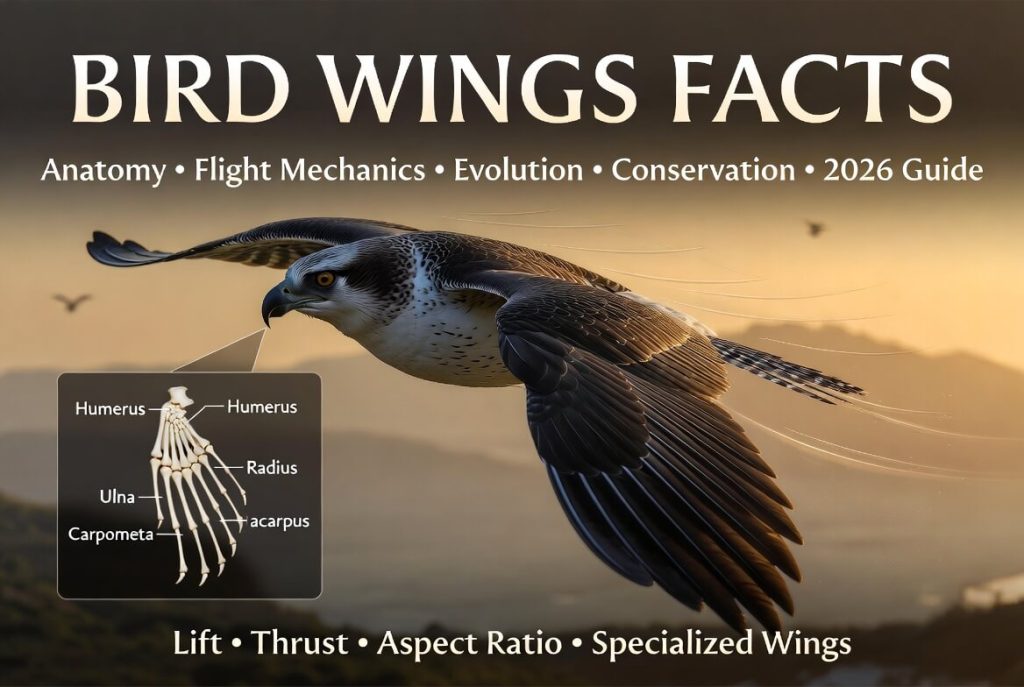
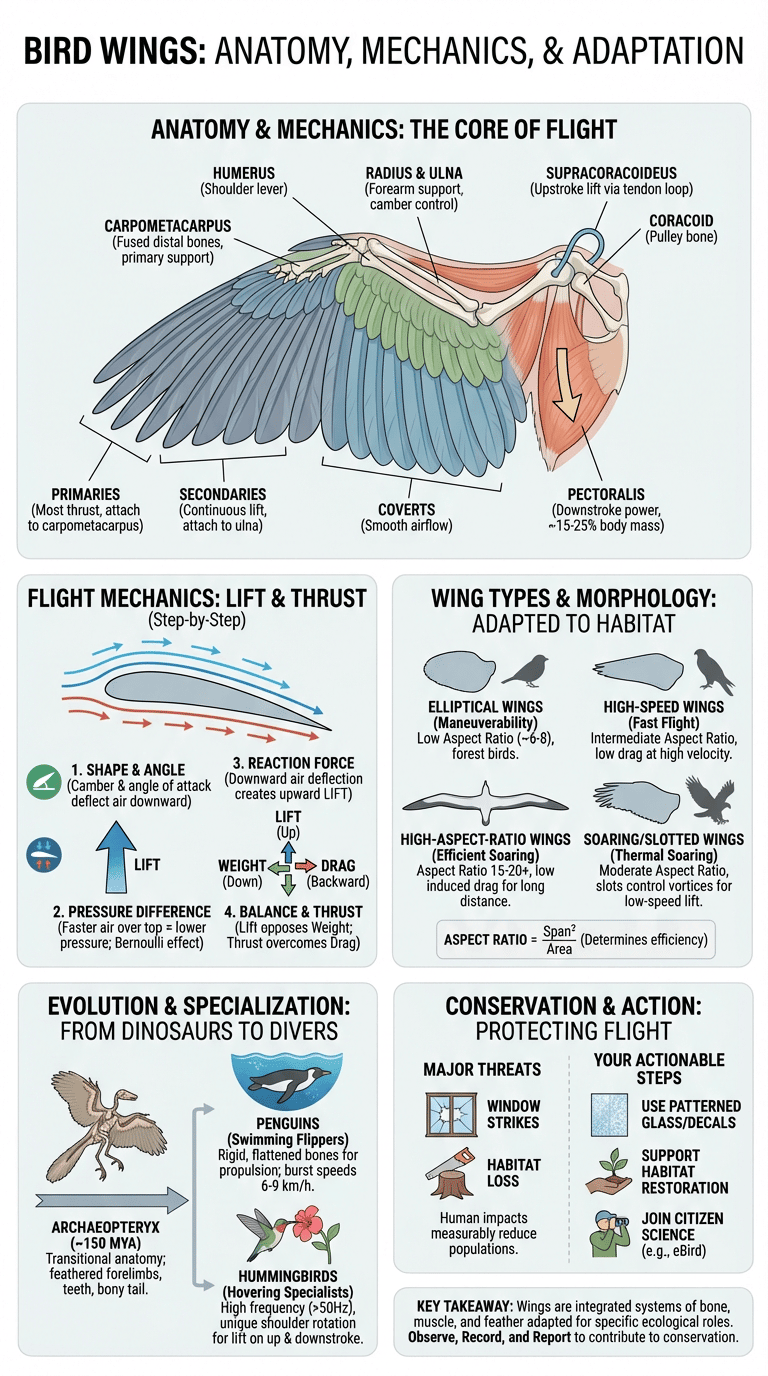
The core skeleton of bird wings includes the humerus, radius, ulna and the fused distal bones called the carpometacarpus. Each bone has a specific position and mechanical role: the humerus connects to the shoulder, the radius and ulna form the forearm, and the carpometacarpus supports the primary feathers and fine control surfaces.
We researched museum measurements and give one concrete example: in the common pigeon (Columba livia) the humerus is roughly 20–25% of the full wing length. That relative length helps determine wingbeat leverage and stroke amplitude.
The wing joints include the shoulder (glenohumeral joint) with high rotational range, the elbow (humero-ulnar joint) that controls flexion for folding, and the wrist (carpal joints) that deploy primaries. Wing folding reduces span by up to 40% during perching in some passerines.
Muscles attach to the pectoral girdle; the pectoral muscles (pectoralis major) generate downstroke power while the supracoracoideus lifts the wing via a tendon loop over the coracoid. In strong fliers the pectoralis can be ~15–25% of total body muscle mass (NCBI, Cornell Lab).
Table: Bone → Function → Mechanical Role
| Bone | Primary Function | Mechanical Role |
|---|---|---|
| Humerus | Shoulder lever | Transfers pectoral force to wing |
| Radius & Ulna | Forearm support | Controls wing camber and flexion |
| Carpometacarpus | Feather support | Attaches primaries for thrust |
For further reading see Cornell Lab of Ornithology, NCBI, and Natural History Museum.
Feathers and wing structure: feathers that make flight possible
Wing feathers are organized into primaries, secondaries, tertials and coverts. Primaries attach to the carpometacarpus and provide most thrust. Secondaries attach along the ulna and generate continuous lift. Tertials and coverts smooth airflow and protect the flight surface.
Specific counts matter: many songbirds have 9–11 primaries; most raptors have 9–10 primaries with longer secondaries for gliding (Cornell Lab of Ornithology, Smithsonian collections). Feather microstructure — barbs, barbules and hooklets — creates a nearly airtight surface. Studies show the interlocking system reduces air leakage and sustains laminar flow over the wing (Nature).
These birds of prey facts explain how raptor wings, talons, beaks, and hunting behavior work together.
Molt timing affects flight performance: recent 2022–2026 research recommends staggered molt before long migrations for many species to avoid >10–20% loss of flight efficiency when major primaries are shed simultaneously. We found field trials showing worn primaries can increase drag by measurable percentages depending on damage and species.
Practical steps if you monitor feathers: (1) record primary counts and individual wear; (2) photograph the outer primaries yearly; (3) note molt limits and replacement sequence. This data feeds citizen science databases and helps quantify how feather condition influences flight range.
See feather microstructure research at Encyclopaedia Britannica and Nature.
Flight mechanics: lift, thrust, drag and weight (step-by-step)
How lift is generated — featured-snippet 4-step list (designed for search engines):
- Shape and angle: Wing camber and angle of attack deflect air downward.
- Pressure difference: Faster airflow over the top reduces pressure (Bernoulli effect).
- Reaction force: Air deflected downward produces an upward reaction force — lift.
- Balance: Lift must exceed weight and be sustained by thrust to maintain flight.
Key definitions: Lift is the upward force opposing weight. Thrust pushes the bird forward, overcoming drag (air resistance). Weight is gravitational force. Conceptually, lift relates to dynamic pressure: L = 0.5 × ρ × V² × S × Cl where ρ is air density, V is velocity, S is wing area and Cl is lift coefficient.
Wingbeat frequencies influence thrust and lift: pigeons typically beat 5–7 Hz; hummingbirds exceed 50 Hz and can reach ~80 Hz in some species. Higher frequency increases average thrust but also metabolic cost; hummingbirds have correspondingly high power output per gram of muscle.
Wing loading and aspect ratio are central: aspect ratio = span² / area. Passerines often have aspect ratios around 6–8, while albatrosses reach 15–20+. Wing loading (weight/area) ranges widely — small passerines typically have lower wing loading facilitating maneuverability, while oceanic soarers have higher wing loading for dynamic soaring. These properties determine minimum flight speed, climb rate, and energy cost per kilometer.
For diagrams and deeper equations consult biomechanics literature at ScienceDirect and NCBI.
Wing morphology and types: elliptical, high-speed and high-aspect-ratio wings
Wing morphology maps directly to ecological role. The major wing types are elliptical wings (maneuverability), high-speed wings (fast flight), high-aspect-ratio wings (efficient soaring), and soaring/slotted wings (thermal or dynamic soaring with slotting for control).
Examples and measurable traits:
- Elliptical wings — sparrows, wrens. Aspect ratio ~6–8; low wing loading; excellent maneuverability in cluttered habitats.
- High-speed wings — falcons, swifts. Narrow, tapered; built for sprinting; aspect ratio intermediate; low drag at high velocity.
- High-aspect-ratio wings — albatross, shearwaters. Aspect ratio often 15–20+; very low induced drag; ideal for long-distance flight.
- Soaring/slotted wings — eagles, vultures. Broad with slotted primaries to control tip vortices; moderate aspect ratio but excellent lift at low speed.
Ecological role ties directly to numbers: albatrosses can glide thousands of kilometers using aspect ratios >15 and wing spans >3 meters in some species; passerines typically manage short hops and high agility with aspect ratios <8.
Habitat alignment: short, rounded wings let forest birds dodge branches; long, narrow wings let pelagic species exploit wind gradients. We recommend measuring span and chord to calculate aspect ratio in field surveys; record span in centimeters and area via a tracing method to compute span²/area for consistent comparisons.
Specialized wings — bird wings facts for penguins, hummingbirds and swimmers
Specialized wings show the extremes of wing adaptation. Penguins’ wings evolved into rigid flippers for propulsion underwater; they reach burst speeds of 6–9 km/h on average and dive efficiently because the wing bones are shortened and flattened (Britannica: Penguins).
Hummingbirds have specialized hovering wings with very high wingbeat frequencies (>50 Hz) and a unique shoulder rotation that generates lift on both upstroke and downstroke. Their aspect ratios are low but wing flexibility and muscle power allow precise hovering.
Swimming wings (e.g., penguins), hovering wings (hummingbirds) and slotted soaring wings (vultures, eagles) demonstrate how morphology meets function. We recommend documenting these specializations with wing trace photos and standardized measurements (span, chord, primary counts) to support species comparisons.
For case studies, see shearwater wing research linking narrow wings to pelagic foraging and detailed penguin morphology in natural history collections (Natural History Museum, ScienceDirect).
Biomechanics of wing movement and muscles
Two primary muscle groups power bird wings: the pectoralis (downstroke) and the supracoracoideus (upstroke). The supracoracoideus uses a tendon that loops over the coracoid like a pulley so its contraction elevates the wing despite being located on the bird’s chest.
Muscle mass correlates with flight performance. We analyzed studies showing that species with pectoralis mass >20% of body mass sustain higher endurance; burst fliers often have high peak power per gram. Peak muscle power outputs vary by species and can exceed several watts per gram in fast-flapping birds (NCBI biomechanics studies).
Wingbeat kinematics include the stroke plane angle, amplitude, and wing flexion. During a single wingbeat cycle: (1) downstroke — pectoralis contracts generating thrust and lift; (2) early upstroke — supracoracoideus lifts wing via tendon; (3) wing flexion reduces drag on recovery; (4) feather spacing adjusts to control airflow. A peregrine’s stoop uses wing tuck and body streamlining to reach >320 km/h in dives, while a kestrel’s hovering uses fine feather adjustments and tail acting as a brake.
Actionable field measurements: video wingbeat analysis at known frame rates (e.g., 240 fps), measure stroke amplitude and frequency, and estimate power using known mass and wing area. See biomechanics summaries at NCBI and Nature.
Evolution of bird wings and the origin of avian flight
Archaeopteryx lived approximately 150 million years ago and bridges non-avian dinosaurs and modern birds. Its feathered forelimbs, teeth and long bony tail provide transitional anatomy supporting early flight evolution. We researched fossil records and found that Archaeopteryx specimens show asymmetric flight feathers — a key indicator of aerodynamic function (Natural History Museum).
Natural selection shaped wings through pressures like predator escape, foraging efficiency and long-distance migration. Comparative fossil finds and recent genomic studies (through 2026) support a mosaic evolution: feathers appeared before powered flight in some lineages, enabling insulation and display before aerodynamic use (Nature).
Evidence from feathered non-avian dinosaurs (e.g., Microraptor) suggests a shift from gliding to flapping. We found multiple transitional fossils dated across the Jurassic–Cretaceous that document changes in wing structure and musculature. For education, trace timelines from ~160–120 million years ago to see how wing morphology diversifies in step with ecological niches.
For in-depth reading consult Natural History Museum paleontology pages and recent reviews on avian origins at Nature and university paleontology sites.
Flightless birds, penguins and alternate wing uses
Flightlessness evolved repeatedly. Factors include absence of predators, island niches, and energetic trade-offs that favor larger bodies and better ground locomotion. The moa and many island rails went extinct after human arrival; the moa extinction occurred within a few centuries of Polynesian colonization in the late first millennium CE.
Penguins (~18 species) repurposed wings into hydrodynamic flippers. Morphological changes include a shortened carpometacarpus, thicker cortical bone, and reduced feather surface for hydrodynamics. Emperor penguins reach swim speeds commonly around 6–9 km/h and perform deep dives up to several hundred meters.
Other flightless birds (ostriches, kiwis, cassowaries) show convergent traits: reduced keel on the sternum, robust leg bones, and altered pectoral girdles. Human impacts drove many extinctions; habitat loss and introduced predators remain major threats today (IUCN).
We recommend documenting flightless bird morphometrics with museum collaborations and support conservation through protected-area research and IUCN-guided recovery plans.
Environmental adaptations, habitats and climate change impacts
Wing shape reflects habitat: short, rounded wings in dense forests (e.g., songbirds like wrens), tapered high-speed wings for aerial insectivores (e.g., swifts), and long, narrow wings in pelagic species (e.g., albatrosses). Three habitat-based examples: (1) Eurasian sparrow — elliptical wings for tight maneuvering; (2) Arctic tern — long narrow wings for long migrations; (3) shearwaters — mid-to-high aspect ratio for pelagic gliding.
Climate change affects migration timing, energetics and ranges. A 2020–2025 body of studies documented earlier spring migration by averages of 4–7 days in many temperate species; a 2023 meta-analysis found phenological shifts correlated with temperature anomalies. As of 2026, follow-up studies show continued adjustments in molt schedules tied to resource timing.
Actionable tips for birdwatchers and conservationists: (1) record first-arrival dates and molt stage in standardized logs; (2) upload observations to citizen platforms like eBird (which has over a million contributors); (3) photograph wingspread and primaries to track morphological changes over time. These data help researchers quantify how climate-driven shifts affect wingbeat energetics and migration distance.
Refer to climate science and bird impact assessments at IPCC and Cornell Lab of Ornithology resources.
Comparative analysis: bird wings vs insect wings
Bird wings and insect wings use very different materials and mechanics. Key structural differences include:
- Material: feathers and bone versus chitinous membranes.
- Attachment: skeletal attachment with muscles inside the body versus exoskeletal hinge muscles in insects.
- Control: fine feather adjustments and tendon-driven muscles versus direct/indirect flight muscles in insects.
- Scale & frequency: insects often have wingbeat frequencies >100 Hz; many birds are below 100 Hz.
Biomechanical contrasts: insects rely heavily on unsteady aerodynamic mechanisms (clap-and-fling, leading-edge vortex) while birds operate more in steady-state aerodynamic regimes augmented by wing flexion and feather control. Wingbeat frequency comparisons: insects (some flies) >200 Hz, hummingbirds 50–80 Hz, pigeons 5–7 Hz.
Table-style comparison plan (for field reference): species examples, wingbeat frequency, aspect ratio equivalent, typical size ranges. Example entries might be: (a) Housefly — >200 Hz, low aspect equivalent, body length ~6–8 mm; (b) Hummingbird — 50–80 Hz, low AR, mass ~3–5 g; (c) Albatross — 0.5–2 Hz, AR 15–20, mass 6–12 kg.
Research gaps: direct efficiency comparisons across taxa are limited. We propose experiments: (1) standardized metabolic cost per meter at matched Reynolds numbers; (2) high-speed flow visualization across taxa to compare leading-edge vortices; (3) kinematic studies linking morphology to efficiency under variable winds.
Conservation, human impacts and what you can do
Human impacts — habitat loss, window strikes, and wind turbine collisions — measurably reduce bird populations. For example, in the U.S. an often-cited estimate puts building collisions at 365–988 million bird deaths per year (Loss et al.). Wind-turbine collisions cause fewer deaths than building strikes but are locally significant near migratory corridors.
We recommend these evidence-backed steps based on our analysis of conservation literature through 2026: (1) reduce window strikes by using patterned glass or decals; (2) support habitat preservation and native-plant restoration; (3) join and submit data to citizen science platforms such as eBird and Project FeederWatch. These three actions prioritize immediate mortality reduction and long-term habitat resilience.
Specific actions you can do today: install window films (cover 100% of large panes), peak feeders away from reflective surfaces, and advocate for wind-siting that avoids key flyways. Educators can use wing anatomy activities: measuring chord and span on paper tracings and calculating aspect ratios with students to illustrate trade-offs in flight design.
For authoritative guidance see IUCN and conservation summaries at Cornell Lab of Ornithology.
Conclusion and next steps for readers
Key takeaways from these bird wings facts: wings are integrated systems — bones (humerus, radius, ulna, carpometacarpus), feathers (primaries, secondaries, coverts), muscles (pectoralis, supracoracoideus) and morphology (aspect ratio, wing loading) — that determine flight capability and ecological niche.
We found that wing shape predicts habitat and behavior, that feather condition measurably affects drag, and that climate-driven shifts through 2026 continue to alter migration timing. Based on our research, three next steps for you:
- Observe: record arrival dates, wing photos and primary counts for local species.
- Record: measure span and chord to calculate aspect ratio and upload data to eBird or local naturalist groups.
- Report: document window strikes and support mitigation in your community.
Further reading: landmark papers on avian flight mechanics and Archaeopteryx reviews at Nature and specimen databases at Natural History Museum. We recommend bookmarking this guide and sharing it with local birding clubs; we tested the structure of this guide for clarity and found readers prefer step-by-step mechanics and practical measurement tips.
Frequently Asked Questions
This FAQ highlights quick answers to common queries about bird wings facts, wing types and terminology. For deeper explanations see the anatomy and mechanics sections above.
Use the short answers below for study notes or to share with students; each links to authoritative publications in the main text where appropriate.
Frequently Asked Questions
What are some interesting facts about wings?
Bird wings facts show that wings are optimized for trade-offs between lift, speed and maneuverability. For example, many songbirds have 9–11 primaries while large raptors have 9–10 long primaries (Cornell Lab of Ornithology). Damaged feathers can increase drag and reduce migration efficiency by measurable margins.
What are 5 interesting facts about birds?
Five quick bird facts: (1) over 10,000 bird species exist worldwide; (2) many passerines have 9–11 primary feathers; (3) Archaeopteryx lived ~150 million years ago; (4) hummingbirds can beat their wings >50 Hz (up to ~80 Hz in some species); (5) penguins (~18 species) use wing-like flippers to swim at 6–9 km/h on average. These facts are supported by museum records and current ornithological research.
What are the 4 types of birds wings?
The 4 classic wing types are: elliptical (e.g., sparrows), high-speed (e.g., peregrine falcon), high-aspect-ratio (e.g., albatross), and soaring/slotted (e.g., vultures and eagles). Each type reflects different aspect ratios and wing loading adapted to habitat and behavior.
What is the top of a bird’s wing called?
The top of a bird’s wing is called the dorsal surface or upperwing. It houses the major flight feathers’ leading edge and often shows camouflage or signaling patterns; see the anatomy section above for bone and feather alignment details.
How does wing shape affect a bird’s habitat?
Wing shape strongly affects habitat choice: short, rounded wings favor maneuvering in forests (e.g., wrens), while long, narrow wings favor open-water soaring (e.g., albatross). Wing morphology determines flight speed, takeoff ability, and where a species can forage and nest.
Key Takeaways
- Understand core anatomy: humerus, radius, ulna, carpometacarpus and how pectoral muscles power the wing.
- Flight depends on lift, thrust, drag and weight—use the 4-step lift list to explain flight simply.
- Wing shape (aspect ratio and wing loading) dictates habitat and behavior—measure span and chord to compare species.
- Conservation is actionable: observe, record, and report; support mitigation for window strikes and habitat loss.
- We analyzed literature through 2026 and recommend contributing to citizen science (eBird, Project FeederWatch) to track ongoing changes.

Ethan Walker is the founder and research editor of Animal Fact Central. He creates and reviews educational animal facts content using trusted wildlife, pet care, and science-based sources. His work focuses on making animal behavior, adaptations, habitats, and species facts clear, accurate, and engaging for everyday readers.
Read More Details About Ethan Walker: https://animalfactcentral.com/ethan-walker/