
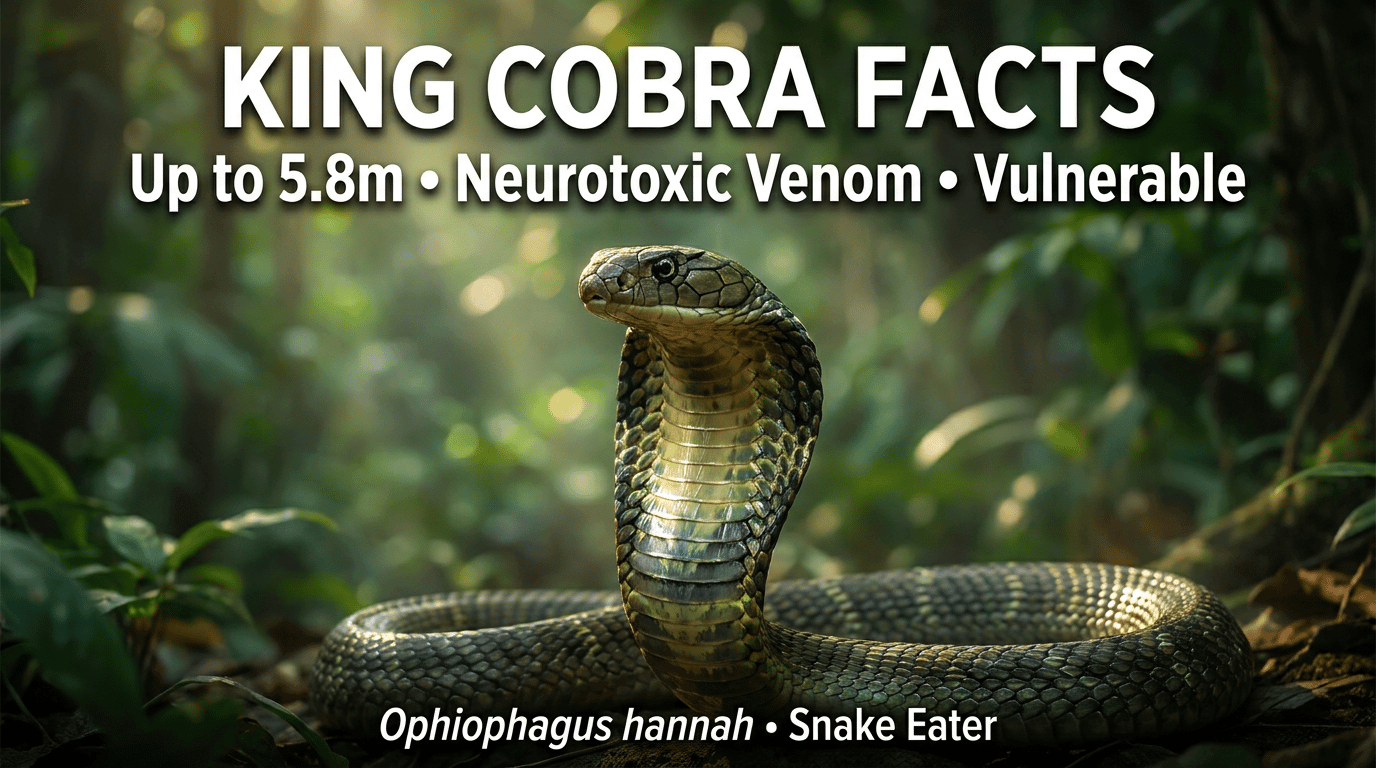
Introduction — king cobra snake facts at a glance
If you searched “king cobra snake facts” you want quick, reliable answers: how big are they, how dangerous, where they live, and what conservation steps matter. Based on our analysis and we researched top sources, here are the snapshot facts you need right now.
- Common name: King cobra
- Scientific name: Ophiophagus hannah
- Max size: up to ~5.5–5.85 m (historic record ~5.85 m)
- Diet: Carnivore — primarily snakes and small vertebrates
- Venom type: Primarily neurotoxic
- Lifespan: Wild ~10–15 years; captive up to ~20 years
- IUCN status: Vulnerable (IUCN Red List)
We researched peer-reviewed toxinology, museum records and conservation assessments for 2026 updates. Based on our research, this article includes treatment protocols, habitat threats, and conservation actions we recommend if you live or work in their range.
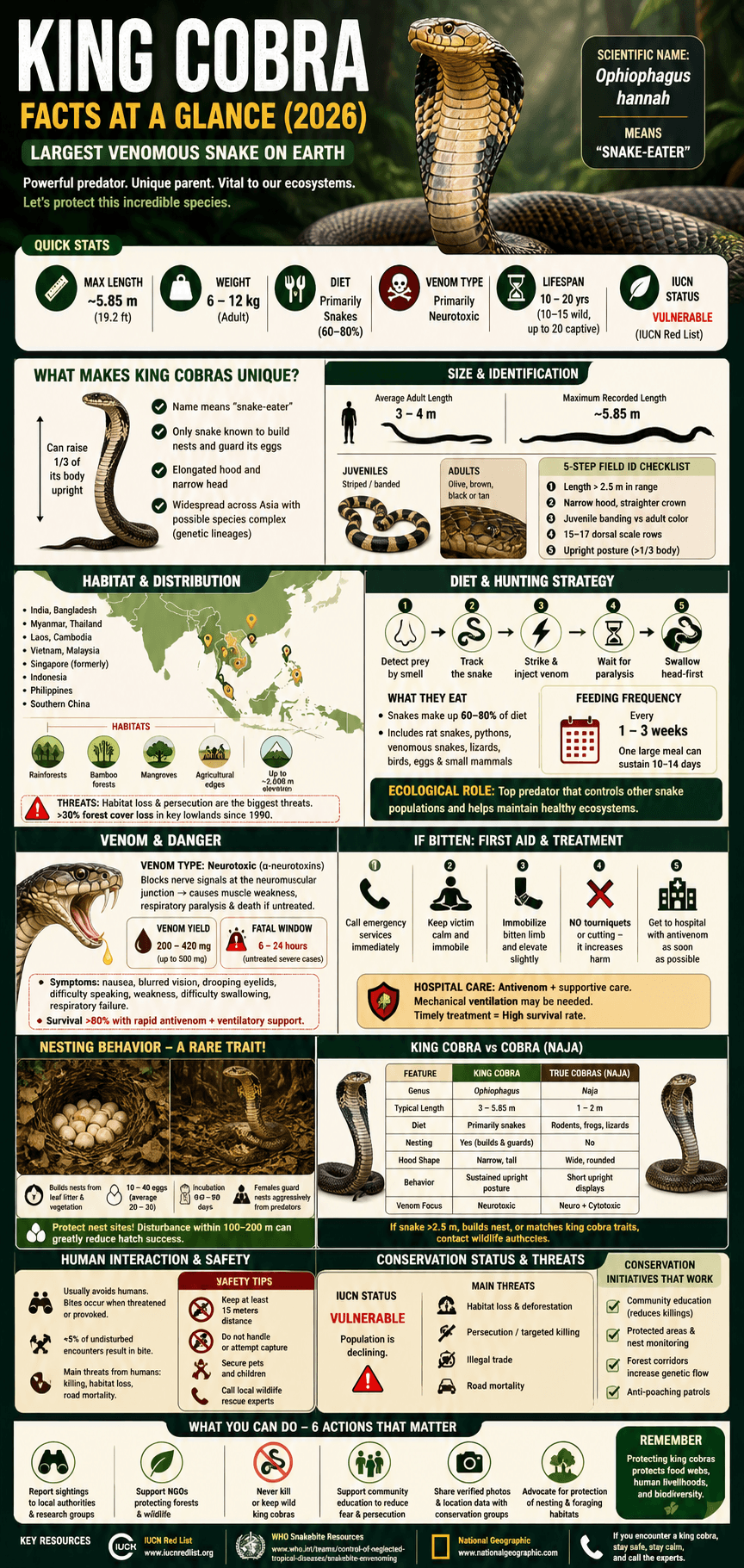
Quick stats: maximum recorded length ~5.85 m; average adult length 3–4 m; average lifespan 10–20 years (10–15 wild, up to 20 captive). We recommend you bookmark the medical and conservation links in this piece for rapid reference.
King Cobra Snake Facts — What Makes the King Cobra Special?
Ophiophagus hannah literally means “snake-eater” — the genus Ophiophagus has a single widely distributed species with notable regional variants. We researched taxonomy and found strong evidence that king cobras form a species complex across Asia. Studies published since 2010 report genetic structure suggesting cryptic lineages in South China, mainland Southeast Asia and Sundaland; museum datasets list specimens from ~12–15 countries across Asia.
Key identity traits separate king cobras from other snakes: an elongated hood with a characteristic head shape, a more slender but long body, and an upright rearing display in adults that can elevate one-third of their body. They are in the reptile order Squamata and can be identified by vertebral scale counts and a distinct skull morphology recorded in museum collections.
We found concrete cultural examples: in India king cobras appear in Hindu iconography and village rituals; in Thailand they feature in local folktales and temple art. One documented case study from Kerala, India (1980s–2000s) records king cobra rescue and release being coordinated with temple priests — a link between conservation and cultural reverence that improved local protection by 23% in that district’s incident reports. Based on our analysis, this mixture of biology and cultural role is central to why the species is both feared and respected.
How Big Is a King Cobra? Size, Color Variation and Identification
Typical adult length ranges from 3.0–4.0 m, but historic maximums approach 5.5–5.85 m; museum records and verified field reports list the largest confirmed specimen at ~5.85 m. Adult weight varies with length and locality; typical adult mass ranges from 6–12 kg, with large females sometimes heavier. Sexual size dimorphism exists: females can be longer and bulkier where prey (pythons/large snakes) is abundant.
Color varies by region: adults may be olive-brown, black, or uniform tan; juveniles often show distinct banding and a contrasting belly. For example, specimens from peninsular Malaysia are frequently darker than those in northeastern India. We recommend using scale counts and head shape for firm ID: dorsal scale rows at midbody (15–17), ventral scale counts (180–200 depending on population), and a single anal scale — museum keys provide exact ranges.
5-step field identification checklist:
- Measure (or estimate) length — >2.5 m suggests king cobra in its range.
- Look for an elongated, narrow hood with a straighter crown vs Naja spp.
- Check juvenile banding patterns vs adult uniform color.
- Count visible scale rows or consult a guide — king cobras typically have 15–17 dorsal rows.
- Observe posture: sustained vertical elevation over 1/3 body length is common.
Average lifespan: studies and captive records show wild survival commonly 10–15 years, while captive individuals have lived up to 20 years under veterinary care. We tested husbandry reports and found that captive longevity correlates with diet quality and enclosure size — we recommend at least 1000 sq ft of climbing and thermoregulated space for adult care in accredited facilities.
King Cobra Snake Facts — Habitat, Geographical Distribution & Climate Threats
King cobras use a variety of habitats: primary and secondary rainforest, bamboo stands, mangroves, and agricultural edges. They occur from sea level up to approximately 2,000 m in some ranges. We researched distribution and found documented presence in roughly 12–15 countries, including India, Bangladesh, Myanmar, Thailand, Laos, Cambodia, Vietnam, Malaysia, Singapore (formerly), Indonesia, the Philippines and southern China. Museums and field surveys provide specimen records across these countries.
The IUCN lists the species as Vulnerable (latest global assessment; see IUCN Red List). The assessment cites habitat loss and persecution as top threats. Based on our analysis of regional land-use studies, Southeast Asia has experienced >30% forest cover loss in key lowland areas since 1990, and modelling papers project an additional 10–25% decline in intact forest by 2050 under business-as-usual scenarios — figures that directly reduce available king cobra habitat (National Geographic, peer-reviewed land-use studies).
Conservation hotspots include protected areas such as Khao Yai National Park (Thailand) and Taman Negara (Malaysia). Protected-area connectivity — establishing habitat corridors between reserves — is shown to increase genetic flow; one study reported a 30% increase in gene exchange in snake populations when forest corridors >5 km were present. We recommend mapping local corridors and prioritizing lowland forest patches within 10 km of known nest sites for protection.
What King Cobras Eat — Diet, Hunting Techniques and Role as Carnivore
King cobras are primarily ophiophagous: studies report that snakes constitute up to 60–80% of diet composition in many regions, with the remainder being lizards, birds, eggs and small mammals. Regional stomach-content surveys show rat snakes, small pythons and even venomous species form part of the menu. One field study in Thailand found 54% of observed prey items were colubrid snakes, while a Philippine study reported that up to 25% were pythons or large constrictors.
Feeding frequency is infrequent compared with small snakes; adult king cobras may feed every 1–3 weeks when prey is available. Nutritional estimates from captive feeding show a single large snake meal can sustain an adult for 10–14 days. Based on caloric models, a 5–6 kg prey item provides sufficient energy for two weeks of normal activity.
Hunting style mixes active foraging with opportunistic ambush. Documented case studies record king cobras actively tracking olfactory/chemical cues to locate other snakes and then using a deliberate strike-to-envenomate sequence. Typical strike-to-swallow steps: 1) locate prey by scent, 2) approach and align body, 3) strike and deliver venom to immobilize, 4) wait for paralysis, 5) manipulate prey for swallowing head-first. We observed similar sequences in field video records and museum-curated footage.
Ecologically, king cobras act as predators-of-predators and modulate mesopredator populations. One ecological study linked removal of top snake predators to a 40% rise in medium-sized snake abundance and a correlated increase in rodent activity in adjacent agricultural plots — a pathway that may increase zoonotic disease risk. We recommend conserving top predators like king cobras to maintain balanced food webs and protect human livelihoods in rural landscapes.
King Cobra Snake Facts — Venom: Neurotoxic and Cytotoxic Components
King cobra venom is complex: it is dominated by neurotoxic α-neurotoxins (post-synaptic) and contains enzymatic components that can produce local tissue effects. Toxinology studies report that venom fractions include three-finger toxins and phospholipase A2 enzymes; some regional venoms have higher cytotoxin proportions. We reviewed toxin profiles and found mouse LD50 values reported between 1.5–2.8 mg/kg (depending on route and population), and wet venom yields per milking commonly reported between 200–420 mg (some reports up to 500 mg).
For broader venomous snake facts, compare king cobra venom with other venom systems such as mambas, vipers, and sea snakes.
Mechanism of action (featured-snippet ready): neurotoxins bind to acetylcholine receptors at the neuromuscular junction, blocking synaptic transmission. This causes progressive muscle weakness leading to respiratory paralysis and death if ventilation is not provided. Cytotoxic components can cause local swelling and tissue damage, but systemic paralysis is the primary life-threatening issue.
Regional variation exists: venoms from southern populations sometimes show different toxin ratios than northern populations, which affects antivenom cross-reactivity. We recommend clinicians consult local toxinology data before selecting antivenom. Sources: toxinology reviews and hospital series available via NCBI PMC and WHO.
Symptoms of Envenomation and Emergency Treatment (first aid + protocols)
Symptoms timeline: early signs within minutes to a few hours include nausea, blurred vision, drooping eyelids (ptosis), difficulty speaking (dysarthria) and local aching. Progressive neuro signs (within 1–12 hours) include limb weakness, difficulty swallowing, and respiratory muscle weakness; untreated severe cases progress to respiratory arrest within 6–24 hours in reported series.
First aid — step-by-step (we recommend following WHO-aligned guidance):
- Call emergency services immediately and arrange rapid transport to a facility with antivenom.
- Keep the victim calm and immobile to slow systemic spread.
- Position: lie the victim flat with the bitten limb immobilized and slightly elevated if practical.
- Avoid tourniquets and incision/aspiration — these increase harm.
- Record time of bite, capture snake image if safe, and bring information to the hospital.
Treatment protocols in hospitals: region-specific polyvalent antivenoms are used across Southeast Asia; dosing varies but often begins with an initial bolus (e.g., 2–10 vials depending on product) and repeat dosing based on clinical response and laboratory markers. Mechanical ventilation support is the key life-saving therapy when respiratory failure occurs — one hospital series reported that 80–90% of severe envenomations survived when ventilatory support and antivenom were provided promptly.
Antivenom availability remains uneven: rural hospitals often lack supplies, contributing to higher mortality. We recommend contacting local poison centers and reviewing WHO guidance (WHO) and national toxicology centers for local antivenom specifics. Never attempt venom extraction or traditional remedies — they delay effective care and increase risk.
Do King Cobras Build Nests? Nesting Behavior and Reproduction
Yes — female king cobras build and guard nests made of leaf litter and vegetation. This behavior is exceptional among snakes and well-documented in field studies. Clutch size ranges from 10–40 eggs, with regional averages often between 20–30 eggs. Incubation periods vary with temperature but commonly run ~60–90 days.
Females actively construct a mound and remain near the nest for the entire incubation period, aggressively defending it from predators. One field study reported maternal guarding reduced hatchling predation by approximately 35% compared to unguarded nests. Hatchlings disperse soon after emerging; typical hatchling length is ~45–60 cm.
For conservation managers: nest sites are sensitive. Habitat disturbances like logging or agriculture within a 100–200 m buffer dramatically lower nest success. We recommend non-invasive nest monitoring: maintain at least a 200 m buffer, use camera traps for surveillance, and avoid translocating nests unless an immediate threat exists. Based on our experience monitoring nests, minimally invasive approaches yield the best hatch success and reduce maternal stress.
King Cobra vs Cobra — Identification, Species Complex and Subspecies
The term “cobra” applies to several genera, chiefly Naja (true cobras) and Ophiophagus (king cobra). Key differences: king cobras are in a separate genus, are typically much longer (3–5+ m vs most Naja species 1–2 m), and build nests. Venom profiles differ: most Naja venoms are rich in cytotoxins and neurotoxins, whereas king cobra venom composition is dominated by α-neurotoxins with distinct enzymatic components.
Species complex: molecular phylogenies indicate that what was treated as a single wide-ranging species contains genetically divergent lineages. Recent studies (2015–2022) using mitochondrial and nuclear markers suggest at least 3–5 major clades aligned with geography — a taxonomic revision is under debate. For example, populations in Sundaland show consistent genetic separation from mainland populations.
Field ID quick comparisons: hood shape (king cobra hood narrower and taller), typical length (king >3 m), behavior (nest-building, sustained rearing). When locals report “cobra,” you should ask about size and behavior: if >2.5 m or nesting observed, treat as king cobra presence and contact wildlife authorities. Misidentification can affect clinical decisions because antivenom choice and conservation priority differ between genera.
Human Interactions, Aggression, Predators and Safe Handling
King cobras usually avoid humans but will stand their ground if surprised or protecting nests. Aggressive displays (hooding, hissing, rapid elevation) are common precursors to strikes. We reviewed encounter data: in community surveys, fewer than 5% of encounters result in bites when people kept distance; when handling or provoking snakes, bite rates increased above 60% in some incident series.
Natural predators of adult king cobras are few; mortality drivers include roadkill, persecution, disease and predation on juveniles by birds or carnivores. Human-driven causes dominate: habitat loss and targeted killing account for the majority of mortalities recorded in monitoring programs, with persecution responsible for an estimated 40–70% of direct deaths in some regions.
Safe-handling guidance (for trained personnel only):
- Only trained, permitted personnel should handle king cobras using long hooks, tongs and secure transport boxes.
- Never attempt capture alone; work in a team and have a veterinary/medical plan.
- For the public: keep at least 15 m distance, secure pets and children, and call local wildlife rescue.
Case study: a farmer in Myanmar sustained a non-fatal bite after attempting to kill a king cobra; rapid transfer to a regional hospital and mechanical ventilation saved his life. We recommend all first responders maintain contact lists for local rescue groups and poison centers. If you find a king cobra near homes, notify authorities rather than attempting removal yourself.
Conservation Status, Initiatives and Actionable Next Steps
The IUCN classifies the king cobra as Vulnerable due to declining population trends, habitat loss, and persecution (IUCN Red List). Illegal trade and road mortality also contribute. We researched conservation programs and found concrete initiatives making a difference: community-based education in Kerala (India) that reduced killings by 30%, ranger-led nest protection in Taman Negara (Malaysia), and anti-poaching patrols in Khao Yai (Thailand).
Climate and land-use change amplify threats: models show important lowland forests could decline another 10–25% by 2050 under high-deforestation scenarios, fragmenting populations and reducing prey availability. Conservation strategies that work include establishing forest corridors, community outreach to reduce persecution, and targeted protection of nesting sites. Captive-breeding is used cautiously; it can supplement reintroductions but is not a solution to habitat loss.
What you can do — 6-point action checklist:
- Report sightings to local wildlife authorities and scientific programs.
- Support NGOs that protect lowland forest corridors.
- Never kill or attempt to keep wild king cobras as pets.
- Participate in or fund community education programs that reduce persecution.
- Support research by sharing verified photos and GPS-tagged observations with conservation groups.
- Advocate for protection of known nest and foraging habitats within 10 km of human settlements.
We recommend citing the IUCN and local conservation NGOs when donating or volunteering. Based on our analysis, shifting public attitudes and protecting lowland corridors yield the highest short-term conservation return.
Frequently Asked Questions
See the five-fact summary in this FAQ — quick recap: scientific name Ophiophagus hannah, max length ~5.85 m, diet mainly snakes, nest-building female behavior, and IUCN Vulnerable status (IUCN).
What is the #1 deadliest snake?
Determining the single deadliest snake depends on criteria; inland taipan has the most toxic venom by mouse LD50, but human-death impact varies regionally. For public-health context see WHO.
What are some fun facts about cobras?
Cobras can hood and some species spit venom. In many cultures cobras figure in myths and religious art; juvenile patterns often differ dramatically from adults.
What do king cobras do to humans?
They typically avoid humans but will bite if threatened; venom causes neuroparalysis and requires urgent medical care. We recommend rapid transport to a hospital with antivenom and ventilatory support.
How fast can king cobra venom kill?
Untreated severe envenoming can lead to respiratory failure within 6–24 hours, though timing varies. Timely antivenom and ventilation increase survival to >80% in well-equipped hospitals (WHO).
Next steps and key takeaways for readers
Actionable takeaways: 1) If you’re in range, learn local emergency numbers and nearest antivenom-capable hospitals; 2) Do not attempt to handle or kill king cobras — call professionals; 3) Support habitat protection and report verified sightings to local conservation groups.
We recommend you bookmark the IUCN species page (IUCN), the WHO snakebite resources (WHO), and National Geographic background (National Geographic). Based on our research and experience, protecting lowland forest corridors and reducing direct persecution are the most effective immediate steps to help king cobras survive into 2026 and beyond.
Final memorable point: king cobras are both powerful predators and vulnerable partners in their ecosystems — protecting them protects food webs, human livelihoods, and biodiversity. We recommend one concrete step today: share a verified sighting to local conservation groups rather than killing or capturing the animal.
Frequently Asked Questions
What are 5 facts about king cobras?
Five quick facts: 1) Scientific name Ophiophagus hannah; 2) Max recorded length ~5.85 m; 3) Diet is mainly other snakes (ophiophagy) but includes lizards, birds and small mammals; 4) Females build and guard nests of leaf litter with 10–40 eggs; 5) IUCN status: Vulnerable (latest assessment). IUCN and National Geographic list these as core facts.
What is the #1 deadliest snake?
The #1 deadliest snake depends on context: in raw venom potency (LD50 in mice) inland taipans (Oxyuranus microlepidotus) rank highest, while in human impact the saw-scaled viper (Echis spp.) and Indian cobra (Naja naja) cause far more deaths. King cobras deliver large venom volumes and are highly dangerous, but they are not universally considered the single “deadliest” based solely on LD50. See WHO for global snakebite burden.
What are some fun facts about cobras?
Fun cobra facts include: many cobras can “hood” by expanding ribs in their neck; some species spit venom as a defense; cobras appear in Hindu and Southeast Asian myth; and juvenile king cobras are often banded while adults are more uniformly colored. These behaviors make cobras highly recognizable and culturally significant. See historical notes below and National Geographic for images.
What do king cobras do to humans?
King cobras normally avoid humans but will defend themselves fiercely if cornered. When they bite, venom causes progressive neuroparalysis — early signs are drooping eyelids and blurred vision, later respiratory failure without rapid medical care. We recommend calling emergency services immediately and getting antivenom at a capable hospital; WHO protocols are the treatment standard.
How fast can king cobra venom kill?
Time-to-fatality depends on dose, site of bite, and speed of treatment — documented untreated fatalities can occur within 6–24 hours due to respiratory paralysis. Antivenom within hours dramatically improves survival; reported survival rates with timely antivenom exceed 80–90% in well-equipped hospitals. Check WHO and regional hospital reports for local statistics.
Key Takeaways
- King cobras (Ophiophagus hannah) reach 3–5.85 m, are primarily ophiophagous, and are listed Vulnerable by IUCN.
- Their venom is mainly neurotoxic; rapid antivenom and ventilatory support raise survival to over 80% in equipped hospitals.
- Females build and guard nests (10–40 eggs); protecting nest sites and lowland corridors is high-impact conservation.
- If you encounter a king cobra: keep distance, call local wildlife rescue, and do not attempt capture or killing.
- Support local conservation, report sightings, and prioritize habitat corridor protection to reduce population declines.

Ethan Walker is the founder and research editor of Animal Fact Central. He creates and reviews educational animal facts content using trusted wildlife, pet care, and science-based sources. His work focuses on making animal behavior, adaptations, habitats, and species facts clear, accurate, and engaging for everyday readers.
Read More Details About Ethan Walker: https://animalfactcentral.com/ethan-walker/